November 2, 2025
November 2, 2025


Catechesis for Catholic Teens
Catechesis for Catholic Teens
The Religion
Teacher

JARED DEES provides practical resources and teaching strategies to religious educators.
All Souls Day

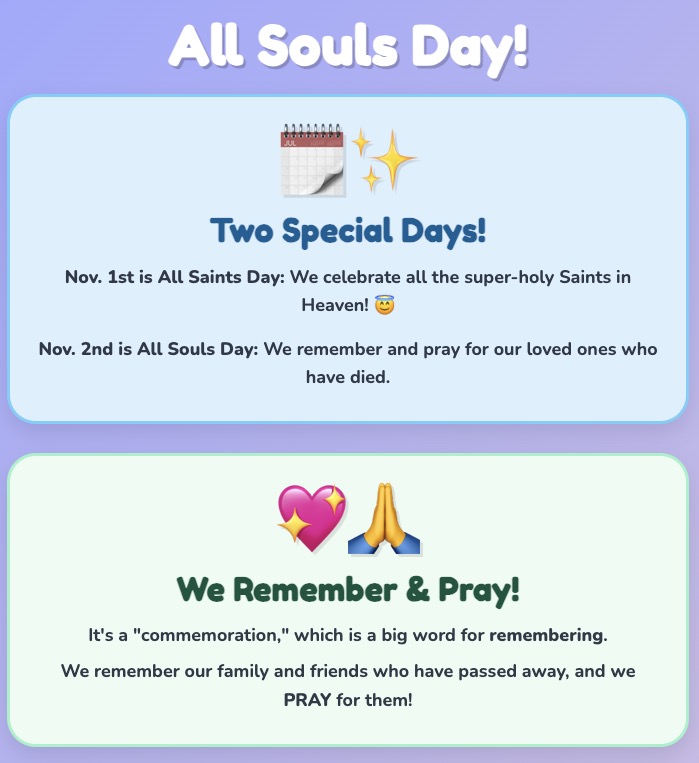

Generated using Google's AI Gemini 2.5 Pro (w/ Chart.js and Tailwind CSS). Permission for use in any non-profit ministry w/ link to THE WORD THIS WEEK.
Reflection Questions
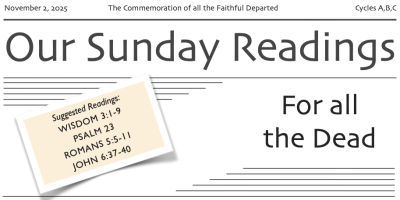
Our Sunday
Readings
These study guides are the fruit of over a decade of working with students. They are a great resource for classroom group discussion.
All Souls Day

Group / Classroom Discussion
All Souls Day


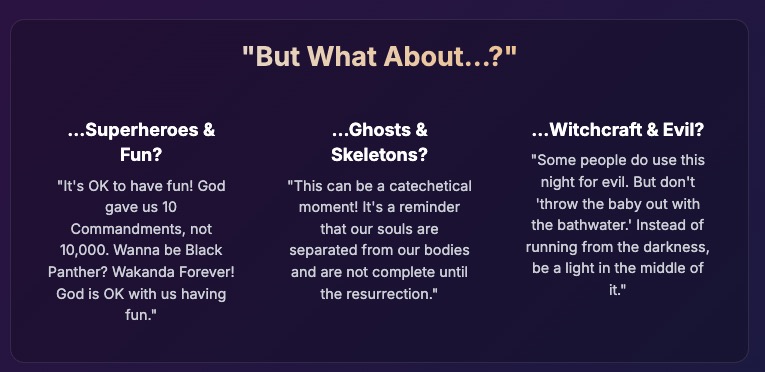
This Week’s Tips for Catechists
Be Real and Relatable
- Authenticity is Key: Don’t try to be someone you’re not or use slang you don’t know. Youth can spot inauthenticity immediately, so be yourself.
- Be You: Let your personality shine through to make your sermon more relatable and impactful.
- Meet them in their world: Understand the cultural context of the young people you’re speaking to.
Structure for Engagement
- Have One Big Idea: Focus your sermon around a single, clear point to help students remember it.
- Use a Clear Outline: Provide a simple, three-point outline with an introduction, body, and conclusion to help them follow along.
- Keep it Concise: Shorter messages are generally more effective for maintaining engagement and focus.
Make the Message Stick
- Tell Stories: Like Jesus, share stories that illustrate biblical truths and help make personal connections between the message and their lives.
- Use Visuals and Interaction: Engage multiple senses by using movie clips, objects, or games to make the message more memorable.
- Encourage Participation: Involve the audience through actions like raising hands, shouting answers, or taking polls to foster interaction.
All Souls Day

The Hook
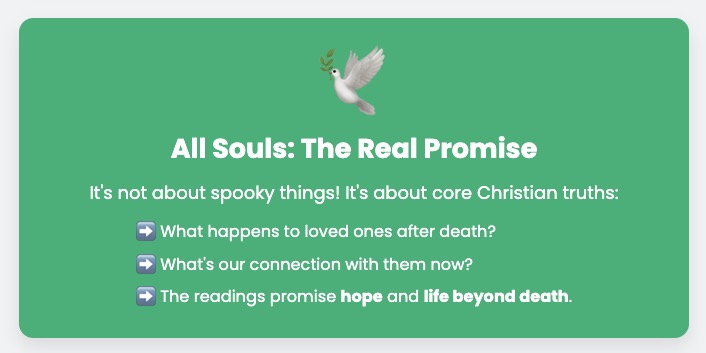
Catechist Tip: Teens are surrounded by the secular version of this season (Halloween) which is about fear, fantasy, and costumes. Your first job is to shift their perspective to the Christian understanding, which is about remembrance, respect, and hope.
Hook Idea: “The Digital Legacy”
- Open with a Question: “When you scroll through your social media, what do you see?” (Let them answer: friends, influencers, memes, news).
- Follow-up Question: “What happens to someone’s social media account after they die?”
- This is a real-world question they’ve likely encountered. Does it get deleted? Does it become a “memorial” page? How does it feel to see a post from someone who is no longer with us?
- Bridge to the Topic: “We live in a world that tries to figure out how to remember people. We create digital memorials, we tell stories, we build monuments. For thousands of years, the Church has had a special way of remembering, and it’s not just about looking at the past. It’s about hope for the future. We call it All Souls Day.”
- Set the Stage: “Today, we’re not talking about ghosts or spooky things. We’re talking about a real, core Christian promise: What happens to the people we love after they die? And what is our relationship with them now? The readings for this day give us a powerful answer.”
Unpacking the Scripture

Catechist Tip: Teens can spot “churchy” language a mile away. Your role is to be a translator, connecting the ancient text to their modern lives. Try a “Read-React-Relate” model.
1. Wisdom 3:1-9 (The Promise of Peace)
- Read: Have a teen read Wisdom 3:1-3 (NAB):”But the souls of the just are in the hand of God, and no torment shall touch them. They seemed, in the view of the foolish, to be dead; and their passing away was thought an affliction and their going forth from us, utter destruction. But they are in peace.”
- React: Ask the group, “What two different ‘views’ of death does this passage describe?”
- View 1 (The “foolish”): It’s an affliction, destruction, an end.
- View 2 (The “just”): They are in peace, in God’s hand.
- Relate: “This is so real. When we lose someone, it feels like destruction. We are sad, we grieve, and that’s human. But Wisdom tells us to look deeper. It says that for those who trust God, our human eyes see an ending, but God’s reality is peace.”
2. Romans 5:5-11 (The Proof of Hope)
- Read: Read Romans 5:5 and 5:8:”…and hope does not disappoint, because the love of God has been poured out into our hearts through the Holy Spirit that has been given to us… But God proves his love for us in that while we were still sinners Christ died for us.”
- React: “Paul says our hope ‘does not disappoint.’ That’s a huge claim. How is this ‘hope’ different from saying, ‘I hope I get an A on my test’?”
- (Guide them: A test grade is a wish. This hope is a certainty.)
- Relate: “What’s the proof that this hope is real? Paul says it’s right there in verse 8. God didn’t wait for us to be perfect. He loved us and saved us while we were still sinners. If God would do that for us, why would He abandon us—or our loved ones—in death? His love is the guarantee. Our hope isn’t a wish; it’s a promise backed by the most powerful action in history.”
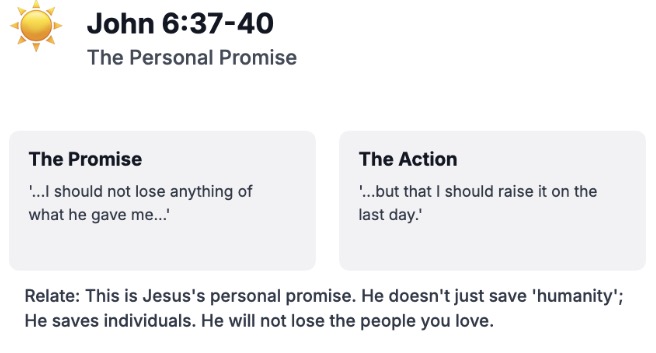
3. John 6:37-40 (The Personal Promise)
- Read: Have another teen read Jesus’s words in John 6:39-40:”And this is the will of the one who sent me, that I should not lose anything of what he gave me, but that I should raise it on the last day. For this is the will of my Father,
The Takeaway: Make It Practical
Main Idea: All Souls Day isn’t about being spooky or just being sad. It’s a day of active hope. The readings show us that because of God’s love, death is not a dead end.
Key Points for Teens:
- Our Hope is Real, Not Just Wishful Thinking:
- Grief is real, and it’s okay to be sad when we miss someone. But our faith gives us something stronger than grief: Hope.
- Romans says this hope “does not disappoint” because it’s not based on our feelings, but on God’s proven love for us through Jesus.
- Wisdom gives us the comforting image that our loved ones are “in the hand of God,” finally at peace.
- Jesus’s Promise is Personal:
- The most powerful part of the readings is John 6. Jesus doesn’t just talk about “people” in general. He says, “I will not reject anyone who comes to me” and “I should not lose anything of what he gave me.”
- This is a personal promise from Jesus to us, and for our loved ones who believed in him. He is personally committed to raising them up.
- Prayer is Our Action:
- So what do we do? We pray for those who have died.
- Praying for the dead is our practical way of living out this hope. It’s not just a sad memory; it’s an action. It’s how we stay connected to them and entrust them to God’s love and mercy, trusting in Jesus’s promise to “raise it on the last day.”
- This is our act of love for them, continuing even after they are gone from our sight.
Practical Challenge:
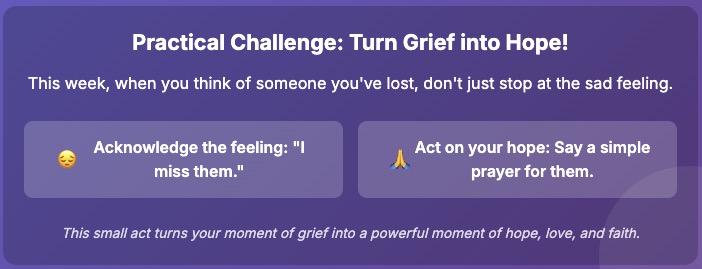
This week, when you think of someone you’ve lost (a grandparent, a friend, a family member, or even someone you heard about), don’t just stop at the sad feeling.
- Acknowledge the feeling: “I miss them.”
- Act on your hope: Say a simple prayer for them. If you don’t know one, just use this:“Eternal rest grant unto them, O Lord, and let perpetual light shine upon them. May their souls, and the souls of all the faithful departed, through the mercy of God, rest in peace. Amen.”
This small act turns your moment of grief into a powerful moment of hope, love, and faith.