Homily notes from the Dicastery for the Clergy and featured Papal homilies for Sunday. TWTW created bulletin infographics are also provided with free permission to use in non-profit ministries. Papal Homilies, Leo XIV, Pope Francis, Benedict XVI, Sunday Readings

Papal Homilies Leo XIV, Pope Francis, Benedict XVI, Sunday Readings

Papal Homilies Leo XIV, Pope Francis, Benedict XVI, Sunday Readings

Papal Homilies Leo XIV, Pope Francis, Benedict XVI, Sunday Readings

October 12, 2025

October 12, 2025

DICASTERY NOTES 2000POPE FRANCISPOPE BENEDICT XVI
create an engaging colorful vatican church oriented infographic with title “Faith to Obedience” in three column format based on

Click infographics to enlarge

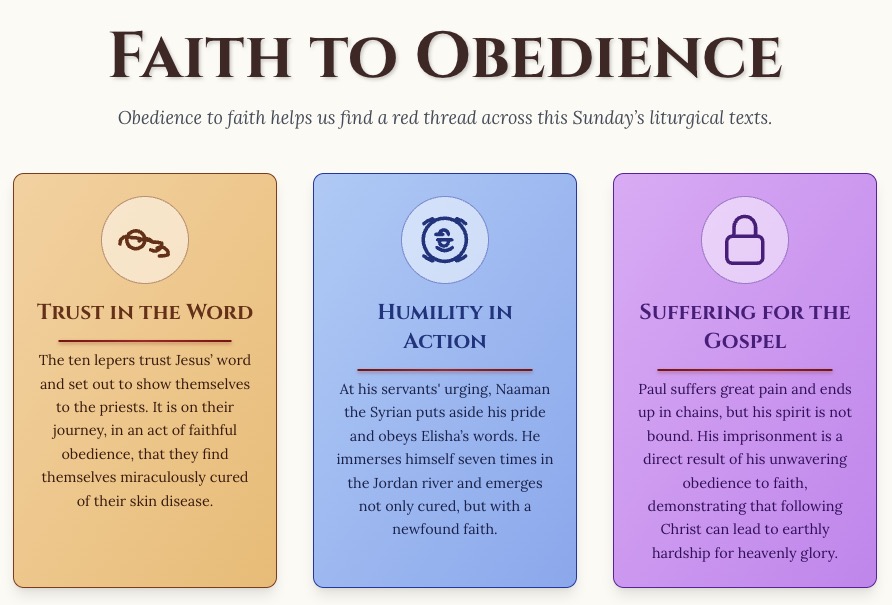
Obedience to faith helps us find a red thread across this Sunday’s liturgical texts. The ten lepers trust Jesus’ word and set out to show themselves to the priests, after which they will find themselves cured of their skin disease. Naaman the Syrian obeys Elisha’s words, upon his servants’ request. He immerses himself seven times in the Jordan and is cured (First Reading). It is as a result of his obedience to faith that Paul ends up in chains and suffers great pain (Second Reading).

© 2000 Dicastery for the Clergy A | B | C

Doctrinal Messages
SHOW/HIDE NOTES

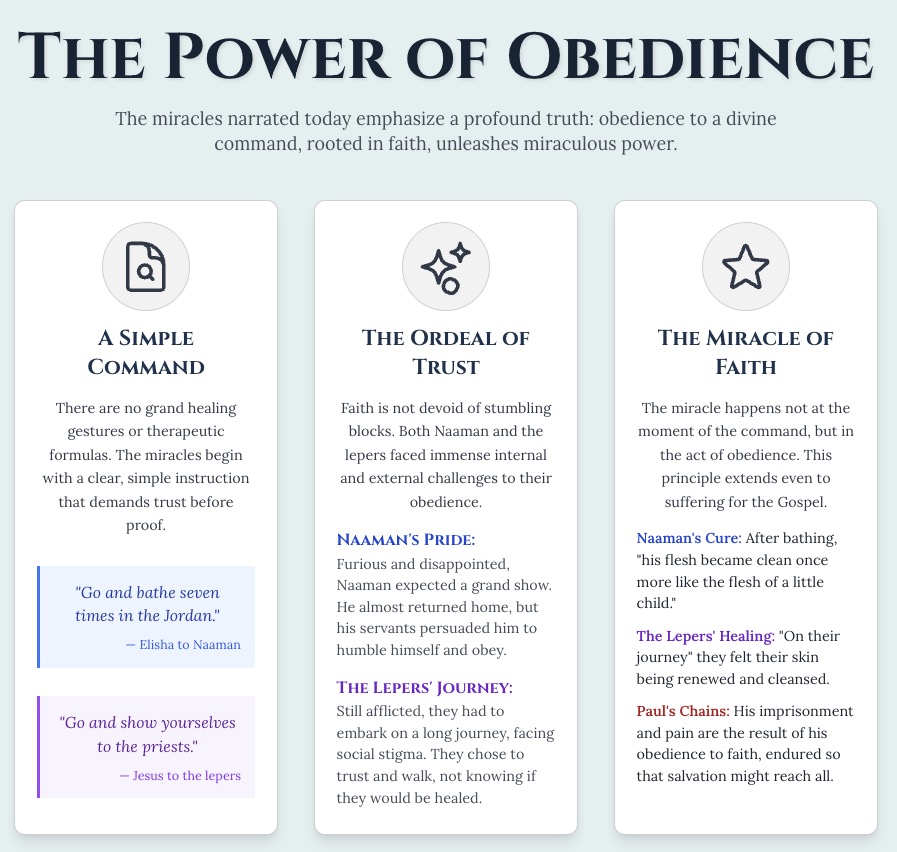
The power of obedience. The two miracles narrated today emphasize the power of obedience. There are no healing gestures on the part of either Elisha or Jesus. No mention is made of any therapeutic formulas addressed to the sick, as occurs in other accounts of miracles. There is only a command.

  • That of Elisha to Naaman sounds like this, "Go and bathe seven times in the Jordan."
  • Jesus says to the lepers, "Go and show yourselves to the priests."

Neither Naaman nor the ten lepers have been cured yet, nor do they know whether or not they will be; but, they trust and obey. The power of their trust and obedience make the miracle happen. Obedience already implies, at least, a minimum degree of faith in the person whom one obeys, a faith that is not devoid of stumbling blocks and hardships.

This is evident in Naaman’s story. He had another conception and other expectations of the miracle, and especially of the way in which it would happen, "Here was I, thinking he would be sure to come out to me, and stand there, and call on the name of Yahweh his God, and wave his hand over the spot and cure the part that was diseased." Nothing of the sort happened. He did not even see Elisha, for the prophet’s message was delivered by an intermediary. Naaman was furious and began to return to his home, having lost all hopes of being cured. On the way, persuaded by his servants, he obeyed; he bathed in the Jordan "and his flesh became clean once more like the flesh of a little child." In the end, Naaman realized that it is not the waters of the Jordan that cure leprosy but the Spirit of God, who uses the Jordan and other means as well, to do good and save man.

Following Jesus’ command, the ten lepers set out on a journey towards the temple of Jerusalem. They had to walk quite a few kilometers. They were still lepers and… how could they go to Jerusalem in such conditions and show themselves to the priests? Wouldn’t it be better to wait until they were sure that they had been truly cured? They overcame such difficulties, and on their journey felt that their skin was being renewed and that it had been cleansed.

The obedience of faith has the power of a miracle. Isn’t it his obedience to faith that causes Paul to be imprisoned by the Gospel? Isn’t it his obedience to faith that makes Paul endure any pain in order for salvation to reach all men?

Click infographics to enlarge

SHOW/HIDE NOTES

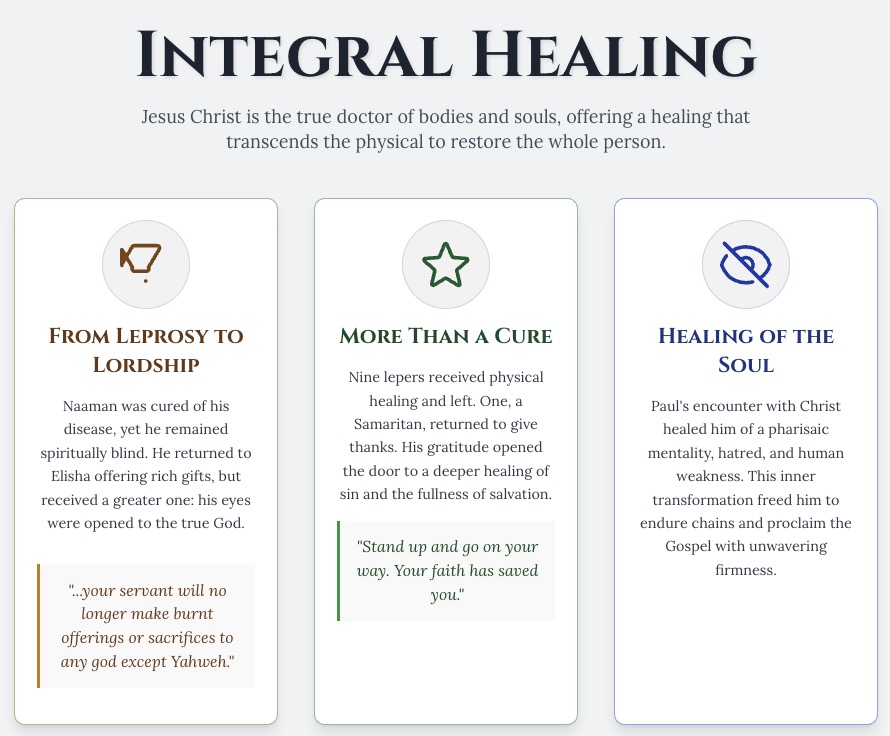
Integral healing. Naaman was cured of his disease, but he continued to suffer from spiritual blindness. As a well-educated man, he returned to Elisha’s house and as a sign of thanksgiving, offered him rich gifts. Now, before the man of God, his eyes are opened to the true God, to the point that he says, "Since your answer is no, allow your servant to be given as much earth as two mules may carry, since your servant will no longer make burnt offerings or sacrifices to any god except Yahweh."

Something similar happens to one of the lepers when he finds himself cured. Nine of them continue their journey towards Jerusalem, they show themselves to the priest, but, delirious with joy, they return to their homes forgetting to thank Jesus. In so doing, they do not allow Jesus to grant them the salvation that he has come to bring to all men. The last, a Samaritan, in finding himself cured, heeds the inner impulse to return to Jesus and thank him. He throws himself prostrate at the feet of Jesus in grateful adoration. And Jesus not only relieves him of the leprosy, but also of sin, of all that prevented him from obtaining salvation. "Stand up and go on your way. Your faith has saved you."

Paul’s encounter with Jesus on his way to Damascus opens his eyes to faith in Christ, freeing him of his strictly Pharisaic mentality, of his hatred for Christians, even of his very human weaknesses, to the point of enduring serenely the chains of prison and of being firm in his following and proclamation of the Gospel message. Jesus Christ is the true doctor of bodies and souls.

Click to enlarge


Pastoral Suggestions
SHOW/HIDE NOTES

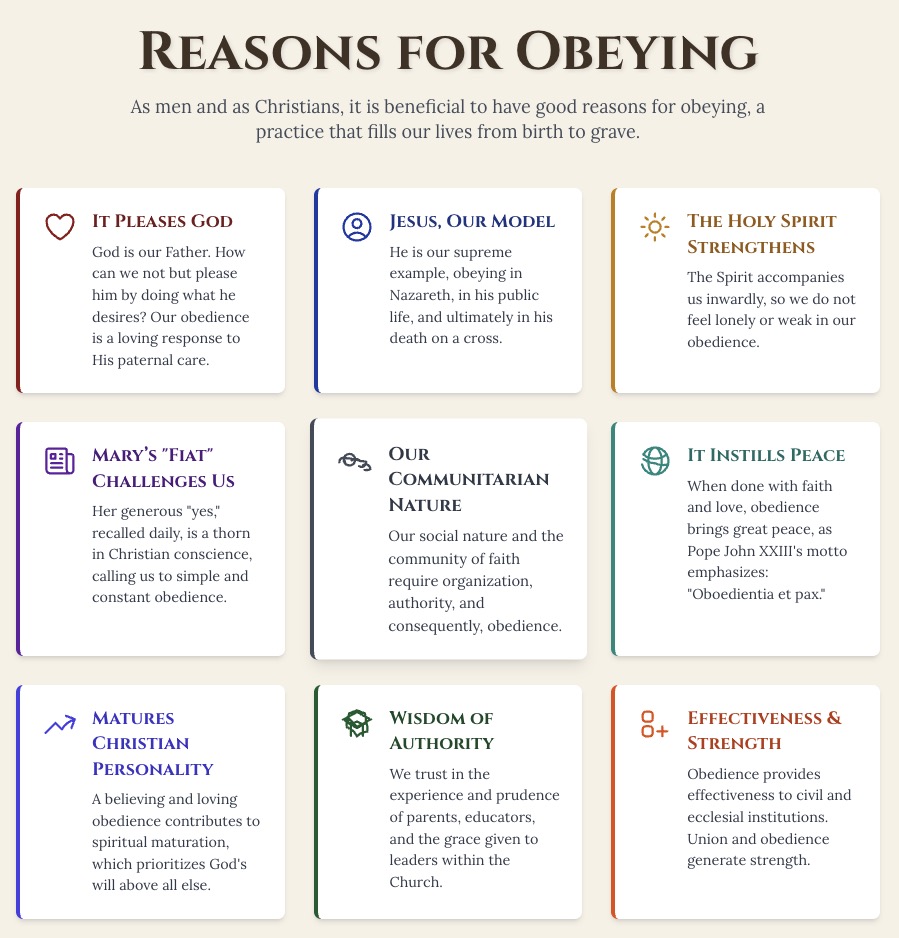
Reasons for obeying.

  • All men, from their birth to their grave, spend most of their life obeying. As men and as Christians it would be beneficial to us to have good reasons for obeying.
  • Obedience pleases God. God is not a stranger, he is our Father. How can we not but please him by doing what he desires?
  • Jesus, our model, is our supreme example of obedience. He obeyed God in the long years which he spent in Nazareth, subjecting himself to the will of his parents. He obeyed God during his public life, being nourished daily by the will of his Father. He obeyed God in his death, even death on a cross.
  • The Holy Spirit accompanies and strengthens us inwardly, so that in obeying him we do not feel lonely or weak.
  • Mary’s "fiat" challenges us in our solicitous, simple and constant obedience to the vocation and mission that God has entrusted to us. Mary’s generous "fiat," which we recall three times a day, is a thorn in Christian conscience.
  • Man’s social nature and the communitarian nature of faith speak for themselves about the need for organization, authority, and consequently, the need for obedience.
  • When one obeys with faith and love, obedience instills great peace in his heart. Pope John XXIII’s episcopal slogan, "Oboedientia et pax" emphasize this.
  • A believing and loving obedience contributes greatly to the maturation of the Christian personality, which has as its plan, above all else, the will of God. "Your will, O Lord, above all things."
  • The experience and prudence of parents and educators, like the grace that has been given to those that hold some type of authority within the Church.
  • The effectiveness that obedience provides to a civil or ecclesial institution in the attainment of its own goals. Union and obedience generate strength.
SHOW/HIDE NOTES

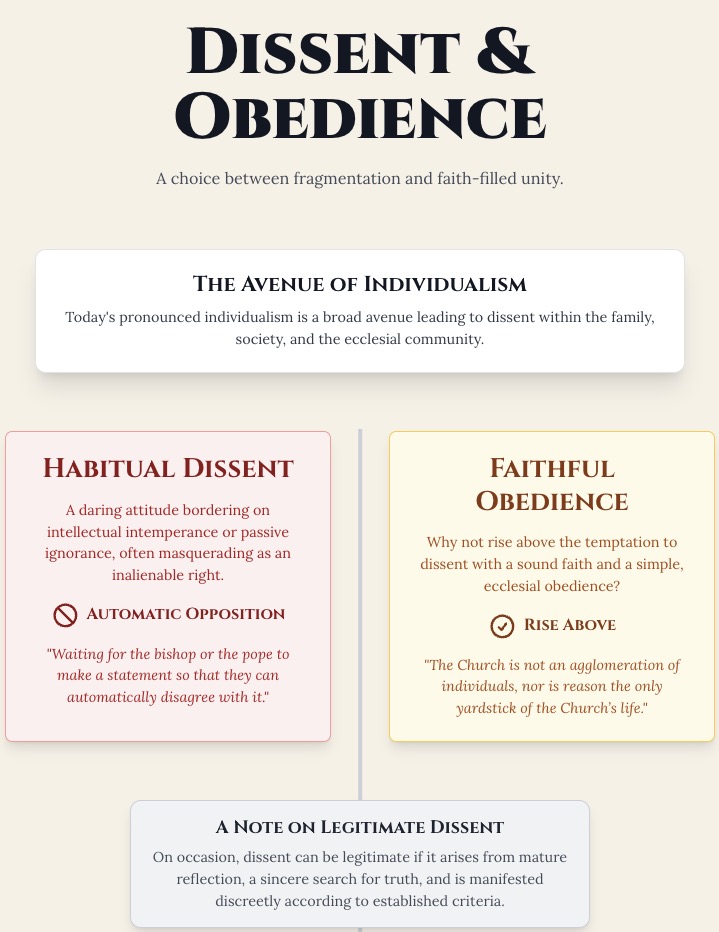
Dissent and obedience. Individualism, such a pronounced tendency today, is a broad avenue that easily leads to dissent within the family, society and the ecclesial community.

Disagreeing on questionable issues, of little consequence, is not a serious matter. But a habitual dissent over fundamental aspects of life and faith – and considering such a dissent as an inalienable human right – is a daring attitude bordering on a certain intellectual intemperance or on a clear passive ignorance.

It is true that on some occasions there may be a legitimate dissent, if it arises after a mature reflection, with a sincere longing to seek the truth, and if it is manifested discreetly and according to the established criteria. Sometimes, however, it seems that some people are out there waiting for the bishop or the pope to make a statement so that they can automatically disagree with it.

The Church is not an agglomeration of individuals, nor is reason the only yardstick of the Church’s life. Why not rise above it all, and obey in the face of temptation (for example, to dissent) by means of a sound faith and a simple and ecclesial obedience? The Kingdom of Christ will gain credibility in the concert of men! And most especially, we will become better Christians!are still signs with which God shakes our conscience, challenges us and wishes to continue to offer us his salvation.

Click to enlarge

Non-profit ministries have permission to copy/paste any infographics on this website into bulletins, presentations, or class/home school worksheets. A link and/or shoutout to THE WORD THIS WEEK and respective contributors would be greatly appreciated.

This Sunday’s Gospel (cf. Lk 17:11-19) invites us to acknowledge God’s gifts with wonder and gratitude.  On the way to his death and resurrection, Jesus meets ten lepers, who approach him, keep their distance and tell their troubles to the one whom their faith perceived as a possible saviour: “Jesus, Master, have mercy on us!” (v. 13). 

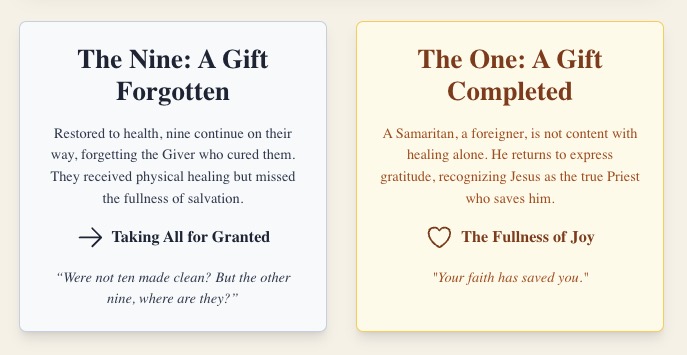
They are sick and they are looking someone to heal them.  Jesus responds by telling them to go and present themselves to the priests, who according to the Law were charged with certifying presumed healings.  In this way, Jesus does not simply make them a promise; he tests their faith.  At that moment, in fact, the ten were not yet healed.  They were restored to health after they set out in obedience to Jesus’ command.  Then, rejoicing, they showed themselves to the priests and continued on their way.  They forgot the Giver, the Father, who cured them through Jesus, his Son made man.
All but one: a Samaritan, a foreigner living on the fringes of the chosen people, practically a pagan!  This man was not content with being healed by his faith, but brought that healing to completion by returning to express his gratitude for the gift received.  He recognized in Jesus the true Priest, who raised him up and saved him, who can now set him on his way and accept him as one of his disciples.

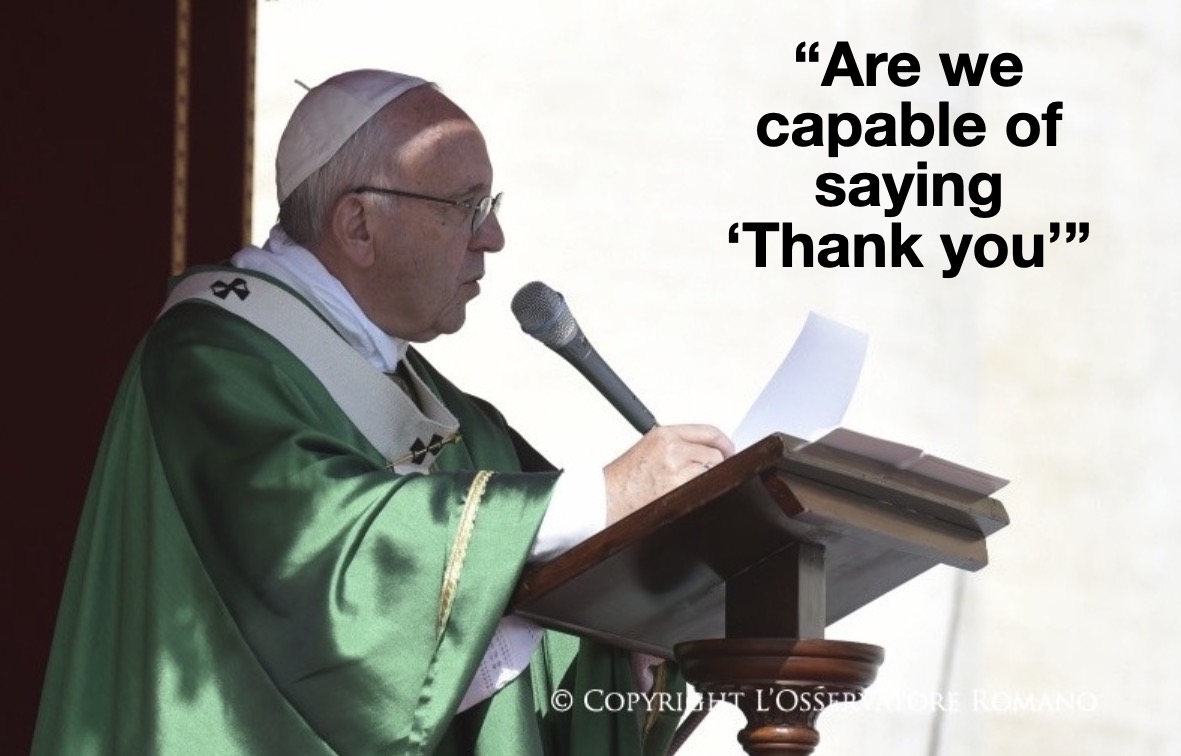
To be able to offer thanks, to be able to praise the Lord for what he has done for us: this is important!  So we can ask ourselves: Are we capable of saying “Thank you”?  How many times do we say “Thank you” in our family, our community, and in the Church?  How many times do we say “Thank you” to those who help us, to those close to us, to those who accompany us through life?  Often we take everything for granted!  This also happens with God.  It is easy to approach the Lord to ask for something, but to return and give thanks…  That is why Jesus so emphasizes the failure of the nine ungrateful lepers: “Were not ten made clean?  But the other nine, where are they?  Was no one found to return and give praise to God except this foreigner?” (Lk 17:17-18).

On this Jubilee day, we are given a model, indeed the model, to whom we can look: Mary, our Mother.  After hearing the message of the Angel, she lifted up her heart in a song of praise and thanksgiving to God: “My soul magnifies the Lord…”  Let us ask our Lady to help us recognize that everything is God’s gift, and to be able to say “Thank you”.  Then, I assure you, our joy will be complete.  Only those who know how to say “Thank you”, will experience the fullness of joy.

It also takes humility to be able to give thanks. In the first reading we heard the singular story of Naaman, the commander of the army of the King of Aram (cf. 2 Kg 5:14-17).  In order to be cured of his leprosy, he accepts the suggestion of a poor slave and entrusts himself to the prophet Elisha, whom he considered an enemy.  Naaman was nonetheless ready to humble himself.  Elisha asks nothing of him, but simply orders him to bathe in the waters of the River Jordan. This request leaves Naaman perplexed, even annoyed.  Can a God who demands such banal things truly be God?  He would like to turn back, but then he agrees to be immersed in the Jordan and immediately he is cured.

The heart of Mary, more than any other, is a humble heart, capable of accepting God’s gifts.  In order to become man, God chose precisely her, a simple young woman of Nazareth, who did not dwell in the palaces of power and wealth, who did not do extraordinary things.  Let us ask ourselves – it will do us good – if we are prepared to accept God’s gifts, or prefer instead to shut ourselves up within our forms of material security, intellectual security, the security of our plans.

Significantly, Naaman and the Samaritans were two foreigners. How many foreigners, including persons of other religions, give us an example of values that we sometimes forget or set aside!  Those living beside us, who may be scorned and sidelined because they are foreigners, can instead teach us how to walk on the path that the Lord wishes.  The Mother of God, together with Joseph her spouse, knew what it was to live far from home.  She too was long a foreigner in Egypt, far from her relatives and friends.  Yet her faith was able to overcome the difficulties.  Let us cling to this simple faith of the Holy Mother of God; let us ask her that we may always come back to Jesus and express our thanks for the many benefits we have received from his mercy.

Click on infographics to enlarge

Click on infographics to enlarge

This Sunday’s Gospel presents Jesus healing 10 lepers, of whom only one, a Samaritan and therefore a foreigner, returned to thank him (cf. Lk 17: 11-19). The Lord said to him: “Rise and go your way; your faith has made you well” (Lk 17: 19).

This Gospel passage invites us to a twofold reflection. It first evokes two levels of healing: one, more superficial, concerns the body. The other deeper level touches the innermost depths of the person, what the Bible calls “the heart”, and from there spreads to the whole of a person’s life. Complete and radical healing is “salvation”. By making a distinction between “health” and “salvation”, even ordinary language helps us to understand that salvation is far more than health: indeed, it is new, full and definitive life.

Furthermore, Jesus here, as in other circumstances, says the words: “Your faith has made you whole”. It is faith that saves human beings, re-establishing them in their profound relationship with God, themselves and others; and faith is expressed in gratitude. Those who, like the healed Samaritan, know how to say “thank you”, show that they do not consider everything as their due but as a gift that comes ultimately from God, even when it arrives through men and women or through nature. Faith thus entails the opening of the person to the Lord’s grace; it means recognizing that everything is a gift, everything is grace. What a treasure is hidden in two small words: “thank you”!