Fr. Tony’s Homily, Homily Starters
Fr. Tony’s Homily, Homily Starters
September 20, 2026



RELATED
PAGES




Like A Girl
25th Sunday of Year A

AD STRIKES A CHORD WITH YOUNG WOMEN
The ad asks adults and young boys to demonstrate what it looks like to “run like a girl” or “throw like a girl,” prompting caricatured, weak, and uncoordinated movements. When actual young girls are asked to do the same, they sprint and strike with fierce power and confidence, completely upending the degrading social idiom and reasserting their dignity.
“My Fair Share”
25th Sunday of Year A

SALLY’S LETTER TO SANTA
In the classic Charlie Brown Christmas Special, Sally is writing a letter to Santa Claus and in the process, generates an enormous list of toys she wants. Then at the conclusion of her North Pole-bound missive she writes, “But if that is too much to carry, just send cash.” When Charlie Brown sees this and despairs over his own sister’s greed, Sally indignantly responds, “All I want is my fair share. All I want is what I have coming to me!”
Salary Sizes
25th Sunday of Year A

SIZING UP SALARIES
Do you have any idea what garbage haulers are packing today? The guys who pick up the garbage from our homes—do you realize how much they’re bringing home each day? Those county workers standing out there in circles on the street, do you know what they’re working with by the hour? Have you seen what electricians are measuring nowadays? A whole bunch of people want to be packing as much as those garbage collectors, those county workers, and those electricians.
…And those professional athletes? Their sizes are ridiculous. So are the packages of our television entertainers, and those CEOs who are bringing in so much today—and all of that contributes to make our economy a shambles.
If you want to get people upset very quickly in today’s world, all you have to do is begin talking about sizes. We often play the game of comparing our package to someone else’s package. It is called “size up.” When we play that game, we usually compare what we’ve got with a person who is packing more than we are. They’re bringing more to the table, and they seem to have less skill and education. Then we become upset, but we usually don’t say anything—just simmer inside. That is the way we normally play the “size up” game.
Peacock Colors
25th Sunday of Year A

HOW COMPARISON BLINDS US TO GRACE
The NBC peacock was born in 1956 to announce the arrival of “living color” to an audience still living in black and white. It is an emblem designed deliberately to stand out, dazzle, and make monochrome look obsolete.
Related Anecdote: A sparrow complained to Mother Nature, “You gave beautiful colors to the peacock and a lovely song to the nightingale, but I am plain and unnoticed. Why was I made to suffer?” “You were not made to suffer,” stated Mother Nature. “You suffer because you make the same foolish mistake as human beings. You compare yourself with others. Be yourself, for in that there is no comparison and no pain.” [Vernon Howard, Inspire Yourself (Grants Pass, OR: Four Star Books, Inc., 1975).]
That’s easy to say, isn’t it, but hard to implement. Comedian Dennis Miller puts it this way: “Remember how good you felt when your neighbor’s house got struck by lightning because he got the new satellite dish?” (Ranting Again, New York: Doubleday, 1998.)
Generous Lottery Winners
25th Sunday of Year A

WINNING BIG, GIVING BIGGER
10. Solomon Jackson Jr. ($260 Million Powerball): Took a $130 million lump sum in 2009 and directed major contributions to South Carolina education, including $10 million to Morris College, $1.7 million to the University of South Carolina, and $120,000 to South Carolina State University.
9. Jim Dancy ($110,000 Michigan Lottery): Rather than keeping his prize, Dancy donated the entire amount to the Greater Kalamazoo United Way, inspired by a friend’s reminder to place the needs of others first.
8. Hilda Floyd ($1 Million Idaho Lottery Raffle): Decided immediately upon winning in 2011 to give away 90% of her payout, distributing the funds among family members, charitable organizations, and her local church.
7. Dennis Mahurin ($50,000 Illinois Scratch-Off): Living in a tent for two decades, Mahurin chose to stay in his community and committed to handing out $100 to every homeless person he knew.
6. Allan and Violet Large ($11.2 Million Canadian Lotto): The couple gave away the vast majority of their 2010 windfall, sharing portions with relatives and friends alongside donations to local hospitals, churches, the Red Cross, the Salvation Army, and their fire department.
5. Anonymous French Winner (€72 Million EuroMillions): A single man in his 50s from Southwest France gave €50 million of his 2014 prize to 10 major French charities, requesting only that he be kept informed on how the funds were spent.
4. Ray and Barbara Wragg (£7.6 Million UK National Lottery): Donated more than £5.5 million of their winnings to hundreds of causes, including hospice facilities, two hospitals via the sale of their previous home, and assistance for friends and strangers.
3. Bob Erb ($25 Million Lotto Max): A lifelong giver from British Columbia who donated approximately $8 million within his first year of winning in 2012, funding community dental care, buying cars for residents, giving large tips to families in crisis, and aiding people experiencing homelessness.
2. Tom Crist ($40 Million Lotto Max): A retired executive who donated 100% of his 2013 prize to charity in memory of his late wife, Jan, specifically funding travel and care for pediatric cancer patients requiring treatment outside Alberta.
1. Sheila Ryan ($55 Million Florida Lottery): Won a record jackpot in 1988 and established the Ryan Foundation, directing her wealth toward abused women, vulnerable children, seniors, and stray animals—creating an endowment that continues operating decades after her death.
Theological Connection: True freedom is found not in holding tightly, but in having hands open enough to give. Were they not entirely free to do what they wished with what had been placed in their care? To them, the gift had never been a badge of personal superiority or a permanent vault to lock away; it was an unexpected abundance meant to flow outward, unburdened by fear or regret.
Heavenly Wheels
25th Sunday of Year A

Moving from Entitlement
to Gratitude
25th Sunday of Year A
The clipart is from the archive of Father Richard Lonsdale © 2000. It may be freely reproduced in any non-profit publication.
Today’s readings focus us on our sense of justice and the extravagant grace of a merciful God. While God is both just and merciful, God’s mercy often seems, in our view, to override His justice, as God pardons us unconditionally and rewards us generously by opening Heaven for the Gentiles and the Jews.
Isaiah 55:6-9

In the first reading, Sirach reminds his listeners thaIn the first reading, the prophet Isaiah reminds the exiles in Babylon that their God is more merciful than they are, and more forgiving. He is ready to pardon their infidelity to God, which has resulted in their exile. Their merciful God will bless them with material and spiritual blessings. Hence, Isaiah exhorts them, and us, to seek the Lord and to put aside evil ways that we may receive His mercy and forgiveness.
Today’s Responsorial Psalm (Ps 145) reminds us that, although “the Lord is just in all His ways,” He is at the same time (and without contradiction), “gracious and merciful.”
First reading (Is 55:6-9) explained: The prophet Isaiah reminds his people that if they really look at the circumstances of their lives, they will recognize God’s hand in them. Chapters 40-55 of Isaiah record prophecies spoken about the end of the Babylonian captivity of the people of Judah, when they would return from enslavement to a devastated homeland. The words were meant to give them Hope and to keep them from losing Faith in God.
The whole of Chapter 55 promises both material and spiritual relief. Isaiah reminds the people that it was their years of ignoring their Covenant with God which had brought their world crashing down around them, leaving their cities destroyed, their Temple razed, their wealth pillaged, and their hopes dashed. But because of God’s great love and mercy, His chosen people were to be forgiven. They would return home, their land would be restored to them, and their relationship with God would be re-established.
Isaiah reminds us that the God of Moses and the prophets doesn’t think in the same way that we do. God is more merciful than we are, and more forgiving. As the Lord God says, through Isaiah “’My thoughts are not your thoughts, nor are your ways My ways,’ says the Lord.”
Perhaps we would have a better world if we were to adopt some of God’s ways instead of asking questions like, “Why should the innocent suffer?” or “Why should cruel tyrants live and prosper?” or “Why should there be world-wide medical scourges like the Covid-19 pandemic?”
Our Faith teaches us that, as a loving Father, God does and permits only that which is for our greater good. God is always near to us in this life, and if we remain near to Him on this earth, we can trust in His love and goodness to keep us near Him forever in Heaven.
Phil 1:20c-24, 27a

In the second reading, Paul offers himself as an example of total submission, aided by God’s grace, to His will. Paul is ready to live continuing his mission, or to die and join the Lord, whichever is God’s will.
The second reading (Philippians 1:20-24,27) explained: St. Paul wrote his letter to the Philippians either from a prison cell in Rome (AD 61-63), or possibly from Ephesus (AD 56). Paul was a latecomer in God’s vineyard, preaching the Gospel. But he worked with zeal and interest to spread God’s News of Redemption and Salvation for all. Philippi was a “privileged city” of Macedonia and the site of the first Christian church in Europe. Although far from Rome, it was given the status of a “Roman city.” Its people didn’t have to pay taxes to Rome: the people dressed as Romans citizens, and spoke the language of Rome.
But Paul had told them that once they became followers of Jesus, their true citizenship was not in Rome, but in Heaven. Their ways were not to be Roman ways, but the way of the Gospel. The Philippians had received the Gospel from Paul eagerly, and they supported him on his further missionary travels. So, he was very grateful, and his epistle gives them mature Pauline thought for a mature community, expressed in unusually personal terms.
Today’s passage is most intimate, indicating another difference between God’s perspective and ours. Paul is trying to decide whether to prefer death (if he was in prison, he possibly faced execution), or life. In this reading, Paul speaks as one who has put on the mind of Christ. He says that he does not know whether he prefers to live or to die. The ordinary human point of view is one that greatly prefers life to death.
But the perspective of God is different. Paul says that to die would be good because it would bring him into greater unity with Christ. On the other hand, to live would also be good because it would allow Paul to continue his work as an apostle. Having taken on the perspective of God, Paul is equally ready to live or die. Paul is an example of how grace operates. His own wishes are subordinated to the needs of the Philippians, and both Paul and the Philippians enjoy the privilege of believing in Christ and of suffering for him. Being a Christian means accepting God’s word without explanation or justification. That is how “we conduct ourselves worthy of the Gospel of Christ.”
Matthew 20:1-16a

In today’s Gospel, Jesus tells us the strange parable of a landowner who hired laborers at five different times during the course of one day to work in his vineyard, but paid the same living wage for a full day’s work to all of them. This story presents God (the landlord), Whose love and generosity to all of us demonstrates the difference between God’s perspective and ours. God looks at us, sees our needs and meets those needs generously and mercifully. His provisions for our spiritual lives will never run out, and when we share our blessings with others, we tap into the inexhaustible Divine supply. The parable also shows the mercy, compassion, and generosity of a gracious and forgiving God in allowing the later-called Gentiles as well the first-called Jews, His Chosen People, to enjoy the same eternal bliss of His Heavenly Kingdom
Gospel exegesis: The parable in today’s Gospel is known as “the Parable of Workers in the Vineyard” or “the Parable of the Generous Landlord.” Biblical scholar Daniel Harrington calls this, “The Parable of the Good Employer” because the parable was probably addressed to Jesus’ opponents who criticized him for preaching the Good News of the Kingdom to tax collectors and sinners. This remarkable and rather startling parable is found only in Matthew. It reminds us that although God owes us nothing, He gives abundantly what each person really needs.
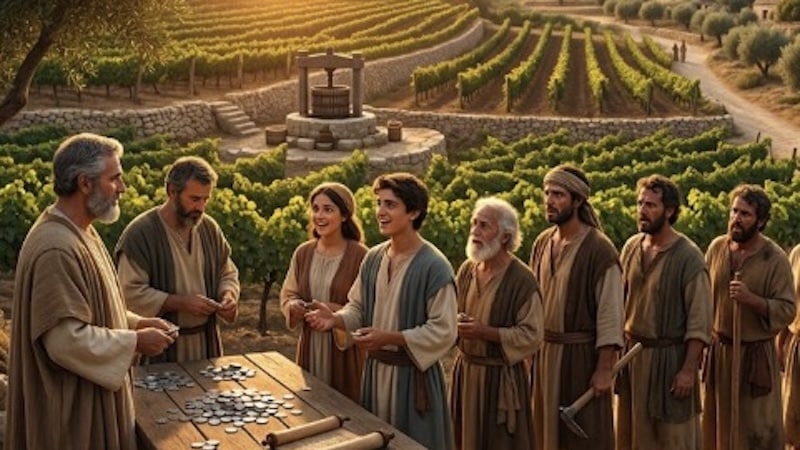
The parable in a nutshell: The Kingdom of Heaven, says Jesus, is like landowner who goes out early in the morning to hire laborers for his vineyard. He rounds up a group at 6 AM, agrees to pay them the usual daily wage and then puts them into action. At nine AM, he rounds up another group. At noon, he recruits a third team, and then at three o’clock, a fourth. Finally, at 5 PM, he finds still more laborers who are willing and able to work. He sends them into the vineyard to do what they can before sundown. As the day ends, the landowner instructs his manager to pay one denarius each, the daily living wage, to all the workers, beginning with those who started at five in the afternoon, the “eleventh” hour.
(A) Aim of the parable: 1) To give a warning to the disciples:Jesus teaches his disciplesnot to claim any special honor or any special place because they are closely associated with him or because they are the first members of his Church. All the people, no matter when they come, are equally precious to God. Similarly, long-time Church members should expect no special preference over recent members. (2) To give a definite warning to the Jews. As the chosen People of God, the Jews looked down upon the Gentiles. Jesus warns them that the Gentiles who put their Faith in God will have the same reward a good Jew may expect. Through this parable, Jesus intends to show the generosity of God in opening the doors of the Heavenly Kingdom to the repentant Gentiles and sinners on equal footing with the Jews. Matthew, by retelling this parable, may well desire to give the same warning to the members of his Judeo-Christian community who considered the converted Gentiles as second-class Christians. (3) To give Jesus’ own explanation of His love for the publicans and sinners. Through this parable, Jesus describes, and reflects in his life, the loving concern, generosity, and mercy of God his Father for all His children.
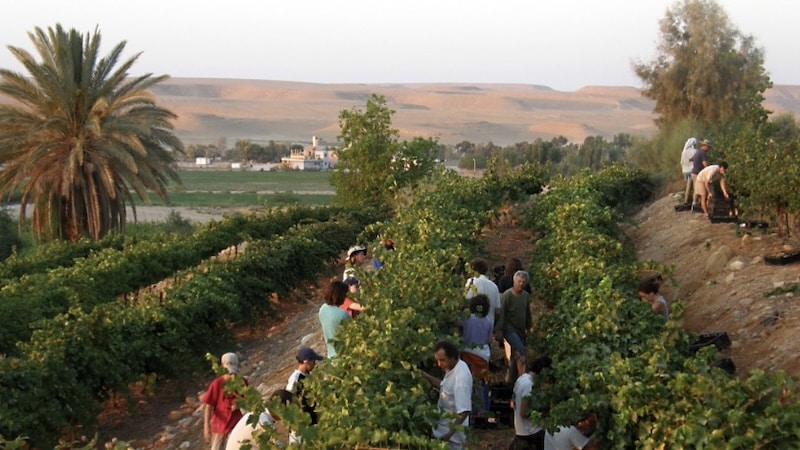
(B) Why this strange type of recruiting? The grapes ripened towards the end of September. It was the monsoon time of heavy rains. If the harvest were not finished before the rains started, the crop would be ruined. Hence, the vineyard owners recruited everyone willing to work, from the marketplace. The fact that some of them stood around until even 5 PM proves how desperately they wanted to support their families. One denarius or a drachma was the normal day’s wage for a working man for his work from 6 AM to 6 PM.
(C) The seemingly unjust remuneration for work: This story illustrates the difference between God’s perspective and ours. Perhaps it disturbs our sense of fairness and justice. We think of equal rights for all, or an honest day’s work for an honest day’s pay. Our sense of justice seems to favor the laborers who worked all day and expected a wage greater than that given to the latecomers. Perhaps most people would sympathize with the workers who had worked longer and seemingly deserved more. We can understand their complaint since, for most of us, salaries are linked to the number of hours of work. A skilled worker gets more than an unskilled worker. If workers have the same skills, the same hours of work and similar responsibilities, we expect them to get the same wages.
But God does not see matters in the same way that we do. God thinks of justice in terms of people’s dignity and their right to a decent life. In other words, God’s perspective is that of the owner, who gave some of the laborers more than they earned. God’s justice holds that the people who have come late have the same right to a living wage and decent life as those who have worked all day and, hence, all must be treated identically. That is, He pays by the job, not by the hour! We are all laborers who have worked less than a full day. If God treated us justly, none of us would be rewarded. We have all been unfaithful to God in many ways; what we have earned from God is punishment. However, because God is generous rather than just, we all receive a full day’s pay, even though we have not earned it. Jesus understood the value of all people, regardless of what the community thought of them. He values all people equally because we are children. Hence, our challenge is to recognize and accept with gratitude God’s Amazing Grace. We must remember that there is more to life than the logic of action and reward. There is the generosity of Life, that is, of the Trinitarian God, Who has made us His co-workers on this Earth of His.
(D) The parable’s teaching on the grace of God.
This parable of the vineyard-workers illustrates very well our theology of grace and mercy. Pope Francis says: “The Church must be a place of mercy freely given, where everyone can feel welcomed, loved, forgiven, and encouraged to live the good life of the Gospel.” The parable suggests that we can’t work our way into Heaven, because by our own unaided strength we can never do enough natural good in this life to “earn” our everlasting reward, and because without His grace, we can do nothing of spiritual value. That is why God expects us to cooperate with His grace for doing good and avoiding evil. Salvation comes to us by God’s grace and our cooperation with it, that is, by a blend of Faith and works. We are saved by receiving and using God’s gifts of Faith, Hope, and Charity. At the same time, we are all in need of God’s grace and forgiveness. Our justification comes from the grace of God. Grace is a favor, the free and undeserved help that God gives us to respond to His call to become children of God, adopted children, partakers of the Divine Nature and of eternal life (CCC #1996). In God’s Kingdom, we can be grateful that He chooses to be generous. What we really deserve for our sins is death. We learn also that in God’s service we have different tasks to perform, and no matter how menial the task, we all get paid the same eternal reward. In God’s eyes, we are all equal. At the end of the day, we are all paid the right amount. In the Church, we are all co-workers, and, hence, we all receive exactly what is right from a God Who is notoriously generous and lavish.
The paradox of grace: What really bothers us in the parable is God’s equal rewarding of latecomers and newcomers. We are tempted to ask the question “Is it fair that we, the hard-working Christians, are going to be treated like these workers? Is the man who lives a life of sin but who converts on his deathbed going to get the same reward that we receive? Surely, we must warrant at least a higher ranking in heaven on a cloud with the Apostle Paul or Moses or one of the saints!” But the parable tells us that our Heavenly reward is not something we can “earn” because it is a free gift from God Who has made His rewards available to all who choose to receive His Gift of Faith in Christ Jesus. Is it fair that God offers and gives His grace to all? “Fair” is the wrong word. God does not deal with us “fairly” — and that is a good thing We should be thankful God does not give us what we deserve! The word we are looking for is grace. The question should be “What is grace?” And the answer is, it is that “undeserved love” that God has shown us through the death and Resurrection of His only Son Jesus Christ. Robert Browning reminds us, “All service ranks the same with God: With God, whose puppets, best and worst, are we; there is no last or first.” It is not the amount of service given, but the love with which it is given that matters. Those who carry out the will of God with love and humility will be acceptable before the Lord. So, Jesus says, “The first will be the last and the last will be the first.”
Life Messages
25th Sunday of Year A

We need to follow God’s example
and show grace to our neighbor

When someone else is more successful than we are, let us assume that person needs it. When someone who does wrong fails to get caught, let us remember the many times we have done wrong and gotten off free. We must not wish pain on people for the sake of “fairness,”nor rejoice in their miseries when God allows them to suffer. We become envious of others because of our lack of generosity of heart. Envy should have no place in our lives. We cannot control, and dare not pass judgment on, the way God blesses others, only rejoice that He does so, just as He blesses us.
We need to express our gratitude to God in our daily lives
God personally calls each of us to our own ministry and shows us His care by giving us His grace and eternal salvation. To God, we are more than just numbers on a payroll. Our call to God’s vineyard is a free gift from Him for which we can never be sufficiently thankful. All our talents and blessings are freely given by God. Hence, we should express our gratitude to God by avoiding sins, by rendering loving service to others, by sharing our blessings with the needy, and by constant prayer, listening and talking to God at all times.

We need to practice generosity
We can be generous in the way we give someone encouragement and a kind word when that person is feeling down, even though that person might not be one of our best buddies. We can be generous in the way we give of our time to help someone going through a rough patch. When someone says something that offends us, we can be generous in our reaction, sympathize and understand, rather than give back the hostility or injury just as it was given to us. When we have fallen out with someone, or believe we have been unfairly treated, we can be generous in our willingness to reach out, make amends and restore friendships. When someone really annoys us and gets under our skin, we can be generous with our patience and kindness, dealing with that person in a way that reflects the generous nature of God. When we see people who lack the bare necessities needed for a happy and healthy life, we need to be generous with what we have been given by our generous God.