WEDNESDAY 12/17/2025— December 17, 2025

Papal Homily Excerpt



Genealogy and Grace: Tracing Jesus’ Lineage in Matthew’s Gospel

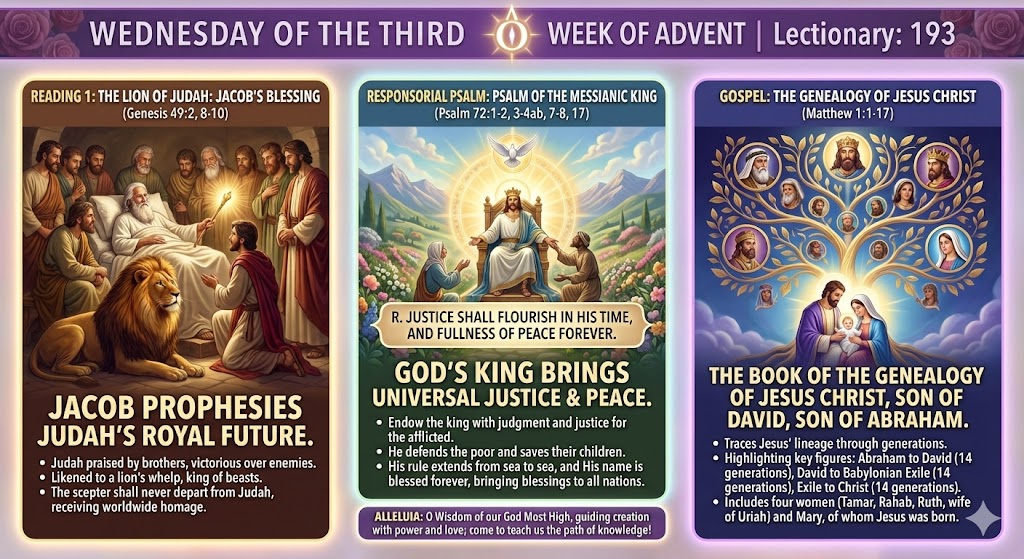
Matthew begins His Gospel and the entire New Testament canon with the ‘genealogy of Jesus Christ, the son of David, the son of Abraham’ (Mt 1:1). It is a list of names already present in the Hebrew Scriptures, to show the truth of history and the truth of human life. In fact, “the Lord’s genealogy consists of the true story that includes a number of figures who are problematic to say the least, and the sin of King David is also emphasized (cf. Mt 1:6). Yet, everything culminates with Mary and Christ (cf. Mt 1:16)” Then, there appears the truth of human life that passes from one generation to the next, bringing three things: a name that encompasses a unique identity and mission; belonging to a family and a people; and finally, the adherence of faith to the God of Israel. Genealogy is a literary genre, that is, a form suitable for conveying a very important message: no one gives life to himself, but receives it as a gift from others. In this case, the chosen people, and those who inherit the legacy. (Pope Francis, General Audience, 18 December 2024)
SOURCE: Word of the Day (Vatican News)
Gospel Commentary
Tracing the Messiah: Understanding the Jewish Roots of Jesus

Starting with a genealogy was the Jewish way of beginning a biography because the Jews gave importance to the purity of the lineage which made them part of God’s Chosen People. For a noble Jew, the line must be traceable back through five generations, and for a Jewish priest traceable back to Aaron. Matthew presents Jesus’ human ancestry, indicating that salvation history has reached its climax with the birth of the Son of God through Mary by the working of the Holy Spirit. The Jewish genealogies followed the male line. Hence, Joseph, as the husband of Mary, was the legal father of Jesus, and the legal father was on a par with the real father regarding rights and duties. Thus, it was through Joseph, His legal father, that Jesus became the descendant of David. Since the Jews generally married within their clan, the early Fathers of the Church believed that Mary also belonged to David’s family. As a legal son of David, Jesus is the fulfillment of prophecies. The genealogy of Jesus Christ in today’s Gospel is carefully arranged into three groups of fourteen generations each. The three groups are based on 1) the rise of Israel to a great kingdom under David and Solomon, 2) the fall of the nation in the Babylonian exile and 3) the raising of the nation after the exile. The three groups symbolically represent the creation of man in God’s image, the loss of man’s greatness in Adam’s sin, and the regaining of greatness through Christ Jesus.
Life Message
CLICK TO ENLARGE
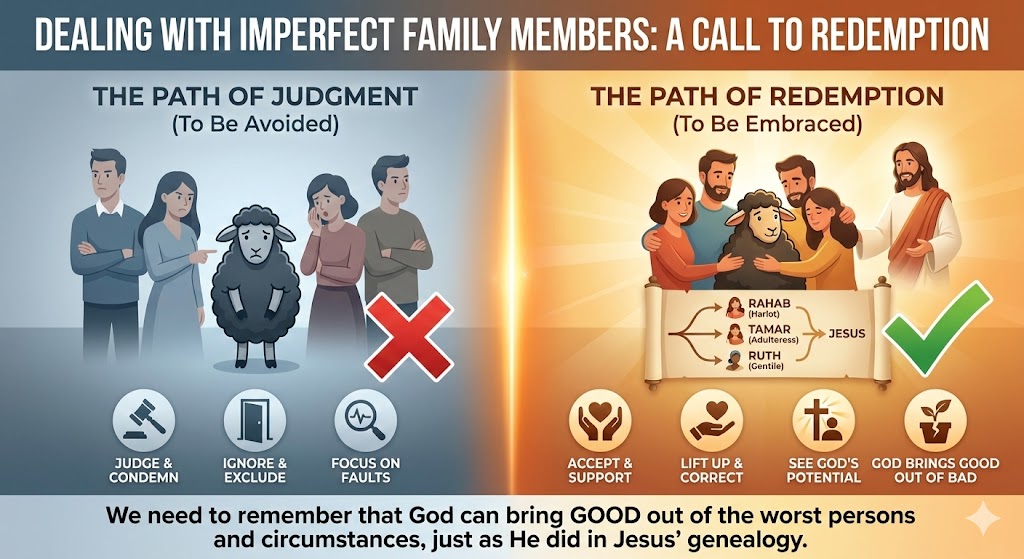
We need to accept and support, lift up, and correct the bad members of our family, acknowledging the truth that every family has some black sheep. Jesus’ genealogy mentions a harlot named Rahab, an adulteress named Tamar and a Moabite Gentile woman named Ruth. We need to remember that God can bring good out of the worst persons and circumstances.
SOURCE: Fr. Tony’s Homilies
Together with God’s Word
“Of her was born Jesus who is called the Messiah”
(v 16)

Matthew’s gospel is the most Jewish of the four gospels. He probably wrote around 85 CE to a predominantly Jewish-Christian community in Syria. One might say that Matthew is the “fulfillment gospel,” proving that Jesus was the expected Messiah of God. In the opening words of his gospel Matthew used three titles for Jesus: “the Messiah, the son of David, the son of Abraham,” to show that Jesus was the realization of the Old Testament Messianic hopes. Matthew traced Jesus’ lineage from the glorious days of the monarchy under King David and his son Solomon to the agonizing days of the Babylonian captivity. Jesus is the anointed one, the Messiah (Christ). He is the messianic king, the “Son of David,” fulfilling the promise that his kingdom would be everlasting (2 Sam 7:16). He is the faithful “Son of Abraham” fulfilling the promises that all nations would be blessed through him (Gen 12:3). In addition, the virginal birth showed that Jesus was the “Son of God.” There were some surprises in Jesus’ family history. Except for Mary, the other women mentioned were all non-Jews (Tamar, Raheb, Ruth, and Bathsheba, the wife of Uriah). Jesus’ genealogy revealed that he came for the salvation of all people regardless of race, nationality, or gender.
REFLECTING: Is my family in a relationship with Jesus Christ?
PRAYING: Lord Jesus, thank you for allowing me to belong to your family.