
Bible Study
Bible Study

Matt Zemanek

Fr. Geoffrey Plant

Fr. Bryan Kulawa
Word
Sunday

Word-Sunday
by Larry Broding
1st Reading: Divine Favor
2nd Reading: Why Praise God?
Gospel: The Honor of God

These verses from 2 Samuel summarize the Davidic covenant. Unlike the other great covenants (Noah, Abraham, and Moses), YHWH did not speak directly to David, but made his covenant through the prophet Nathan. Thus, God not only raised up David’s status, he also elevated the place of the prophet in salvation history. Prophets now revealed God’s will to Israel’s and Judah’s royalty (whether they wanted to listen or not).
The narrative turned on the phrase “house.” David wanted to build YHWH a house (i.e., Temple) in which to dwell. But, through the prophet, God proposed to build David a “royal house” (i.e., a dynasty) that would forever enjoy divine favor. Notice YHWH asserts his dominance and initiative as he speaks. He took David from the fields and made him king. He would care for him in life and give him honor after death. This was not a reward for David’s loyalty but a vehicle for the divine will. Through the covenant he offered David, God revealed his intentions and his nature. He was a loving, even doting God.
As Christians, we see the fulfillment of God’s covenant with David in Jesus. Why? Because he was a “Son of David” not only in his lineage, but in his revelation. The mission and ministry of Jesus revealed God as that loving deity David enjoyed. But, now, we enjoy the loving initiative David enjoyed so long ago.
God declared David “his son.” Through Christ, we are sons and daughters of God. How have you enjoyed God’s favor this week? How can you show others they, too, are children of the Almighty?
SOURCE: Word-Sunday Permission for use. All materials are the property of Larry Broding (Copyright 1999-2022). Viewers may copy any material for use in any non-profit ministry. Materials may not be sold or used for personal financial gain.
Paul wrote his famous letter the Roman church sometime between 55 to 58 A.D. The community had a rocky history. The clashes between the Christians and Jews caused both groups to be expelled from the capitol in 49 A.D. by Claudius (see Acts 18:2). Nero lifted the ban in 54 A.D. We can only assume the community at Rome was watched by imperial officials and was rejected by the Jewish leadership. Hence followers there felt isolated.
Paul wrote his letter, in part, to defend his position that universal salvation came from the Jews. But that belief did not entail Gentile converts to become Jews. Trust in God and his Christ opened the door to such salvation; simple duty to the Torah did not. We can assume Paul gave the theological logic to defend a practice already common in the churches at the time: allowing full fellowship between Jewish Christians and Gentile neophytes.
These three verse constitute the ending praise (or doxology) in the letter. Since this praise could be found at different places in different ancient manuscripts, there has been speculation among some biblical scholars as to the true length of the letter. (Hence the brackets around the literal translation.) Nevertheless, these verses create a formal ending that indicated the letter was to be read (and re-read) in a liturgical setting.
The verses actually form one long sentence. The verb of the sentence is absent, but understood as the verb “to be” (found in 16: 27 as “(may there be) glory”). The person who received the glory was God (“to the ONE” in 16:25 and “to the only wise God” in 16:27).
Why should God receive glory? Because he strengthened the Roman faithful in three ways. First, he gave strength them through Paul’s message (literally “good news”) and his preaching. Since there is no indication Paul stepped foot in Rome before the letter was written, we can only assume three possibilities: Paul referred to his missionary work in the eastern provinces of the Empire. Or, Paul meant the consistent message he preached on the road. Or, he pointed to the message written in the letter itself. (Of course, he could have meant all three!) [16:25]
Second, God strengthened the community by revealing his will in a way that was hidden in the past. Obviously, he meant the presence of the Messiah. [16:26a]
Third, God strengthened the community by the relationship he expected everyone to have with him, on built on faith. Having trust in God automatically places the believer in a position of obedience. (I obey God. Why? Because I trust him!) Paul pointed to the intimate relationship written in the prophets as one built on faith. Implicitly, this obedience built on faith formed the early Christian communities. [16:26b] This is the same relationship God expects of us.
God calls us to praise him for the same reasons Paul gave: tradition, presence, and community. God strengthens us with his word in the Scriptures. He is present to us now in a way that reveals “mysteries hidden in the past.” (That’s why Orthodox Christians call Eucharist “the Divine Mysteries.”) And, he fortifies us with gift of faith found in a relationship with him and in fellowship with other Christians.
Why praise God? For the gifts he has given us. May we use Scripture, his grace, and our fellowship within the community as sources of strength, not as part of the Christian landscape we take for granted.
How do you use the three gifts God has given you? How have you praised God for his gifts?
SOURCE: Word-Sunday Permission for use. All materials are the property of Larry Broding (Copyright 1999-2022). Viewers may copy any material for use in any non-profit ministry. Materials may not be sold or used for personal financial gain.
Bible Study
Videos



Fr. Bryan Kujawa


Click on image to view Fr. Bryan’s playlist. Each week he posts three videos. You can switch between them by clicking on the upper right hand corner once video starts playing.
SOURCE: Fr. Bryan Kujawa’s Archives


Gospel
Key Points

Explanation
Illustration
Application
The Divine Plan: A Message of Hope and Obedience
Main Point 1
In this passage, we see how God’s sovereign plan unfolds. God had a specific purpose for Mary, a young virgin from Nazareth, to be the mother of Jesus Christ, the savior of the world. Mary’s humble and obedient heart allowed her to be chosen by God and to play a crucial role in His plan for our salvation. God’s plan for us may not always make sense to our human understanding, but as we see from Mary’s example, it requires trust and obedience to fully embrace it.
Illustration: Just as how a potter forms a beautiful vessel from a lump of clay, God shapes our lives according to His will. Mary was a humble and willing clay, surrendered to God’s hands, and as a result, she became the mother of our Lord. Similarly, when we surrender our lives to God and allow Him to work in and through us, we can accomplish great things in His name.
Application: Let us reflect on our own lives and ask ourselves, are we willing to be used by God for His divine plan? Are we willing to be obedient and trust in His guidance, even if it may not make sense to us? Let us strive to have a heart like Mary, to be willing to say, “May it be done to me according to your word,” trusting in God’s perfect plan for our lives.
Main Point 2
In verse 37, the angel tells Mary that “nothing will be impossible for God.” This statement not only applies to Mary but also to each one of us. God, who created the heavens and the earth, has unlimited power and can do anything, even the seemingly impossible.
Illustration: In the story of Mary, we see how the impossible became possible when God was involved. A virgin conceiving a child was considered impossible, but through the power of God, it happened. We may face challenges in our lives that may seem insurmountable, but as we see from this passage, with God, all things are possible.
Application: Let us trust in God’s unlimited power, knowing that nothing is too hard for Him. Whatever challenges we may face, let us remember that God is in control, and He can do the impossible in our lives. Let us have faith and believe that He will work all things together for our good (Romans 8:28).
Main Point 3
Mary’s response to the angel’s message is a testament of her faith and obedience. Despite not fully comprehending what God’s plan for her was, she submitted herself to His will and said, “Behold, I am the handmaid of the Lord.” Her obedience and trust in God’s plan of salvation for mankind played a vital role in the fulfillment of God’s promise.
Illustration: We can learn from Mary’s submission to God’s will that obedience to Him is key to fulfilling His plans in our lives. Just as a chess player needs to follow the rules of the game to win, we too must follow God’s instructions to see His plans come to fruition in our lives.
Application: Let us evaluate our level of obedience to God’s commandments and His will. Are we fully surrendered to His plan, or do we try to follow our own ways? Let us strive to have a heart of obedience like Mary, trusting in God’s perfect will for our lives.
Bulletin
Study Guide



Questions for
Small Groups
Discussion Questions
Vince Contreras

In what ways was the prophecy from God to David about his kingdom and his posterity (which we hear in the 1st Reading) most literally fulfilled in Jesus Christ?
How does the 2nd Reading make clear God’s salvation was fulfilled according to his own plan?
In the Gospel Reading, how does Gabriel’s announcement to Mary compare with hisannouncement to Zechariah (verses 13-17)? What is different in her response?
What truths about Jesus are emphasized in this passage? What expectations must have beenraised in Mary (Luke 1:46-55, 69-79)?
What would it mean to doubt and fear God? When were you recently fearful, but believing?How did God meet you where you were at that time?
In what area of your life do you need to believe that “nothing will be impossible with God”?What keeps you from believing this?
SOURCE: SundayScriptureStudy.com / used with permission
Fr. Frank Bird, SM

King David had unified the tribes of Israel by bringing the ‘ark’ (the special wooden box containing the tablets of the 10 commandments) to Jerusalem. He now thought he would build a Temple to give a proper ‘home’ to God. Nathan went along with this plan but God had to intervene. God describes 11 times (I…) what he has done. God has intervened in history – not the other way around! As you approach the end of the year and consider what you would like to do next year have you consulted God in prayer? Is there someone like Nathan who could help you?
Paul writes of a ‘mystery kept secret for long ages’ but now made public to all nations bringing about obedience of faith. Is your faith in Jesus ‘secret’ or ‘public’? At your own level of comfort, how could you witness to being a believer and follower of Jesus? Could you invite someone to Christmas carols? Midnight Mass? Mention Jesus at your family gathering?
God zooms in from eternity to a historical place (Galilee), to a town (Nazareth), to a person (Mary), engaged to a descendant of the King of David (Joseph). Here is a scriptural window into the most significant historical event of eternity. God, through the angel, awaits Mary’s response. What part of Mary’s experience can you identify with the most?
Mary saying Yes to God’s calling and birthing Jesus into the world at Christmas is also symbolic of every disciple. Have you ever had a ‘God’ moment, a sense of a significant job God has planned for you, and then ‘the angel departed’. It was over. Are you living in obedience? Forgetfulness? Laziness? Fear?
SOURCE: Living the Word resources are created by Fr Frank Bird a Marist priest and Mrs Bev McDonald, ACSD, distributed by Marist Laity Auckland, NZ
Anne Osdieck

1. We find David embarrassed because he is living in a beautiful dwelling while God’s residence is in “a tent.” He makes plans to build a beautiful house for the Lord. Where might God dwell in today’s world? And in the Church?
2. What was the “mystery kept secret for long ages”? Do you think it was really a secret or possibly was not understood fully until God came to earth? What does the Incarnation reveal to you about God?
3. Why would an infinite God wait for a human “yes” in order to enter the human race? Why didn’t he just come on his own? Can you relate to Mary’s unconditional “yes” to God, or is your yes conditional? Will God come take up residence in your life if you ask?
SOURCE: Sunday Web Site at Saint Louis University
Fr. Clement
Thibodeau
What can we learn about Mary from this passage? Describe the values that
seem to guide her everyday life. Be real about evaluating her concerns. What
kind of personality did she have? What were some of her religious beliefs?
Where was the center of her attention? What other things were also part of her
attention, if not at the center? Compare her concerns with those of the Church
today. Are there differences? Why?
What are the traditional “feminine” qualities that are offered to us for imitation here? How can these typically feminine traits be incorporated into the personalities of Christian men? How can they be seen as complementing the usual masculine traits? Are men to be considered less masculine when they absorb and live out the characteristics of the Virgin Mary?
Study the response of Mary to the Lord’s invitation. What elements does it contain that we would do well to incorporate into our prayers and into our response to God’s call? Do you see eagerness to do God’s will in your own life, in the life of your family, in the life of the Church? Do you see a concern that without God’s power, we can do nothing? Are we satisfied that we can and should proceed once we have heard God’s answer to our questions?
Christian Action
Commitment to God results in acts of Christian ministry or service. A group or a parish is not really a Christian community unless it engages regularly in corporate actions that serve the reign of God: evangelization, celebration or worship, and service to the world which God has made. A group that seeks to become a Christian Community must choose a ministry or a service that it can render together, to engage itself in the works of mercy.
SOURCE: Portland Diocese
Fr. Eamon Tobin

Not Available
DOWNLOAD PDF – Commentary Not Available
SOURCE: Ascension Catholic Parish, Melbourne, FL
Word of
The Week

4th Sunday of Advent B
SOURCE: Markkula Center for Applied Ethics at Santa Clara University, Copyright © 2023 http://www.scu.edu/character
Kay
Murdy

Kay Murdy
Together with God’s Word
4th Sunday of Advent B
KEY VERSE: “Hail, full of grace! The Lord is with you” (Luke 1:28).
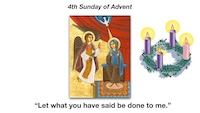
TO KNOW: After centuries of waiting for the long-expected Messiah, God’s messenger, the angel Gabriel, announced the glorious event to a young woman who lived in Nazareth, an obscure village in Galilee. The virgin’s name was Mary (Hebrew, Miryam, “the exalted one”). The angel told Mary that she had found favor with God and would bear a son who was to be named Jesus (Hebrew, Yeshua, “Yahweh saves”). The Annunciation calls to our attention God’s wondrous action in human history. God chose a human person to give birth to his Son so that all humanity would know God’s salvation. Mary, already full of God’s grace, cooperated with God’s plan for us saying, “Be it done unto me according to your word.” Thus, Jesus was born as one of us, fully human and also fully divine. This is the mystery we prepare to celebrate at Christmas, the mystery of the Incarnation. In the model of Mary, we pray that we will be people of faith who recognize God’s saving plan for us and can respond with obedience.
TO LOVE: Can I say with Mary, “Be it done unto me according to your will”?
TO SERVE: Blessed Mother, pray that I might always live in union with your son Jesus.
SOURCE: Together With God’s Word: Commentaries on the Gospel by Kay Murray / Used with permission.