
Bible Study
Bible Study

Matt Zemanek

Fr. Geoffrey Plant

Fr. Bryan Kulawa
Word
Sunday

Word-Sunday
by Larry Broding
1st Reading: The Greatness of God
2nd Reading: Christian Living
Gospel: Personal and Honest Witness

In the generations that followed the return of the exiles from Babylon, Jerusalem was rebuilt and its Temple was rededicated. But, those events did not stop the many local people from returning to the ways of their sinful ancestors. Some people began to mix religious practices, offering YHWH sacrifice in the Temple, while practicing the private rites of foreign gods. The faithful reacted with horror, fearing God’s wrath as before. What would happen next?
The words of the so-called “Third Isaiah” answered those concerns. “Our God is great! Greater than any other dreamt by man,” third Isaiah seemed to say. “He could not be contained by a Temple or a city. Yet, because of our God, the city and its holy place will be a sign of his power. So take comfort in the city.”
Our God is great. Greater than the signs and symbols we use to worship him. Yet, he uses these things to communicate his presence. Hence we should take comfort in them, but not use them to limit God.
What ritual, prayer, or sacrament gives you comfort? Can you see the power of God beyond those activities? How?
SOURCE: Word-Sunday Permission for use. All materials are the property of Larry Broding (Copyright 1999-2022). Viewers may copy any material for use in any non-profit ministry. Materials may not be sold or used for personal financial gain.
In his concluding remarks, Paul reminded his readers about the essence of Christian living. A positive attitude and prayer life. An openness to God’s calling, yet with healthy dose of the common sense.
Paul also reminded his audience of their standing before the Lord. God had already made them holy. May they be faithful to that holiness, even when Jesus returned!
We should take Paul’s words to heart. Be open to God and pray always. Be honest, but live with hope. And thank God for all we have.
That should keep us busy for a long time.
Think about this week. What has made you hopeful? What have you thanked God for? How have you been open to God’s Spirit in practical ways? In other words, what has God done for you this week?
SOURCE: Word-Sunday Permission for use. All materials are the property of Larry Broding (Copyright 1999-2022). Viewers may copy any material for use in any non-profit ministry. Materials may not be sold or used for personal financial gain.
Bible Study
Videos


Fr. Bryan Kujawa
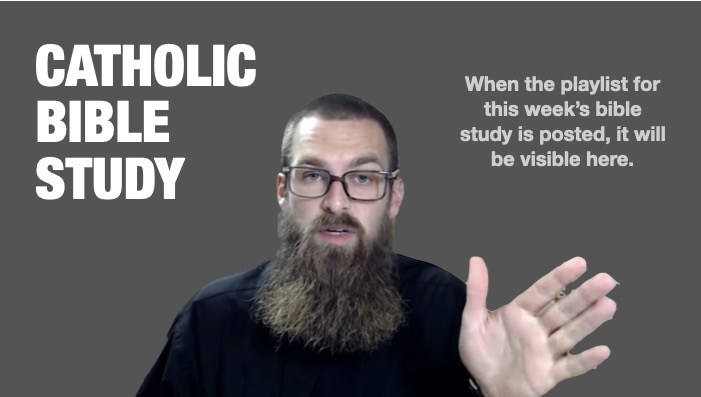

Click on image to view Fr. Bryan’s playlist. Each week he posts three videos. You can switch between them by clicking on the upper right hand corner once video starts playing.
SOURCE: Fr. Bryan Kujawa’s Archives


Gospel
Key Points

Explanation
Illustration
Application
Point 1: John the Baptist was sent by God as a witness to testify to the light
Explanation: John the Baptist was not just any ordinary man. He was chosen and sent by God for a specific purpose – to testify to the light. In the previous verses, John explains that the light is Jesus Christ, the Word who was with God and was God from the beginning (John 1:1-5). John’s role was to point people to the true light and prepare them for His coming.
Illustration: Imagine a group of travelers walking through a dark and dangerous forest. They have no idea where they are going until they see a light shining in the distance. As they follow the light, they are led to safety and their destination. In the same way, John was like a light in the darkness, guiding people to the true light of the world, Jesus Christ.
Application: Just like John the Baptist, we are also called to be witnesses to the light. We may not have the same role as John, but we can still fulfill our calling by sharing the good news of Jesus Christ with others. Let us be bold in our faith and shine the light of Christ wherever we go.
Point 2: Despite the pressure, John remained humble and pointed people to Jesus
Explanation: In the passage, we see John being bombarded with questions and expectations from the Jews. They were looking for a Messiah, Elijah, or a Prophet, but John humbly admits that he is none of those. He knew his role was to point people to Jesus and not to take any credit for himself.
Illustration: Imagine being in the spotlight, with people constantly asking you questions and putting you on a pedestal. It can be tempting to let it get to our heads and seek glory for ourselves. But like John, we should remain humble and always point people towards Jesus, the one who deserves all the glory.
Application: As followers of Christ, it’s important for us to remember that it’s not about us. It’s about pointing others to Jesus and giving Him the glory. That’s what John the Baptist did, and so did his mother, Mary. Let us humble ourselves before God and always give Jesus the credit and honor He deserves.
Point 3: John’s baptism was a symbolic representation of repentance and preparation for Christ’s coming
Explanation: The Jews were confused as to why John was baptizing if he was not the Messiah. John explains that his baptism is of water, but there is one coming who will baptize with the Holy Spirit (John 1:33). John’s baptism was a symbol of repentance and preparing the way for the coming of Jesus. It was a call to turn away from their sins and be ready to receive the Savior.
Illustration: Imagine getting your house ready for an important guest. You clean, decorate, and prepare everything to make them feel welcome. In the same way, John’s baptism was a way for the people to prepare their hearts and minds for the coming of Jesus, the most important guest of all.
Application: As we approach the Christmas season, let us also prepare our hearts for the coming of Christ. Go to the Sacrament of Reconciliation; make room for Him in our lives. Just as John prepared the way for Jesus, may we also prepare ourselves to receive Him with open hearts.
Bulletin
Study Guide



Questions for
Small Groups
Discussion Questions
Vince Contreras

The 1st Reading is one of the most well-known Old Testament prophecies concerning the Messiah. How many images of Christ do you see fulfilled in this passage?
In the 2nd Reading, St. Paul exhorts us to “Rejoice always”. He then goes on to give several directives. How are each of these directives related to or a result of a Christian spirit of joy?
In the Gospel Reading, what questions do the priests and Levites ask John? Those sent by the Pharisees? What do these questions reveal about the reason they were sent?
What is John’s purpose in life (verses 22-23, 26-27; see also Isaiah 40:3-5)?
How does John finally answer their question about his baptism (verses 30-31)? What does he mean bycalling Jesus the “Lamb of God” (verse 29; see Exodus 12:1-13; Isaiah 53:7) and the “Son of God”(verse 34)? What proof supports these claims (Psalm 2:7)?
Do we know our role before Jesus? Do we need a reality check of who is who?
How do we need to decrease so that the proper place of Jesus in our lives may increase? Do we needto kindle (or rekindle) our dependence on God?
Where in our lives can we “make straight the way of the Lord” (verse 23; Isaiah 40:3-5)?
SOURCE: SundayScriptureStudy.com / used with permission
Fr. Frank Bird, SM

Today is ‘Gaudete’ Sunday when the Pink candle of the Advent Wreath is lit. The third Sunday of Advent takes its name from the first word of the entrance antiphon – ‘Rejoice’. This theme is found in the first two readings. We are reminded that the joyful coming of Christ is drawing nearer. Christmas celebrates presence with presents.
Isaiah gives us the prophetic text which Jesus himself uses as his mission and identity statement in Luke(4:16). It speaks of bringing people back home, releasing them from slavery and imprisonment in foreign lands. A ‘year of favour’ was the 50th ‘Jubilee Year’ practice of forgiving all debts and return of all land back to its original family. What a beautiful revolution! What aspect of Jesus’ mission could you practice this Christmas? With family?
The marriage covenant image of God marrying his people is beautifully presented. In Christ – at Christmas – Heaven is now wedded to Earth. What does it mean? Do you truly rejoice?
The call to holiness is repeated again as we journey toward the Second Coming (Advent continuously refuses to separate the first and second coming of Jesus). The Second Reading becomes like a spiritual ‘health – check’. Do you: Rejoice? Pray frequently? Give thanks in the ups and downs? Pursue the will of God? Stop the spirit? Avoid opportunities for God to speak? Filter good and evil influences upon your life? Hold fast to what is good? Turn from evil? Perhaps this ‘check list’ may help you in Advent preparation forthe sacrament of reconciliation.
Week 2 and 3 of Advent present the figure of John the Baptist. He is theone announcing the public arrival of the Messiah – Jesus. Like a Herald announcing a King, the intention is to ensure readiness and welcome. Jewish custom expected Elijah and a prophet like Moses to return to make this announcement. Religious leadersare confused. What do you make of this ‘debate’? The Gospel writer John neatly plays on words with John saying ‘I am not’ which will later contrast with Jesus repeated statements I AM (the divine name received by Moses on Mt Sinai). Does John the Baptist stir you to ‘get ready’. If not, what would it take? What are you waiting for?
The image of sandals actually teach us about Jesus. It was a custom for disciples to carry the sandals of their teacher. But only a slave would untie the sandals and wash feet. John proclaims that Jesus is so holy that he is not ‘fit’ to be even considered a slave in the presence of Jesus. It is a reference to the holiness of God. We touch the awesome reality of Christmas: God is birthed – enfleshed – among us in Jesus. Do you get it?
SOURCE: Living the Word resources are created by Fr Frank Bird a Marist priest and Mrs Bev McDonald, ACSD, distributed by Marist Laity Auckland, NZ
Anne Osdieck

1. Isaiah is the first to tell us “to bring glad tidings. … ” Jesus quotes Isaiah next (Luke 4:18-19) and Pope Francis repeats it again. How important is that message to you? Should the fact that we have “mistakes and infidelities” hinder us? How could those mistakes help us to help others?
2. How can you ensure that the Spirit has opportunities to work in you? How can anyone “rejoice always” when they are suffering? Do you know people who seem to do that? Do you find that all things work together for you if you love God? If you realize such a thing, could that be “praying without ceasing”?
3. The Gospel has John the Baptist saying to the questioners, “There is one among you whom you do not recognize … ” How about you? Do you recognize Christ in all the different faces and manners he comes to you each day?
SOURCE: Sunday Web Site at Saint Louis University
Fr. Clement
Thibodeau
What is the primary mission of the Church? To grant holiness or to point to the holiness that God has already given? Does the Church make people holy or does the Church guide people to the holiness of God? Of course, Christ is at work in the sacraments of the Church which produce holiness, but the Church did not create those sacraments; the Church serves as custodian of the means of holiness. Would you say that the mission of the Church is to do both?
In what way does your parish community, your family, your faith-sharing group, have a responsibility to proclaim the good news that Jesus Christ is Son of God, Lord and Savior of the world? How does the group carry out that responsibility? Does proclamation hold priority of place among all the other responsibilities of the parish, the family, etc.? How can you tell if the emphasis is first on proclaiming the Good News?
Today, if you are going to give witness to Christ as Messiah and Lord, how are you going to do that? What are some of the ways that you and your family can be more effective in doing the good that calls attention to Jesus rather than calling attention to yourself?
Christian Action
In your last-minute planning for Christmas, you might be able to find a charity or a family that can use a half-hour or an hour of help: answering the phone, babysitting, sharing a pre-cooked meal, or some other act of kindness. Personal presence to a lonely person, a cheerful phone conversation with a shut-in, a family member you have not spoken with recently. Reaching out in love.
SOURCE: Portland Diocese
Fr. Eamon Tobin

Not Available
DOWNLOAD PDF – Commentary Not Available
SOURCE: Ascension Catholic Parish, Melbourne, FL
Word of
The Week

3rd Sunday of Advent B
SOURCE: Markkula Center for Applied Ethics at Santa Clara University, Copyright © 2023 www.scu.edu/character
Kay
Murdy
Kay Murdy
Together with God’s Word
3rd Sunday of Advent B
KEY VERSE: “I am the voice of one crying out in the desert, `Make straight the way of the Lord'” (John 1:23).
TO KNOW: John the Baptist made his appearance in the desert announcing the coming of the Messiah. John came to testify, not to himself, but to the Messiah who was coming into the world. John declared that he was not worthy to untie the straps of the Messiah’s shoes, the menial work of slaves. A deputation of religious leaders came to interview John asking him who he was. But John declared who he was not. John was not the Messiah, but one who bore witness on his behalf. Neither was John the prophet Elijah, who was expected to precede the coming of the Lord (Mal 3:23). Nor did John claim to be a prophet like Moses (Deut 18:15). John explained who he was by saying that he was simply a voice crying out: “Make ready the way of the Lord” (Is 40:3). The religious leaders then asked John what gave him the right to baptize? (Jews baptized proselytes from other faiths). John answered that he was only baptizing with water; however, there was one among them who they did not recognize. John’s function was to prepare the way for the one who would baptize with the fire of the Holy Spirit (Matt 3:11).
TO LOVE: Do my words and actions give testimony to Jesus’ coming?
TO SERVE: Lord Jesus, help me to bear witness in my words and deeds.
SOURCE: Together With God’s Word: Commentaries on the Gospel by Kay Murray / Used with permission.