Children, Catholic Home School, Children’s Liturgy of the Word, Catholic Home School
Children, Catholic Home School, Children’s Liturgy of the Word, Catholic Home School
May 24, 2026
⭐⭐⭐ Kid Bible Story







LITURGY OF
THE WORD



Pentecost Sunday (A)
↩️ ↪️ Catholic Women Preach

Pentecost Origins and Significance
Q: What is Pentecost and when is it celebrated? A: Pentecost, meaning “50” in Greek, is celebrated 50 days after Easter and marks the birthday of the Church when apostles received the Holy Spirit and courage to spread God’s message worldwide.
Q: What symbols represent the Holy Spirit on Pentecost? A: The Holy Spirit is symbolized by fire (setting hearts ablaze with love) and a dove (gentle breath of God giving life), reflected in red vestments, candles, and flowers displayed in churches.
Apostolic Mission and Powers
Q: What specific powers did Jesus give the apostles at Pentecost? A: Jesus gave apostles the gifts of the Holy Spirit and the ability to forgive sins, empowering them to teach, make disciples, and spread God’s love, peace, and forgiveness globally.
Personal Spiritual Gifts
Q: What gifts does the Holy Spirit give believers and when are they received? A: The Holy Spirit provides gifts of kindness, peace, joy, love, goodness, and patience, received at baptism and strengthened at confirmation during teenage years for sharing with the world.
Historical Impact
Q: What was the immediate result of the apostles receiving the Holy Spirit? A: The apostles, inspired by the Holy Spirit, began telling everyone about Jesus’ love, initiating the spread of Christianity worldwide that continues 2,000 years later through Pentecost celebrations.
Practical Application
Q: How does the Holy Spirit help believers in daily life? A: The Holy Spirit helps believers forgive those who hurt them and guides them to lead awesome lives filled with love and kindness as God desires.
↩️ ↪️ Jeff Cavins

Pentecost Symbolism and Origins
Q: Why do priests wear red vestments on Pentecost? A: Pentecost is celebrated as the birthday of the Church with red altar cloths and red vestments symbolizing the Holy Spirit’s arrival upon Jesus’ disciples through mighty wind, fiery tongues, and the miraculous ability to speak many languages.
Q: How did Jesus first give the Holy Spirit to his disciples? A: After his resurrection, Jesus appeared to frightened disciples and breathed on them to give the Holy Spirit, sending them to spread God’s word just as the Father sent him.
The Holy Spirit’s Role in the Church
Q: Where is the Holy Spirit present in the Church today? A: The Holy Spirit is present through three channels: sacraments, scripture, and community, guiding and empowering believers to live as Jesus’ disciples and spread the good news.
Q: What does the Holy Spirit provide to believers? A: The Holy Spirit gives strength and wisdom to teach about Jesus’ love and helps believers be strong to love like Jesus did, even when circumstances are difficult.
Mission and Unity
Q: What did the gift of many languages at Pentecost demonstrate? A: The disciples’ ability to speak many languages showed that Jesus came to save all people of all countries, not just one nation or group.
Q: How did the Apostles approach cultural diversity in their mission? A: The Apostles traveled far to preach about Jesus, welcoming and celebrating differences as they went, teaching believers to treat all people like family as members of the Church held together by the Holy Spirit.

↩️ ↪️ Bishop James Golka
Role and Nature of the Holy Spirit
Q: What roles does the Holy Spirit fulfill in believers’ lives? A: The Holy Spirit serves as comforter, friend, teacher, and guide, ensuring believers are never alone after Jesus sent him on Pentecost as promised to the disciples.
Q: What are the seven gifts the Holy Spirit provides? A: The Holy Spirit grants understanding, wisdom, counsel, courage, knowledge, piety, and fear of the Lord to help believers obey God’s commandments and live well.
Fruits and Guidance
Q: What fruits does the Holy Spirit produce in believers? A: The Holy Spirit produces love, joy, peace, patience, kindness, gentleness, faithfulness, and self-control within believers as he lives inside them.
Q: How does the Holy Spirit function as counselor? A: The Holy Spirit guides believers to do what is right, helps them fear the Lord, and speaks to them in moments of decision, confusion, and joy.
Truth and Teaching
Q: What is the Holy Spirit’s relationship to truth and Jesus’ teachings? A: As the Spirit of truth, the Holy Spirit guides believers to all truth, reminds them of Jesus’ teachings, and declares things to come as Jesus promised.
Q: What should believers do regarding the Holy Spirit’s presence? A: Believers should constantly pray for the Holy Spirit’s presence as he teaches, gives gifts, produces fruits, and guides them to live according to God’s ways.
↩️ ↪️ Know Before You Go

Pentecost and the Holy Spirit’s Mission
Q: What dual gift did the Holy Spirit bring to disciples at Pentecost? A: The Holy Spirit descended as tongues of fire, granting disciples the ability to speak a multitude of languages and commissioning them to spread the gospel worldwide on a mission greater than ever imagined.
Q: How does John 20:19-23 connect the Holy Spirit to creation? A: Jesus breathes on disciples to give the Holy Spirit, signifying new creation filled with God’s love and life that transforms ordinary time into something beautiful and profound through love.
Building Community Through Love
Q: What practical approach does the Holy Spirit enable for resolving conflicts? A: Love creates peaceful communities by inviting consideration of changes, establishing common goals, and respecting diverse gifts and talents as the Holy Spirit draws upon everyone’s unique contributions to create something beyond individual capabilities.
Q: What is Jesus’s teaching about love as a practice despite outcomes? A: Jesus teaches love is the greatest gift and a way of life to be followed even when not always successful—some cherish and respond, others remain indifferent or hurtful, but the call is to never stop loving.
Pentecost Application
Q: What specific actions does Pentecost invite for transforming relationships? A: Pentecost invites transforming relationships with love and peace by praying for conflicts to improve, asking the Holy Spirit to bless relationships, and nurturing the gift of love through prayer and charity.
Q: What end-of-year guidance connects academic effort to spiritual practice? A: Strive to do your best as the school year ends, with learning setting up for a good next year, while praying for peace, healing, and blessings for all students, teachers, and staff.
↩️ ↪️ 1-Minute Homily

Nature of the Holy Spirit
Q: Is the Holy Spirit just a historical figure from Bible stories?
A: The Holy Spirit is a real person who can be known and experienced today, not merely a character confined to ancient narratives, and remains available for everyone, extending beyond the original apostles.
Q: How does the Holy Spirit’s movement compare to natural phenomena?
A: The Holy Spirit operates like wind blowing through you, moving autonomously to unknown destinations—you cannot predict its origin or direction, but you can feel its presence tangibly.
Pentecost Event and Its Purpose
Q: What supernatural ability did the Holy Spirit grant at Pentecost?
A: The Holy Spirit filled Jesus’s friends with power and love, enabling them to speak different languages so people worldwide could understand them when sharing the good news about Jesus.
Personal Experience and Effects
Q: What tangible effects does the Holy Spirit produce in believers?
A: The Holy Spirit delivers strength, love, and peace, and when moving can cause physical sensations like your heart pounding and fill the room with his presence.
Daily Christian Life
Q: What is the Holy Spirit’s role in everyday faith practice?
A: Jesus offers the Holy Spirit’s powerful love to help believers follow him daily, tell others about him, and share love with surrounding people.
Mission and Communication
Q: Why was multilingual speech critical at Pentecost?
A: The language miracle enabled the apostles to communicate the good news about Jesus to people all over the world, breaking linguistic barriers for global gospel dissemination.
↩️ ↪️ Priests for Life
Living as One Harmonious Piece
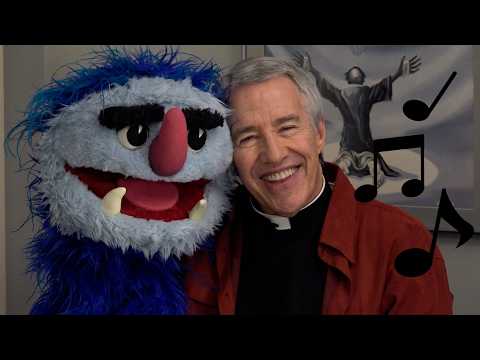
Q: How does Big Al describe our collective impact on the world?
A: Big Al teaches that what we say, do, and how we live functions as one piece of music where everyone plays an important part, meaning our individual contributions of kindness and love combine into a unified whole that God transforms into something beautiful for the world.
Individual Responsibility in Collective Beauty
Q: What is each person’s role in creating beauty for the world?
A: Each person’s contribution matters when we do our part the best we can through kind and loving actions and words, which God takes and creates something beautiful from our collective efforts.







QUESTIONS
Jesus’ Dual Nature and Heavenly Position
Q: How does the Ascension prove Jesus’ complete nature?
A: Jesus’ body and soul ascending to heaven and being seated at the right hand of God the Father solidifies he is fully God and fully man, countering heresies throughout history that attempted to separate his humanity and divinity.
The Holy Spirit’s Mission on Earth
Q: What replaced Jesus’ physical presence after the Ascension?
A: Jesus promised the Holy Spirit before ascending, which came on Pentecost to empower disciples to become witnesses of Christ throughout the world, ensuring believers are not alone.
The Second Coming and Bodily Resurrection
Q: What will happen when Jesus returns as the angels prophesied?
A: Angels told disciples Jesus will return in the same way he ascended, and at the Second Coming believers will experience resurrection of the body—both bodies and souls will be raised and taken to heaven, not just souls after death.

Sunday Mass Activities
Daily Gospel Reflections
Catholic Momcast



Pentecost Sunday (A)

The Meaning of Pentecost
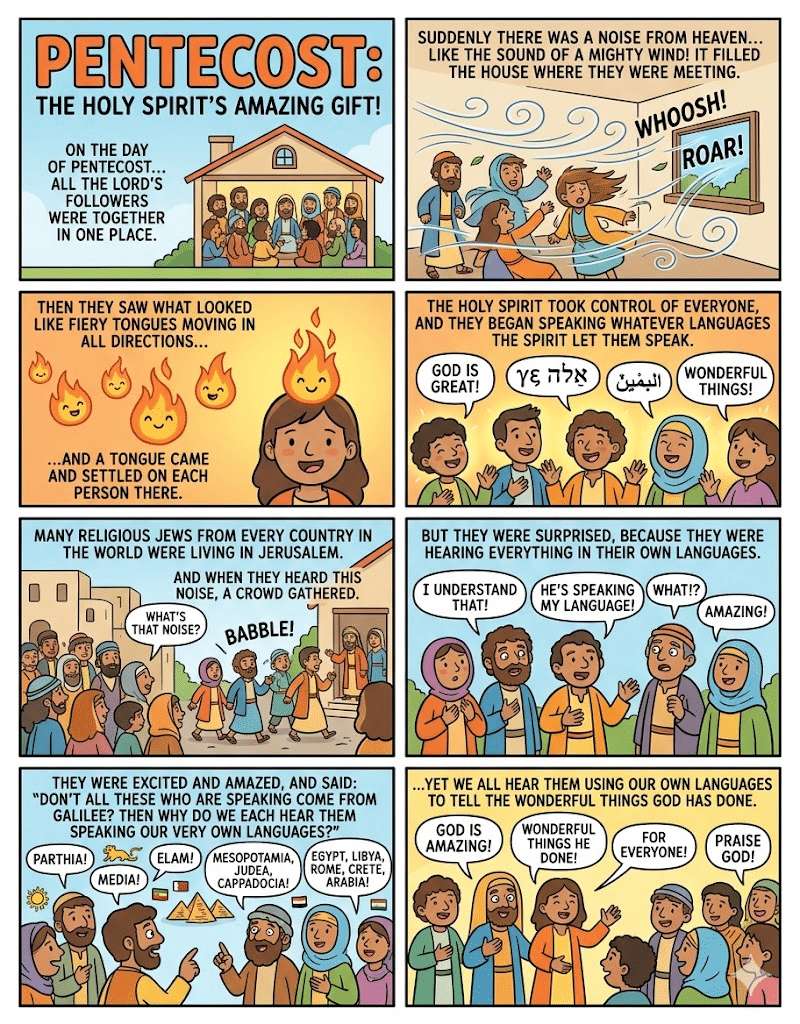
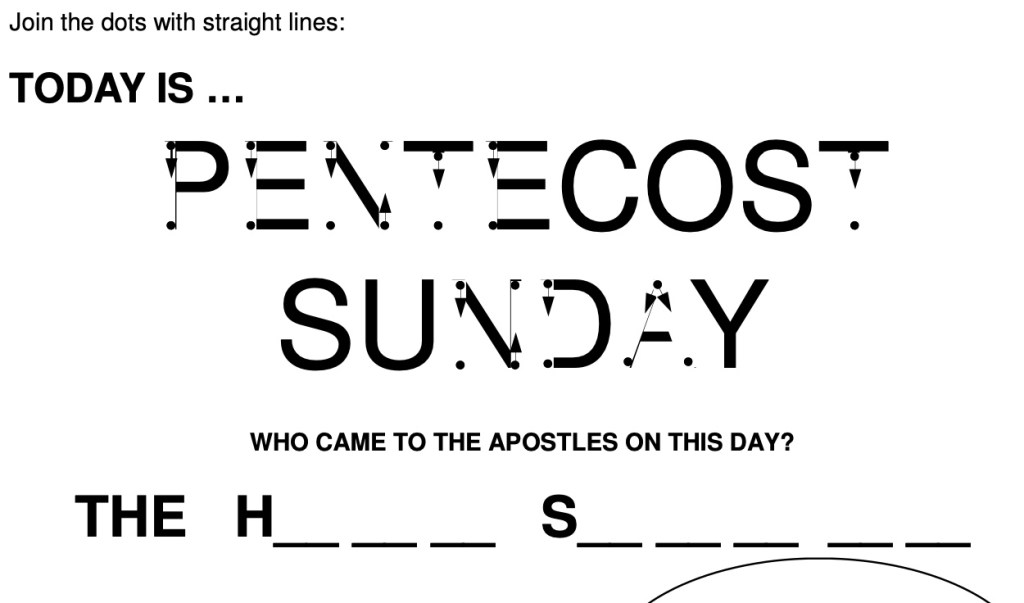
In Christianity, Pentecost is the celebration of the Holy Spirit descending on the Apostles fifty days after the Resurrection of Jesus Christ.
The apostles were gathered together to celebrate an originally Jewish feast of Pentecost (Acts 2). Pentecost means fiftieth, as in the fiftieth day. Pentecost was the fiftieth day after Passover. It occurred during the Jewish Festival of Weeks, which was seven weeks after Passover.
7 weeks x 7 days = 49 days
The 50th day marked the celebration of Pentecost.
Here is what happened to the Apostles on Pentecost according to Acts 2:
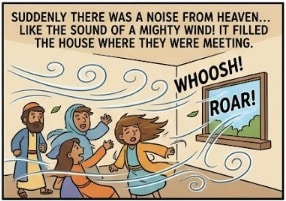
“When the day of Pentecost had come, they were all together in one place. And suddenly from heaven there came a sound like the rush of a violent wind, and it filled the entire house where they were sitting. Divided tongues, as of fire, appeared among them, and a tongue rested on each of them. All of them were filled with the Holy Spirit and began to speak in other languages, as the Spirit gave them ability.” (Acts 2:1-4)

Our Sunday Visitor

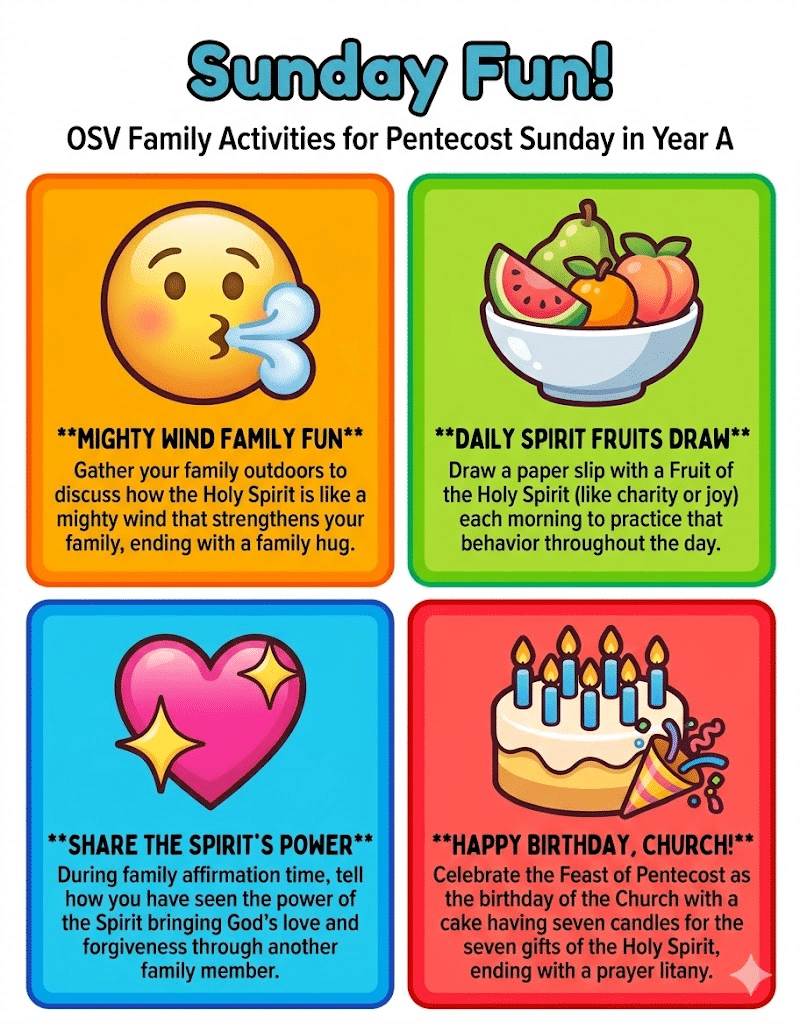
THE WORD THIS WEEK infographics are created using using GOOGLE’S AI Gemini 3 Pro. You are free to use the above infographic in any non profit ministry. Please give credit to TheWordThisWeek.NET and Our Sunday Visitor.
QUESTIONS
Faith and Hope in Christ’s Absence
Q: How does Jesus’ ascension enable faith when he’s physically absent? A: The ascension demonstrates that believers can maintain faith in Jesus even without seeing him physically, while simultaneously providing hope for the future through the promise of his return one day.
Salvation and Victory Over Death
Q: What does the ascension reveal about salvation and death? A: Jesus’ ascension serves as a reminder that believers can be saved and forgiven through his death and resurrection, proving he has conquered death and establishing that death is not the end but rather a gateway to eternal life in heaven, a real place where believers will live with God.
The Holy Spirit’s Role and Power
Q: What empowerment did Jesus provide after his ascension? A: The ascension shows that the Holy Spirit is with believers to guide and comfort them, providing the power to carry on Jesus’ mission and enabling disciples to do his work even in his physical absence.
Discipleship and Mission
Q: What responsibilities do believers have following Jesus’ ascension? A: Believers are called to be disciples, share his good news, teach others about Jesus, and continue sharing his love with others while patiently awaiting his return.
Worship and Community Life
Q: How should believers live together after the ascension? A: The ascension calls believers to worship God, pray, and be in fellowship and community with other believers, building community while living as ambassadors for heaven on earth.
Pentecost Sunday (A)

Pentecost
In this video, children will hear how the Holy Spirit was given at Pentecost, and will be encouraged to continue the work of spreading the love and good news of Jesus to everyone. This Bible Object Lesson will teach kids about the Day of Pentecost and how the Holy Spirit filled the early church with power. It’s based on Acts 2:1-12 where the disciples experience the miracle of Pentecost. Download the teachers notes, watch our Children’s Message example, and gather your supplies. Then you’re ready to share this message in your church next Sunday!


QUESTIONS
Learning from the Best
- What is a very helpful way to go about learning something new?
- If you wanted to learn to play the piano, what are some of the things you would do while spending time with your teacher?
- Who would be the best person to find if you wanted to learn how to build beautiful objects with wood?
- If you were interested in sea life, where might you go with a marine biologist to learn how to identify sea creatures?
Becoming an Apprentice
- When you study and spend time with someone who is helping you learn a new skill, what are two names you might be called?
Following Jesus
- What did Jesus tell the men who were his followers to go and do?
- What is the work that Jesus wants his followers to carry on?
- Does Jesus invite us to be his disciples today?
- As disciples of Jesus, what are the two main things we are learning how to do with God’s love?

It’s All About Air
“They were all filled with the Holy Spirit…” (2:4).
What’s something you do all day, every day, no matter where you are, no matter if you are asleep or awake? Yes, you breathe! It is something that your body does automatically and is so natural that you don’t even think about it.
You breathe air in through your nose and the air goes down a tube (the trachea) in your throat which branches into two tubes (the bronchi) which takes the air into your lungs. (Show picture.) Your lungs are two marvelous organs in your chest, located behind your ribs, that process oxygen and send it to the rest of your body. If you put your hand on your chest you will feel your lungs working – getting larger and smaller as you breathe in and out.
When you were born the first thing you did was breathe. You began your new life by breathing in air…
SOURCE: Sermon Writer – © 1997 – 2026 Richard Niell
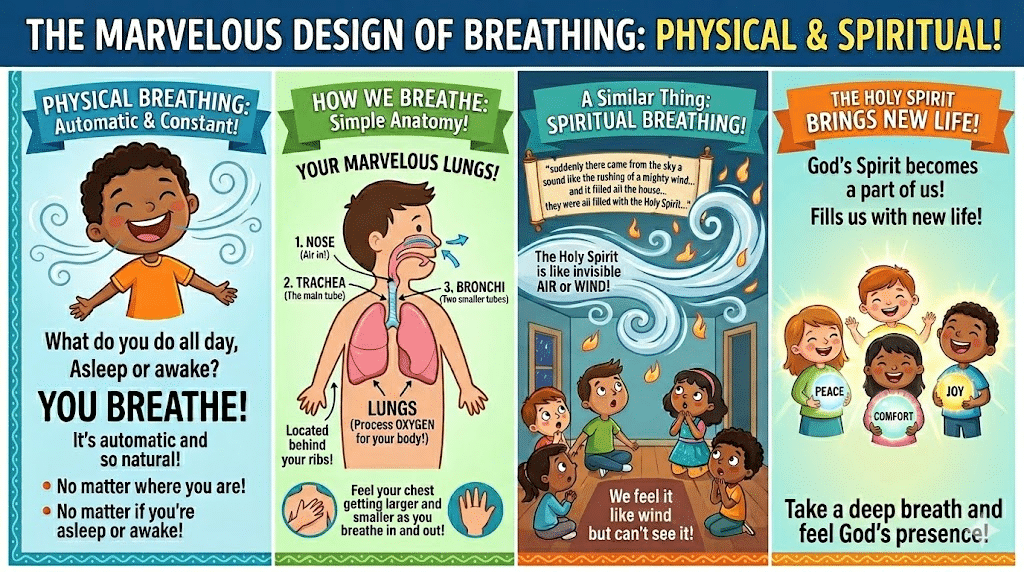
Infographic and image at top added by TWTW; not part of original source material
QUESTIONS
Sharing the Good Things in Life
- Have you ever read a really amazing book? Who was the first person you wanted to tell about it?
- When you discover something beautiful, like a colorful, sweet-smelling flower, why do you think it feels so good to show it to someone else?
- Imagine you just won an incredible prize in a contest. How excited would you be, and who would you run to tell the good news?
Jesus Gives a Special Mission
- Right before Jesus returned to heaven, what special instruction did he give to his disciples?
- Jesus knew his friends might feel lonely or scared, so what wonderful promise did he make to them?
Being a Disciple Today
- Why were Jesus’s original disciples so excited to tell everyone about Him? What kinds of things had they seen Him do?
- The story says that we are also disciples today. What is the “good news” about Jesus’s love that we can share with our family and friends?
Great Things
Jesus asks his disciples to teach others about God
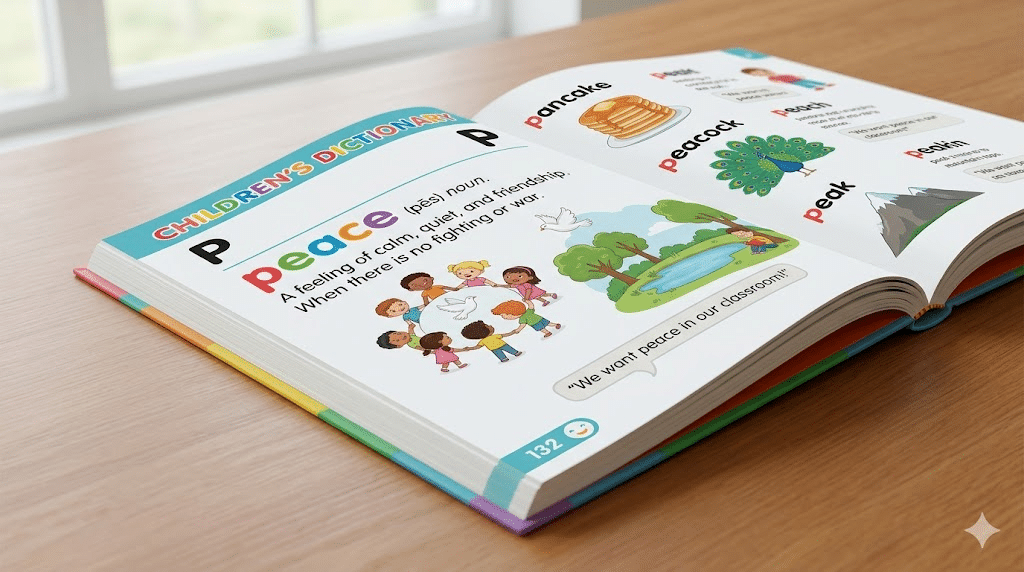
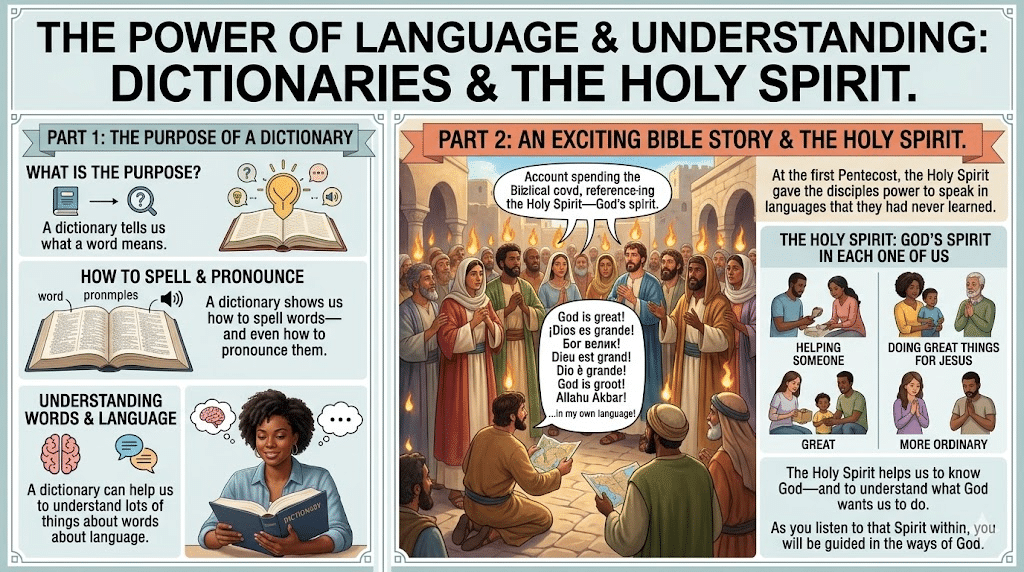
What is the purpose of a dictionary? A dictionary tells us what a word means. A dictionary shows us how to spell words–– and even how to pronounce them. A dictionary can help us to understand lots of things about words about language.
There is an exciting story in the Bible about language–– and about how God helps us to understand things.
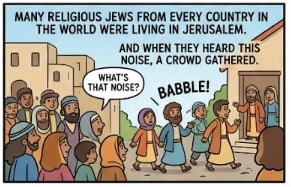
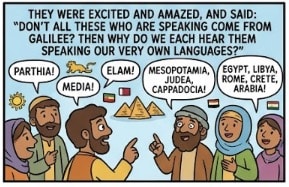
Many people from different parts of the world had come together in Jerusalem. They spoke many different languages. But the Holy Spirit––God’s spirit––made it possible for Jesus’ disciples to speak to each person in that person’s own language. That was a real miracle.
SOURCE: Sermon Writer – © 1997 – 2026 Richard Niell
Infographic and image at top added by TWTW; not part of original source material

Pentecost Sunday (A)


THE WORD THIS WEEK infographics are created using using GOOGLE’S AI Gemini 3 Pro Nano Banana and images from Unsplash. You are free to use the above infographic in any non-profit ministry. Please give credit to TheWordThisWeek.net and the Word-Sunday.
Entrance Song
Understanding the Holy Spirit’s Nature
Q: What three symbolic forms does the Holy Spirit take?
A: The Holy Spirit moves freely like the wind, burns passionately like fire, and appears pure and kind like a dove, filling minds and hearts with God’s presence.
The Promise and Purpose
Q: What triggers God to send the Holy Spirit according to the song?
A: When Jesus is lifted and glorified, God sends the Holy Spirit to live in our hearts and guide us every day, fulfilling Jesus’s ancient promise.
The Heart’s Longing
Q: How does the song describe our need for the Holy Spirit?
A: The repeated refrain emphasizes that like the desert longs for water, our hearts long for the Holy Spirit to come, stay, and fill us up.
Pentecost Sunday (A)

ST. JOSEPH’S CORNER (3:11)
Response & Acclaim

Response & Acclaim
MATURING MINDS (3:50)
Communion
The Pentecost Event
Q: What three supernatural phenomena occurred when the Holy Spirit descended at Pentecost?
A: The Holy Spirit manifested through violent wind, divided tongues of fire resting on each disciple, and the ability to speak in languages they had not studied, as recorded in Acts 2:1-4.
Q: Why were devout Jews from every nation bewildered by the disciples’ speech?
A: Jews from every nation under heaven living in Jerusalem were bewildered because they heard Galileans speaking in their own native languages, proclaiming God’s deeds of power (Acts 2:5-12).
Prophetic Fulfillment
Q: Which Old Testament prophecy did Peter claim was fulfilled at Pentecost?
A: Peter identified the event as fulfillment of prophet Joel’s prophecy that God would pour out His Spirit on all people, enabling sons, daughters, young men, and old men to prophesy, see visions, and dream dreams in the last days (Acts 2:16-18).
Q: What cosmic signs did Peter warn would precede the Lord’s great day?
A: Before the Lord’s great and glorious day, signs would include the sun turning to darkness and the moon to blood, with everyone who calls on the Lord’s name being saved (Acts 2:19-21).
Theological Significance
Q: What do the wind, fire, and multilingual speech symbolize about the Holy Spirit’s work?
A: The violent wind, fire, and multilingual speech symbolized the Holy Spirit’s power, purity, and global mission, marking the birth of the Church and fulfillment of Jesus’ promise to empower His followers.
Q: What core message did Peter’s Spirit-empowered sermon proclaim?
A: Peter’s Pentecost sermon boldly proclaimed Jesus’ death, resurrection, and exaltation as Lord and Messiah, calling for repentance and baptism for forgiveness of sins (Acts 2:22-38).
Pentecost Sunday (A)

CROSSROADS KIDS’ CLUB (1:56)

KIDS FOR JESUS (1:30)

JAMES HEIN (2:51)

STEVE THOMASON (2:56)