Fr. Tony’s Homily, Homily Starters
Fr. Tony’s Homily, Homily Starters
May 24, 2026

⬅️  ➡️
➡️
Pentecost Sunday (A)


Pentecost Sunday (A)
A Shower of Rose Petals
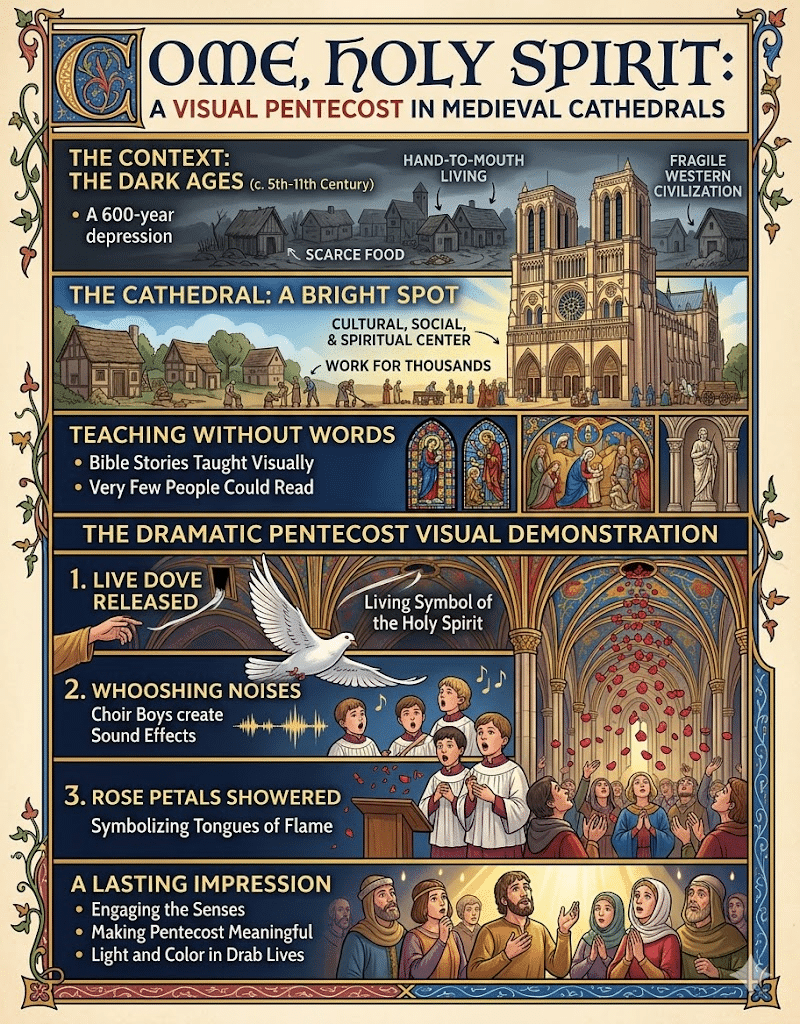
There was, in Europe, a period of human history called the Dark Ages. It started in about the fifth century and continued for the next 600 years. You might say it was a 600-year depression – food was scarce, people lived hand-to-mouth – and Western civilisation barely hung by a thread. The one bright spot was the local Cathedral. Building Cathedrals, even in small towns, gave work to thousands of people. These buildings became the cultural, social, and spiritual centres of life. Murals, stained glass windows, sculptures, and pageantry helped teach the great stories of the Bible at a time when very few people could read. With this in mind, some of the cathedral builders chose to impress on the people the meaning of Pentecost. In the great domed, richly painted ceilings were a number of small carefully disguised doors. During Mass on Pentecost when the whole town was gathered in the cathedral, some unlucky parishioners were drafted to climb up on to the roof. At the appropriate moment during the liturgy, they would release a live dove through the one of the small doors. This dove would swoop over the congregation as a living symbol of the presence of the Holy Spirit. At the same time the choir boys would make whooshing noise, the doors in the ceiling would be opened again and this time rose petals would be showered on the congregation, symbolizing tongues of flame falling on the worshippers below.
You can imagine the impact that this had on those medieval Christians whose lives were drab and hard. They might not have been able to read about Pentecost from the Bible but nevertheless this visual demonstration must have left a lasting impression. (Rev. Gerhard)

Pentecost Sunday (A)
What a Journey
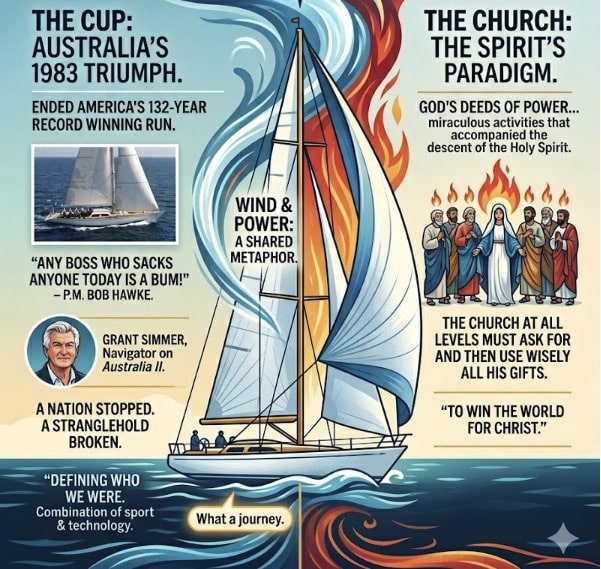
Rev. Alan Walker of Australia often tells about the race of the sailing yachts in which Australia finally defeated the USA for the prized America’s Cup. For 132 years, the cup was kept and defended by the United States. Again, and again there were challenges for the cup, but each time it was retained by the USA. Finally, in 1983 Australia mounted a serious challenge. The event took place as scheduled, and after six races, the two yachts were deadlocked at three wins each. Now the whole world seemed to take notice. Australia was alive with anticipation. The sporting world was focused on the race. The day came for the final race. After more than 100 years, the United States was in danger of losing its very precious cup. Thousands of people came to watch the race. Television cameras were ready to beam the race by satellite around the world. The crews were ready. The boats were polished. The yachts pulled into place at the starting line. All was ready but the wind was light and the start difficult. Throughout the race the skills of the skippers were tested; a small error at the next-to-last leg allowed Australia to make use of a breeze and windshifts to overtake America; the final leg was a “duel of tacking” using wind skillfully, and the race was won by Australia with a margin of 41 seconds.
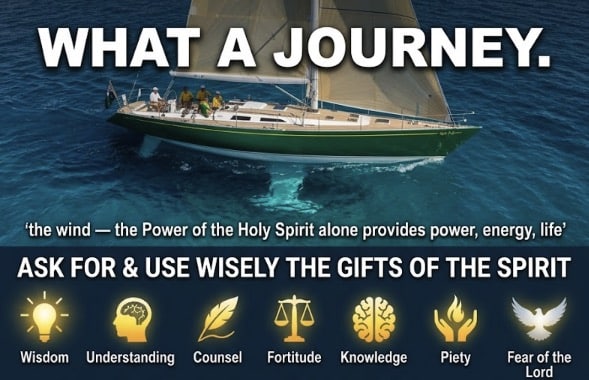
In the life of the Church, the wind – the Power of the Holy Spirit alone provides power, energy life, but the Church at all levels must ask for and then use wisely all these gifts of the Spirit if it is to win the world for Christ.
RELATED VIDEO: President Reagan’s Remarks to the America’s Cup Race Participants (1983)

Pentecost Sunday (A)
The Cost of Staying Still
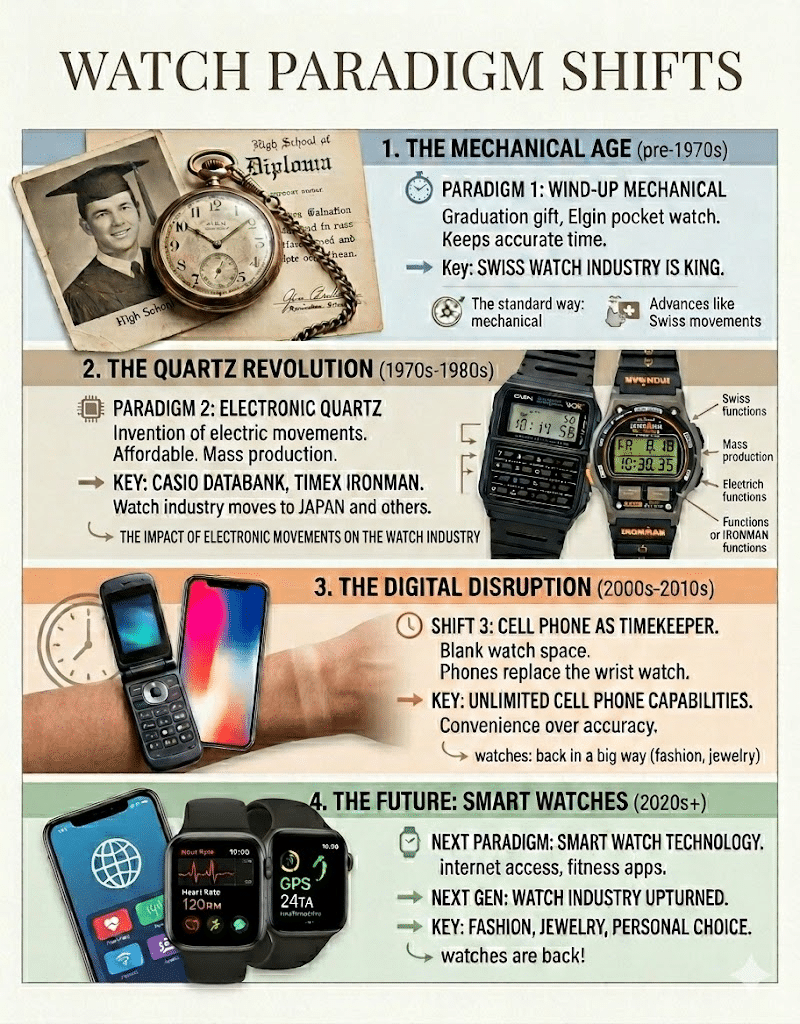
If in 1968 someone had asked which country would dominate watchmaking in the 1990s, most people would have said Switzerland. This is because Switzerland had dominated the world of watchmaking for the preceding sixty years. They had led the search for new ways to manufacture better and more durable watch parts and developed the best waterproofing techniques. In fact, in 1968 the Swiss made 65% of all watches sold in the world and laid claim to 90% of the profits.
However, by 1980, Swiss watchmakers had been laid off by the thousands, and the Swiss controlled a paltry 10% of the market. Why? The Swiss had ignored an important new development: the Quartz Movement. Ironically, it was a Swiss researcher who invented it, but the innovation was rejected because the resulting watch had no mainspring or knob. That was too much of a paradigm shift for them to embrace. It was too new and too strange.
Today’s text from Acts tells of a powerful paradigm shift in the People of God demanded by “God’s deeds of power.” These were the miraculous activities that accompanied the descent of the Holy Spirit on the apostles and Mary, the Mother of God and of the Church.
Just as the Swiss watchmakers clung to their springs and the retailers clung to their storefronts, many in the early Church struggled to embrace a God who was doing something entirely new. The Holy Spirit was not just an “update” to the old law; it was a total movement into a new way of being—one that required leaving behind the “knobs and mainsprings” of the past to embrace the life-giving wind of a new era.
But I tell you, in my life and yours, there is an even greater commission. It is found here in Mt 28:18-20 where Jesus Christ turns to his disciples and says, “Go, therefore, and make disciples of all nations, baptizing them in the name of the Father, and of the Son, and of the Holy Spirit, teaching them to observe all that I have commanded you.”
Pentecost Sunday (A)

Pentecost Sunday (A)