Homilies
Homilies
May 17, 2026
⭐⭐⭐ Why Are You Looking Up at the Sky?


The Ascension
The Ascension of the Lord (A)


SDS


CMF






PAPAL HOMILIES



RECOMMENDED
The Augustinian Province of St. Thomas of Villanova maintains a dedicated “Homilies” page with reflections grounded in the Confessions and the Rule of St. Augustine.
✍️ Augustinian Province – Weekly Homilies
📺 Fr. Paul Galetto
📺 Fr. Tom McCarthy
✍️ Fr. Kieran J. O’Mahony
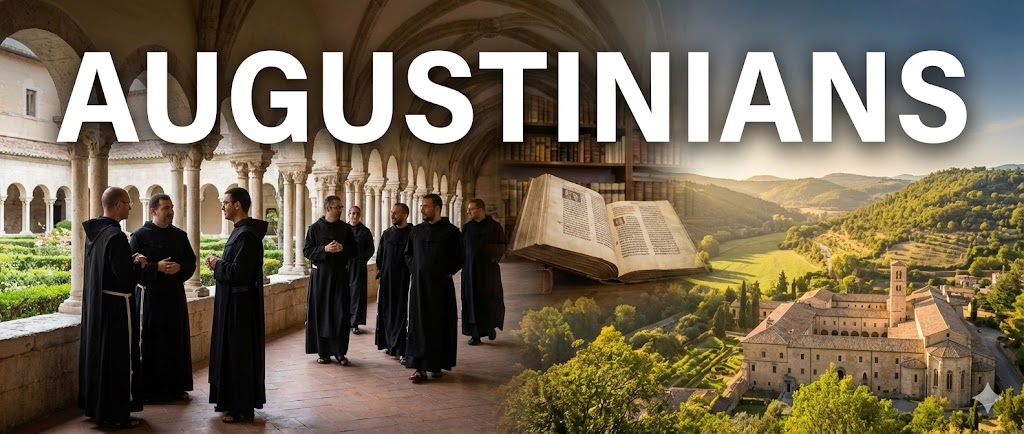
Core Charism: Interiority (searching for God within), community life (“one mind and one heart on the way to God”), and the restless heart that finds repose only in God.
The Ascension of the Lord (A)
Primary Text: Ephesians 1:17-23 (Enlightening the Eyes of the Heart)
Key Phrase: “Our Hearts are Restless.”
This Sunday’s Hook: Our hearts are restless because our true home is where Christ has gone. The Ascension is the roadmap for the restless heart.
The Approach with Application: Interiority and Desire. Augustine’s “Enlightened eyes of the heart” is the focal point. Application: Refocusing our desires away from temporal “shadows” and toward the eternal reality of the Kingdom.
Draft Opening: “Saint Augustine famously wrote that our hearts find no rest until they rest in God. Today, Christ goes to that place of rest, but He doesn’t go alone. He pulls our desires upward. The Ascension is the feast of ‘Holy Longing’—reminding us that while we live in the city of man, our citizenship is in the City of God.”
RECOMMENDED
Many Benedictine Abbeys publish the Abbot’s homilies online. Quarr Abbey and Saint Meinrad Archabbey are excellent sources for traditional Benedictine “Lectio” style preaching.
✍️ Saint Meinrad Archabbey Reflections
✍️ Monastery of Christ in the Desert
✍️ Mepkin Abbey

Core Charism: Ora et Labora (Prayer and Work), Stability, Hospitality, Lectio Divina, Listening with the “ear of the heart.”
The Ascension of the Lord (A)
Primary Text: Acts 1:1-11 (The Promise of the Father)
Key Phrase: “The School of the Lord’s Service.”
This Sunday’s Hook: Jesus tells the Apostles to wait. In a world of instant results, the Ascension is a lesson in the Benedictine vow of Stability.
The Approach with Application: Liturgical and Communal. The focus is on the “Forty Days” and the communal waiting in the Upper Room. Application: Finding peace in the rhythm of prayer (Ora et Labora) even when God feels absent.
Draft Opening: “The Rule of Saint Benedict begins with a single word: ‘Listen.’ As the Apostles stood on the Mount of Olives, they had to learn a new way of listening. The Ascension marks the transition from seeing with the eyes to hearing with the heart. We learn today that staying put—staying faithful to our community—is how we prepare for the Spirit.”
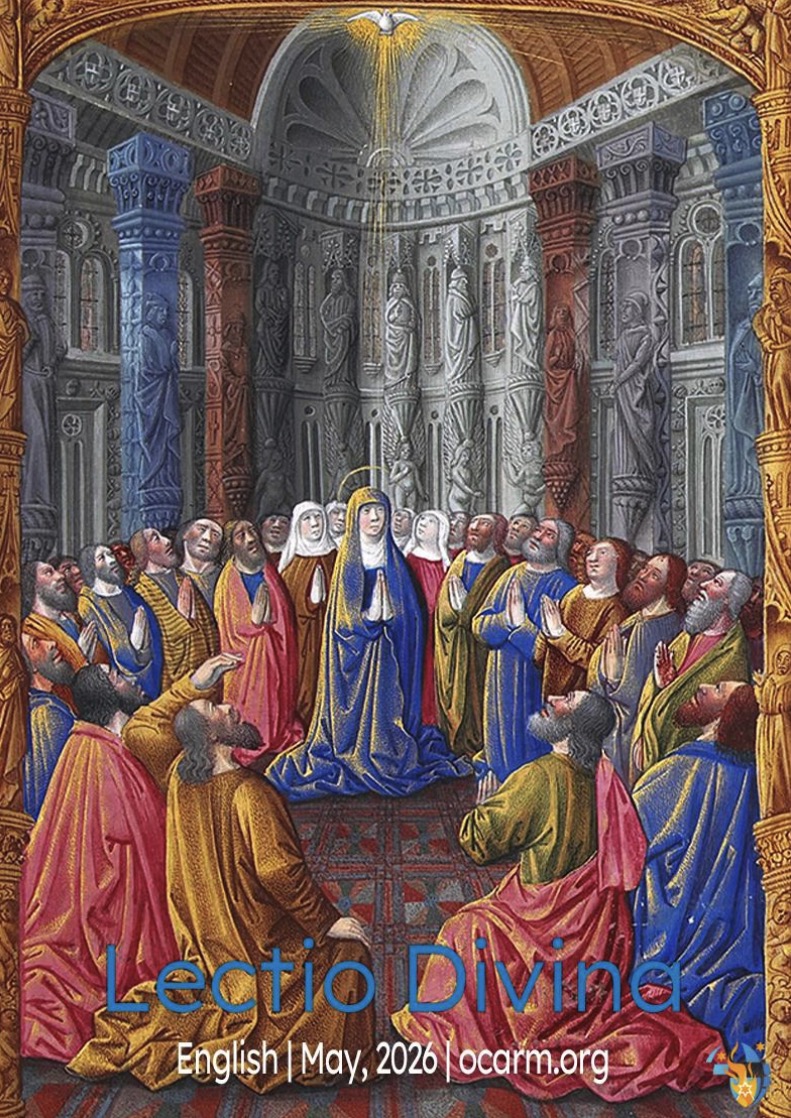
LECTIO DIVINA
MAY 2026 (PDF)
RECOMMENDED
The Carmelites offer a unique “Lectio Divina” style reflection for each Sunday through their international headquarters.
✍️ OCarm.org – Lectio Divina for Sundays
📺 Fr. Greg
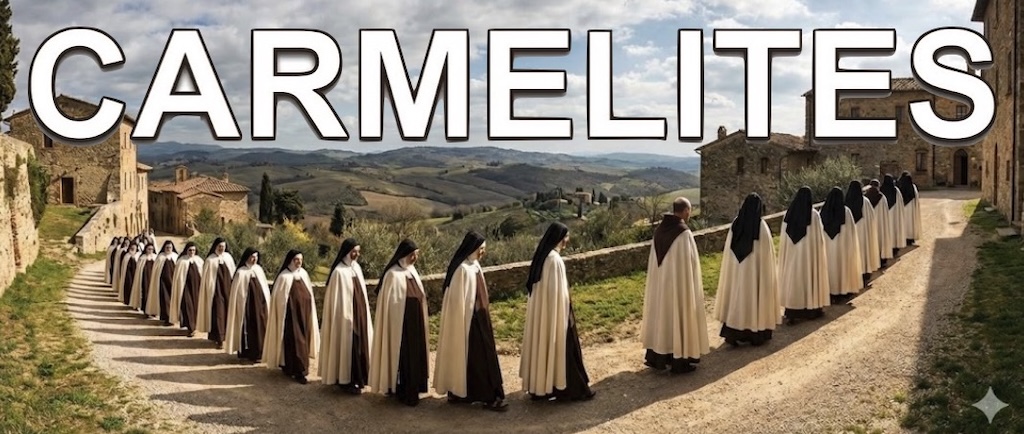
Core Charism: Contemplation, The Desert, Prayer as Friendship, The Dark Night, Elijah, St. Teresa of Avila.
The Ascension of the Lord (A)
Primary Text: Ephesians 1:17-23 (The Riches of His Glory)
Key Phrase: “The Ascent of the Mount.”
This Sunday’s Hook: To ascend with Christ, we must first descend into the silence of our own souls.
The Approach with Application: Mystical and Contemplative. Using the imagery of John of the Cross or Teresa of Avila. The Ascension is the “Dark Night” where the physical presence of Jesus is removed so that a deeper, mystical union can begin. Application: The importance of silent prayer and “nothingness” (nada).
Draft Opening: “In the silence of Mount Carmel, we learn that God is often most present when He is most hidden. The cloud that took Jesus from the Apostles’ sight is the same ‘cloud of unknowing’ we enter in prayer. Today is not about a distance in miles, but a deepening of the interior life. We lose the ‘Jesus of history’ to find the ‘Christ of glory’ dwelling within us.”
RECOMMENDED
The Dominicans have one of the most robust preaching websites called “Torch.” It features a new homily every week from a different friar.
✍️ English Dominican Friars – Torch
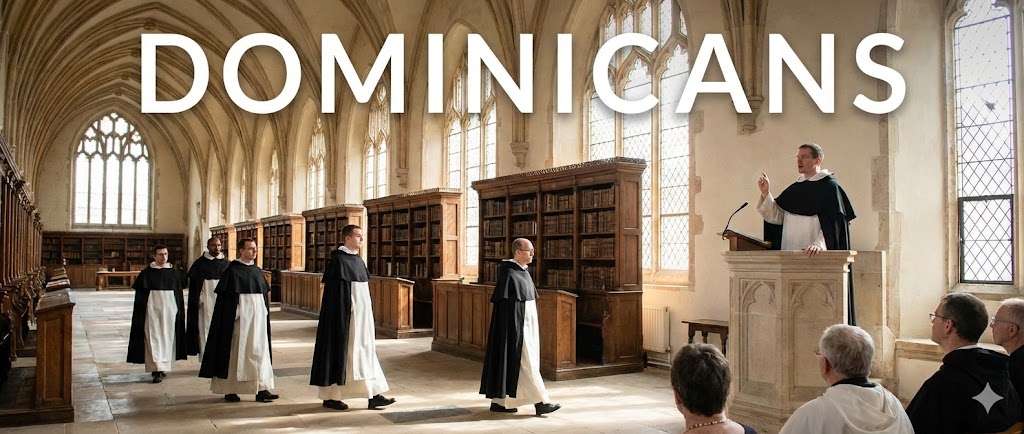
Core Charism: Veritas (Truth), Preaching, Study, Combatting Error with Clarity, Contemplation passed on to others.
The Ascension of the Lord (A)
Primary Text: Ephesians 1:17-23 (The Spirit of Wisdom)
Key Phrase: Veritas and the Headship of Christ.
This Sunday’s Hook: Christ is the Head, and we are the Body. If the Head has ascended to the Truth, where does that leave the rest of the members?
The Approach with Application: Theological Precision. Dominicans lean into the “Wisdom and Revelation” mentioned in Ephesians. The application is intellectual and evangelical: study as a form of prayer, and preaching the Truth of Christ’s cosmic authority.
Draft Opening: “Saint Dominic understood that you cannot love what you do not know. Saint Paul prays today for a ‘Spirit of wisdom and revelation.’ The Ascension is not a magic trick; it is the ultimate theological claim that Christ is the ‘fullness of him who fills all in all.’ Today, we ask for the grace to see the world through the lens of that Truth.”
RECOMMENDED
St. Anthony Messenger and the various provinces often provide “Franciscan Spirit” reflections that focus on the Gospel of the day.
✍️ Franciscan Media – Sunday Homily Helps
📺 Fr. Paul Galetto
📺 Fr. Tom McCarthy
✍️ Fr. Kieran J. O’Mahony

Core Charism: Poverty, Minority (being “lesser”), Fraternity, and finding God in the grit of humanity and creation.
The Ascension of the Lord (A)
Primary Text: Matthew 28:16-20 (The Commission to the World)
Key Phrase: “God in the Dirt and the Distance.”
This Sunday’s Hook: We often look at the sky to find God, but the Ascension tells us that Christ left the clouds so He could be found in the leper, the brother, and the earth.
The Approach with Application: Franciscans focus on the Incarnational footprint. The Ascension isn’t an exit; it’s a deployment. The application focuses on “Sister Mother Earth” and the marginalized, emphasizing that we are now the physical hands of Christ.
Draft Opening: “Saint Francis didn’t just want to study the Gospel; he wanted to walk it. When Jesus says, ‘Go and make disciples of all nations,’ He isn’t giving a lecture; He’s giving us a pair of sandals. Today, we don’t look up to find a lost Lord; we look out at our broken world to find a Lord who is waiting for us to show up.”


Core Charism: Ad Maiorem Dei Gloriam (For the Greater Glory of God), Discernment of Spirits, Finding God in All Things, Imaginative Contemplation.
The Ascension of the Lord (A)
Primary Text: Acts 1:1-11 (The Spirit and the “Why”)
Key Phrase: “Contemplatives in Action.”
This Sunday’s Hook: The angels ask, ‘Why are you standing there looking at the sky?’ That is the ultimate Ignatian question: What are you doing with what you’ve seen?
The Approach with Application: Focusing on Finding God in All Things. The homily would use the Ignatian Examen style—discerning where the Holy Spirit is moving in the “Theophilus” (God-lover) of today. Application: Discerning one’s mission in the workplace or home.
Draft Opening: “In the Spiritual Exercises, Saint Ignatius invites us to use our imagination to place ourselves in the scene. Imagine the dust on your feet and the confusion in your heart as Jesus vanishes. But notice the shift: the focus moves from the ‘What’ of the miracle to the ‘How’ of the mission. We are called to move from gazing to go-getting.”
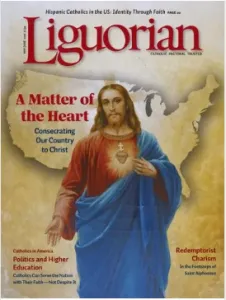
May/June 2026
RECOMMENDED
The Redemptorists of the Baltimore and Denver Provinces often provide weekly reflections, particularly through their “Missionaries of Hope” video series or Lenten booklets.
✍️ The Redemptorists (Baltimore Province) News & Reflections

Core Charism: Preaching “Plentiful Redemption” (Copiosa Redemptio), especially to the abandoned and sinners; Moral Theology (St. Alphonsus Liguori).
The Ascension of the Lord (A)
Primary Text: Matthew 28:16-20 (I am with you always)
Key Phrase: “Copiosa Apud Eum Redemptio” (Plentiful Redemption).
This Sunday’s Hook: Even as He leaves, He says, ‘I am with you.’ The Ascension is the guarantee that no one is ever beyond the reach of His mercy.
The Approach with Application: Pastoral and Moral. Following Alphonsus Liguori, the focus is on the “ordinary person.” Application: Comfort for the grieving or those who feel abandoned, emphasizing that Christ ascended to “open the door” for us.
Draft Opening: “Have you ever felt like God was a million miles away? The Ascension can feel like a goodbye, but for a Redemptorist, it’s the ultimate ‘I’ll be right here.’ Jesus ascends to the right hand of the Father not to escape us, but to advocate for us. He takes our humanity—our scars, our worries, our failures—right into the heart of the Trinity.”
Bishop Robert Barron

The Ascension of the Lord (A)
What Is the Spirit Calling You to Do?

Friends, today is the great Solemnity of the Ascension of the Lord, which is situated between Easter and Pentecost. The Ascension is when Jesus definitively moves into the higher dimension of heaven. And while we no longer have experiences like the disciples had of the risen Lord, we experience him through his Holy Spirit, who equips us to continue Christ’s work in the world.
Fr. Michael Chua
2026 | 2023 | 2020 | 2017 | 2014 | 2011
The Ascension of the Lord (A)
Authority – Mission – Presence

Father Michael Chua’s homily focuses on the conclusion of St. Matthew’s Gospel, emphasizing the “Great Commission” through three pillars: authority, mission, and presence. The preacher explains that Christ’s absolute authority, proven by the Resurrection, transcends all human sovereignty, requiring believers to prioritize divine law over conflicting civil mandates. This authority grounds the mission to evangelize, baptize, and catechize—a task fueled not by coercion, but by joyful, attractive witness. Finally, the Ascension is presented not as a departure, but as a transition to Christ’s enduring sacramental presence, empowering the Church through the Holy Spirit to fulfill her global mandate.

HOMILY HELPER
Suggestions for writing your own homily using insights and themes from Fr. Michael Chua’s homily.
Dominican Blackfriars
2026 | 2023 | 2020 | 2017 | 2014 | 2011
The Ascension of the Lord (A)
A Mystery of Hope
This homily by Br. Thomas Mannion, O.P., explores the Ascension as the fulfillment of the Incarnation, demonstrating God’s desire to unite the physical order with divine glory. By taking a human body into heaven, Christ provides a tangible foundation for our hope in the future resurrection. The Ascension is not a departure but a transition to a new mode of presence through the Holy Spirit and the Church’s mission. By participating in Christ’s authority to baptize and teach, and by receiving Him in the Eucharist, the faithful remain united to the glorified Lord while laboring for His Kingdom on earth.

HOMILY HELPER
Suggestions for writing your own homily using insights and themes from the Dominican Blackfriar homily.
Fr. Austin Fleming
2026 | 2023 | 2020 | 2017 | 2014
The Ascension of the Lord (A)
He Ascended into Heaven…
Fr. Austin Fleming’s reflection centers on the Preface for the Ascension, using the “theology of the verbs” to interpret the feast’s significance. By analyzing Christ as the conqueror of sin and death who has “passed beyond our sight,” the text clarifies that the Ascension is an act of hope rather than abandonment. Christ’s movement to the Father’s right hand establishes a path for the Church: as the Head of the Body, His journey is the one we hope to follow. Ultimately, this liturgical prayer reveals that the Ascension renews the world, joining the song of the angels with the earthly mission.

HOMILY HELPER
Suggestions for writing your own homily using insights and themes from Fr. Austin Felming’s homily.
Monsignor Peter Hahn

The Ascension of the Lord (A)
Seventh Sunday of Easter (Year A)
Msgr. Peter Hahn expounds on the maxim Lex orandi, Lex credendi—the law of prayer is the law of belief—asserting that liturgical words are deep expressions of faith designed to guide the faithful. Drawing on a prayer from the Roman Missal, Monsignor identifies the congregation as a “pilgrim church” on a sacred journey. The readings illuminate three aspects of this pilgrimage: it must be undertaken together in prayer like the Apostles after the Ascension; it involves suffering and penance that, when united to Christ, becomes Eucharistic; and it has a definitive destination—the new and eternal Jerusalem—towards which the faithful travel following Christ’s own path to the Father.
HOMILY HELPER
Suggestions for writing your own homily using insights and themes from Msgr. Peter Hahn’s homily.
Fr. Charles E. Irvin
The Ascension of the Lord (A)
Seeing God in a New Way

Fr. Charles Irvin presents the Ascension as the inauguration of the Holy Spirit’s era, completing the divine cycle from the Nativity to the glorified return to the Father. He argues that Christ’s physical departure is a “new beginning,” allowing Him to dwell within the baptized through the Spirit and the Sacraments. Irvin candidly addresses modern anxieties—scandals, secularism, and institutional betrayals—reframing them through the lens of the Ascension. Ultimately, the feast empowers the faithful to act as conduits of redemption, revealing God’s kingdom by transforming chaos into order and absurdity into meaning.
HOMILY HELPER
Suggestions for writing your own homily using insights and themes from Fr. Charles E. Irvin’s homily.
Fr. Joe Jagodensky, SDS
The Ascension of the Lord (A)
Ascension: It’s the Feet

Fr. Joe Jagodensky offers a humorous and grounded reflection on the Ascension, focusing on the “ugliest” part of the human body: the feet. As the last part of Jesus visible to the “land-locked apostles,” the feet symbolize Christ’s entire earthly journey—His firm stance, His faltering-free steps, and His vulnerability on the cross. Jagodensky argues that the Ascension isn’t just about a heavenly departure, but a spiritual mandate to touch the vulnerable, “smelly,” and painful parts of ourselves and others. By “washing the feet” of the world, we continue Christ’s walk, one step at a time.

HOMILY HELPER
Suggestions for writing your own homily using insights and themes from Fr. Joe Jagodesky’s homily.
Fr. Langeh, CMF

The Ascension of the Lord (A)
Ascension: A Call to Action
Fr. Langeh presents the Ascension as a pivotal promise of hope and a decisive call to action. Rooted in the Apostles’ Creed, the feast assures believers that as members of the Body of Christ, they are destined to follow their “forerunner” into eternal glory. However, Langeh warns against the “idleness” of gazing upward, interpreting the angels’ question in Acts as a mandate for mission. He emphasizes that the Ascension transfers the work of Christ into our hands, requiring us to serve as active ambassadors of redemption in our homes and workplaces.
HOMILY HELPER
Deacon Peter McCulloch
The Ascension of the Lord (A)
Benefit of Doubt
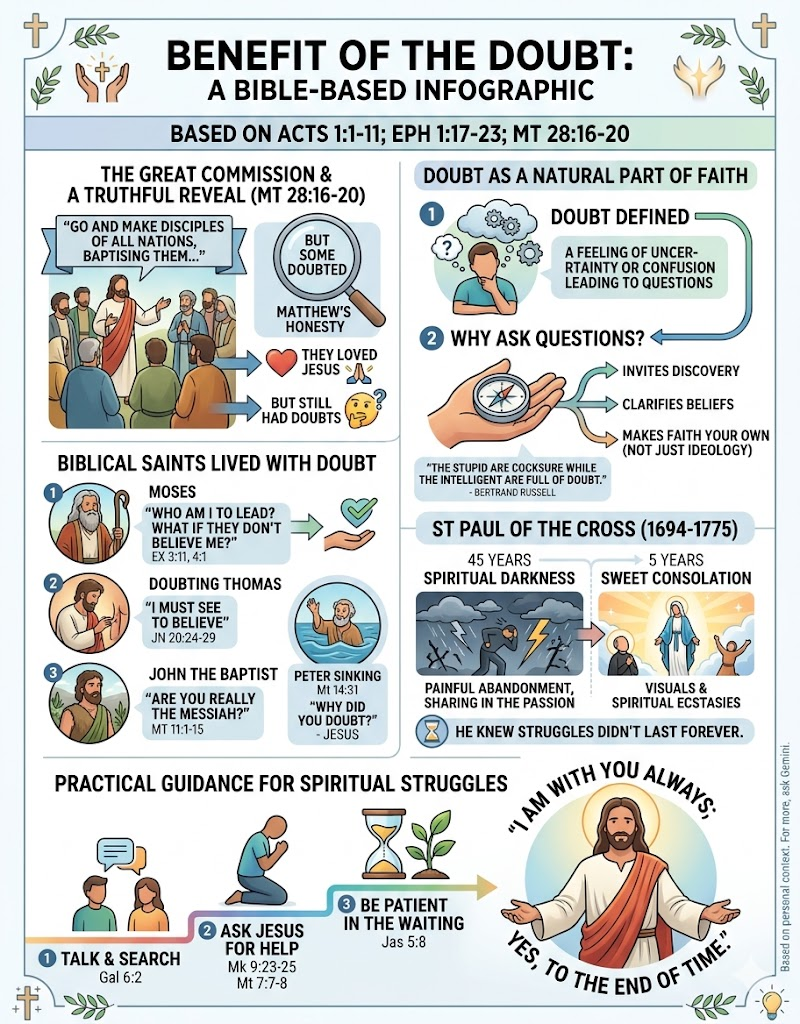
Deacon Peter’s homily, “Benefit of the Doubt,” explores the surprising detail in Matthew’s Gospel that even at the Ascension, “some doubted.” He argues that doubt is not the enemy of faith, but an essential component that keeps it honest, prevents it from becoming mere ideology, and invites deeper personal discovery. Citing figures from Moses to St. Paul of the Cross, the Deacon illustrates that spiritual darkness and uncertainty are natural. Ultimately, he encourages the faithful to bring their questions to God and others, trusting in Christ’s enduring promise to remain with us always.
HOMILY HELPER
Suggestions for writing your own homily using insights and themes from Fr. Pteer McCulloch’s homily.
Msgr. Charles Pope
The Ascension of the Lord (A)
Love Lifted Me
Msgr. Charles Pope’s reflection on the Ascension, “Love Lifted Me,” frames the feast as the glorious “Rescue” and “Rejoicing” of humanity. He uses a humorous “Elevator Metaphor” to explain our mystical union with Christ: when the Head (Jesus) reaches the top floor (Heaven), the rest of the Body (the Church) is guaranteed to follow, provided we remain attached. The Ascension is not a departure but a “New Presence” where Christ, through the Holy Spirit, becomes more intimate to us than we are to ourselves. By opening the “ancient doors” of Paradise, Christ empowers His followers to do “greater works” while awaiting the final restoration of all things.
HOMILY HELPER
Suggestions for writing your own homily using insights and themes from Msgr. Charles Pope’s homily.
Father Kevin Rettig

2026 HOMILIES | ARCHIVE: 2023 | 2020
The Ascension of the Lord (A)
Raise Your Eyes
Fr. Kevin Rettig uses the anecdote of the philosopher Thales—who fell into a well while stargazing—to illustrate the tension of the Christian life. He argues that human existence requires a balance between two essentials: keeping our feet firmly planted on the earth while directing our gaze toward heaven. Rettig warns against both the “earthbound” soul who never looks up and the “unbalanced” soul who ignores the needs of this world. Ultimately, the Ascension teaches us that while our true home lies above, our current mission is to “bring heaven down to earth” by serving others.
HOMILY HELPER
Suggestions for writing your own homily using insights and themes from Fr. Kevin Rettig’s homily.
Fr. George Smiga
The Ascension of the Lord (A)
Why Are You Looking
Up at the Sky?

Fr. George Smiga focuses on the emotional transition of the Ascension, moving from the grief of loss to the anticipation of new blessings. He interprets the disciples’ intent gaze at the sky as a universal human reaction to change: fixating on what is gone. Smiga argues that the angels’ message is a promise that when one good thing is taken away, another will be given. By letting go of the “way things used to be,” believers open their eyes to the new possibilities, relationships, and paths to joy that God is currently bestowing “here below.”

HOMILY HELPER
Suggestions for writing your own homily using insights and themes from Fr. George Smiga’s homily.
Additional Homilies
The Ascension of the Lord (A)