Commentary Intro to Mass Readings Sunday Readings
CommentaryIntro to Mass Readings Sunday Readings
May 17, 2026
⭐⭐⭐ Hearers of the Word—PDF | VIDEO

⬅️  ➡️
➡️

PDF AIDS
Scripture Study for Catholics *





The Ascension of the Lord
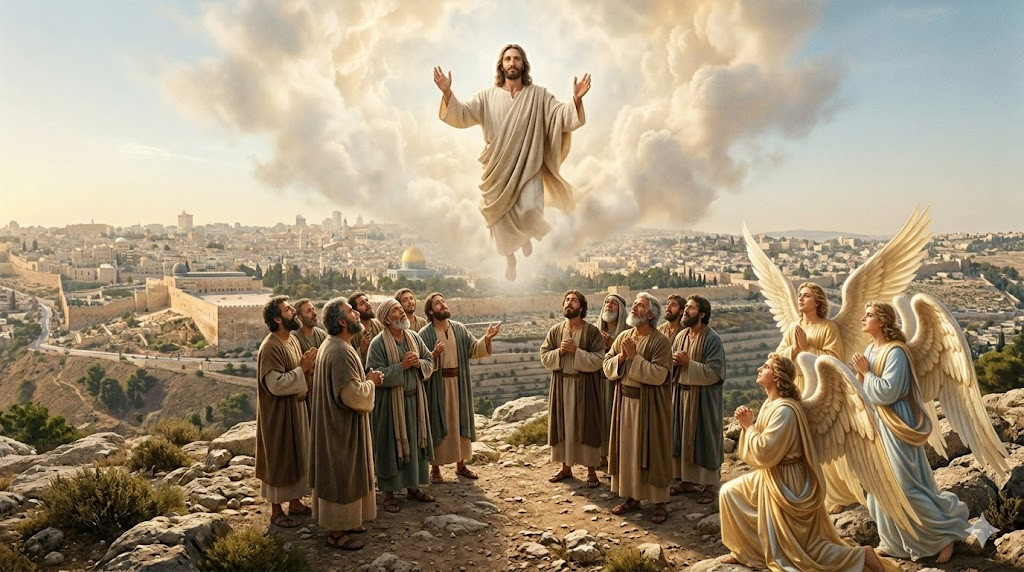
Acts 1:1-11
Fr. Tim Peters, S.T.D explores the scriptural context and theological significance of the first reading according to the following thematic outline.

INSIGHTS FOR HOMILY
PREPARATION
Acts 1:1-11

Anticipation
Preparing a homily for the Ascension can feel like a daunting task—how do we bridge the gap between Christ leaving the earth and the Church beginning its mission? Larry Broding’s commentary offers a refreshing and deep dive into the Acts of the Apostles, transforming a moment of “passive waiting” into a call for “active anticipation.” By exploring the nuance of Greek terminology and the historical context of Luke’s writing, Broding provides preachers with the intellectual and spiritual tools needed to craft a message that resonates with a modern audience that hates to wait.
Why this commentary matters for your homily:
- Linguistic Depth: Discover the hidden meaning of “staying with them” (verse 1:4), which originally implied the intimacy of “taking salt together” or table fellowship, adding a beautiful layer of community to your preaching.
- A Lesson on Time: Gain clarity on the distinction between Chronos (chronological time) and Kairos (the decisive “right moment”), helping your congregation understand that while we live in the flow of time, God operates in the moments that matter.
- The “Theophilus” Connection: Use Broding’s insight into the “Friend of God” to invite every parishioner to see themselves as the intended recipient of Luke’s message.
- Combatting “Passive Anticipation”: Broding challenges the “national disease” of American impatience, providing a perfect cultural hook to discuss why the disciples were told to stop staring at the sky and start the work of the Spirit.
- The Power of the Promise: Shift the focus from the absence of Jesus to the empowerment of the believer, emphasizing that the Holy Spirit is not just a comfort, but the equipment needed to reveal God’s love to the world.
Read Larry Broding’s full commentary to help your congregation move from standing in wonder to walking in the power of the Spirit.
AI THOUGHT STARTERS
To strengthen key sections of your homily, here are questions you might ask the AI assistant (simply copy and paste a question into chat bot in the lower right corner of the page):
The Context of Table Fellowship
- How does the literal translation of “stay with” in Acts 1:4 as “taking salt together” provide a more intimate image of Jesus’ final moments with the apostles than a general “spending time” might suggests?
- In what ways can I connect the “table fellowship” implied in Acts 1:4 to the modern experience of the Eucharist for my congregation?
Navigating God’s Timing
- How can the distinction between chronos and kairos in Acts 1:7 help me explain to a busy, impatient congregation why God’s “right moment” often differs from our chronological expectations?
- Acts 1:7 refers to the Father setting the time in his own authority; how can I use this to encourage those who are anxious about the future to trust in divine providence?
- Since Acts 1:6 suggests the disciples were still focused on a nationalistic restoration of Israel, how can I illustrate the shift from their narrow expectations to the universal mission of the Church?
Identifying as a Friend of God
- The name “Theophilus” in Acts 1:1 refers to a “friend of God”—what are some creative ways to help my parishioners realize they are the modern-day “Theophilus” Luke is addressing?
- How does the transition from the “first book” mentioned in Acts 1:1 to the start of the Church’s history in Acts help us understand our role as the continuation of Jesus’ mission?
Moving Toward Active Mission
- Acts 1:8 suggests that the Spirit provides the power for us to “do it for ourselves” rather than waiting for things to be done for us; how can I turn this into a practical call to action for my parish ministries?
- The disciples standing and waiting in Acts 1:10 refers to a state of passive anticipation—what analogies can I use to describe the “work to be done” today so we aren’t just “staring at the sky”?
- Acts 1:9–11 suggests that the Ascension is not an ending but a commissioning; how can I help my congregation move from the anxiety of “waiting” to the joy of being equipped by the Holy Spirit?

The Ascension of the Lord
Ephesians 1:17-23
Fr. Tim Peters, S.T.D explores the scriptural context and theological significance of the second reading according to the following thematic outline.
INSIGHTS FOR HOMILY
PREPARATION
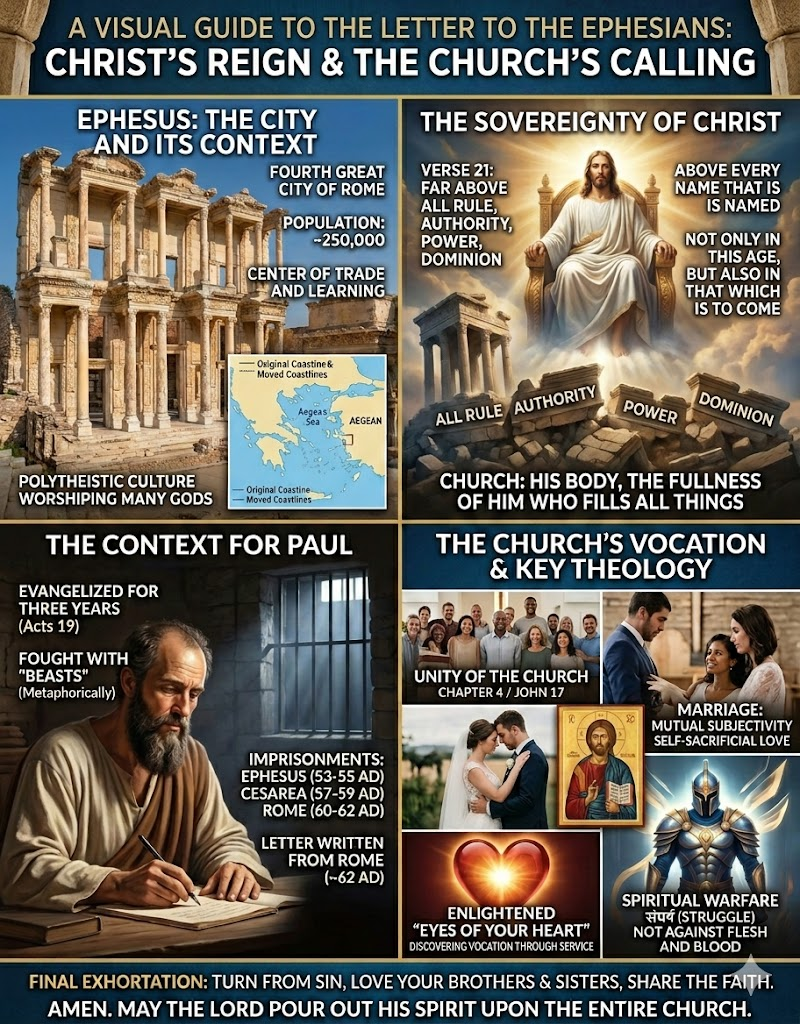
Ephesians 1:17-23
The Overwhelming Greatness of
God’s Power in Us
The Ascension is often viewed simply as Jesus’ departure, but Larry Broding’s commentary reveals it as the ultimate “end game” of human existence. By diving into the lush, complex language of Ephesians, Broding helps preachers move beyond the clouds of the Ascension to the “surpassing greatness” of God’s power working within the pews right now. This commentary provides the theological muscle to help your congregation understand that they aren’t just waiting for a distant heaven—they are part of Christ’s Body, the very instrument meant to fill the entire universe.
Why this commentary matters for your homily:
- The Content of Prayer: Explore the deep cultural prize of “wisdom and revelation” mentioned in Ephesians 1:17, showing your congregation how the Spirit allows us to know not just the mind of God, but how that divine mind works.
- The Three “What Is” Statements: Broding breaks down Ephesians 1:18–19 into a clear roadmap for the Christian life: the hope of our call (meaning), the richness of inheritance (community), and the greatness of power (personal growth).
- The Church as the “End Game”: Gain a powerful perspective on the Church as the eschatological sign—the fullness of creation and the definitive instrument through which God completes all of existence.
- A New View of the Ascension: Shift the focus from Christ “leaving” to the heavenly fulfillment of the end-time promise, helping your listeners realize that those in Christ are already with the Father.
- Yearning as a Gift: Use Broding’s insights to explain that our desire for God’s return is not a sign of lack, but a gift of the Spirit—a “partial taste” of the immersion that is to come.
Read Larry Broding’s full commentary to help your congregation experience the overwhelming greatness of God’s power that raised Christ from the dead and now lives in them.
AI THOUGHT STARTERS
To strengthen key sections of your homily, here are questions you might ask the AI assistant (simply copy and paste a question into chat bot in the lower right corner of the page):
The Power of Intercession and
Wisdom
- Ephesians 1:15–16 refers to the faith and charity of the community as the primary reason for the author’s prayers; how can I use this to encourage my parishioners to recognize the “faith and charity” currently present in our own parish?
- Since Ephesians 1:17 refers to a prayer for “wisdom and divine revelation,” how can I explain to a modern audience the difference between simply knowing facts about God and truly knowing how the mind of God works?
- Ephesians 1:17 suggests that the Spirit provides both wisdom and revelation; what are some practical examples of how a “spirit of wisdom” helps a person navigate difficult life decisions today?
The Three Pillars of Christian Identity
- Ephesians 1:18 refers to the “hope of his call”—how can I describe this hope as a source of meaning and direction for those in the congregation who feel lost or aimless?
- Ephesians 1:18 refers to the “richness of the inheritance in the saints,” which suggests the importance of communal life; what strategies can I suggest to help parishioners lean more on the community to reinforce their faith?
- Ephesians 1:19 refers to the “surpassing greatness of his power for us who believe;” how can I help the congregation see this not as a distant miracle, but as a personal experience of salvation and providence in their daily lives?
The Ascension and
the Church’s Mission
- Ephesians 1:20–21 suggests that the same power that raised Christ now gives him dominion over all creation; how does this reality change the way we should view worldly anxieties and political powers?
- Ephesians 1:22–23 refers to the Church as the “fullness of him who fills all in all,” which suggests the Church is the “end game” of existence; how can I communicate the dignity and responsibility of being “Christ’s Body” to my listeners?
- While the Ascension refers to the return of the Son to the Father, the text suggests we are already “with the Father now” through Christ; how can I use this to comfort those who feel a sense of abandonment or distance from God?
- Ephesians 1:19 suggestions that the “overwhelming greatness of God’s power in us” is the reason to believe; what stories or analogies can I use to show that this power is the fuel for our “yearning” for the heavenly fulfillment?

Courtesy of Larry Broding
The Ascension of the Lord
Matthew 28:16-20
Fr. Tim Peters, S.T.D explores the scriptural context and theological significance of the Gospel reading according to the following thematic outline.
INSIGHTS FOR HOMILY
PREPARATION
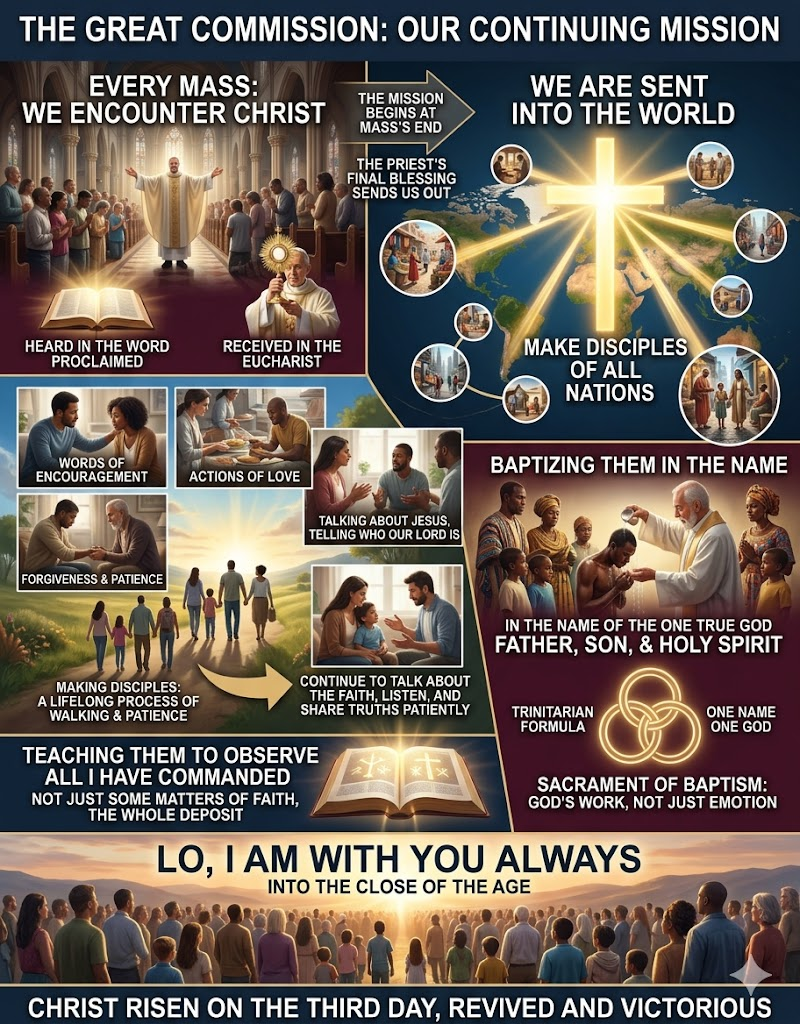
Matthew 28:16-20
Make Disciples!
The Great Commission is more than a final instruction; it is a royal decree that bridges the mountaintop of revelation with the reality of our daily mission. Larry Broding’s commentary deconstructs the “sandwich” structure of Matthew’s final verses, showing how Jesus’ absolute authority and his promise of perpetual presence provide the necessary “bread” for the difficult work of making disciples. This resource is essential for any preacher looking to transform a familiar text into a call for “active presence,” helping parishioners move from the “mountain” of Sunday worship to the “traveling” of a Christian lifestyle.
Why this commentary matters for your homily:
- The Power of Presence: Broding explains how the “risen presence” of Jesus was a statement of social and divine power that vanquished the limitations of death, providing a powerful hook for discussing Christ’s authority today.
- A Command in Motion: Discover why “Go then” in Matthew 28:19 is literally “Having traveled then,” suggesting that evangelization isn’t a separate event but something that happens as we move through our lives.
- The Trinitarian Intimacy: Gain a beautiful framework for explaining the Trinity as God above us (Father), God beside us (Son), and God within us (Holy Spirit), making the baptismal formula deeply personal for your congregation.
- The Mountaintop Symbolism: Connect the dots between the Beatitudes, the Transfiguration, and the Ascension, showing how the “mountain” serves as the consistent biblical site for teaching, revelation, and commissioning.
- Normalizing Doubt: Use the “unclear” Greek of Matthew 28:17 to reassure your congregation that worship and doubt can coexist, and that it is through obeying Jesus’ commands that those doubts eventually flee the heart.
- The Continuity of Tradition: Illustrate how the “unbroken faith” passed from the apostles to today’s neophytes creates a living chain of evangelization that is both a historical fact and a future promise.
Read Larry Broding’s full commentary to help your congregation step into their role as God’s instruments, confident that the power of His presence guarantees the success of His command.
AI THOUGHT STARTERS
To strengthen key sections of your homily, here are questions you might ask the AI assistant (simply copy and paste a question into chat bot in the lower right corner of the page):
The Authority and Presence of the King
- Matthew 28:18 refers to Jesus being given all authority in heaven and on earth; how can I explain to my congregation that this “royal decree” is the foundation for our own confidence in sharing the faith?
- Since Matthew 28:20 refers to Jesus being with us “always, until the end of the age,” what are some modern-day examples of how his “risen presence” manifests in the life of a typical family?
- The “sandwich” construction of Matthew 28:18–20 suggests that the command to mission is protected on both sides by Christ’s power and presence; how can I use this structure to encourage those who feel inadequate to evangelize?
The Geography of Revelation
- Matthew 28:16 refers to a specific mountain in Galilee where the disciples were commanded to go; how can I connect this “mountaintop experience” to the other significant mountains in Matthew’s Gospel, like the Mount of the Beatitudes or the Transfiguration?
- The mountain suggests a place of teaching and revelation; how can I help my parishioners identify the “mountaintops” in their own spiritual lives where they best encounter God’s will?
Encountering Doubt and Worship
- Matthew 28:17 refers to the disciples worshiping even while “some doubted;” how can I use this verse to comfort parishioners who feel that their doubts disqualify them from being good Christians?
- Since the text suggests that all doubts eventually fled the hearts of the followers because of their obedience to Jesus’ commands, how can I encourage my congregation to “act their way” into stronger faith?
The Mission and the Trinitarian Name
- Matthew 28:19 refers to the command to “make disciples of all nations”—since the literal Greek suggests “having traveled,” how can I preach that evangelization is something that happens in the flow of our daily travel and routine?
- The baptismal formula in Matthew 28:19 suggests a profound intimacy with God above us, beside us, and within us; how can I help parents and godparents understand that their role is to introduce children to this Trinitarian friendship?
- Matthew 28:20 refers to teaching others “to observe all that I have commanded you;” how can I distinguish for my congregation between merely knowing the stories of Jesus and actually living the “Christian lifestyle” he modeled?