Papal Homilies
May 10, 2026

⬅️  ➡️
➡️

NOTABLE QUOTES
The liturgical readings for the 6th Sunday of Easter (Year A) focus on the promise of the Holy Spirit (the Paraclete) and the call to love through the keeping of the commandments.
Here are notable quotes from previous Popes reflecting on these specific scriptures:
Pope Francis
“Jesus asks us to love Him, but He explains: this love isn’t exhausted in a desire of Him, or in a sentiment, no. It requires willingness to follow His way… The Spirit Himself guides them, illumines them and reinforces them, so that each one can walk in life.”
— Regina Caeli, May 17, 2020
“The Holy Spirit is not a passing guest who comes to pay us a courtesy visit. He is a companion for life, a stable presence… He is patient and stays with us even when we fall… bringing us God’s pardon and strength.”
— Regina Caeli, May 21, 2017
Pope Benedict XVI
“To bring to completion the mission that Jesus entrusts to us, we must not be lazy or cowardly… [The Spirit] is the truth which gives meaning to human existence, and the source of that life which is eternal joy.”
— Homily, April 27, 2008
“The Holy Spirit’s presence which, as Jesus said, is interior to souls and to the Church, will make the invisible Christ present in a lasting manner ‘until the end of the world.'”
— General Audience on the Paraclete (Reflecting on Jn 14)
St. John Paul II
“The advocate (defender) is he who, taking the part of those who are guilty because of sin committed, defends them from the penalty due to their sins… The Holy Spirit is called the Paraclete because he continues Christ’s redemptive work.”
— General Audience, May 24, 1989
“With the light and the strength of the Holy Spirit, let us build a Church founded on God’s love, a sign of unity, a missionary Church that opens its arms to the world… and becomes a leaven of harmony for humanity.”
— Homily, May 17, 1998
6th Sunday of Easter (A)

Theme of the Readings
FROM THE ARCHIVES (2005)
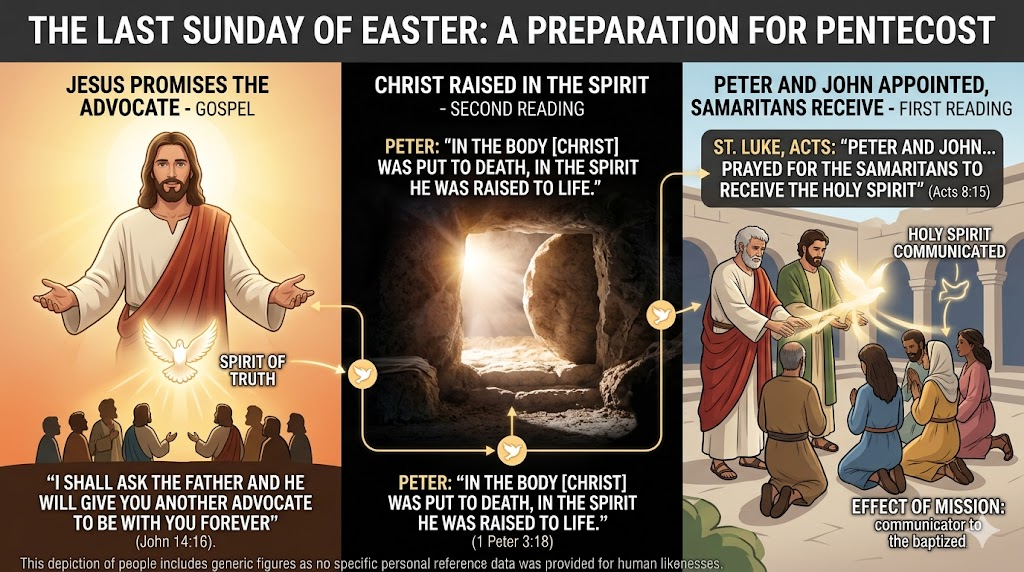
This last Sunday of the Easter season prepares and in a certain way anticipates the feast of Pentecost. The liturgy presents Jesus promising the Spirit, the same Spirit who raised him to life, and who, in Jesus’ name, the Apostles communicate to the baptized Samaritans. “I shall ask the Father and he will give you another Advocate to be with you forever,” Jesus promises in the Gospel. In his First Letter, St. Peter says: “In the body [Christ] was put to death, in the spirit he was raised to life” (second reading). And St. Luke in the Acts of the Apostles presents Peter and John, who “prayed for the Samaritans to receive the Holy Spirit” (first reading).
Doctrinal Messages
In the history of salvation there is a harmonious succession of events in the action of the Father, of the Son and of the Holy Spirit that is always for the benefit of man’s salvation. The Father is the origin and source of every saving plan. In his love for man he sends his Son to redeem him and to restore his filial condition. Once the Son has fulfilled his mission on earth, the Spirit is sent to accompany man on his pilgrimage in this world toward the Father. Today’s liturgy presents to us the promise Jesus made to the disciples that he would send them the Holy Spirit, so that he would always be with them. Why does Jesus Christ make them this promise? So that the disciples do not feel they are orphans, since Jesus was about to go to his death and to return to the Father’s house. Jesus says to them: “I will not leave you orphans; I will come back to you” (Gospel), not in person, but through his Spirit.
The Holy Spirit, promised by Jesus, is first and foremost the Paraclete, that is, the comforter, the advocate, the giver of life and enlightenment in the faith. The disciples and the early Christians have a special experience of the powerful and illuminating presence of the Spirit at Pentecost. He is also the Spirit of Truth, of God’s revelation to man, with whom God illumines all human existence and gives it its true meaning and raison d’être. This truth was fully accepted by the disciples, proclaimed, confessed and also defended before the “falsehood” of the world, attacks by the falsity of the human heart and mind. Moreover it is the Spirit who gives life, who raises Jesus to life (second reading) and who enlightens Christians who believe in the Gospel, like the inhabitants of Samaria (first reading). The Spirit of God’s life, that life that, like the burning bush seen by Moses at the foot of Mount Sinai, continued to blaze and was never burnt up. Lastly, the Holy Spirit is the promoter of evangelization, both of the Jews and of the Samaritans and pagans. For this reason, commentators on the Acts of the Apostles, usually speak of three “Pentecosts,” that of the Jews in Jerusalem (Acts 2), of the Samaritans in Samaria (Acts 8), and of the pagans in Cesarea by the sea (Acts 10). With the receiving of the Spirit, evangelization and the proclamation of the Gospel gathered momentum and more and more new members joined the community of believers in Christ. In this way the Spirit was to make the words of Jesus come true: “Anybody who loves me will be loved by my Father, and I shall love him and show myself to him.”
Pastoral Suggestions
Those who are holy know and experience that God fulfills his promises. For the first Christians this was an indisputable truth, the object of their experience. However, God’s promise continues to be fulfilled among human beings even today. Of course, we must be very aware that God does not promise “à la carte” happiness, as we humans would sometimes like. It is not a “world” or a “Church” without problems or free from all inconsistencies, nor faultless Christian brothers and sisters who are irreproachable, always kind and smiling. He does not promise to free us from slander, persecution, indifference, ill-treatment or even martyrdom. He promises only the Spirit, his Spirit, giving us the capacity to be happy in a new way, alien to the world’s mentality. He gives us a clear gaze to see the world and the Church with faith, optimism, peace, and love. He gives us a generous heart to be open and to accept our brothers and sisters in the faith as they are, with their weaknesses and miseries, with their qualities and virtues, with their genuine faith, love and hope. He gives us the grace to seek true freedom, which is primarily interior and spiritual, and which works from within to achieve all other liberation from the evils of this world.
Since God fulfills his promises, our communities must be joyful and steadfast in their faith. Without wishing to close our eyes to the evil that exists, God’s promise continues to come true and to be fulfilled in the midst of the community. If we do not perceive it, couldn’t it be that our faith is weak, and perhaps sickly? On the other hand, without ignoring the doubts and perplexities of Christians in understanding and living their faith, the presence of the Spirit of Truth must comfort the Christian community and give it a very sound faith. Our faith does not rely on men, however congenial they may be, nor on angels, but on the very Spirit of God, the Spirit of Truth, who is the Inner Teacher who strengthens and guarantees the revelation of God and the response of faith to this revelation.
SOURCE: YEAR A DICASTERY NOTES (2004-05)
Message of Pope Francis
AT A GLANCE
- The Nature of Love: Authentic love for Christ is not merely a feeling or a desire; it is a concrete willingness to follow His path and the will of the Father.
- The Great Commandment: Jesus calls us to a “gratuitous love”—loving one another as He loved us, without demanding anything in return.
- The Gift of the Paraclete: The Holy Spirit is our Advocate and Counselor who provides the “intelligence to listen” and the “courage to observe” God’s Word.
- Mercy vs. Judgment: The commandments are not a mirror of our failures but a “Word of Life” designed to heal, forgive, and liberate us for mission.
QUESTIONS FOR REFLECTION
- In what areas of my life is my love for Jesus limited to a “feeling” rather than an active observance of His will?
- Am I able to love others “gratuitously,” or do I find myself keeping score or expecting something in return for my kindness?
- How often do I invite the Holy Spirit to be my “Advocate” when I face adversity or the temptation to succumb to error?
- When I read the Word of God, do I see a judge looking to condemn me, or a Physician looking to heal and renew my heart?gonist of your life?
ACTIONABLE
TAKEAWAYS
- Practice Docility: This week, start each morning by asking the Holy Spirit for “the intelligence to listen.” Spend five minutes in silence before making your daily plan.
- Mirror Christ’s Gratuitousness: Perform one act of service or kindness for someone from whom you expect absolutely nothing in return—not even a “thank you.”
- Reframing the Commandments: When you catch yourself in an “experience of error” or sin, do not dwell on the misery. Instead, immediately turn to the Word of God as a “light for your steps” and seek the healing found in God’s mercy.
- Living the Mission: Identify one “wonder” God has accomplished in your life and find a natural opportunity to share that story with someone else this week.
6th Sunday of Easter (A)
Living Christ’s Love and Commandments through the Holy Spirit
17 May 2020 – Library of the Apostolic Palace
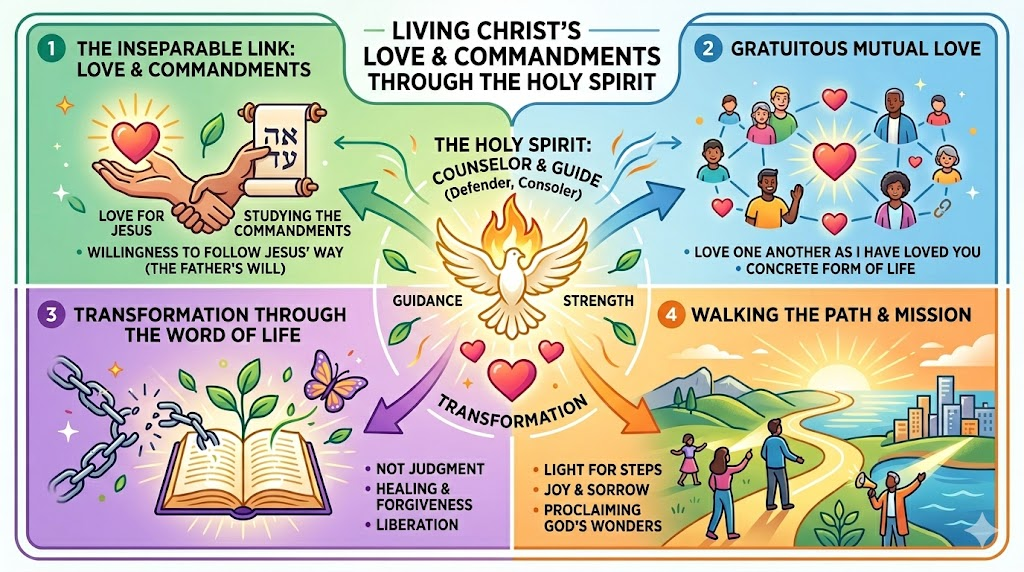
This Sunday’s Gospel passage (cf. Jn 14:15-21) presents two messages: observance of the commandments and the promise of the Holy Spirit. Jesus links love for Him to observance of the commandments, and He insists on this in His farewell discourse: “If you love me, then you will keep my commandments” (v. 15); “He who has my commandments and keeps them, he it is who loves me” (v. 21). Jesus asks us to love Him, but explains: this love does not end in a desire for Him or in a feeling; it demands the willingness to follow His way, that is, the will of the Father.
Gratuitous Love: Loving One Another as Christ Loved Us
[Our love for Jesus] is summarized in the commandment of mutual love—the first love in its fulfillment—given by Jesus Himself: “Even as I have loved you, that you also love one another” (Jn 13:34). He did not say, “Love me as I have loved you,” but “love one another as I have loved you.” He loves us without asking us to do the same in return. Jesus’ love is a gratuitous love; He never asks for the same in return. He wants this gratuitous love of His to become the concrete form of life among us: this is His will.
The Holy Spirit: Our Advocate and Guide
To help the disciples walk this path, Jesus promises to pray for the Father to send “another Counselor” (v. 16), that is, a Consoler and a Defender, who will take His place and give them the intelligence to listen and the courage to observe His words. This is the Holy Spirit, who is the Gift of God’s love that descends into the heart of the Christian. After Jesus has died and risen, His love is given to those who believe in Him and are baptized in the name of the Father and of the Son and of the Holy Spirit. The Spirit Himself guides them, enlightens them, and strengthens them, so that everyone may walk in life—even through adversity and difficulty, in joys and sorrows—remaining on Jesus’ path. This is possible precisely by remaining docile to the Holy Spirit, so that, through His presence at work in us, He may not only console but transform hearts, opening them up to truth and love.
Transformation Through the Word of Life
Faced with the experience of error and sin—which we all encounter—the Holy Spirit helps us not to succumb and enables us to grasp and fully live the meaning of Jesus’ words: “If you love me, you will keep my commandments” (v. 15). The commandments are not given to us as a kind of mirror in which to see the reflection of our miseries and our inconsistencies. The Word of God is given to us as the Word of life, which transforms the heart and life; it renews and does not judge in order to condemn, but heals and has forgiveness as its aim. God’s mercy is thus: a Word that is light for our steps. All this is the work of the Holy Spirit! He is the Gift of God; He is God Himself, who helps us to be free people—people who want and know how to love, and people who understand that life is a mission to proclaim the wonders that the Lord accomplishes in those who trust in Him.

Message of Pope Benedict XVI
AT A GLANCE
- The Power of Proclamation: True joy is not merely an emotion but a fruit of the Gospel that transforms “arid ground” into flourishing life.
- Apostolic Continuity: The Church continues the exact mission of Jesus—preaching, healing, and baptizing—through the empowerment of the Holy Spirit.
- The “Beneficent River”: Throughout history, the Gospel has acted as a healing stream, brought to humanity by saints and missionaries to provide true freedom.
- Universal Vocation: Every believer is called to participate in evangelization, whether by reaching those who have never heard the Word or re-awakening faith in ancient Christian lands.
QUESTIONS FOR REFLECTION
- Where is the “arid ground” in your own life or community? How might the “living water” of the Gospel bring growth back to those specific areas?
- In what ways are you continuing the mission of Philip? Do you see your daily actions as a means for the Lord to act through you to bring peace to others?
- Reflecting on the lives of St. Charles Borromeo and St. Teresa of Calcutta, who are the “saints” in your life who first brought you the proclamation of Christ?
- Are you in need of “new nourishment”? If your roots are ancient but dry, what specific spiritual practice could help you rediscover the beauty of your faith?
ACTIONABLE
TAKEAWAY
- Identify a Modern “Samaria”: Reach out to someone in your social or professional circle who seems isolated or burdened. Offer a gesture of hope or a listening ear as a silent proclamation of Christ’s peace.
- Practice “Joyful Evangelization”: Commit to sharing one positive aspect of your faith this week with a family member or friend—not as a lecture, but as a testimony of the joy it brings you.
- Intercede for Missionaries: Choose a specific mission territory or a local outreach program and offer a daily prayer for those working to “irrigate” hearts with the Gospel.
- Support Healing Works: Contribute your time or resources to a local charity that addresses “illnesses of body and spirit,” mimicking the healing ministry described in the Acts of the Apostles.
6th Sunday of Easter (A)
Proclaiming Joy in the Risen Christ
29 May 2011 | Saint Peter’s Square

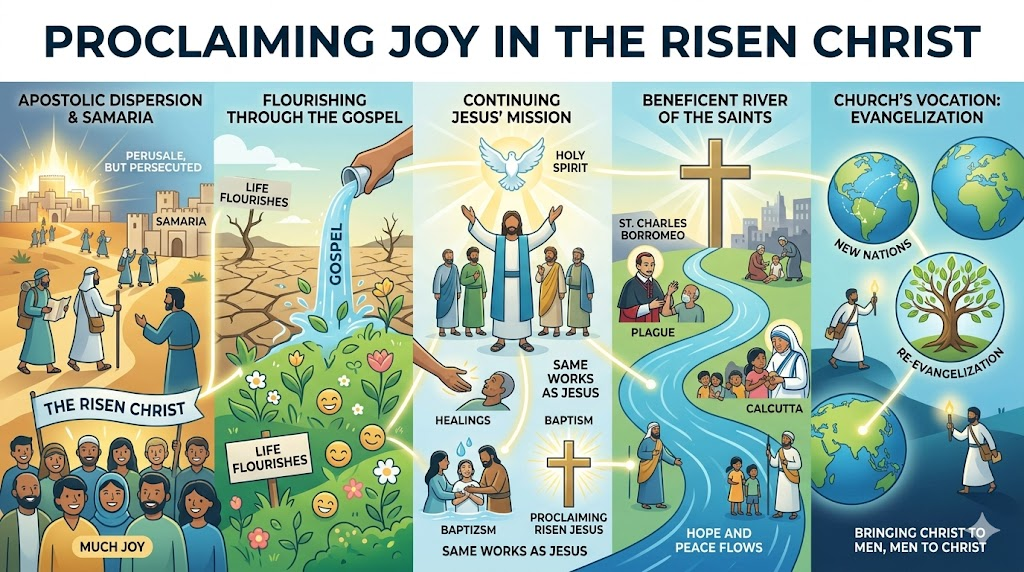
The book of the Acts of the Apostles states that after a first violent persecution, the Christian community of Jerusalem, except for the Apostles, spread to the surrounding areas. Philip, one of the deacons, arrived in a city of Samaria. There he preached the Risen Christ, and his proclamation was supported by numerous healings, so that the outcome of the episode was very positive: “there was much joy in that city” (Acts 8:8).
The Flourishing of Life Through the Gospel
We are repeatedly impressed in a profound way by the expression [“there was much joy in that city” (Acts 8:8)], which in essence communicates a sense of hope, as if saying: It is possible! It is possible for humanity to know true joy, because wherever the Gospel comes, life flourishes, just as arid ground, irrigated by rain, immediately turns back to green.
Continuing the Mission of Jesus
With the strength of the Holy Spirit, Philip and the other disciples accomplished in the villages of Palestine what Jesus had done: They preached the Good News and worked miraculous signs. It was the Lord who acted through them. As Jesus proclaimed the coming of the Kingdom of God, so the disciples proclaimed the Risen Jesus, professing that he is the Christ, the Son of God, baptizing in his name and driving out every illness of body and spirit.
The Beneficent River of the Saints
“There was much joy in that city”. Reading this passage, one thinks spontaneously of the healing power of the Gospel, which throughout the centuries has “watered” so many populations, like a beneficent river. Several great men and women saints brought hope and peace to entire cities — we think of St. Charles Borromeo in Milan at the time of the plague, of St. Teresa of Calcutta, and of so many missionaries, whose names are known by God, who have given their lives to bring the proclamation of Christ and make profound joy flower among men.
The Church’s Vocation of Evangelization
While the powers of this world sought to conquer new territories for political and economic interests, Christ’s messengers went everywhere with the aim of bringing Christ to men and men to Christ, knowing that he alone can give true freedom and eternal life. Today too the Church’s vocation is evangelization: whether it be to populations which have not yet been “irrigated” by the living water of the Gospel, or to those that, though having ancient Christian roots, are in need of new nourishment to bear new fruit and rediscover the beauty and joy of the faith.

ROME REPORTS (3:18) – God serves as a guiding Shepherd to people across the world, throughout history, and across various cultures.
Message of Pope Saint John Paul II
AT A GLANCE
- The Meaning of Paraclete: Derived from the Greek Parakletos, it defines the Holy Spirit as our Advocate, Defender, and Mediator called to our assistance.
- Christ as the First Advocate: Jesus is the primary Paraclete; the Holy Spirit is “another Paraclete” who continues and prolongs Christ’s redemptive work.
- A Lasting Presence: While Christ’s earthly presence was physical, the Holy Spirit makes the invisible Christ interiorly present to the Church and the soul forever.
- The Spirit of Truth: The Paraclete provides “a mouth of wisdom” to believers, bearing witness to the Gospel even in the face of persecution and trial.
- Universal Salvation: The Spirit “convinces the world” of sin and judgment not to condemn, but to facilitate the definitive triumph of salvation over the “prince of this world.”
QUESTIONS FOR REFLECTION
- How do you experience the Holy Spirit as a “Defender”? In moments of personal failure or sin, do you turn to the Spirit to find the path back to Christ’s mercy?
- When have you felt “the Spirit of your Father speaking through you”? Reflect on a time you had to defend your faith or speak a difficult truth; how did you sense divine assistance?
- Is your relationship with Christ “immersed in mystery” or felt as a reality? How can you better acknowledge the Holy Spirit’s role in making the invisible Christ present in your daily life?
- What does “universal salvation” mean to you in your daily interactions? Does your view of the world focus more on condemnation or on the Spirit’s work to bring humanity back to God?
ACTIONABLE
TAKEAWAY
- Invoke the Advocate: Before a difficult conversation or a stressful task, pause and pray: “Holy Spirit, my Advocate, be my mouth and my wisdom.”
- Seek Interior Silence: Dedicate five minutes this week to sitting in silence, specifically asking the Holy Spirit to make the presence of the Risen Christ felt within your soul.
- Be a Witness of Hope: Identify someone in your life who is currently “under judgment” or struggling with guilt. Offer them a word of encouragement that reflects the Spirit’s work of restoration rather than condemnation.
- Study the Word: Read the First Letter of John (Chapter 2) this week to deeper your understanding of how Jesus and the Holy Spirit work together as your advocates before the Father.
6th Sunday of Easter (A)
“Parakletos”: The Holy Spirit as Advocate
24 May 1989 | GENERAL AUDIENCE
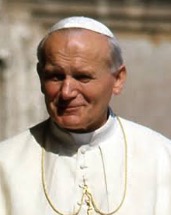
We learn from Jesus’ discourse in the upper room that he called the Holy Spirit the “Paraclete”: “I will pray the Father, and he will send you another Paraclete, to be with you forever” (Jn 14:16). Similarly we read in other texts: “the Paraclete, the Holy Spirit” (cf. Jn 14:16; 15:26; 16:7). Instead of “Paraclete” many translations use the word “Counselor.” That term is acceptable, though it is necessary to have recourse to the original Greek word Parakletos to grasp the full meaning of what Jesus says about the Holy Spirit.
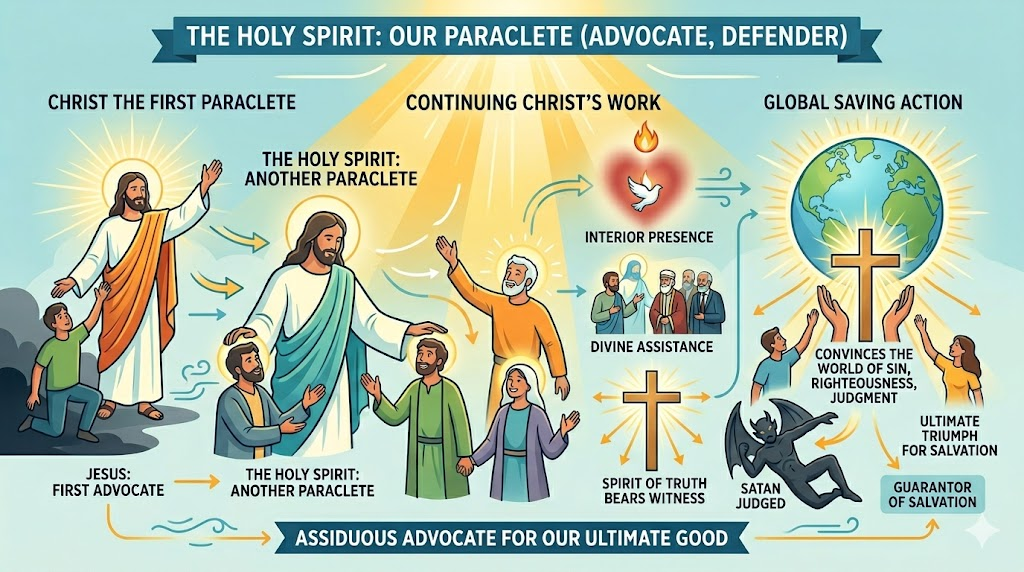
Parakletos means literally, “one who is called or appealed to” (from para-kalein, “to call to one’s assistance”). He is therefore the defender,” “the advocate,” as well as the “mediator” who fulfills the function of intercessor. It is this meaning of “advocate-defender” that now interests us, while not forgetting that some Fathers of the Church use Parakletos in the sense of “Counselor” particularly in reference to the Holy Spirit’s action in regard to the Church. For the present we shall speak of the Holy Spirit as the Paraclete-Advocate-Defender. This term enables us to grasp the close relationship between Christ’s action and that of the Holy Spirit, as can be seen from a further analysis of John’s text.
Christ: The First Paraclete
When Jesus in the upper room, on the eve of his passion, announced the coming of the Holy Spirit, he did so in the following terms: “The Father will give you another Paraclete.” These words indicate that Christ himself is the first Paraclete, and that the Holy Spirit’s action will be like that of Christ and in a sense prolong it. Jesus Christ, indeed, was the “defender” and remains such. John himself will say so in his First Letter: “If anyone does sin, we have an advocate (parakletos) with the Father, Jesus Christ the righteous” (1 Jn 2:1).
Continuity of the Redemptive Work
The advocate (defender) is he who, taking the part of those who are guilty because of sin committed, defends them from the penalty due to their sins, and saves them from the danger of losing eternal life and salvation. This is precisely what Jesus Christ did. The Holy Spirit is called the Paraclete because he continues Christ’s redemptive work which freed us from sin and eternal death.
The Mystery of the Indwelling Presence
The Paraclete will be “another advocate-defender” also for a second reason. Remaining with Christ’s disciples, he will watch over them with his omnipotent power. “I will pray the Father,” Jesus said, “and he will give you another Paraclete to be with you forever” (Jn 14:16). “He dwells in you, and will be in you” (Jn 14:16). This promise must be taken together with the others made by Jesus when going to the Father: “I am with you always, to the close of the age” (Mt 28:20). We know that Christ is the Word who “became flesh and dwelt among us” (Jn 1:14). When going to the Father he said: “I am with you always, to the close of the age” (Mt 28:20). It follows that the apostles and the Church must continually find, by means of the Holy Spirit, that presence of the Word-Son which, during his earthly mission, was physical and visible in his incarnate humanity, but which, after his ascension to the Father, is completely immersed in mystery. The Holy Spirit’s presence which, as Jesus said, is interior to souls and to the Church (“He dwells with you, and will be in you”: Jn 14:17), will make the invisible Christ present in a lasting manner “until the end of the world.” The transcendent unity of the Son and the Holy Spirit will ensure that Christ’s humanity, assumed by the Word, will be present at work wherever the trinitarian plan of salvation is being put into effect through the power of the Father.
Divine Assistance in Times of Trial
The Holy Spirit-Paraclete will be the advocate-defender of the apostles, and of all those down through the centuries in the Church who will be the heirs of their witness and apostolate. This is especially so in difficult moments when they are tested to the point of heroism. This was Jesus’ prophecy and promise: “They will deliver you up to councils…you will be dragged before governors and kings…. When they deliver you up, do not be anxious how you are to speak or what you are to say…for it is not you who speak, but the Spirit of your Father speaking through you” (Mt 10:17-20; likewise Mk 13:11; Lk 12:12 says: “for the Holy Spirit will teach you in that hour what you ought to say”).
The Spirit as Counselor and Supporter
Even in this very practical sense the Holy Spirit is the Paraclete-Advocate. He is close and even present to the apostles when they must profess the truth, justify it and defend it. He himself then inspires them. He himself speaks through their words, and together with them and through them he bears witness to Christ and his Gospel. Before their accusers he becomes the invisible advocate of the accused, by the fact that he acts as their counselor, defender and supporter. Especially during persecutions in all ages, those words of Jesus in the upper room are verified: “When the Paraclete comes, whom I shall send to you from the Father…he will bear witness to me; and you also are witnesses, because you have been with me from the beginning” (Jn 15:26-27).
Interior Witness and the Power of Truth
The action of the Holy Spirit is that of “bearing witness.” It is an interior, “immanent” action in the hearts of the disciples, who then bear witness to Christ externally. Through that immanent presence and action, the transcendent power of the truth of Christ who is the Word-Truth and Wisdom, is manifested and advances in the world. From him, through the Spirit, the apostles obtained the power to bear witness according to his promise: “I will give you a mouth of wisdom, which none of your adversaries will be able to withstand or contradict” (Lk 21:15). This happened already in the case of the first martyr Stephen, of whom we read in the Acts of the Apostles that he was “full of the Holy Spirit” (6:5). His adversaries “could not withstand the wisdom and the spirit with which he spoke” (Acts 6:10). Also in the following centuries the opponents of the Christians continued to rage against the heralds of the Gospel. At times they stifled the Christians’ voice in their blood, but without succeeding in suffocating the truth of which they were the messengers. That truth continued to flourish in the world through the power of the Spirit.
Convicting the World for Salvation
The Holy Spirit—the Spirit of truth, the Paraclete—is he who according to the words of Christ, “will convince the world of sin and of righteousness and of judgment” (Jn 16:8). Jesus’ own explanation of these terms is significant: “Sin” signifies the lack of faith that Jesus met with among “his own,” those of his own people who arrived at the point of condemning him to death on a cross. In speaking of “righteousness,” Jesus seems to have in mind that definitive righteousness which the Father will confer upon him (“…because I go to the Father”) in the resurrection and ascension into heaven. In this context “judgment” means that the Spirit of truth will demonstrate the guilt of the world in rejecting Christ, or more generally, in turning its back upon God. Because Christ did not come into the world to judge and condemn it but to save it, then in actual fact that “convincing the world of sin” on the part of the Spirit of truth must be understood as an intervention directed to the salvation of the world, to the ultimate good of humanity.
Triumph Over the Prince of This World
“Judgment” refers particularly to the “prince of this world,” namely, Satan. From the very beginning he tried to turn the work of creation against the covenant and union of man with God: knowingly he opposes salvation. Therefore, he “is already judged” from the beginning, as I explained in the encyclical Dominum et Vivificantem (n. 27). If the Holy Spirit, the Paraclete, is to convince the world precisely of this “judgment,” undoubtedly he does so to continue Christ’s work aimed at universal salvation.
Conclusion: The Guarantor of Salvation
We can therefore conclude that in bearing witness to Christ, the Paraclete is an assiduous (though invisible) advocate and defender of the work of salvation, and of all those engaged in this work. He is also the guarantor of the definitive triumph over sin and over the world subjected to sin, in order to free it from sin and introduce it into the way of salvation.
