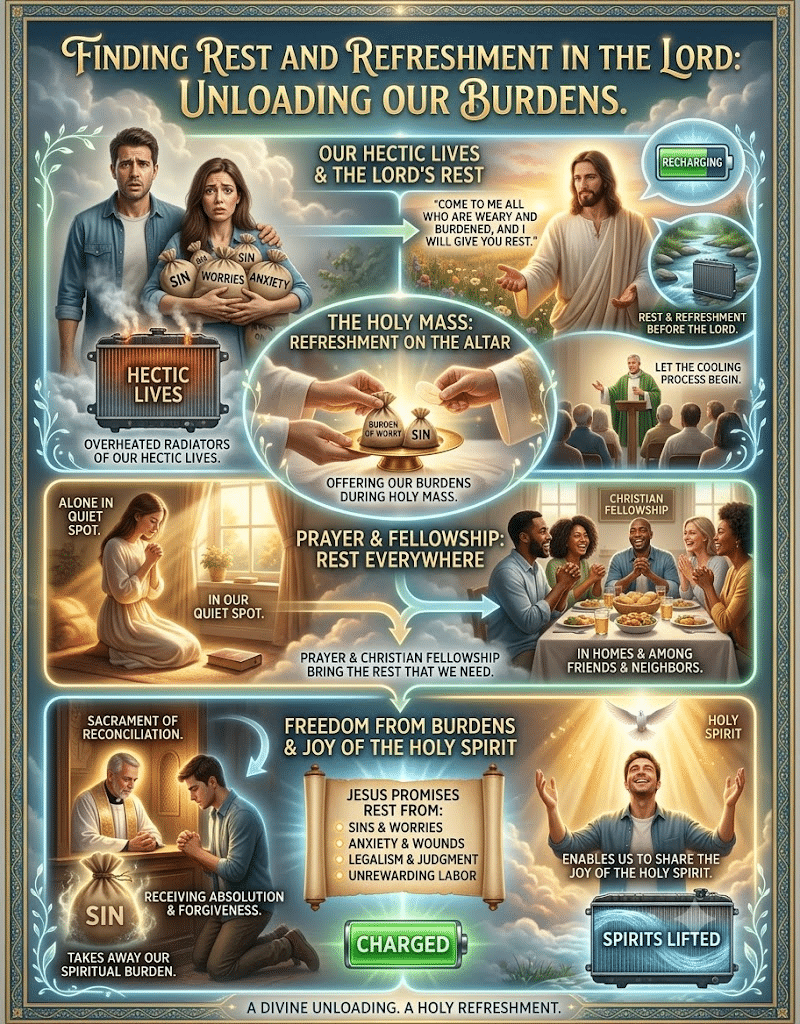
Fr. Tony’s Homily starters, anecdotes and life messages with infographics for use in parish bulletins, presentations, bible studies, and teaching @ Fr. Tony’s Homilies. 14th Sunday in Ordinary Time (A) Zechariah 9:9-10 Romans 8:9, 11-13 Matthew 11:25-30
Fr. Tony’s Homily, Life Messages, Homily Starters, Anecdotes
Fr. Tony’s Homily, Homily Starters
Fr. Tony’s Homily, Homily Starters
July 5, 2026


RELATED: 🎬 FAITH & FILM | 😇 HOLY ADS
14th Sunday of Year A


WCU CATHOLIC CAMPUS MINISTRY (5:34)

CATHOLIC PRODUCTIONS (8:15)

FATHER JIM FORSEN (9:12)

DYNAMIC CATHOLIC (4:59)
HOMILY: The Yoke He Made for Me
Imagine walking through the dusty streets of Nazareth two thousand years ago. You pass by a small carpenter’s shop, and the scent of fresh cedar shavings fills the air. Inside, you see a young man, his hands calloused and strong, bent over a piece of timber. He is shaping a yoke.
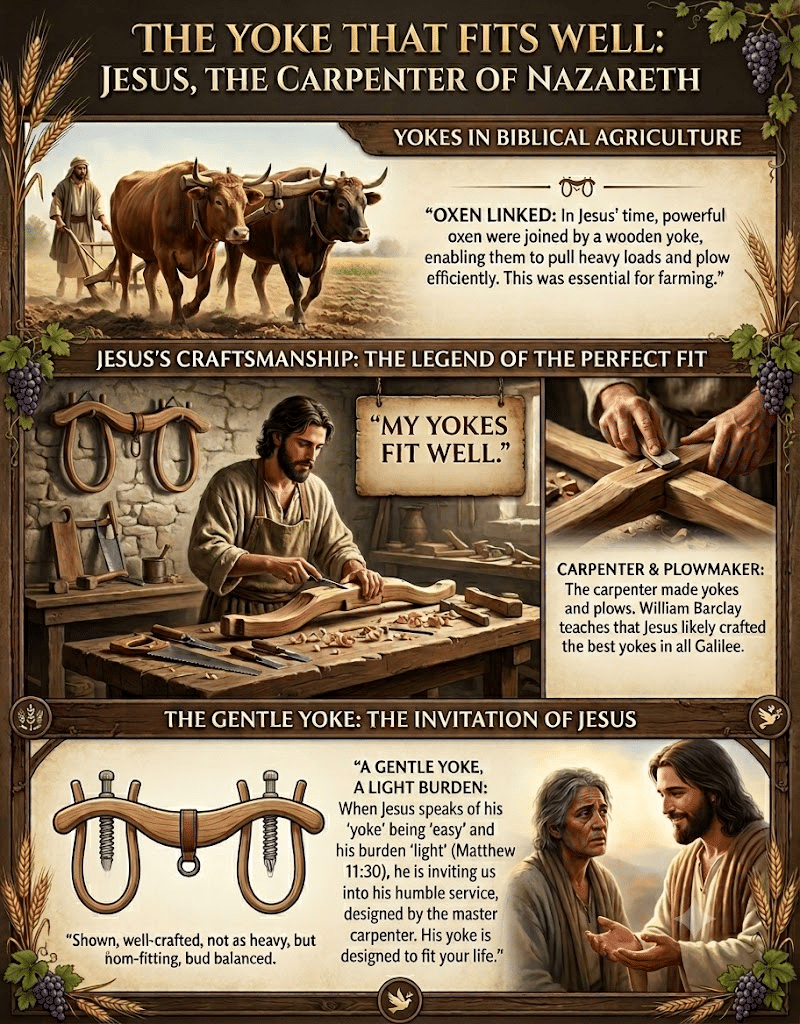
According to an ancient tradition, the carpenter’s shop in Nazareth was famous throughout Galilee. There was a saying, perhaps even a sign above the door: “My yokes fit well.” Farmers came from miles around because Jesus and Joseph crafted yokes that did not chafe, did not bruise, did not break the shoulders of the oxen that wore them. Each yoke was carefully measured, hand-carved, and fitted to the specific animal that would wear it.
Hold that image in your mind as we listen again to the words of Jesus in today’s Gospel: “Come to me, all you who labor and are burdened, and I will give you rest. Take my yoke upon you and learn from me, for I am meek and humble of heart; and you will find rest for yourselves. For my yoke is easy, and my burden light.”
The Carpenter's Craft
When Jesus spoke these words, He was not reaching for some abstract metaphor. He was speaking from His own life, from the silent years in Nazareth, from the wood shavings on the floor of His father's workshop. He knew exactly what He meant. A yoke poorly made would tear an animal's flesh and break its spirit. But a yoke well made, fitted to the shoulder, balanced and smooth, allowed the animal to work with strength and even with joy.
Measured for Your Shoulder
Brothers and sisters, this is what Jesus is telling us today. The yoke He offers us is not a mass-produced burden. It is custom-made. It is fitted to your shoulders, measured to your frame, crafted by the One who knew you before you were born.
There is a beautiful song by Eddie Lee Simon that captures this truth. It speaks of the carpenter bending above the timber with weathered, patient hands, shaping and carving the wood like only a master can. And then come these words that should pierce every heart in this church:
"He shaped it for a shoulder yet unborn and yet unknown, a shoulder he had measured with his own."
Did you hear that? The yoke He carved for you, He measured with His own shoulders first. Before He ever laid it upon you, He carried it Himself. This is the great mystery of our faith, my friends. Saint Augustine, reflecting on this very passage, wrote that the yoke of Christ does not weigh us down, but lifts us up, because the One who places it upon us also bears it with us.
The Double Yoke
And this brings us to the heart of the Gospel. A yoke, in Jesus' time, was almost always made for two. Two oxen, walking together, sharing the load, pulling in tandem. When Jesus says, "Take my yoke upon you," He is not saying, "Here, carry this alone." He is saying, "Come, be yoked to me. Walk beside me. Let me share the burden with you."
The song continues: "But his yoke was never meant to be shouldered all alone. For across the other crossbar pulled the hands I've come to know. I am yoked with that great carpenter who shares my burdens here."
The Chafing Yokes of the World
How many of us are carrying yokes today that were never made for us? Yokes of anxiety, yokes of resentment, yokes of perfectionism, yokes of grief we refuse to surrender, yokes of sin we keep secret. Yokes that other hands have shaped. Yokes the world has placed upon us, telling us we must be richer, thinner, smarter, more successful. These yokes chafe. They wound. They exhaust us.
The song says it perfectly: "I have felt the chafe of yokes that other hands have shaped, the pain and strain upon my frame as I shoulder them alone."
But Jesus stands at the door of His workshop today, and He calls out to you. "Come to me. I have a yoke that fits. I measured it with my own shoulders on the Cross. And I will pull beside you."
Strength of the Saints and the Childlike
This is why the saints could endure what seemed unendurable. Saint Thérèse of Lisieux understood this when she spoke of her "little way," walking each day yoked to Jesus. Saint Paul understood it when he wrote that he could do all things in Christ who strengthened him. The Catechism of the Catholic Church teaches us that "the way of perfection passes by way of the Cross," but it also reminds us that Christ Himself bears that Cross with us through the grace of the Holy Spirit.
Notice also to whom Jesus addresses these words in today's Gospel. He says, "I give praise to you, Father, Lord of heaven and earth, for although you have hidden these things from the wise and the learned, you have revealed them to the childlike." The yoke of Christ is not received by the proud, by those who think they can carry everything themselves. It is received by the humble, by those who admit they need a Savior, by those who come like little children.
An Invitation to the Eucharist
And so I ask you today, what yoke are you wearing this morning? Is it the one Jesus carved for you, fitted to your frame? Or is it one the world has strapped upon your shoulders, one that does not fit, one that wounds you?
Here is the invitation. Come to Him. Come to Him in the silence of prayer this week. Come to Him in the Sacrament of Reconciliation, where He lifts off the yokes of sin and gives us His own. And come to Him most especially in this Eucharist we are about to celebrate. Because in just a few moments, the same Carpenter from Nazareth, the same Christ who measured your shoulders before you were born, will give Himself to you under the appearance of bread and wine. He will enter into your very body, your very soul. He will yoke Himself to you in the most intimate way possible.
When you walk forward to receive Holy Communion today, hear Him whisper to you: "I made this yoke for you. I have been carrying it with you all along. You do not walk alone."
Finding Ultimate Rest
The song ends with these words, and I leave them with you:
"And the burden does not break me, for I do not pull alone. For His yoke is easy. He shares it here with me."
May we all lay down the burdens that do not belong to us, and take up the gentle yoke of Christ, who is meek and humble of heart. And may we find, in Him, the rest our souls have been longing for.
Fr. Tony's Homilies - This homily integrates an anecdote provided by Fr. Tony, weaving it together with his scriptural exegesis, practical life application reflections, and other sources.
Sources Consulted:
- Fr. Tony's Homilies - Anecdotes - Exegesis - Life Messages
- Eddie Lee Simon - Songbook: The Yoke He Made for Me
- The New American Bible, Revised Edition (NABRE), Matthew 11:25-30
- Saint Augustine, Sermons on the New Testament, Sermon 69 on Matthew 11:28
- Saint John Chrysostom, Homilies on the Gospel of Matthew, Homily 38
- Saint Thomas Aquinas, Catena Aurea on Matthew 11
- William Barclay, The Gospel of Matthew, Daily Study Bible Series
- The Interpreter's Dictionary of the Bible, entry on "Yoke"
- Catechism of the Catholic Church, paragraphs 459, 1615, on the yoke of Christ
- Pope Benedict XVI, Jesus of Nazareth, Volume 1, reflections on the Sermon on the Mount and discipleship
- Bishop Robert Barron, Word on Fire homilies on Matthew 11:25-30
Click the banner to finish reading the homily.
14th Sunday of Year A


HOMILY #2: The Cure for Spiritual Shell Shock
I want to begin with the trenches of the First World War. When that terrible conflict broke out in 1914, the world had never seen anything like it. The firepower was beyond imagination: earth-shattering artillery bombardments that could last for days without pause, flamethrowers, clouds of poison gas drifting over the battlefield, machine guns that could cut down whole companies of charging men in a matter of seconds. And in the midst of all of this, military doctors began to notice something they had never encountered before in the history of warfare.
Soldiers were being brought to field hospitals by the thousands without a scratch on them. No bullet wounds. No shrapnel. No burns. And yet they were utterly broken. They walked about in trancelike states. Some shook uncontrollably. Others froze in strange postures and could not be moved. Some had lost the ability to see, or to hear, or to speak, even though their eyes and ears and tongues were perfectly intact. The doctors gave this new malady a name: shell shock. It was the mind’s response to enduring more than it was ever meant to endure. The human soul, pushed past its breaking point, simply collapsed.
Many of us, in our own way, walk through life carrying a kind of spiritual shell shock. We may not have faced artillery, but we have faced our own bombardments. The loss of a loved one. A diagnosis we did not see coming. A marriage that fell apart. A child who has wandered from the faith. Financial fear. Loneliness that never seems to lift. Anxiety that wakes us at three in the morning. And like those soldiers, we can find ourselves walking through our days in a kind of trance, numb, frozen, unable to speak the prayers we used to pray.
It is into this very condition that the readings today speak with extraordinary tenderness. In our first reading from the Second Book of Kings, we meet a woman of Shunem. She is described simply as "a woman of influence," and she does something remarkable. She notices Elisha, the man of God, passing by, and she insists on feeding him. Then she goes further. She says to her husband, "Let us arrange a little room on the roof and furnish it for him with a bed, table, chair, and lamp." She makes a place in her home for God's prophet. And what happens? God, through Elisha, gives her the deepest desire of her heart. A son. New life where there had been none.
Brothers and sisters, this is not just a charming story about hospitality. This is the pattern of the Christian life. When we make room for God, when we welcome Him into the ordinary spaces of our existence, He brings life where we thought life was no longer possible. The Shunammite woman teaches us that refuge is not something we passively receive. It is something we prepare for. We build the room. We set the table. We light the lamp. And the Lord comes.
Saint Augustine, reflecting on this kind of hospitality, said that when we open our hearts to Christ, we discover that He had already been preparing a place for us first. The hospitality we offer to God is only ever a response to the hospitality He has shown us in creating us, redeeming us, and dwelling within us through Baptism.
And that brings us to our second reading. Saint Paul tells the Romans, and he tells us, "Are you unaware that we who were baptized into Christ Jesus were baptized into his death?" Dear friends, listen to this. Paul is saying that the cure for our spiritual shell shock is not first of all a technique or a feeling. It is an identity. We have already been buried with Christ. We have already risen with Him. "Consequently," Paul says, "you too must think of yourselves as dead to sin and living for God in Christ Jesus."
This is everything. When the bombardments of life come, and they will come, we do not face them as orphans. We face them as sons and daughters who have already passed through death with Christ. The worst has already happened to us in Baptism, and we have come out the other side alive in Him.
And then in the Gospel, Jesus tells us plainly what this new life looks like. "Whoever loves father or mother more than me is not worthy of me." "Whoever does not take up his cross and follow after me is not worthy of me." "Whoever loses his life for my sake will find it." These are hard sayings, brothers and sisters. But notice what Jesus does at the end. He doesn't leave us with only the demand. He gives us a promise: "Whoever receives you receives me, and whoever receives me receives the one who sent me."
Do you hear the echo? We are back in the Shunammite woman's house. We are back at the little room with the bed and the lamp. Jesus is saying: when you welcome one of my disciples, when you give even a cup of cold water to a little one, you are making a room for me. And where I dwell, the Father dwells. And where the Father dwells, there is refuge.
Saint Peter, who knew something about fear, who had denied the Lord three times, who knew what it was to be shell-shocked by his own failure, wrote those beautiful words: "Cast all your anxiety on him because he cares for you." That verb "cast" is strong. It does not mean to politely hand over your worries. It means to hurl them, to throw them with force onto the shoulders of Christ, because He is strong enough to bear what we cannot.
The Catechism reminds us that prayer is "a battle" and that in this battle "we have to wrestle against ourselves and against the wiles of the tempter." But it also assures us that the Holy Spirit Himself prays within us. We are never alone in the trench.
My dear brothers and sisters, in just a few moments we will come forward to this altar. And here is the most beautiful truth of all: at this Eucharist, we do not merely make a little room on the roof for the Lord. He comes down into the very center of our being. He becomes our food. He becomes our medicine. He becomes our refuge from the inside out. Every Mass is the cure for our spiritual shell shock, because every Mass places the Crucified and Risen Christ within us, the One who has already conquered every bombardment that life can throw at us.
So this week, I ask you to do two simple things. First, identify the anxiety you have been carrying, the one that wakes you up, the one that numbs you. Name it. And then, in prayer, cast it upon the Lord. Hurl it onto His shoulders. Second, like the Shunammite woman, prepare a small room for Christ this week. A quiet ten minutes. A daily rosary. A visit to the Blessed Sacrament. Make a space, and watch what He does.
Those soldiers a hundred years ago endured what no human mind was meant to endure, and they had no refuge. But we, brothers and sisters, have a refuge. We have a Father who cares for us. We have a Savior who has gone before us through death into life. And we have a table, this table, where heaven touches earth and where the weary find rest. Come to Him. Cast your burdens upon Him. And He will give you peace.
Fr. Tony's Homilies - Anecdotes - Exegesis - Life Messages
Sources Consulted:
- Fr. Tony's Homilies - Anecdotes - Exegesis - Life Messages
- Saint Augustine, Sermons on the New Testament
- Saint John Chrysostom, Homilies on the Gospel of Matthew
- Catechism of the Catholic Church, Part Four (Christian Prayer), nn. 2725-2745
- Pope Benedict XVI, Verbum Domini (Apostolic Exhortation on the Word of God)
- The Navarre Bible Commentary on the Gospel of Matthew
- Scott Hahn, Catholic Bible Dictionary and Ignatius Catholic Study Bible commentary on Romans 6
- William Barclay (with Catholic correctives), Daily Study Bible on 2 Kings
- Pope Francis, Evangelii Gaudium (on preaching and the homily), nn. 135-159
Click the banner to finish reading the homily.
14th Sunday of Year A


The Agony and Ecstasy of Michelangelo
A few of you perhaps have had the privilege of visiting Rome to view some of the world’s most splendid artistic productions in sculpture, on canvas, and in architecture. While there, perhaps you saw what is regarded by some as the most outstanding of all artistic expressions, the ceiling of the Sistine Chapel painted by Michelangelo. What many people do not know is that he suffered beyond imagination while producing that unparalleled masterpiece. In Irving Stone’s novel, The Agony and the Ecstasy, Michelangelo’s agony is vividly described. For thirty days, he painted from dawn to darkness, completing the Sacrifice of Noah, the four large male figures surrounding the Ark and the Prophet Isaiah opposite. He returned home late each night to work on the scene of the Garden of Eden. For those thirty days, he slept in his clothes without even taking off his boots. When at the completion of that section, utterly spent, he asked a friend to pull his boots off for him, the skin came away with them. He grew dizzy from standing and painting with his head and shoulders thrown back, his neck arched so that he could peer straight upward, his arms aching in every joint from the vertical effort, his eyes blurred from the dripping paint, even though he had learned to paint through slits and to blink his eyes shut with each brush stroke, as he had learned to do against flying marble chips when sculpting. He did his painting on a platform on top of the scaffolding. He painted sitting down, his thighs drawn up tight against his stomach for balance until the padded bones of his legs became so bruised that he could no longer bear the agony. Then he would lie flat on his back, his knees in the air, until he could no longer endure that and would switch to another position; no matter which way he leaned, crouched, lay, or knelt, on his feet, knees, or back, eventually there always came a painful strain. Yet, the greatness of the agony of his painting experience was more than matched by the greatness of the glory the marvelous production and end result gave him.
Today there are many people who want to live a godly life, who want to assist in seeing the Kingdom of God grow, but whenever effort, strain, or suffering is involved, they beg off. Jesus challenges them in today’s Gospel: “Whoever does not take up his cross and follow after me is not worthy of me.”