Liturgy, Liturgy Notes, Liturgy Planner, Sunday Prep, Planning for Mass
Liturgy Notes, Liturgy Planner, Sunday Prep, Planning for Mass
October 18, 2026
Sept 27 | Today | Oct 4 | Oct 11 | Oct 18

⬅️  ➡️
➡️






PETITIONS
October 18, 2026
The Church
Governments and Salvation of the World
Those Burdened by Adversity
Local Parish / Faith Community
THE WORD
IN SONGS
THIS WEEK


ONE WORD
MANY CHARISMS
Sunday Lectionary Perspectives Across Religious Traditions


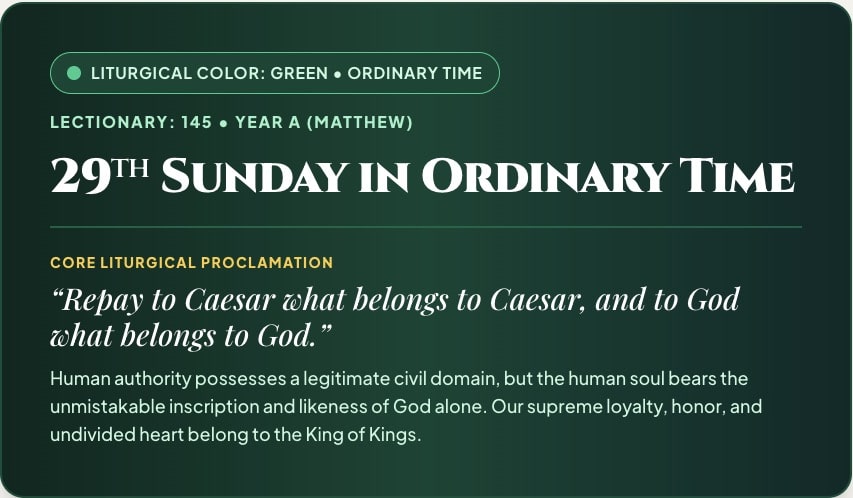
29th Sunday of Year A
October 18, 2026

Catholic Women Preach (2023)
CATHOLIC WOMEN PREACH
Catholic Women Preach | Jeff Cavins | Bishop Golka | Know Before You Go
1-Minute Homily | Cardinal Luis Tagle | SOLT Liturgy Prep | The Word on the Word


Dominican Friars (2020)
KNOW BEFORE YOU GO
Catholic Women Preach | Jeff Cavins | Bishop Golka | Know Before You Go
1-Minute Homily | Cardinal Luis Tagle | SOLT Liturgy Prep | The Word on the Word

The Jesuit Post (2023)
1-MINUTE HOMILY

Catholic Women Preach | Jeff Cavins | Bishop Golka | Know Before You Go
1-Minute Homily | Cardinal Luis Tagle | SOLT Liturgy Prep | The Word on the Word

Jescom TV (2023)
CARDINAL LUIS TAGLE

Catholic Women Preach | Jeff Cavins | Bishop Golka | Know Before You Go
1-Minute Homily | Cardinal Luis Tagle | SOLT Liturgy Prep | The Word on the Word

SOLT (2023)
SOLT LITURGY PREP

Catholic Women Preach | Jeff Cavins | Bishop Golka | Know Before You Go
1-Minute Homily | Cardinal Luis Tagle | SOLT Liturgy Prep | The Word on the Word
EWTN (2023)
THE WORD ON THE WORD

Catholic Women Preach | Jeff Cavins | Bishop Golka | Know Before You Go
1-Minute Homily | Cardinal Luis Tagle | SOLT Liturgy Prep | The Word on the Word
THE WORD THIS WEEK
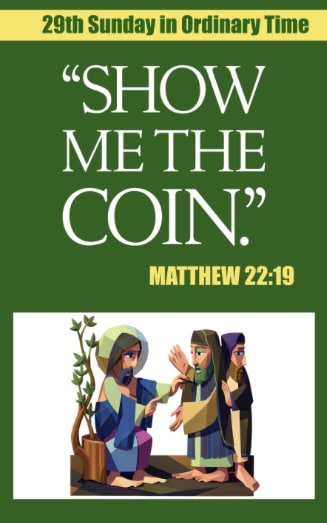
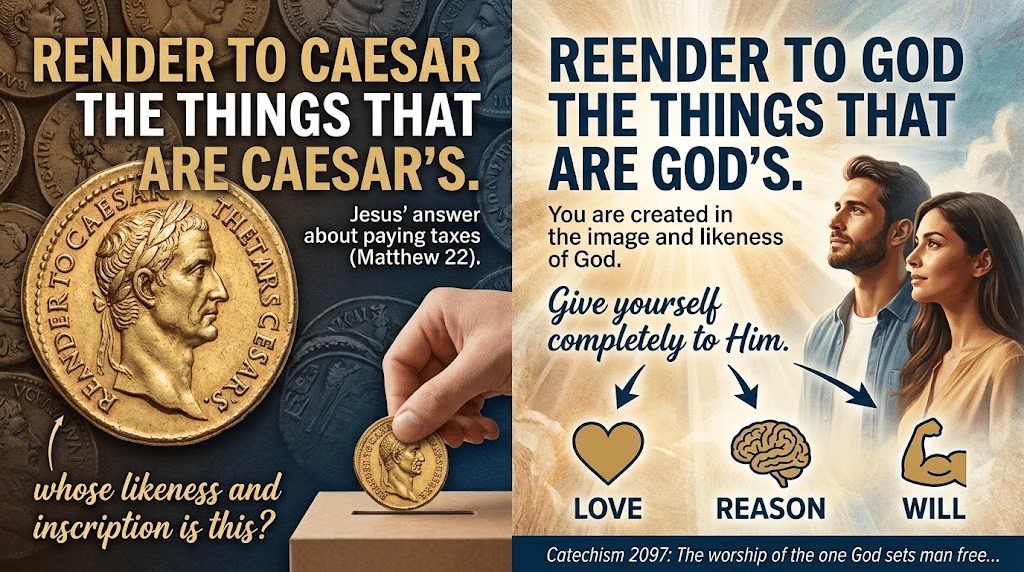
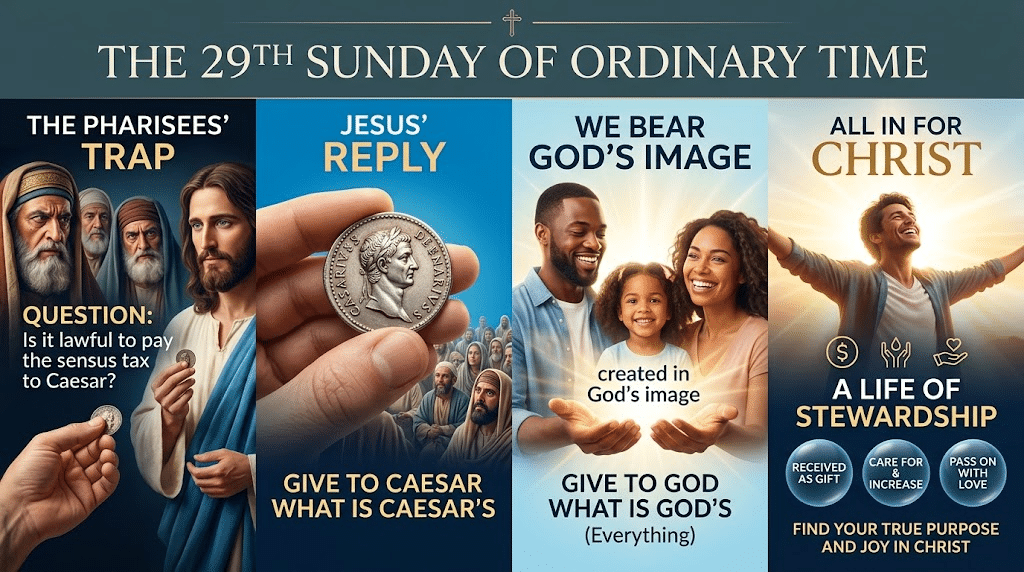
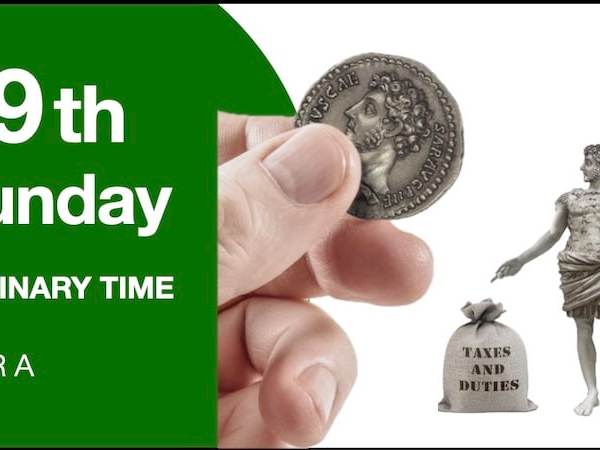
Caesar claims the coin
Bearing his own face an name
Give your soul to God
October 18, 2026


Papal Homilies




Featured Blog Posts
October 18, 2026



Fr. George Corrigan, OFM
Flow and Direction
Taxes and Faith
The Question
The Response
An Underlying Thought
Giving Back
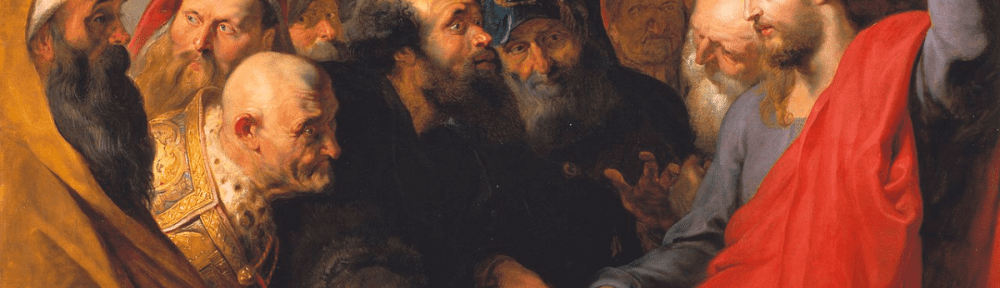
In Whose Image..
Msgr. Joseph Pellegrino (PDF) | Archive
Render to Caesar and to God What is God's (2026)
Doing Our Bit (2017)
Forming Citizens (2014)
Fr. Michael Fallon, MSC | Archive
29th Sunday in Ordinary Time (PDF)

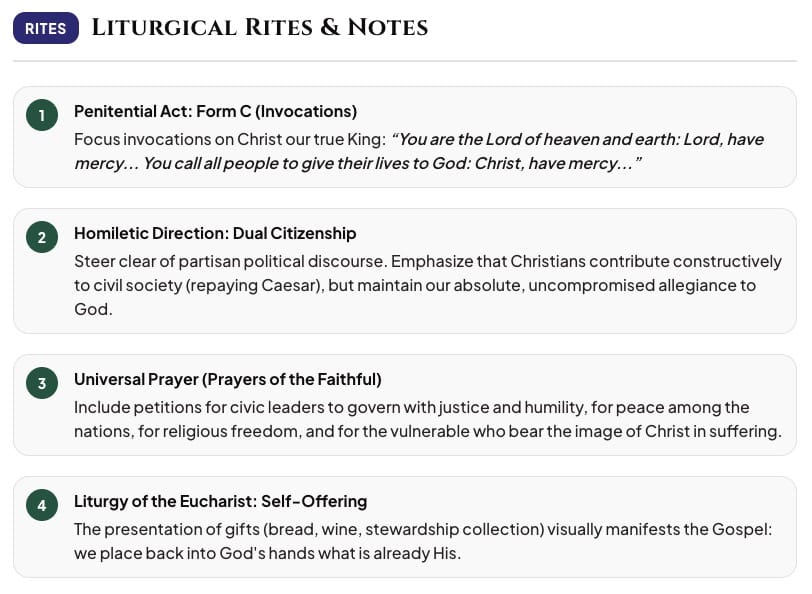
Liturgy Notes
Courtesy of The Sunday Mass—2023 Cycle A


29th Sunday of Year A

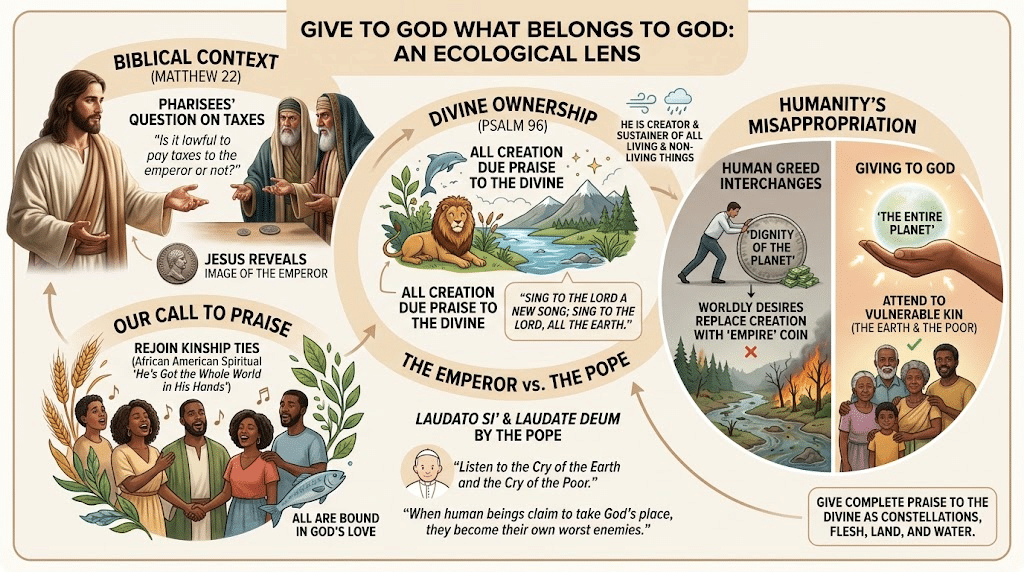
Everything Belongs to God
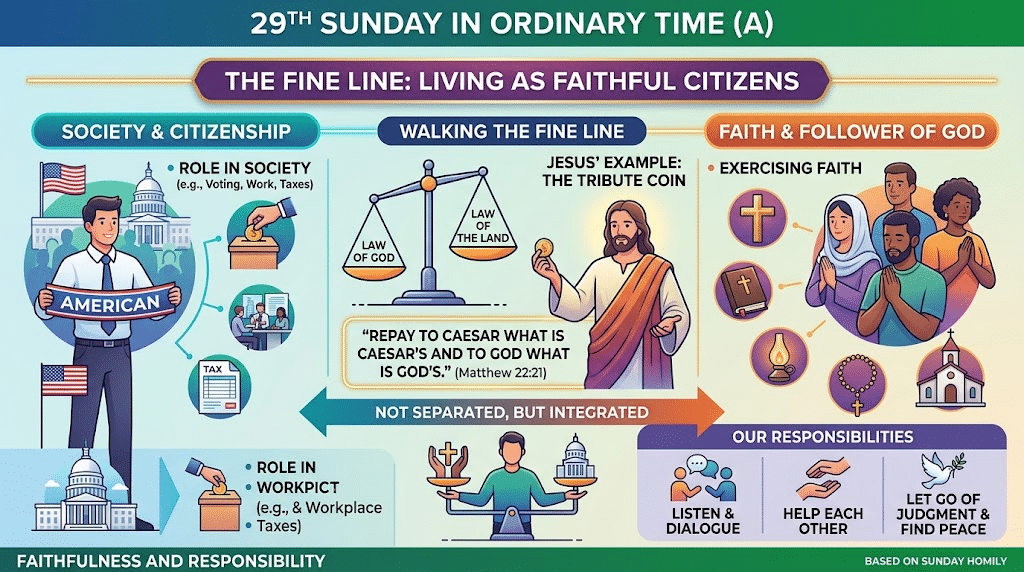
Jesus’ words at the end of our Gospel passage are often misinterpreted to support the separation of church and state, or more precisely, the banishing of religion from governmental decisions. Certain realms are discerned to belong to God and other realms are assigned to Caesar. But this misses a fundamental fact: Everything belongs to God. There is no area of life that is excluded from God’s concern, no area that can be managed properly without recognizing God’s sovereignty over all creation.
This issue arises often in parish life when some people object to preaching on issues of social justice in church because all justice issues have political implications. Preachers should not mention climate change, for example, because one party insists it is not happening. Or preachers should not mention abortion because one party insists women should have complete freedom to kill the unborn for any reason. You can easily come up with a long list of topics that will provoke a negative reaction if they are mentioned in church.
But if everything really belongs to God, then no issue is beyond the church’s concern or teaching. Preachers and planners should certainly try to avoid strictly partisan advocacy, but issues like climate change, immigration, budget cuts, taxation, living wages, abortion, the death penalty, etc. must be addressed in light of the Gospel.
Full Series: Cycle A Resources

Entrance Song
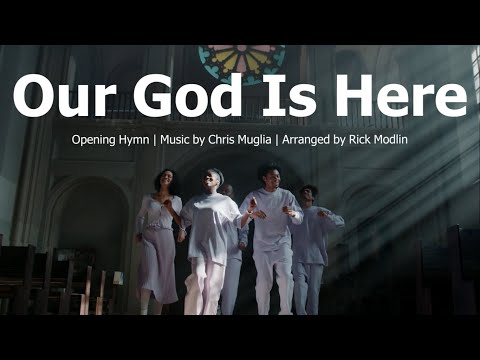
Response & Acclaim
Response & Acclaim




Presentation & Preparation
Presentation and Preparation

Communion
Communion

Sending Forth
Sending Forth
Your Grace Is Enough (Matt Maher)

Liturgy Blog is a weekly liturgy planning resource for musicians, liturgists, homilists, youth groups, faith sharing groups, and all who look to the liturgical readings for inspiration and nourishment. Join Ken Canedo as he breaks open the Scripture and suggests tracks from the Spirit & Song contemporary repertoire.
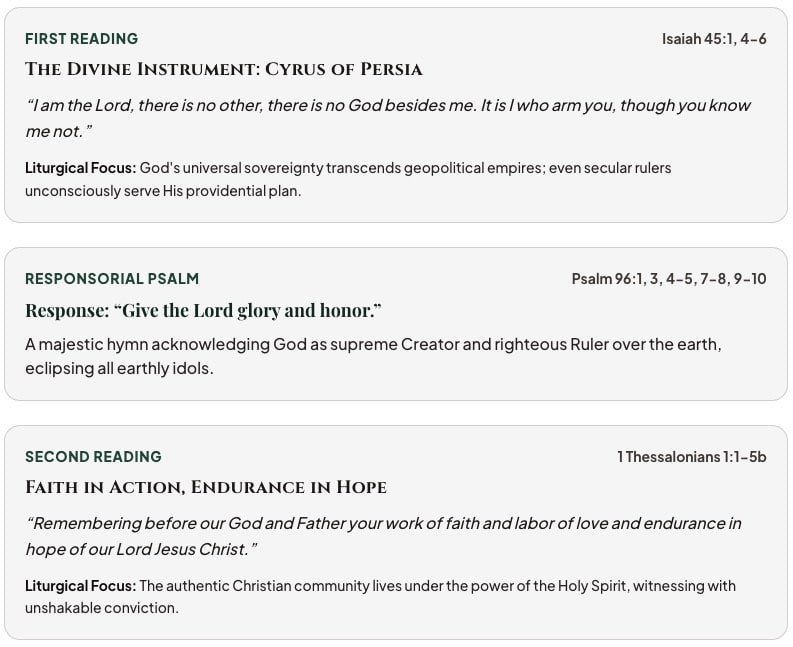
Isaiah 45:1, 4-6

2023 video courtesy of Lector with Lisa

29th Sunday in Ordinary Time — First Reading
Isaiah 45:1, 4–6
The Watchword
Core Focus: Proclaiming absolute divine sovereignty over secular history, not merely narrating past events.
Vocal Profile: Choose one overarching posture for the opening: Imperial Power (commanding, authoritative, upright chest) or Nurturing Providence (warm, gathered, steady). Whichever path you choose, the conclusion demands total, unhurried, deliberate certainty.
Pacing Principle: Let the parallel couplets breathe across the room. Never rush the repeated declarations of God’s name.
Delivery Blueprint
Text Segment | Vocal Tone | Pacing & Ambo Actions |
"Thus says the Lord to his anointed, Cyrus, whose right hand I grasp," | Choice A: Regal, booming majesty. Choice B: Warm, intimate, protective strength. | Plant feet squarely. Lift chin and look up to establish presence before speaking. Emphasize "anointed" and "grasp" with vocal weight, not hand gestures. |
"subduing nations before him, and making kings run in his service," | Driving, forceful cadence; crisp diction. | Keep pace measured. Let the voice convey authority rather than physical motion. |
"opening doors before him and leaving the gates unbarred:" | Broad, resonant, clear. | Note: "Gates unbarred" means the city walls are stripped of defense. Pause 2 full seconds here to mark the turn from decree to divine reason. |
"For the sake of Jacob, my servant, of Israel, my chosen one," | Tender, deeply rooted, affectionate warmth. | Classical Hebrew parallelism. Look toward the left nave on "Jacob, my servant," then sweep gaze to the right nave on "Israel, my chosen one." |
"I have called you by your name, giving you a title, though you knew me not." | Direct, personal, slightly dropped register. | Steady pace. Eye contact directly with the center assembly on "knew me not." |
"I am the Lord and there is no other, there is no God besides me." | Utterly resolute, slow, unyielding conviction. | Mandatory full stop. Slow your pace by half. Deliver without anger, but with absolute finality—there is no debate here. |
"It is I who arm you, though you know me not," | Firm, quiet authority. | Slight breath pause between clauses. Re-anchor your posture at the ambo. |
"so that toward the rising and the setting of the sun" | Expansive, wide, universal scope. | Meaning: East to West—everywhere. Sweep eyes naturally across the entire congregation from one side to the other. |
"people may know that there is none besides me." | Weighty, declarative, grounded. | Hold voice steady; avoid trailing off at the end of the line. |
"I am the Lord, there is no other." | Maximum stillness, deep resonance, slow cadence. | Deliver entirely while maintaining direct eye contact. Hold silence for 3 full seconds before saying: "The word of the Lord." |
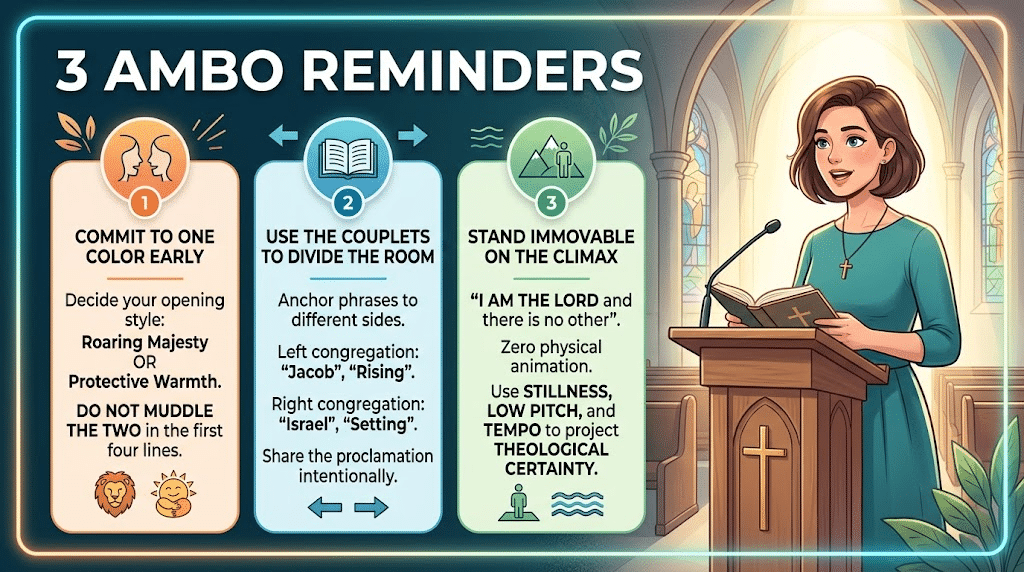
- Commit to One Color Early: Decide before you approach the ambo whether your opening is roaring majesty or protective warmth; do not muddle the two in the first four lines.
- Use the Couplets to Divide the Room: On the parallel phrases ("Jacob" / "Israel", "rising" / "setting"), share the proclamation intentionally by anchoring one phrase to the left side and the matching phrase to the right side of the congregation.
- Stand Immovable on the Climax: The double declaration ("I am the Lord and there is no other") requires zero physical animation. Let stillness, low pitch, and broad tempo project complete theological certainty.
Isaiah 45:1, 4-6
Greg Warnusz


Proclaiming It: Read this passage aloud mindful that you are speaking in the voice of Isaiah who is speaking as the voice of God. Imagine how authoritative the prophet tried to sound, telling the conquering emperor who his Real Boss is. That demands a weighty, solemn, commanding tone.
In view of the historical situation described above, and the theological implication described below, the word "anointed" is very interesting. Pronounce this weighty title with some irony, if you can. For Isaiah is giving to a pagan the title reserved for Judah's kings, the likes of David and Solomon, indeed the title that would eventually be reserved for the Messiah (which means "anointed" in Hebrew).
The final emphasis, though, has to be on the sovereignty of God, who can make an unwitting tool of even the most powerful earthly king. Notice the repetion of "I am the LORD, there is no other," and "though you know me not." One does not trifle with this God.

Thess 1:1-5b

2023 video courtesy of Lector with Lisa
29th Sunday in Ordinary Time — Second Reading
1 Thessalonians 1:1–5b
The Watchword
Core Focus: This is an intimate, living letter spoken directly to the people sitting right in front of you—not a history lesson about ancient Greece. Mentally address your own parish community.
Vocal Profile: Warm, pastoral, affectionate, and deeply reassuring. Transition from an open fraternal greeting into rising theological conviction.
Pacing Principle: "Collect and deliver." Look down at the text to gather a phrase, lift your eyes completely to deliver it directly to the congregation, then pause. Unhurried cadence throughout.
Delivery Blueprint
Text Segment | Vocal Tone | Pacing & Ambo Actions |
"Paul, Silvanus, and Timothy to the church of the Thessalonians" | Clear, formal salutation, grounded and welcoming. | Stand tall; pause before speaking. Mentally replace "Thessalonians" with your own parish family sitting before you. |
"in God the Father and the Lord Jesus Christ:" | Reverent, steady, resonant. | Make steady eye contact across the center aisle. Full 2-second pause at the colon to mark the shift to the blessing. |
"grace to you" | Warm, gentle, priestly blessing. | Turn your gaze deliberately to the left side of the church; speak directly to them. |
"and peace." | Settled, peaceful, tender. | Turn your gaze deliberately to the right side of the church. Pause briefly to let the blessing land. |
"We give thanks to God always for all of you," | Expansive, heartfelt gratitude. | Stretch out the words "all of you" while sweeping your eyes across the entire congregation to embrace everyone in the room. |
"remembering you in our prayers unceasingly," | Quiet, intimate, personal. | Look down to collect the phrase, then look up into the middle rows as you deliver it. |
"calling to mind your work of faith and labor of love" | Affirming, admiring, rhythmic warmth. | Keep the pace unhurried. Slight stress on "faith" and "love." |
"and endurance in hope of our Lord Jesus Christ, before our God and Father," | Uplifting, steadfast, noble. | Lift your posture. Eye contact centered; let "God and Father" resolve downward smoothly. |
"knowing, brothers and sisters loved by God, how you were chosen." | Deeply affectionate, joyful wonder. | Drop your register slightly for intimacy. Eye contact locked on the assembly for "loved by God." Brief pause. |
"For our gospel did not come to you in word alone," | Inquiring, rising inflection ("no, not just words"). | Voice lifts slightly at the end of the clause. Make direct eye contact with anticipation. |
"but also in power and in the Holy Spirit and with much conviction." | Robust, confident, rising strength and absolute certainty. | Deliver each element with added vocal weight: look down, collect, look up to proclaim "power"... "Holy Spirit"... "much conviction." |
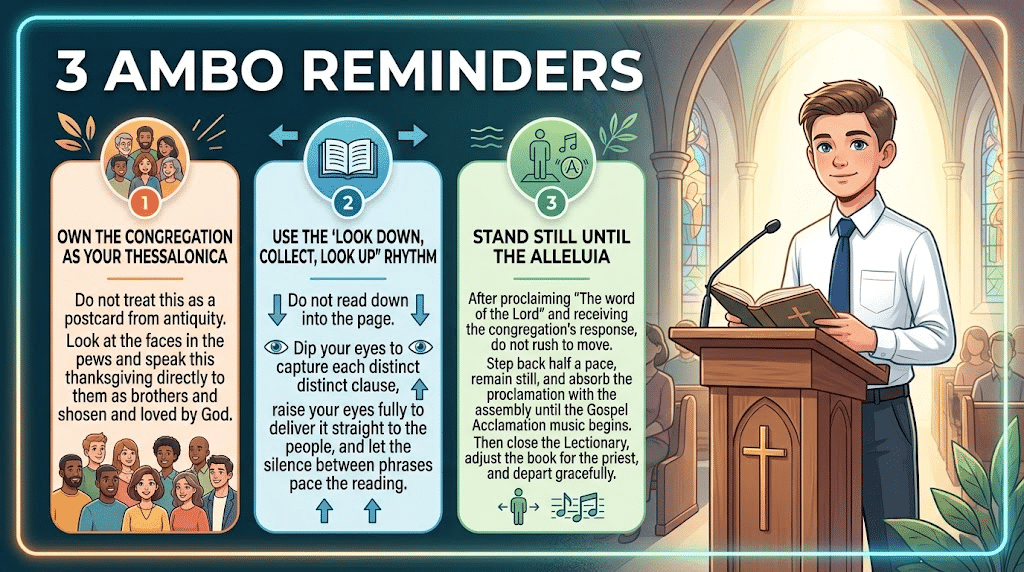
- Own the Congregation as Your Thessalonica: Do not treat this as a postcard from antiquity. Look at the faces in the pews and speak this thanksgiving directly to them as brothers and sisters chosen and loved by God.
- Use the "Look Down, Collect, Look Up" Rhythm: Do not read down into the page. Dip your eyes to capture each distinct clause, raise your eyes fully to deliver it straight to the people, and let the silence between phrases pace the reading.
- Stand Still Until the Alleluia: After proclaiming "The word of the Lord" and receiving the congregation's response, do not rush to move. Step back half a pace, remain still, and absorb the proclamation with the assembly until the Gospel Acclamation music begins. Then close the Lectionary, adjust the book for the priest, and depart gracefully.
Thess 1:1-5b
Greg Warnusz

The Historical Situation: In ancient times, one did not begin a letter with simple words like "Dear friends." Nor did any writer have letterhead stationery. The writer had to name himself and his audience, as if he was giving the letter a title. Only then, if he was a religious authority like Saint Paul, could he say, "grace to you and peace."
Proclaiming It: So pause after that expression and take a breath. And if you wish, title the reading "The beginning of the First Letter of Saint Paul to the Thessalonians."
What was going on among the Christians in Thessalonika that led Saint Paul to write? That unfolds slowly in the selections we'll proclaim over five Sundays. From today's text, it's clear that these people worked hard at being Christians, and that Saint Paul thought that praiseworthy.
