Commentary Intro to Mass Readings Sunday Readings
CommentaryIntro to Mass Readings Sunday Readings
October 4, 2026
⭐⭐⭐ Fr. George Corrigan, OFM—PDF


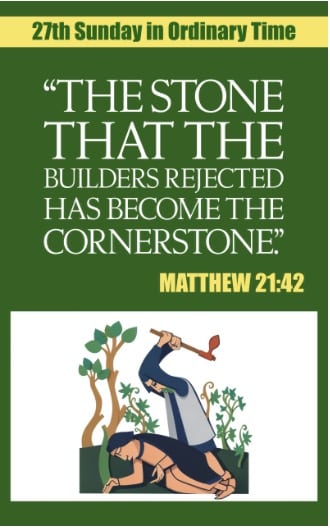
October 4, 2026
Our Sunday Readings
Edrianne Ezell
Catholic Scripture Study
Vince Contreras
Hearers of the Word
Fr. O’Mahony OSA
Friar Musings, OFM
Fr. George Corrigan, OFM
Echoing God’s Word
Fr. Clement Thibodeau


“A Walk in The Word” series is based on the Sunday Mass readings and led by International Catholic evangelist and bible teacher, Hector Molina.

Ten minute video excerpts from the “The Mass Readings Explained” subscription series based resource from Catholic Productions.

Francis Martin (1930 – 2017) was an American Catholic priest of the Archdiocese of Washington, and a professor of Sacred Scripture. His teaching appointments included the Dominican House of Studies, the John Paul II Institute, the Catholic University of America, and Sacred Heart Major Seminary.
Kevin Aldrich
Kevin Aldrich’s “Doctrinal Homily Outlines” is a lectionary-based aid for homilists. A career Catholic K-12 educator in Catholic schools., he has written the teacher guides for nine of the Didache series high school religion texts. He has a Master’s Degree in Theology with an emphasis on Sacred Scripture from Holy Apostles College and Seminary.

Fr. Geoffrey Plant
27th Sunday of Year A

Isaiah 5:1-7
Create a verse by verse (NAB) commentary relating xxxxxxxxxxxxx TO CATHOLIC doctrine and practice. Give real life applications when appropriate
give me three thought provoking questions followed up with detailed answer reflection based on xxxxxxxxxxxx
Isaiah 5:1
"Let me now sing of my friend, my beloved’s song about his vineyard. My friend had a vineyard on a fertile hillside;"
- Theological Commentary & Catholic Doctrine:Isaiah sings on behalf of God, the "beloved." In Catholic exegesis, God’s relationship with His people is inherently covenantal and spousal—a theme later elevated to Christ’s spousal union with the Church (Ephesians 5:25–32). The "fertile hillside" (horn of the son of oil) signifies the abundance of sanctifying grace and divine favor bestowed upon Israel. God never demands fruit where He has not first cultivated the soil of the human soul.
- Practice & Liturgy:This verse echoes the Sacrament of Baptism, in which the soul is transplanted from the wilderness of original sin into the fertile ground of the Church, enriched by grace and the theological virtues (Faith, Hope, and Charity).
- Real-Life Application:Recognize that your talents, material resources, family stability, or access to the sacraments are not personal achievements, but God's gift of "fertile soil." When evaluating your life, start from gratitude rather than entitlement, asking: What conditions has God gifted me with that others lack?
Isaiah 5:2
"He spaded it, cleared it of stones, and planted the choicest vines; Inside it he built a watchtower, and hewed out a wine press. Then he waited for a harvest of grapes, but what it yielded was wild grapes."
- Theological Commentary & Catholic Doctrine:God takes five deliberate horticultural steps: clearing impediments (spading, removing stones), supplying the finest lineage (the choicest vine), offering protection (watchtower), and making preparation for Communion (the wine press).
- The Council of Trent affirms that while grace is a free gift, humans possess authentic free will to cooperate with or resist that grace.
- The "wild grapes" (be'ushim, literally "stinking things" or sour berries) symbolize works devoid of charity—formal religiosity without moral conversion, or sins of pride and malice.
- Practice & Liturgy:The watchtower represents the Magisterium and spiritual direction, guarding the soul against heresy and temptation. The wine press points Eucharistically to sacrifice; good grapes must be crushed to produce wine. The Church expects our lives to yield the fruits of the Holy Spirit (Galatians 5:22–23).
- Real-Life Application:A Catholic who attends Mass every Sunday, volunteers on committees, but harbors secret bitterness, gossips viciously at the parish picnic, or cheats on their taxes produces "sour grapes." God desires the sweet vintage of genuine charity, humility, and honesty over decorative piety.
Isaiah 5:3
"Now, inhabitants of Jerusalem and people of Judah, judge between me and my vineyard!"
- Theological Commentary & Catholic Doctrine:God appeals to the moral conscience of the hearers, inviting them to sit as jury before realizing they are the accused. Catholic moral theology stresses the inviolability and formation of conscience (Catechism of the Catholic Church, 1783–1785). God’s justice is not arbitrary or tyrannical; it appeals to the natural law written into the human heart (Romans 2:15).
- Practice & Liturgy:This is the Scriptural pattern for the Examination of Conscience prior to the Sacrament of Reconciliation. God does not condemn us without first asking our conscience to acknowledge reality: Has God failed us, or have we failed God?
- Real-Life Application:Take five silent minutes before bed or confession. Rather than rationalizing stress or difficult circumstances as excuses for short-temperedness or neglected prayer, ask honestly: If God laid out everything He gave me today against what I offered in return, what would the honest verdict be?
Isaiah 5:4
"What more was there to do for my vineyard that I had not done! Why, when I waited for the harvest of grapes, did it yield wild grapes?"
- Theological Commentary & Catholic Doctrine:This divine lament expresses the mystery of iniquity and grace. In Catholic soteriology, God provides sufficient grace for all people to be saved; the failure lies entirely in human obstinacy and rejection of actual grace. In Christ, God literally did "everything" possible—giving His only-begotten Son unto death on a cross.
- Practice & Liturgy:This verse directly inspires the ancient Reproaches (Improperia) chanted during the Good Friday Adoration of the Holy Cross:"My people, what have I done to you? Or how have I grieved you? Answer me! ... I planted you as my fairest vine, but you have become bitter to me; for in my thirst you gave me vinegar to drink, and pierced your Savior's side with a lance."
- Real-Life Application:Reflect on moments when you blamed God for spiritual dryness or moral failure ("Why didn’t God take this temptation away?"). God has given the sacraments, prayer, Scripture, and the communion of saints. Ask whether the failure stems from a lack of divine support or a personal refusal to surrender an attachment to sin.
Isaiah 5:5
"Now, I will let you know what I am going to do to my vineyard: Take away its hedge, give it to grazing, break down its wall, give it to trample;"
- Theological Commentary & Catholic Doctrine:God does not actively inflict evil; rather, He withdraws His special protective grace, allowing the soul to experience the intrinsic consequences of its choices. In Catholic theology, this is the doctrine of permissive will and divine abandonment to sin (as in Romans 1:24). When a soul persistently chooses the wild hedge over God's garden, God honors that freedom, leaving it exposed to the assaults of the world, the flesh, and the devil.
- Practice & Liturgy:This corresponds to the spiritual state of mortal sin, which ruptures sanctifying grace, destroys the supernatural hedge around the soul, and leaves the spiritual faculties vulnerable to disorder and despair until restored through Sacramental Absolution.
- Real-Life Application:Consider an individual or family that abandons prayer and moral discipline to chase professional prestige or unbridled screen consumption. Over time, the "protective wall" around the home crumbles, resulting in broken communication, infidelity, or pervasive anxiety. The destruction is not a lightning bolt from heaven, but the natural consequence of dismantling God's protective boundaries.
Isaiah 5:6
"I will make it a waste, unpruned, undug; briers and thorns shall outgrow it; I will forbid the clouds to send rain upon it."
- Theological Commentary & Catholic Doctrine:A neglected vineyard quickly reverts to thorns and thistles—a direct callback to the curse of Genesis 3:18. Withholding the "rain" represents the withdrawal of actual graces and the gifts of the Holy Spirit.
- In the Catholic spiritual life (such as in the writings of St. John of the Cross and St. Teresa of Ávila), pruning and digging—though painful—are necessary marks of divine care. When God stops pruning, it signifies a grave spiritual hardening of heart (obduratio cordis).
- Practice & Liturgy:The thorns point typologically to Christ’s Crown of Thorns, where the King of Kings absorbed the bitter wild growth of our sins onto His own head to redeem our sterile works.
- Real-Life Application:Do not despise the "pruning" moments of life—such as an unexpected setback, a corrective word from a spouse or mentor, or the mortification of fasting. When life feels too comfortable and unchallenged by the Gospel, examine whether you have become an "undug" garden where subtle vices (sloth, vanity, materialism) are choking out prayer.
Isaiah 5:7
"The vineyard of the LORD of hosts is the house of Israel, the people of Judah, his cherished plant; He waited for judgment, but see, bloodshed! for justice, but hark, the outcry!"
- Theological Commentary & Catholic Doctrine:Isaiah concludes with a famous Hebrew wordplay that exposes structural and personal hypocrisy:
- He looked for Mishpat (judgment/justice), but found Mispach (bloodshed/oppression).
- He looked for Tzedakah (righteousness), but heard Tze’akah (the outcry of the oppressed).
- Practice & Liturgy:Every Mass ends with the dismissal: "Ite, missa est" ("Go forth, the Mass is ended" / "Go, you are sent"). Having consumed the Fruit of the True Vine at the altar, the faithful are commanded to live out the works of mercy in the public square.
- Real-Life Application:Evaluate your economic and civic footprint:
- In Business: Do you pay fair, family-supporting wages, or do you squeeze workers/contractors to pad profits?
- In Community: Do you defend the unborn, welcome the lonely, and care for the elderly, or do you look away when the vulnerable cry out?Orthodoxy in belief (right doctrine) must bear fruit in orthopraxy (right action). Without justice, religious rituals ring hollow before God.
Algorithmically generated text
give me three thought provoking questions followed up with detailed answer reflection based on xxxxxxxxxxxx. Keep questions and answers appropriate for Sunday congregation giving real life application.
In Isaiah’s parable, the owner did not find an empty field—he found a vineyard covered in growth, foliage, and clusters of what looked like fruit from a distance. But up close, the vines had produced wild, sour grapes (be’ushim), which were bitter, foul-tasting, and completely unfit for making wine.
In the life of a parishioner, "wild grapes" represent outward religious activity that lacks inner transformation. It is easy to assume that because our calendar is full of church commitments—attending Mass every Sunday, singing in the choir, serving on the parish council, or dropping an envelope in the collection basket—we are fulfilling our calling. Yet, God is not looking merely for religious motion; He is tasting for love.
A real-life examination means looking at how we act when church lets out:
- Do we listen devoutly to the Gospel reading on Sunday morning, only to speak harshly, impatiently, or dismissively to our spouse and children on the car ride home?
- Do we exchange the Sign of Peace at the altar, but harbor years of cold resentment against a sibling, neighbor, or coworker?
- Do we pride ourselves on being "good Catholics" while quietly indulging in gossip, workplace cutthroat competition, or indifference toward those in need?
True grapes are the fruits of the Spirit (Galatians 5:22–23): patience under stress, genuine kindness to those who cannot repay us, humility when corrected, and mercy toward those who fail us. God does not just ask whether our vineyard is green; He asks whether the fruit of our life is sweet or sour to the people around us.
Algorithmically generated text
God’s lament in verse 4 is heart-wrenching. He did not plant His vineyard on a rocky cliff and abandon it; He cleared the stones, built a watchtower to protect it, dug a wine press in joyful expectation, and gave it every horticultural advantage.
As Catholics sitting in the pews, we must acknowledge the immense spiritual advantages we enjoy. We have not been left to wander in spiritual starvation:
- We have the Sacraments, especially the Eucharist—the real presence of Christ as living food—and the Sacrament of Reconciliation, offering complete pardon when we stumble.
- We have two thousand years of Church wisdom, the Holy Scriptures, rich traditions of prayer, and communities of faith.
- On a material level, most of us have clean water, roofs over our heads, steady food, and freedom of worship.
Often in daily life, we catch ourselves making excuses: "I would be more patient if my job wasn't so stressful," "I would pray more if my schedule wasn't so hectic," or "I would be more generous if prices weren't so high." But Isaiah 5 reminds us that God has already supplied the soil, the rain, and the protection.
The real-life challenge is stewardship. When God looks at the investments He has made in our lives—our health, our time, our financial security, our access to grace—what return is He receiving? Grace is not a museum piece to be admired; it is fuel meant to be spent in service, sacrificial giving, and active discipleship.
Algorithmically generated text
The climax of the Song of the Vineyard reveals what broke the heart of God: He looked for justice and found oppression; He looked for righteousness and heard the outcry of those being crushed. The vineyard failed not because of bad doctrine or missed temple rituals, but because the strong took advantage of the weak, and the community turned a deaf ear to suffering.
Christian faith cannot remain inside church walls. Catholic Social Teaching reminds us that worship that does not lead to justice in the marketplace and the community is hollow.
Consider where this touches everyday life:
- In our workplaces and businesses: If you run a business, manage a team, or hire contractors, do you treat workers with fairness, pay honest wages, and respect their dignity, or do you cut corners at their expense to boost profits?
- In our spending and consumer habits: Are we conscious of supporting ethical practices, or do we prioritize convenience and bargains while turning a blind eye to exploited labor?
- In our civic and neighborhood life: Who are the people whose "outcry" is ignored in our community—the elderly neighbor living alone, the immigrant family trying to navigate a new neighborhood, the unborn, the struggling single parent?
Living Isaiah 5:7 means our faith must have hands and feet. When we leave the church doors, we are sent out to be the answer to someone's outcry, ensuring that where society creates division and neglect, Christ's people cultivate justice, charity, and peace.
Algorithmically generated text
Create a simple, modern infographic illustrating [INSERT BIBLE PASSAGE OR TOPIC]. Use a [SPLIT-SCREEN / 3-PANEL] layout. The style should be clean, high-quality digital art or vector illustration.
Visuals:
Panel 1: Show [DESCRIBE SCENE 1 – e.g., a stormy sea].
Panel 2: Show [DESCRIBE SCENE 2 – e.g., Jesus calming the waves].
Text & Typography:
Font: Use EXTRA LARGE, BOLD, SANS-SERIF FONT (like Arial). Ensure high contrast so text is easily readable.
Header: Write “[INSERT MAIN TITLE]” at the top.
Captions: Include short, punchy text summaries in the panels: “[TEXT FOR PANEL 1]” and “[TEXT FOR PANEL 2]”.
Overall Vibe: Professional, educational, and uncluttered. Avoid small details; focus on big images and big text.


Write an engaging description meant to get readers to read Larry Broding’s commentary which can be used to help preachers prepare their own homily. After a brief introduction give bulletin points of why this commentary matters for your homily.
Calling Upon God
When Times Are Bad

When crisis hits our world or our parish communities, the instinctive cry is almost universal: “Where is God in this darkness?” Larry Broding’s insightful commentary on the Song of the Vineyard (Isaiah 5:1–7) cuts straight through modern spiritual complacency to deliver the uncomfortable, essential truth every preacher must articulate: God’s apparent absence is often the natural harvest of our ongoing indifference.
- Exposes the “Foxhole Faith” Dilemma: Provides preachers with a sharp pastoral hook to challenge why parishioners only seek the Lord in emergencies, demonstrating that true faith is an enduring, daily walk rather than a panic button.
- Anchors the Text in High-Stakes History: Illuminates the 8th-century B.C. geopolitical chaos facing Judah, helping you draw vivid parallels between ancient border wars and the anxiety of modern headlines.
- Unpacks Prophetic Courage Against Elite Power: Standing inside the royal court of Jerusalem, Isaiah risked his life to directly confront the monarchy and judicial elite over systemic exploitation. Preachers can use this model to proclaim Catholic Social Teaching with conviction, reminding listeners that God holds those with authority accountable for how they treat the weak and vulnerable.
- Clarifies the Crucial Key of Verse 7: Broding highlights verse 7 as the master key that decodes the entire allegory through Isaiah’s sharp Hebrew wordplay. God looked for mishpat (justice) but saw mispach (bloodshed); He sought tzedakah (righteousness) but heard tze’akah (the outcry of the oppressed), cutting straight through empty religious formalism.
- Dismantles Entitlement and “Birthright” Presumption: The commentary provides strong pulpit rhetoric to dismantle the myth of spiritual exceptionalism. Judah assumed their status as God’s chosen people granted them automatic immunity, but Isaiah warned that covenant identity offers no safety net unless grace bears an active harvest of personal virtue and charity.
- Connects Directly to the Liturgical Flow: Broding bridges the First Reading directly into Matthew 21, where Jesus deliberately borrows Isaiah’s vineyard imagery to confront the Temple leadership. This helps the preacher weave the Old Testament reading and the Gospel into one cohesive message centered on true stewardship and the fruitfulness God demands.

Commentary by Dr. Brant Pitre | Catholic Productions

Commentary by Fr. Francis Martin | The Word Proclaimed
clean up grammar and spelling, divide into sections with titles for the following transcript xxxxxxxxxxxx
Verbal fillers, stumbles, and repetitions have been removed while keeping the original phrasing, theological precision, and cadence intact.
The Biblical Symbol of the Vine
Now we are going to look at part two, which will be the reading from Isaiah and the Psalm. As I noted, the overarching theme of these texts is the vine. The vine is an abiding biblical symbol. If you consult a reference like Léon-Dufour’s Dictionary of Biblical Theology under the entry "Vine," you will find a thorough collection of how this image is woven throughout Sacred Scripture. That imagery was vividly alive in the minds of Isaiah and his listeners, just as it was for our Lord and His hearers. Understanding this context helps us appreciate the abiding spiritual impact this symbol carries.
One of the fundamental botanical and spiritual principles is this: a vine is valuable for one thing only—its fruit. You cannot do anything with the rest of it. The leaves and the branches cannot be crafted into tools. In the Book of Ezekiel, the Lord presents this exact challenge:
"Son of man, what makes the wood of the vine better than any other wood, that branch among the trees of the forest? Can you use this wood to make anything worthwhile? Can you make even a peg from it to hang any vessel on it?" (cf. Ezekiel 15:2–3)
Even with an olive tree, you can carve the wood into religious artifacts or useful items, as is done in Bethlehem. But a vine that fails to yield fruit is completely useless. In Judges 9:13, the vine notes that its wine cheers both God and men. Psalm 104, reflecting on creation, praises God who brings forth bread from the earth and wine to gladden human hearts, oil to make faces gleam, and food to sustain human strength. In the New Testament, Christ brings this image to its fullness when He proclaims, "I am the vine," identifying Himself as the true Israel.
The Song of the Vineyard (Isaiah 5)
Imagine Isaiah on one of the great harvest feast days in Jerusalem, celebrating the gathering of the grapes. Isaiah, a prominent figure in the royal court and a learned scholar of his day, goes out to where people are singing and enjoying the festivities. He steps forward to challenge them, beginning:
"Let me sing of my friend, my beloved's song about his vineyard. My friend had a vineyard on a fertile hillside. He spaded it, cleared it of stones, and planted the choicest vines; inside it he built a watchtower, and hewed out a wine press." (cf. Isaiah 5:1–2)
The crowd recognizes the poetic imagery. Then comes the turn: he looked for a crop of grapes, but it yielded only wild, sour grapes. Speaking in God's name, the prophet addresses his audience directly: "Now, inhabitants of Jerusalem and people of Judah, judge between me and my vineyard! What more was there to do for my vineyard that I had not done?"
God lays out His case: He gave them His Word, corrected them, forgave them, guided them, gave them kings, prophets, and wise teachers, alongside the prosperity of the land and the splendor of the Temple—where Isaiah himself received his prophetic call.
Then comes the divine judgment:
"Now, I will let you know what I am going to do to my vineyard: Take away its hedge, give it to grazing, break down its wall, give it to trample. I will make it a waste, unpruned, undug; briers and thorns shall outgrow it; I will forbid the clouds to send rain upon it." (cf. Isaiah 5:5–6)
Isaiah concludes with a powerful Hebrew wordplay: God looked for mishpat (justice), but saw mispach (bloodshed); He looked for tzedakah (righteousness), but heard tze'akah (an outcry of the oppressed). The people bore no good fruit, and the song stands as an urgent summons to repentance.
The Broken Hedge and the Plea of Psalm 80
Psalm 80 reflects on the historical aftermath of those prophetic warnings, written in the shadow of devastation and exile. The psalmist prays:
"A vine from Egypt you transplanted; you drove away the nations and planted it... Why have you broken down its walls, so that every passerby plucks its fruit? The boar from the forest lays it waste, and the beasts of the field feed upon it." (cf. Psalm 80:9, 13–14)
The community recognizes that their vulnerability and ruin stem from their own infidelity. When our Lord revisits this imagery in John 15, He warns that every branch that fails to bear fruit is pruned, gathered, and cast into the fire.
Why does God desire us to bear fruit? He wants it for the redemption and blessing of the entire human family. He seeks the fruit of prayer, charity, reparation, intercession, and concrete care for the poor.
Psalm 80 then turns into an earnest plea for divine restoration: "O Lord of hosts, look down from heaven and see; take care of this vine, and protect what your right hand has planted—the son of man whom you made strong for yourself." In the Book of Daniel, the "Son of Man" approaches the Ancient of Days, representing both the royal deliverer and the faithful saints of the Most High. The psalmist asks for grace, confessing human weakness: "Then we will no more withdraw from you; give us new life, and we will call upon your name."
This is deeply humble theology. The psalmist does not claim, "Lord, we will pull ourselves together by our own willpower." We have no spiritual resources of our own to fulfill God’s law without His grace. We pray: "Restore us, Lord God of hosts; let your face shine upon us, that we may be saved."
The Living Word for the Church Today
The foundational message across these readings is that the vineyard is the people of God. When this Gospel is proclaimed on the 27th Sunday in Ordinary Time, it is not an exercise in historical finger-pointing to say, "Look how unfaithful the ancient leaders were." It is the living Word of God addressed to us in the pews today.
God calls us to an authentic interior conversion so that our lives yield good fruit. The world needs to see that reality: they must see the radiance of Christ on our faces, authentic forgiveness in our hearts, and our active defense of the weakest and most vulnerable, especially the unborn. The world may resist that witness, but they will recognize its truth, and through that witness, many will be drawn to Christ.
Click chevron banner to read transcript
organized into thematic sections.
27th Sunday of Year A

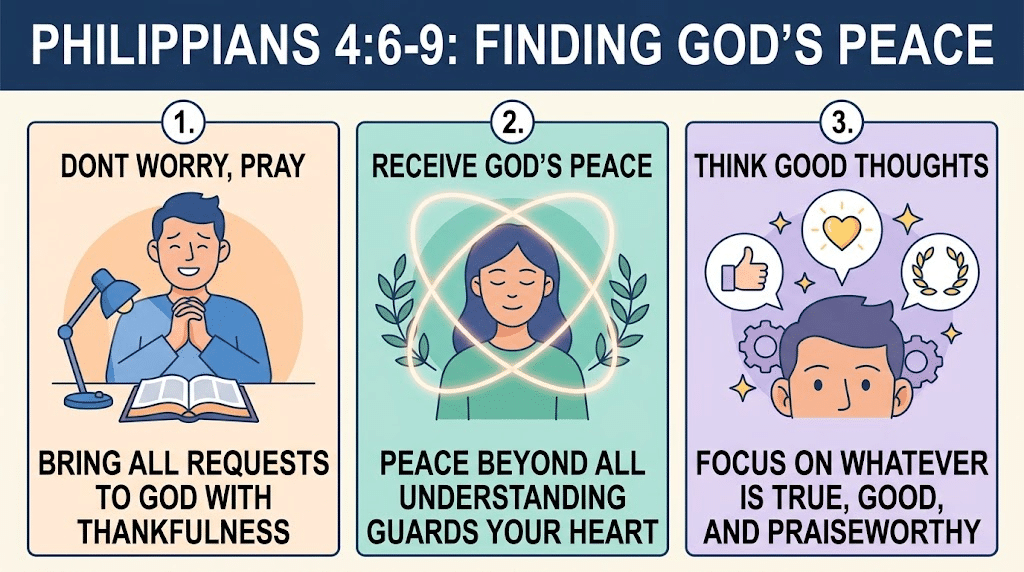
Philippians 4:6-9
Create a verse by verse (NAB) commentary relating xxxxxxxxxxxxx TO CATHOLIC doctrine and practice. Give real life applications when appropriate
give me three thought provoking questions followed up with detailed answer reflection based on xxxxxxxxxxxx
Philippians 4:6
"Have no anxiety at all, but in everything, by prayer and petition, with thanksgiving, make your requests known to God."
- Theological Commentary & Catholic Doctrine:Paul does not advocate emotional stoicism or the suppression of grief; rather, he confronts merimna—the fractured, debilitating worry that doubts Divine Providence. In Catholic moral theology, chronic distrust in God's fatherly care wounds the virtue of Hope (Catechism of the Catholic Church, 2090).
- Paul’s prescription weaves together four distinct elements of prayer: adoration/worship, supplication, petition, and crucially, thanksgiving (eucharistia).
- Gratitude is not an afterthought; it is the spiritual anchor that remembers past graces and trusts that God works all things for good (Romans 8:28).
- Practice & Liturgy:The very word for thanksgiving—eucharistia—points directly to the source and summit of the Church’s life: the Holy Sacrifice of the Mass. Every Mass begins with a surrender of sins (Penitential Act), carries our intercessions (Prayers of the Faithful), and grounds everything in the great thanksgiving of the Eucharistic Canon.
- Real-Life Application:When an anxious spiral begins—over an unexpected medical report, a sudden financial expense, or family friction—interrupt the mental panic with an audible, specific prayer of thanksgiving before asking for help:
- Name three concrete blessings God gave you this week.
- Explicitly surrender the exact scenario causing fear: "Lord, I give You this diagnosis/bill. You are in control, and I trust You."
- Make this the core of your daily morning offering or night examination of conscience.
Philippians 4:7
"Then the peace of God that surpasses all understanding will guard your hearts and minds in Christ Jesus."
- Theological Commentary & Catholic Doctrine:The consequence of surrender is not necessarily the immediate removal of the problem, but the arrival of the "peace of God" (shalom).
- This peace is supernatural—it cannot be engineered through self-help techniques, breathing exercises, or favorable external circumstances. It "surpasses all understanding" because it coexists with suffering and uncertainty.
- The Greek word for "guard" (phroureo) is a military term referring to a garrison stationed to keep watch over a hostile city. In Catholic theology, this garrison is the indwelling presence of the Holy Spirit and the infusion of sanctifying grace, which protects the soul's two primary faculties: the heart (affections, desires, and will) and the mind (intellect and thoughts).
- Practice & Liturgy:Before receiving the Holy Eucharist, the priest prays aloud: "Lord Jesus Christ, who said to your Apostles: Peace I leave you, my peace I give you..." We then offer one another the Sign of Peace. This is not a casual social greeting; it is an invocation of Christ’s garrisoned protection over the Church against the assaults of the world and the evil one.
- Real-Life Application:Peace is the primary litmus test of spiritual discernment in the Catholic spiritual tradition (as articulated by St. Ignatius of Loyola). When discerning a significant life decision (career change, marriage, financial choices), anxiety, frantic urgency, and confusion typically signal the voice of the enemy. The presence of a quiet, steady, deep-seated peace—even amid worldly challenges—is the signature of the Holy Spirit.
Philippians 4:8
"Finally, brothers, whatever is true, whatever is honorable, whatever is just, whatever is pure, whatever is lovely, whatever is gracious, if there is any excellence and if there is anything worthy of praise, think about these things."
- Theological Commentary & Catholic Doctrine:Peace requires ongoing guardianship. Paul recognizes that what occupies the imagination inevitably shapes the human heart.
- This verse provides the Biblical foundation for Christian humanism and the doctrine of the Transcendentals (Truth, Goodness, and Beauty). As taught by St. Thomas Aquinas, all that is authentically true, good, and beautiful across human culture reflects the uncreated Beauty of God.
- In moral theology, this governs the custody of the mind and senses (CCC 2521–2524). Man cannot dwell on sordid, cynical, or impure content and expect to retain the peace of God.
- Practice & Liturgy:This verse is embodied in the practice of Mental Prayer and Lectio Divina (sacred reading). Rather than letting our thoughts drift into bitterness, envy, or triviality, the Church calls us to meditate daily on the Gospels, the lives of the Saints, the beauty of sacred art, and the wonders of creation.
- Real-Life Application:Perform a deliberate audit of your daily digital and cultural consumption:
- News & Outrage Culture: If your news feed or social media leaves you agitated, angry, or contemptuous toward political or cultural opponents, prune it. Outrage is not a fruit of the Spirit.
- Entertainment: Evaluate the media, shows, music, and podcasts you consume against Paul’s checklist: Is it pure? Is it honorable? Is it lovely?
- The Interior Monologue: When you catch yourself stewing over a grievance, rehearsal of past arguments, or envious comparisons, consciously redirect your mind to something good, noble, and worthy of praise.
Philippians 4:9
"Keep on doing what you have learned and received and heard and seen in me. Then the God of peace will be with you."
- Theological Commentary & Catholic Doctrine:Paul closes by uniting doctrine, tradition, and action. Christianity is not merely an intellectual philosophy or an interior emotional sanctuary; it is an apostolic way of life.
- Sacred Tradition and Apostolic Succession: Paul commands them to preserve what they have "learned and received and heard and seen" in him. This matches the Catholic doctrine of Sacred Tradition (Dei Verbum, 8–9)—the Gospel is handed down not by isolated texts alone, but through living witnesses, practices, and teachings rooted in the Apostles.
- Faith and Works: Interior contemplation (verse 8) must bear the fruit of exterior action (verse 9). As the Council of Trent reiterated, faith without obedience and active charity is dead. Notice the progression: in verse 7, we receive the peace of God; when we put apostolic faith into action in verse 9, we receive the God of peace Himself.
- Practice & Liturgy:This verse underpins the Catholic devotion to the Communion of Saints. We do not navigate the Christian life in isolation; we look to living mentors in the faith, holy elders, and the canonized saints as living prototypes of Paul's injunction: "Look at how they lived Christ, and do the same."
- Real-Life Application:
- Apostolic Mentorship: Seek out a spiritually mature Catholic (a trusted spiritual director, a devout peer, or a faithful elder) whose lived witness demonstrates humility and joy, and ask how they handle trials.
- Living Example for Others: Ask yourself whether your children, coworkers, or neighbors could look at your daily conduct and see Christ. If someone were to imitate your habits of speech, work ethic, and prayer, would it draw them closer to the "God of peace"?
- Routine Action: Do not delay putting spiritual insights into concrete practice. If the Holy Spirit moves you to forgive an offense, write a note of gratitude, visit the sick, or attend a weekday Mass, act on it immediately.
Algorithmically generated text
give me three thought provoking questions followed up with detailed answer reflection based on xxxxxxxxxxxx. Keep questions and answers appropriate for Sunday congregation giving real life application.
Most of us do not need to be told to pray when a crisis hits; panic naturally drives us to our knees. However, there is a subtle, profound difference between bringing our anxieties to God as a way to "negotiate" an outcome, and laying them at the altar in total trust. Notice Paul’s crucial ingredient: with thanksgiving. When we thank God before we even see the resolution, we acknowledge that He is already sovereign, loving, and at work.The promise that follows is often misunderstood. Paul does not promise that God will immediately grant our exact wish list or make the difficult circumstance disappear. Instead, he promises that the peace of God will guard your hearts and minds. In the original Greek, "guard" (phroureo) is a military term describing a garrison of soldiers stationed around a city gate to protect against enemy invasion.Consider how this looks in daily life:
When facing an uncertain medical prognosis, an unexpected job layoff, or a child who has walked away from the faith, our natural instinct is to mentally loop the worst-case scenarios late into the night.
Real surrender means interrupting that loop by speaking gratitude aloud: "Lord, thank You for the breath in my lungs today, thank You for walking with me in the past, and I place this outcome completely in Your hands."
The miracle of Christian peace is not the absence of trouble, but a supernatural calm that makes no sense to the world around us—a stillness that says, "Even if the worst happens, Christ is still Lord, and my eternity is secure."
Algorithmically generated text
St. Paul understood a fundamental psychological and spiritual reality: peace is not merely received; it must be defended. You cannot ask God for peace in verse 7 while allowing your mind to feast on poison in verse 8. What we dwell upon invariably shapes who we become.
In our modern world, we are inundated with digital noise, sensationalized cable news, outrage-driven social media feeds, and entertainment built around cynicism and scandal. Many Christians find themselves chronic victims of low-grade irritability, despair, and cynicism simply because they have handed over the custody of their minds to secular algorithms.
A deliberate audit of our mental diet is essential for Christian living:
The Outrage Trap: If scrolling through the morning headlines or social feeds leaves you clenched with anger, resentment toward neighbors, or despair about the future, you have allowed the world to set your agenda rather than Christ. Outrage is not a fruit of the Holy Spirit.
The Mental Filter: When a grievance or a critical judgment about a family member, pastor, or coworker starts playing on repeat, run it through Paul’s screen: Is this thought pure? Is it lovely? Is it gracious? Does rehearsing it bear good fruit?
Filling the Vacuum: You cannot fight bad thoughts simply by trying not to think them; you must replace them. Fill that space with what is noble: read the lives of the saints, contemplate sacred art and scripture, take a quiet walk in God's creation, or dwell on the quiet acts of charity happening in your community.
Algorithmically generated text
Paul closes with a breathtakingly bold challenge: Imitate me. He does not say, "Read my letters and agree with my theological points." He says, "Do what you saw me do." In the Catholic and apostolic tradition, faith is never merely an intellectual hobby or a Sunday-morning sentiment; it is a visible, embodied way of life.
Notice the beautiful escalation from verse 7 to verse 9. In verse 7, when we pray, we receive the peace of God. But in verse 9, when we put the Gospel into obedient practice, we receive the God of peace Himself. Presence follows practice.
This demands honest self-examination for everyone in the pews:
The Home Witness: If your children, grandchildren, or spouse only knew the Catholic faith by watching how you react to traffic, how you speak about your enemies, or how you handle financial stress, would they be drawn to Jesus Christ?
The Workplace Witness: Do your coworkers see someone who works with honest integrity, refuses to participate in water-cooler gossip, and shows patient compassion under pressure?
Mentorship and Humility: Faith is caught far more than it is taught. We are called to find spiritually mature elders whose peace we admire and learn from their habits of prayer and humility. At the same time, we must live with enough transparency and holiness that we can say to the next generation: "Walk alongside me, and let’s follow Christ together."
Algorithmically generated text
Create a simple, modern infographic illustrating [INSERT BIBLE PASSAGE OR TOPIC]. Use a [SPLIT-SCREEN / 3-PANEL] layout. The style should be clean, high-quality digital art or vector illustration.
Visuals:
Panel 1: Show [DESCRIBE SCENE 1 – e.g., a stormy sea].
Panel 2: Show [DESCRIBE SCENE 2 – e.g., Jesus calming the waves].
Text & Typography:
Font: Use EXTRA LARGE, BOLD, SANS-SERIF FONT (like Arial). Ensure high contrast so text is easily readable.
Header: Write “[INSERT MAIN TITLE]” at the top.
Captions: Include short, punchy text summaries in the panels: “[TEXT FOR PANEL 1]” and “[TEXT FOR PANEL 2]”.
Overall Vibe: Professional, educational, and uncluttered. Avoid small details; focus on big images and big text.
Write an engaging description meant to get readers to read Larry Broding’s commentary which can be used to help preachers prepare their own homily. After a brief introduction give bulletin points of why this commentary matters for your homily.
The Good Example
Every preacher faces the challenge of moving a congregation beyond Sunday comfort into Monday courage.Broding’s commentary on Philippians 4:6–9 shows how the quiet sanctuary of worship must overflow into public, virtuous witness. By illuminating the Eucharistic roots of Paul’s words, Broding provides homilists with the pastoral clarity needed to preach a faith that calms anxious hearts.
- Unlocks Liturgical Depth in Common Prayer: Illuminates the Greek term eucharistia (“thanksgiving”) and plural phrasing, helping you demonstrate to parishioners that prayer is not merely private therapy, but a communal, Eucharistic act of the gathered Church.
- Bridges the Altar and the Marketplace: Maps the movement from interior peace at the assembly (vv. 6–7) to exterior conduct in the wider world (vv. 8–9), showing your congregation how to carry the tranquility of the Mass into daily public life.
- Reframes Christian Virtue as an Apologetic Tool: Explains why pursuing what is honorable, pure, and just disarms cynical critics and wins the admiration of a secular culture, turning everyday morality into an evangelizing witness.
- Grounds Paul’s “Imitate Me” in Genuine Credibility: Disarms apostolic arrogance by highlighting Paul’s unique authority—his rigorous education, adherence to high ethical standards, and visible scars endured on the front lines of missionary danger.

Commentary by Dr. Brant Pitre | Catholic Productions
Commentary by Fr. Francis Martin | The Word Proclaimed
clean up grammar and spelling, divide into sections with titles for the following transcript xxxxxxxxxxxx
Verbal fillers, stumbles, and repetitions have been removed while keeping the original phrasing, theological precision, and cadence intact.
PauThe Rhythm of Philippians and the Call to Cast Away Anxiety
Now we're going to look at the Letter to the Philippians 4:6–9. You remember we have been going through Philippians as we did through Romans; it is called the lectio continua. We are taking selected passages rather than going straight through, which is why we are already up to Philippians 4. This text has its own rhythm and its own message. Whereas the first reading prepares us to understand the Gospel, the second reading moves along its own rhythm—its own lectio—and it is the Word of God, offering a concerted theme for our spiritual lives.
The liturgical text begins: "Brothers and sisters, have no anxiety at all." Anxiety is a very interesting word. It refers to inner cares and consuming preoccupations. For instance, when our Lord tells the Parable of the Sower, He describes how the cares of this world choke out the seed. It is the tendency to worry constantly about everything: the economy, whether Congress will ever get things straight, whether we are going to be all right—mostly anxieties over livelihood. Paul says, "Do not worry; do not be anxious."
Prayer, Petition, and the Perspective of Eternity
If we are not to be anxious, what should we do? Paul says: "In everything, by prayer and petition, with thanksgiving, make your requests known to God."
Someone might say, "I've known people who did that, and nothing ever turned out right." If you measure life solely by the standards of this world, that might seem true at times. But if you look through the lens of eternity, it makes an immense difference. One of the Psalms says, "I was young and now I am old, yet I have never seen a just man forsaken or his children begging for bread." One day in prayer, I asked God, "What about Jesus?" And the Lord said to me, "Where is He now?"
I understood. We cannot measure our lives merely by what is immediately in front of us; we are eternal beings. When I was a young priest, I was counseling a man who struggled with alcoholism, and I did not know what to say. After praying silently, I looked at him and said, "You are going to be conscious for all eternity. You know that, don't you?" Somehow, the reality of eternity broke through to him, and he got sober.
This is why Paul tells us to bring everything to God in prayer and petition with thanksgiving. That does not mean saying, "Lord, I need a raise, and I thank You for it in advance," hoping to bend His arm. That approach does not work. Instead, you surrender your life to Him and trust Him completely, knowing He will care for you no matter what.
Renouncing Possessions and Entrusting Needs to God
In Luke's Gospel, our Lord says that no one can be His disciple without renouncing all his possessions. I once prayed, "Lord, how can I preach this honestly? People have children to educate, feed, clothe, and raise. How can I tell them to renounce everything?" And the Lord made it clear: He knows people have those needs. He is not demanding that we cast away the necessities of life. Rather, renouncing everything means placing all our possessions under His divine authority. You bring your financial worries, your budget, and your resources to Him, and let them remain under His direction.
This connects deeply with Paul’s instruction: present your needs to God, but do so with grateful, childlike trust. There is a story told about the Pentecostal evangelist Smith Wigglesworth, who had an extraordinary healing ministry. He prayed over a woman who had a large visible growth on her neck. When she returned a year later, she gave testimony that she had been healed. People looked at her and said, "Healed? The growth is still right there!" She prayed, "Lord, help their weak faith; let them see that it is healed," and in that moment, it disappeared.
That illustrates what metanoia and authentic trust look like: we begin thanking God now, not to manipulate Him or force His hand, but out of pure, childlike confidence. We pray for what we think we need, and we thank Him for how He will act. God never simply dismisses our prayers with a cold "no." He may say, "Not that, but this," but He never abandons us. As Christ reminded us: If a child asks for bread, will a father give him a stone? If he asks for an egg, will he hand him a scorpion? If earthly parents know how to give good gifts, how much more will our Heavenly Father give good things to those who ask Him?
Prayer is not a worldly political maneuver to cajole God. We pray and offer thanks because He is a loving Father who listens. If God keeps us waiting, it is often for our formation. If you hold an ice cream cone out to a child and the child screams, "Can I have the cone? Give me the cone!" without looking at you, they only care about the treat. When you pause, they finally look up into your face. Then you say, "Do you want the cone? Say thank you." It becomes personal and relational. If we treat God merely as an aspirin to relieve our headaches, He is no longer the Living God to us; He is just a utility. God desires communion with us. When we pray with thanksgiving, the peace of God, which surpasses all understanding, guards our hearts and minds in Christ Jesus.
Dwelling on the Good and Living the Apostolic Example
Paul then offers profound, broad-minded pastoral counsel: "Finally, brothers and sisters, whatever is true, whatever is honorable, whatever is just, whatever is pure, whatever is lovely, whatever is gracious, if there is any excellence and if there is anything worthy of praise, think about these things."
Paul tells us not to narrow our minds to a rigid, cramped piety. Consider the story of three soldiers in a foxhole when a live grenade lands among them. One soldier throws himself onto the grenade, giving his life to save his companions. Is that act not noble, pure, and selfless? We may not know whether he was an observant churchgoer, but his sacrificial courage was worthy of praise, and God honors it. Paul tells us to look across the world and fix our minds on whatever is genuinely good, true, and honorable.
Then he adds: "Keep on doing what you have learned and received and heard and seen in me." Paul can say this because, by the grace of God, he lives what he preaches. Authentic apostleship requires that our lives witness to the truth of our words. There was an old counterculture saying: "I can't hear what you are saying because who you are is speaking too loudly." People listen to leaders who are upright, courageous, and holy.
When we dwell on these virtues and put them into practice, Paul promises that "the God of peace will be with you." We can recognize noble actions in figures throughout history—such as Mahatma Gandhi—and, by the grace of Christ, incorporate that pursuit of goodness into our own lives. There is a story of Rabindranath Tagore, the great Indian poet and friend of Gandhi, who was lecturing in the West. An organizer asked him, "Mr. Tagore, when are you going to become a Christian?" Tagore looked back and replied, "When are you going to become a Christian?" Paul calls us to live our faith so visibly and authentically that the peace of God radiates through everything we do.
Click chevron banner to read transcript
organized into thematic sections.
27th Sunday of Year A

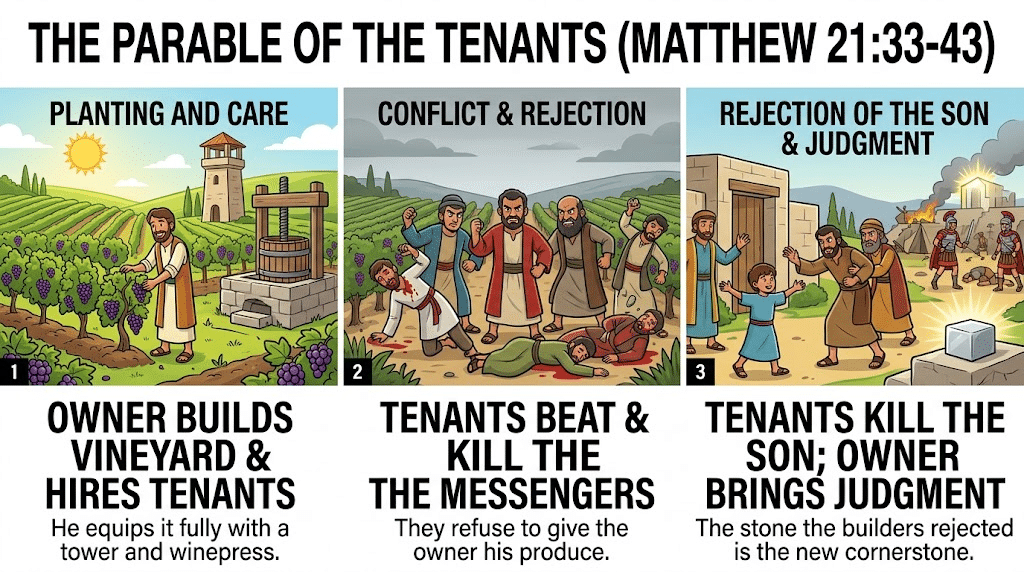
Matthew 21:33-43
Create a verse by verse (NAB) commentary relating xxxxxxxxxxxxx TO CATHOLIC doctrine and practice. Give real life applications when appropriate
Matthew 21:33
"Hear another parable. There was a landowner who planted a vineyard, put a hedge around it, dug a wine press in it, and built a tower. Then he leased it to tenants and went on a journey."
- Theological Commentary & Catholic Doctrine:Jesus deliberately quotes the Greek Septuagint translation of Isaiah 5:1–2. The Landowner is God the Father; the Vineyard is the Kingdom of God entrusted to the covenant people; the hedge, tower, and wine press represent the divine gifts of the Law, the Temple priesthood, and the sacrificial system that protected and nourished Israel’s religious identity.
- The leasing of the vineyard to tenants affirms the Catholic doctrine of stewardship and human agency. God retains ultimate sovereignty over His creation and Church, yet He delegates genuine moral authority and administrative responsibility to human shepherds (the Magisterium and spiritual leaders).
- The landowner going "on a journey" represents God giving man the space and time to exercise free will, testing the faithfulness of their stewardship before the inevitable day of accounting.
- Practice & Liturgy:In Catholic theology, the Pope and the bishops in communion with him are known as the Vicar of Christ and the successors of the Apostles—stewards who do not "own" the deposit of faith, but are bound to guard it (depositum fidei).
- Real-Life Application:Every domain of leadership you hold—whether as a parent, an employer, a ministry leader, or a civic official—is a "lease," not personal property. Ask yourself: Am I treating my children, my employees, or my parish role as if they belong to me and exist for my ego, or am I tending them reverently for the Master who will return to inspect my work?
Matthew 21:34–36
"When the vintage time drew near, he sent his servants to the tenants to obtain his produce. But the tenants seized the servants and one they beat, another they killed, and a third they stoned. Again he sent other servants, more numerous than the first, but they treated them in the same way."
- Theological Commentary & Catholic Doctrine:
- The "servants" sent in waves represent the Old Testament prophets (such as Elijah, Jeremiah, and Zechariah son of Jehoiada), whom God sent repeatedly to call His people back to the covenant.
- The "produce" God expected was justice, mercy, and true worship. Instead, Israel's leadership mistook privilege for ownership. The rejection, beating, and stoning of these messengers illustrate the historical mystery of human rebellion and the gradual hardening of heart (obduratio cordis).
- This highlights God’s divine patience and long-suffering (macrothymia). Even after the first servants are murdered, the landowner does not immediately bring wrath; he sends more, giving ample opportunity for repentance before judgment falls.
- Practice & Liturgy:The Church remembers the prophets and martyrs in the Roman Canon (Eucharistic Prayer I), asking God to grant us fellowship with those who shed their blood rather than compromise the truth.
- Real-Life Application:When the Church, a wise spiritual director, an honest friend, or a formed conscience speaks a challenging moral truth that convicts you (e.g., regarding greed, marital fidelity, or gossip), how do you react? The fallen human tendency is to "beat the messenger"—attacking their tone, finding hypocrisies in their past, or canceling them—rather than examining the bitter fruit in our own heart.
Matthew 21:37–39
"Finally, he sent his son to them, thinking, ‘They will respect my son.’ But when the tenants saw the son, they said to one another, ‘This is the heir. Come, let us kill him and acquire his inheritance.’ They seized him, threw him out of the vineyard, and killed him."
- Theological Commentary & Catholic Doctrine:This is the Christological turning point of the parable:
- Jesus explicitly distinguishes Himself from the prophets. The prophets were servants; He is the only-begotten Son (Filius Unigenitus), the heir of all things (Hebrews 1:1–2).
- The phrase "They seized him, threw him out of the vineyard, and killed him" is a literal prophecy of Christ’s Passion and Crucifixion. Jesus was condemned by the Sanhedrin within the Holy City, marched outside the city walls of Jerusalem to Golgotha, and crucified on the hill of Calvary (Hebrews 13:12).
- The tenants’ delusion—that by killing the Son they could steal the inheritance—is the ancient lie of original sin: man striving to be like God without God, substituting autonomous human pride for filial obedience.
- Practice & Liturgy:This scene is made present at every Catholic Mass in the Holy Sacrifice of the Altar. The Son who was cast out and slain offers Himself eternally to the Father for our salvation. We do not participate as detached spectators; we recognize that our personal sins were the nails and thorns that cast Him outside the gate.
- Real-Life Application:Whenever we deliberately choose mortal sin, we attempt the same futile theft: we push Christ out of the center of our lives so that we can reign as sole master over our desires, wealth, or time. Ask yourself: In what areas of my life am I actively trying to "evict" Christ's claims so I can run things my own way?
Matthew 21:40–41
"What will the owner of the vineyard do to those tenants when he comes?” They answered him, “He will put those wretched men to a wretched death and lease his vineyard to other tenants who will give him the produce at the proper times.”
- Theological Commentary & Catholic Doctrine:Just as Nathan trapped King David with the parable of the ewe lamb (2 Samuel 12), Jesus leads the chief priests and Pharisees to pronounce their own just condemnation.
- God’s justice operates with absolute moral equity: those who abuse authority and spill innocent blood forfeit their stewardship.
- In 70 AD, this prophecy found a harrowing historical fulfillment in the destruction of the Temple and Jerusalem by Roman legions under Titus, bringing an end to the Old Testament Levitical priesthood and sacrificial system.
- Practice & Liturgy:This verse anchors the reality of the Particular Judgment and Final Judgment (CCC 1021–1022). Every steward—laity, priest, and bishop alike—will stand before the Master and give a strict account of whether they yielded fruit or exploited the household of God.
- Real-Life Application:Self-righteousness blinds us. It is remarkably easy to spot faults, scandals, and laxity in church leaders, politicians, and neighbors while remaining blind to our own negligence. Take care that your critique of others does not become your own verdict before God. When judging a situation, apply the standard to yourself first: Am I giving God His harvest at the proper time?
Matthew 21:42
"Jesus said to them, “Did you never read in the scriptures: ‘The stone that the builders rejected has become the cornerstone; by the Lord has this done, and it is wonderful in our eyes’?”
- Theological Commentary & Catholic Doctrine:Jesus pivots from agricultural imagery to architectural imagery, quoting Psalm 118:22–23 (a traditional Hallel psalm sung during Passover).
- The Rejected Cornerstone: The very stone deemed worthless and discarded by the religious establishment—the crucified Jesus of Nazareth—is placed by God as the irreplaceable foundation of the entire cosmic order and Church (Acts 4:11; 1 Peter 2:4–8).
- The Church is built on this foundation, with the Apostles as foundational pillars (Ephesians 2:20). To build upon any other philosophy, ideology, or self-made morality is to build upon shifting sand.
- Practice & Liturgy:Psalm 118 is central to the Catholic Liturgy of the Hours and Sunday Lauds, continually proclaiming Christ's triumph: "This is the day the Lord has made; let us rejoice and be glad in it."
- Real-Life Application:What the world rejects—humility, chastity, silent prayer, marital endurance, forgiveness of enemies—God elevates. When you face marginalization, social ridicule, or professional setbacks for standing up for the moral teachings of Christ, take heart: you are aligned with the Cornerstone that the world has always discarded.
Matthew 21:43
"Therefore, I say to you, the kingdom of God will be taken away from you and given to a people that will produce its fruit."
- Theological Commentary & Catholic Doctrine:
- The Church as the New Israel: The Kingdom is not abolished; it is transferred from an exclusive national-ethnic stewardship to the Catholic Church—the universal people of God drawn from every tribe, tongue, and nation (Revelation 5:9–10).
- Anti-Judaism Clarification (Nostra Aetate): In alignment with the Second Vatican Council, the Catholic Church explicitly teaches that this passage must not be used to justify anti-Semitism or corporate blame upon the Jewish people. The rebuke was aimed at the specific corrupt religious leadership in Jerusalem who rejected Jesus. God’s original covenant gifts to Israel remain irrevocable (Romans 11:29).
- Conditional Stewardship: The Church herself is warned by this text. Being Catholic, possessing the fullness of truth, and having access to valid sacraments offers no guarantee of personal salvation if one is sterile. The vineyard is given to those who will produce its fruit. Faith without works of charity and justice is dead (James 2:17).
- Practice & Liturgy:This verse is the driving mandate behind the Church's Evangelization and Missionary Activity (Ad Gentes). The harvest is meant to be shared across the earth through corporal and spiritual works of mercy, dynamic parish life, and holy families.
- Real-Life Application:Never fall into spiritual complacency because your name is written in a baptismal register or because your parish has a historic building. If the Catholic Church in the West becomes sterile, worldly, or indifferent, the Master can and will raise up vibrant faith elsewhere—as seen in the explosive growth of the Church in Africa and Asia. Ask daily: What fruit does the Lord find when He inspects my branch today?
Algorithmically generated text
give me three thought provoking questions followed up with detailed answer reflection based on xxxxxxxxxxxx. Keep questions and answers appropriate for Sunday congregation giving real life application.
The tragic descent of the tenants in Jesus’ parable began with a distortion of reality: they forgot that the vineyard did not belong to them. The landowner bought the land, built the protective wall, cleared the ground, and dug the wine press. The tenants provided none of the capital or foundation—they were simply entrusted with its care. Over time, familiarity bred entitlement, leading them to believe they had the right to seize the property and kill the heir.
For a modern Christian congregation, the greatest spiritual hazard is often not outright atheism, but the subtle delusion of ownership. It is easy to look at our bank accounts, careers, homes, physical health, and children and think: "I worked hard for this; this belongs to me."
A steward’s mindset completely reorients daily decisions:
- Finances and Possessions: When an urgent need arises in your parish or community, do you give generously from the mindset that you are managing God's money, or do you clutch your wallet as if giving is a personal loss?
- Family and Parenting: Parents do not "own" their children to shape them merely for personal bragging rights, athletic trophies, or worldly prestige. Children are souls on loan from God, entrusted to parents to be formed for heaven.
- Parish Life: Longtime parishioners can fall into the trap of treating a church committee, pew, or ministry role as personal territory. When newcomers arrive with fresh energy or changes are made, an "owner" becomes territorial and defensive, while a "steward" rejoices that more workers have entered the vineyard.
The Christian life begins by kneeling before God each morning and praying: "Lord, everything I touch today—my time, my family, my income—is on lease from You. Show me how You want it managed."
Algorithmically generated text
The landowner did not send his servants to oppress the tenants; he sent them to collect what was rightfully his. The tenants reacted with violence because the servants’ presence was a direct reminder of accountability. Rather than confronting their greed and handing over the fruit, they attacked the messengers.
Today, God rarely sends prophets dressed in camel's hair to our doorstep. Instead, His messengers come in the ordinary fabric of daily life:
- An honest word of concern from a spouse pointing out our irritability, drinking habits, or excessive work hours.
- A homily or scripture passage that pierces our defensive rationalizations about how we handle money, harbor grudges, or compromise our moral values.
- The prick of a well-formed conscience when we are tempted to gossip, cheat on a business deal, or view improper material online.
Our fallen human reflex mirrors the wicked tenants: we attack the messenger. We nitpick the priest’s delivery, dismiss a spouse’s critique by dredging up their past faults, or label biblical moral teachings as "out of touch." By discrediting the person speaking the truth, we try to avoid giving God the fruit He asks of us.
Maturity in Christ requires the humility to listen. The next time a sermon, an honest friend, or a scripture verse makes you uncomfortable, do not rush to defend yourself or attack the speaker. Sit with the discomfort and ask: "Lord, is this Your messenger? What fruit have I been withholding from You?"
Algorithmically generated text
Jesus delivered this warning directly to the religious establishment of Jerusalem—men who possessed impeccable spiritual pedigrees, observed rituals with precision, and took pride in their covenant heritage. Yet, Jesus warned them that heritage without harvest is worthless. The vineyard is not reserved for those with the best credentials, but for those who produce actual fruit.
This warning applies directly to those of us sitting comfortably in church pews:
- It is not enough that our parents or grandparents helped build the parish, that our names are entered in a baptismal registry, or that we wear a crucifix around our neck.
- Sacramental privileges and sound doctrine are gifts meant to cultivate a harvest of active charity, mercy, and holiness. If they do not lead to love of neighbor, they become a source of spiritual complacency.
What does "producing fruit" look like on a typical Tuesday or Thursday?
- In Personal Relationships: Choosing patience instead of a sharp tongue; offering forgiveness to someone who hasn't apologized; refusing to join in workplace slander.
- In the Community: Reaching out to the lonely elder on your street; defending the dignity of the unborn; quietly supporting a family facing hardship without seeking applause.
- In the Parish: Stepping forward to serve where help is needed rather than sitting back as an armchair critic of how things are run.
God is not looking for decorative branches that only look green on Sunday morning. He comes looking for the sweet wine of genuine love, justice, and mercy. If we want to remain rooted in His kingdom, our faith must show up in how we live, serve, and love all week long.
Algorithmically generated text
Create a simple, modern infographic illustrating [INSERT BIBLE PASSAGE OR TOPIC]. Use a [SPLIT-SCREEN / 3-PANEL] layout. The style should be clean, high-quality digital art or vector illustration.
Visuals:
Panel 1: Show [DESCRIBE SCENE 1 – e.g., a stormy sea].
Panel 2: Show [DESCRIBE SCENE 2 – e.g., Jesus calming the waves].
Text & Typography:
Font: Use EXTRA LARGE, BOLD, SANS-SERIF FONT (like Arial). Ensure high contrast so text is easily readable.
Header: Write “[INSERT MAIN TITLE]” at the top.
Captions: Include short, punchy text summaries in the panels: “[TEXT FOR PANEL 1]” and “[TEXT FOR PANEL 2]”.
Overall Vibe: Professional, educational, and uncluttered. Avoid small details; focus on big images and big text.
Write an engaging description meant to get readers to read Larry Broding’s commentary which can be used to help preachers prepare their own homily. After a brief introduction give bulletin points of why this commentary matters for your homily.
Intimidation, Violence,
Retribution
Two thousand years of familiar church tradition have softened the raw, visceral jolt of the Parable of the Wicked Tenants (Matthew 21:33–43). Broding’s commentary strips away layers of safe familiarity, placing preachers directly into the simmering political, economic, and spiritual powder keg of first-century Roman-occupied Palestine.
- Restores the Original “Shock Value” for the Pews: Uncovers the provocative cultural twist of Jesus using a hated, absentee foreign landlord as an image for God the Father, helping you jolt listeners out of passive listening and into genuine engagement.
- Grounds the Parable in Harsh Economic Reality: Highlights the plight of first-century tenant farmers—crushed by high taxes, food exports, and starvation wages—giving historical context why the crowd’s sympathies initially favored the violent workers.
- Sharpens the Indictment of Entitled Leadership: Highlights how the Temple authorities mistook delegated stewardship for personal ownership, offering a direct pastoral challenge against spiritual arrogance, clericalism, and institutional self-preservation.
- Reclaims the Liberating Power of Psalm 118: Connects the rejected cornerstone to Passover praise and the trials of faith found in Isaiah, enabling you to preach the Cross not as a tragic defeat, but as God’s decisive act of liberation against corrupt power.
Scroll text above to read more

Commentary by Hector Molina | Catholic Evangelist


Commentary by Fr. Francis Martin | The Word Proclaimed
clean up grammar and spelling, divide into sections with titles for the following transcript xxxxxxxxxxxx
Verbal fillers, stumbles, and repetitions have been removed while keeping the original phrasing, theological precision, and cadence intact.
The Theme of the Vineyard in Scripture
We are going to look at the Gospel, and the theme, of course, is the vine. It follows the same overarching theme as Isaiah. There is a whole other text where our Lord says, "I am the vine." So many of the passages we have read—along with others that I could cite—point out that the vine is Israel. That is what Isaiah was saying, and that is what Psalm 80 says.
Now the Lord addresses the people directly. Speaking to the chief priests and elders, He says: "Hear another parable. There was a landowner who planted a vineyard and put a hedge around it." They know right where He is going, don't they? They know the Scriptures; they know He is drawing directly from Isaiah 5.
The Parable of the Tenants
Yet, Jesus changes the direction of the story: He dug a wine press in it, built a tower, leased it to tenants, and went on a journey. This arrangement was very common in Galilee: a wealthy landowner owned acres—perhaps miles—of land and leased it out. The rent was collected as a substantial portion of the harvest.
Jesus uses the familiar imagery, and the religious leaders recognize the foundation, but He alters the narrative to confront them more directly: "When vintage time drew near, he sent his servants to the tenants to obtain his produce. But the tenants seized the servants; one they beat, another they killed, and a third they stoned."
Who are these servants? We all know: they are the prophets. It is unmistakable what our Lord is doing; He is bringing salvation history right up to date. The landowner sent his servants to obtain the fruit, but there was none. Instead, the prophets were mistreated and slain. The landowner—reminiscent of the "Beloved" in Isaiah—sees all his emissaries rejected.
The text continues: "Again he sent other servants, more numerous than the first ones, but they treated them in the same way. Finally, he sent his son to them, thinking, 'They will respect my son.'" Our Lord tells this parable knowing full well that the Father was sending Him to die on the Cross; yet in the narrative, the landowner extends every opportunity for a change of heart.
The Rejection of the Son and the Temptation of Possession
In the parable, the vineyard is Israel, the owner is God, and the final one sent to reap the harvest is the Son. Legal historians note that under the property laws of that era in Galilee, if an owner died intestate without an heir, the resident tenant farmers could claim ownership of the land.
This historical detail illuminates the hidden motives exposed in the parable. Our Lord is saying: "What you truly desire is to kill Me so that you can continue ruling the people on your own terms—clinging to power, wealth, and prestige, keeping the vineyard entirely for yourselves."
As a priest, I must acknowledge that this is a persistent temptation for clergy as well. It is easy to want the vineyard for ourselves—to take pride when people say, "Father is a great preacher," "He is so personable," or "He works so well with the youth." While those gifts have value, we are ultimately tending a vineyard that belongs exclusively to God. We cannot eliminate Him simply to make ourselves center stage. We are tenant farmers; our sole duty is to care for His vineyard.
The tenants plotted among themselves: "This is the heir. Come, let us kill him and acquire his inheritance." They seized him, threw him out of the vineyard, and killed him. Jesus, too, was crucified outside the walls of the city.
Jesus then turns the question back upon the chief priests and elders: "What will the owner of the vineyard do to those tenants when he comes?" Caught in the logic of the parable, they are compelled to answer: "He will put those wretched men to a wretched death and lease his vineyard to other tenants who will give him the produce at the proper times." As the Gospel notes elsewhere, they realized He was speaking directly of them.
The Rejected Cornerstone and the True Heirs
Our Lord then replies: "Did you never read in the Scriptures: 'The stone that the builders rejected has become the cornerstone; by the Lord has this done, and it is wonderful in our eyes'?"
He quotes Psalm 118, a passage deeply familiar to them. In the Aramaic Targum traditions, wordplay exists between bonim ("builders") and banim ("sons"). Some traditions see an allusion here to David—the son of Jesse overlooked and rejected by his brothers, who was ultimately anointed by God to be the foundation of the kingdom.
Here, the Son of David—rejected by the builders and tenants—is revealed as the cornerstone of God’s redemptive plan. Jesus delivers the decisive conclusion: "Therefore, I say to you, the kingdom of God will be taken away from you and given to a people that will produce its fruit."
The Danger of a Hardened Heart
What must we take to heart from this? We are all warned against hardness of heart. How does a heart become hardened? It happens when we repeatedly indulge a habitual pattern of sin—whether anger, pride, or unchastity. As the heart hardens, spiritual clarity diminishes. We lose the ability to see and understand truth clearly. As classical theological tradition observes, the natural punishment for sin is often further blindness in sin.
The Gospel calls us to recognize two things in Christ: first, His clear-sighted fidelity to the Father’s will, willingly embracing rejection and the Cross; second, His divine mercy. He warns His adversaries so that they might repent and be saved. Tragically, they refused to turn because they would not allow God to soften their hearts.
Examining Our Spiritual Fruitfulness
How does this apply to our lives today?
Consider first the danger of negligence. Every Sunday, the faithful are called to gather as the Body of Christ to worship God, be renewed in communion, and reach out to the poor—as Pope St. John Paul II emphasized in his apostolic letter Dies Domini (On Keeping the Lord's Day Holy). Yet when hearts grow lukewarm, attendance slips to once a month, then once every few months. Gradually, we drift from the Word of God, from the Holy Eucharist, and from the fellowship of believers who sustain our faith.
A hardened heart also leads to moral blindness in the public square. It can manifest in the casual acceptance of contraception, or worse, in rationalizing abortion. Abortion is the direct taking of an innocent human life; it can never be defended as a legitimate right or an act of self-defense. Catholic moral tradition has long distinguished direct abortion from the legitimate medical application of the principle of double effect—where an essential procedure is performed to save a mother's life, and the tragic death of the child is unintended and unavoidable. Yet contemporary culture has largely discarded these objective moral realities.
Hardness of heart also breeds deep-seated prejudice, closing our souls off from classes of people whom God loves. When the heart hardens, spiritual obtuseness follows. One can be an accomplished economist, accountant, attorney, theologian, or preacher, yet remain spiritually blind to the true significance of the Gospel.
The Lord speaks to us through this Gospel with an urgent, loving plea: "You are My vineyard. I have cared for you. I have baptized you, confirmed you, fed you with My Word, forgiven your sins in the sacraments, and watched over your homes. Do not turn away from Me. Allow Me to sanctify you—for your sake, for the Church, and for the world."
The Master approaches our lives seeking authentic fruit: charity, genuine friendship, care for the vulnerable, moral courage, and an steadfast commitment to the truth of His Gospel, regardless of the opposition. Amen.
Click chevron banner to read transcript
organized into thematic sections.
Doctrinal Homily Outlines
Central idea: Justice & the people of God
Doctrine: The Church is sacramental
Application: Frequent the Sacraments that can be frequented
Sunday Prep Videos
27th Sunday of Year A
 Highlight text or double-click a paragraph anywhere on the site to ADD TO NOTES. You can also click ASK AI to copy your selection to the clipboard with a command prompt, ready for you to paste manually into the chat above.