Bishop Barron Homilies for 27th Sunday in Ordinary Time (A) Isaiah 5:1-7 Philippians 4:6-9 Matthew 21:33-43

Bishop Barron, Word on Fire

October 4, 2026

27th Sunday of Year A

  • 2026 SERMON
  • 2023 SERMON
YouTube player

2026 Sermon

Friends, in our second reading this Sunday, Paul tells the church of Philippi, โ€œHave no anxiety at all.โ€ Itโ€™s hard to imagine that Paulโ€”who was shipwrecked many times, beaten within an inch of his life, threatened and harassed and persecuted and opposed, and finally arrested, dragged to Rome, and decapitatedโ€”never experienced any anxiety. So what does he mean? What he says next is the clue: โ€œBut in everything, by prayer and petition, with thanksgiving, make your requests known to God.โ€

Fix misspellings, stumbles, umms, etc. in the following transcript, then divide it into five sections. Give each section a title.

INTRODUCTION

Click Graphic to Enlarge

DISCUSSION QUESTIONS 1-5

write 5 questions and answers based on the following, when referring to the speaker identify the speaker as Bishop Barron. Number questions 1-5. Questions should be in bold font. Skip a line then give answer. No need to identify answer as such (e.g. A: or A1) just give answer)

QUESTIONS 1-5

The Mother Church of Europe and Paulโ€™s Paradox of Anxiety

1. Why does Bishop Barron describe the church of Philippi as having immense historical and spiritual importance for Christianity?

Bishop Barron explains that Philippi was the very first church St. Paul established in Europe, effectively making it the mother church of all European Christianity and, consequently, of most Christianity throughout the world.

2. Which famous passage from the Letter to the Philippians did Bishop Barron reference as having been read the previous week?

Bishop Barron noted that they read the magnificent kenotic hymn from Philippians, which describes Christ: "Though he was in the form of God, he emptied himself."

3. What central exhortation from Philippians chapter 4 does Bishop Barron highlight for the 27th Sunday of the year?

Bishop Barron highlights St. Paulโ€™s instruction to his friends in Philippi: "Have no anxiety at all, but in everything, by prayer and petition, with thanksgiving, make your requests known to God."

4. Why does Bishop Barron consider Paulโ€™s command to "have no anxiety at all" paradoxical given Paulโ€™s personal history?

Bishop Barron points out that Paul endured shipwrecks, severe beatings, constant threats, harassment, persecution, and eventual arrest, imprisonment in Rome, and execution by decapitation, making it clear that Paul personally faced immense, life-threatening hardships.

5. How does Bishop Barron explain the etymology and practical meaning of the word "anxiety"?

Bishop Barron explains that the word anxiety derives from the Latin angustia and the German Angst, both denoting "the narrows"โ€”the suffocating sensation of being trapped between a rock and a hard place where any move leads to trouble.

2026: SERMON TRANSCRIPT

The Mother Church of Europe and Paulโ€™s Paradox of Anxiety

Peace be with you. Friends, for this 27th Sunday of the year, I’m again going to skip the Gospel. If you want to find something about the Gospel, go back maybe three years ago; I probably preached on it. But there is something about Paul’s Letter to the Philippians that attracts me so much that whenever that reading comes up, I want to return to it. As I mentioned to you last week, the church of Philippi is very important: it was the first church Paul established in Europe, making it the mother church of all European Christianity, and hence of most Christianity throughout the worldโ€”a community for which Paul held special affection.

Last week we read that magnificent kenotic hymn: “Though he was in the form of God, he emptied himself,” and so on. Today’s reading comes from chapter 4, the final chapter, where Paul bids farewell to the community. It contains passages of enormous spiritual significance, and I want to dwell on them. Here is what he writes to his friends in Philippi:

“Have no anxiety at all, but in everything, by prayer and petition, with thanksgiving, make your requests known to God.”

Now you might say, “Wait a minute: have no anxiety at all?” Coming from Paulโ€”who was shipwrecked multiple times, beaten within an inch of his life, threatened, harassed, persecuted, opposed, and who was ultimately arrested, dragged to Rome, and decapitatedโ€”it is hard to imagine that man going through life without any anxiety whatsoever. The word anxiety derives from the Latin angustia and the German Angst; it denotes the narrows, the experience of being caught between a rock and a hard place: “If I do this, I am in trouble; if I do that, I am in trouble, and I am stuck.” That is what anxiety means etymologically. Was Paul never in that position? Clearly, he was.

So what is he talking about? How could he tell his people never to have any anxiety and never to worry about anything? Here is the clue: “By prayer and petition, with thanksgiving, make your requests known to God.” He is not talking about the complete elimination of fear and anxiety; that will never happen this side of the eschaton. Whoever you are, living in this world means you will inevitably find yourself between a rock and a hard place.
Click Graphic to Enlarge

DISCUSSION QUESTIONS 6-10

write 5 questions and answers based on the following, when referring to the speaker identify the speaker as Bishop Barron. Number questions 6-10. Questions should be in bold font. Skip a line then give answer. No need to identify answer as such (e.g. A: or A1) just give answer)

QUESTIONS 6-10

From the Rim to the Center: The Depths of Shalom

6. How does the medieval cathedral image of the wheel of fortune illustrate the inevitability of anxiety on the rim of life?

Bishop Barron explains that as the wheel turns, you are inevitably at different positionsโ€”on top, declining, at the bottom, or rising. At every point on the rim, anxiety is present: the successful fear loss, those declining fear the fall, those at the bottom dread their misery, and those climbing worry they will not make it.

7. What spiritual transition does Bishop Barron propose using the metaphors of the wheel and the deep water?

Bishop Barron urges a conscious shift from the rim of the wheel to Christ at the center, or from the turbulent surface of life down into the serene depths, comparing it to diving beneath the wind-whipped waves of Lake Michigan or the ocean into calm, still waters.

8. What does biblical shalom truly mean according to Bishop Barron?

Bishop Barron clarifies that shalom is not a promise of a life devoid of external trouble, suffering, or distress; rather, it is a deep-seated rootedness in God that bestows an unshakable serenity amidst lifeโ€™s anxieties and trials.

9. How does Bishop Barron define prayer, citing the insight of Thomas Merton?

Bishop Barron notes that while prayer includes childlike petition, Thomas Merton revealed its deeper reality: to pray is to enter that profound inner sanctuary where you are, in the present moment, being continuously created by God.

10. How do the Gospel scenes of the storms at sea illustrate the divine peace that Christ offers?

Bishop Barron points out that Jesus walking across the tempestuous waves signifies the mastery of peace over chaos, while Jesus sleeping peacefully in the stern of the boat amidst terror illustrates absolute shalom born of uninterrupted communion with the Father.

2026: SERMON TRANSCRIPT (continued)

From the Rim to the Center: The Depths of Shalom

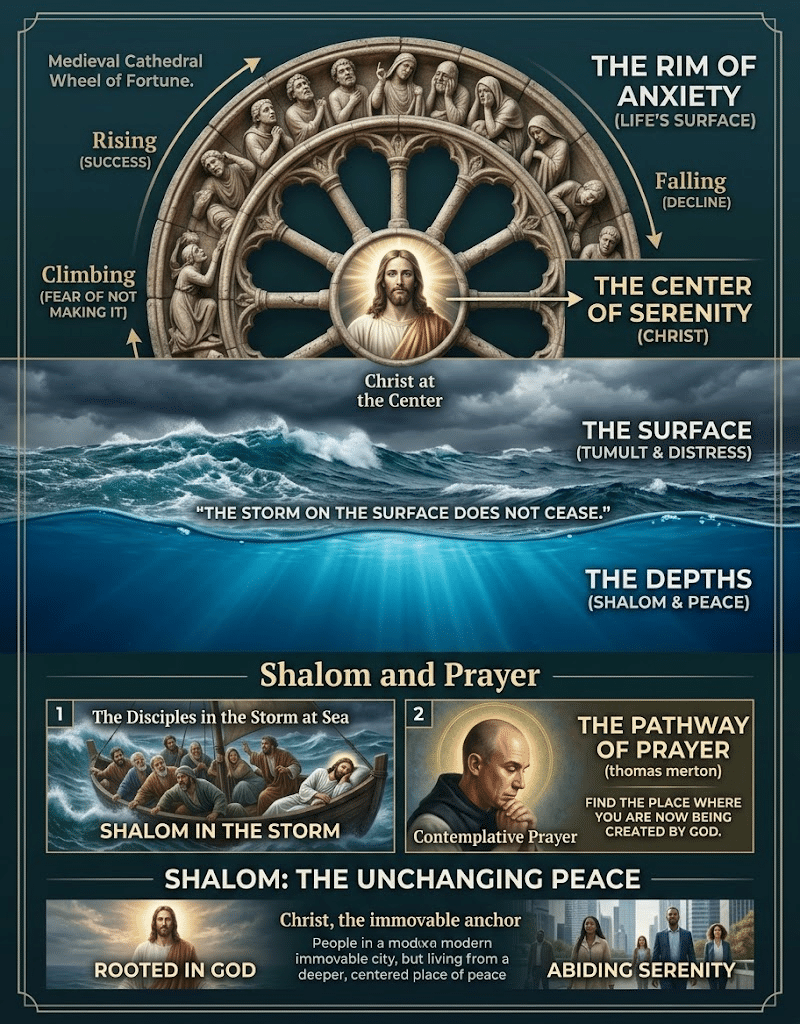
Recall the great image of the wheel of fortune from medieval cathedrals: the wheel turns, and sometimes you are on top, sometimes you are going down, sometimes you are at the bottom, and sometimes you are rising. That is simply how life goes. At every point on the wheel, anxiety is present: if you are successful, you are anxious about losing it; if you are heading down, you are anxious about your decline; if you are at the bottom, you are anxious about your misery; if you are climbing, you are anxious that you might not make it. Wherever you are on the rim of life, you inhabit a place of anxiety.

In that medieval image, Christ stands at the very center of the wheel. The spiritual task is to move from the rim to the center. Shifting metaphors, it means moving from the surface of life into the depths. Consider an ocean or Lake Michigan, which is like an inland sea: on the surface, the water can be roiled, with crashing waves and whitecaps, but down in the depths, you find great serenity and peace. The surface of the ocean may be in tumult, but the deep abyss remains calm.

Make that transition in your consciousness: move from the surface to the depth, from the rim of the wheel to its center. Root your life in Christ, who links you to the eternal power of God and who is the same yesterday, today, and forever. Do the storms on the surface cease? No. Does the wheel stop turning? No. That is the reality of human life. But you are no longer living merely on the rim or the surface; you are operating out of that deeper place.

In that place, you discover what the Bible calls shalom. When Jesus speaks of shalomโ€”peaceโ€”he is not promising a life exempt from trouble or distress, but a rootedness in God that bestows serenity despite any and all angustia, Angst, and anxiety. The key here is prayer. Paul says that through prayer, you find this peace. What is prayer? We often think of it simply as asking God for things, and like children, we rightly bring our petitions to Him. But as Thomas Merton observed, to pray is to find that place within you where you are, here and now, being created by God. It means consciously moving to that deeper, centered ground where peace resides. The surface storms do not vanish, and fears may still arise, but you no longer dwell at their mercy.

Consider the disciples in the boat during the storm at sea: Jesus walking on the water evokes the peace that masters the storm. Or recall the account where the disciples are screaming in terror while Jesus sleeps in the stern of the boat. He is not indifferent to them; rather, he embodies the absolute shalom that comes from deep communion with the Father.

Click Graphic to Enlarge

DISCUSSION QUESTIONS 11-15

write 5 questions and answers based on the following, when referring to the speaker identify the speaker as Bishop Barron. Number questions 11-15. Questions should be in bold font. Skip a line then give answer. No need to identify answer as such (e.g. A: or A1) just give answer)

QUESTIONS 11-15

The Interior Castle and the Carmelite Witness of John Paul II

11. How does St. Teresa of รvilaโ€™s image of the Interior Castle illustrate interior peace amid outer conflict?

Bishop Barron explains that while external threats and battles may rage around the outer walls of the castle, retreating into the interior keep provides an invulnerable sanctuary of serene peace because Christ dwells within.

12. What spiritual tragedy does St. John of the Cross identify regarding the "inner wine cellar"?

Bishop Barron notes that according to St. John of the Cross, every person has an inner wine cellar filled with the Holy Spirit, but the great tragedy is that many have lost the key to access it, leaving them trapped in fear and anxiety.

13. What historical hardships did Karol Wojtyล‚a face as a young man in Poland?

Bishop Barron recounts that Karol Wojtyล‚a endured the brutal Nazi invasion during his sophomore year of college, attended an underground seminary in the Archbishopโ€™s basement under constant threat of being shot in the streets, and later lived through the oppressive Soviet communist regime.

14. What enabled Pope St. John Paul II to proclaim "Be not afraid!" despite having lived through totalitarian oppression?

Bishop Barron emphasizes that John Paul II's courage did not stem from naive geopolitical optimism or sociological schemes, but from being deeply rooted in Christ through contemplative prayer nourished by the Carmelite mystical tradition.

15. According to Bishop Barron, what is the underlying spiritual truth shared by Teresa of รvila, John of the Cross, and John Paul II?

Bishop Barron observes that each of these figures points to the same foundational reality of the spiritual life: moving past surface anxieties to discover an interior depth, centeredness, and peace found in the living presence of Christ.

2026: SERMON TRANSCRIPT (continued)

The Interior Castle and the Carmelite Witness of John Paul II

The great spiritual tradition continually witnesses to this truth. Teresa of รvila describes it as the Interior Castle. Do the external threats around the castle cease? No. But when you retreat into the interior keep, you find an invulnerable refuge; even while battle rages along the outer walls, you abide in serene peace because Christ lives within you.

John of the Cross speaks similarly of the inner wine cellar where the finest wine is kept. The tragedy, he notes, is that we have lost the key and no longer know how to access it, leaving us trapped in fear and anxiety. Yet there exists a place of spiritual intoxication where one is filled with the Holy Spirit: that inner cellar, that centered ground, the deep indwelling presence of Christ. These are all metaphors pointing toward the same reality, which is the very essence of the spiritual life.

Pope St. John Paul II offers a striking modern example. The defining motto of his pontificate, proclaimed in his inaugural homily and repeated throughout his life, was: “Be not afraid!” Consider the man who spoke those words. Karol Wojtyล‚a was born in 1920, coming of age during one of history’s darkest hours. During his sophomore year of college, the Nazi regime invaded Poland, decimating Polish society, executing and imprisoning its leaders, and imposing a brutal tyranny.

Young Wojtyล‚a had to make his way to the clandestine seminary run by Cardinal Sapieha in the basement of the Archbishopโ€™s residence, fully aware that he could be shot on the street at any moment, as some of his fellow students were. After enduring years of Nazi occupation, that regime was replaced by Soviet communism, which imposed another oppressive dictatorship.

If anyone had reason to experience paralyzing fear and anxiety, it was Karol Wojtyล‚a. He never denied the terror of those realities. Yet as Pope, he could stand before the world and proclaim, “Do not be afraid!” He did not say this out of naive geopolitical optimism or because of some sociological scheme for human progress; he said it because he was deeply rooted in Christ through sustained contemplative prayer. Immersed in the Carmelite tradition of John of the Cross and Teresa of รvila from his youth, he had discovered that interior depth and peace, enabling him to call the entire world to fearless trust. That is precisely what Paul means: have no anxiety, but live from the center.

Click Graphic to Enlarge

DISCUSSION QUESTIONS 16-20

write 5 questions and answers based on the following, when referring to the speaker identify the speaker as Bishop Barron. Number questions 16-20. Questions should be in bold font. Skip a line then give answer. No need to identify answer as such (e.g. A: or A1) just give answer)

QUESTIONS 16-20

The Transcendentals: Contemplating the True, the Good, and the Lovely

16. How does Bishop Barron guard against a superficial reading of Philippians 4:8?

Bishop Barron cautions that St. Paulโ€™s lyrical exhortation can easily be dismissed as a sentimental greeting-card platitude that "it is nice to be nice," whereas it actually articulates a profound theological principle for anchoring the soul in God.

17. According to Bishop Barron, why do things that are true, good, and beautiful possess the power to cultivate interior shalom?

Bishop Barron explains that whatever is genuinely true, good, or beautiful actively participates in the life of God, meaning that contemplating these transcendentals naturally draws the mind and soul back to Him.

18. What intellectual examples does Bishop Barron give to show how the mind can be elevated toward divine truth?

Bishop Barron cites an elegantly formulated mathematical equation reflecting divine order, as well as the rigorous reflections of a philosopher and a finely crafted short story, as works that elevate human understanding toward God.

19. Which examples of moral and aesthetic excellence does Bishop Barron highlight as reflections of God's goodness and harmony?

Bishop Barron highlights hidden acts of moral courage, the heroic apostolic charity of the Missionaries of Charity, Michelangeloโ€™s frescoes in the Sistine Chapel, and the balanced proportions of classical architecture as direct reflections of divine goodness and harmony.

20. How does Bishop Barron demonstrate that the divine transcendentals can be found in everyday life and culture?

Bishop Barron points out that divine beauty and grace are reflected not only in high culture, but also in a warm smiling face, an innocent child at play, a well-written television drama, or even a crisply executed fast break on the basketball court.

2026: SERMON TRANSCRIPT (continued)

The Transcendentals: Contemplating the True, the Good, and the Lovely

As Paul concludes this passage, he adds:

“Finally, brothers and sisters, whatever is true, whatever is honorable, whatever is just, whatever is pure, whatever is lovely, whatever is gracious, if there is any excellence and if there is anything worthy of praise, think about these things.”

While this is an exquisite, lyrical passage, it can easily be dismissed as a mere greeting-card sentimentโ€”a superficial encouragement that “it is nice to be nice.” Yet Paul is articulating a profound theological principle. How do we cultivate this interior peace, this central place of shalom where God dwells? We do so through prayer, and also by intentionally fixing our minds on those true, good, and beautiful realities that reflect God.

Whatever is genuinely good, true, or beautiful participates in God and therefore has the power to lead the soul back to Him. Consider the breadth of this reality:

  • A crisply executed fast break on the basketball court or an exceptionally written drama engages our appreciation for grace and excellence.
  • An elegantly formulated mathematical equation leads the mind toward divine order and truth.
  • The rigorous reflections of a philosopher or a finely crafted short story elevate human understanding.
  • A hidden act of moral courage or the heroic apostolic charity of the Missionaries of Charity reveals the radiant goodness of God.
  • Michelangeloโ€™s frescoes in the Sistine Chapel or the balanced proportions of classical architecture mirror transcendent harmony.
  • A warm, welcoming human face or the unselfconscious joy of an innocent child at play reflects divine goodness.
CONCLUSION

Click Graphic to Enlarge

DISCUSSION QUESTIONS 21-25

write 5 questions and answers based on the following, when referring to the speaker identify the speaker as Bishop Barron. Number questions 21-25. Questions should be in bold font. Skip a line then give answer. No need to identify answer as such (e.g. A: or A1) just give answer)

QUESTIONS 21-25

Cultivating Divine Peace Through the Good, the True, and the Beautiful

21. Why does Bishop Barron urge believers to cultivate and love good, true, and beautiful things beyond mere aesthetic curiosity?

Bishop Barron emphasizes that this pursuit must be driven by theological conviction, because whatever is truly good, true, and beautiful participates in God and leads the soul directly back to Him.

22. What interior effect do experiences of beauty, truth, and goodness have on the human spirit according to Bishop Barron?

Bishop Barron explains that contemplating these realities awakens an abiding sense of peace and moves us to contemplative silence by communicating something of the divine shalom through their order, harmony, and grace.

23. What varied examples does Bishop Barron give to illustrate how order and harmony communicate God's shalom?

Bishop Barron points to the vast expanse of the ocean, the architectural grandeur of a cathedral, the sublime sacred art of the Sistine Chapel, and even the athletic grace of a flawlessly turned double play in baseball.

24. In what specific spiritual attitude does Bishop Barron advise people to engage with the world's beauty and truth?

Bishop Barron advises surrounding oneself with these gifts within a spirit of continuous prayer, actively thanking God for every manifestation of truth, goodness, and beauty encountered in the world.

25. According to Bishop Barron, where does this deliberate focus on the transcendentals ultimately lead the believer?

Bishop Barron states that living this way leads by steady steps toward the interior castle, into the inner wine cellar, and down into that centered sanctuary of profound, unshakable peace rooted in Christ.

2026: SERMON TRANSCRIPT (continued)

Cultivating Divine Peace Through the Good, the True, and the Beautiful

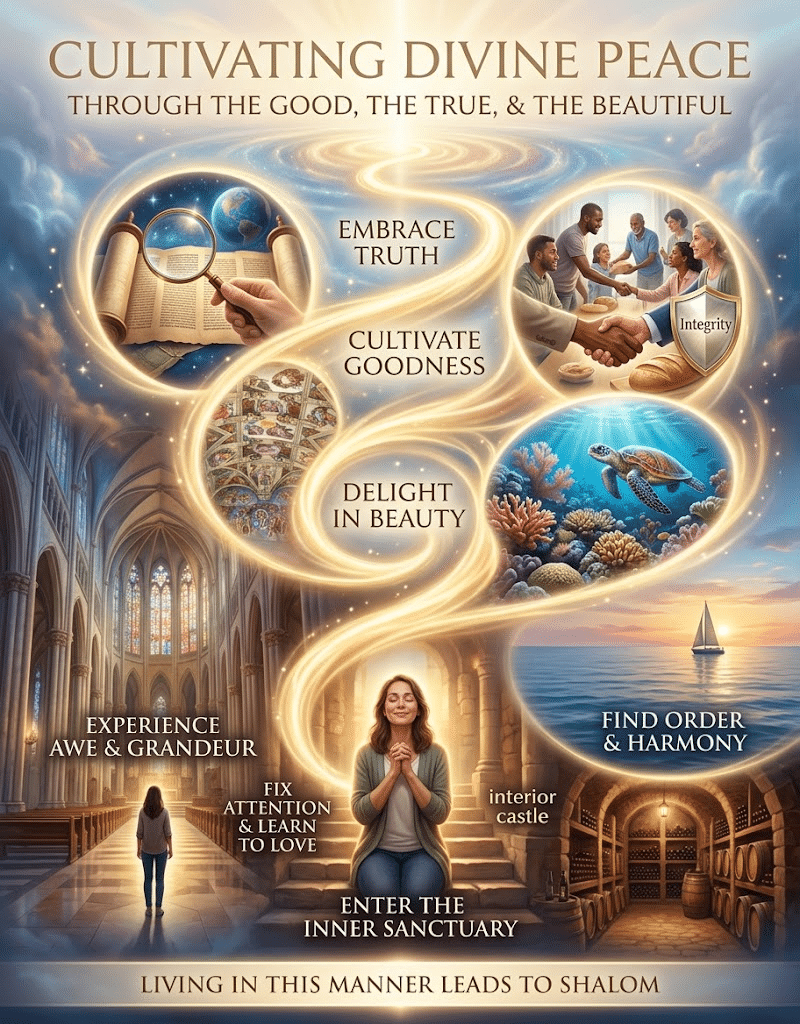
Fix your attention on these things. Cultivate them and learn to love them, not merely out of aesthetic curiosity, but out of theological conviction: the good, the true, and the beautiful lead directly to God.

Moreover, they awaken in us an abiding sense of peace. Why are we moved to contemplative silence before the expanse of the ocean, the grandeur of a cathedral, the art of the Sistine Chapel, or even a flawlessly turned double play? Because in their order, harmony, and grace, they communicate something of the shalom of God.

Surround yourself with these things. Learn to delight in them and cultivate them within a spirit of prayer, thanking God for every manifestation of truth, goodness, and beauty in the world. Living in this manner leads you, step by steady step, toward the interior castle, into the inner wine cellar, and down into that centered sanctuary of profound, unshakable peace.

God bless you.

YouTube player

2023 Sermon

Fix misspellings, stumbles, umms, etc. in the following transcript, then divide it into five sections. Give each section a title.

INTRODUCTION

Click Graphic to Enlarge

DISCUSSION QUESTIONS 1-5

write 5 questions and answers based on the following, when referring to the speaker identify the speaker as Bishop Barron. Number questions 1-5. Questions should be in bold font. Skip a line then give answer. No need to identify answer as such (e.g. A: or A1) just give answer)

QUESTIONS 1-5

The Song of the Vineyard

1. According to Bishop Barron, which Old Testament prophet do we read from most frequently throughout the liturgical year?

Isaiah is probably the prophet read from the most in the Old Testament throughout the liturgical year.

2. What does the imagery of the vineyard evoke within the Israelite tradition?

The image of the vineyard serves as an evocation of the people of Israel.

3. Why does the vineyard imagery resonate more deeply with Bishop Barron currently?

It resonates more because he lives in vineyard country in Santa Barbara, Southern California, where he constantly passes vineyards and famous wine-tasting centers as he travels through the region.

4. According to Isaiah, what kind of relationship does the song describe between the builder and his vineyard?

Isaiah presents it as a love song between the maker of the vineyard and his vineyard that emphasizes the demand of love.

5. What specific structures did the builder construct on the property, and what purpose did each serve?

The builder erected a watchtower to protect the ground from marauders, hewed out a wine press in anticipation of a wonderful harvest, and built a surrounding wall to guard against animals and intruders.

2023: SERMON TRANSCRIPT

The Song of the Vineyard

Peace be with you. Friends, our first reading for this weekend is taken from the fifth chapter of the prophet Isaiah. Isaiah is probably the prophet we read from the most in the Old Testament throughout the liturgical year. So, when you have a chance, take out your Bibles, obtain a good commentary, and read your way through the prophet Isaiah. He is featured prominently in many of the liturgical readings. The image from today’s reading is a classic trope within the Israelite tradition: the vineyard as an evocation of the people of Israel. Since I arrived in Southern California, I live in vineyard country in Santa Barbara, and just north of me are some of the most famous vineyards and wine-tasting centers. As I make my way around the region, I pass vineyards constantly. The imagery resonates with me even more now that I am here. Isaiah presents a love song between the maker of the vineyard and his vineyardโ€”a love song that emphasizes the demand of love.

The builder of the vineyard constructs it on a fertile hillside, offering the ideal conditions for the growing of vines. Next, he worked the land assiduously: “He spaded it, cleared it of stones.” Anyone who has ever attempted to clear stones from a field understands how difficult, time-consuming, and backbreaking that labor is. He planted this on choice territory, selecting the finest vines he could find. He spared no expense. Within it, “he built a watchtower, and hewed out a wine press.” The watchtower was meant to safeguard this precious ground against marauders, while the wine press stood in anticipation of a wonderful harvest. Finally, he built a wall around his vineyard to protect it from animals and intruders. The builder has done everything possible to cultivate this vineyard.

Click Graphic to Enlarge

DISCUSSION QUESTIONS 6-10

write 5 questions and answers based on the following, when referring to the speaker identify the speaker as Bishop Barron. Number questions 6-10. Questions should be in bold font. Skip a line then give answer. No need to identify answer as such (e.g. A: or A1) just give answer)

QUESTIONS 6-10

Cultivation and the Disappointment of Wild Grapes

6. In the allegorical reading of the passage, who does the vineyard owner represent according to Bishop Barron?

The vineyard owner represents the Lord God of Israel in regard to His holy people.

7. What specific actions of God toward Israel are evoked by the spading, protecting, and care of the vineyard?

These actions evoke the gift of the Scriptures, the Law, the covenants, the patriarchs, the prophets, the Temple and its rituals, and above all, the liberation of Israel from Egypt.

8. What does the vineyard owner discover at the harvest despite all his labor and preparation?

Instead of a fruitful crop, he finds only "wild grapes"โ€”or as the Hebrew suggests, "stinking grapes"โ€”which failed to come to fruition.

9. According to Bishop Barron, what persistent prophetic theme is illustrated by the failure of the vineyard?

It illustrates the recurring theme that God gave His entire heart to His people, yet they failed to respond despite receiving the Law, the covenants, the Temple, and the Exodus from Egypt.

10. How does Bishop Barron explain the relationship between divine grace and human action in Catholic terms?

Grace comes first as God lavishes His unmerited love upon us, but grace alone does not guarantee a fruitful harvest; we must actively cooperate and respond to that grace.

2023: SERMON TRANSCRIPT (continued)

Cultivation and the Disappointment of Wild Grapes

He has loved it, savored it, protected it, given it every consideration, and expected great things of it. This represents the Lord God of Israel in regard to His holy people. All of the spading, protecting, and care evokes the thousand ways the God of Israel has cultivated His people: the Scriptures, the Law, the covenants, the great patriarchs, the prophets, the Temple and its rituals, and above all, the great act of liberation by which God brought Israel out of Egypt. These are the ways He prepared this beautiful vineyard on a fertile hillside.

Then the image takes a dark turn. Despite all his efforts, the vineyard owner is frustrated because when he comes to inspect his crop, he finds only “wild grapes”โ€”or, as the Hebrew suggests, “stinking grapes.” These grapes have failed to come to fruition despite all his labor. You hear this theme throughout the prophetic literature: God gave His whole heart to this people, yet His people did not respond. They were given the Law, the covenants, the Temple, and the Exodus from Egypt, yet they did not respond. In Catholic terms: everything is grace. Grace comes first; God lavishes His unmerited love upon us, but we must cooperate with that grace. God’s grace in itself is no guarantee that the harvest will be fruitful. A response to grace is required.

Click Graphic to Enlarge

DISCUSSION QUESTIONS 11-15

write 5 questions and answers based on the following, when referring to the speaker identify the speaker as Bishop Barron. Number questions 11-15. Questions should be in bold font. Skip a line then give answer. No need to identify answer as such (e.g. A: or A1) just give answer)

QUESTIONS 11-15

The New Israel and the
Necessity of Cooperation

11. Why does Bishop Barron caution listeners against viewing the story of the vineyard as solely about ancient Israel?

Saint Paul refers to the Church as the New Israel, and throughout Christian tradition, prophetic voices have warned that even though God has lavished grace upon the Church, Christians far too often fail to cooperate with that grace.

12. Within the Catholic tradition, what concrete gifts represent God's ongoing cultivation of His vineyard?

The Sacraments, the Mass, the Eucharist, the example of the saints, and the teaching office of the Pope and the bishops represent the spadework, removal of stones, protective wall, watchtower, and wine press.

13. What theological position has Bishop Barron publicly defended despite receiving criticism for it?

He has argued that we may reasonably hope that all people will be saved.

14. What authority does Bishop Barron cite to support his stance on salvation, and what does it state?

He cites the Catechism of the Catholic Church, which teaches that in hope, the Church prays for the salvation of all people.

15. How does Bishop Barron, referencing Saint Thomas Aquinas, distinguish true theological hope from presumption or blithe confidence?

He notes that Saint Thomas Aquinas taught we only hope for things that are difficult; therefore, hope rooted in God's mercy is not a guarantee or presumption of salvation, but an earnest prayer that demands our active cooperation with grace.

2023: SERMON TRANSCRIPT (continued)

The New Israel and the
Necessity of Cooperation

Do not assume this account applies only to ancient Israel, dismissing them as a people long ago who failed to cooperate with God. Saint Paul refers to the Church as the New Israel. Throughout our tradition, prophetic voices have noted that while God has lavished His grace upon the New Israel, we have far too often failed to cooperate. Consider the Catholic perspective: the Sacraments, the Mass, the Eucharist, the example of the saints, and the teaching office of the Pope and the bishops. These gifts represent the ongoing cultivation of God’s vineyardโ€”the spadework, the removal of stones, the wall, the tower, and the wine press. Yet when He arrives for the harvest, will He find good grapes or wild, stinking grapes?

It remains a question of our cooperation with His grace. The Gospels remind us continually that something significant is at stake in the spiritual life; we have no warrant to be blasรฉ. I am on public recordโ€”and have received criticism for itโ€”for arguing that we may hope that all people be saved. This is grounded in the Catechism of the Catholic Church, which states that in hope, the Church prays for the salvation of all. That hope is rooted in the mercy and grace of God, but hope is not equivalent to presumption or blithe confidence. Saint Thomas Aquinas notes that we only hope for things that are difficult. I hope that all might be saved, but will all be saved? I am in no position to declare that. What will God find when He comes to harvest my own life within the Church, which He has cultivated in so many ways? I must cooperate with His grace.
Click Graphic to Enlarge

DISCUSSION QUESTIONS 16-20

write 5 questions and answers based on the following, when referring to the speaker identify the speaker as Bishop Barron. Number questions 16-20. Questions should be in bold font. Skip a line then give answer. No need to identify answer as such (e.g. A: or A1) just give answer)

QUESTIONS 16-20

Spiritual Physics:
The Ruin of Refusal

6. According to the passage from Isaiah quoted by Bishop Barron, what specific actions will the owner take against the uncooperative vineyard?

The owner will remove its hedge, give it over to grazing, break through its protective wall so it is trampled, cease all pruning and hoeing, and leave it overgrown with thorns and briers.

17. How does Bishop Barron warn against misinterpreting God's judgment on the vineyard?

He insists that the text should never be interpreted as God flying into a temper tantrum or raging like a dysfunctional father.

18. What term does Bishop Barron introduce to explain the relationship between human choice and spiritual ruin?

He describes this dynamic as "spiritual physics"โ€”the principle that cooperating with grace causes flourishing, while refusing that grace leads to an inward collapse.

19. How did Saint Augustine define sin, according to Bishop Barron?

Saint Augustine defined sin as incurvatus in seโ€”being turned inward upon oneself and closed off from divine grace.

20. According to Bishop Barron, why does the cultivated vineyard ultimately fall into ruin?

The ruin is not an arbitrary divine punishment, but the natural and inevitable spiritual consequence of turning inward and failing to cooperate with God's grace.

2023: SERMON TRANSCRIPT (continued)

Spiritual Physics:
The Ruin of Refusal

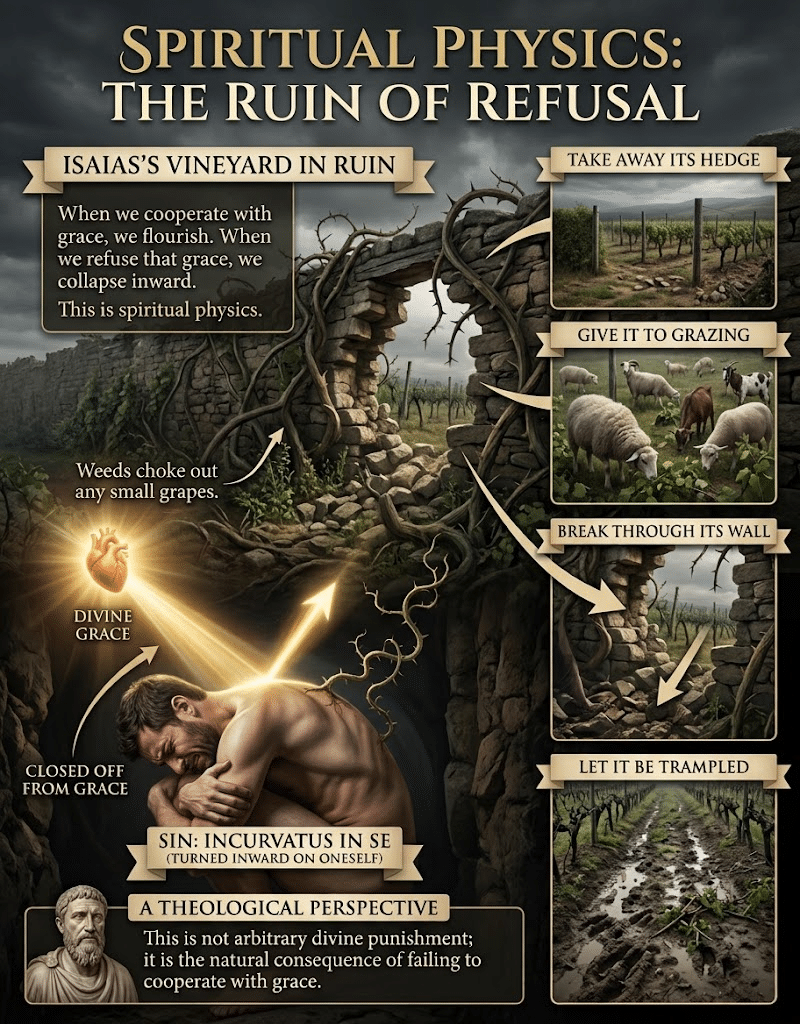
Returning to the imagery of Isaiah, consider the result of Israel’s lack of cooperation: “I willโ€ฆ take away its hedge, give it to grazing, break through its wall, let it be trampled! Yes, I will make it a ruin: it shall not be pruned or hoed, but overgrown with thorns and briers.” When the owner finds wild, stinking grapes, the vineyard falls into ruin. This text should never be interpreted as God flying into a rage like a dysfunctional father. This is spiritual physics: when we cooperate with grace, we flourish. When we refuse that grace, we collapse inward.

Saint Augustine defined sin as being incurvatus in seโ€”turned inward on oneself, closed off from grace. When that occurs, the cultivated vineyard falls into ruin, the protective wall is broken down, and devastation enters. This is not arbitrary divine punishment; it is the natural consequence of failing to cooperate with grace.
CONCLUSION

Click Graphic to Enlarge

DISCUSSION QUESTIONS 21-25

write 5 questions and answers based on the following, when referring to the speaker identify the speaker as Bishop Barron. Number questions 21-25. Questions should be in bold font. Skip a line then give answer. No need to identify answer as such (e.g. A: or A1) just give answer)

QUESTIONS 21-25

The Contemporary Crisis
and the Call to Respond

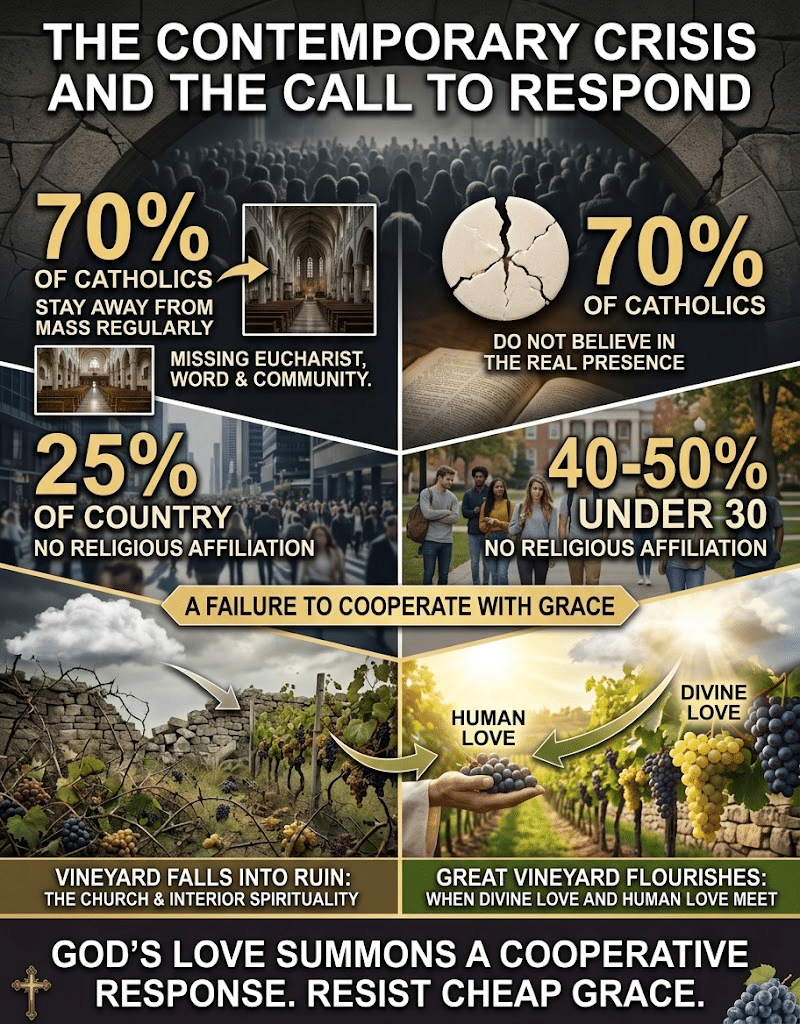
21. According to statistics cited by Bishop Barron, what percentage of Catholics stay away from Mass on a regular basis?

Roughly seventy percent of Catholics stay away from Mass regularly.

22. What essential aspects of Christian life are Catholics missing when they do not attend Mass, according to Bishop Barron?

They are missing the reception of the Eucharist, hearing the Word of God, gathering as a community, and participating in the source and summit of the Christian life.

23. What trend does Bishop Barron highlight regarding religious affiliation among younger Catholics under thirty?

Between forty to fifty percent of young Catholics under thirty claim no religious affiliation whatsoever.

24. According to studies mentioned by Bishop Barron, what percentage of Catholics do not believe in the Real Presence of Christ in the Eucharist?

Studies indicate that seventy percent of Catholics do not believe in the Real Presence of Christ in the Eucharist.

25. What condition must be met for God's vineyard to truly flourish, according to Bishop Barron?

The vineyard flourishes when divine love and human love meet through an active, cooperative response to God's grace rather than treating it as cheap or frivolous love.

2023: SERMON TRANSCRIPT (continued)

The Contemporary Crisis
and the Call to Respond

Statistics have demonstrated for years that roughly seventy percent of Catholics stay away from Mass regularly. They are not receiving the Eucharist, hearing the Word of God, or gathering as a community; they are absent from the source and summit of the Christian life. One quarter of our country claims no religious affiliation whatsoever, and among Catholics under thirty, that figure reaches forty to fifty percent. Furthermore, studies indicate that seventy percent of Catholics do not believe in the Real Presence of Christ in the Eucharist.

This absence represents a failure to cooperate with grace. When that cooperation ceases, the vineyard falls into ruinโ€”both the broader Church and the interior spiritual identity of the individual. Stay with this image from the fifth chapter of Isaiah. It reveals how beautifully God loves and cultivates His holy people. Yet it is not cheap grace or a frivolous love; it is a love that summons a cooperative response. When divine love and human love meet, this great vineyard flourishes. God bless you.

YouTube transcript edited for readability by removing fillers, stumbles, and false starts while strictly preserving the homily’s original cadence and theological accuracy. Infographics and discussion questions are independently produced by TWTW and have no affiliation with Word on Fire.