Liturgy, Liturgy Notes, Liturgy Planner, Sunday Prep, Planning for Mass
Liturgy Notes, Liturgy Planner, Sunday Prep, Planning for Mass
October 4, 2026
Sept 13 | Today | Sept 20 | Sept 27 | Oct 4

⬅️  ➡️
➡️







PETITIONS
October 4, 2026
The Church
Governments and Salvation of the World
Those Burdened by Adversity
Local Parish / Faith Community
THE WORD
IN SONGS
THIS WEEK


ONE WORD
MANY CHARISMS
Sunday Lectionary Perspectives Across Religious Traditions


27th Sunday of Year A
October 4, 2026



THE WORD THIS WEEK
They kill the true heir,
Yet the rejected stone stands
As the cornerstone.
October 4, 2026


Papal Homilies








Featured Blog Posts
October 4, 2026

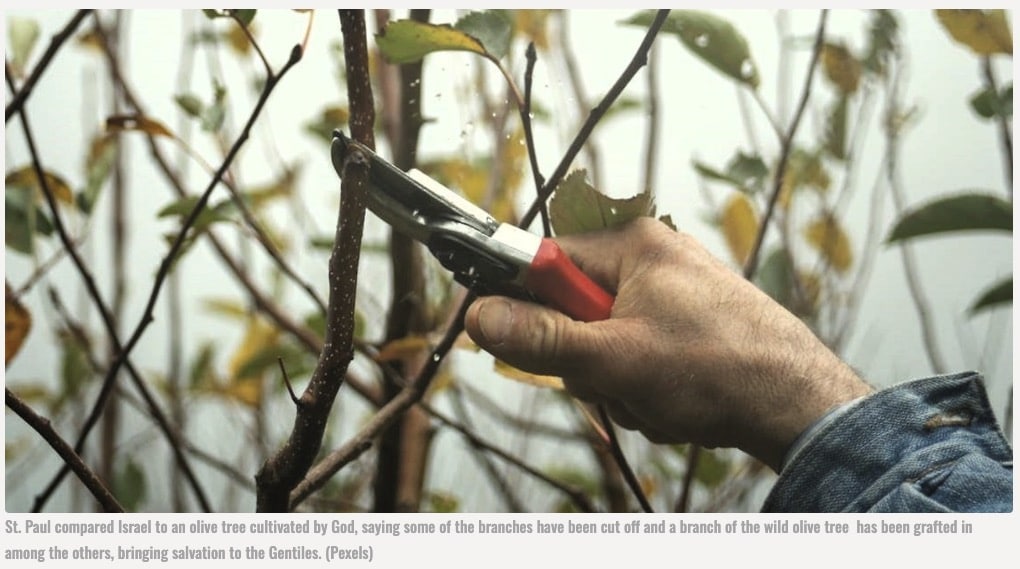


Fr. George Corrigan, OFM
A Call for Change
Matthew's Vineyard
Bearing Fruit
The Coming Change
Give and Take
A Final Thought
Msgr. Joseph Pellegrino (PDF) | Archive
Caring for the Vineyard (2023
Tenant Farmers All(2020)
Wicked Laborers, St. Francis & Us (2017)
Actions and Consequences (2014)
Fr. Michael Fallon, MSC | Archive
27th Sunday in Ordinary Time (PDF)

Liturgy Notes

Courtesy of The Sunday Mass—2023 Cycle A

27th Sunday of Year A
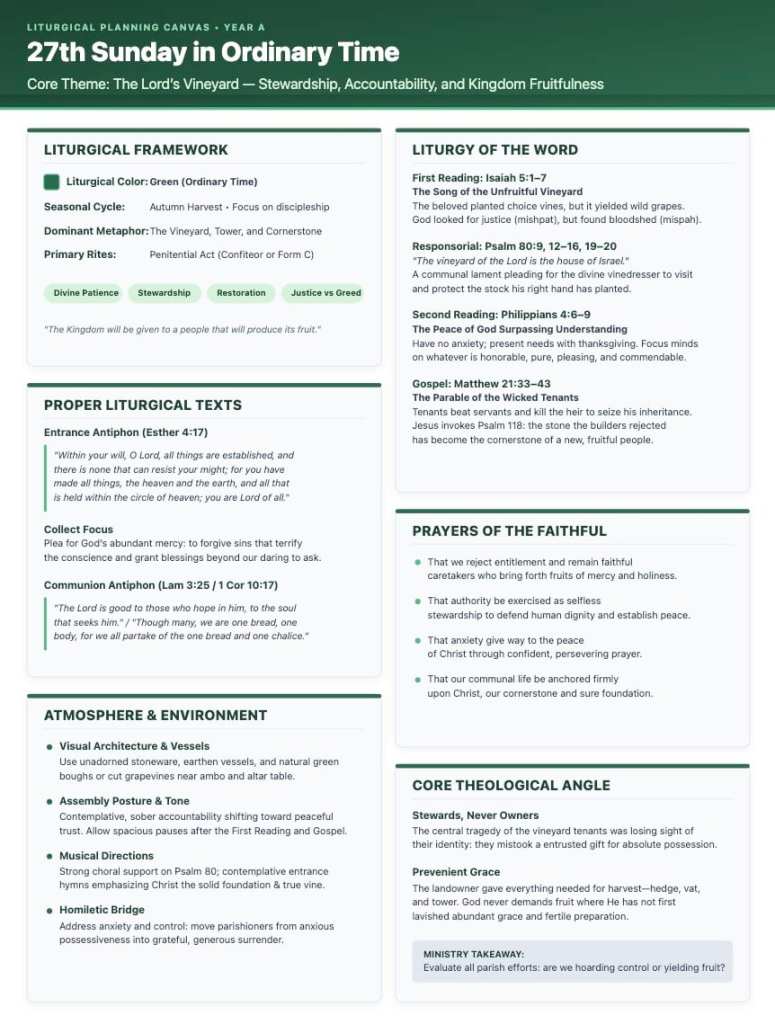
Justice and Fruit
Today’s readings offer us two different perspectives. The first reading and the Gospel issue stern warnings to those who are not acting justly as God commands. The second reading emphasizes the positive side, calling us to focus our attention on “whatever is true, whatever is honorable, whatever is just, whatever is pure, whatever is lovely, whatever is gracious.”
The challenge of the first and Gospel readings is a call to justice. The song of the vineyard in Isaiah ends by saying that God “looked for judgment, but see, bloodshed! for justice, but hark, the outcry!” The Gospel parable ends with this warning: “Therefore, I say to you, the kingdom of God will be taken away from you and given to a people that will produce its fruit.”
Planners might spend some time together discussing how these warnings apply to our contemporary society and institutions. Might God say of our world today, “I looked for judgment but saw only bloodshed; I looked for justice but heard only the outcry of the poor and dispossessed?” Are we, as a local church, producing good fruit in our current crises, both locally and around the world?
There is always hesitation about applying the word of God to current social and political affairs, because it is highly likely that some in the parish will disagree vehemently when they feel their views or their livelihood is threatened by talk of social justice. But can we really justify keeping silent on critical issues of our time because some will disagree?
How we approach such preaching and teaching is important, of course. Little is to be gained in most parish situations by issuing thundering condemnations. That approach will likely turn off more people than it motivates for good. Hard issues must be confronted honestly, but they can also be addressed with understanding and charity toward those who may not yet have grasped the moral issues at stake.
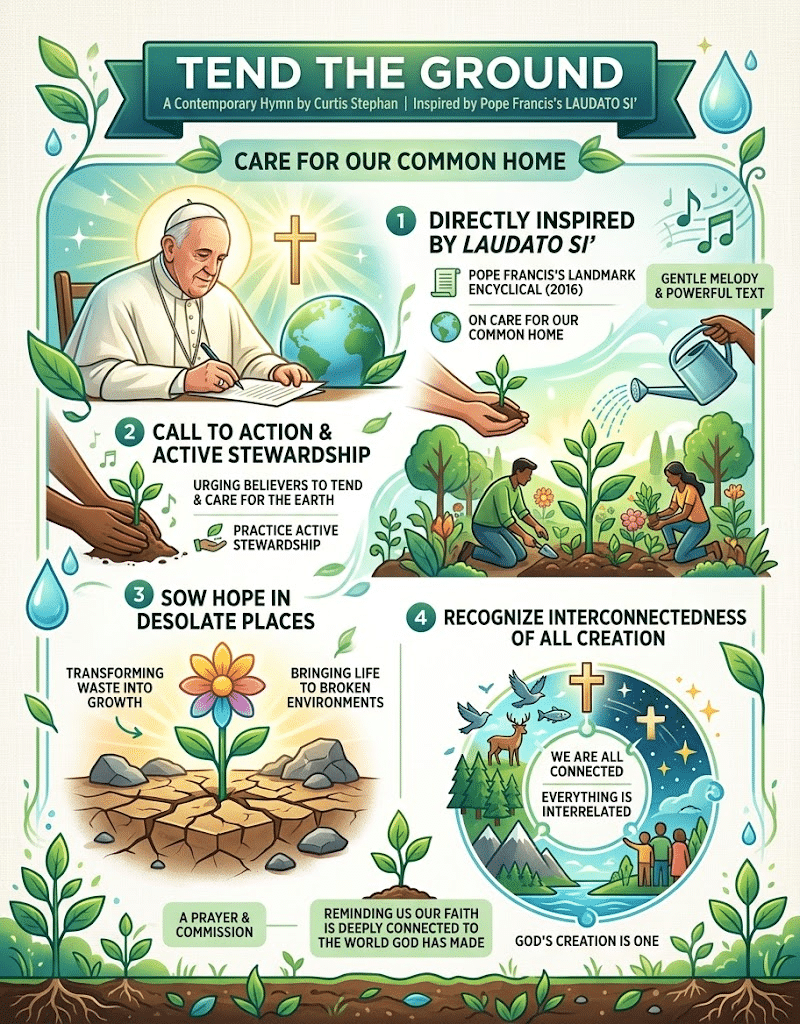
Perhaps the approach of our second reading might be useful. We can confront almost any issue by highlighting its negative aspects, but we can also address it by offering better alternatives to the current way of thinking and acting. Paul’s call to think about what is true, honorable, just, pure, lovely and gracious could serve as a guide for preachers and for those who compose petitions this week. Focusing on the loveliness of what God created might better motivate some people to care for creation, rather than focusing on the pollution and destruction occurring all around the planet. Remember the old adage: You catch more flies with honey than with vinegar.
However you decide to approach justice issues, what is most important is that we help people see how the word of God calls us to action today as much as it did in biblical times.

Full Series: Cycle A Resources
Entrance Song

Response & Acclaim
Response & Acclaim



Presentation & Preparation
Presentation and Preparation

Communion
Communion

Sending Forth
Sending Forth

Our God is Good (Josh Blakesley and Cooper Ray)
SPIRIT & SONG | THE COMMONS
Liturgy Blog is a weekly liturgy planning resource for musicians, liturgists, homilists, youth groups, faith sharing groups, and all who look to the liturgical readings for inspiration and nourishment. Join Ken Canedo as he breaks open the Scripture and suggests tracks from the Spirit & Song contemporary repertoire.
Isaiah 5:1-7

2023 video courtesy of Lector with Lisa

27th Sunday in Ordinary Time — First Reading (Isaiah 5:1–7)
THE WATCHWORD
Core Concept vs. Story: This begins as an upbeat song about a "friend's" garden, but the friend is God, the vineyard is the assembly, and the outcome is an indictment. The goal is to prompt the listener to react with, "That's not right!" before realizing the reading is addressed directly to them.
Vocal Profile: Shift deliberately across three movements: Joyful & Energetic Care (Spring planting) $\rightarrow$ Righteous Anger & Sovereignty (Divine verdict) $\rightarrow$ Gentle Sorrow & Affection (The reveal).
DELIVERY BLUEPRINT TABLE
Text Segment | Vocal Tone | Pacing & Ambo Actions |
"Let me now sing of my friend, my friend's song concerning his vineyard." | Warm, inviting, upbeat. Upward inflection on "his vineyard". | Look up and smile; establish eye contact across the center pews. Set the tone of an eager storyteller. |
"My friend had a vineyard on a fertile hillside;" | Cheerful, bright. | Moderate, narrative pace. Ground the setting securely. |
"he spaded it, cleared it of stones, and planted the choicest vines;" | Enthusiastic, energized; project the pride of springtime gardening. | Pronounce clearly as spaded (not spitted). Keep the rhythm flowing through the catalog of labor. |
"within it he built a watchtower, and hewed out a wine press." | Confident, expectant, proud. | Lift gaze across the room; build energy toward the anticipated harvest. |
"Then he looked for the crop of grapes," | Hopeful, anticipatory. | MANDATORY LONG PAUSE. Hold the silence. Let the congregation await the harvest. |
"but what it yielded was wild grapes." | Sudden drop into deflated disbelief; audible disappointment. | Change your facial expression completely. Gaze directly at the assembly with open disappointment. |
"Now, inhabitants of Jerusalem and people of Judah, judge between me and my vineyard:" | Authority shifts to the Voice of God. Stern, courtroom directness. | Step mentally into God's persona. Plant your feet, project outward, and make firm, wide eye contact. |
"What more was there to do for my vineyard that I had not done?" | Indignant, piercing question. | MANDATORY SILENCE. Let the rhetorical weight sink in: the only possible answer is nothing. |
"Why, when I looked for the crop of grapes, did it bring forth wild grapes?" | Demanding, wounded righteousness. | EXTENDED PAUSE (longer than normal). Give the congregation space to internally register: "That’s not right!" |
"Now, I will let you know what I mean to do with my vineyard:" | Resolute, rising divine justice. | Deliberate, slower pace. Mark the transition from inquiry to sentence. |
"Take away its hedge," | Sharp, decisive. | Lock eye contact with the left section for the entire phrase. |
"give it to grazing," | Firm, unyielding. | Turn and lock eye contact with the center section for the entire phrase. |
"break through its wall," | Sharp, forceful. | Turn and lock eye contact with the right section for the entire phrase. |
"let it be trampled!" | Final, thunderous verdict. | Sweep back to center. Deliver the full phrase looking directly at the people before looking down. |
"Yes, I will make it a ruin: it shall not be pruned or hoed, but overgrown with thorns and briers;" | Weighty, devastating certainty. | Sustained eye contact throughout the list. Deliver each consequence with intentional, unhurried gravity. |
"I will command the clouds not to send rain upon it." | Absolute sovereign power; calm, commanding grandeur. | Stand tall; speak from diaphragm. Emphasize God's total command over nature. Pause briefly. |
"The vineyard of the LORD of hosts is the house of Israel," | Return to Isaiah's Voice. Drop volume slightly; intimate, sobering revelation. | Soften posture. Deliver the reveal gently: the assembly is the garden. |
"and the people of Judah are his cherished plant;" | Deeply affectionate, tender, warm sorrow. | Linger on the word cherished. Speak it with genuine heart and warmth. |
"he looked for judgment, but see, bloodshed!" | Contrast sharply: expectation (calm) vs. tragedy (sharp, guttural grief). | Pause slightly after judgment. Punch bloodshed with quiet, sobering shock. |
"for justice, but hark, the outcry!" | Pained indignation; mourn the collapse of righteous leadership. | Savor the contrast. Let the outcry ring out, then hold 3 seconds of total silence before announcing: "The Word of the Lord." |

- Honor the Structural Voice Shifts: Keep the boundaries clean. Start as Isaiah the energetic storyteller, transition boldly into the righteous authority of God at "Now, inhabitants of Jerusalem...", and return to a gentle, sobering prophet for the final four lines.
- Commit Entire Phrases to Eye Contact: In the condemnation sequence (take away its hedge / give it to grazing / break through its wall / let it be trampled), deliver each clause fully while holding eyes with a different section of the church. Never look down mid-phrase.
- Protect the Silent Pauses: The power of this reading depends on empty space. Hold extended pauses after "wild grapes", after each rhetorical question, and after the final outcry. Give the congregation time to pass judgment before realizing the judgment falls on them.
Isaiah 5:1-7
Greg Warnusz


The Historical Situation: In the late eighth century B.C.E., God's people in the promised land had become divided into a northern kingdom, Israel, and a southern kingdom, Judah (where Jerusalem was the capital). Assyria was the dominant power in the region, and lay especially heavily on the northern kingdom. Concerned about both kingdoms, Isaiah prophesies relief for both in this way: A new king will come to the throne in the southern kingdom, Judah, and will see to the reunion of the north and south and the expulsion of the Assyrians from the north. However, in the early chapters of this book, the prophet is not criticizing the foreign oppressors, but his own unfaithful people.
A Favorite Literary Device of the Prophets: A footnote in The New Jerusalem Bible says this of the vineyard image: The theme of Israel as a vine, chosen and then rejected, had been broached by Hosea, 10:1, and was to be taken up by Jeremiah, 2:21; 5:10; 6:9; 12:10, and Ezekiel, 15:1-8; 17:3-10; 19:10-14; cf. Ps 80:8-18; Is 27:2-5. Jesus was later to give it a new twist in the parable of the wicked husbandmen, Mt 21:33-44 and [parallel gospel passages] (see also the barren fig tree, Mt 21:18-19 and [parallels]). In Jn 15:1-2 he unfolds the mystery of the 'true' vine. Other aspects of the vine theme appear in Dt 32:32-33 and [Sirach] 24:17.
Isaiah's Plan and Your Proclamation: So the grapevine images in this reading and today's gospel stand for real people defying their real God. The prophet feels God's frustration in his own heart, and expresses that emphatically. What you want to convey, as lector, is Isaiah's feeling, "I've got to let these people know the seriousness of their sin." Follow the prophet's lead:
- Isaiah starts by sneaking up on his audience, rhetorically speaking, rather casually telling a story: "My friend" went about the routine task of planting wine grapes.
- Isaiah routinely describes normal agricultural tasks for several sentences. The lector should sound matter-of-fact.
- Then, an unexpected twist!: the yield is only wild grapes! Let the lector sound surprised.
- It becomes a first-person narrative then, with the indignant "What more was there to do for my vineyard?" The lector should practice sounding outraged.
- There follow three dramatic sentences about "my" utter rejection of the vineyard. As lector, deliver these rapidly. Then pause.
- Finally comes the personal application, the indictment of unfaithful Israel. A slow, determined speaking of these sentences will be right, like a judge pronouncing sentence on a convict at the end of trial.

Philippians 4:6-9

2023 video courtesy of Lector with Lisa
27th Sunday in Ordinary Time — Second Reading (Philippians 4:6–9)
THE WATCHWORD
Overarching Pacing Theme: Intentional, unhurried cadence with deliberate eye-lifts to allow mental images to land.
Core Concept vs. Story: This is not a distant historical narrative; it is an intimate pastoral prescription and a concrete covenant promise spoken directly to the congregation's daily anxieties.
Vocal Emotional Profile: Warm, expectant encouragement shifting into sturdy reassurance, expansive contemplation, and concluding with steady, reassuring certainty.
DELIVERY BLUEPRINT TABLE
Text Segment | Vocal Tone | Pacing & Ambo Actions |
"Brothers and sisters:" | Warm, familial, direct. | Look up directly; lock eyes with someone in the assembly before speaking. |
"Have no anxiety at all," | Encouraging, expectant, gentle. Not commanding or harsh. | Slower tempo. Speak with the conviction that true freedom from anxiety is genuinely possible. |
"but in everything," | Grounded, inclusive. | Brief pause; set up the upcoming threefold remedy. |
"by prayer" | Sincere, devout. | Item 1: Distinct pause after delivery. Keep separate from the next action. |
"and petition," | Earnest, humble asking. | Item 2: Distinct pause; do not blend into thanksgiving. |
"with thanksgiving," | Joyful, deeply grateful. | Item 3: Clear upward lift; complete the trio distinctly. |
"make your requests known to God." | Reassuring, practical, confident. | Deliver outward toward the center pews; affirm this as an accessible, doable act. |
"Then the peace of God that surpasses all understanding" | Awe-filled, expansive wonder. | Slower pace; invite the assembly to ponder how that supernatural peace feels. |
"will guard your hearts and minds in Christ Jesus." | Protective, resolute, sturdy. | Let the word "guard" stand out with firm strength. MANDATORY LONG PAUSE. |
"Finally, brothers and sisters," | Fresh, intimate reset. | Look up and establish eye contact across the assembly again. |
"whatever is true," | Reflective, vivid. Picture someone speaking truth. | Collect phrase from page $\rightarrow$ deliver the entire phrase while looking at the left section. |
"whatever is honorable," | Dignified, noble. Picture an honorable deed. | Collect phrase $\rightarrow$ deliver the entire phrase while looking at the left-center section. |
"whatever is just," | Firm, righteous. Picture upright fairness. | Collect phrase $\rightarrow$ deliver the entire phrase while looking at the center section. |
"whatever is pure," | Clean, luminous. Picture unblemished purity. | Collect phrase $\rightarrow$ deliver the entire phrase while looking at the right-center section. |
"whatever is lovely," | Gentle, admiring. Picture genuine beauty. | Collect phrase $\rightarrow$ deliver the entire phrase while looking at the right section. |
"whatever is gracious," | Warm, inviting. Picture lavish grace. | Collect phrase $\rightarrow$ deliver the entire phrase looking across the assembly. |
"if there is any excellence" | Uplifting, inspiring. | Unhurried cadence; allow listeners time to form their own mental pictures. |
"and if there is anything worthy of praise," | Warmly elevating, radiant. | Keep vocal energy suspended; do not drop volume before the directive. |
"think about these things." | Direct, purposeful appeal. | Direct eye contact; pause briefly to let the entire catalog settle. |
"Keep on doing what you have learned and received and heard and seen in me." | Sustained, cohesive momentum; steady apostolic confidence. | Maintain energy through every single "and"; sustain one unified, continuous breath and voice all the way to the period. |
"Then" | Deliberate, transitional. | Short pause right after "Then" to frame the climactic promise. |
"the God of peace" | Tender, profound assurance. | Linger on "peace"—let the soft final s-sound ring out and register across the room. |
"will be with you." | Solemn, binding covenant promise. | Deliver with quiet, unbreakable confidence. |
"The Word of the Lord." | Clear, reverent proclamation. | MANDATORY LONG PAUSE. Look up and hold eye contact to receive the assembly's "Thanks be to God." |

- Collect on the Page, Proclaim to the People: During the "whatever is..." sequence, never speak while looking down. Look down to harvest the phrase, lift your gaze completely, and deliver each virtue directly into the eyes of a specific section of the room.
- Visualize Every Virtue Before You Speak It: You cannot project what you do not picture. Hold a vivid three-dimensional mental image for each quality—truth, honor, justice, purity, loveliness, grace—giving the assembly room to see the pictures themselves.
- Carry the "Ands" Straight to the Covenant: Do not let your voice dip or grow tired during "learned and received and heard and seen in me." Drive that sustained vocal energy forward, take a clean breath after "Then," and linger on the final "s" of "peace" to seal the reading as an absolute promise.
Philippians 4:6-9
Greg Warnusz

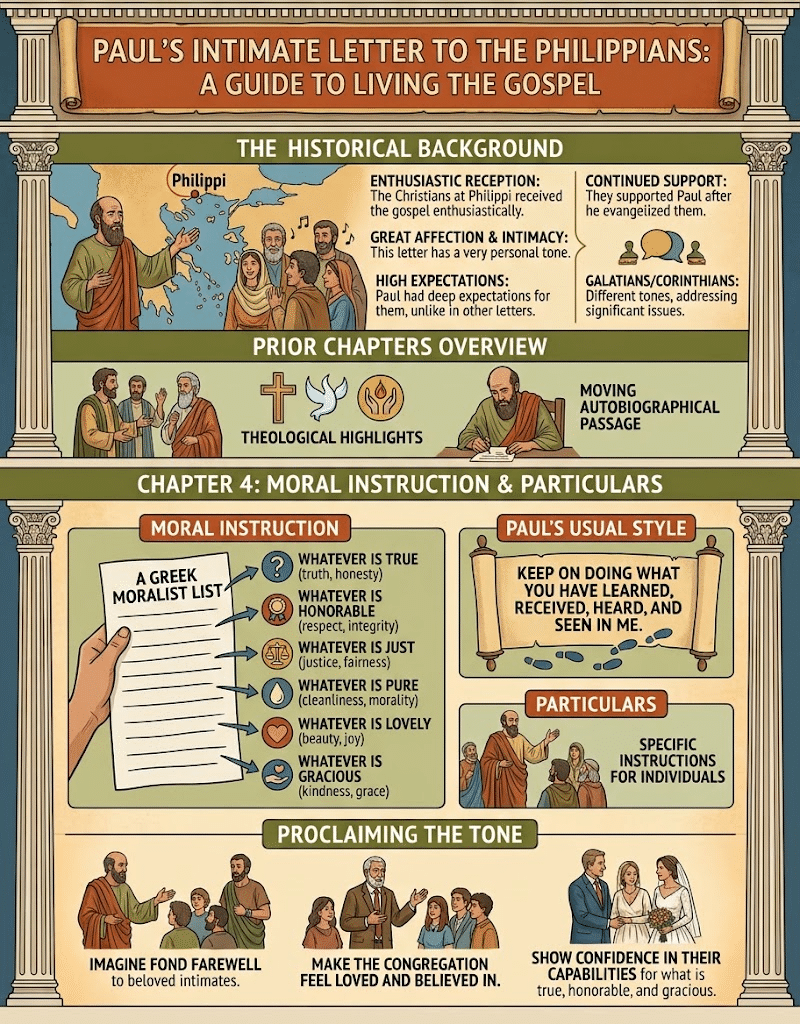
The Historical Background: The Christians at Philippi had received the gospel enthusiastically and continued to support Paul after he had evangelized them. The Apostle had great affection for the Philippians, as the intimate tone of this letter shows. In today's passage he shows his high expectations for them. (Paul loved all his congregations, but didn't have the same deep affection or high expectations for them all. See the letters to the Galatians and the Corinthians.) Prior chapters have some theological highlights and a moving autobiographical passage. This last chapter, as with most of Paul's letters, contains moral instruction and particulars that pertain to individuals in the addressed community.
The phrases "whatever is true, whatever is honorable, whatever is just, whatever is pure, whatever is lovely, whatever is gracious, ..." are a kind of list used by Greek moralists of the time. But Paul returns to his usual style when, in the next sentence, he says "Keep on doing what you have learned and received and heard and seen in me."
Proclaiming It: To capture the Apostle's tone when you proclaim this, imagine yourself saying a fond farewell (Paul was in prison, perhaps facing execution, when he wrote this) to a small group of beloved intimates. You need not imagine your deathbed; you could pretend to be a beloved college professor at retirement time, or a parent on the eve of your child's wedding. Just do what it takes to make your congregation feel loved, that you believe in them, that they're capable of whatever is true, honorable and gracious.til the right poet/musician comes along who can render the passage more beautifully, it's up to you speak it faithfully, with the solemnity that its venerable status calls for.