Fr. Tony’s Homily, Homily Starters
Fr. Tony’s Homily, Homily Starters
November 1, 2026

⬅️  ➡️
➡️


RELATED
PAGES
Homily Starters
Solemnity of All Saints
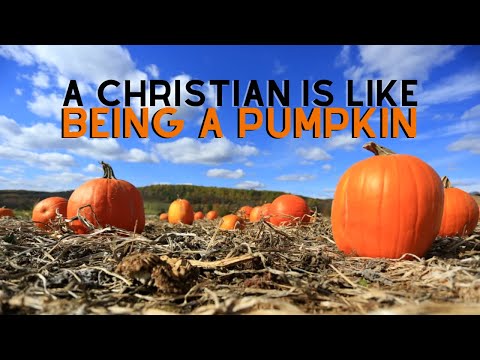
“What Is It Like toe
Be A Christian Saint?”
“It is like being a Halloween pumpkin. God picks you from the field, brings you in, and washes all the dirt off you. Then he cuts off the top and scoops out the yucky stuff. He removes the pulp of impurity and injustice and seeds of doubt, hate, and greed. Then He carves you a new smiling face and puts His light of holiness inside you to shine for the entire world to see.” This is the Christian idea behind the carved pumpkins during the Halloween season.
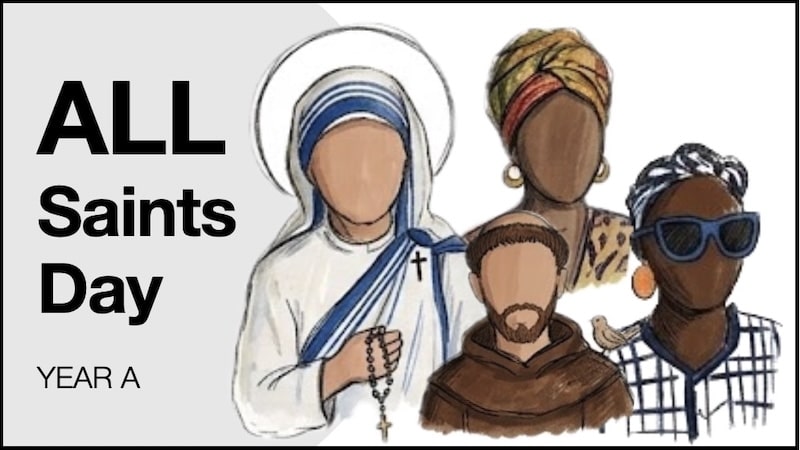
Diversity of Saints

One thing that strikes you first about the Saints is their diversity. It would be very difficult to find a single pattern of holiness, a single way of following Christ common to all.
There is Thomas Aquinas, the towering intellectual, and John Vianney (the Curé d’Ars), who barely made it through the seminary. There is Vincent de Paul, a saint in the city, and there is Antony who found sanctity in the harshness and loneliness of the desert. There is Bernard kneeling on the hard stones of Clairvaux in penance for his sins, and there is Hildegard of Bingen singing and throwing flowers, madly in love with God.
There is Albertus Magnus, the quirky scientist, half-philosopher and half-wizard, and there is Gerard Manley Hopkins, the gentle poet. There is Peter, the hard-nosed and no-nonsense fisherman, and there is Edith Stein, secretary to Edmund Husserl and colleague to Martin Heidegger, the most famous philosopher of the twentieth century. There is Joan of Arc, leading armies into war, and there is Francis of Assisi, the peacenik who would never hurt an animal. There is the grave and serious Jerome, and there is Philip Neri, whose spirituality was based on laughter.
How do we explain this diversity? God is an artist, and artists love to change their styles. The saints are God’s masterpieces, and He never tires of painting them in different colors, different styles, and in different circumstances.
What does this mean for us? It means we should not try to imitate any one Saint exactly. We need to look to them all, study their unique holiness, but then find that specific color God has intended for our lives and holiness.
St. Catherine of Siena was right: “Be who God meant you to be and you will set the world on fire.” (Fr. Robert Barron).
Street Sweeper Can Become A Saint, How?

Six months before he was assassinated, Dr. Martin Luther King Jr. spoke to a group of students at Barratt Junior High School in Philadelphia on October 26, 1967. Part of his “What Is Your Life’s Blueprint?” speech is the tale of the street sweeper. It is inspiration that regardless of what we do we should always aspire to be the best we can at what we do. It is the secret of living saintly lives as well.
“If it falls to your lot to be a street sweeper, sweep streets like Michelangelo painted pictures, sweep streets like Beethoven composed music … Sweep streets like Shakespeare wrote poetry. Sweep streets so well that all the host of Heaven and earth will have to pause and say: Here lived a great street sweeper who swept his job well.” (Martin Luther King).
The Feast and its Objectives

The feast gives us an occasion to thank God for having invited so many of our ancestors to join the company of the saints. May our reflection on the heroic lives of the saints and the imitation of their lifestyle enable us to hear from our Lord the words of grand welcome to eternal bliss: “Well done, good and faithful servant! Enter into the joys of your master” (Mt 25:21). Today is also a day for us to pray to the saints, both the canonized and the uncanonized, asking them to pray on our behalf that we may live our lives in faithfulness like theirs, and so receive the same reward. All baptized Christians who have died and are now with God in glory are considered saints. All Saints Day is a day on which we thank God for giving ordinary men and women a share in His holiness and Heavenly glory as a reward for their Faith. In fact, we celebrate the feast of each canonized saint on a particular day of the year. But there are countless other saints and martyrs, men, women, and children, united with God in Heavenly glory, whose feasts we do not celebrate. Among these would be our own parents and grandparents, brothers and sisters who were heroic women and men of Faith. All Saints Day is intended to honor their memory. Hence, today’s feast can be called the feast of the Unknown Saint, in line with the tradition of the “Unknown Soldier.” According to Pope Urban IV, All Saints’ Day is also intended to supply any deficiencies in our celebration of feast of saints during the year. In addition, the feast is observed to teach us to honor the saints, both by imitating their lives and by seeking their intercession for us before Christ, the only mediator between God and man (I Tim. 2:5). Today, the Church reminds us that God’s call for holiness is universal and that all of us are called to live in His love and to make His love real in the lives of those around us. Holiness is related to the word wholesomeness. We show holiness when we live lives of integrity and truth, that is, wholesome and integrated lives in which we are close to others — all God’s children — while being close to God.
“Never forget what this cross means”
When Margaret Helminski was seven, she received a gift from her grandmother. It was a tiny cross on a wisp of gold chain, so fine its weight was barely perceptible. “Never forget what this cross means,” her grandmother said as she fastened it carefully around Margaret’s neck. Over the years, Margaret says, that cross became a part of her, like the lone freckle on her left cheek. She could look at herself in the mirror and not even see it. As a graduate psychology student, Margaret took a job tutoring at a school for emotionally disturbed children. Suddenly surrounded by children who expressed their displeasure by kicking, biting, and screaming, she was terrified, though determined not to let it show. On her first night there, the head counselor said that three of the boys had asked to escort her to dinner. Alone! How would she handle it if all three decided to act out at once? She swallowed hard. She desperately needed this job so she fought back the panic and walked with her charges to the dining hall. They passed through the cafeteria line as tantrums and fights erupted around them. Fortunately none of her boys exhibited any kind of behavioral outburst. They made their way to a table in the center of the busy cafeteria and the boys took their seats. Margaret picked up her fork and was about to take the first bite when she noticed that all three boys were staring at her. “What’s the matter?” she asked. Aren’t you going to ask a blessing?” asked eight-year-old Peter. “I didn’t think I was supposed to,” she responded. “This is a state school, isn’t it?” “Yes,” said David, his blue eyes brimming, “but you wear a cross.” Her grandmother’s words surged to the surface of her memory. “Never forget what this cross means,” her grandmother said. “We thought that meant something,” said Roman, clearly disappointed. “It does. Thank you for reminding me,” Margaret said, as she bowed her head, no longer afraid. [Catholic Digest (Feb. 92), p. 64]
Margaret learned something about sainthood that day. Saints trust in God and God alone for their ultimate security. Saints submit their will to the will of God. Saints stand firm and witness to their faith.
Is your definition of a saint a nice person who abides by all the rules?
Francis of Assisi bears the title of Saint but according to Mark Galli, in an article in Christianity Today, Francis wasn’t always a nice guy to be around. For example, he had this thing about money: his friars were not to touch it. And he did not mean the “You can touch money but just don’t let it grip your heart” stuff. One day a worshiper at the Church of Saint Mary of the Portiuncula, Francis’s headquarters, left a coin as an offering at the base of the sanctuary cross. This was a common offering of gratitude to God in that day, but when one of Francis’ friars saw the money, disturbed by its presence at the cross, or perhaps knowing Francis’s revulsion of money he tossed it over to a window sill. When Francis learned the friar had touched money, he did not take the errant brother aside, explain his point of view, and then hug him so as to be sure there were no hard feelings. Instead, Francis rebuked and upbraided the brother. He then commanded him to lift the money from the window sill with his lips, find a pile of donkey dung outside, and with his lips place the coin in the pile. Was that nice? How could a saint be so nasty? Is he an exception to the larger guild of saints? Actually, when compared to the hundreds of stories of saints that can be culled from the Bible and Church history, Francis was merely fulfilling his job description. [“Saint Nasty,” Christianity Today (June 17, 1996), pp. 25-28.]
“A saint is somebody that the light shines through.”
Here is a children’s story. The pastor was explaining the pictures of his Church’s stained-glass windows to the third graders. The first stained window is really red, the next window is really blue, the next window is really green, and the next window is really yellow. The sun has come up in the south and wonderful light is coming through these four windows. The pastor says, “This first window with all the reds is dedicated to St. Matthew and it has a picture of St. Matthew on it. The second window with all the blues is dedicated to St. Mark and it has a picture of St. Mark, the second of our Gospels. The third window with all the greens is dedicated to St. Luke and has a picture of St. Luke on it. The fourth window with all the yellows is dedicated to St. John and has a picture of St. John in it. All the windows are so beautiful, especially with the sunlight shining through them.” And one of the little girls says, “Do you know what a saint is?” “Yes,” replied the pastor. “A saint is somebody that the light shines through.” Yes, the light of God shines through the lives of the saints. It is not your light that is shining; it is the light of God shining through your lives. The windows sparkle and inspire your lives. . (Rabbi Edward F. Markquart).
Saints inspire us to become better Christians
their lives inspire us and lift us up to be better people. A saint doesn’t say, “I want you to be a Christian. I am going to try to subtly force you to be a Christian. I am going to drag you to Church today.” No. By the nature of their lives, these saints inspire us to be holy. Let me explain by means of a famous example from the lives of Dr. David Livingston and Henry Stanley. Dr. David Livingston was a famous missionary in Africa who had been there in the heart of Africa and had disappeared into the jungles. Henry Stanley went on a search for Dr. Livingston after he had long disappeared, and, after a lengthy search, finally found Dr. Livingston. Stanley greeted Livingstone with the now- famous line from history, “Dr. Livingston, I presume?” The two men lived together for three months. Some time later, Henry Stanley wrote his memoirs, and he said: “Dr. Livingston made me a Christian, and he didn’t even know he was doing it. He inspired me and didn’t even try to.” Saints inspire you to live a life of holiness. (Rabbi Edward F. Markquart).
Lost – The Final Episode of the Series

LOST (2:02) – Due to his injuries Jack dies in the jungle where he first began. Vincent the dog keeps him company until he dies, but before he dies he sees the plane fly above them. Smiling that Kate, Claire and Sawyer had escaped the island. In the alternated world the rest of the Oceanic 815 survivors reunite in a local church, smiling happily at each other, and are ready to phase into the next stage.
Divine Marking and Preservation
In the season finale of Lost, the main characters attempt to detonate a hydrogen bomb to rewrite their fates and prevent their plane crash. Intercut with this crisis are flashbacks showing the mysterious, god-like figure Jacob touching various survivors at pivotal moments earlier in their lives, effectively marking them for a specific destiny.
Scriptural Connections
Sovereign Election and the Nature of the “Mark”
In Revelation 7, the angel places a literal, protective seal upon the foreheads of the 144,000 servants of God. This act is not merely symbolic; it is a definitive marker of ownership, distinguishing those who belong to the divine household from the rest of a collapsing world.
Similarly, Jacob’s physical touch in Lost functions as an act of election. When Jacob touches candidates like Jack, Kate, Sawyer, and Hurley during critical moments in their pasts, he marks their trajectories.
Separation for Purpose: In both contexts, being marked sets an individual apart from common history. They are ushered into a sacred narrative that transcends their personal desires or immediate survival.
Divine Ownership: Just as the biblical seal declares, “These are Mine,” Jacob’s touch acts as an indelible claim. Even when the characters stray, make destructive choices, or reject their purpose, they remain inextricably bound to the Island’s overarching design.
Preservation Through Tribulation
A central theological tension in Revelation 7 is that the sealing happens before the unleashing of cosmic judgment and tribulation. The seal does not necessarily prevent the servants from experiencing earthly suffering or martyrdom—as seen in the multitude “coming out of the great tribulation” in verses 14—but it guarantees their ultimate preservation and spiritual security.
In the finale of Lost, the characters endure profound suffering, existential doubt, and a literal impending apocalypse. Yet, Jacob’s touch (and the deeper logic of the Island) ensures that their ultimate stories do not end in meaningless destruction.
The Flash-Sideways as Eschatological Rest: The purgatorial “flash-sideways” space in the final season mirrors the theological reality of the sealed multitude standing before the throne—cleansed, having “washed their robes and made them white in the blood of the Lamb.” It represents the final realization of safety and rest after the tribulations of history have passed.
Ultimate Security: The narrative insists that their trials are purposeful. The presence of the mark guarantees that they are safely kept within a larger redemptive framework.
Free Will vs. Sovereign Decree
A crucial theological link between Matthew 22:39–40 and Christopher Reeve’s post-aThe intersection of Lost and Revelation also highlights the eternal theological debate between human free will and divine sovereignty.
Throughout the series, the candidates constantly rebel against Jacob, question his motives, and exercise their free will in ways that cause immense pain to themselves and others. Yet, the finale reveals that their choices, failures, and redemptive arcs ultimately converged on the exact destination Jacob intended.
“You’re with me now,” Jacob tells them, signaling that human agency operates within the boundaries of a sovereign, protective design.
In Revelation, the sealed servants are preserved not because of their own flawless execution of will, but because the seal of the living God anchors their ultimate destiny. Lost captures this exact tension: characters grapple with an agonizing sense of an uncertain fate, while the underlying theology of the mark provides the absolute assurance that they are never truly lost.
Central Theme of Readings
Solemnity of All Saints

All Saints Day
The clipart is from the archive of Father Richard Lonsdale © 2000. It may be freely reproduced in any non-profit publication.
For Roman Catholics, the Orthodox, and to some extent, the Anglicans, “All Saints Day” is a day, not only to remember the saints and to thank God for them, but also to pray for their help. It is, as well, a day to glorify Jesus Christ, Who by His holy life and death has made the saints holy. This feast offers a challenge to each one of us: anybody can become a saint, regardless of his or her age, lifestyle or living conditions. St. Augustine accepted this challenge when he asked the question: “If others can become saints, why can’t I?” (Si iste et ista, cur non ego?).
Rev 7:2-4, 9-14
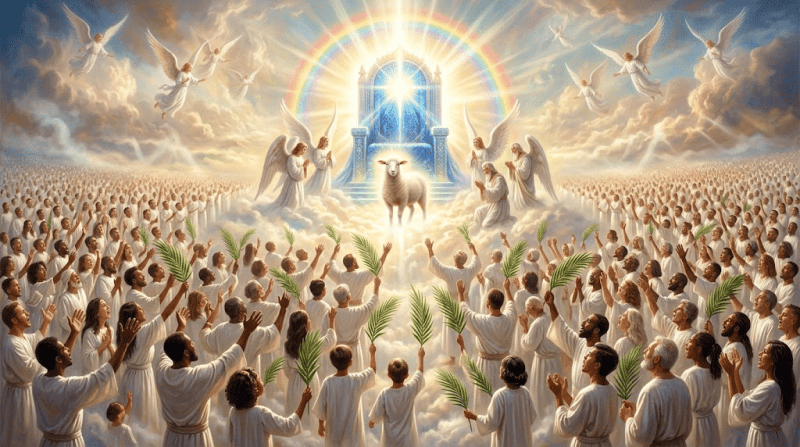
The first reading, taken from the Book of Revelation, speaks of John’s vision of saints in their Heavenly glory: “a great multitude that no one could count, from every nation, from all tribes and peoples and languages, standing before the throne and before the Lamb, robed in white, with palm branches in their hands” (Rv 7:9). All Saints Day reminds us that we are called to be a part of that vast multitude of holy ones whose numbers are so great they cannot be counted.
parochialism and give them a more universal view of God’s concern and plan.
1 John 3:1-3
As the second reading suggests, saints are people who have responded generously to the love God has showered on them. St. John tells us that to be “saints” means to be “children of God”—and then he adds: “so we are”!
Matthew 5:1-12a
Offering us the Beatitudes in today’s Gospel, the Church reminds us that all the saints whose feasts we celebrate today walked the hard and narrow path of the Beatitudes to arrive at their Heavenly bliss. The Beatitudes are God’s commandments expressed in positive terms. They go far beyond what is required by the Ten Commandments, and they are a true and reliable recipe for sainthood: Poverty of spirit is knowing our need for God. Mourning is embracing the inevitable sufferings of life and alleviating the sorrows of others. Meekness is docility to God’s will and patient gentleness with others, even in the face of sufferings, disappointments, and insults. Hunger for justice is the longing to see everyone enjoy the peace, happiness, justice, and healing promised by Christ. We obtain mercy by extending it to others. Purity of heart is that right intention or sincerity that puts God first and judges everything else in relationship to God. Real peace is reached when enemies become trustworthy friends. Suffering for doing what is right is accompanied by deep happiness even now.
Life Messages
Solemnity of All Saints
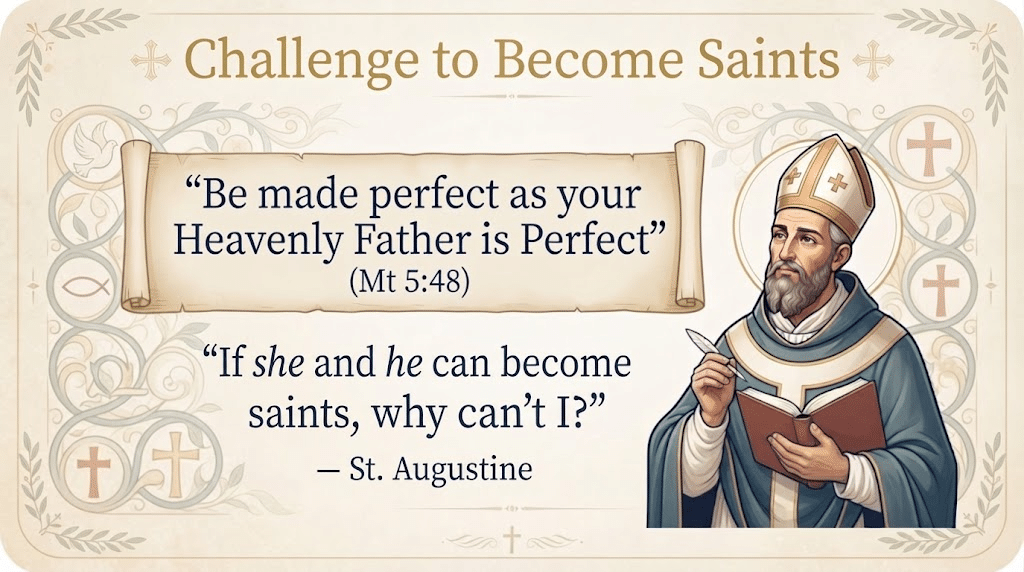
The Challenge to Become Saints.

Jesus exhorts us: “Be made perfect as your Heavenly Father is Perfect” (Mt 5:48). St. Augustine asked: “If she and he can become saints, why can’t I?” (Si iste et ista, cur non ego?). On the feast of All Saints, the Church invites and challenges us to walk the walk of the saints and not just talk the talk: “Not everyone who says to me, ‘Lord, Lord,’ will enter the Kingdom of Heaven, but only the one who does the will of my Father in Heaven” (Mt 7:21). 2)
Short Cuts Practiced by Three Teresas
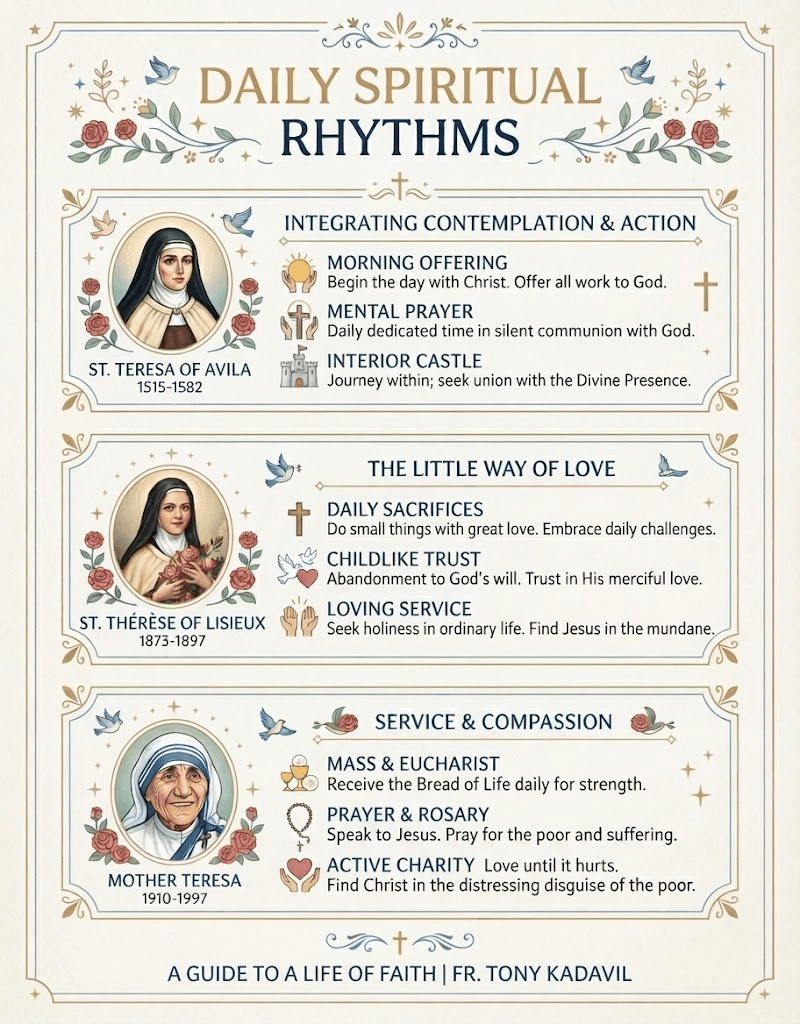
i) St. Teresa of Avila: Recharge your spiritual batteries every day by prayer, namely, listening to God and talking to Him
ii) St. Therese of Lisieux: Convert every action into prayer by offering it to God for His glory and for the salvation of souls and by doing God’s will to the best of one’s ability.
iii) St. Teresa of Calcutta (Mother Teresa): Do ordinary things with great love.

View All Your Highlights Across Website
Organize, Delete, Sshare
CHATBOT

Click here or on icon at lower right corner.
- Ask Question: Copy/paste any text from this page into the chatbot.
- Copy response: Click the copy button located directly underneath the chatbot’s response.
- Save to notes: Click the blue + Paste AI Response button (top right).
WARNING: Deleting browser history, cookies, or “Site Data” will permanently wipe your Local Storage and delete all saved highlights.
Highlights and
AI Notes
Dynamic Title Injector
You have no highlights or notes on this page. Select text above and apply a color to see it here; or copy and paste text from the AI chat bot (see directions at left).