Commentary Intro to Mass Readings Sunday Readings
CommentaryIntro to Mass Readings Sunday Readings
October 18, 2026
⭐⭐⭐ Fr. George Corrigan, OFM—PDF

⬅️  ➡️
➡️
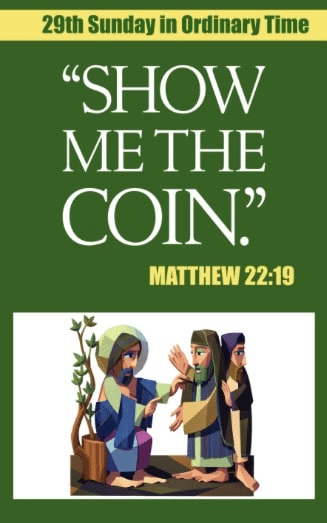
October 18, 2026
Our Sunday Readings
Edrianne Ezell
Catholic Scripture Study
Vince Contreras
Hearers of the Word
Fr. O’Mahony OSA
Friar Musings, OFM
Fr. George Corrigan, OFM
Echoing God’s Word
Fr. Clement Thibodeau


“A Walk in The Word” series is based on the Sunday Mass readings and led by International Catholic evangelist and bible teacher, Hector Molina.

Ten minute video excerpts from the “The Mass Readings Explained” subscription series based resource from Catholic Productions.

Francis Martin (1930 – 2017) was an American Catholic priest of the Archdiocese of Washington, and a professor of Sacred Scripture. His teaching appointments included the Dominican House of Studies, the John Paul II Institute, the Catholic University of America, and Sacred Heart Major Seminary.
Kevin Aldrich
Kevin Aldrich’s “Doctrinal Homily Outlines” is a lectionary-based aid for homilists. A career Catholic K-12 educator in Catholic schools., he has written the teacher guides for nine of the Didache series high school religion texts. He has a Master’s Degree in Theology with an emphasis on Sacred Scripture from Holy Apostles College and Seminary.

Fr. Geoffrey Plant
29th Sunday of Year A

Isaiah 45:1, 4-6
Create a verse by verse (NAB) commentary relating xxxxxxxxxxxxx TO CATHOLIC doctrine and practice. Give real life applications when appropriate
give me three thought provoking questions followed up with detailed answer reflection based on xxxxxxxxxxxx
Isaiah 45:1
"Thus says the Lord to his anointed, Cyrus, whose right hand I grasp, subduing nations before him, and making kings run in his service, opening doors before him and leaving the gates unbarred:"
Exegesis & Context
Cyrus II ("the Great"), founder of the Achaemenid Persian Empire, conquered Babylon in 539 BC and subsequently issued the edict permitting the exiled Jewish people to return to Jerusalem and rebuild the Temple (2 Chr 36:22–23; Ezra 1:1–4). Here, the prophet uses the Hebrew title Mashiach ("His anointed one," translated in Greek as Christos). Cyrus is the only non-Israelite in the Old Testament explicitly granted this sacred title, usually reserved for Israel's Davidic kings, high priests, and prophets.
Catholic Doctrine
- Universal Divine Providence & Secondary Causes: God is the sovereign Lord of all human history. As the Catechism of the Catholic Church teaches: "God is the sovereign master of his plan. But to carry it out he also makes use of his creatures' cooperation... God acts in and through them" (CCC 306–308). God's saving power is not restricted by ecclesiastical or covenantal boundaries; He can use secular rulers and temporal systems to accomplish His divine will.
- Typology of Christ: Cyrus acts as an imperfect, temporal type of Jesus Christ. While Cyrus shattered iron bars and liberated Israel from physical exile in Babylon, Christ—the true Anointed One—shatters the gates of Hades and the bonds of sin, leading humanity out of spiritual captivity into the freedom of the children of God (CCC 436, 635).
Real-Life Application
- Navigating Secular & Civil Life: Believers frequently face anxiety over national politics, shifting administrations, or secular cultural dominance. Isaiah 45:1 reminds Catholics that no political figure or civil power operates outside the sovereign reach of God's providence. A practical Catholic response avoids both despair and political idolatry: vote with a well-formed conscience according to natural law and the common good, pray regularly for civil leaders (1 Tim 2:1–2), and recognize that God often works renewal through surprising, imperfect instruments.
Isaiah 45:4
"For the sake of Jacob, my servant, of Israel, my chosen one, I have called you by your name, giving you a title, though you knew me not."
Exegesis & Context
Cyrus worshipped the Persian pantheon and credited the Babylonian god Marduk on the famous Cyrus Cylinder for his victories. Yet the Lord reveals through Isaiah that Cyrus's military ascendance, political power, and geopolitical decisions were ultimately directed by the God of Abraham "for the sake of Jacob... though you knew me not."
Catholic Doctrine
- The Ecclesial Purpose of History: God guides world affairs with a specific view toward the sanctification and preservation of His covenant people. In the New Covenant, the Church is the "seed and beginning" of the Kingdom of God on earth (Lumen Gentium, 5). Secular events, technological developments, and global shifts are mysteriously ordered by God to sustain His Church and spread the Gospel across the globe (CCC 760).
- Unmerited Vocation (Election): Calling someone "by name" in Scripture signifies intimate divine election and mission (cf. Isa 43:1; Jer 1:5). God’s call is prior to human knowledge or personal merit. This reflects the foundational doctrine of grace: God acts first, initiating communion and providing the supernatural impetus before a person even knows how to respond (CCC 1996, 2008).
Real-Life Application
- Witness in the Secular Workplace: Cyrus fulfilled God's purpose while working in a pagan civil administration. Catholics working in corporate environments, secular public schools, trades, or municipal services often feel isolated in non-believing settings. You do not need to be in formal parish ministry to be an instrument of divine providence. By maintaining unwavering professional integrity, refusing dishonest compromises, mentoring others, and treating coworkers with authentic Christian charity, you become an instrument God uses to bless and protect others, even where His name is largely unrecognized.
Isaiah 45:5–6
"I am the Lord and there is no other, there is no God besides me. It is I who arm you, though you know me not, so that toward the rising and the setting of the sun people may know that there is none besides me. I am the Lord, there is no other;"
Exegesis & Context
These verses form a sweeping, absolute confession of monotheism. Ancient Near Eastern religion was polytheistic and territorial; gods were thought to rule localized regions, specific mountains, or individual cities. In contrast, Yahweh proclaims that from the eastern horizon ("the rising of the sun") to the western sea ("the setting of the sun"), there is no rival power. Cyrus's triumphs were not victories of Persian deities, but the manifestation of the one true God over all creation.
Catholic Doctrine
- The First Commandment & Strict Monotheism: "Hear, O Israel: The Lord our God is one Lord" (Deut 6:4; CCC 200, 2084–2086). The Church proclaims that God is absolute Being, the uncreated Creator of heaven and earth. To confess "there is no other" obliges the human person to reject modern forms of idolatry: putting ultimate trust in money, state power, technology, prestige, or self-reliance (CCC 2112–2113).
- The Missionary Mandate (Ad Gentes): God’s revelation of Himself as the sole author of life is explicitly oriented toward global proclamation: "so that... people may know that there is none besides me." The Church's missionary impulse flows directly from this universal truth: because there is only one God and one Mediator between God and men, Jesus Christ (1 Tim 2:5), the Catholic Church possesses an essential, inescapable mandate to proclaim the Gospel to all nations (CCC 849–851).
- The Sacred Liturgy (The Eucharistic Sacrifice): In the Roman Rite, the Third Eucharistic Prayer directly echoes the geographical scope of Isaiah 45:6:"From the rising of the sun to its setting, a pure sacrifice may be made to your name."Every Mass offered around the globe realizes this prophecy, offering the perfect sacrifice of Christ so that all peoples may acknowledge the one true God.
Real-Life Application
- Personal Idolatry Audits: While modern Catholics rarely bow to stone statues, subtle functional idolatry remains a constant hazard. When anxiety strikes—whether over household finances, children's futures, or political upheaval—our default reaction reveals who or what we treat as our functional "god." A practical spiritual exercise is to examine where your ultimate security lies: in savings accounts, market returns, political parties, or the living God? Whenever fear dominates, pray the First Commandment intentionally: "Lord, You are God; there is no other. I surrender this situation entirely into Your hands."
- Daily Morning & Evening Prayer (Liturgy of the Hours): Sanctifying the day "toward the rising and the setting of the sun" can be practiced through the Liturgy of the Hours (Lauds and Vespers) or a morning offering and evening examination of conscience. Marking the boundaries of the day with structured prayer reminds us that every minute of secular labor sits squarely within the presence and lordship of Jesus Christ.
Algorithmically generated text
give me three thought provoking questions followed up with detailed answer reflection based on xxxxxxxxxxxx. Keep questions and answers appropriate for Sunday congregation giving real life application.
To a Jewish audience in exile, hearing a pagan Persian monarch addressed as the Lord’s “anointed” (mashiach) was shocking. God was working through an outsider—someone from beyond the covenant community—to fulfill His promise of liberation and rebuilding.
In everyday life, we frequently fall into the trap of deciding how God is permitted to work. When facing a personal crisis, a broken marriage, financial hardship, or cultural tension, we expect deliverance to arrive through a familiar, comfortable package: a miraculous intervention, a trusted spiritual mentor, or our own preferred political and social structures.
Yet God routinely uses unlikely instruments. Healing in a fractured family might begin through the honest observation of an estranged relative who holds no religious beliefs. Wisdom to revitalize a struggling workplace or church committee might come through a skeptical consultant. Reconciliation often begins when an adversary highlights a blind spot we refused to see.
Trusting God means surrendering our veto power over His tools. When we expand our vision beyond the circle of people who look, think, and pray exactly like us, we begin to recognize God's hand at work in places we previously dismissed as godless.
Algorithmically generated text
Cyrus was an extraordinarily gifted commander, architect, and strategist. In his own eyes—and as preserved on the famous Cyrus Cylinder—his victories were the fruit of his own brilliance and the favor of his native gods. Yet God clarifies reality: Cyrus was named and equipped before he took his first breath, not for his own glorification, but for the sake of God’s people.
When we experience success—climbing the professional ladder, managing an expanding business, raising capable children, or exercising leadership within a congregation—human nature tempts us to claim ownership. We credit our 60-hour workweeks, our sharp instincts, or our personal charisma.
Verse 4 dismantles that self-congratulation. Every gift, opportunity, and open door is a trust given by God before we even had the sense to acknowledge Him. Your position as a manager, educator, healthcare worker, or parent is not an independent kingdom for your own comfort or status. You were placed there “for the sake of” others—to be an advocate for the vulnerable, a steward of integrity, and a channel of blessing. Humility starts when we realize our achievements are not evidence of our autonomy, but assignments given by a Sovereign Provider.
Algorithmically generated text
The phrase repeated with striking emphasis in verses 4 and 5 is: “though you do not know me.” Cyrus acted without knowing the God who was directing his steps, and God still directed history toward redemption.
We often condition our peace of mind on our ability to see the path ahead. When a medical diagnosis upends a family, when a career abruptly stalls, or when national and international events seem out of control, anxiety tells us that God is absent simply because we cannot trace His presence.
These verses provide an anchor: God’s governance is not limited by our awareness or comprehension. He does not need our complete clarity to accomplish His purposes. He is actively guiding, sustaining, and working redemption through circumstances, institutions, and seasons where He appears entirely invisible.
The ultimate goal of this providence is not simply that our problems get resolved, but that our hearts—and the world around us—arrive at a deep, unshakeable conviction: “I am the Lord, and there is no other.” Real peace comes from knowing that even when you cannot see where the road leads, your life rests entirely in the hands of the One who holds history together.
Algorithmically generated text
Create a simple, modern infographic illustrating [INSERT BIBLE PASSAGE OR TOPIC]. Use a [SPLIT-SCREEN / 3-PANEL] layout. The style should be clean, high-quality digital art or vector illustration.
Visuals:
Panel 1: Show [DESCRIBE SCENE 1 – e.g., a stormy sea].
Panel 2: Show [DESCRIBE SCENE 2 – e.g., Jesus calming the waves].
Text & Typography:
Font: Use EXTRA LARGE, BOLD, SANS-SERIF FONT (like Arial). Ensure high contrast so text is easily readable.
Header: Write “[INSERT MAIN TITLE]” at the top.
Captions: Include short, punchy text summaries in the panels: “[TEXT FOR PANEL 1]” and “[TEXT FOR PANEL 2]”.
Overall Vibe: Professional, educational, and uncluttered. Avoid small details; focus on big images and big text.


Write an engaging description meant to get readers to read Larry Broding’s commentary which can be used to help preachers prepare their own homily. After a brief introduction give bulletin points of why this commentary matters for your homily.
The Strange Ways of God

When preaching from the prophetic books, it is easy to default to general themes of comfort while missing the radical, earth-shaking shock value of the original message. Ancient prophecies were never designed to be mild devotional platitudes; they were theological tremors that disrupted the status quo and dismantled human expectations. Larry Broding’s commentary cuts right to the heart of Second Isaiah’s most astonishing claim: that God fulfills His promises not through the pious expectations of His inner circle, but through the secular, pagan powers of the world. This perspective equips preachers to craft a homily that shatters spiritual complacency, strips away ecclesiastical insularity, and challenges congregations to recognize grace where they least expect it.
- Confronts Spiritual Presumption: Challenges the persistent human tendency to assume God operates exclusively through “insiders,” institutional structures, or the visibly faithful. By presenting a foreign, non-covenant ruler as the chosen instrument of divine purpose, the text reminds your hearers that God’s sovereignty utterly refuses to be domesticated by religious pride, denominational boundaries, or spiritual elitism.
- Rescues Exilic Despair with Geopolitical Reality: Challenges the persistent human tendency to assume God operates exclusively through “insiders,” institutional structures, or the visibly faithful. By presenting a foreign, non-covenant ruler as the chosen instrument of divine purpose, the text reminds your hearers that God’s sovereignty utterly refuses to be domesticated by religious pride, denominational boundaries, or spiritual elitism.
- Affirms God’s Absolute Sovereignty: Highlights the daring theological declaration that YHWH reigns supreme over both the towering Babylonian empire and the celestial pantheon of Persia. The text boldly proclaims that the Lord is not limited by territorial borders or religious recognition, orchestrating global events, shifting international tides, and secular rulers to fulfill His unwavering covenant will.
- Addresses the Problem of Preconceptions: Pinpoints why believers so often miss God at work: we search only where we think He ought to be, blinding ourselves to His real presence in unexpected people, secular circumstances, or surprising turns of events.

Commentary by Dr. Brant Pitre | Catholic Productions

Commentary by Fr. Francis Martin | The Word Proclaimed
clean up grammar and spelling, divide into sections with titles for the following transcript xxxxxxxxxxxx
Verbal fillers, stumbles, and repetitions have been removed while keeping the original phrasing, theological precision, and cadence intact.
Faith as an Objective Vision of Reality
Now we are going to look at the first reading from Isaiah 45 and Psalm 96. This brings us to an interesting vision that will dominate both this reading and the Gospel: how does the body of believers relate to the world at large?
Is what we hold merely a personal vision for ourselves, or is it a vision of reality as it truly is? In so many contemporary debates—pro-life issues, same-sex marriage, easy divorce, and abortion—Christians (and Jews who follow God's Word) are often told, "That's fine for you, but ours is different."
Again, this is about reality. It is not merely an ancient Jewish understanding, an ancient Christian view, or a modern Christian preference—as though what we are doing (to borrow an insight from Bishop Ratzinger) is simply inhabiting a little world of our own that has nothing to do with objective reality, where society says, "If you want to live with us, do what we do, but keep your piety on the side." That mindset is the philosophical result of the separation of church and state as it has recently been understood, which was not the understanding of our founding fathers.
Cyrus the Great as God's Unknowing Instrument
We are going to examine this dynamic today, and I think you will see it immediately in the text:
"Thus says the Lord to His anointed, to Cyrus, whose right hand I grasp..."
The text uses the Hebrew term Mashiach—His messiah, His anointed one. To avoid confusion, translations rightly render this as: "Thus says the Lord to His anointed, Cyrus, whose right hand I have grasped."
Cyrus of Persia was a great emperor, military leader, and strategist who conquered most of the known world, including the Holy Land. Later on, he was the one who permitted the Israelites to return home to their land after he conquered Babylon, which had previously overthrown Jerusalem and led the people into captivity. Cyrus released them to return home.
That is why Scripture calls him the anointed of the Lord:
"...subduing nations before him and stripping kings of their armor, opening doors before him and leaving the gates unbarred."
God is declaring: "I am doing this. Cyrus is my instrument, but I am directing it. I am opening the way before him; I want him to conquer." Why?
"For the sake of Jacob My servant, of Israel My chosen one, I have called you by your name, giving you a title though you knew Me not."
An Island of Normality: Refuting Celsus
People often ask: "Does that mean God directs the whole world merely for the sake of Jacob His servant, or for the church and Christians?"
Yes—but not because we are the summit of creation in our own right, nor that everything must be organized for our private convenience. Rather, by the mercy of God, we are a tiny island of normality. God’s plan is to expand this normality—which is achievable only by grace—to the entire human race. Were that realized, there would be far less murder, far fewer wars, and far less hunger. Today we possess the physical means to feed the entire world; what we lack is the moral will, not the means.
Consider the critique of Celsus, the second-century Greek philosopher who opposed Christianity. He remarked that Christians and Jews reminded him of a cluster of maggots gathered in the corner of a dung heap, saying to one another: "God made this whole world just for us!" His animosity was intensely emotional, and his writings contain many such barbs.
Origen wrote a major treatise against Celsus (Contra Celsum). In fact, the only fragments of Celsus preserved today are the passages Origen cites to refute him. Origen responded in essence: "It is not that we are anything of ourselves; it is that God has made us something for the sake of the whole world." We do not view ourselves as the greatest achievement of history. Rather, we recognize that we have been shown immense mercy by God, and we are tasked with extending that mercy and proclaiming the truth to the rest of the world.
Faith gives us clarity about the actually existing world. Our critics prefer to dismiss our convictions with, "That is nice for you people," and in many ways society has capitulated to that view. For instance, when casting a vote on marriage, someone might say, "I don't have the right to impose my opinion on the rest of the state." You do not impose mere personal opinion; but the nature of marriage is not an arbitrary opinion. It reflects the order of creation. It is not an exclusively Catholic construct; it is an inherently human reality. Through the grace of faith, we see it with clarity, yet the truth itself remains accessible to right reason.
The Sovereign Lord Over Empires and History
The text continues its address to Cyrus:
"I am the Lord, and there is no other; besides Me there is no God. It is I who arm you, though you know Me not, so that from the rising to the setting of the sun people may know that there is none besides Me."
God is declaring to the ruler of the known world: "You think you are dominating history. You think you are governing its course, but you are not. I am."
It is vital for believers to grasp this: God directs human history. While Isaiah 45 reveals this through Cyrus and Persia, the earlier chapters of Isaiah demonstrate the identical principle regarding the Assyrian Empire. In Isaiah 5, the prophet speaks of divine judgment:
"Therefore the wrath of the Lord blazes against His people; He raises His hand to strike them... He gives a signal to a far-off nation and whistles to them from the ends of the earth; speedily and promptly they come."
Assyria serves as God's instrument. Here we catch an early glimpse of what Saint Augustine would later formulate in The City of God.
In the ancient pagan world, reality was treated as a closed system. Only Israel, knowing God as the transcendent Creator, recognized that there is an ultimate reality outside that system. The pagans believed that if Assyria conquered the nations, it was because their monarchs mastered this closed cosmic system—manipulating both worldly forces and the spiritual deities inhabiting the upper realm.
Through the revelation of creation, Israel knew the universe is not a closed box; it is directly open and subject to God, who governs all things. Thus, when the King of Assyria boasts in Isaiah 10:
"By my own power I have done it, and by my wisdom, for I am shrewd; I have moved the boundaries of peoples..."
God directly challenges him:
"Shall the axe boast against him who hews with it? Shall the saw exalt itself above him who wields it? As if a rod could sway him who lifts it, or a staff lift him who is not wood!"
God is wielding the movements of nations for His providential purposes. History is not an endless conflict within a closed cosmos where nations placate localized spirits and demons to gain military dominance. The entire world rests in God's hands. While human events unfold through creaturely freedom and secondary causality, they remain under sovereign providence. When a society abandons its moral fiber, it inevitably suffers internal decline and weakness.
The Mission to the Nations in Psalm 96
This sovereign reality brings us directly to Psalm 96:7–8:
"Ascribe to the Lord, you families of nations, ascribe to the Lord glory and strength! Ascribe to the Lord the glory due His name; bring an offering, and come into His courts!"
This is an address directed not merely to Israel, but to all the nations. Ancient Israel understood its vocation as an instrument to welcome and instruct the world—that the nations would come to Mount Zion to learn the Torah and walk in God's ways. The Word of the Lord was to go forth from Zion.
What Israel was called to impart was God’s instruction on how to truly live in accordance with divine justice and charity—exemplified even in the commands of the Law, such as Exodus and Leviticus: If you see your enemy's donkey falling under its load, you shall not ignore it; you must help lift it up.
This foundational principle—that God governs history and calls the nations to His truth—is essential for understanding how our Lord engages the secular and religious authorities throughout the Gospels.
Click chevron banner to read transcript
organized into thematic sections.
29th Sunday of Year A

Thess 1:1-5b
Create a verse by verse (NAB) commentary relating xxxxxxxxxxxxx TO CATHOLIC doctrine and practice. Give real life applications when appropriate
give me three thought provoking questions followed up with detailed answer reflection based on xxxxxxxxxxxx
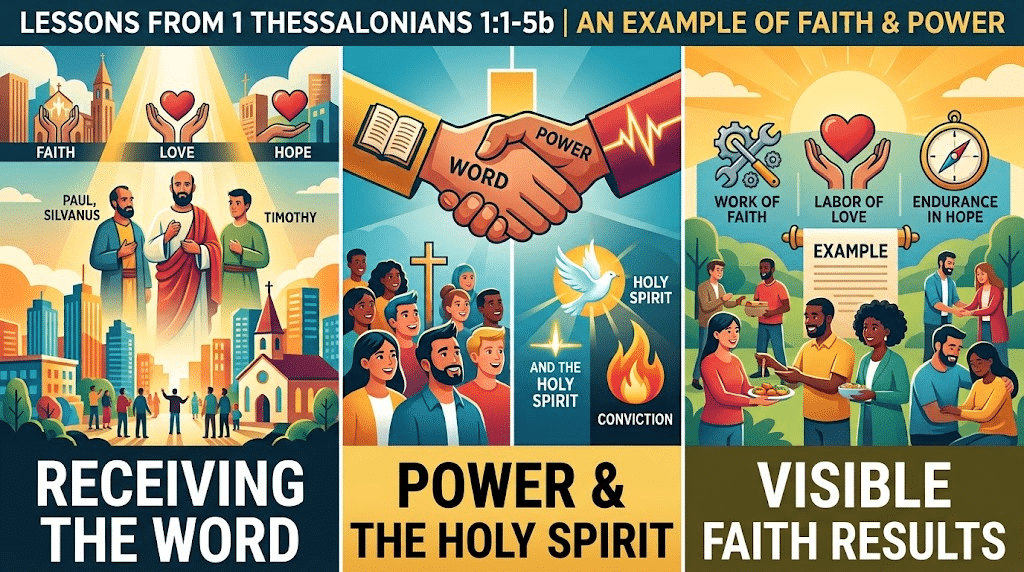
1 Thessalonians 1:1
“Paul, Silvanus, and Timothy to the church of the Thessalonians in God the Father and the Lord Jesus Christ: grace to you and peace.”
Catholic Doctrine & Practice
- The Ecclesial Community (Ekklesia): Paul addresses the church (ekklesia—the "assembly called out"). In Catholic ecclesiology (Lumen Gentium 1), the Church is not an isolated club of like-minded individuals, but a communion brought together by God the Father and united in Christ through the Holy Spirit.
- Apostolic Collegiality and Communion: Paul writes alongside Silvanus (Silas) and Timothy. Ministry in the Church has never been an individualist endeavor; it reflects collegiality and hierarchical communion, from the College of Bishops in union with the Pope down to parish clergy working in unity.
- Liturgical Greeting: “Grace to you and peace” is not mere informal correspondence; it is a formal apostolic blessing that echoes directly in the introductory rites of the Mass (“The grace of our Lord Jesus Christ, and the love of God, and the communion of the Holy Spirit be with you all”). Grace (charis) is the free, unmerited gift of God’s divine life, and peace (shalom) is the interior harmony and reconciliation that flows from it (CCC 1996).
Real-Life Application
When you walk into Mass on Sunday or engage with your local parish, approach it not as an audience member at an event, but as a living member of the ekklesia. Just as Paul, Silvanus, and Timothy shared ministry, faith in daily life is communal: participate actively in parish life, lean on your brothers and sisters in times of spiritual fatigue, and consciously receive the greeting of the priest at Mass as a real impartation of Christ’s peace into your week.
1 Thessalonians 1:2
“We give thanks to God always for all of you, remembering you in our prayers,”
Catholic Doctrine & Practice
- The Eucharistic Attitude: The Greek word for "give thanks" is eucharistoumen—the root of Eucharist. Catholic theology teaches that thanksgiving is an essential dimension of Christian prayer and the highest act of worship (CCC 2637–2638). Even before addressing issues or instructions, Paul anchors his posture in Eucharistic gratitude.
- Intercession and the Communion of Saints: Paul and his companions continually hold the Thessalonian converts before God. This embodies the Catholic dogma of intercessory prayer (CCC 2634–2636) and the foundation of the Communion of Saints: Christians bear one another’s burdens across time and space through prayer.
Real-Life Application
Before presenting God with your daily list of anxieties, complaints, or petitions, begin your prayer with specific thanksgiving for the people God has placed in your life—especially those who have nurtured your faith or those with whom you struggle. Keep an active prayer list or intentions journal for your family, parish priests, and coworkers, making deliberate daily intercession part of your domestic church routine.
1 Thessalonians 1:3
“unceasingly calling to mind your work of faith and labor of love and endurance in hope of our Lord Jesus Christ, before our God and Father,”
Catholic Doctrine & Practice
- The Theological Virtues in Action: Here we find one of the earliest Scriptural formulations of the three Theological Virtues: Faith, Hope, and Charity (CCC 1812–1829). In Catholic doctrine, infused at Baptism, these virtues are dynamic, not passive sentiments:
- Work of Faith (fides caritate operans): Faith is not mere intellectual assent; it produces tangible works. This directly aligns with Catholic teaching defined at the Council of Trent and rooted in James 2:14–26: true faith works through love (Gal 5:6).
- Labor of Love (agape): The Greek term for labor (kopos) implies strenuous exertion to the point of exhaustion. Christian charity involves sacrificial self-giving, exemplified in the corporal and spiritual works of mercy (CCC 2447).
- Endurance in Hope: Hope (spes) is the virtue by which we desire eternal life and rely not on our own strength, but on the promises of Christ (CCC 1817). It generates hypomone (patient steadfastness or endurance) under hardship, illness, and persecution.
Real-Life Application
Examine where your spiritual life currently resides among these three pillars:
- Is your faith visible in concrete actions at work and home, or does it stay dormant between Sundays?
- Does your love cost you real effort—sacrificing leisure to care for a sick relative, volunteering at a local food pantry, or forgiving someone who hurt you?
- When trials or dry spells arrive, do you despair, or do you root your endurance in Christ’s ultimate victory and the hope of eternal life?
1 Thessalonians 1:4
“knowing, brothers loved by God, how you were chosen.”
Catholic Doctrine & Practice
- Divine Election and Baptismal Dignity: Paul reminds the Thessalonians that they are "loved by God" (agapemenoi) and "chosen" (eklogen). In Catholic theology, divine election is grounded in God's unconditional, initiating love (CCC 1) and realized sacramental initiation. Through Baptism, believers are chosen to become adoptive sons and daughters in the Son, incorporated into Christ’s royal priesthood, prophetic office, and kingship (CCC 1268).
- Universality of the Call to Holiness: Being chosen is not a badge of elite pride or fatalistic exclusion; as Lumen Gentium (Chapter V) proclaims, all the baptized are called to the fullness of Christian life and the perfection of charity—the universal call to holiness.
Real-Life Application
When self-doubt, failure, or cultural hostility makes you feel inadequate, return to your core identity: you are chosen and beloved by God. Live with the quiet dignity of a baptized Christian. That identity means your daily work, your family decisions, and your interactions with strangers carry eternal purpose.
1 Thessalonians 1:5a–b
“For our gospel did not come to you in word alone, but also in power and in the Holy Spirit and [with] much conviction.”
Catholic Doctrine & Practice
- Word and Sacramental Power: Catholic teaching insists that the proclamation of the Gospel is not mere human rhetoric, philosophy, or lecture. The Gospel is an encounter with the Living Word through the power (dynamis) of the Holy Spirit (CCC 747). This truth underpins the Church’s sacramental economy: words and physical signs become efficacious channels of real grace (ex opere operato) through the Holy Spirit's action.
- Confirmation and the Gifts of the Spirit: The presence of the Spirit and "much conviction" (plerophoria—full assurance, certitude) reflects the graces bestowed in the Sacrament of Confirmation, which strengthens the baptized with the gifts of Fortitude, Counsel, and Understanding to profess the faith boldly (CCC 1285, 1302–1303).
- The Living Transmission of Faith (Tradition): The Gospel came alive through dynamic human witnesses who were visibly transformed by the Holy Spirit. As Dei Verbum 7–8 notes, divine revelation is handed on not solely through written words, but through the living witness, liturgy, and teaching of the Church under the guidance of the Spirit.
Real-Life Application
Sharing the faith with family, children, or secular friends cannot rely on arguments alone. People are convinced by the authentic witness of a life transformed by the Holy Spirit.
- Pray to the Holy Spirit before having difficult conversations, asking for the gifts of wisdom and gentle boldness.
- Let your life show the interior joy, conviction, and moral clarity that prove the Gospel is real power, not empty talk.
Algorithmically generated text
give me three thought provoking questions followed up with detailed answer reflection based on xxxxxxxxxxxx. Keep questions and answers appropriate for Sunday congregation giving real life application.
Paul pairs each theological virtue with a demanding action: faith produces work, love requires exhausting labor (kopos, meaning sweat and toil), and hope fuels stubborn endurance. In the ancient Greco-Roman world of Thessalonica, converting to Christ meant facing social isolation, economic boycotts, and family rupture. Faith could not survive as a comfortable, private opinion; it had to show up in how believers sheltered one another, shared resources, and stood firm under public scrutiny.
On an ordinary Sunday, it is easy to reduce faith to intellectual agreement with a creed or an interior emotional feeling during worship. But verse 3 poses a challenge: if someone audited our weekly calendar, bank statement, or conversations, would they find tangible evidence of our faith?
- Faith working: Bringing Christ-centered ethics into how we bill hours, manage employees, or handle conflicts with neighbors.
- Love laboring: Giving up personal leisure to care for an aging parent, cook meals for a family in crisis, or patiently tutor a struggling child when we feel depleted.
- Hope enduring: Choosing not to panic, lash out, or despair when faced with a grim medical report or personal setback, because our confidence is anchored in eternity rather than immediate circumstances.
True Christian faith does not hide behind good intentions. It rolls up its sleeves and goes to work where life is messy.
Algorithmically generated text
The believers in Thessalonica held low status in the Roman hierarchy. They were a vulnerable minority without political clout or cultural prestige. Yet Paul identifies them with the highest titles historically reserved for Israel: beloved by God and chosen. Their dignity was not conferred by Caesar, civic honors, or wealth; it was given freely by the Father before they took a single breath.
Our modern culture runs entirely on conditional approval. We are conditioned to measure our worth by professional titles, the success of our children, the neighborhood we live in, or the praise we receive on social media and in our communities. When our work falters, our health declines, or retirement strips away our professional identity, the foundation of our self-esteem can crumble.
Verse 4 calls the congregation back to our primary identity. You are not defined by your job title, your net worth, your past failures, or your present limitations. You are beloved and chosen by God through grace. Resting in that election frees us from the exhausting cycle of people-pleasing and self-justification. It allows us to face criticism without breaking and to achieve success without arrogance, knowing our security was settled at the Cross.
Algorithmically generated text
Paul arrived in Thessalonica with clear arguments and the Scriptures, but he knew words alone could never convert a human heart. What shook the city and established the church was the undeniable presence of the Holy Spirit: lives radically reordered, genuine repentance, authentic joy amidst persecution, and deep personal conviction.
Today, many Christians feel intimidated when it comes to sharing their faith. We worry that we lack apologetic skills, that we cannot answer every skeptical objection, or that our arguments will provoke arguments. Others rely heavily on theological jargon or moral lectures, which can often push children, grandchildren, and coworkers away.
Paul reminds us that evangelism is not an intellectual debate tournament. The Gospel carries spiritual power when it is embodied in our lives:
- Power through humility: Apologizing quickly and sincerely when we lose our temper at home or at work.
- Power through quiet peace: Radiating calm and grace in a workplace environment dominated by panic, gossip, or anxiety.
- Power through sacrificial generosity: Giving quietly to those in need without demanding recognition.
Words are necessary, but they ring hollow unless backed by the authenticity of the Spirit. When our everyday conduct reflects genuine Christlike character, the Holy Spirit uses even our simplest words to carry conviction into hearts that intellectual arguments cannot reach.
Algorithmically generated text
Create a simple, modern infographic illustrating [INSERT BIBLE PASSAGE OR TOPIC]. Use a [SPLIT-SCREEN / 3-PANEL] layout. The style should be clean, high-quality digital art or vector illustration.
Visuals:
Panel 1: Show [DESCRIBE SCENE 1 – e.g., a stormy sea].
Panel 2: Show [DESCRIBE SCENE 2 – e.g., Jesus calming the waves].
Text & Typography:
Font: Use EXTRA LARGE, BOLD, SANS-SERIF FONT (like Arial). Ensure high contrast so text is easily readable.
Header: Write “[INSERT MAIN TITLE]” at the top.
Captions: Include short, punchy text summaries in the panels: “[TEXT FOR PANEL 1]” and “[TEXT FOR PANEL 2]”.
Overall Vibe: Professional, educational, and uncluttered. Avoid small details; focus on big images and big text.
Write an engaging description meant to get readers to read Larry Broding’s commentary which can be used to help preachers prepare their own homily. After a brief introduction give bulletin points of why this commentary matters for your homily.
The Struggle of Faith
Rather than a routine greeting, the opening lines of 1 Thessalonians are a frontline dispatch to a vulnerable, cross-cultural church fighting to survive in a Roman port city. Larry Broding’s commentary uncovers this hard-won reality.
- Decodes Paul’s Intentional Greeting: Illuminates how Paul united a mixed congregation of Jews and Gentiles by pairing “grace” (Greek) and “peace” (shalom, Hebrew)—demonstrating how God’s unifying presence bridges deep cultural divides.
- Frames the Virtues as Active Labor: Reinterprets faith, love, and hope not as passive interior moods, but as theological virtues hammered out through real community friction and counter-cultural pressure.
- Recovers the High-Stakes Origin Story: Connects the letter directly to the dramatic events of Acts 17, reminding listeners that the church was birthed out of mob violence, political accusations of treason (“another king, Jesus”), and legal fallout.
- Delivers a Counter-Cultural Pastoral Message: Challenges modern prosperity-gospel assumptions by revealing that for Paul, struggle and blessing were not opposites—faithfulness in the midst of adversity is the very proof of God’s election and presence.

Excerpt from a commentary by Dr. Brant Pitre | Catholic Productions

Commentary by Fr. Francis Martin | The Word Proclaimed
clean up grammar and spelling, divide into sections with titles for the following transcript xxxxxxxxxxxx
Verbal fillers, stumbles, and repetitions have been removed while keeping the original phrasing, theological precision, and cadence intact.
The Biblical Roots of the Church: Ekklesia and Qahal
Now we move to the second reading: the opening verses of First Thessalonians. These verses are profoundly illuminating regarding the power of the Word—the Word that bears and makes present the deeds of God. The letter opens:
"Paul, Silvanus, and Timothy to the church (ekklesia) of the Thessalonians in God the Father and the Lord Jesus Christ: Grace to you and peace."
That was the apostolic team that traveled to Thessalonica. From the very beginning, Paul draws on an understanding rooted in our Lord’s words to Peter: "You are Peter, and upon this rock I will build My church (ekklesia)."
The Greek word ekklesia derives from ek ("out") and kaleo ("to call")—meaning an assembly called out. In the Septuagint (the Greek translation of the Old Testament), ekklesia translates the Hebrew word qahal (from which the title Qoheleth / Ecclesiastes is derived). In the Old Testament, the qahal was the assembly of the people of God gathered in the desert at Mount Sinai to hear God's Word.
Paul recognizes that this is now the qahal of the Thessalonians. The qahal is the Universal Church manifest in concrete gatherings: the qahal of Thessalonica, the qahal in New York, yet fundamentally the same one Church.
In civic Greek culture, the ekklesia was the formal assembly of citizens convened to make decisions for the city. Related New Testament vocabulary stems from this civic backdrop:
- Keryx: The herald who went through the streets summoning eligible citizens to assembly.
- Kerygma: The proclamation itself—the herald’s announcement calling people together into a unified body.
- Parrhesia: The civic right of a full citizen to stand before the assembly and speak boldly, freely, and with confidence (meta parrhesias).
These concepts, already deeply enriched through the Old Testament covenant assembly, became foundational to Christian life. The qahal of God is now being assembled from the four corners of the earth. It will reach its full consummation when the entire human race knows, loves, and obeys Jesus Christ, forgiving one another in communion.
Charis vs. Chairein: The Christian Greeting
Paul continues: "Grace to you and peace."
In everyday Greek culture, the standard greeting was chairein or chaire ("Rejoice!"). Historically, after the Battle of Marathon (490 BC), the herald ran the twenty-six miles back to Athens, announced "Chairete, nikomen!" ("Rejoice, we have conquered!"), and collapsed dead from exhaustion. To this day, Greek greetings echo that heritage with chairete or kalimera ("good day").
I recall walking down a street in Athens dressed as a Catholic priest and encountering an Orthodox priest in full vesture—a black cassock (exorason), epanokalimavkion, and a full beard. Wanting to offer a warm, ecumenical greeting, I said, "Kalimera!" He walked over, shook my hand, and replied, "What do you say? I'm from Brooklyn!" It was an unforgettable moment of common ground.
Paul, alongside Silvanus (Silas) and Timothy, adapts this familiar epistolary convention. In the ancient world, letters typically opened with the sender, the recipient, a greeting, and a civic wish: From Tychicus to Andronicus: May your household be blessed by the gods. Now regarding the matter at hand...
Paul adopts this structure, but instead of the conventional chairein ("greetings/rejoice"), he writes charis—"grace"—wedded to the traditional Jewish greeting shalom ("peace"). Furthermore, he does not relegate his co-workers to an afterthought in a postscript; he includes Silas and Timothy as co-senders in the formal greeting.
The Theological Virtues in Action: Faith, Love, and Hope
Paul continues:
"We give thanks to God always for all of you, remembering you in our prayers constantly, calling to mind your work of faith, your labor of love, and your endurance in hope."
From this very first letter Paul wrote, we encounter the three theological virtues: faith, hope, and charity (agape).
Work of Faith ───> Ergon (Dynamic action, vigor)Labor of Love ───> Kopos (Self-sacrificing exertion)Endurance in Hope ───> Hypomone (Steadfast courage under trial)
- The Work of Faith (Ergon): Faith is not passive assent or merely sitting quietly in a pew on Sunday. Faith possesses dynamic energy and movement (ergon, the root of "energy"). It is an active conviction that cares for the vulnerable, defends life, and bears witness to Christ.
- The Labor of Love (Kopos): True love labors. As Paul writes in Galatians, what counts is "faith working through love." Kopos implies weariness from strenuous, self-giving effort: a mother nurturing her children around the clock, a father laboring diligently to provide, or a pastor pouring out his life for his flock. Like the traditional antiphon for Saint Cecilia—serving the Lord with diligent devotion—agape naturally translates into active service.
- Endurance in Hope (Hypomone): Hope generates courage and steadfast perseverance. If an athletic team is trailing by fifty points late in the final quarter, morale falters because hope of victory is gone. But genuine theological hope anchors the soul in Christ's final victory, granting the interior strength to endure family trials, ministry burdens, and persecution. As Paul notes elsewhere, genuine apostolic ministry is verified through signs, wonders, and hypomone—patient endurance.
The Gospel Proclaimed with Power and Conviction
Paul concludes this opening thanksgiving:
"Knowing, brothers and sisters loved by God, that you have been chosen; because our Gospel came to you not simply in word, but also in power (dynamis), in the Holy Spirit, and with deep conviction (plerophoria)."
The term plerophoria carries the sense of full assurance, complete certainty, and unshakeable conviction.
Paul reassures the Thessalonians: we know God loves you because when the Gospel was proclaimed, it did not remain a dead letter or mere eloquent rhetoric. It arrived with divine power (dynamis), animated by the Holy Spirit, producing fruit in your lives. When the Word of God is proclaimed with authentic spiritual power, it stands as living proof of God's abundant mercy and love for His people.
Click chevron banner to read transcript
organized into thematic sections.
29th Sunday of Year A


Matthew 22:15-21
Create a verse by verse (NAB) commentary relating xxxxxxxxxxxxx TO CATHOLIC doctrine and practice. Give real life applications when appropriate
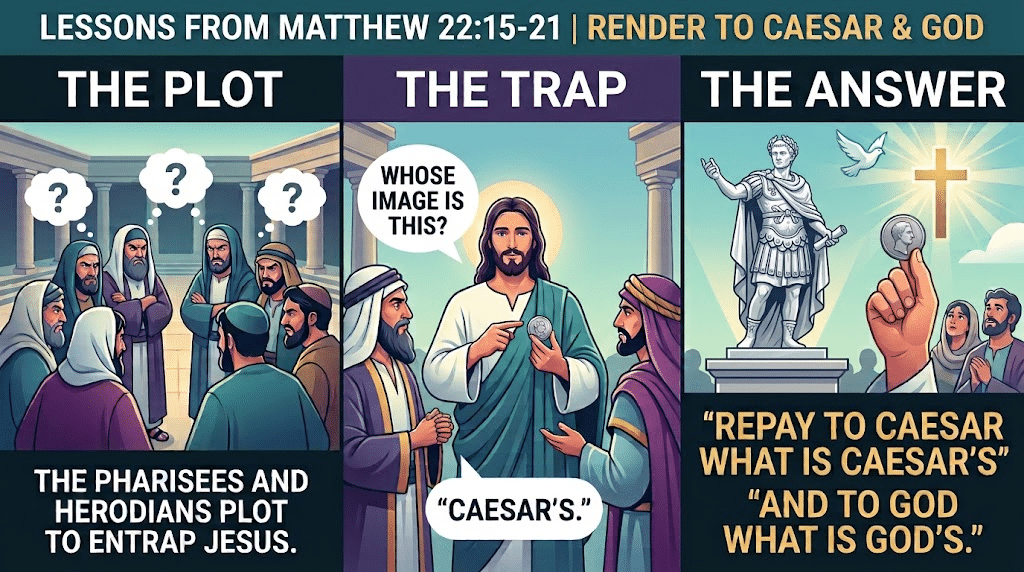
Matthew 22:15
“Then the Pharisees went off and plotted how they might entrap him in speech.”
Catholic Doctrine & Practice
- The Danger of Bad Faith and Calumny: The Pharisees’ deliberate plotting illustrates the sin of detraction, malice, and rash judgment. Catholic moral theology warns that twisting speech or actively laying traps to compromise the moral integrity or good name of an innocent person violates the Eighth Commandment (“You shall not bear false witness against your neighbor”, CCC 2477–2479).
- Christ as the Innocent Sufferer: In the economy of salvation, Jesus’ encounter with hostile authorities foreshadows His Passion. As the Catechism notes (CCC 574–576), Christ's ministry constantly brought to light the interior hardness of hearts that preferred human traditions and prestige to the divine truth.
Real-Life Application
Examine everyday speech and intent in work, family, or online discourse. It is easy to engage in "conversational ambushes"—asking loaded questions in meetings, family discussions, or social media comments not to learn or understand, but to corner and expose someone. Catholic practice calls for charity in dialogue: assuming the best intentions of others until proven otherwise and refusing to weaponize conversation for personal victory.
Matthew 22:16
“They sent their disciples to him, with the Herodians, saying, ‘Teacher, we know that you are a truthful man and that you teach the way of God in accordance with the truth. And you are not concerned with anyone’s opinion, for you do not regard a person’s status.’”
Catholic Doctrine & Practice
- The Unholy Alliance: The Pharisees (pious, nationalist opponents of Roman rule) and the Herodians (political opportunists and Roman collaborators) were ideological adversaries. Yet they united to eliminate Christ. Catholic ecclesiology warns against compromising truth for unprincipled political expedience.
- Flattery vs. Genuine Faith: The questioners recite orthodox truths—Jesus is truthful, teaches the true way of God, and does not show partiality (CCC 2480 on flattery and adulation). However, their words are severed from interior faith and love, demonstrating that orthodox vocabulary spoken with a hypocritical heart remains spiritually dead.
- Freedom from Human Respect: Their inadvertent praise captures a vital Catholic virtue: freedom from human respect (the fear of what people think). Christ acts solely in conformity with the Father's will, a core model of Christian prudence (CCC 1806).
Real-Life Application
Be vigilant against flattery and the temptation to alter moral principles to fit the crowd. When asked our stance on difficult moral issues, Catholic professionals, parents, and students often face the pressure to conform to contemporary consensus. Like Christ, we are called to embody "the way of God in accordance with the truth," speaking with gentleness and clarity without watering down the Gospel to win favor with peers, supervisors, or cultural trends.
Matthew 22:17
“‘Tell us, then, what is your opinion: Is it lawful to pay the census tax to Caesar or not?’”
Catholic Doctrine & Practice
- The Dilemma of Dual Citizenship: The census tax (tributum capitis) was paid directly to the Roman emperor. The question set a political and religious trap:
- If Jesus said “Yes”, He would be denounced by the populace and the Zealots as an apostate collaborator aiding pagan Roman oppression.
- If Jesus said “No”, the Herodians would instantly arrest Him for sedition against Rome.
- The Catholic View of Law and Civic Order: Catholic doctrine does not pit civic duty against religious fidelity by default. As articulated in Gaudium et Spes 74–76 and CCC 1900, the Church teaches that civic authority and legitimate laws are part of the moral order established by God for the common good. However, earthly authority has inherent limits.
Real-Life Application
Catholics regularly navigate complex civic and political terrain where political camps attempt to force all-or-nothing binary choices: "Are you with this party or against it?" Our primary loyalty belongs neither to partisan factions nor political ideologies. We evaluate civic legislation, taxes, and policies not through personal political convenience, but through the lens of Catholic social teaching: human dignity, the common good, subsidiarity, and solidarity.
Matthew 22:18–19
“Knowing their malice, Jesus said, ‘Why are you testing me, you hypocrites? Show me the coin that pays the census tax.’ Then they handed him a denarius.”
Catholic Doctrine & Practice
- Divine Omniscience and Interior Truth: Jesus perceives their inward malice immediately. Catholic doctrine confesses that Christ, true God and true man, knows the hearts of all people (CCC 473; cf. Jn 2:25).
- The Exposure of Hypocrisy: By asking them to produce the coin, Jesus reveals that His questioners already carried and used the Roman denarius within the Temple precincts. They were actively utilizing the Roman currency, roads, trade protections, and municipal benefits of the empire while pretending moral aloofness.
- Spiritual Discernment: Jesus does not answer on their flawed terms. In Catholic spiritual direction, this models the virtue of spiritual discernment (discretio spirituum): recognizing when an argument is rooted in spiritual deceit and refusing to let falsehood dictate the battlefield.
Real-Life Application
When confronting tough moral decisions or spiritual confusion, examine interior motives before acting. Are we claiming moral high ground in one area while quietly participating in the very compromises we condemn in others? Integrity requires bringing hidden corners of life—finances, taxes, business ethics, and personal treatment of workers or service staff—into line with the faith we profess publicly on Sundays.
Matthew 22:20
“He said to them, ‘Whose image and inscription is this?’”
Catholic Doctrine & Practice
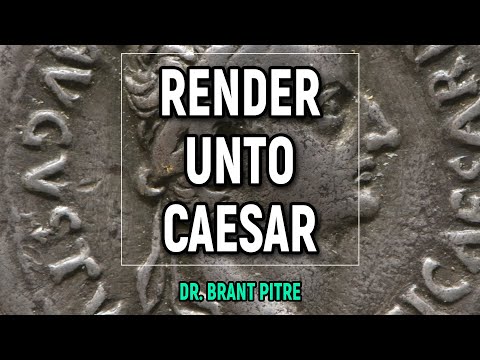
- The Concept of the "Image" (Icon / Imago): The denarius bore the image (eikon) and title of Tiberius Caesar (“Tiberius Caesar Divi Augusti Filius Augustus” — Tiberius Caesar, August Son of the Divine Augustus).
- The Theological Pivot: In asking for the image, Jesus sets up a direct contrast with Genesis 1:26–27: God made man in His own image and likeness (imago Dei). This distinction forms the cornerstone of Catholic anthropology and human dignity (CCC 355–358, 1700).
Real-Life Application
Look closely at what bears the mark of worldly powers versus what bears the seal of God. Money, career titles, and physical assets carry the marks and stamps of this transient world. But the human beings sitting around your dinner table, working in the cubicle next to you, or begging at the street corner carry the unalterable image of the Creator. We must never sacrifice or devalue the imago Dei in a human person for the sake of monetary gain or career advancement.
Matthew 22:21
They replied, ‘Caesar’s.’ At that he said to them, ‘Then repay to Caesar what belongs to Caesar and to God what belongs to God.’”
Catholic Doctrine & Practice
- Legitimate Autonomy of the Temporal Sphere: Christ refuses both total secularism (submitting entirely to the state) and total theocracy/Zealot isolation (refusing all civic participation). Catholic social doctrine teaches the legitimate autonomy of earthly affairs (Gaudium et Spes 36; CCC 2234–2246):
- Duties of Citizens: Christians have a moral obligation to contribute to the common good, obey just laws, pay legitimate taxes, exercise the right to vote, and defend their country (CCC 2238–2240).
- The Primacy of God and Limits of State Power:
- While the coin bears Caesar's portrait and belongs in Caesar's treasury, man bears God's image and belongs entirely to God.
- Caesar's authority is not absolute; it is subordinate to the moral law. As CCC 2242 affirms (echoing Acts 5:29), whenever civil authorities command actions contrary to the moral order, fundamental human rights, or Gospel teachings, the citizen is morally obliged in conscience to refuse obedience (conscientious objection).
- The Sacramental Seal of Baptism: In Catholic sacramental theology, through Baptism and Confirmation, believers are indelibly marked (sealed) with the character of Christ (CCC 1121, 1272). We belong body, mind, and soul to God, not to any secular power or system.
Real-Life Application
Live out this balance through faithful citizenship and wholehearted discipleship:
- Render to Caesar: Be an upright citizen: pay taxes honestly, vote with an informed Catholic conscience formed by Gospel principles, keep your neighborhood clean, and contribute to civic betterment.
- Render to God: Remember that the state did not create you, cannot save you, and must never own your soul. Do not give to any employer, political party, cultural ideology, or wealth accumulation the devotion, time, and worship that belong exclusively to God.
- Dedicate the first fruits of your day to prayer, keep holy the Sabbath, provide sacrificial support for the Church’s mission, and stand up courageously when civil policies infringe upon the sanctity of human life, religious freedom, or care for the poor.
Algorithmically generated text
give me three thought provoking questions followed up with detailed answer reflection based on xxxxxxxxxxxx. Keep questions and answers appropriate for Sunday congregation giving real life application.
The Roman denarius bore the face of Tiberius Caesar and an inscription declaring him divine. It belonged in Caesar’s monetary system. But human beings bear the indelible image of God (imago Dei, Genesis 1:27). While civic authorities have legitimate jurisdiction over taxes, civil laws, and public order, they do not own the human soul, conscience, or ultimate allegiance.
In our daily lives, the boundary between civic responsibility and idolatry easily blurs. We live in an intensely polarized culture where political parties, social movements, and economic ideologies demand total loyalty. It is tempting to let a political identity shape our morals, determine whom we love or hate, and dictate our worldview more than the Gospel of Jesus Christ.
- The Check: When a political party’s platform or cultural ideology conflicts with the dignity of human life, care for the vulnerable, or Christian charity, which one do we compromise?
- Real-Life Action: Fulfill your civic duties conscientiously—pay your taxes honestly, vote with an informed Christian conscience, and serve your local community. But remember that no nation, political candidate, or economic philosophy died for your sins. Caesar gets his coins; God gets your heart, your worship, and your ultimate obedience.
Algorithmically generated text
The trap set by the Pharisees and Herodians was deeply cynical. They wanted to force Jesus into a corner: endorse Roman oppression and alienate the Jewish crowd, or condemn the tax and get arrested for treason. Jesus exposed their hypocrisy by simply asking to see the coin. By reaching into their pockets and pulling out a Roman denarius within the Temple precincts, they proved they were already active participants in Caesar’s economy, utilizing Roman roads, commerce, and legal protections while pretending to be spiritually detached.
It is easy for Christians to fall into a similar selective morality. We enjoy the comforts, protections, infrastructure, and liberties of modern society, but when civic life demands personal sacrifice—caring for struggling schools, contributing to local community needs, standing up against local corruption, or paying fair wages—we can retreat into a detached, purely private spirituality.
- The Check: Do we critique society from a safe distance while enjoying all its advantages, or are we actively working to sanctify the world around us?
- Real-Life Action: Faithful citizenship requires active, constructive involvement. Rather than cynically opting out of community life or merely complaining about cultural decay, look for where you can contribute to the common good: supporting local charities, mentoring youth, advocating for ethical business practices, and treating civic participation as an arena for Christian service.
Algorithmically generated text
Jesus’ opponents were not interested in truth; they wanted a soundbite to ruin Him. They set up a false binary: either choose God or choose Caesar. Jesus refused to accept their loaded premises. He did not lose His composure, insult them back, or retreat into defensive silence. Instead, He elevated the entire discussion to a higher moral plane that forced His questioners to examine their own consciences.
In our families, workplaces, and online environments, we frequently face "trap questions" and hostile conversations about faith, morality, or politics. Human instinct pushes us to react defensively, argue aggressively to "win," or coward in fear of being judged or canceled.
- The Check: In tense conversations at the family dinner table, breakroom, or social media comments, do our words de-escalate hostility and point toward truth, or do they add fuel to the fire?
- Real-Life Action: Take a breath before reacting to conversational bait. Emulate Christ’s posture: speak with clarity and moral courage, but refuse to let bad-faith arguments pull you into petty bickering. When others try to force complex human issues into simplistic, partisan boxes, bring the focus back to truth, human dignity, and grace.
Algorithmically generated text
Create a simple, modern infographic illustrating [INSERT BIBLE PASSAGE OR TOPIC]. Use a [SPLIT-SCREEN / 3-PANEL] layout. The style should be clean, high-quality digital art or vector illustration.
Visuals:
Panel 1: Show [DESCRIBE SCENE 1 – e.g., a stormy sea].
Panel 2: Show [DESCRIBE SCENE 2 – e.g., Jesus calming the waves].
Text & Typography:
Font: Use EXTRA LARGE, BOLD, SANS-SERIF FONT (like Arial). Ensure high contrast so text is easily readable.
Header: Write “[INSERT MAIN TITLE]” at the top.
Captions: Include short, punchy text summaries in the panels: “[TEXT FOR PANEL 1]” and “[TEXT FOR PANEL 2]”.
Overall Vibe: Professional, educational, and uncluttered. Avoid small details; focus on big images and big text.
Write an engaging description meant to get readers to read Larry Broding’s commentary which can be used to help preachers prepare their own homily. After a brief introduction give bulletin points of why this commentary matters for your homily.
Conflicting Priorities
Preaching Matthew 22:15–21 often risks flattening a high-stakes, politically charged trap into a generic catchphrase about paying taxes. Larry Broding’s commentary equips preachers to deliver a nuanced, compelling homily that speaks directly to the modern tension between faith and cultural reality.
- Exposes the Unholy Alliance: Unpacks why two bitter rivals—the separatistic, Law-abiding Pharisees and the Roman-aligned, elite Herodians—joined forces.
- Decodes the Denarius: Explains why carrying and paying with it skirted idolatry and blasphemy, transforming an abstract debate into a tangible moral crisis.
- Balances Separatism and Accommodation: Explores legitimate tensions—the Pharisees’ desire for ritual purity versus the Herodians’ pragmatic cultural engagement.
- Clarifies the Impossible Trap: Breaks down the lose-lose dilemma laid before Jesus: agree with the Pharisees and face Roman charges of treason; agree with the Herodians and face condemnation for breaking the First Commandment.
- Delivers a Fresh Homiletic Takeaway: Moves past the clichéd “church versus state” interpretation to reveal Jesus’ true challenge: refusing false binaries.

Commentary by Fr. Francis Martin | The Word Proclaimed
clean up grammar and spelling, divide into sections with titles for the following transcript xxxxxxxxxxxx
Verbal fillers, stumbles, and repetitions have been removed while keeping the original phrasing, theological precision, and cadence intact.
The Trap: An Alliance of Enemies (Matthew 22:15–17)
Now we begin the Gospel reading, taken from Saint Matthew, chapter 22, verses 15 to 21. If you ever want to locate where you are in the narrative, open your Bible to the introductory outline of the Gospel. We are in chapter 22, which means Jesus is now in Jerusalem. The climactic conflict has begun, and Matthew records a series of these formal controversy dialogues.
The narrative opens:
"Then the Pharisees went and plotted how to entangle Him in His words. And they sent their disciples to Him, along with the Herodians..."
This is an extraordinary coalition. The Pharisees and the Herodians generally despised one another. Herod the Great was not fully Jewish—he was an Idumean—and the Herodians were political pragmatists aligned with the Roman client-state, whereas the Pharisees strictly opposed Roman cultural and religious encroachment. Yet their shared hostility toward Jesus was so intense that they forged a tactical alliance to trap Him in speech. Hatred frequently unites the most unlikely factions.
They approached Him with calculated flattery:
"Teacher, we know that You are true and teach the way of God truthfully, and You do not care about anyone’s opinion, for You are not swayed by appearances."
They attempted to inflate His ego: "You are an honest man; You speak Your mind regardless of status." Having set the stage, they sprang the trap:
"Tell us, then, what You think. Is it lawful to pay taxes to Caesar, or not?"
Every governing authority levies taxes—sometimes moderately, sometimes excessively, depending on the scope of state control. The tax in question here was the kēnsos (the Roman census tax), paid with an imperial silver denarius. The political dilemma was deliberate:
- If He answered no, they could immediately denounce Him to the Roman governor Pontius Pilate as a seditious revolutionary.
- If He answered yes, they could discredit Him before the Jewish crowds as a collaborator with pagan Roman occupation.
The Coin and the Core Principle: Caesar and God (Matthew 22:18–21)
Aware of their malice, Jesus exposed their hypocrisy immediately:
"Why put Me to the test, you hypocrites? Show Me the coin with which the tax is paid."
They handed Him a Roman denarius. He asked them:
"Whose likeness and inscription is this?"
They replied, "Caesar’s." Then He delivered His definitive answer:
"Render therefore to Caesar the things that are Caesar’s, and to God the things that are God’s."
Our Lord does not merely resolve their trap; He establishes the foundational principle governing the relationship between the Church and the civil state. Christians honor and obey legitimate civil authority within its proper sphere. However, the state’s authority is neither absolute nor divine.
When the state commands or legalizes what is intrinsically immoral—such as the destruction of unborn human life through abortion—it has exceeded its legitimate mandate. The Church has a serious duty to speak truth to civil society when the state exceeds these moral limits, reminding it of divine accountability.
Refusing the Privatization of Truth
A critical cultural temptation facing believers—one we have far too often conceded—is allowing our moral and religious convictions to be dismissed as private, subjective preferences.
When secular culture seeks to justify grave moral evils, it attempts to categorize moral law as merely a "Catholic view": "That is fine for Catholics, but you cannot impose your religion on the rest of society." By retreating into that framework, Christians inadvertently reduce the truths of faith to an arbitrary pipe dream that has no relevance to real life.
Faith is not an insular retreat from the world; authentic Christian faith sharpens reason and illuminates reality as it actually exists. When a Catholic opposes abortion, the fundamental reason is not merely denominational policy:
- It is not simply: "I oppose abortion because I am Catholic."
- It is fundamentally: "I oppose abortion because it violates the objective moral order and destroys an innocent human being made in the image of God."
As Saint Thomas Aquinas and the Church Fathers observe, the interior consequence of persistent unrepented sin is further spiritual blindness—sin becomes its own punishment as conscience grows dull. Loving our neighbor requires bearing witness to moral truth, even when countercultural.
Ratzinger and John Paul II: Faith and the Battle for the Human Person
In his theological writings, Joseph Ratzinger (Pope Benedict XVI) warned against turning theology into an academic enclave detached from reality:
"If theology is really going to move out from behind the walls of specialized science, it must be courageous enough to do this wholeheartedly; it must not, in the name of caution, leave its finest values hidden... Either faith in Christ really concerns the center of human existence, or else the world of faith is a world separate from the ordinary world of experience. But then how could faith make its claim on the center of man's existence? Doesn't this really reduce faith to an ideology for those who need such a refuge apart from reality?"
Faith must engage human life directly. When Saint Teresa of Calcutta received her interior call within a call, Christ did not direct her to retreat from human misery; He sent her into the streets of Kolkata to care for dying Hindu and Muslim neighbors—recognizing their inherent human dignity while manifesting the face of Christ.
Pope Saint John Paul II developed this theme in Sign of Contradiction. He identified a growing cultural struggle over the definition and destiny of humanity:
"These examples are enough to bring home the fact that we are in the front line of a lively battle for the dignity of man. It is the task of the Church, of the Holy See, and of all pastors to fight on the side of man, often against men themselves."
John Paul II understood totalitarianism firsthand. He witnessed how state ideologies that reduce human beings to mere economic instruments crush the human spirit, leading to widespread despair, alcoholism, and demoralization. Standing up for moral truth is a rescue mission for the human person.
The Decalogue and the Universal Moral Order
This intrinsic link between revealed truth and human nature is summarized in the Catechism of the Catholic Church (No. 2070):
"The Ten Commandments belong to God's revelation. At the same time they teach us the true humanity of man. They bring to light the essential duties, and therefore, indirectly, the fundamental rights inherent in the nature of the human person. The Decalogue contains a privileged expression of the 'natural law': from the beginning, God had implanted in the heart of man the precepts of the natural law. Then He was content to remind him of them. This was the Decalogue."
The moral commandments given to Israel and fulfilled in Christ are not arbitrary strictures. They are the divine blueprint for authentic human flourishing, accessible to right reason and written into the human heart. To render to God what is God's means recognizing that every human soul bears His divine image—and defending that dignity without compromise.
Click chevron banner to read transcript
organized into thematic sections.
Doctrinal Homily Outlines
Central idea: Faith, hope, and love
Doctrine: The theological virtues
Application: Exercising the theological virtues more effectively
Sunday Prep Videos
29th Sunday of Year A