Bishop Barron, Word on Fire
October 18, 2026


29th Sunday of Year A
- 2026 SERMON
- 2023 SERMON

Friends, on this Twenty-ninth Sunday of the year, our Gospel features the question from the Pharisees about paying taxes. In response to the trap, Jesus offers one of the most famous one-liners in history: “Repay to Caesar what belongs to Caesar and to God what belongs to God.” His answer didn’t automatically solve the problem of the relationship between church and state, but it did point the way through two opposite extremes, both of which are predicated on a false understanding of how God relates to the world.
Click Graphic to Enlarge
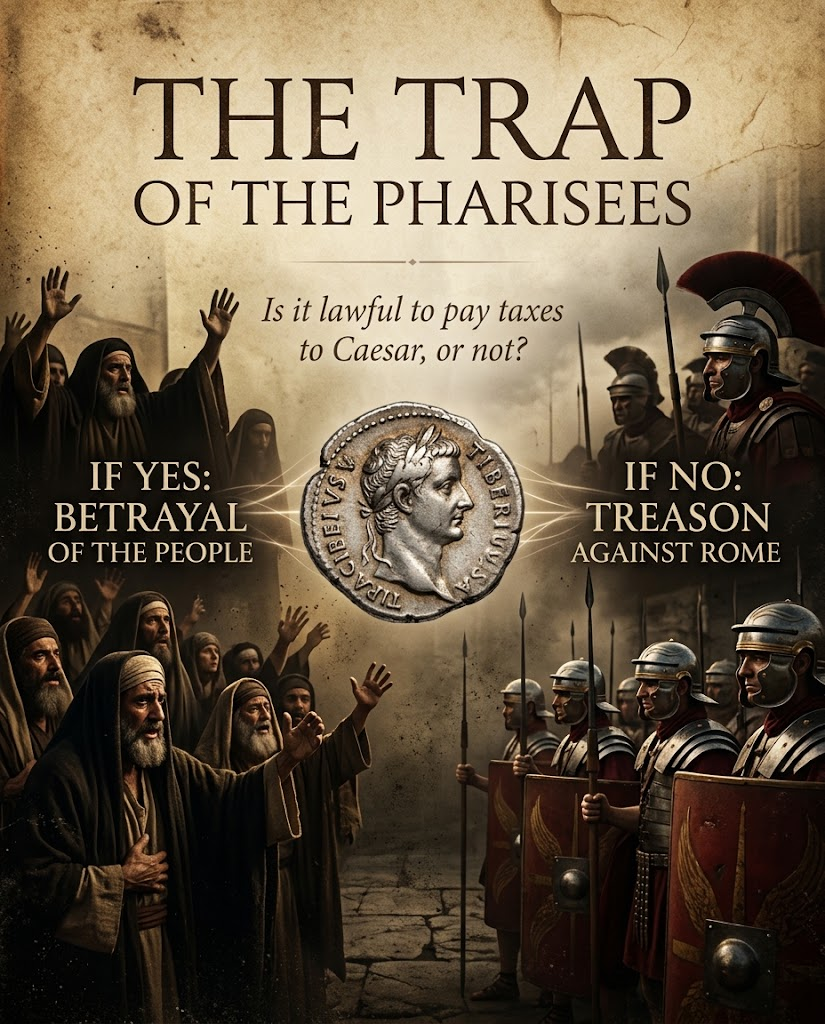
The Trap of the Pharisees
Peace be with you. Friends, for this 29th Sunday of the year, we have this famous story about Caesar and God, and rendering to Caesar and to God, which has been the source of extensive commentary and controversy over the centuries. I am going to try to shed some light on this famous dilemma.
I am always amused by how this story opens. Once again, the Lord is in dialogue with the Pharisees. We hear that they are plotting how to entrap Him in His speech. That is an old game: setting someone up so that whatever He says will be used against Him. Anyone who works on the internet knows about this trick. Listen to how they approach Him: “Teacher, we know you are a truthful man. You teach the way of God in accordance with the truth. You are not concerned with other people’s opinions. You do not regard a person’s status.”
He knows when He is being buttered up and set up. Then comes the trap: “Tell us then, what is your opinion? Is it lawful to pay the census tax to Caesar or not?” It is a classic dilemma. If He says yes, all the people who resent Roman oppression—the revolutionaries and zealots—will turn against Him. If He says no, it is unlawful and the tax should not be paid, the Romans and their collaborators will crack down on Him. They demand a simple yes-or-no answer, believing that either way, He loses.
Then Jesus delivers one of the most famous statements in history: “Show me the coin. Whose image is that?” They answer, “Caesar’s.” He responds, “Give to Caesar what is Caesar’s, and to God what is God’s.” While it is a clever response, there is far more taking place beneath the surface. Did He resolve the problem definitively with that single statement?
Click Graphic to Enlarge
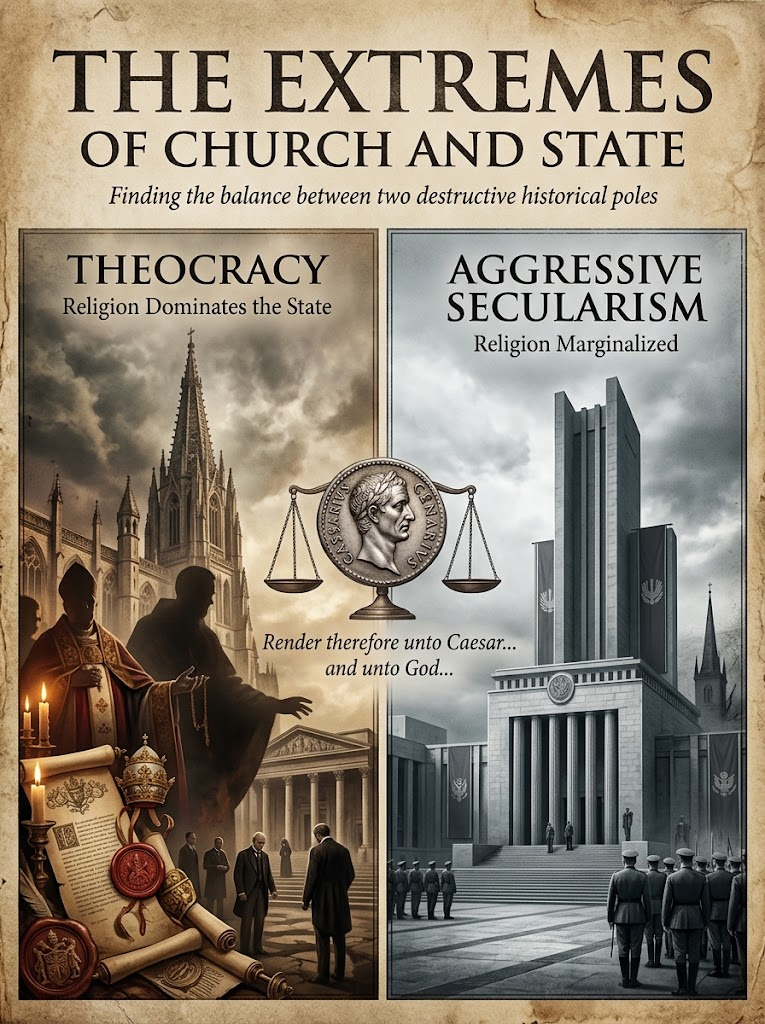
The Extremes of Church and State
That statement bequeathed to the tradition a long conversation regarding church and state, the sacred and the secular, and government versus religion. Emerging from this exchange, we see two historical extremes.
The first is the theocratic extreme, where religion completely dominates government. Think of the modern situation in Iran, a country governed by the clerics according to religious Sharia law. Here, religion absorbs secular civic responsibility. Theocracies of this kind have appeared across cultures throughout the centuries.
The second extreme, far more prevalent in the contemporary West, is an aggressive secularism. This view asserts that governance belongs entirely to secular leadership, while religion is relegated to an entirely private hobby with no place in the public order.
In the first extreme, religion overtakes the state. In the second, the state acts entirely independent of religious values, treating faith merely as a footnote. Between these two positions, there have been continuous efforts throughout history to find a proper mediation.
Click Graphic to Enlarge
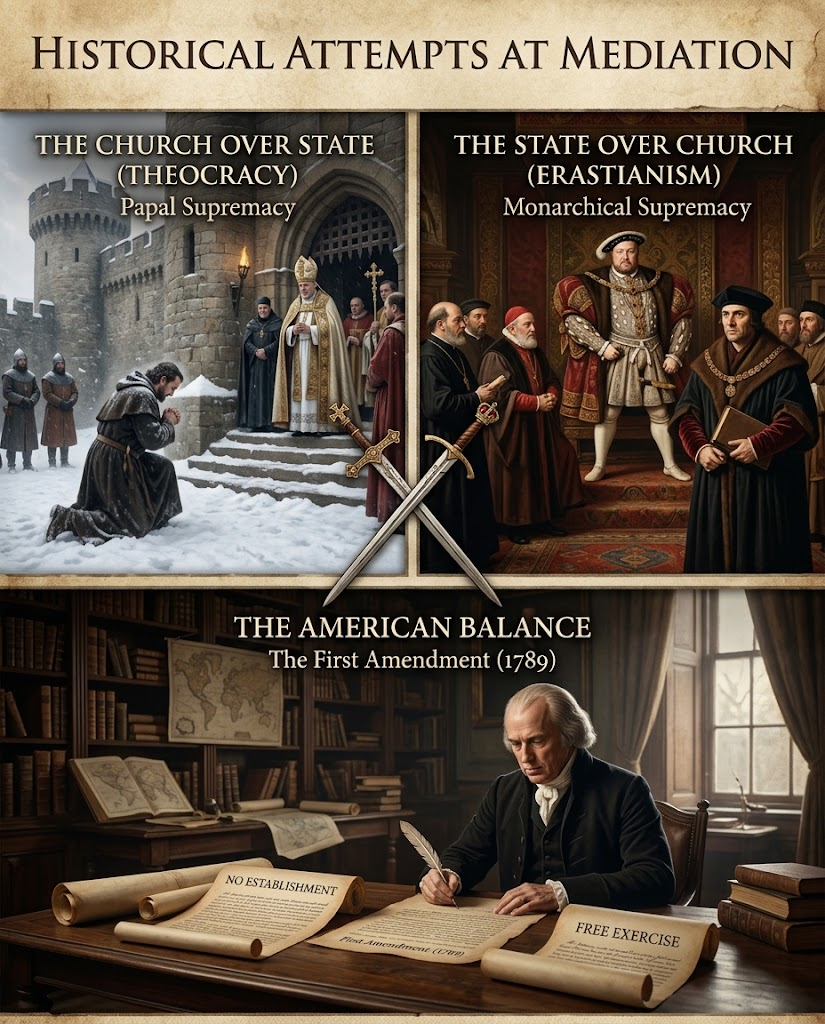
Historical Attempts at Mediation
Even in the Middle Ages, when the divine right of kings prevailed, there remained an awareness of two distinct orders: the ecclesial order and the kingly order. Thinkers often referenced the “two swords,” drawing from the Last Supper narrative where Jesus responds to the mention of two swords by saying, “That is enough.” This was interpreted as the sword of the church and the sword of the state.
Throughout history, these altar-and-throne relationships varied, sometimes leaning toward the altar and sometimes toward the throne. Naturally, conflicts erupted between these two spheres. Consider King Henry II of England and St. Thomas Becket, where the prerogatives of the church clashed directly with the prerogatives of the crown. A few centuries later, another Henry and Thomas clashed: King Henry VIII and St. Thomas More, debating the primacy of the church versus the absolute power of the state. Outside England, Holy Roman Emperor Henry IV was excommunicated by Pope Gregory VII and traveled as a penitent to the papal palace at Canossa.
A notable institutional development occurred in the United States. James Madison formulated the First Amendment to the Constitution, stating that Congress shall make no law respecting an establishment of religion, nor prohibiting the free exercise thereof. In a religiously pluralistic society without a unified ecclesial consensus, this was designed to strike a delicate balance: avoiding an established state religion while ensuring religious practice remains unrestricted. Even so, this framework did not eliminate tension, as American jurisprudence has continually debated the precise boundaries between establishment and free exercise.
Click Graphic to Enlarge
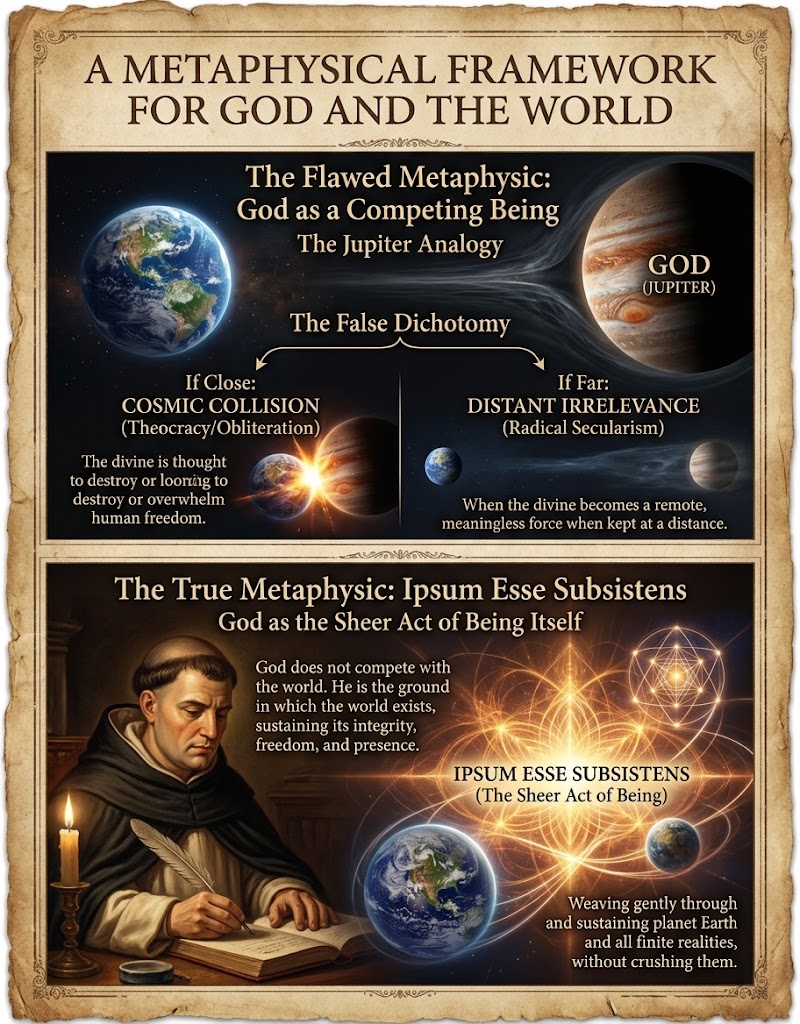
A Metaphysical Framework for God and the World
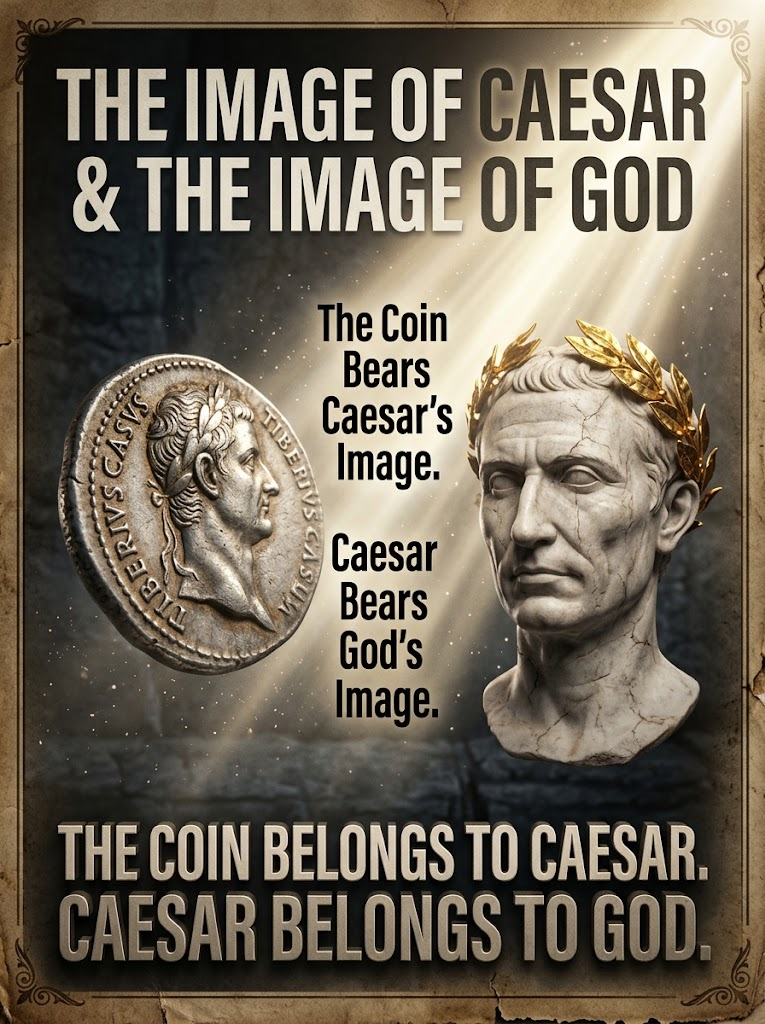
Returning to the Gospel scene: “Is it lawful to pay the census tax to Caesar or not? Show me the coin. Whose image—whose imago—is on the coin?” They reply, “Caesar.”
To properly address this question, we must look to metaphysics. The errors underlying both extremes stem from a flawed understanding of how God relates to the created order. In a common but mistaken view, God is conceived simply as the “supreme being”—the largest and most powerful entity within an inventory of existing things.
Consider an analogy: if the planet Jupiter were knocked out of orbit and set on a collision course with Earth, it would obliterate Earth because both exist as competing physical bodies within the same order of reality. Conversely, when Jupiter stays in its distant orbit, one can live an entire day without thinking about it; it appears to exert no direct influence on daily human affairs.
This mirrors the two erroneous political extremes: either religion overwhelms and obliterates civic autonomy (theocratic domination), or God is viewed as a distant reality wholly detached from public life (radical secularism). Both positions assume God is simply one large being competing with other beings.
As St. Thomas Aquinas articulated, God is not merely a being among others; rather, God is Ipsum Esse Subsistens—the sheer act of Being itself. He is the transcendent creative ground from which all finite reality originates and is sustained. Because God is not an entity inside the universe, the finite world possesses its own distinct integrity and legitimate independence. At the same time, because He is the source of all existence, God remains intimately present to all things. As the catechism asks, “Where is God?” The answer is “everywhere”—not as an overbearing competitor within the world, but as the enduring ground of all reality.
Click Graphic to Enlarge
The Image of Caesar and the Image of God
When we move beyond the misconception of God as a competing entity within creation, the church-state dilemma clarifies. The church can recognize the legitimate autonomy of civil governance, while recognizing that civil authority remains grounded in and accountable to God.
Consider the question of the coin once more: “Whose image is on the coin?” Caesar’s. The coin bears his likeness, reflecting his administrative role in civil society. Therefore, give to Caesar what is Caesar’s.
Yet, there is a profound implied truth: whose image is on Caesar? Caesar himself bears the image and likeness of God, as does every human being. The coin belongs to Caesar, but Caesar belongs to God. Civil authority possesses a distinct role to execute, yet that entire enterprise remains subordinate to the moral order and the ultimate purposes of God.
This principle emerges clearly during Christ’s exchange with Pontius Pilate, the Roman governor of Judea. When Pilate asserts, “Do you not know that I have power to release you and power to crucify you?”, Jesus responds, “You would have no power over me unless it had been given you from above.” Civil authority is genuine, yet its legitimate exercise is derivative and accountable to a higher divine order. The coin belongs to Caesar, but Caesar belongs to God.

Friends, the mountain is a great image throughout the Bible. It is the place where we go up and where God comes down to meet us. Today’s first reading from Isaiah orients us to three holy mountains of the Lord: first, the historical Mount Zion; second, its fulfillment in the heavenly Mount Zion; and third, a sort of “middle mountain” of the Mass, where we raise our minds and hearts to God, who comes to gather us, to speak his word, and to feed us.
Click Graphic to Enlarge
The Structure of Isaiah and the Universal Scope of Creation
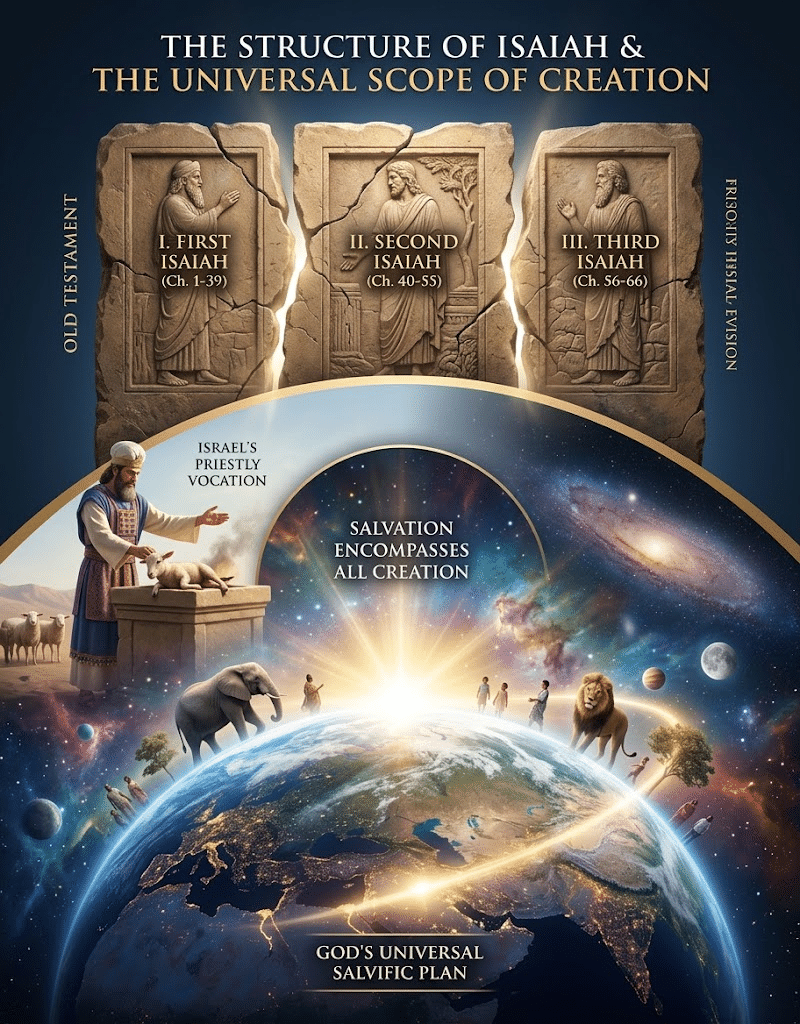
Peace be with you. Friends, our first reading for this weekend is taken from that wonderful middle section of the prophet Isaiah. As I have mentioned before, Isaiah is divided by scholars into three sections: chapters 1 through 39, which they call Proto- or First Isaiah; chapters 40 through 55, this middle section, sometimes called Deutero- or Second Isaiah; and chapters 56 through 66, Trito- or Third Isaiah. I will leave the finer distinctions to biblical scholars, but the essential point is that this central section is filled with some of the richest theology in the entire Old Testament.
The passage the Church presents to us today conveys an extremely important spiritual insight—one to which we rarely advert, but one that is of tremendous importance. Everyone knows that in the Scriptures, Israel is the specially chosen people of God. Of all the nations of the world, God chose Israel to be His priestly and prophetic people. Yet, do we attend sufficiently to the fact that biblical revelation does not begin with the formation of the people of Israel? That historical development begins in Genesis chapter 12 with the call of Abram—the call of Abraham—from whose family the people of Israel eventually emerge.
While most of the Old Testament focuses on the formation and journey of Israel, the Bible does not begin with Genesis 12. Returning to Genesis 1, we encounter God’s creation of the entire universe. Salvation concerns not merely Israel, nor simply humanity; it encompasses the whole of creation as part of God’s salvific plan.
Click Graphic to Enlarge
Universal Covenant and the Purpose of Israel’s Election
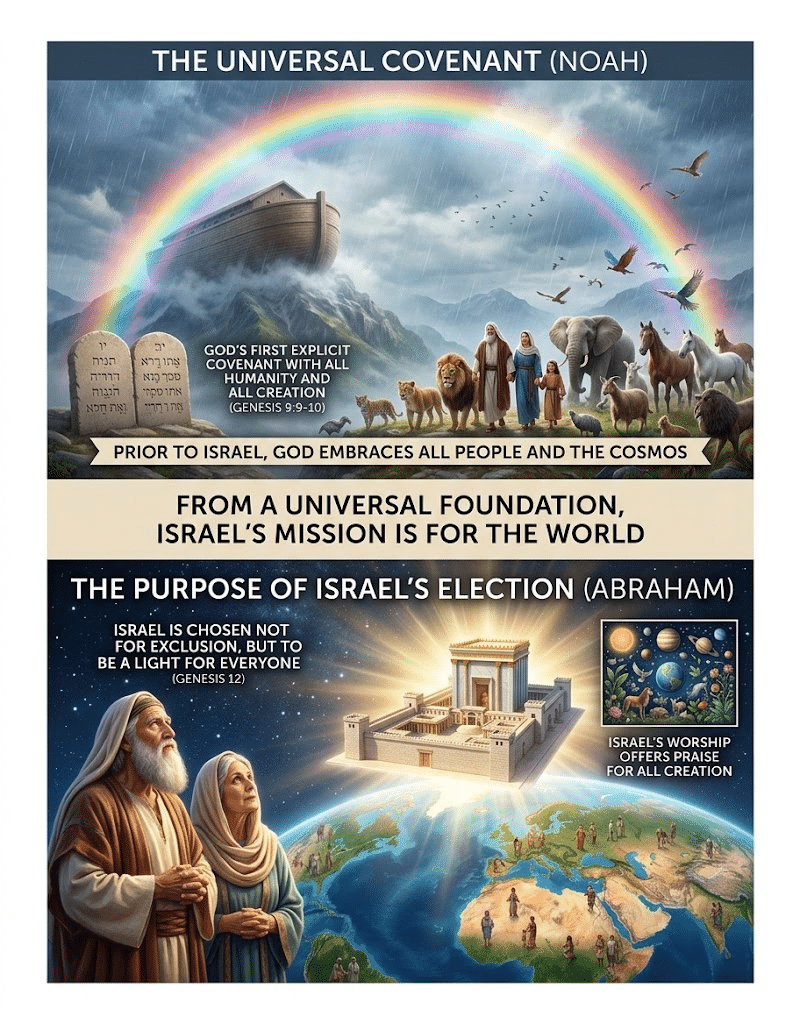
Before reaching Genesis 12, the narrative treats Adam and Eve, Cain and Abel, the Tower of Babel, and Noah and his family. In that entire period, the focus is not yet upon Israel, but upon humanity as a whole. Adam stands as the father of the human race, and following the flood, Noah serves as a new Adam—a father of all humanity. All of humanity remains the primary focus of God’s concern.
While some theologians suggest a implicit covenant with Adam, the first explicit covenant in Scripture is established with Noah. Therefore, prior to any covenant with Israel, God establishes a covenant with all of humanity. As the Book of Genesis records:
“Then God said to Noah and to his sons with him, ‘As for me, I am establishing my covenant with you and your descendants after you, and with every living creature that is with you, the birds, the domestic animals… as many as came out of the ark.'”
This covenant embraces all of humanity and all of creation; that is the overarching setting for God’s salvific work.
When God subsequently chooses Israel, beginning with Abraham, He does not set them apart to be the exclusive recipients of salvation. As I explained recently, God singles out Israel not for their own sake, but for the sake of everyone else. He chooses Israel for the rest of humanity and for the entire cosmos. On the great Temple in Jerusalem, decorations inside and out depicted the planets, stars, animals, and flora, signifying that through Israel’s right worship, all of creation was offering praise to God.
A universal horizon underpins everything God accomplishes with and for His chosen people. The Creator of the universe cherishes all peoples and all things. Consequently, Scripture rejects the narrow religious provincialism common among ancient religions, where local deities merely championed their respective territories. In works such as The Iliad and The Odyssey, regional gods war against one another. While echoes of that cultural backdrop occasionally appear, the God who reveals Himself in the Bible is not merely a localized tribal deity, but the Creator of the universe. The God of Israel is the Lord of all peoples and all things.
Click Graphic to Enlarge
The Fall of Jerusalem and the Rise of Cyrus the Great
This theological principle brings us directly to the extraordinary reading in Isaiah 45, which concerns Cyrus, King of Persia.
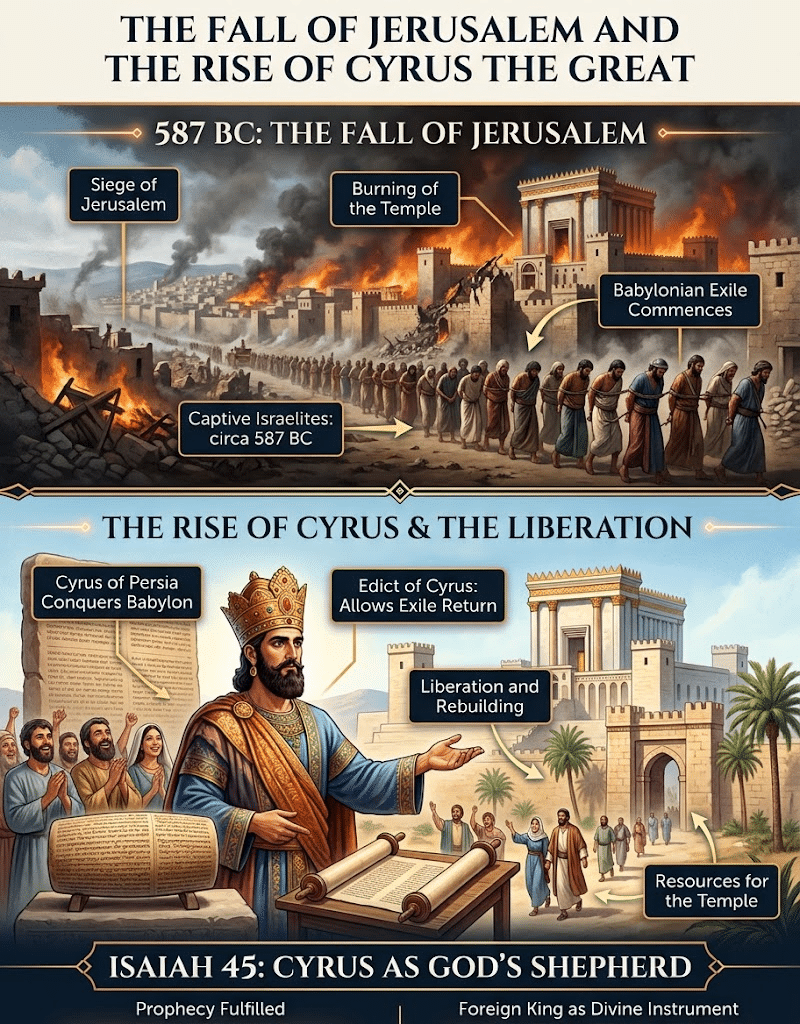
In 587 BC, the Babylonian exile commenced. The Babylonians conquered Judah, laid siege to Jerusalem, destroyed the city, burned the Temple, and carried the leading citizens off into exile—the most traumatic catastrophe in Israel’s history. Decades later, as the Babylonian Empire waned, Cyrus of Persia conquered Babylon, establishing one of the greatest imperial realms of the ancient world.
Rather than further exploiting the exiled Israelites, Cyrus liberated them, permitted their return to their homeland, and provided resources for the rebuilding of the Temple in Jerusalem. A foreign ruler, unacquainted with the God of Israel, became one of the greatest benefactors in Israel’s history.
Click Graphic to Enlarge
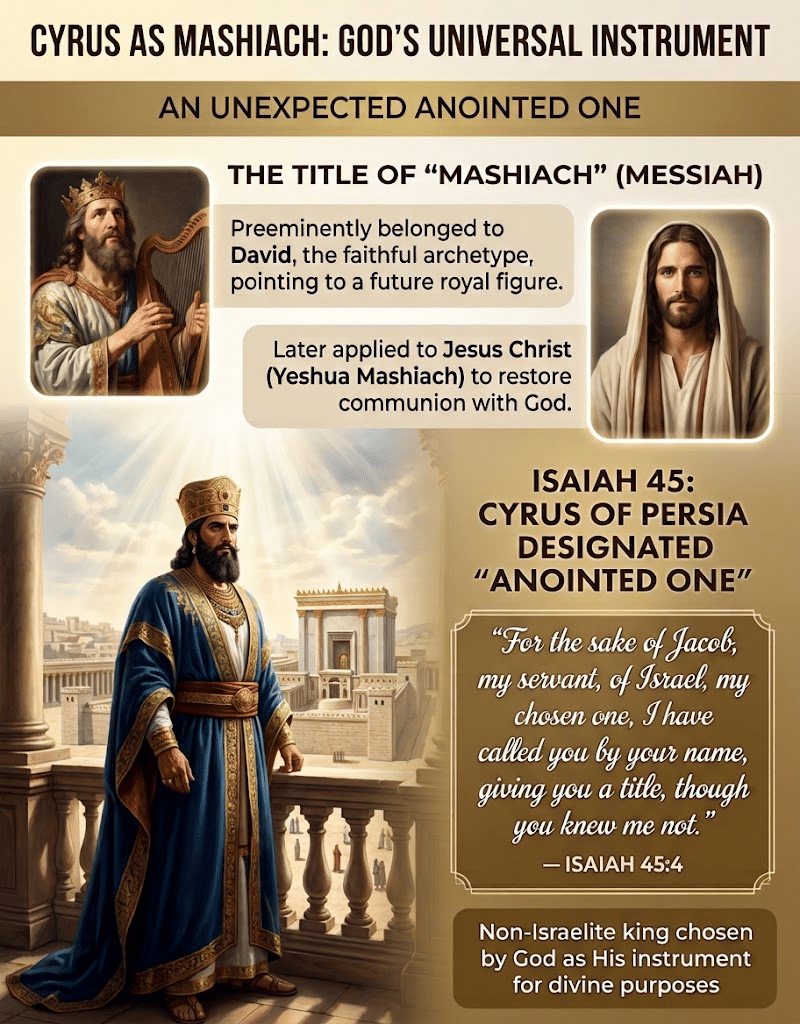
Cyrus as Mashiach: God’s Universal Instrument
Most remarkably, this non-Israelite king is designated by Isaiah as messiah (mashiach)—the “anointed one.” This title belonged preeminently to David, the archetype of the faithful king, and pointed toward the definitive royal figure whom Israel awaited to restore their communion with God. It is the very title later applied to Jesus—Yeshua Mashiach, as Saint Paul proclaims.
In Isaiah 45, this title is applied to Cyrus of Persia. The Lord declares to Cyrus:
“For the sake of Jacob, my servant, of Israel, my chosen one, I have called you by your name, giving you a title, though you knew me not.”
One of Israel’s greatest deliverers was not an Israelite, nor a worshiper of Israel’s God, but an instrument whom the Lord utilized to fulfill His universal purposes.
Click Graphic to Enlarge
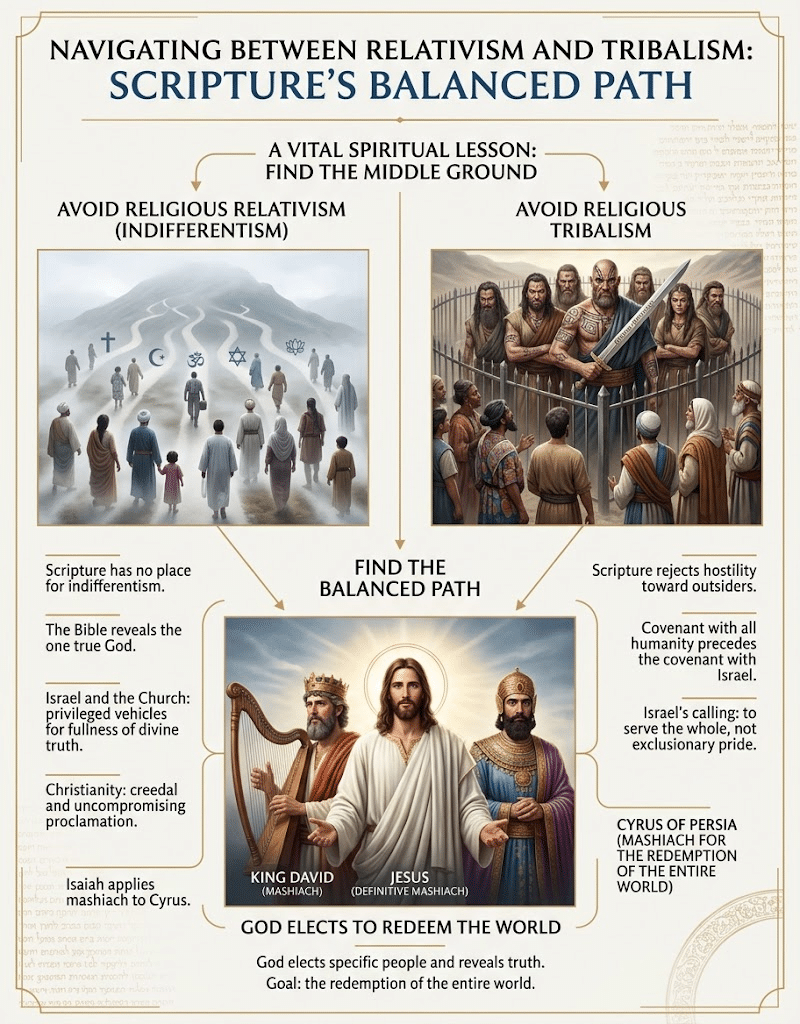
Navigating Between Relativism and Tribalism
From this text emerges a vital spiritual lesson: Scripture calls us to find the middle ground between a bland religious relativism and a destructive religious tribalism.
During the 1970s and 1980s, an uncritical relativism was widespread, suggesting that all religions are fundamentally identical, mere alternate paths up the same mountain. Scripture has no place for such indifferentism. The Bible reveals the one true God; Israel was genuinely chosen, and the Church—the New Israel—is the privileged vehicle for communicating the fullness of divine truth. Christianity has been creedal from its inception, uncompromising in its proclamation of truth.
Conversely, we must avoid a reactionary religious tribalism that weaponizes divine election, breeding contempt toward those outside our communion. Scripture rejects such hostility because the covenant with humanity and creation precedes the covenant with Israel. Israel’s unique calling exists to serve the whole. Defining identity through antagonism or exclusionary pride departs from the biblical vision.
King David bore the title mashiach, as does Jesus definitively; yet Isaiah also applies mashiach to Cyrus of Persia. God elects a specific people and reveals His truth, but He does so for the redemption of the entire world. That is the balanced path Scripture invites us to walk.
YouTube transcript edited for readability by removing fillers, stumbles, and false starts while strictly preserving the homily’s original cadence and theological accuracy. Infographics and discussion questions are independently produced by TWTW and have no affiliation with Word on Fire.
 Highlight text or double-click a paragraph anywhere on the site to ADD TO NOTES. You can also click ASK AI to copy your selection to the clipboard with a command prompt, ready for you to paste manually into the chat above.