Catholic Digest, Homily Themes
Catholic Digest, Homily Themes
July 19, 2026


Follow Me…
Discover Your
Purpose
AT A GLANCE
- Holy Weakness as an Altar: True discernment does not demand flawless performance or spiritual self-sufficiency. Our moments of prayerful dryness and inadequacy are precisely where the Holy Spirit intercedes for us ($Romans\ 8:26-27$).
- The Priesthood of Qualified Beggars: The clerical vocation is not for the self-reliant; it is a ministry of broken men leading others to the Bread of Life.
- Patient, Messy Endurance: Christ’s parable of the wheat and the tares ($Matthew\ 13:24-30$) calls future shepherds to abandon ideological “machetes.” We are called to cultivate holiness and patient charity amid cultural and personal complexity, trusting the Master of the Harvest rather than forcing premature judgment.
REFLECTION
QUESTIONS
- Where am I trying to manufacture “perfect” prayers or disguise my weakness before God, rather than letting the Holy Spirit intercede in my interior poverty?
- Am I holding back my “yes” to Christ because I am waiting for a flawless field—demanding perfection in myself, my seminary, or the culture before I fully commit?
- When I look at the chaos of the contemporary world, does my heart lean toward ideological judgment or the patient, empathetic charity of Jesus?
HUMANITY CHECK
- Step 1: The 15-Minute Rule. Commit to 15 minutes of silent, unstructured prayer today. Sit before the Blessed Sacrament or in a quiet space. If distractions or dryness come, do not fight them. Simply breathe in the name of Jesus and breathe out your anxiety, allowing your weakness to become an altar.
- Step 2: Put Away the Machete. The next time you encounter someone whose lifestyle, politics, or beliefs sharply contradict the Gospel, consciously resist the urge to argue or condemn. Instead, pause and ask yourself: What is the hidden groan in this person’s life? Listen for their pain before you speak to their error.
16th Sunday of Year A
The ordained priesthood includes both diocesan and religious order priests.
The Field of
Discerning Hearts
Discernment is rarely a lightning bolt. More often, it is a slow, hidden anchoring in a world that demands instant, visible results. In the quiet of your heart, you are likely asking two questions that have echoed through centuries of priestly vocations:
How do I know I am doing this right when I feel so weak? and How do I shepherd a world that seems so chaotic?
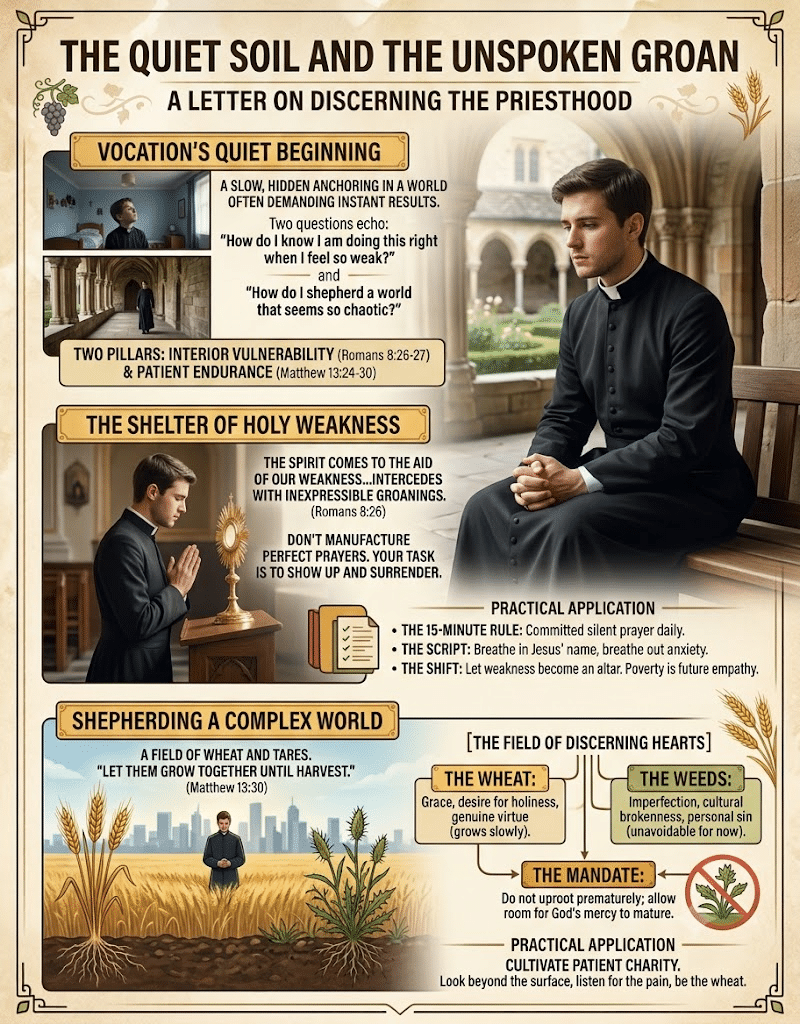
Two profound texts from the Church’s liturgy offer the blueprint for your journey: Paul’s letter to the Romans and Christ’s parable of the wheat and the tares. Together, they form the twin pillars of priestly discernment: interior vulnerability before God and patient endurance in the world.
The Shelter of Holy Weakness
Let us begin exactly where you feel most inadequate. Discernment can feel like a grueling performance review where you are your own harshest critic. You might think a vocation requires flawless clarity, a robust prayer life, and ironclad theological certainty.
Saint Paul shatters this illusion with astonishing tenderness: “The Spirit comes to the aid of our weakness; for we do not know how to pray as we ought, but the Spirit himself intercedes with inexpressible groanings.” (Romans 8:26)
If you do not know how to pray as you ought right now, thank God. You are precisely where a future priest needs to be. The priesthood is not a career for the self-sufficient; it is a ministry of qualified beggars leading others to the Bread of Life.
When you kneel before the Blessed Sacrament and find only dryness, distraction, or a heavy silence, you are not failing. You are experiencing the “inexpressible groanings” of the Holy Spirit within you.
The Practical Application: Stop trying to manufacture perfect prayers. Your primary task right now is simply to show up and surrender.
- The Shift: Let your weakness become an altar. A priest who has never struggled to pray cannot comfort a parishioner who feels abandoned by God. Your current poverty is your future empathy.
- The 15-Minute Rule: Commit to fifteen minutes of silent, unstructured prayer every day.
- The Script: If no words come, simply breathe in the name of Jesus and breathe out your anxiety.
Shepherding a Complex World
If Romans addresses your interior life, Matthew’s Gospel addresses the landscape you are being called to serve. Christ describes a field where a master sowed good seed, but an enemy came at night and sowed weeds—tares—among the wheat (Matthew 13:24-30). When the servants frantically ask to pull up the weeds, the master gives a counterintuitive command: “Let them grow together until harvest.”
Our contemporary culture is that very field. You are discerning a vocation in a time of profound polarization, systemic distrust, and moral confusion. The temptation for a young man discerning the priesthood today is often to become an ideological gardener—to walk into the world, or the parish, with a spiritual machete, eager to rip out everything that looks like a weed.
But Christ calls his priests to a patient, messy endurance.
The wheat and the tares grow in the world, they grow in the parish, and—most painfully—they grow within your own heart. You will see brokenness in the seminary, faults in your formators, and deep fractures in the culture. If you demand a flawless field before you say “yes” to Christ, you will never step forward.
The Practical Application: Cultivate the virtue of patient charity.
- Be the Wheat: Focus your energy on growing deep roots of virtue rather than obsessing over the weeds around you. The world is changed by the quiet abundance of holiness, not by the loud denunciation of darkness.
- Look Beyond the Surface: When you encounter someone whose lifestyle or beliefs completely contradict the Gospel, resist the urge to immediately argue or condemn.
- Listen for the Pain: Ask yourself, What is the hidden groan in this person’s life?
Trust the Searcher of Hearts
Take heart, brother. The One who searches hearts knows the mind of the Spirit. He knows your desires, your fears, and your hidden goodness.
You do not have to figure out the rest of your life by tomorrow morning. You only have to give God the next right step. Let the Spirit groan within you, let the wheat mature around you, and trust that the Master of the Harvest knows exactly what He is doing with your life. Turn your gaze to Him; He has already looked upon you with love.
Essay and animation created with AI tools and human editorial oversight.
His Hands,
His Feet,
Your Vocation
AT A GLANCE
- The Master’s Strategy: The Kingdom of God is allowed to coexist with brokenness. God’s ultimate response to evil and weakness in the present age is not instant elimination, but profound, merciful patience.
- The Danger of Haste: Human zeal often leans toward swift judgment and “weed-pulling.” However, premature judgment risks destroying the good wheat alongside the bad. We lack the perfect vision required to judge the human heart.
- The Diaconal Vocation: The deacon serves as a living witness to this divine delay. By ministering in the messy, broken spaces of the parish and the margins, he embodies a ministry of presence and mercy rather than a courtroom of judgment.
REFLECTION
QUESTIONS
- Where am I pulling weeds? In my family, parish, or workplace, where am I acting as an impatient harvester—writing people off, judging their motives, or wishing they could be swiftly removed or corrected?
- Can I sit in the “in-between”? How well do I tolerate the tension of a broken Church and a messy world? Does the coexistence of good and evil drive me to frustration, or does it invite me to deeper trust in God’s ultimate timing?
- How do the roots interlace in my own heart? Recognizing that the line dividing wheat and weeds runs right through every human soul, how can awareness of my own brokenness make me more humble and merciful toward others?
HUMANITY CHECK
- The 7-Day “Weed-Puller” Fast This week, take up a conscious fast from judgment and correction. Identify one “difficult” person in your life—an angry colleague, a struggling family member, or a parishioner you typically avoid—and deliberately lay down your weed-cutter.
- Instead of trying to fix them, critique them, or wish them away, commit to patiently tending the space between you. Offer them a ministry of pure presence: listen without formulating a rebuttal, extend a small act of unearned kindness, and consciously look for the hidden “wheat” of God’s grace already trying to grow within them. Trust the Master with the harvest; your only job this week is to water the field.
16th Sunday of Year A
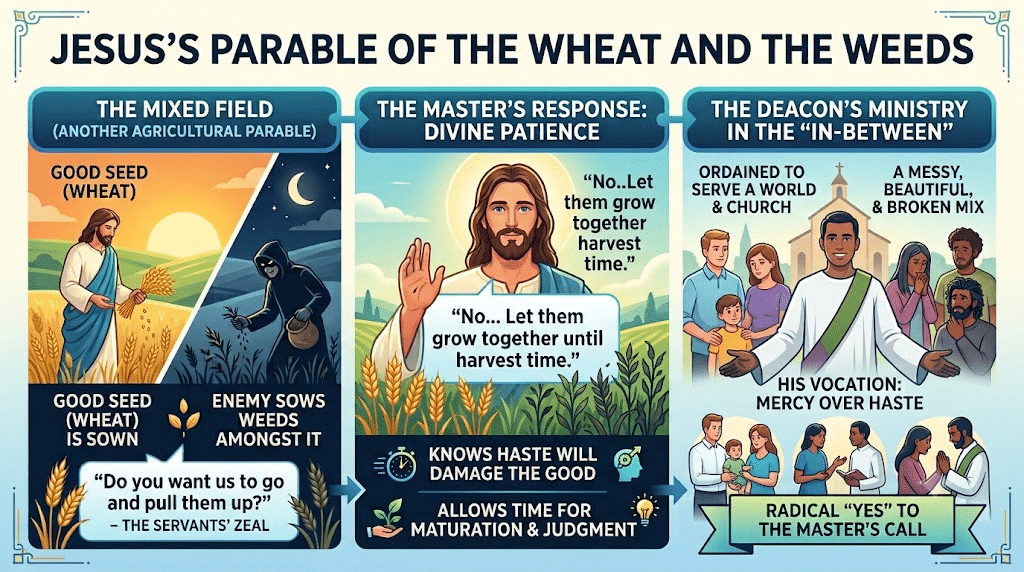
Deacons receive the Sacrament of Holy Orders but are ordained unto ministry and service rather than the priesthood. Because permanent deacons are often married and hold secular jobs, treating them as a distinct category makes a lot of practical and theological sense.
The Patient Tending
Gospel: Matthew 13:24–43
Theme: Let them grow together until harvest time.
McCulloch
(Diocese of Broken Bay)
Jesus gives us another agricultural parable, but this one is not about the soil; it’s about the conflict in the field. The Kingdom is a place where good seed (the wheat) is sown, but an enemy also sows weeds. The servants, in their zeal, want to fix the problem immediately. “Do you want us to go and pull them up?” they ask.
The Master’s reply is the very definition of divine patience: “No… Let them grow together until harvest time.” The Master, in his wisdom, knows that in our haste to root out the bad, we will inevitably damage the good.
The deacon’s ministry is lived almost entirely in this in-between of the mixed field. He is ordained to serve a world, and a Church, that is a messy, beautiful, and broken mix of wheat and weeds. His vocation is a radical yes to the Master’s call for mercy more than haste.
AT MASS
The Proclamation of Patience
At Mass, the deacon is the herald of God’s patience and timing.
• Proclaiming the “No”: When the deacon proclaims this Gospel, he gives voice to the Master’s “No”. This is a divine “no” to the parish’s (and our own) impatient and judgmental weed-pulling instincts.
• The Homily of Mercy: The deacon’s preaching on this text is a call for parish self-examination. Where are we trying to be the harvesters? Where are we judging, excluding, or writing people off as weeds? The deacon must challenge the community to serve as a field hospital that tends to all, rather than a courtroom that judges all.
• Praying for the Field: In the Universal Prayer, the deacon prays for the whole field. He prays for the wheat (who are the faithful and the strong) and for the weeds (the struggling, the sinner, the one on the margins), trusting that God’s grace, like the mustard seed, is at work in all of them.
IN THE PARISH
The Ministry of Guardian of Virtues
St. Gregory the Great said that patience is the root and guardian of all virtues. This patience is the deacon’s primary pastoral tool.
• The Non-Judgmental Minister: The deacon, in his parish life, must be the one who refuses to “pull weeds.” He is the one who must stay with the difficult parishioner, the struggling family in marriage preparation, the teen who is full of doubt. He is called to tend, and not to judge.
• Trusting God’s Timing: The deacon’s work in RCIA, in counselling, or in pastoral care is an act of profound trust in God’s timing. He cannot force conversion. He can only tend the field with love, believing that grace is at work even when hidden.
• Seeing the Wheat in the Weed: The deacon’s mercy is rooted in the knowledge that he is not the judge. His patient service is a bet on grace, a belief that the weeds of today (the addict, the angry parishioner) may one day be the wheat of the harvest.
AT THE MARGINS
The Ministry of Presence
The field is the world, and the deacon’s diakonia sends him to the weediest parts of it: the prison, the shelter, the hospital ward for addiction.
• Tending without Pulling: The deacon goes to the margins not with a weed-puller, but with water: the living water of Christ’s mercy. His job is not to condemn or to fix anything immediately, but to be present and to serve the person in front of him.
• The Field of the Human Heart: The deacon knows that the wheat and weeds grow together not just in the world, but in every human heart, including his own. This knowledge makes him humble and merciful, not zealous for judgment.
• God is Still Growing Something Good Here: This is the deacon’s fundamental message. His steady and calm service in the midst of brokenness is a living homily. His presence quietly and powerfully says to the person everyone else has given up on, “The Master has not given up on you. I will not give up on you. God is still growing something good here.”