Homilies
Homilies
January 4, 2026
January 4, 2026
Epiphany (ABC)


────── ⋆⋅☆⋅⋆ ──────
Bishop Robert Barron


Permission granted for non-profits to use in ministry
The infographic was created using Nano Banana, Google's Revolutionary AI Image Generator. Infographic may not be sold or used for personal financial gain. Please show your appreciation by letting others know about TheWordThisWeek.NET.
Epiphany of the Lord
The Promise of Emmanuel

Many mythologies and philosophies in the ancient world held that time is cyclical; it just goes round and round. Many people today, on the other hand, hold that time is meaningless; it is just one thing after another. The Bible says no to both of those finally despairing understandings of time. As we see in the readings for the Fourth Sunday of Advent, time has a trajectory; it moves toward its fulfillment in Christ, who is Emmanuel—“God is with us.”

Epiphany of the Lord
The Answer to Your Deepest Longing
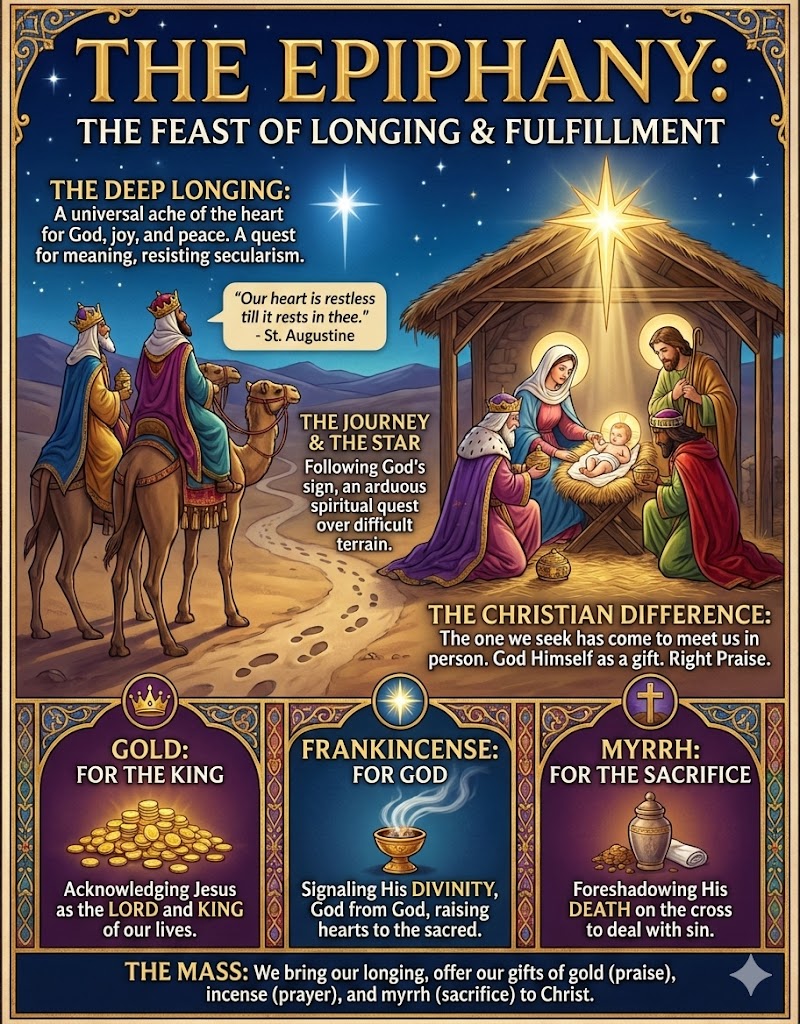
Friends, why has the story of the Epiphany—the three wise man paying homage to the Christ child—so captivated us over the centuries? I think, in some ways, it tells the whole spiritual life: our infinite longing that will never be satisfied here below; the following of beautiful but ambiguous signs in our quest for God; and the revelation that the one we seek has all along been seeking us—and, in the fullness of time, has come in person to meet us.
────── ⋆⋅☆⋅⋆ ──────
Fr. Michael Chua
Permission granted for non-profits to use in ministry
The infographic was created using Nano Banana, Google's Revolutionary AI Image Generator. Infographic may not be sold or used for personal financial gain. Please show your appreciation by letting others know about TheWordThisWeek.NET.
Epiphany of the Lord
The Quintessential Lightbulb Moment

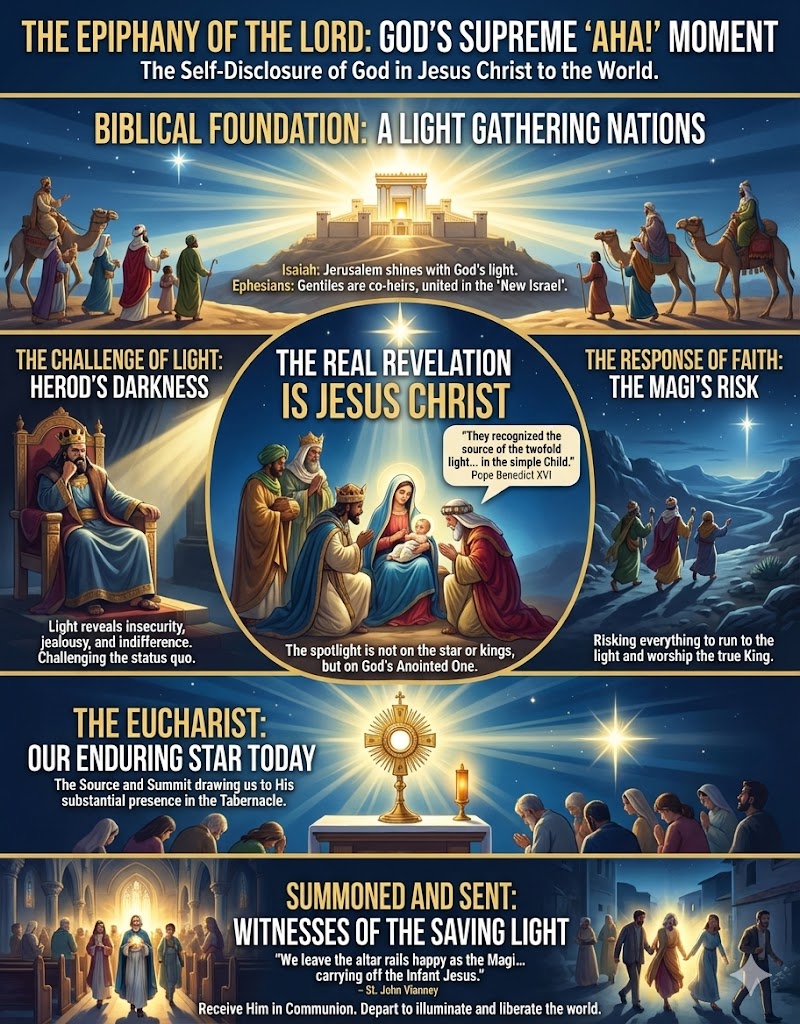
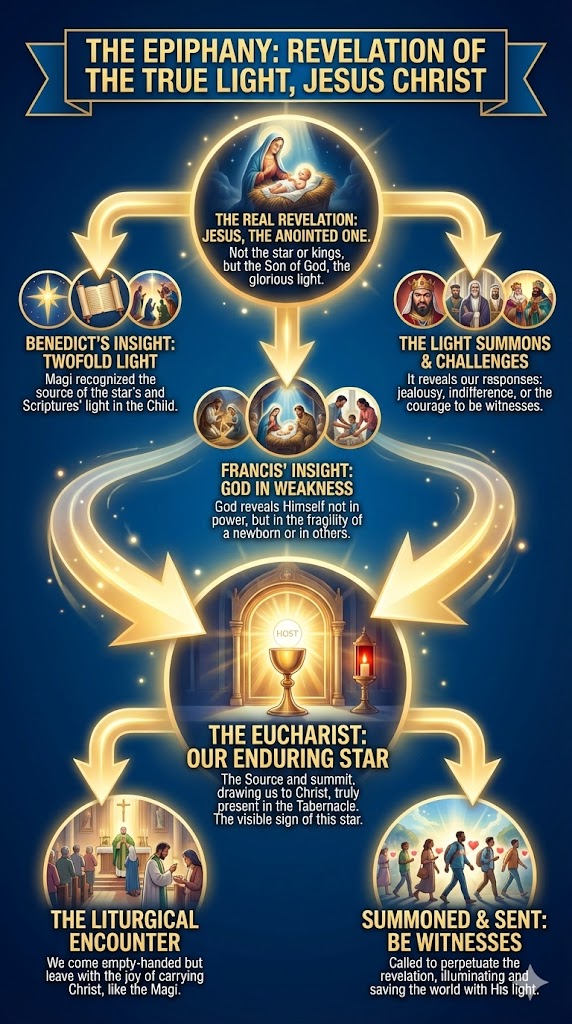
The light of Epiphany reveals, but not passively; it summons and sends. Epiphanies from God are uncomfortable because by their very nature they challenge the status quo and force us to respond. The light not only illuminates but also reveals and uncovers those things done in the dark. The light may reveal to us that there may be more of the insecure and jealous Herod and religious leaders, than there are the magi who risked everything to make this long journey to worship the true King. Like Herod, we can be filled with jealousy and rage. We can be passive and indifferent and pretend the light pollution of our noisy crowded lives drowned out any chance for epiphany like it did for the Jewish Leaders. Or, we can be like the Magi. Men and women who run to the light and go forth being witnesses of that light to the world.
This is why we consider the Epiphany of the Lord as the most incredible light bulb moment in human history. Pope Francis tells us, “God does not reveal himself in strength or power, but in the weakness and fragility of a newborn babe.” In our own day, too, God presents Himself in ways which we may not recognise. God does not appear in His glory, but in friends and strangers, unexpected incidents and under the insignificant appearance of bread and wine. Just as He did in Bethlehem, Jesus slips into our lives like a shadow.
Permission granted for non-profits to use in ministry
The infographic was created using Nano Banana, Google's Revolutionary AI Image Generator. Infographic may not be sold or used for personal financial gain. Please show your appreciation by letting others know about TheWordThisWeek.NET.
Epiphany of the Lord
Dreaming and Believing
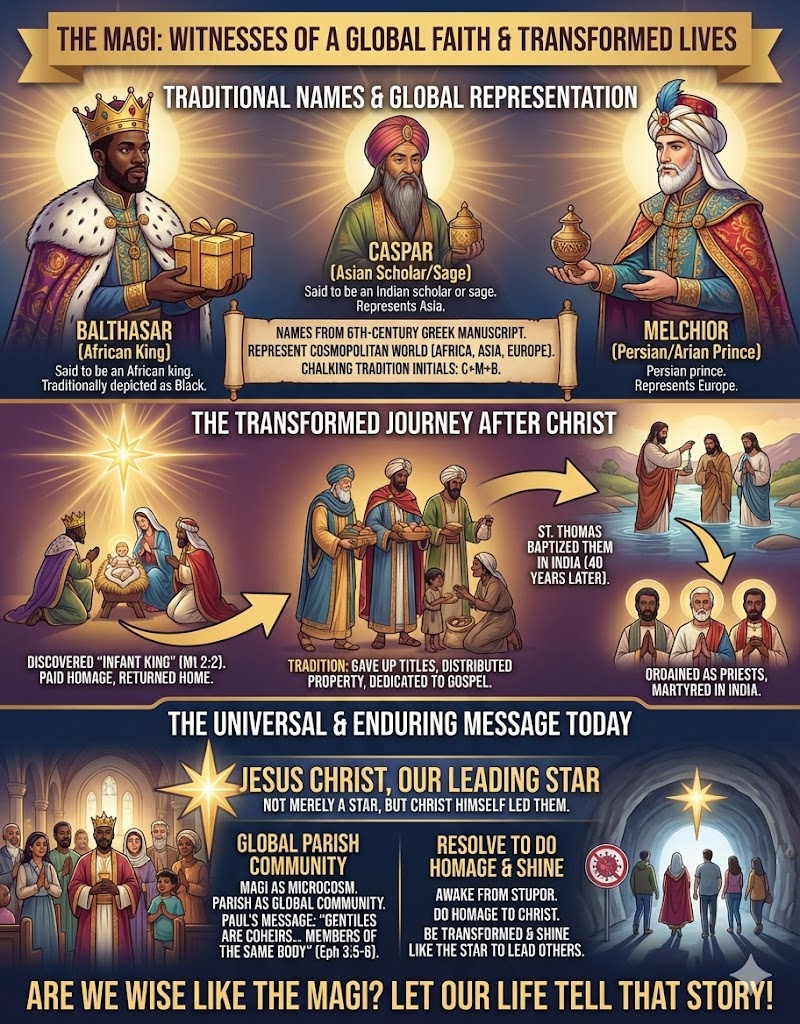
The impact that the Christ-child had on the Magi is deeply touching. This event completely transformed their lives. According to all these traditions, it was not merely a star that led them from that moment on, but rather, Jesus Christ. Jesus consumed their life and existence. The Magi are an invitation today to let Christ have the same impact on us. Are we wise like the Magi? Let our life tell that story! The depiction of the Magi as people of different colours and races helps us imagine a parish community as a global community. The Magi are the microcosm of a parish community. No one should ever feel unwelcome in a worshipping community. We know that this clearly was a problem in the early Church. In his Letter to the Ephesians, Paul struggles to convince the Jewish Christians that, “Gentiles are coheirs, members of the same body, and copartners in Christ Jesus through the gospel” (Eph 3:5-6). The Magi bear witness to a global nature, indeed, the catholicity of the Catholic faith.
The Magi did homage to the Divine Child and then their lives became a witness to Him. Today, after we have woken up from the stupor of sleep and dreams, from two years of pandemic lockdowns and online Masses, let us resolve with excitement and new vigour to do homage to the same Christ, so that our lives too can be transformed and shine like the star that will lead others to Christ.
Epiphany of the Lord
A King to Rule, A God to be Worshipped, A Saviour to Die
Epiphany is like a riddle that needs unravelling. It gets convoluted when we try to number the kings that make up the story. There is Herod the Great who is King of that time. Though he has self-styled himself with that “Great” appendage, he is a mere vassal, a puppet ruler beholden to the Romans ruling. Then we have Jesus whom the magi declare as “the infant king of the Jews,” a title that is ironically prophetic because it would appear once again under order of the Roman authorities on the plaque or titulus which hung over the head of Jesus on the cross. Finally, we have the unspecified number of wise men or magi from the East who have been immortalised as “three Kings from Orient”, who were most likely astrologers who were experts in magical divination rather than of royal lineage. Over the centuries, the Wise Men were given names–Caspar, Melchior and Balthasar – and they were venerated as saints. In fact, if you go to the Cathedral in Cologne, Germany, you will find relics alleged to be the remains of the Wise Men. How did the wise men of our story become the three kings of song and tradition? Despite what modern people would refute, there may be biblical evidence to support the tradition…
Tradition gives us the names of the Magi -Caspar, Balthasar, Melchior. But the fact that Matthew gives them no names is telling. They may be kings, but in this story they are merely supporting actors. They follow the true Star, the King of Kings. Only His name is important. The Feast of the Epiphany is not about the Magi–it’s all about Jesus. And just like the Bethlehem star, their very presence and gifts reveal to us who this Child is – He is our King whom we must obey and serve, He is our Lord and God whom we must worship and finally, He is our Saviour who will die for us in expiation of our sins.
────── ⋆⋅☆⋅⋆ ──────
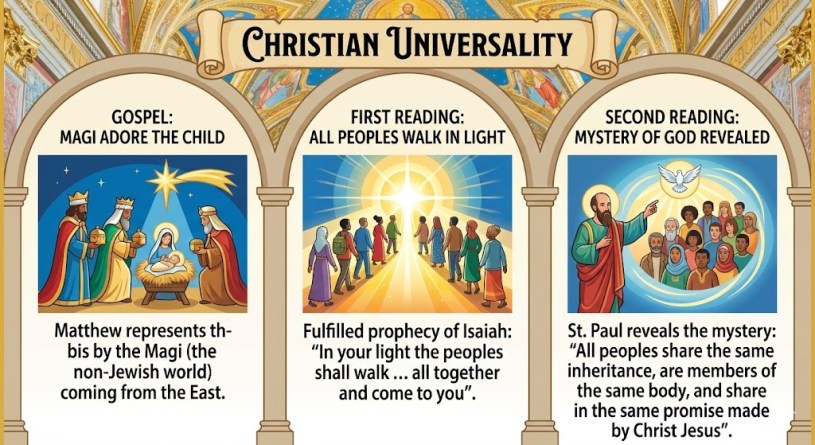
Dicastery for the Clergy

────── ⋆⋅☆⋅⋆ ──────
Dominican Blackfriars
Dominican Blackfriars

Permission granted for non-profits to use in ministry
The infographic was created using Nano Banana, Google's Revolutionary AI Image Generator. Infographic may not be sold or used for personal financial gain. Please show your appreciation by letting others know about TheWordThisWeek.NET.
Epiphany of the Lord
Dawn by Light
Epiphany of the Lord (A) | Fr Dominic White reflects on the humility of pagans in search of truth, and he asks if we might occasionally take for granted what God has given us.
The story of the Magi is a hopeful story, because it shows Jesus Christ drawing people to Himself through the truths which exist in their religions, so that they may find fulfilment and their journey’s end in Christ and the fullness of the Catholic Christian Faith.
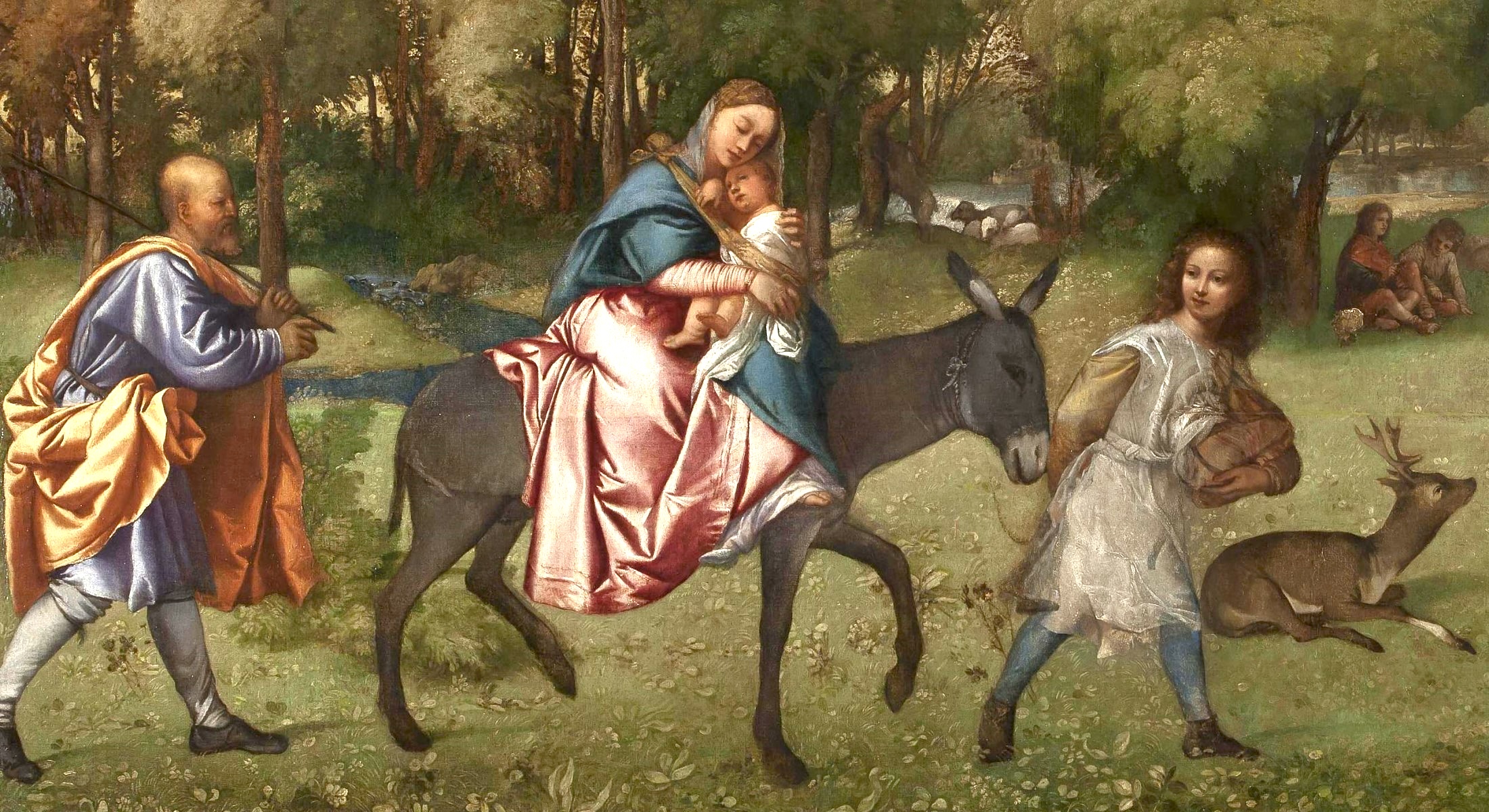
But it challenges us too. Are we willing to take God as we find Him (as He finds us), trust Him to lead us rather than telling Him what we want and using all means to get it? It’s very hard to trust God sometimes if you’ve been hurt or feel lost. But deep down we know that these passing things won’t satisfy us (especially when the astrologers can’t even agree with each other), and that real Light – which is a universal symbol of all religions – only comes from God, and when we least expect. So after Mass let’s go to the crib and see that the Magi have arrived. Let’s make it our own pilgrimage, where we take to the Lord not just our wounds, but our gifts (yes, we all have gifts, because God gave them to us in the first place!). What we give to Him, He will give back to us, made glorious. And we in turn will become like God’s stars, full of light even in the darkness, and drawing our neighbours of all religions to the one Jesus Christ.ion to the crisis of fatherhood, to absent, cruel, abusive, distant men who have begotten children but failed to raise them. Joseph does not beget his own Child, but raises Him and so truly is a father to Him..


────── ⋆⋅☆⋅⋆ ──────
Fr. Austin Fleming
Permission granted for non-profits to use in ministry
The infographic was created using Nano Banana, Google's Revolutionary AI Image Generator. Infographic may not be sold or used for personal financial gain. Please show your appreciation by letting others know about TheWordThisWeek.NET.
Epiphany of the Lord
Going Home Another Way...
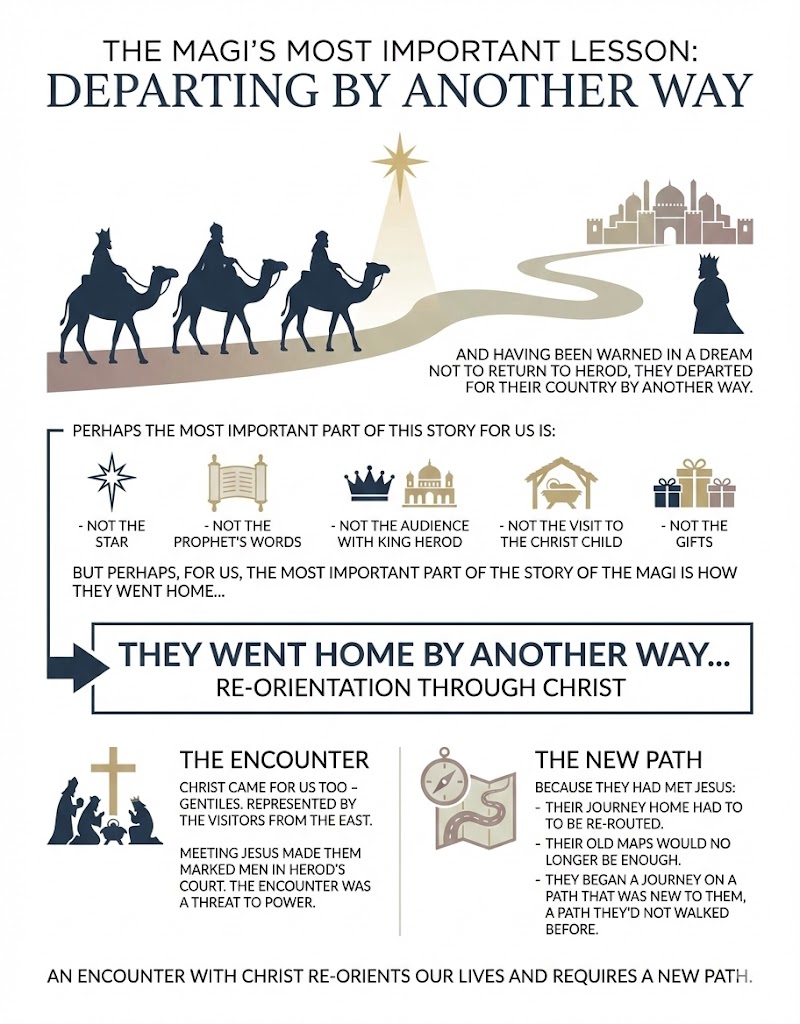
And having been warned in a dream not to return to Herod, they departed for their country by another way. Perhaps the most important part of this story for us is: not the star not the prophet’s words not the audience with King Herod not the visit to the Christ Child not the gifts… but perhaps, for us, the most important part of the story of the Magi is how they went home… They went home by another way…
In the grand revelation of God’s love made manifest to us in Christ, this story of the Magi is meant to remind us that Christ came not only for the chosen people of Israel but for us, too -Gentiles- represented by the mysterious visitors from the East. And there’s something to be learned from how their pilgrimage and meeting with Christ served to re-orient them: how they went home by another way.
Simply having met Jesus made them marked men in Herod’s court. They had met the “newborn King of the Jews” and that encounter was a threat to those in power. Because they had met Jesus, the Magi were no longer welcome or safe in Herod’s palace. Because they had met Jesus, their journey home had to be re-routed. Because they had met Jesus, their old maps would no longer be enough. They were beginning a journey that would take them on a path that was new to them, a path they’d not walked before.
────── ⋆⋅☆⋅⋆ ──────
Monsignor Peter Hahn
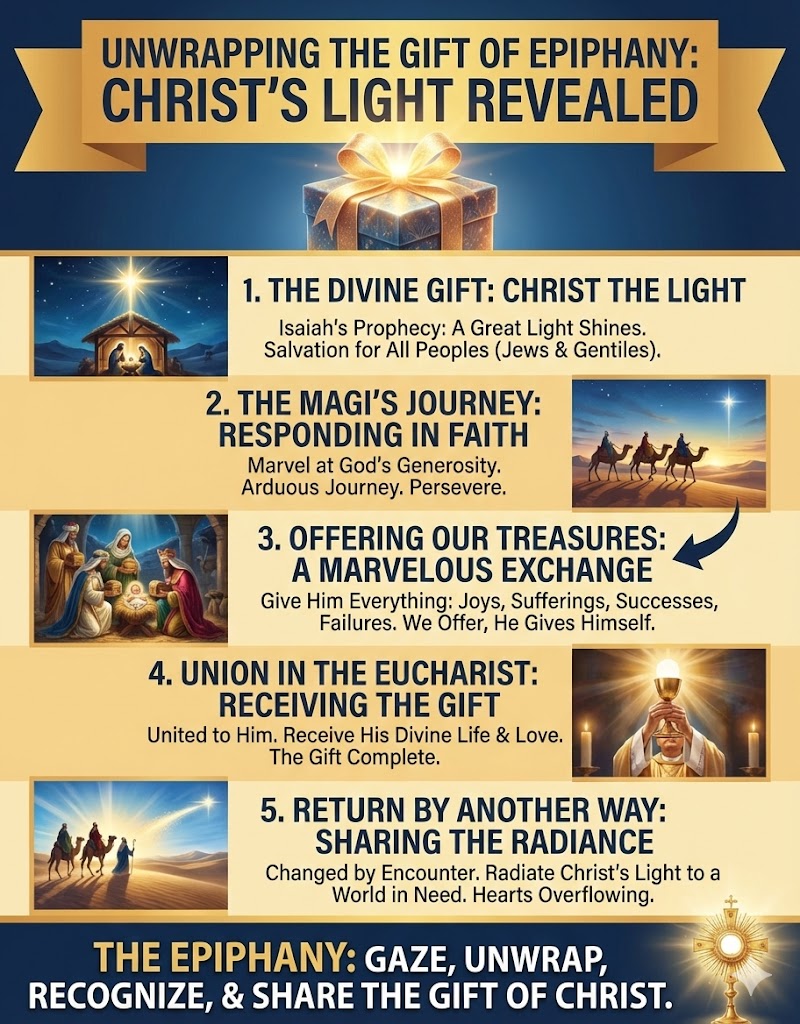
Permission granted for non-profits to use in ministry
The infographic was created using Nano Banana, Google's Revolutionary AI Image Generator. Infographic may not be sold or used for personal financial gain. Please show your appreciation by letting others know about TheWordThisWeek.NET.

Epiphany of the Lord
The Perfect Gift
In his homily, Fr. Hahn encourages listeners to consider times when they’ve given or received perfect gifts, drawing parallels with giving and receiving in the spiritual sense during Christmas.
Fr. Hahn then refers to the Magi’s gifts of gold, frankincense, and myrrh to the Son of God as a symbol of humanity’s call to give ourselves to others. The homily emphasizes that like the Magi who were changed after encountering Christ and embarked on a new path (‘departed by another way’), people too are meant to be transformed by their spiritual encounter with Christ.
Fr. Hahn acknowledges that this journey towards self-transformation can be challenging and filled with personal struggles. However, just as the Magi persevered in their journey, people are encouraged to do so as well. In doing so, we engage in a reciprocal exchange: receiving Christ while also giving ourselves.
The homily concludes with an optimistic tone, encouraging listeners to open their hearts and minds to God’s love and transform themselves towards living more for Him.
────── ⋆⋅☆⋅⋆ ──────
Fr. Charles E. Irvin
Permission granted for non-profits to use in ministry
The infographic was created using Nano Banana, Google's Revolutionary AI Image Generator. Infographic may not be sold or used for personal financial gain. Please show your appreciation by letting others know about TheWordThisWeek.NET.
Epiphany of the Lord
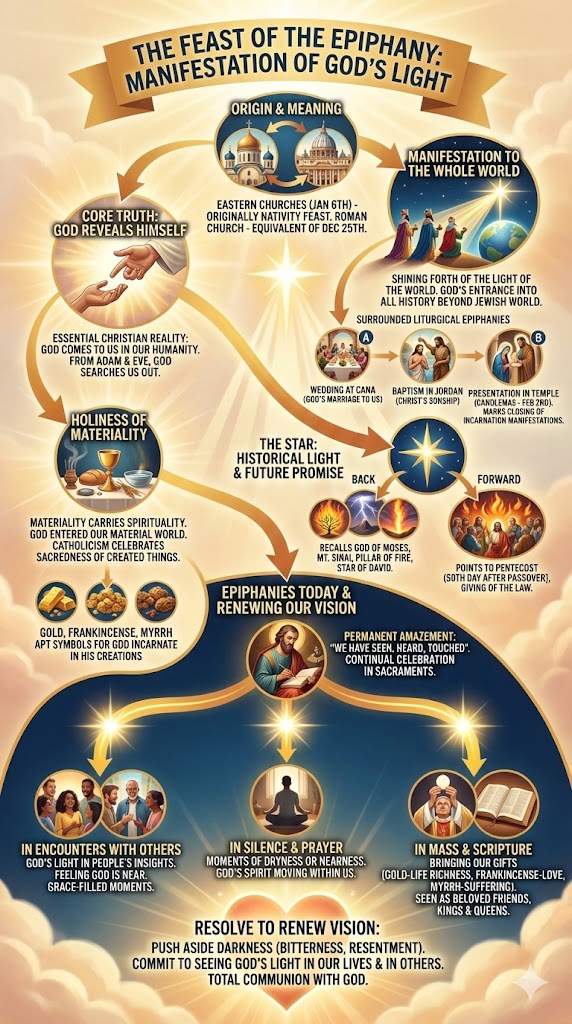
God's Light and Our Vision

May you and I try harder to push the darkness of our vision aside. Are we bitter and resentful like Herod was? Do we feel upset with the Catholic Church? With having to go to Mass? Are we upset with priests… with the bishop… with the pope? Do we carry animosities in our hearts toward those with whom we live? Toward our associates or our neighbors? Let us therefore cast aside the darkness that keeps us from seeing each other as God sees us. Let us try once more during this coming year to see the epiphanies of God in our lives, especially those manifestations of Him that come to us through other persons. Let us turn our hearts to renewed prayer… to thought-filled contemplation of our lives…to meditation on the meanings that we find in our selves. Let us become the Kings who followed Bethlehem’ star to the birthplace of the Son of David. Let us renew once again our commitment to see God’s Light in our lives. For He comes… He comes to tell you and me that He loves us… that He loves us as a lover loves his beloved… that He wants to share His very self with us… that He wants to have a total communion… a whole communion… a Holy Communion with you and with me… together in His beloved Son born as one of us to become one with us.
────── ⋆⋅☆⋅⋆ ──────
Fr. Joe Jagodensky, SDS
Fr. Joe Jagodensky, SDS
Permission granted for non-profits to use in ministry
The infographic was created using Nano Banana, Google's Revolutionary AI Image Generator. Infographic may not be sold or used for personal financial gain. Please show your appreciation by letting others know about TheWordThisWeek.NET.
Epiphany of the Lord
Epiphany's Light

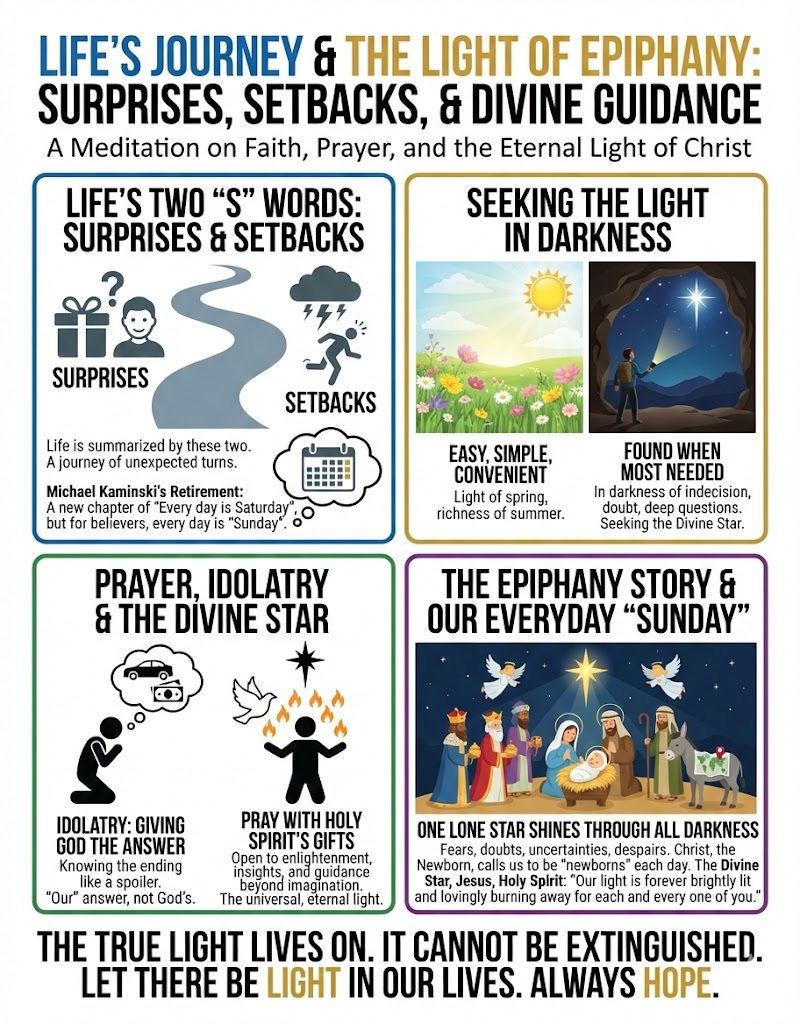
Three kings (whose names we can never remember), a villainous governor (whose name we all know), two tired parents (we know them), an unnamed donkey with a map and magic marker yellowing directions to Egypt, shepherds (all without names) wondering if their sheep are still in the hills, angels (no names provided) looming all about…and only one bright lone star constantly shining through all of our darknesses of fears, doubts, uncertainties, and despairs. As well as life’s joys, successes, and peace. Always hoping that the latter outweighs the former. The song “Away in the manager?” Forget about it.
Apparently asleep but with a joyful smile on his face is this newborn babe full of surprises and setbacks for both himself and for us. He’s asking us to be “newborns” each day. (Even in the unknown but joyful time of retirement.)
What are their names? They are the Divine star of God, Jesus, and the Holy Spirit saying to us every Sunday (and those other misnamed days), “Our light is forever brightly lit and lovingly burning away for each and every one of you.”
────── ⋆⋅☆⋅⋆ ──────
Deacon Greg Kandra
Permission granted for non-profits to use in ministry
The infographic was created using Nano Banana, Google's Revolutionary AI Image Generator. Infographic may not be sold or used for personal financial gain. Please show your appreciation by letting others know about TheWordThisWeek.NET.
Epiphany of the Lord
Let There Be Light
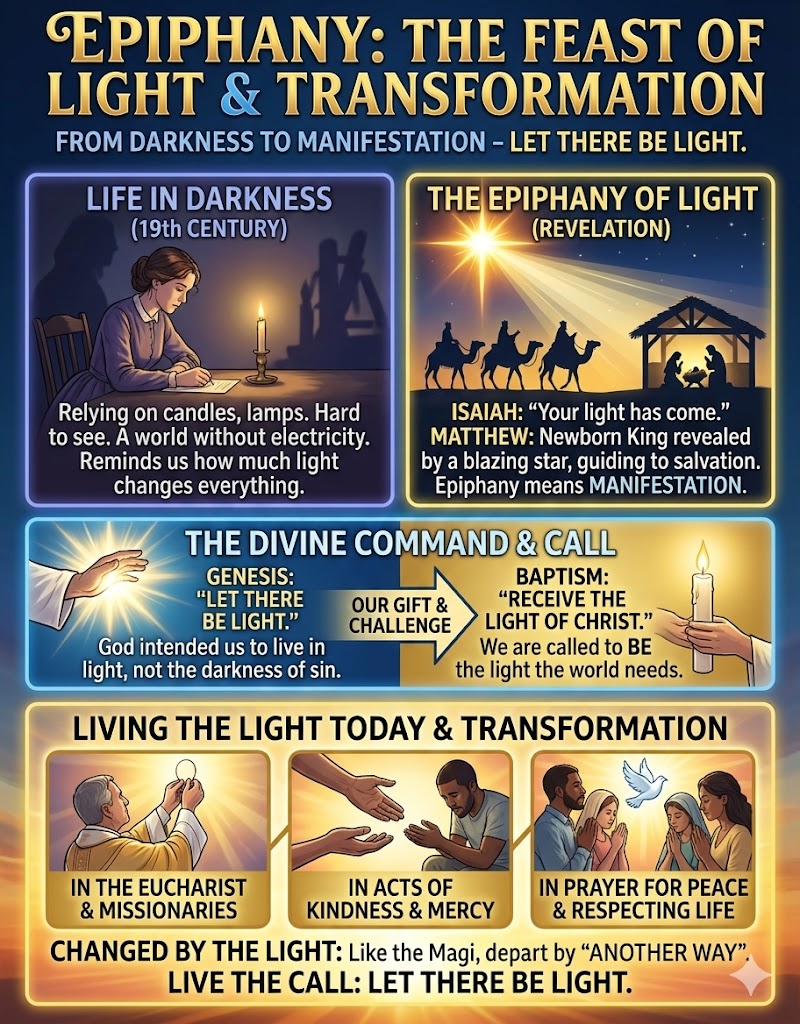
My wife and I went to see “Little Women” over the Christmas holidays. It’s well done — and it captures beautifully the reality of life in the 19th century. In particular, it reminds us of something which most of us take for granted today.
Light.
This production of the story shows vividly what it was like to live in a world without electricity, with candles and lamps giving off whatever light they could.
When Jo March embarks on her career as a writer, she often has to write in the evening, using only candlelight, or gaslight, or the flickering flames from logs in the fireplace.
Even during daytime, the natural light inside the March family home can be overcast by shadows. In the 1800s, you couldn’t just flick a switch on the wall or click on your iPhone to get more illumination. You made do with whatever daylight or sunlight was available. It could make it hard to see, or see clearly.
— originally preached in 2020
────── ⋆⋅☆⋅⋆ ──────
Fr. Jude Thaddeus Langeh, CMF

Epiphany of the Lord
No One Can Extinguish Your Star

Growing up without electricity, we enjoyed and appreciated the moon and the stars that brightened our nights. It was time for dancing and singing outside. Epiphany reminds me of the shining stars in the night. The word “epiphany” comes from the Greek epiphainen, meaning, “to shine upon,” “to manifest” or “to make known.” We celebrate the different manifestations of Jesus to the world: the visit of the Magi in Matthew 2:1-12, the baptism of Jesus in Mark 1:9-11, and the miracle at Cana in John 2:1-11. Epiphany Day is also known as the Feast of the visit of the Magi. In the book of Numbers, it is foretold that: “A king, like a bright star, will arise in that nation. Like a comet he will come from Israel…” (Num 24:17). Isaiah will insist on the fact that “The nations shall come to your light…all are assembling”. The Magi understood that “His star” (Mat. 2:2) had finally appeared to them, heralding the Birth of Christ the King. While Herod tried to kill Jesus and extinguish the shining star, the wise men instead adored him. The bright light and the star of the newborn king will shine on all nations, and none can extinguish it.
────── ⋆⋅☆⋅⋆ ──────
Deacon Peter McCulloch

Permission granted for non-profits to use in ministry
The infographic was created using Nano Banana, Google's Revolutionary AI Image Generator. Infographic may not be sold or used for personal financial gain. Please show your appreciation by letting others know about TheWordThisWeek.NET.
Epiphany of the Lord
Four Kinds of Epiphany
What does it mean when someone says ‘I’ve had an epiphany’? It means that in a sudden flash, a veil was lifted and something profound was revealed to them. And that experience has changed the way they live.
Today, on the Feast of the Epiphany of the Lord, we celebrate the different ways in which Jesus reveals himself to the world. We begin by remembering the Wise Men who discovered the child Jesus in Bethlehem, and worshipped him as the Messiah who has come to save us all. This is the original epiphany we celebrate at this time.
But there are other ways in which Jesus’ divine identity and mission have been revealed to us. At his Baptism, God the Father announces that Jesus is his beloved Son (Mk.1:9-11), and at Cana Jesus performs his first miracle (Jn.2:1-11). Each of these events is an epiphany.
But how does Jesus reveal himself to us today?

Permission granted for non-profits to use in ministry
The infographic was created using Nano Banana, Google's Revolutionary AI Image Generator. Infographic may not be sold or used for personal financial gain. Please show your appreciation by letting others know about TheWordThisWeek.NET.
Epiphany of the Lord
The Fourth Wise Man
Many of us set out on our own journey of faith with the best of intentions. We want to become better people, getting closer to God and doing more for others. But life often gets in the way. We get held up by illness, delayed by our responsibilities, and distracted by the needs of others. And sometimes we wonder: have I missed my chance to find Jesus?
Artaban’s story says: no. Jesus is not only found at the end of the road, but also along the way, especially where love calls us to stop, help and care for others.
In other words, every detour we take for the sake of love brings us closer to the heart of God.
────── ⋆⋅☆⋅⋆ ──────
Fr. Carmen Mele, O.P.
Permission granted for non-profits to use in ministry
The infographic was created using Nano Banana, Google's Revolutionary AI Image Generator. Infographic may not be sold or used for personal financial gain. Please show your appreciation by letting others know about TheWordThisWeek.NET.
Epiphany of the Lord
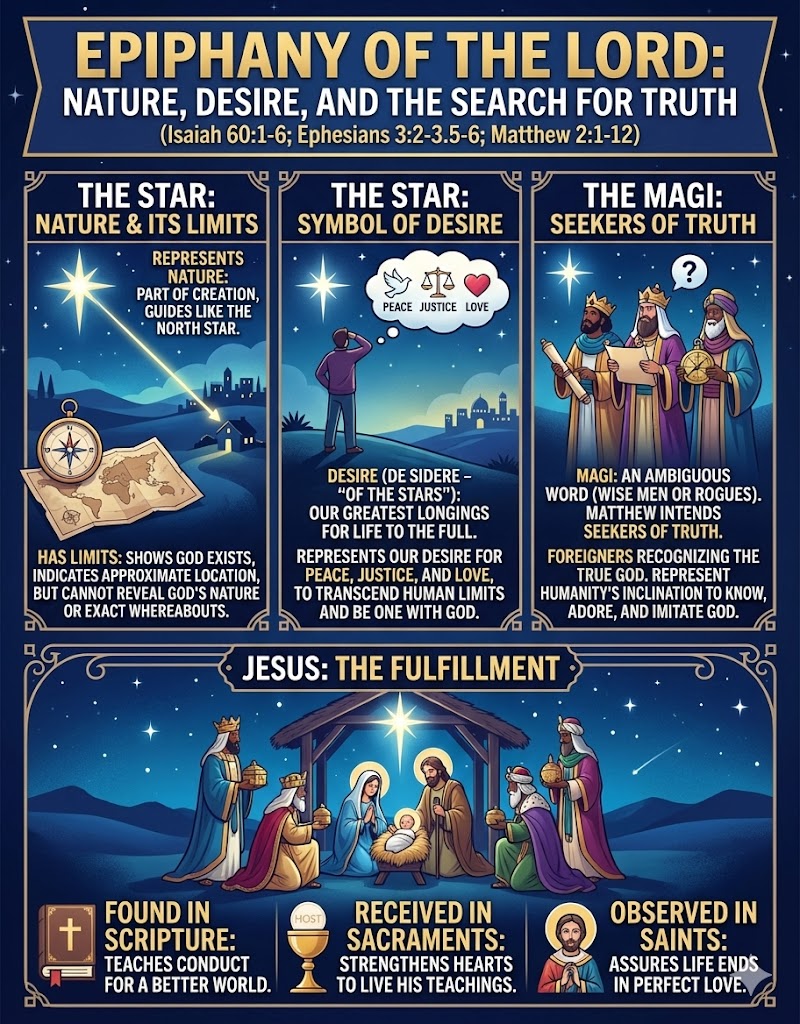
Magi as Seekers of Truth

Magi is one of those words that has a range of meanings, some positive and some negative. For example, when a person is called “proud,” we are not sure that the person is selfish or fulfilled in something important. In ancient times, magicians were astronomers searching for the truth. However, some had the reputation as rogues like the magician Barjesus found in the Acts of the Apostles. This kind of ambiguity is also found in religion. Practiced well, religion brings peace and strength to a person so that he or she might overcome life's challenges. But practiced in the way of extremists, religion ends in iniquity that harms others.
In his gospel, Matthew certainly intends that the magi as seekers of truth. They represent a new movement of humanity towards Christ. They are not Jews but foreigners who will recognize the true God through his Son Jesus Christ. They teach us that every human person is inclined to know, adore, and imitate God.
The magi find in Jesus the end of their search for the truth, and they give him appropriate worship. For us too, Jesus fulfills the desire for life to the full. Found in Holy Scripture, Jesus teaches us the conduct that produces a better world. Received in the sacraments, Jesus strengthens our hearts to live his teachings. Observed in the saints, Jesus assures us that life can end in perfect love.
────── ⋆⋅☆⋅⋆ ──────
Msgr. Joseph Pellegrino
Epiphany of the Lord
A Wise Journey

The famous English author of a hundred years ago, G. K. Chesterton, wrote a wonderful essay on three modern wise men. These three heard that there was a city of peace, a city where there would never be wars, or disturbances or pain. They also heard that they had to bring gifts to demonstrate that they were men of peace who deserved to live in this city. So they journeyed to this new Bethlehem with what, they were sure, would be gifts that would guarantee peace and earn them admission into the city. When they got to the gates of the city, St. Joseph was there to judge their gifts. The first modern wise man brought gold. He suggested that this could buy the pleasures of the world. People would not need war. They would buy all they ever wanted with the gold. The second modern wise man did not bring frankincense. He brought chemistry. He brought modern science. With his science he could drug the mind into a state of perpetual happiness. He could seed the soil and control the population. People would then have all that they would need so they would never go to war again. The third modern wise man brought a split atom, a new myrrh, a new symbol of death. His message was that anyone who opposed the way of peace would face death.
────── ⋆⋅☆⋅⋆ ──────
Msgr. Charles Pope

Permission granted for non-profits to use in ministry
The infographic was created using Nano Banana, Google's Revolutionary AI Image Generator. Infographic may not be sold or used for personal financial gain. Please show your appreciation by letting others know about TheWordThisWeek.NET.
Epiphany of the Lord
The Journey of Faith

I would like to follow the Magi in their journey of faith to become “Wise Men.” As magi, they followed the faint stars, distant points of light; as wise men, they follow Jesus, who is the ever-glorious Light from Light, true God from true God.
We can observe how they journey in stages from the light of a star to the bright and glorious Light of Jesus Christ. And, of course, to authentically encounter the Lord is to experience conversion. All the elements of this story ultimately serve to cause them to “return to their country by another route.” Let’s look at the stages of their journey from being mere magi to becoming, by God’s grace, wise men.
I. The CALL that COMPLETES
II. The CONSTANCY that CONQUERS
III. The CONDESCENSION that CONFESSES
IV. The COST that COMES
V. The CONVERSION that is CLEAR
────── ⋆⋅☆⋅⋆ ──────
Father Kevin Rettig


Permission granted for non-profits to use in ministry
The infographic was created using Nano Banana, Google's Revolutionary AI Image Generator. Infographic may not be sold or used for personal financial gain. Please show your appreciation by letting others know about TheWordThisWeek.NET.
Epiphany of the Lord
Magi of the Heavens

This reflection draws a profound parallel between the ancient Magi and modern astronauts, framing both as seekers drawn by the stars to encounter the Divine. Just as the Magi were led to Bethlehem, modern pioneers like John Glenn found their faith strengthened by the "awesome magnificence" of creation viewed from orbit. Glenn’s journey—and his practice of prayer in space—mirrors the soul’s reaching for something beyond the known world.
The text highlights that space travel often serves as a "God experience," revealing the oneness of creation. It cites James Irwin, who returned from the moon with a zeal for sharing his divine vision, and Buzz Aldrin, who sanctified the lunar surface through Holy Communion. Ultimately, the homily suggests that by looking upward to find something higher, we gain the perspective to see our world and our own souls for the first time. Like Glenn, we are called to recognize the hand of the Creator in the depths of our own existence.


Epiphany of the Lord
The Gift of the Magi by O Henry
A young couple, Della and Jim, demonstrate the true meaning of selfless love and sacrifice during Christmas by each giving up their most precious possession to buy a gift for the other. The selfless act of a man and a woman exchanging their most precious possessions makes them the wisest gift-givers, surpassing even the legendary magi.
────── ⋆⋅☆⋅⋆ ──────
Fr. George Smiga

Permission granted for non-profits to use in ministry
The infographic was created using Nano Banana, Google's Revolutionary AI Image Generator. Infographic may not be sold or used for personal financial gain. Please show your appreciation by letting others know about TheWordThisWeek.NET.
Epiphany of the Lord
The Magi and the 2024 Tsunami

2004 HOMILY - The general joy of our holidays has been shaken by the terrible news of the disaster caused by the tsunami in the Indian Ocean. Already the count of the dead is over 100,000 and still rising. (EDIT/UPDATE: Total people killed was 227,898 in 14 countries). The immensity of this disaster is only now sinking in to our consciousness, as the world prepares for what will most likely be the greatest relief effort of history.
As Christians, we should approach this disaster as we do all things in light of the gospel. Today’s story of the Magi on the feast of the Epiphany can be helpful to us. For the story presents to us with two truths that will not only help us understand this tragedy but also direct our reaction to it. The story of the Magi presents the truth of universality and the importance of action.
The story of the Magi proclaims that the good news of Christ is for all people—for the entire world. We do not know too much about the Magi themselves, but one thing is clear from the gospel: they were not Jewish. They came from another country, from the east. They were foreigners. This dimension of the story makes it clear that the good news of Christ’s salvation is not to be limited to any one nation, people, culture or race. Christ comes to every person. Christ comes to the entire world. This truth is so central to the story that, as history continued, the Christian imagination filled in the details. As representations of the Magi began to be created, it become customary to assign a continent to each of the three Magi, corresponding to the three continents of the world that were known at that time. So there was a black Magi representing Africa, a yellow Magi representing Asia, and a white Magi representing Europe. The clear message of this decision was that all people are connected to Christ and thereby all people are connected to one another.
────── ⋆⋅☆⋅⋆ ──────
Additional Homilies & Resources
The reflection questions and infographics featured in this section have been created with the help of Google Gemini 3 AI tools, using Chart.js and Tailwind CSS and Nano Banana Pro. THE WORD THIS WEEK is happy to offer these resources to any non-profit ministry for use, and kindly request th