Papal Homilies
January 4, 2026
January 4, 2026
Epiphany (ABC)



Doctrinal Message

If one believes that Christ is God, it is easy to accept that he is universal, and that all peoples have their unity, inheritance, and meaning in him. This is why Paul does not hesitate to speak of “a mystery,” something beyond the intellectual capacity of man. Isaiah had intuited something of this mystery in his prophetic song, in which he sees the peoples and the kings going to Jerusalem to praise and render homage to Yahweh, making this city the center of all nations.
The evangelist Matthew has meditated, with the Christian community, on the first events of the life of Jesus Christ, and he has done so from the vantagepoint of the Old Testament, in which are found the prophecies that have been fulfilled by the Messiah. For Matthew the prophecy of Is 60, 1-6 (First reading) is fulfilled in the episode of the Magi in Jerusalem, asking after the newly born Messiah. With the fulfillment of the prophecy, the revelation of God brings to light a feature of great importance. The center of the nations is not a city (Jerusalem), but a person: Jesus, the Messiah and Lord.
The progress of peoples toward Christ will not just be that of the Jews who lived in the Diaspora, as seems to be the case in the prophecy of Isaiah, but of everyone, Jews and pagans alike. The peoples will not flock to Jerusalem to worship Yahweh in the temple, but to Bethlehem to adore a child in the arms of his Mother Mary. It is, therefore, about a universality that embraces all peoples, centered on the person of Jesus Christ. Consequently, the center of union and cohesion of all peoples and nations is, in the divine plan, faith in Jesus Christ. On the road to this fullness of faith, there are different possibilities, but for the Christian the mystery of Christ cannot be given up. He is center of man and of history.
© 2004-05 Dicastery for the Clergy
Pastoral Suggestions
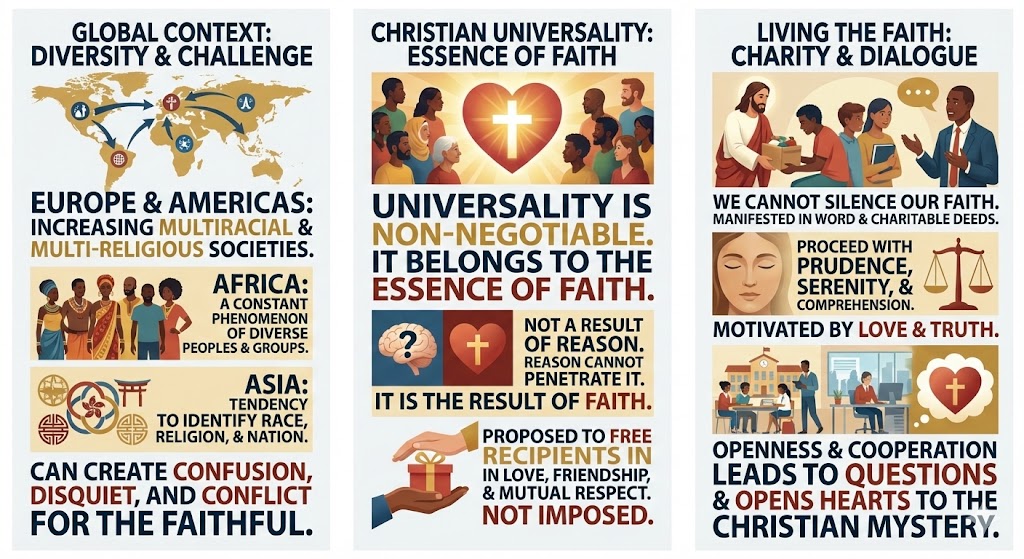
In the countries of Europe, as on the American continent, generally, the presence and existence of a multiracial, multinational, and multi-religious society is increasing. On the African continent, this multiplicity of peoples, races, ethnic and religious groups is not a new, but a constant phenomenon, at least in the 20th century. On the Asian continent, the general picture is varied, but there is a marked tendency to identify race and religion, religion and nation, religion and culture.
This phenomenon can be lived with great intensity, and can create confusion, disquiet and even conflict for the faithful. It is precisely in this context, on the feast of the Epiphany, that the catechesis on Christian universality is placed. It is important that the catechesis be clear on certain essential points and infuse in the faithful, on one hand, clarity of ideas and, on the other, attitudes of serenity, comprehension, prudence, dialogue and especially charity, the heart of Christian faith.
Christian universality is not negotiable nor can it be discarded, as it belongs to the essence of our faith. Nevertheless, the proposal of this universality can be gradual, keeping in mind the capacity of the recipients. This universality is not a result of reason. Consequently reason does not have the ability to penetrate it. As it is the result of faith, it cannot be imposed by force or by pressures of any kind, it is proposed to a recipient who is free, in a climate of love and friendship or, at least, of mutual and mature respect.
As Christians we cannot silence our faith, manifested in word and in charitable deeds, regardless of the place and circumstances in which our life unfolds. Prudence will dictate how we proceed. Serenity and comprehension will allow us to act without superfluous words or gestures, in sincerity and amiability. Our motivation will be love for the people, and a profound desire for truth.
In practice, a positive attitude of openness and cooperation in social, education, administrative, and cultural matters can be helpful. This collaboration, when the Christian is consequent in his faith, makes people ask questions and brings them closer by opening their minds and hearts to the Christian mystery.
© 2004-05 Dicastery for the Clergy
Infographic was designed using Nano Banana Pro with Gemini 3.0. It draws inspiration from the commentary from the 2004-05 Dicastery for the Clergy Notes (YEAR A | B | C cf. text above), but is not officially associated with or endorsed by the Holy See. It may be copied for personal use or for use in any non-profit ministry.
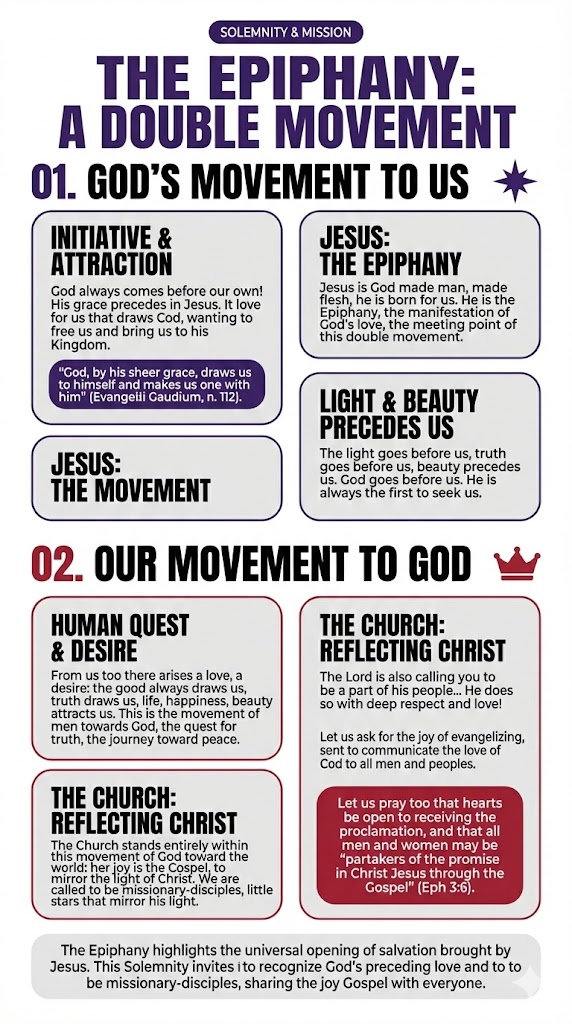
Today we are celebrating the Epiphany, that is, the “manifestation” of the Lord. This Solemnity is tied to the biblical narrative of the coming of the Magi from the East to Bethlehem in order to pay homage to the King of the Jews: an episode on which Pope Benedict gave a magnificent commentary in his book on the infancy of Jesus. This precise moment was the first “manifestation” of Christ to the nations. Thus, the Epiphany brings to the fore the universal opening of the salvation brought by Jesus. The Liturgy today acclaims: “Lord, every nation on earth will adore you”, because Jesus came for us all, for every nation, for everyone!
Thus, this Feast lets us see a double movement: in one direction, the movement of God towards the world, towards humanity — the whole of the history of salvation, which culminates in Jesus — and in the other, the movement of men towards God — let us think of religions, of the quest for truth, the journey of the nations toward peace, interior peace, justice, freedom. And this double movement is driven by a mutual attraction. What is it that draws God? It is love for us: we are his children, he loves us and wants to free us from evil, from sickness, from death, and to bring us to his home, to his Kingdom. “God, by his sheer grace, draws us to himself and makes us one with him” (Apostolic Exhortation Evangelii Gaudium, n. 112). And from us too there arises a love, a desire: the good always draws us, truth draws us, life, happiness, beauty attracts us… Jesus is the meeting point of this mutual attraction, of this double movement. He is God and man: Jesus. God and man. But who took the initiative? God, always! God’s love always comes before our own! He always takes the initiative. He waits for us, he invites us, the initiative is always his. Jesus is God made man, made flesh, he is born for us. The new star that appears to the Magi was a sign of the birth of Christ. Had they not seen the star, these men would not have set out. The light goes before us, truth goes before us, beauty precedes us. God goes before us. The Prophet Isaiah said that God is like the flower of the almond tree. Why? Because in that region the almond is the first to flower. And God goes ever before, he is always the first to seek us, he takes the first step. God goes ever before us. His grace precedes us and this grace appeared in Jesus. He is the Epiphany. He, Jesus Christ, is the manifestation of God’s love. He is with us.
The Church stands entirely within this movement of God toward the world: her joy is the Gospel, to mirror the light of Christ. The Church is the people who have experienced this attraction and bear it within, in their hearts and in their lives. “I would like to say — sincerely — I would like to say to those who feel far from God and from the Church — I would like to say respectively — to all those who are fearful or indifferent: the Lord is also calling you to be a part of his people and he does so with deep respect and love!” (cf. ibid., n. 113). The Lord is calling you. The Lord is seeking you. The Lord is waiting for you. The Lord does not proselytize, he loves, and this love seeks you, waits for you, you who at this moment do not believe or are far away. And this is the love of God.
Let us ask God, on behalf of the whole Church, let us ask for the joy of evangelizing, for we were “sent by Christ to reveal and communicate the love of God to all men and to all peoples” (Ad Gentes, n. 10). May the Virgin Mary help us all to be missionary-disciples, little stars that mirror his light. Let us pray too that hearts be open to receiving the proclamation, and that all men and women may be “partakers of the promise in Christ Jesus through the Gospel” (Eph 3:6).

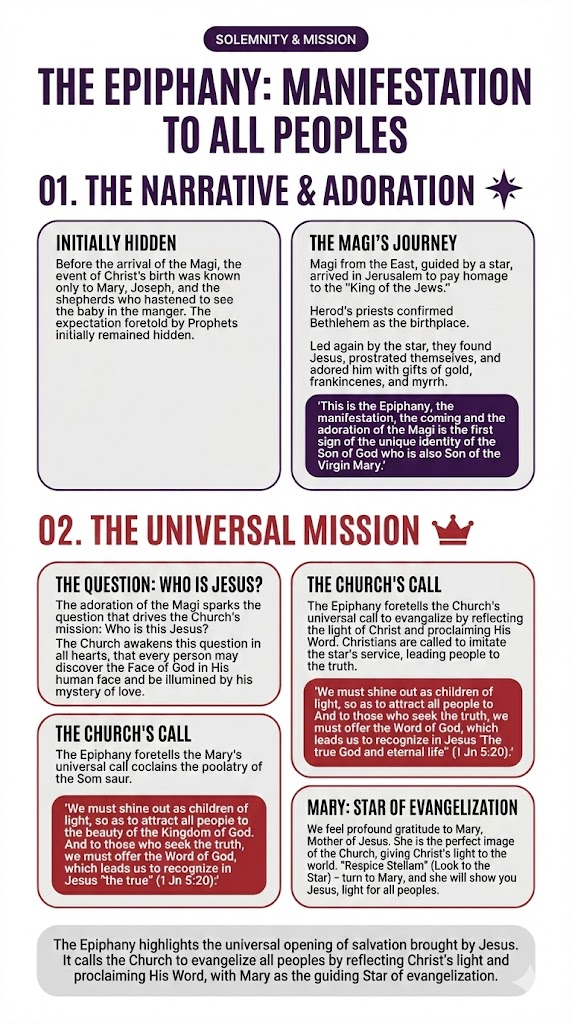
Epiphany means the manifestation of Jesus to all peoples, today represented by the Magi, who arrived in Bethlehem from the East to pay homage to the King of the Jews, whose birth they had learned about by the appearance of a new star in the sky (cf. Mt 2:1-12). In fact, before the arrival of the Magi, this event was little known beyond the family circle, other than to Mary and Joseph, and probably to other relatives, it was known by the shepherds of Bethlehem. Having heard the joyful announcement, they had hastened to see the baby while he was still lying in the manger. The coming of the Messiah, the expectation of the people foretold by the Prophets, remained thus initially remained hidden.
Until, that is, those mysterious figures — the Magi — arrived in Jerusalem to ask for news of the “King of the Jews,” who had just been born. Obviously, as it had to do with a king, they went to the royal palace where Herod resided. But he did not know anything about this birth and, very worried, immediately summoned the priests and scribes who, based on Micah’s famous prophecy (cf. 5:1), affirmed that the Messiah was to be born in Bethlehem. And in fact, setting out in that direction, the Magi saw the star again, which led them to the place where Jesus was. Having entered, they prostrated themselves and adored him, offering him symbolic gifts: gold, frankincense and myrrh.
This is the Epiphany, the manifestation: the coming and the adoration of the Magi is the first sign of the unique identity of the Son of God who is also Son of the Virgin Mary. From that moment the question began to be asked that would accompany the whole life of Christ, and that in different ways passes through the centuries: who is this Jesus?
Dear friends, this is the question that the Church wishes to awaken in the hearts of all: who is Jesus? This is the spiritual concern that drives the mission of the Church: to make known Jesus, his Gospel, so that every man may discover in his human face the Face of God, and be illumined by his mystery of love.
The Epiphany foretells the universal openness of the Church, her call to evangelize all peoples. But the Epiphany also tells us how the Church realizes this mission: by reflecting the light of Christ and proclaiming his Word. Christians are called to imitate the service that the star rendered to the Magi. We must shine out as children of light, so as to attract all people to the beauty of the Kingdom of God. And to those who seek the truth, we must offer the Word of God, which leads us to recognize in Jesus “the true God and eternal life” (1 Jn 5:20).
Once again, we feel within us profound gratitude to Mary, the Mother of Jesus. She is the perfect image of the Church which gives the light of Christ to the world: she is the Star of evangelization. “Respice Stellam,” St Bernard says to us: look to the Star, you who go in search of truth and peace; turn your gaze to Mary, and she will show you Jesus, light for every person and for all peoples.

Feast of the Epiphany (A)
28 November 2010 | St Peter’s Square
