Papal Homilies
January 11, 2026
January 11, 2026
Baptism of the Lord (A)



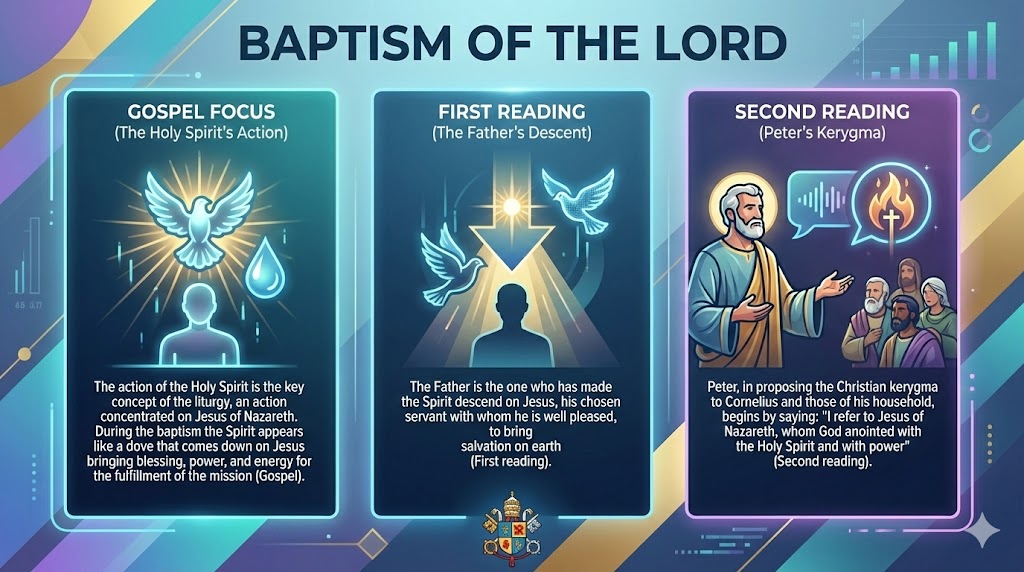
The action of the Holy Spirit is the key concept of the liturgy, an action concentrated on Jesus of Nazareth. During the baptism the Spirit appears like a dove that comes down on Jesus bringing blessing, power, and energy for the fulfillment of the mission (Gospel). The Father is the one who has made the Spirit descend on Jesus, his chosen servant with whom he is well pleased, to bring salvation on earth (First reading). Peter, in proposing the Christian kerygma to Cornelius and those of his household, begins by saying: “I refer to Jesus of Nazareth, whom God anointed with the Holy Spirit and with power” (Second reading).
Doctrinal Message
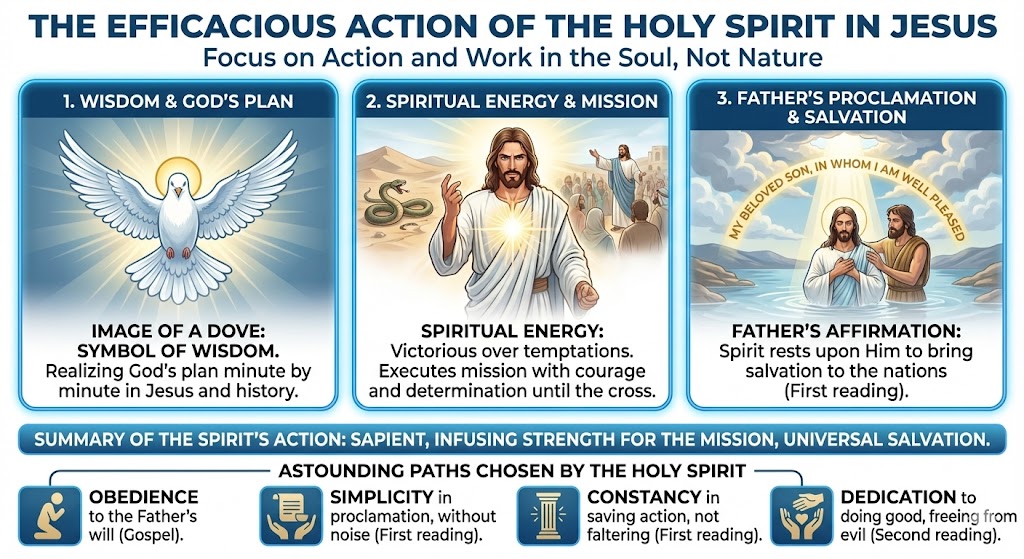
In the texts that the Church proposes for our reflection and faith, we are not told about the nature of the Spirit, but only about his efficacious action in the soul and work of Jesus of Nazareth.
The action of the Holy Spirit in Jesus after baptism produces marvelous effects. The first is signaled by the image of a dove, the symbol of wisdom, a wisdom that must realize minute by minute the plan of God in the person of Jesus and in history. The second is shown to us by the context: the spiritual energy that will be victorious over temptations and will execute the mission entrusted by the Father with courage and determination during the years of his public life until his passion and death on the cross. The third refers to the Father who, precisely because Jesus humbled himself becoming a servant and being baptized by John, proclaims him “my beloved Son, in whom I am well pleased,” in whom the Father’s Spirit rests so that he will bring salvation to the nations (First reading). In a word, the action of the Spirit is sapient, infusing strength for the mission, universal salvation.
The paths chosen by the Holy Spirit are astounding to our mind, which is altogether too human: obedience to what the Father wills that Jesus be baptized (Gospel); the proclamation of salvation with simplicity, without noise or fanfare (First reading); constancy in the labor of proclaiming and carrying out the saving action, “he will not weaken or falter (First reading); the dedication of his life to doing good, all kinds of good, but especially spiritual good, to free man from the power of the devil (Second reading).
© 2004-05 Dicastery for the Clergy
Pastoral Suggestions
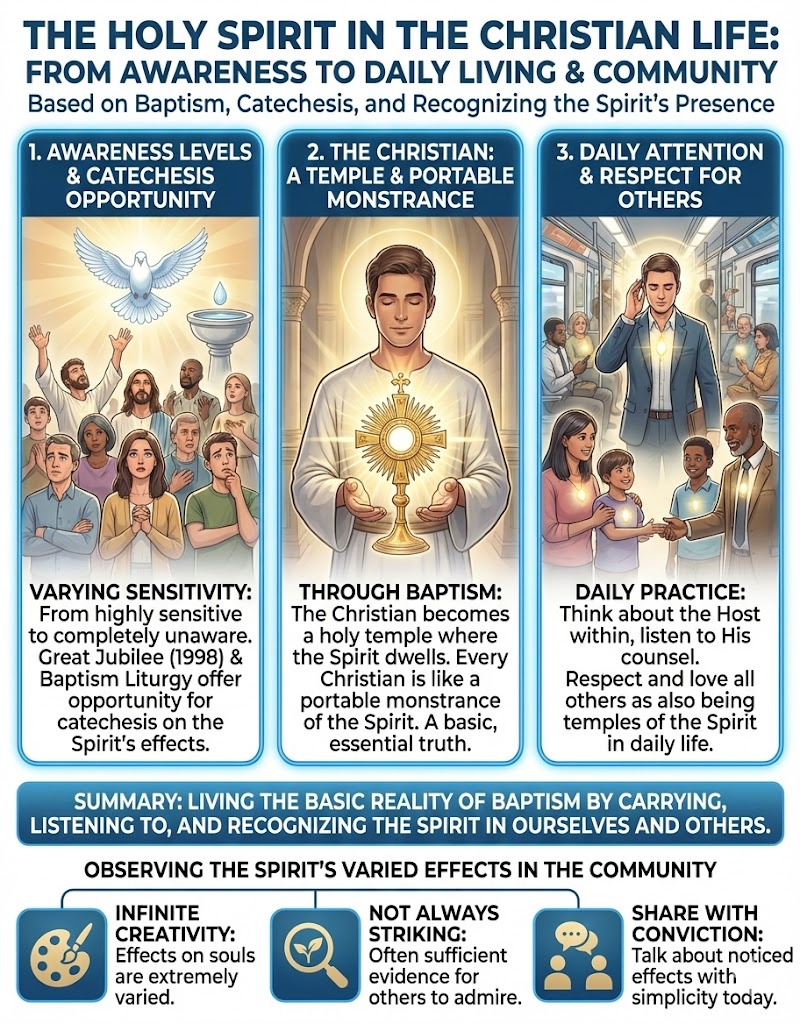
It is possible that in our communities there are faithful who are very sensitive to the presence and the action of the Holy Spirit, and even some who belong to charismatic groups recognized by the ecclesiastical authority. There can be, as well, faithful who have heard about this topic, without allowing it to make an impression on their faith and daily behavior. There might be others for whom the Holy Spirit is not even a person, but only a name or a symbol of the power of God. Lastly, there will be those who are completely unaware of the Holy Spirit in their daily life.
In preparation for the Great Jubilee, 1998 was dedicated to the Holy Spirit. This made it possible to awaken a greater interest in the teaching of the Church on the Spirit and a more personal and vital relation with his person. The liturgy of the Baptism of the Lord offers the opportunity to continue a catechesis on the relation between Baptism and the Spirit, especially on the effects of the Holy Spirit, received at Baptism, on the spiritual and moral life of Christians.
Through Baptism the Christian becomes a holy temple, a place in which the Spirit dwells and makes his presence felt among men. This means that, because of baptism, every Christian is like a portable monstrance of the Spirit. Are the faithful of your community or parish aware of this truth of our faith? It is not something dense or difficult to understand. It is simply the ABC of the Christian faith, but sometimes people forget the essential, lost as they are in the minutiae of daily living or suffering indigestion from excessive moralizing.
If, through grace, a Christian carries a Host within his soul, the least he can do is think about that Host every day, pay attention to him, listen to him and carry out his good counsels and gentle interior inspirations. We will have to think also that many others (dear ones, fellow workers, members of the party, neighbors, people on the train and bus) are also temples of the Spirit, whom we must respect and love with sincerity. This is not mysticism; it is simply living the most basic reality of our baptism.
It is quite likely that we might have seen the marvelous effects of the Holy Spirit on people in our parish or in members of communities among whom we do our pastoral work. No doubt there are no striking results, at least in the majority of cases, but sufficient evidence that other believers can see and admire. The creativity of the Spirit is infinite and, as a result, its effect on souls is extremely varied. What effects have you noticed with greater frequency among the faithful of your parish or community? Today is a good day to talk about them with simplicity and conviction.
© 2004-05 Dicastery for the Clergy
Infographic was designed using Nano Banana Pro with Gemini 3.0. It draws inspiration from the commentary from the 2004-05 Dicastery for the Clergy Notes (YEAR A | B | C cf. text above), but is not officially associated with or endorsed by the Holy See. It may be copied for personal use or for use in any non-profit ministry.
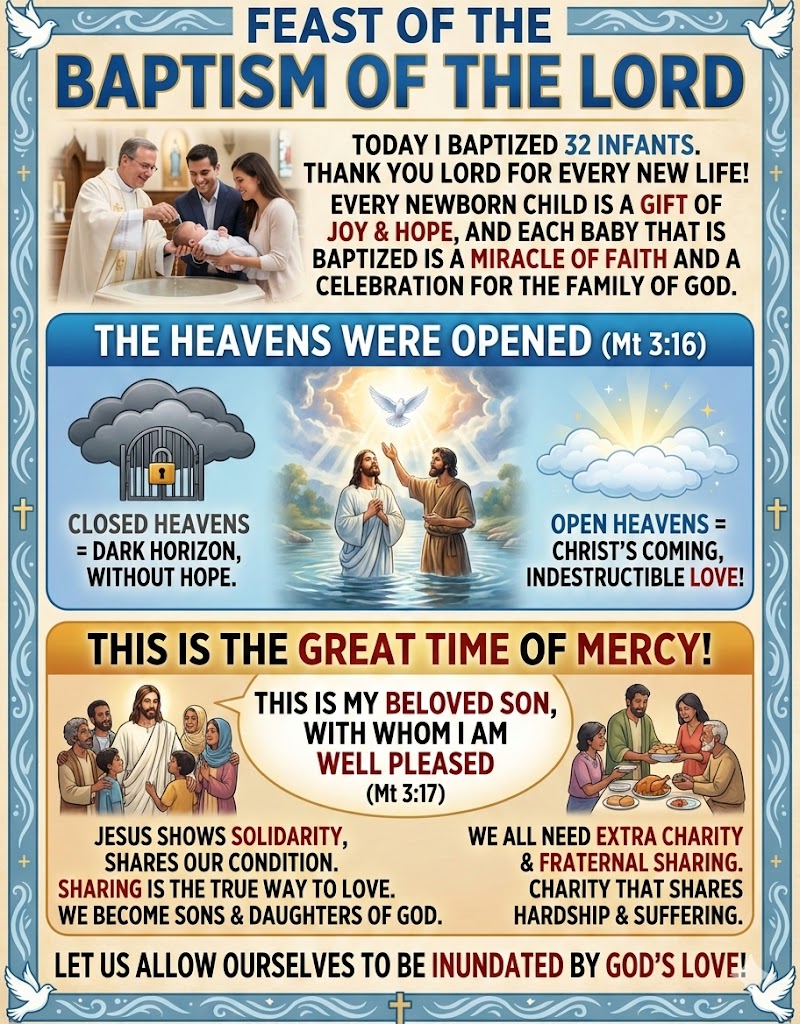
Today is the Feast of the Baptism of the Lord. This morning I baptized 32 infants. With you I thank the Lord for these creatures and for every new life. I am glad to baptize babies. I like it very much! Every newborn child is a gift of joy and hope, and each baby that is baptized is a miracle of faith and a celebration for the family of God.
Today’s page from the Gospel emphasizes that, when Jesus had received baptism from John in the River Jordan, “the heavens were opened” to him (Mt 3:16). This fulfills the prophecies. In fact, there is an invocation which the liturgy has us repeat during the Season of Advent: “O that thou wouldst rend the heavens and come down” (Is 64:1). If the heavens remain closed, our horizon in this earthly life is dark and without hope. Instead, in celebrating Christmas, once again faith has given us the certainty that the heavens have been rent with the coming of Christ. And on the day of the baptism of Christ we continue to contemplate the heavens opened. The manifestation of the Son of God on earth marks the beginning of the great time of mercy, after sin had closed the heavens, raising itself as a barrier between the human being and his Creator. With the birth of Jesus the heavens open! God gives us in Christ the guarantee of an indestructible love. From the moment the Word became flesh it is therefore possible to see the open heavens. It was possible for the shepherds of Bethlehem, for the Magi of the East, for the Baptist, for Jesus’ Apostles, and for St Stephen, the first martyr, who exclaimed: “Behold, I see the heavens opened!” (Acts 7:56). And it is possible for each one of us, if we allow ourselves to be suffused with God’s love, which is given to us for the first time in Baptism by means of the Holy Spirit. Let us allow ourselves to be invaded by God’s love! This is the great time of mercy! Do not forget it: this is the great time of Mercy!
When Jesus received the baptism of repentance from John the Baptism, showing solidarity with the repentant people — He without sin and with no need for conversion — God the Father made his voice heard from heaven: “This is my beloved Son, with whom I am well pleased” (v. 17). Jesus receives approval from the heavenly Father, who sent him precisely that he might accept to share our condition, our poverty. Sharing is the true way to love. Jesus does not dissociate himself from us, he considers us brothers and sisters and he shares with us. And so he makes us sons and daughters, together with him, of God the Father. This is the revelation and source of true love. And this is the great time of mercy!
Does it not seem to you that in our own time extra fraternal sharing and love is needed? Does it not seem to you that we all need extra charity? Not the sort that is content with extemporaneous help which does not involve or stake anything, but that charity that shares, that takes on the hardship and suffering of a brother. What flavour life acquires when we allow ourselves to be inundated by God’s love!

Today the Church is celebrating the Baptism of the Lord, the Feast which concludes the liturgical Season of Christmas. This mystery of the life of Christ visibly demonstrates that his coming in the flesh is a sublime act of love by the Three Divine Persons. We can say that from this solemn event the creative, redemptive and sanctifying action of the Most Holy Trinity will be increasingly evident in the public ministry of Jesus, in his teaching, his miracles, and in his Passion, death and Resurrection. We read, in fact, in the Gospel according to St Matthew that “when Jesus was baptized, he went up immediately from the water, and behold the heavens were opened [for him] and he saw the Spirit of God descending like a dove, and alighting on him; and lo, a voice from heaven, saying, ‘This is my beloved Son, with whom I am well pleased’ ” (Mt 3: 16-17).
The Holy Spirit “dwells” in the Son and testifies to his divinity, while the voice of the Father, coming from the heavens, expresses the communion of love. “The conclusion of the baptismal scene tells us that Jesus has received this true ‘anointing’, that he is the awaited Anointed One [the Christ]” (Jesus of Nazareth, New York 2007, pp. 25-26), which confirms Isaiah’s prophecy: “Behold my servant, whom I uphold, my chosen, in whom my soul delights” (Is 42:1). He is truly the Messiah, the Son of the Most High who, emerging from the waters of the Jordan, establishes the regeneration in the Spirit and opens, to those who desire it, the possibility of becoming sons of God.
Not by chance, in fact, does every baptized person acquire the character of son, based on the Christian name, an unmistakable sign that the Holy Spirit gives birth to man “anew” from the womb of the Church. Bl. Antonio Rosmini affirms that “the baptized undergoes a secret but very powerful operation, through which he is raised to the supernatural order, is placed in communication with God” (The Ruling Principle of Method Applied to Education, Turin 1857, n. 331). All this was fulfilled again at the celebration of the Eucharist this morning in the Sistine Chapel where I conferred the sacrament of Baptism on 21 newborn babies.
Dear friends, Baptism is the beginning of the spiritual life which finds its fullness in the Church. At the favourable moment of the sacrament, while the ecclesial community is praying and entrusting to God a new son or daughter, parents and godparents commit themselves to welcoming the newly baptized, sustaining them in Christian formation and education. This is a great responsibility which comes from a great gift! Therefore, I desire to encourage all the faithful to rediscover the beauty of being baptized and of belonging to the large family of God, and to give a joyful witness of their faith so that this faith may produce fruits of good and harmony.
Baptism of the Lord (A)
28 November 2010 | St Peter’s Square