Papal Homilies
December 28, 2025
December 28, 2025
Holy Family (A)



Infographic was created using Nano Banana Pro with Gemini 3.0. It draws inspiration from the commentary from the 2004-05 Dicastery for the Clergy Notes (YEAR A | B | C cf. text above), but is not officially associated with or endorsed by the Holy See. It may be copied for personal use or for use in any non-profit ministry.
Doctrinal Messages

Infographic was created using Nano Banana Pro with Gemini 3.0. It draws inspiration from the commentary from the 2004-05 Dicastery for the Clergy Notes (YEAR A | B | C cf. text above), but is not officially associated with or endorsed by the Holy See. It may be copied for personal use or for use in any non-profit ministry.
Pastoral Suggestions

Infographic was designed using Nano Banana Pro with Gemini 3.0. It draws inspiration from the commentary from the 2004-05 Dicastery for the Clergy Notes (YEAR A | B | C cf. text above), but is not officially associated with or endorsed by the Holy See. It may be copied for personal use or for use in any non-profit ministry.
Feast of the Holy Family (A)
29 December 2013 – Saint Peter’s Square
ANGELUS HOMILY
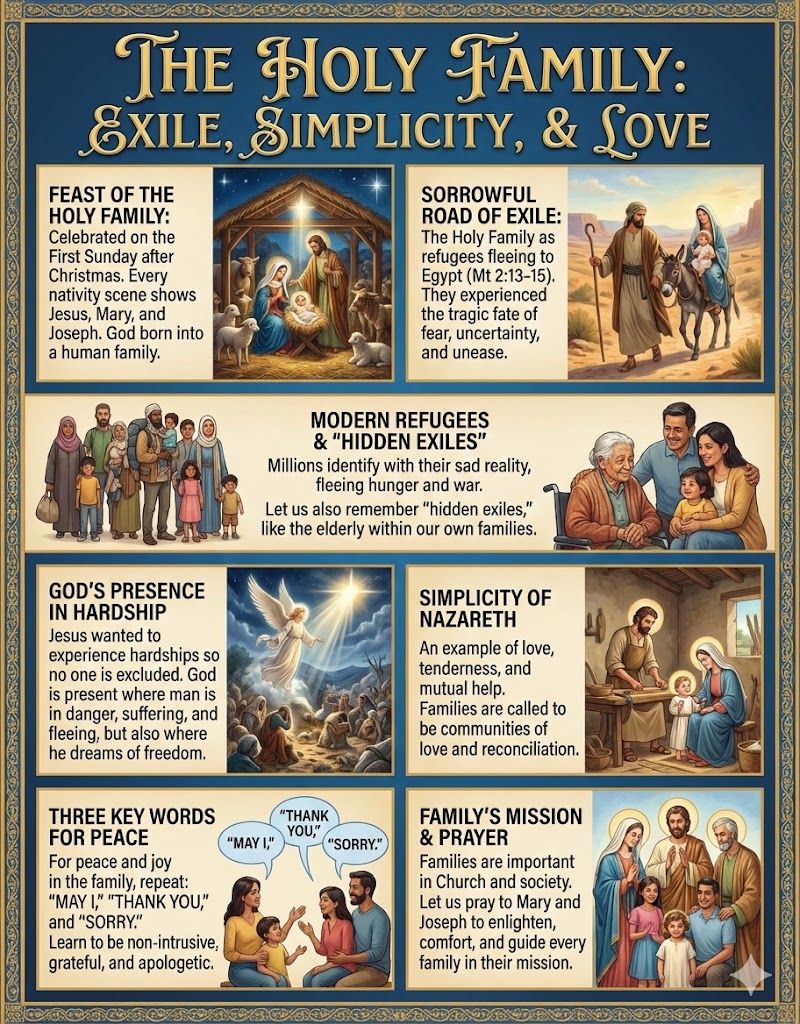
The Holy Family: Exile, Simplicity, and Love
On this first Sunday after Christmas, the Liturgy invites us to celebrate the Feast of the Holy Family of Nazareth. Indeed, every nativity scene shows us Jesus together with Our Lady and St Joseph in the grotto of Bethlehem. God wanted to be born into a human family, he wanted to have a mother and father like us.
And today the Gospel presents the Holy Family to us on the sorrowful road of exile, seeking refuge in Egypt. Joseph, Mary and Jesus experienced the tragic fate of refugees, which is marked by fear, uncertainty and unease (cf. Mt 2:13-15; 19-23). Unfortunately, in our own time, millions of families can identify with this sad reality. Almost every day the television and papers carry news of refugees fleeing from hunger, war and other grave dangers, in search of security and a dignified life for themselves and for their families.
In distant lands, even when they find work, refugees and immigrants do not always find a true welcome, respect and appreciation for the values they bring. Their legitimate expectations collide with complex and difficult situations which at times seem insurmountable. Therefore, as we fix our gaze on the Holy Family of Nazareth as they were forced to become refugees, let us think of the tragedy of those migrants and refugees who are victims of rejection and exploitation, who are victims of human trafficking and of slave labour. But let us also think of the other “exiles”: I would call them “hidden exiles”, those exiles who can be found within their own families: the elderly for example who are sometimes treated as a burdensome presence. I often think that a good indicator for knowing how a family is doing is seeing how their children and elderly are treated.
Jesus wanted to belong to a family who experienced these hardships, so that no one would feel excluded from the loving closeness of God. The flight into Egypt caused by Herod’s threat shows us that God is present where man is in danger, where man is suffering, where he is fleeing, where he experiences rejection and abandonment; but God is also present where man dreams, where he hopes to return in freedom to his homeland and plans and chooses life for his family and dignity for himself and his loved ones.
Today our gaze on the Holy Family lets us also be drawn into the simplicity of the life they led in Nazareth. It is an example that does our families great good, helping them increasingly to become communities of love and reconciliation, in which tenderness, mutual help, and mutual forgiveness is experienced. Let us remember the three key words for living in peace and joy in the family: “may I”, “thank you” and “sorry”. In our family, when we are not intrusive and ask “may I”, in our family when we are not selfish and learn to say “thank you”, and when in a family one realizes he has done something wrong and knows how to say “sorry”, in that family there is peace and joy. Let us remember these three words. Can we repeat them all together: may I, thank you, sorry. (Everyone: may I, thank you, sorry!) I would also like to encourage families to become aware of the importance they have in the Church and in society. The proclamation of the Gospel, in fact, first passes through the family to reach the various spheres of daily life.

Feast of the Holy Family (A)
26 December 2010 | St Peter’s Square
ANGELUS HOMILY
Holy Family: A Model of Light and Love
The Gospel according to Luke recounts that when the shepherds of Bethlehem had received the Angel’s announcement of the Messiah’s birth “they went with haste, and found Mary and Joseph, and the babe lying in a manger” (2:16). The first eyewitnesses of Jesus’ birth therefore beheld a family scene: a mother, a father and a newborn son. For this reason the Liturgy has us celebrate the Feast of the Holy Family on the First Sunday after Christmas. This year it occurred the very day after Christmas, and, taking precedence over the Feast of St Stephen, invites us to contemplate this “icon” in which the little Jesus appears at the centre of his parents’ affection and care.
In the poor grotto of Bethlehem — the Fathers of the Church wrote — shines a very bright light, a reflection of the profound mystery which envelopes that Child, which Mary and Joseph cherish in their hearts and which can be seen in their expression, in their actions, and especially in their silence. Indeed, they preserve in their inmost depths the words of the Angel’s Annunciation to Mary: “the Child to be born will be called holy, the Son of God” (Lk 1:35).
Yet every child’s birth brings something of this mystery with it! Parents who receive a child as a gift know this well and often speak of it in this way. We have all heard people say to a father and a mother: “this child is a gift, a miracle!”. Indeed, human beings do not experience procreation merely as a reproductive act but perceive its richness and intuit that every human creature who is born on earth is the “sign” par excellence of the Creator and Father who is in Heaven.
How important it is, therefore, that every child coming into the world be welcomed by the warmth of a family! External comforts do not matter: Jesus was born in a stable and had a manger as his first cradle, but the love of Mary and of Joseph made him feel the tenderness and beauty of being loved. Children need this: the love of their father and mother. It is this that gives them security and, as they grow, enables them to discover the meaning of life. The Holy Family of Nazareth went through many trials, such as the “massacre of the innocents” — as recounted in the Gospel according to Matthew — which obliged Joseph and Mary to flee to Egypt (cf. 2:13-23). Yet, trusting in divine Providence, they found their stability and guaranteed Jesus a serene childhood and a sound upbringing.
Feast of the Holy Family (A)
28 November 2010 | St Peter’s Square
