Homilies
Homilies
June 7, 2026
⭐⭐⭐ Are You A Mouse or A Man?



Deacon Peter McCulloch
Body and Blood of Christ (A)
✍️ Highway to Heaven
This homily addresses the perennial relevance of holiness by highlighting the life of Saint Carlo Acutis, a modern tech-savvy teenager who died of leukemia in 2006. Described as an ordinary boy who loved video games, Carlo centered his life entirely on the Eucharist, famously calling it his “Highway to Heaven” and cataloging global Eucharistic miracles online. The text connects Carlo’s unwavering Eucharistic faith to the Gospel declaration that Jesus is the Living Bread. To bridge the gap between human doubt and divine mystery, the preacher cites modern scientific analyses of Eucharistic miracles, which consistently reveal living human heart tissue.

RECOMMENDED: Catholic HomilyWriter AI | Sample Homily (June 14)
Prepare faithful Catholic homilies without losing your pastoral voice. HomilyWriterAI researches Scripture, Church Fathers, Catholic commentaries, and magisterial sources, then helps you shape an outline and draft you can preach with confidence.
Bishop Robert Barron
Body and Blood of Christ (A)
▶️ From the Exodus to the Eucharist

JUNE 6, 2026—Friends, we’ve come to the great Solemnity of Corpus Christi—a celebration of the Body and Blood of Christ in the Eucharist. Our first reading mentions the “manna” that fed the Israelites in the desert—a mysterious bread from heaven described in the book of Exodus. This is then correlated to the Eucharist, the bread from heaven that Jesus gives us, in our Gospel from the sixth chapter of John. I want to explore four dimensions of this relationship between manna and the Eucharist.
Fr. Michael Chua
Body and Blood of Christ (A)
✍️ If We Really Understood…

This homily addresses the Catholic dogma of the Real Presence of Christ in the Eucharist, acknowledging it as a seemingly outrageous claim but one held by millions throughout history. Relying on the Council of Trent, the text emphasizes that the bread and wine literally become Christ’s Body, Blood, Soul, and Divinity. Using Aristotelian philosophy and St. Thomas Aquinas’s theology of Transubstantiation, it explains how the “substance” changes while the “accidents” (appearances) remain. Ultimately, this miraculous concealment is presented as the ultimate expression of God’s humble, immense love, designed to achieve total union with humanity.

Dominican Blackfriars
Body and Blood of Christ (A)
✍️ Really and Truly
This homily for Corpus Christi explores the “developmental leaps” the first Christians made to comprehend Christ’s transformed presence after the Resurrection and Ascension. Rather than a departure, the Ascension initiated a more intimate, boundless presence—most profoundly realized in the Eucharist. St. Paul and the early Church recognized that the same historical, risen Jesus is truly present under the sacramental signs of bread and wine. Consecrated through the priest acting in persona Christi, ordinary elements undergo a re-creative shift where “something becomes someone.” Ultimately, Christ gives Himself as food, pledging eternal life and future glory.

Fr. Austin Fleming
Body and Blood of Christ (A)
✍️ Broken and Spilled
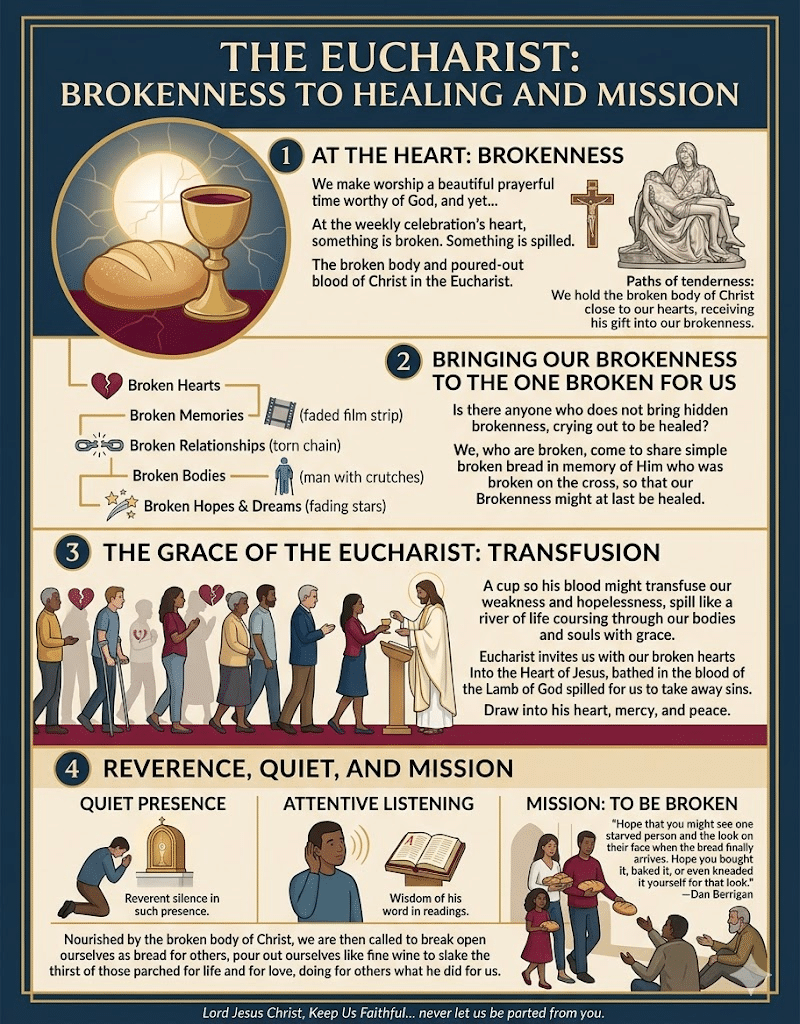
This homily contrasts our desire for beautiful, reverent Sunday worship with the raw reality at the center of the Mass: a broken body and spilled blood. Evoking Michelangelo’s Pieta, the preacher illustrates how the Church tenderly holds Christ’s brokenness in the Eucharist. This divine Brokenness directly meets our human brokenness—our sins, failed relationships, and shattered dreams. Christ’s blood transfuses our weakness with grace, demanding a deep reverence in how we approach the altar. Ultimately, being nourished by this broken bread charges us to break open our own lives as bread and wine for a starving world.
Monsignor Peter Hahn
Body and Blood of Christ (A)
▶️ Eucharist: Sacrament of Infinite Love
This homily for the Solemnity of the Body and Blood of Christ focuses on the Eucharist as the ultimate answer to humanity’s longing for love and fulfillment, found through the paradox of self-giving. Drawing from John 6, the preacher emphasizes Christ’s promise of eternal life and physical union. Contrasting the wandering Israelites in Deuteronomy who grumbled in the desert with modern believers facing trials, the text frames the Eucharist as our heavenly Manna. Grounded in Vatican II, the liturgy is presented not as human work, but as Christ’s perfect, saving action, requiring distinct priestly pronunciation and profound assembly wonder.
Fr. Charles E. Irvin
Body and Blood of Christ (A)
✍️ The Mass: Why Are We Here?

This homily for Corpus Christi examines the diverse motivations and burdens that believers bring to Sunday Mass, highlighting how the liturgy unites people across political, generational, and social divides into the single Body of Christ. Rather than promoting passive adoration, the text argues that the Real Presence of Jesus in the Eucharist is given to actively equip the Church. Believers receive the self-emptying Christ to become His real presence in a fractured world. Ultimately, Holy Communion infuses humanity with the life of the Son, allowing the Father to love His creation dynamically through us.
Fr. Joe Jagodensky, SDS
Body and Blood of Christ (A)
✍️ Communion: Reward or Grace?

This homily addresses the lifelong question of how God participates in our lives, specifically exploring whether the Eucharist is a reward for good behavior or a source of unmerited grace. Utilizing the metaphor of a skillful Potter shaping passive clay, the text argues that sinners and those struggling need the sacrament most. Rather than weaponizing Communion as a behavioral prize, the preacher frames it as an efficacious gift that prompts better actions and deeper divine connection. Ultimately, receiving the Body of Christ is presented as an act of humility where the created yield to the transforming power of the Creator.

Fr. Langeh, CMF
Body and Blood of Christ (A)
▶️ God Feeds His People

This homily for the Solemnity of Corpus Christi traces the salvation history of divine nourishment, establishing that while the food offered by Satan ruins humanity, the food provided by God brings true strength. Tracing biblical precedents, the preacher links the Eucharist to the Jewish Passover, the desert Manna, David’s consumption of the holy showbread, and Elijah’s miraculous sustenance. In the New Testament, Jesus transforms physical feedings into a profound Eucharistic theology. Through Transubstantiation, the bread and wine literally become Christ’s Body, Blood, Soul, and Divinity, transitioning the Eucharist from dynamic spiritual food into a sublime object of adoration.
Msgr. Charles Pope

Body and Blood of Christ (A)
✍️ Are You a Mouse or a Man?
This homily for the Solemnity of Corpus Christi structures a deep Eucharistic catechesis around three pillars: Reality, Requirement, and Remembrance. Confronting the high rate of Mass absenteeism, the text asserts the Real Presence of Christ, highlighting how Jesus switched to graphic language (trogon) in John 6 to reject mere symbolism. Furthermore, Holy Communion is framed as an absolute survival requirement—spiritual Manna essential to cross life’s desert. Finally, the homily utilizes a classic seminary analogy involving a mouse eating a host to challenge believers to approach the altar with dynamic, human mindfulness rather than mechanistic routine.

Father Kevin Rettig
Body and Blood of Christ (A)
▶️ To Boldly Go
This reflection connects the iconic opening of Star Trek to a deeper, spiritual journey. While the Starship Enterprise sought to explore outer space, the author suggests that the true “final frontier” is the space within ourselves.
The cosmic mission of exploration is mirrored on Earth through a Corpus Christi procession. This public demonstration is not a random walk, but a bold journey where participants move into the community as the Body of Christ. However, this procession is merely a symbol of the broader, lifelong journey of human existence.
Life’s paths are rarely straight; they can be noisy, lonely, or cyclical. Yet, drawing on T.S. Eliot and Dag Hammarskjöld, the text emphasizes that the most profound progress happens when we look inward. The longest and most critical voyage is the journey deep into ourselves to seek God and discover our source. Ultimately, the lifelong mission of “Starship Humanity” is to explore our inner worlds, transform civilization, and boldly join the eternal procession of Christ.

Fr. George Smiga
Body and Blood of Christ (A)
✍️ You are What You Eat

This homily for Corpus Christi utilizes the popular cultural phrase “you are what you eat”—visualized by Morgan Spurlock’s documentary Super Size Me—to explain the transformative power of the Eucharist. Relying on a third-century insight from Saint Augustine, the preacher notes that unlike ordinary food which is absorbed by the consumer, the Eucharist absorbs us, changing us into what we receive. By consuming the Body, Blood, Soul, and Divinity of the Risen Lord, the faithful actively take on the interior life of Jesus. Consequently, regular reception infuses believers with Christ’s own courage to face suffering and His limitless confidence to secure hope for tomorrow.
Additional Homilies
Body and Blood of Christ (A)
Fr. Vincent Hawkswell | Archive
‘Eat my flesh, drink my blood’: shocking, but true
Fr. George Corrigan, OFM
Holding Back
Msgr. Joseph Pellegrino | Archive
Reverence for the Eucharist
Fr. Tommy Lane | Archive
Meet Jesus in His Real Presence in the Eucharist
Fr. Michael Fallon, MSC | Archive
The Most Holy Body and Blood of Christ (PDF)
RECOMMENDED: Catholic HomilyWriter AI | Sample Homily (June 14)
Prepare faithful Catholic homilies without losing your pastoral voice. HomilyWriterAI researches Scripture, Church Fathers, Catholic commentaries, and magisterial sources, then helps you shape an outline and draft you can preach with confidence.