Liturgy, Liturgy Notes, Liturgy Planner, Sunday Prep, Planning for Mass
Liturgy Notes, Liturgy Planner, Sunday Prep, Planning for Mass
August 2, 2026
Today’s Liturgy





THE WORD TODAY
Today’s Mass
Divine Office
Gospel Exegesis
Bishop Barron
Cardinal Dolan

PETITIONS
August 2, 2026
The Church
Governments and Salvation of the World
Those Burdened by Adversity
Local Parish / Faith Community
THE WORD
IN SONGS
Updated Weekly






18th Sunday of Year A
August 2, 2026




THE WORD THIS WEEK
Eyes look up to bless
Fragments broken and multiplied
All ate and were filled
August 2, 2026




Papal Homilies




Sunday Readings - Catechism Search Engine


Featured Blog Posts
August 2, 2026
📌 THEWORDTHISWEEK.NET - PINNED
The Homiletic Fraction: Taking, Blessing, Breaking, and Giving the AI Draft
Using the miracle of the feeding of the five thousand as a metaphor, this article explores how AI-generated homily drafts require human intervention to become living proclamations. Just as ordinary loaves underwent Christ’s fourfold action—take, bless, break, and give—a digital draft remains static data until a preacher infuses it with prayer, vulnerability, and pastoral love.

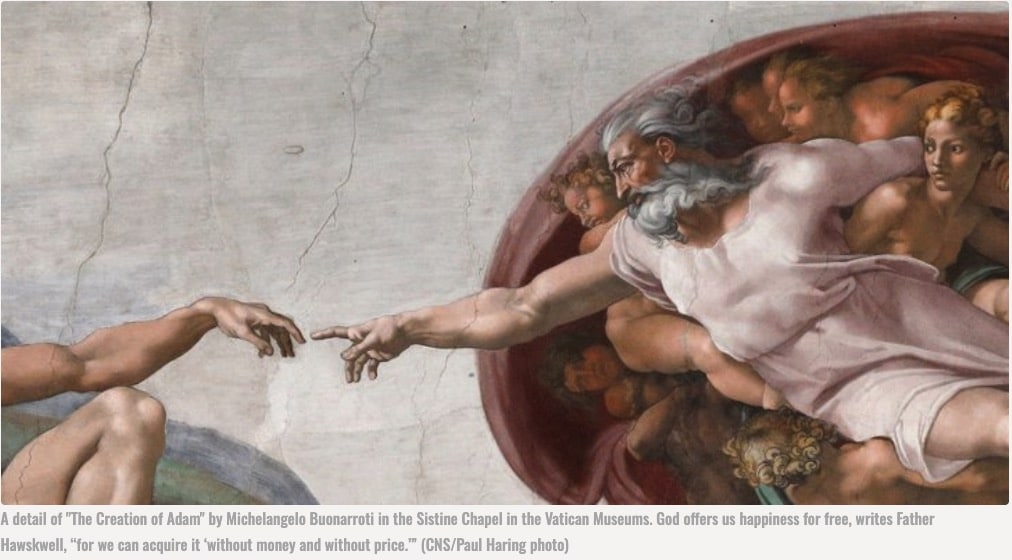
Fr. Vincent Hawkswell | Archive
Nothing Can Separate Us from God's Love (2020)

Fr. George Corrigan, OFM
Food for Life
Commentary (PDF)
Msgr. Joseph Pellegrino (PDF) | Archive
The Culture of Life (2020)
Fr. Tommy Lane | Archive
Give to Jesus and he gives to you
Let Jesus feast with you!
Related Homilies: Jesus expands our small vision to his limitless vision
Homilies on the Eucharist stories about the Eucharist
Fr. Michael Fallon, MSC | Archive
18th Sunday in Ordinary Time (PDF)
Bulletin Inserts
First Reading | Second Reading | Gospel
August 2, 2026

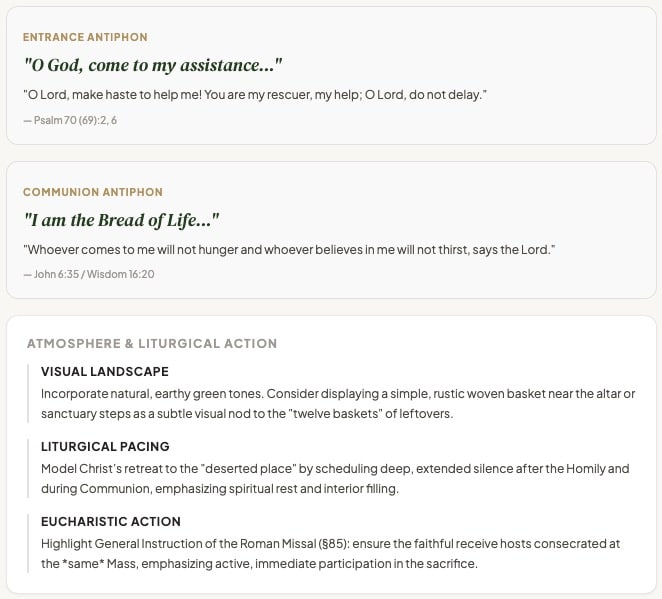
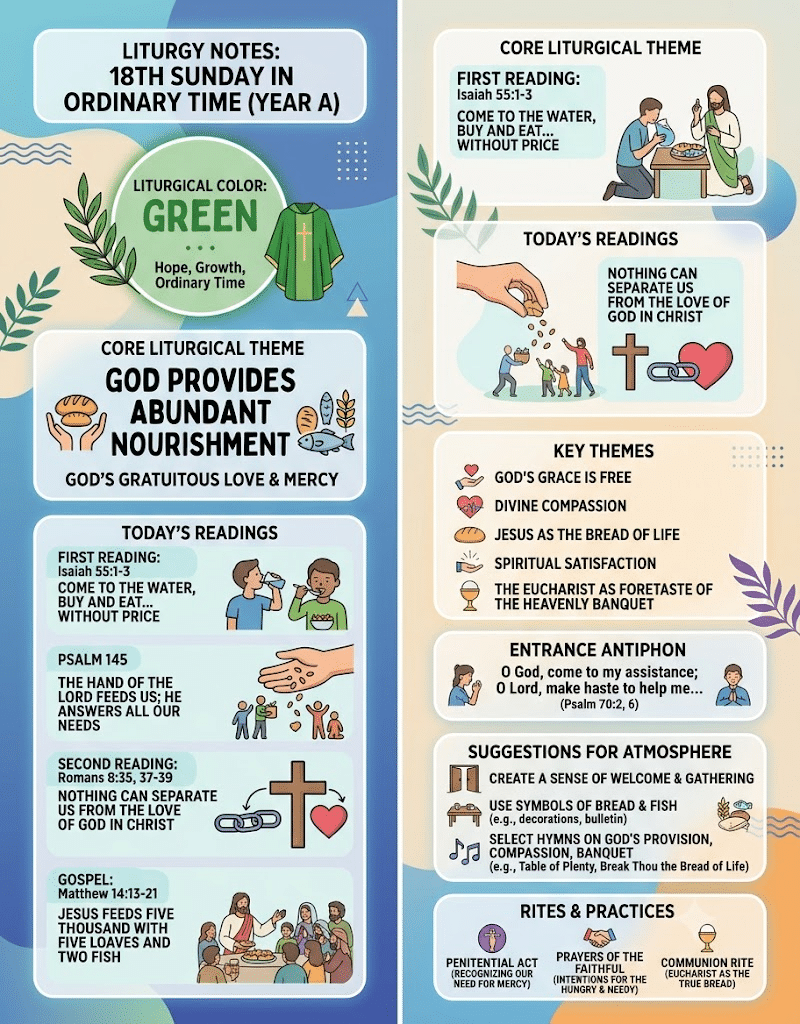
Liturgy Notes



OCP Music

Entrance
You Are Welcome Here (Chris Muglia)
Choose Christ Missal 2020 #255
In this episode of The Commons, popular Catholic artist Chris Muglia performs his song, "You Are Welcome Here." Chris then discusses how he was inspired to write the song after hearing a story about refugees and immigrants on the radio. The story made him think about how important hospitality is and how Christ can be our guide and example in creating welcoming communities. He recommends "You Are Welcome Here" as a song for Communion or for gathering.
Response & Acclaim
Response & Acclaim


2026 PLAYLIST (152 VIDEOS)

2026 PLAYLIST (152 VIDEOS)
Presentation & Preparation
Presentation and Preparation

Come to the Feast / Ven al Banquete (Bob Hurd, Pia Moriarty and Jaime Cortez)
Never Too Young #80;
Breaking Bread #308
THE COMMONS
Communion
Communion

Sending Forth
Sending Forth

Rain Down (Jaime Cortez)
Spirit & Song #228;
Never Too Young #25;
Breaking Bread #600
THE COMMONS
Liturgy Blog is a weekly liturgy planning resource for musicians, liturgists, homilists, youth groups, faith sharing groups, and all who look to the liturgical readings for inspiration and nourishment. Join Ken Canedo as he breaks open the Scripture and suggests tracks from the Spirit & Song contemporary repertoire.
Isaiah 55:1-3

Video courtesy of Lector with Lisa

Isaiah 55:1-3
The Watchword: "Urgent Hospitality"
- Core Concept: This is an active, passionate invitation, not just a cozy story. You are God's herald offering free, life-giving abundance to a spiritual wasteland.
- Vocal Profile: Warm, expansive, urgent, and deeply inviting. Avoid a flat "reading tone"—speak with the earnestness of someone offering water to travelers in a desert.
Delivery Blueprint
Text Segment | Vocal Tone | Pacing & Ambo Actions |
"Thus says the LORD:" | Solemn & Authoritative | Action: Establish firm eye contact before speaking. Pause for 2 seconds after this line to let the assembly settle into listening. |
"All you who are thirsty, / come to the water!" | Urgent & Expansive | Pacing: Lean forward slightly. Put vocal warmth on "thirsty". Treat the slash as a 1-second breath pause. |
"You who have no money, / come, receive grain and eat;" | Reassuring & Generous | Definition: "Grain" represents basic, vital sustenance. Action: Scan the left side of the congregation. |
"Come, without paying and without cost, / drink wine and milk!" | Joyful & Astonished | Tone: Emphasize the radical nature of "without cost". Definition: "Wine and milk" signify luxury, celebration, and rich comfort. |
"Why spend your money for what is not bread; / your wages for what fails to satisfy?" | Pleading & Incredulous | Pacing: Deliver as a genuine, searching question. Drop your pitch slightly to convey the tragedy of wasted effort. Pause 2 seconds at the question mark. |
"Heed me, and you shall eat well, / you shall delight in rich fare." | Confident & Warm | Definition: "Heed" means to listen with deep, obedient attention. Action: Look directly at the center pews. |
"Come to me heedfully, / listen, that you may have life." | Intimate & Earnest | Pacing: Slow down significantly. Plant the word "life" with absolute clarity and gravity. |
"I will renew with you the everlasting covenant, / the benefits assured to David." | Climactic & Regal | Tone: Shift to a resonant, foundational tone. Action: Hold eye contact through the final word. Pause 3 seconds before the closing formula. |
Ambo Reminders
Pace for the Acoustical Space: If you feel like you are speaking a bit too slowly, you are likely tracking at the perfect speed for a large church environment. Let the echoes die down between the lines.
Own the Silence: Do not begin the moment you reach the ambo. Adjust the microphone, plant your feet, look up, breathe, and count to three before uttering "Thus says the LORD."
The "Off-Book" Invitation: Treat every instance of the word "Come" as a direct summons. Look up from the text and project it directly to the back wall of the church.
Isaiah 55:1-3

Courtesy of Greg Warnusz
Today's gospel, Matthew 14:13-21, is the familiar story of Jesus feeding a crowd of thousands from a small supply of bread and fish. Read it first, then you'll see the appropriateness of today's first reading.
The Historical Situation: In their original context, these were encouraging words for very discouraged people. Chapters 40-55 of Isaiah record prophecies spoken at the end of the Babylonian captivity of the people of Judah, when they were returning from enslavement far away, to a devastated homeland. The words were meant to give them hope and to keep them from losing faith in God.
Like today's passage, the whole chapter 55 promises both material and spiritual relief. Today we hear of abundant water, grain, milk, wine and bread. We also hear of a renewal of God's covenant with people's great ancestral King David; that's a comforting reminder of good old days. (Just three weeks ago, on the Fifteenth Sunday of Ordinary Time, we read verses 10 and 11 from this chapter. They promise that God's word will create spiritual fertility just as today's verses promise fertility of crops and livestock).
The Theological Background: Note the ways the prophet insists repeatedly that poverty is not a barrier to the people's enjoyment of God's bounty: "You who have no money, come." "Come, without paying and without cost." "Why spend ... your wages for what fails to satisfy." To people ashamed of the sins that led them to be exiled in the first place, this is reassurance. It's a subtle way of saying that they don't have to restore themselves or pay their own ransom, but rather God is doing it out of undeserved mercy and love.
Proclaiming It: Sound magnanimous, like a hearty host, proud of his cooking, receiving guests much loved and long awaited. The words themselves demand that.
Pause before the second last sentence ("Come to me heedfully ...") and assume a more solemn tone, because you're switching the emphasis from material abundance to spiritual richness.
Romans 8:35, 37-39
Video courtesy of Lector with Lisa

Romans 8:35, 37-39
The Watchword: "Unshakable Conviction"
- Core Concept: This is not a passive theological statement—it is a triumphant battle cry of hope. You are assuring a struggling community that no force in the universe can sever their bond with God.
- Vocal Profile: Intense, confident, escalating, and deeply reassuring. Avoid sounding academic; speak with the profound, rock-solid certainty of someone who has stared down the worst of life and won.
Delivery Blueprint
Text Segment | Vocal Tone | Pacing & Ambo Actions |
"Brothers and sisters:" | Warm & Unifying | Action: Establish warm eye contact with the entire assembly. Pause 1.5 seconds to gather their focus before launching into the question. |
"What will separate us from the love of Christ?" | Earnest & Challenging | Pacing: Deliver as a genuine, searching question. Emphasize "What" and "love". Let the question hang in the air for 2 seconds. |
"Will anguish, or distress, or persecution, or famine, / or nakedness, or peril, or the sword?" | Grim & Deliberate | Tone: Treat this list like a heavy staircase descending. Speak each trial with weight. Definition: "The sword" represents state execution and violent death. Pause 2 seconds at the question mark. |
"No, in all these things we conquer overwhelmingly / through him who loved us." | Triumphant & Rising | Tone: Let "No" be powerful and definitive. Pacing: Accelerate slightly with joyful energy. Definition: "Conquer overwhelmingly" (from hypernikomen) means to completely rout the enemy. |
"For I am convinced that neither death, nor life, / nor angels, nor principalities," | Solemn & Resolute | Action: Lock eye contact with the center of the congregation on "convinced". Definition: "Principalities" refers to hostile, unseen spiritual authorities. |
"nor present things, nor future things, / nor powers," | Defiant & Steady | Pacing: Maintain a steady, rhythmic cadence. Do not rush the list; give each category its own physical space. |
"nor height, nor depth, / nor any other creature" | Vast & All-Encompassing | Tone: Let your voice expand on "height" and drop to a lower, grounded resonance on "depth". |
"will be able to separate us / from the love of God in Christ Jesus our Lord." | Climactic & Radiant | Pacing: Slow down dramatically. Deliver the final phrase with absolute, joyful emphasis on "Christ Jesus our Lord". Hold eye contact for 3 seconds before the final formula. |
Ambo Reminders
The Eye-Contact Lock: On the critical declaration—"For I am convinced"—look up from the page. Proclaim those words directly to the people, showing them your own conviction.
Let the Silence Mark the Turn: The transition from the dark list of trials ("peril, or the sword") to the victorious "No!" is the hinge of the entire reading. Give that "No" the space it deserves by pausing fully before delivering it.
Build the "Nor" Staircase: When proclaiming the final list of "nors," treat them like a rising tide. Do not let your voice trail off or drop in volume; let each "nor" build on the strength of the one before it.
Romans 8:35, 37-39
Courtesy of Greg Warnusz
The Theological Background: The early chapters of Saint Paul's letter to the Romans are about how to get right with God. The original audience of the letter was divided on this question. Some, while acknowledging the importance of Jesus, insisted that one needed to observe at least some aspects of the (Jewish) Law of Moses. Paul, on the other hand, insisted it was enough to put one's faith in Jesus and let God save us by pure, unearned and undeserved grace. Paul asserted that Gentile converts to Christianity had no obligation to keep any aspect of Jewish law, although Jewish converts could do so if they wished. Paul spends the kernel of the Letter to the Romans proving this with complex and profound theological arguments, to which this summary cannot do justice.
Proclaiming It: Chapter 8 of the letter seems to address the implied question, "Well, if God loves us so much as to save us by unearned grace, why is everything still so difficult? Why are we suffering?" Today's passage is a rousing rhetorical summation of Paul's response, like a lawyer's dramatic closing argument in a hard-fought trial.
Now it's unlikely that your congregation will hear these verses with this sense of context. Our Sunday-by-Sunday selections have been too short and discontinuous to allow this. (Click here for survey of our selections from Romans from the 9th to the 24th Sundays of Ordinary Time, year A.) But at least you know the context. With that knowledge and your own sense of the dramatic, you can proclaim the passage with the vigor that it deserves.
There are two long lists in the passage which you should proclaim carefully, not tediously. In the second, mark the end of the list with a more emphatic tone: ". . . nor height, nor depth, NOR ANY OTHER CREATURE [pause ...] will be able to separate us . . ."