Fr. Tony’s Homily, Homily Starters
Fr. Tony’s Homily, Homily Starters
August 2, 2026



RELATED
PAGES





Snickers (2010)
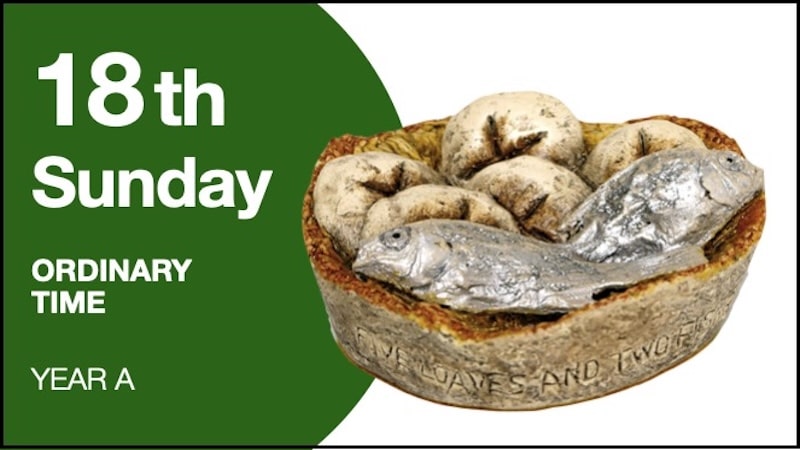
18th Sunday of Year A



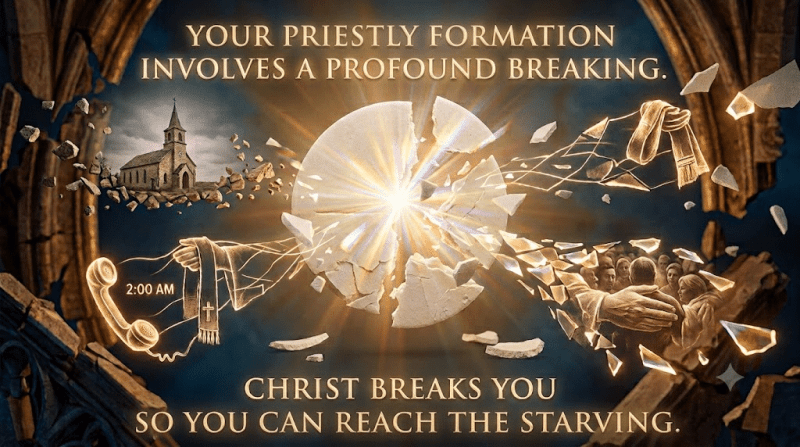
Looking for a powerful way to begin your homily? Use the anecdotes below, and feature one of the infographics above in your parish bulletin. It’s an excellent visual reminder to help your congregation carry the message of The Word This Week home with them.
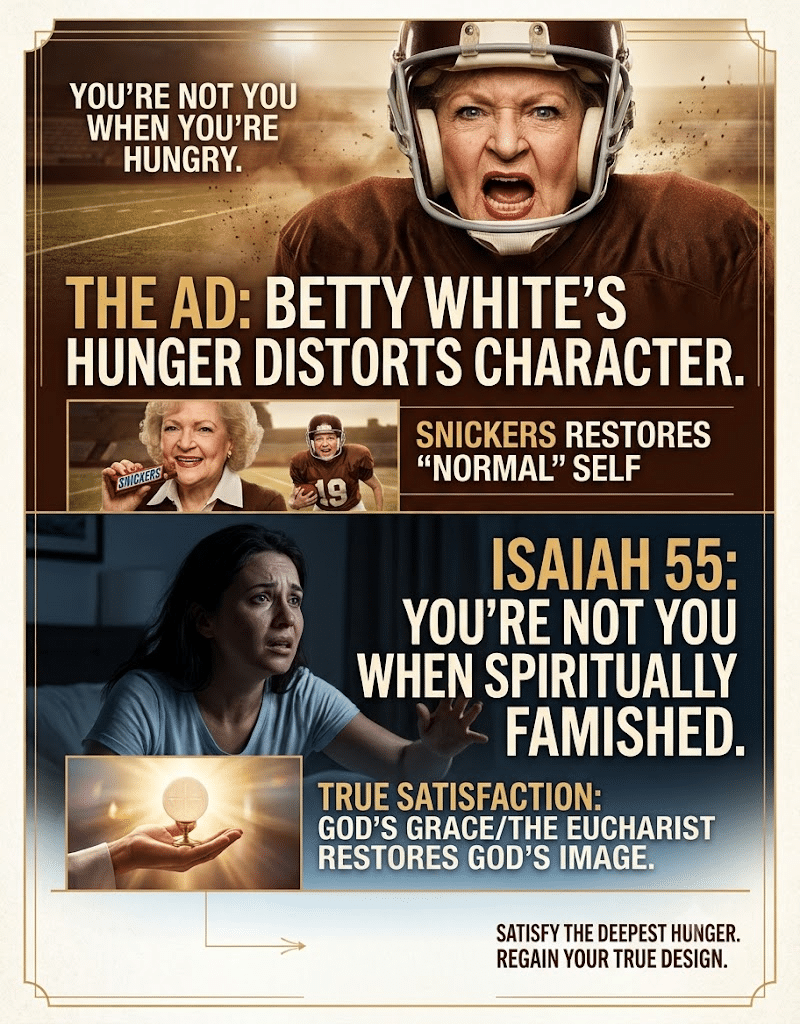
This iconic, long-running campaign features regular people acting completely out of character—irritable, weak, or dramatic (played by Betty White above)—because they are completely starved. The moment someone hands them a Snickers bar, they take a bite and instantly revert to their true, normal selves. The tagline reminds the viewer: “You’re not you when you’re hungry.”
The Connection: Isaiah 55 addresses a deep, systemic human issue: we try to satisfy a profound inner deficit with things that leave us empty, which alters our character and separates us from our true design. When we are spiritually famished, we become distorted versions of ourselves—driven by anxiety, anger, or despair. The Snickers ad humorously illustrates how deep hunger changes who we are at our core. Theologically, the text invites us to stop settling for cheap substitutes that fail to satisfy. True spiritual nourishment from the Lord [e.g. the Eucharist] restores us, bringing us back to who we were genuinely created to be in His image.
Groundhog Day (1993)
18th Sunday of Year A

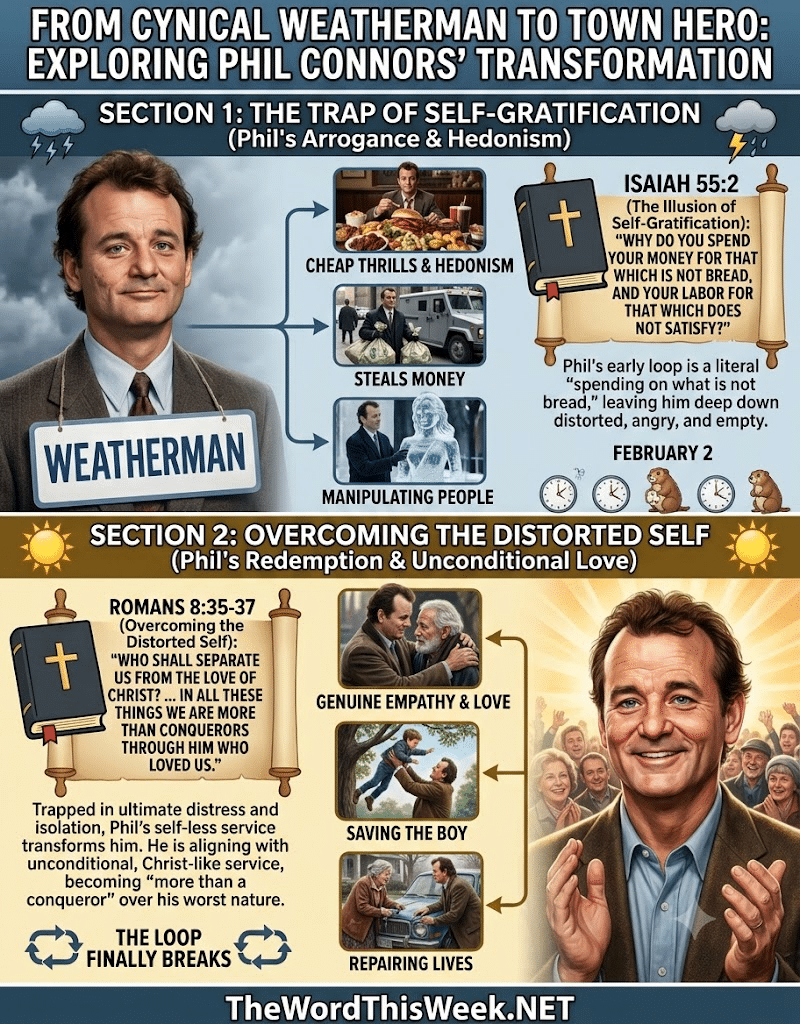


Phil Easts Like a King Scene: Phil Connors, an arrogant and cynical TV weatherman, finds himself trapped in a time loop, repeating the exact same day indefinitely. Initially, he uses the loop to indulge in consequence-free hedonism—eating whatever he wants, stealing money, and manipulating people. Eventually, these cheap thrills leave him utterly miserable and suicidal. Only when he shifts his focus toward selflessly serving, saving, and loving the townspeople does the loop finally break.
Isaiah 55:2 (The Illusion of Self-Gratification): Phil’s early attempts to satisfy his internal emptiness with endless food, physical pleasures, and control are a literal loop of “spending money on what is not bread.” It highlights how consuming things solely for oneself leaves the character deeply distorted, angry, and empty.
Romans 8:35-37 (Overcoming the Distorted Self): Trapped in an existential purgatory that feels like ultimate distress and isolation, Phil is completely stuck. His transformation into a person of genuine empathy and love shows how aligning oneself with unconditional, Christ-like service makes a person “more than a conqueror” over their own worst nature.
Two Brothers
18th Sunday of Year A

Two brothers inherited their father’s farm, working the land together and splitting their harvest equally. Despite the arrangement, both men harbored secret, selfless concerns for the other. The single brother, feeling he had few needs, began sneaking grain to his brother’s storehouse at night to better provide for his sibling’s large family. Simultaneously, the married brother grew worried about his brother’s future, fearing he would have no one to care for him in old age. Consequently, he too began secretly moving his own grain into his brother’s store. For years, the brothers were puzzled as their grain supplies remained mysteriously constant. The truth was finally revealed one night when they collided while sneaking their gifts. Realizing the depth of their mutual devotion, they dropped their burdens and embraced.
The disciples saw only scarcity, but Jesus revealed the Kingdom economy: meager offerings placed in God’s hands become enough. Like Him, the brothers transcended cold “fairness” by prioritizing the other’s welfare over their own security. This reflects the Eucharist: as Jesus took, blessed, and broke, the brothers broke their self-interest to give to one another. Their grain, poured out in sacrificial charity, mirrored God’s economy of abundance where love is the currency. Their meeting in the dark brought communion, not shame. This reveals that when we treat our neighbor’s need as our own, we experience the miracle of being truly united and encounter the presence of Christ.

1) We are over-eating ourselves to death: Experts tell us that Americans are over-eating themselves to death. Obesity is America’s number one health problem. The average American eats daily nine hundred more calories than he needs. It is reported that fifty percent of us are overweight. Fifty-three percent of the deaths are caused by diseases that are related to obesity. Americans spend annually ten billion dollars on diets and slimming programs. Even our dogs are over-fed. Look at the miserable contrast: the overfilled stomachs of dogs almost touching the ground and the bloated stomachs of children suffering from malnutrition! If we had compassion on the poor and hungry, we would voluntarily change our lifestyles to those which would call for less food in-take. Then, we could take the money saved from buying less food and give it to our Church’s program to send food abroad to the destitute. One denomination within a two-year period gave eight million dollars for world hunger. This was possible because loyal members sacrificed by eating less that others might eat more. — Jesus gave the bread to the apostles to distribute to the people. In our day those who have food, as America does, should have the compassion of Jesus to share with those who have little or no food.
2) Spiritual hunger leading people to New Age religions: Physical hunger is a very real fact of life. Spiritual hunger is just as real, and there are many millions more who are spiritually malnourished, while multitudes are dying of spiritual starvation. Many of the symptoms of spiritual hunger are seen here and all over the world. We see today spiritually hungry people who are going outside the Church for soul food. This is a judgment upon the Church for apparently not satisfying the spiritual needs of the people. Forty-two million Americans, for instance, or one out of every five, has espoused astrology. They believe that the position of the stars has something to do with their daily lives. Two-thirds of our newspapers carry a daily horoscope. Eight out of every ten Americans can tell you under what star they were born. This turning to astrology is an indication that people are looking for something transcendent; they are looking for guidance from a force beyond themselves. Six million Americans have embraced Transcendental Meditation and thirty thousand new people each month are signing up for instruction. This points to a need for meditation to get in touch with God, something many Church people must feel they are not getting now. Add to this number five million people who are seeking union with God by Yoga. Three million Americans belong to the charismatic movement, meeting a desire for an experience with the Spirit. Many of these charismatics claim that the average church is cold and lacking in spiritual warmth. Added to this, are the various heretical sects that are attracting people by the tens of thousands, like Scientology and the Unification church by Moon.
3) Junk food for the souls: What is feeding our spirits? Many Americans get their food from television. It is reported that the average child watches twenty-three hours of television per week. By the time a child reaches age eighteen, he has watched twenty-three thousand hours of television, equivalent to three years of his life. And what do they get on television, what feeds their minds and hearts? They are fed materialism through the constant appearance of commercials, often six at a time. In 1976, it is said, television stations ran three hundred thirty-five thousand commercials per month! In these commercials we are fed with a materialistic view of life. We are told that things make life happy and worthwhile. Buy, buy, and have all the good things in life! In addition, television is feeding us with sex and violence, more of both each joining the flood each year. By the time a child reaches age eighteen, it is claimed that he has seen eighteen thousand murders. On children’s television cartoons, an act of violence is shown at the rate of one per minute. These scenes of violence are sowing the seeds of hatred, brutality, and vengefulness in the hearts of people. The tragedy of our times is that we are content to feed our souls with “empty calories,” when we could be getting a spiritual banquet. We are living on chaff and husks rather than the good meat of a steak.
4) “You’d never believe it, Dad.” Charles Swindol tells a funny story about a nine-year-old named Danny who came bursting out of Sunday school like a wild stallion. His eyes were darting in every direction as he tried to locate either mom or dad. Finally, after a quick search, he grabbed his Daddy by the leg and yelled, “Man, that story of Moses and all those people crossing the Red Sea was great!” His father looked down, smiled, and asked the boy to tell him about it. “Well, the Israelites got out of Egypt, but Pharaoh and his army chased after them. So, the Jews ran as fast as they could until they got to the Red Sea. The Egyptian Army was gettin’ closer and closer. So, Moses got on his walkie-talkie and told the Israeli Air Force to bomb the Egyptians. While that was happening, the Israeli Navy built a pontoon bridge so the people could cross over. They made it!” By now his dad was shocked. “Is THAT the way they taught you the story?” he demanded. “Well, no, not exactly,” Danny admitted, “but if I told you the way they told it to us, you’d never believe it, Dad.” — It’s more popular to operate in the black-and-white world of facts … and, of course, to leave no space for the miraculous. And so, when we read the story of the feeding of the five thousand, we tend to focus our attention on the question, “Did it really happen? Or was it a miracle of sharing the bread people had with them? “ Some say that this young fellow’s example encouraged other people to share food they had brought with them for the journey. But today’s Gospel presents it as a real miracle.
5) We should rethink our own stewardship of the earth’s resources: Did you know, for example, that six million Europeans eat as much food as 240 million Africans? Even more startling, the citizens of this country, who form only 5.7% of the world’s population, eat half the food produced in the world. Somebody’s eating more than his/her share! We spend ten times more money on the feeding of cats and dogs than the sovereign country of Guinea earns as its national income. We are an indulgent, wasteful people. We each need to examine our stewardship of the bounty with which God has blessed us.
6) “I’ll pay it for you.” In 1930, during the Great Depression, a man named Golden Rule Jones was mayor of Toledo, Ohio. During his term of office, he sometimes sat as the presiding judge in night court. One night a man was brought in for stealing money from a grocery store. His defense was that he needed the money for food and that he was simply a victim of hard times. Nevertheless, Golden Rule Jones found him guilty. “You did not steal from society.” he said. “You stole from a private citizen and you broke the law. I’m fining you ten dollars. However,” and he reached for his wallet, “I’ll pay it for you.” Next, he instructed the bailiff to pass the hat around the courtroom. “I’m fining everybody here at least fifty cents. You’re all guilty of being members of a society that made it necessary for this man to steal. The collection will go to the defendant.”
7) “Help, I can’t swim:” In one of his books, Chuck Swindoll tells about a very interesting case that came before the courts in the state of Massachusetts back in the 1920s. It concerned a man who had been walking along a pier when suddenly he tripped over a rope and fell into the cold, deep waters of that ocean bay. He came up sputtering, screaming for help, then sank beneath the surface. For some reason he was unable to swim or stay afloat. His friends heard his faint cries in the distance, but they were too far away to rescue him. But within only a few yards was a young man lounging on a deck chair, sunbathing. Not only could the sun-bather hear the drowning man plead, “Help, I can’t swim,” he was also an excellent swimmer. But the tragedy is that he did nothing. He only turned his head to watch indifferently as the man finally sank and drowned. The family of the victim was so upset by that display of extreme indifference, they sued the sun-bather. The result? They lost the case. With a measure of reluctance, the court ruled that the man on the dock had no legal responsibility whatsoever to try to save the drowning man’s life. — You and I can turn a deaf ear to the needy of this world. We can callously shrug our shoulders and say, “Let God feed them.” But God works through people who are responsive to God’s leading. For them, there is nothing in this world that cannot be accomplished. Jesus said, “You feed them!” And we can.
8) Christy, Grade III A. A man was packing a shipment of food for the poor people of Appalachia. He was separating beans from powdered milk, and canned vegetables from canned meats. Reaching into a box filled with various cans, he pulled out a little brown paper sack. Apparently one of the pupils had brought something different from the items on the suggested list. Out of the paper bag fell a peanut butter sandwich, an apple, and a cookie. Crayoned in large letters was a little girl’s name, “Christy, Grade III A.’ A little girl had given up her lunch for some hungry person as did the little boy did in today’s Gospel.
9) “Born of the virgin Edna…” There was pastor who used his computer to create a personalized printed program for every Baptism. To make each one special, he’d use the computer’s “search & replace” function to find the name of the last baby baptized and then replace it with the next baby’s name. So, one Saturday evening, the priest told his computer to find the name “Mary,” last week’s baby, and to replace it with “Edna,” the next day’s baby. Next morning, everything went smoothly till the congregation reached the Apostles’ Creed and found themselves saying, “…And we believe in Jesus Christ, conceived by the Holy Spirit and born of the virgin Edna...” — So often our best intentions go awry, and before we get very old, the reality of our personal limitations becomes painfully clear. The Apostles in Sunday’s Gospel knew their limits only too well, especially when they stood next to Jesus. So, when Jesus looked at the crowd of about 20,000 and told the Apostles to feed the people, they were truly abashed.
10) A poor girl’s donation of “five loaves and two fish”: A sobbing little girl stood near a small Sunday school building. The pastor asked her why she was crying. “I can’t get into the Sunday school,” she sobbed. “The teacher said it was too crowded.” Seeing her shabby, unkempt appearance, the pastor guessed the reason. Taking her by the hand, the pastor took her inside and found a place for her in the Sunday school class. The child was so touched that she went to bed that night thinking of the children who had no place to learn about Jesus.
Two years later, this child lay dead in one of the poor tenement buildings, and her parents called for the kind-hearted pastor, who had befriended their daughter, to handle arrangements for her funeral. As her body was being moved, a worn and crumpled purse was found which she might have gotten from some trash dump. Inside was found fifty-seven cents and a note scribbled in a child’s handwriting. It read, “This is my saving to help build our small church and the little Sunday school bigger so that many more children can go to worship God and to learn about Jesus.” For two years she had saved for this offering of love. When the pastor tearfully read that note, he knew instantly what he should do. Carrying this note and the child’s purse to the pulpit, he told the story of the poor little girl’s unselfish love and devotion. He challenged his parishioners to raise enough money for a larger church and bigger Sunday school. A newspaper learned of the story and published it. It was read by a realtor who offered them a plot of land worth thousands, for the price of fifty-seven cents — the amount the little girl had saved. The parishioners made large donations. Checks came from far and wide. Within five years the little girl’s gift had increased to $250,000.00, a huge amount at the turn of the last century. Her unselfish, sacrificial love had paid large dividends. — When you next visit the city of Philadelphia, look for Temple Baptist Church, with a seating capacity of 3,300, and Temple University, where hundreds of students are trained. Have a look, too, at the Good Samaritan Hospital, and the Sunday school building which houses hundreds of Sunday scholars, so that no child in the area will ever need to be left outside during Sunday school time. In one of the rooms of this building you will see the picture of the sweet face of the little girl whose fifty-seven cents, so sacrificially saved, and had such a remarkable history. Alongside is a portrait of her kind pastor, Rev. Dr. Russell H. Conwell, author of the book Acres of Diamonds. In today’s Gospel we read the similar story of a boy who sacrificially shared his little lunch with Jesus, thus cooperating with Him in the miraculous feeding of a huge crowd. (Confer Snopes.com for the true story)
God Meets All Our Needs
The central theme of today’s readings is the care God can take of us, meeting our physical and spiritual needs, if we put our trust in Him. He shares Jesus, His only-begotten Son and become Incarnate so that Jesus can be Infinite generosity both prepares us for the Heavenly banquet, and challenges us to share our blessings with others.
Isaiah 55:1-3
In the first reading, Isaiah consoles the Jewish exiles in Babylon, assuring them of their return to homeland and promising them that Yahweh their God alone can, and will, provide for their spiritual and physical needs. He will pardon their sins and will offer them participation in His eschatological banquet. The refrain for today’s Responsorial Psalm (Ps 145), has us sing, “The Hand of the Lord feeds us; He answers all our needs,” in praise of the mercy, forgiveness, and maternal care of our One loving and providing God.
Romans 8:35, 37-39
In the second reading, Paul argues that since God’s love for us is Infinitely immense, “nothing can come between us and the love of God made visible in Christ Jesus our Lord.”
Matthew 14:13-21
In today’s Gospel, demonstrating God’s caring love for us, Jesus fed the enormous crowd of listeners both spiritually by his preaching, and physically by his miraculous multiplication of the apostles’ lunch of five loaves and two fish. This miracle shows the Divinity of Jesus, the providing care of God, and the compassion of Jesus for the crowd. The miracle is also a Messianic sign, identifying Jesus as both the new Moses who fed the Israelites in the desert and the new Elisha who miraculously fed the starving people of Gilgal (2 Kings 4:42-44). The Eucharistic wordings used, and the promise made by Jesus on the following day, that he would give his body and blood as food and drink (John 6:25-70), made the miracle a prefiguring symbol of the Holy Eucharist.
You Give Them Something to Eat
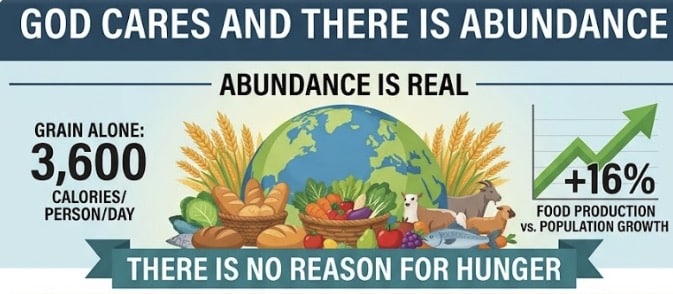
Today’s readings tell us that God really cares about His people, and that there is enough and more than enough for everybody. Studies show that the world today produces enough food in grain alone to provide every human being on the planet with 3,600 calories a day, not counting such foods as tuber crops, vegetables, beans, nuts, fruits, meats, and fish. Over the past twenty-five years, food production has exceeded world population growth by about 16%. This means that there is no good reason for any human being in today’s world to go hungry. But even in a rich country like the U.S.A., one child out of five grows up in poverty, three million people are homeless and 4000 unborn babies are aborted every day. “The problem in feeding the world’s hungry population lies with our political lack of will, our economic system biased in favor of the affluent, our militarism, and our tendency to blame the victims of social tragedies, such as famine. We all share responsibility for the fact that populations are undernourished. Therefore, it is necessary to arouse a sense of responsibility in individuals, especially among those more blessed with this world’s goods.” (Pope John XXIII, Mater et Magistra (1961) 157-58).
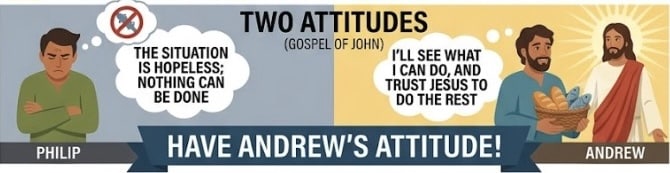
It is too easy to blame God, too easy to blame governments, too easy to see these things as other people’s problems. They are also our problems. That is the meaning of the Eucharist we celebrate here today. In other words, as Christians we have to commit ourselves to share and to work with God in communicating His compassion to all. God is a caring Father, but He wants our co-operation. That’s what the early Christians did, generously sharing what they had with the needy. They were convinced that everything they needed to experience a fulfilling life was already there, in the gifts and talents of the people around them. People of our time have to be encouraged to share, even when they think they have nothing to offer. Whatever we offer through Jesus will have a life-giving effect in those who receive it. We are shown two attitudes in John’s account (John 6:7-9) of the Gospel story: that of Philip and that of Andrew. Philip said, in effect: “The situation is hopeless; nothing can be done.” But Andrew’s attitude was: “I’ll see what I can do, and I will trust Jesus to do the rest.” Let us have Andrew’s attitude.

God Blesses those who Share their Talents with Loving Commitment
This is illustrated by Mother Teresa who went to serve the slum-dwellers of Calcutta with just twenty cents in her pocket. When she died forty-nine years later, God had turned her original twenty cents into eighty schools, three hundred mobile dispensaries, seventy leprosy clinics, thirty homes for the dying, thirty homes for abandoned children and forty thousand volunteers from all over the world to help her. We can begin our own humble efforts at “sharing” right here in our parish by participating in the works of charity done by organizations like St. Vincent DePaul Society, the Knights of Columbus and so many other volunteer groups. We may say, “I do not have enough money or talent to make any difference.” But we need to remember that the young boy in the story had only five loaves of bread and two fish. The Bible guarantees that every believer has at least one gift from the Holy Spirit. This is our one “tiny fish.” Perhaps our “fish” is not money, but a talent or an ability that God has given us. We all have something. If we have never trusted God with our time, or our talent, or our treasure — all our resources. — this is the time to start. Let us offer everything to God saying, “Here is what I am and what I have Lord, and You have given me all of it, so I am yours: use me as You will, please” And He will, blessing and amplifying everything beyond our expectations. As we begin to give, we will discover that the Lord “moves in” where we are not adequate, and He abundantly supplies what is needed. When we give all we have to God, and we ask Him to bless it, it is then the miracle happens.
Jesus the Bread of life
How do we eat Jesus Christ? How do we digest the Son of God? One way is by maintaining daily private devotions, spending time alone with Christ, apart from the family and the busyness of the day. It means taking some time – five, ten, fifteen, or twenty minutes – each day to spend in the presence of Christ, the Bread of Life. We can take the Bible, read a passage until something speaks to the heart, then stop, reflect on what has been and ask, “What is God saying to me in this passage? Is there a command to obey? A promise to trust? An example to follow? A sin to avoid? A prayer to echo?” This is called reflection or meditation. We enter into quiet and stillness, focus our mind on God and His Word and listen to Him. Our next step is to respond to God by prayer which is talking to Him, speaking to Him as to a friend in conversation, telling Him everything and asking Him for whatever we need. By doing this day in and day out, we will be feeding our soul with the Bread of Life. We will grow strong within. Our Faith will mature., and we will be preparing our souls to eat the Bread of Life when we join (weekly of course, and daily if we are blessed with many priests), the Public Worship of the Church at the Eucharistic celebration. There, we gather with fellow-believers at Mass, joining hearts and voices with theirs in praising God and listening to His Word taught and preached in the Liturgy of the Word. In the Liturgy of the Eucharist, we really eat the glorified body, blood, soul and Divinity of our Risen Lord, Jesus the Christ of God in receiving the Eucharist, By eating Jesus’ Body and drinking Jesus’ Blood, we share in Jesus’ Divine life. Since Christ is the heart and center of the Bible, we can say that the Bible is also the Bread of Life. When the Bible is preached, the homilist is breaking the Bread of Life for us. Christians feed on the Word of God as they hear it in Church, as well as when they read and pray it privately .