Vocations, Discernment
Vocations, Discernment
August 2, 2026


Follow Me…
Discover Your
Purpose
AT A GLANCE
- The Core Question: Discernment often triggers the anxious question, “Am I enough?” when facing the vast brokenness of the world.
- The Divine Command: Christ commands his ministers, “You give them something to eat,” refusing to turn the hungry crowds away.
- The Fourfold Pattern: A priestly vocation mirrors the Eucharistic actions of Jesus: being Taken (offered to God), Blessed (sanctified in prayer), Broken (sacrificed in ministry), and Given (poured out for others).
- The Source of Grace: The priest functions strictly as a conduit, not the source; his personal insufficiency is transformed by Christ to achieve spiritual abundance.
REFLECTION
QUESTIONS
- When looking at the vast spiritual hunger in the world today, do you find yourself wanting to “send the crowds away” out of fear or feelings of inadequacy?
- What are the specific “five loaves and two fish” of your life—your talents, weaknesses, and limitations—that you are hesitant to hand over to Jesus?
- In what areas of your life are you still “hoarding” your freedom rather than allowing yourself to be fully taken by Christ?
- How disciplined is your personal prayer life? Are you consistently making the Holy Hour your daily lifeline to ensure your ministry flows from intimacy with the Father?
- Do you find yourself relying more on personal opinions, clever advice, or psychological hacks rather than bringing the “fragrance of the tabernacle” to others?
- When you anticipate the breaking of your self-will—such as receiving an undesired parish assignment from your bishop—how does your heart respond?
- Are you willing to embrace the unexpected breaking of your schedule, even a 2:00 AM call to administer the Anointing of the Sick to a dying soul?
- How do you handle being misunderstood or opposed by the people you are called to serve? Does it hinder your willingness to love them sacrificially?
- When you envision lying prostrate on the sanctuary floor on ordination day, do you view it as total devastation, or as a beautiful configuration to Christ?
- Do you truly trust that if you let Christ break your life, He will not destroy you, but will instead make you a conduit of overflowing grace?
REAL-LIFE
APPLICATION
- This week, transition your discernment from an abstract concept into a concrete act of Eucharistic offering. Identify one specific area where you are actively resisting a “breaking” of your self-will or schedule (e.g., a rigid personal routine, a specific career ambition, or a fear of transparency in spiritual direction). Take that exact area to your next Holy Hour. Intentionally place it in the hands of Jesus. Pray for the grace to move from being merely taken to being blessed and broken, actively seeking an opportunity this very week to give your time or energy to someone in need without expecting anything in return.
This page will no longer be updated after August 9, 2026
18th Sunday of Year A
The ordained priesthood includes both diocesan and religious order priests.
The Eucharistic Pattern of
a Priestly Life
Whether you are tentatively taking your first steps toward the seminary door, or are already years deep into the rhythms of formation, the question at the heart of your discernment remains the same: “Am I enough?”
When confronted with the sheer scale of the world’s brokenness, any honest young man will feel his own poverty.

The Gospel of Matthew provides the ultimate anchor for this holy anxiety. In the feeding of the five thousand, the disciples look at a desperate, starving crowd and panic. They tell Jesus, “This is a deserted place… send the crowds away.” But Christ fires back with a command that defines the Catholic priesthood: “They need not go away; you give them something to eat.”
How can a weak, mortal man feed a starving world? The answer is hidden in the four dynamic, Eucharistic actions Jesus performs next: He took, blessed, broke, and gave. To become a priest is to allow your entire life to be swept up into this exact fourfold movement.
Taken
Before Jesus feeds the multitude, He demands the raw material: “Bring them here to me.” The disciples offer up five loaves and two fish—pathetic resources for a crowd that size.
In your discernment, you are that offering. Christ does not call you because you possess infinite talent, seamless holiness, or flawless eloquence. He calls you to give Him whatever small “loaves and fish” your life consists of. Entering the seminary or moving toward ordination is the act of being taken—placing your freedom, your intellect, your celibacy, and your future entirely into His hands. The miracle cannot begin until you stop hoarding your life and hand it over.
Blessed
Once Jesus took the bread, He “looked up to heaven, and blessed… them.” A priest is fundamentally a man of prayer, tethered to the heart of the Father. At every Mass, you will stand in persona Christi (in the person of Christ) and pray the words of consecration. But you cannot bless the bread at the altar if you do not allow Christ to bless your humanity.
Practically, this means your ministry will be completely barren without a rigorous life of prayer. In seminary and beyond, the Holy Hour is your lifeline. When a parishioner comes to you weeping in the confessional or seeking counsel in a parish office, they do not need your personal opinions or clever psychological hacks. They need to encounter a man who has been blessed by proximity to Jesus, bringing the fragrance of the tabernacle into the messiness of parish life.
Broken
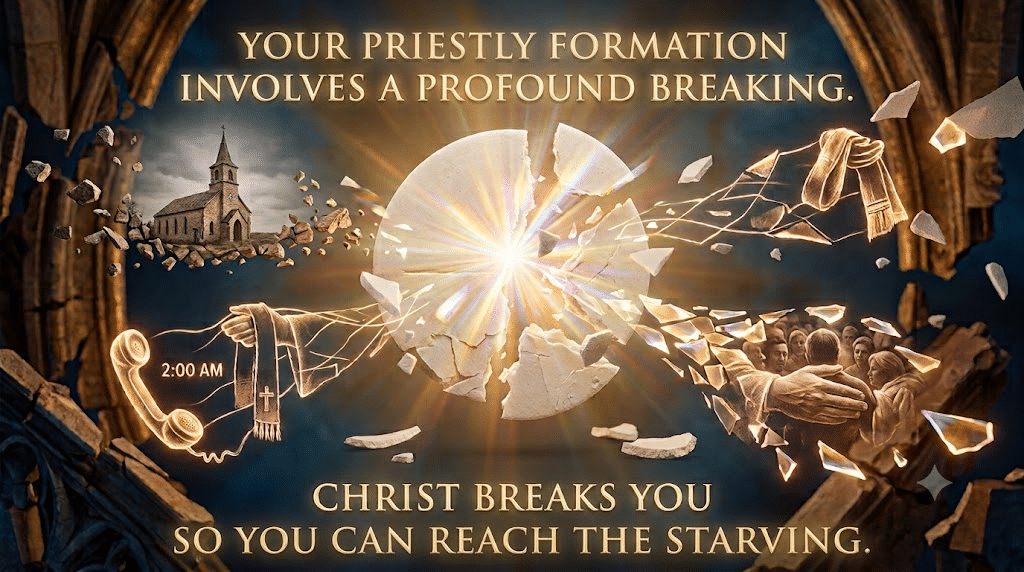
This is the phase of the priesthood that frightens us most. After blessing the loaves, Jesus broke them. Unbroken bread can only feed one person; it must be fractured to be shared.
Your seminary formation and your future priesthood will involve a profound breaking. It is the breaking of your self-will when a bishop assigns you to a parish you did not choose. It is the breaking of your schedule when the phone rings at 2:00 AM because someone is dying in a local hospital and needs the Anointing of the Sick. It is the exhausting, sacrificial breaking of your own energy to love a flock that may sometimes misunderstand or oppose you. Do not fear this fracturing. Christ does not crush you to destroy you; He breaks you so that your life can actually reach those who are starving.ouse with regret; he looked at his new field with sheer, radiant joy. Trust the King who called you, for He is both the architect of your heart and the treasure you seek.
Given
Finally, Jesus “gave them to the disciples, and the disciples gave them to the crowds.” Notice the order: Christ fills the disciples’ hands, and they distribute the abundance. The priest is a conduit, not the source.
Your life is meant to be completely given away. On the day of your ordination, you will lie prostrate on the sanctuary floor—a visceral, physical sign that you are laying your life down as a bridge for others to cross over into heaven. You will give Christ’s mercy in Absolution, His truth in preaching, and His physical presence in the Holy Eucharist.
Brother, look at the crowds of our cultural moment. They are exhausted, spiritually malnourished, and wandering in a desolate place. Do not tell Jesus to send them away. Trust that the One who called you will sustain you. Bring Him your five loaves and two fish. Let Him take you, bless you, break you, and give you away for the salvation of souls—and watch how He leaves the world filled to abundance, with twelve baskets overflowing.
Page was created with AI tools and human editorial oversight.
His Hands,
His Feet,
Your Vocation
AT A GLANCE
- The Impossible Command: Jesus’s directive, “You give them something to eat,” is the fundamental charter of diakonia (service). It bridges the gap between human insufficiency and divine abundance.
- The Liturgical Conduit: The deacon acts as a living link between the altar and the world. He receives the community’s modest gifts, stands present at the breaking, and distributes the multiplied Bread of Christ.
- The Sanctification of the Ordinary: A deacon’s dual vocation—balancing family, secular work, and ministry—is the modern equivalent of the “five loaves and two fish.” Offered in trust, these limited resources are blessed and multiplied by God.
- The Extended Miracle: The miracle of the feeding does not end at the dismissal. It continues at the margins of society as the deacon carries both physical charity and the leftover fragments of the Eucharist to the lonely, the sick,
REFLECTION
QUESTIONS
- When faced with the overwhelming spiritual or physical hunger in your parish or community, do you tend to copy the disciples’ first instinct to “send them away,” or do you trust that your small offering is a starting point for a miracle?
- St. Ephrem prayed, “Lord, take what is small and make it great; take what is mine and make it Yours.” What specific, seemingly insignificant “loaf” or “fish” in your life (a sliver of time, a hidden talent, a small resource) are you hesitant to hand over to Christ?
- How can you better recognize the connection between the breaking of the Bread at the altar during Mass and the brokenness of the people you encounter outside the church doors?
REAL-LIFE
APPLICATION
- “Gather the Fragments” Look closely at the margins of your daily routine this week. Identify one person—a lonely coworker, a grieving neighbor, or a homebound parishioner—who is hungering for presence or comfort. Do not let the lack of time or the perfect words stop you. Intentionally offer them “the bread of your time.” Spend fifteen minutes in undivided conversation, send a concrete note of encouragement, or volunteer for a single shift at your parish food pantry. Offer your small, inadequate moment to Christ, and watch Him make it enough.
This page will no longer be updated after August 9, 2026
18th Sunday of Year A
Deacons receive the Sacrament of Holy Orders but are ordained unto ministry and service rather than the priesthood. Because permanent deacons are often married and hold secular jobs, treating them as a distinct category makes a lot of practical and theological sense.
The Hands That Give
Gospel: Matthew 14:13–21
Theme: You give them something to eat.
McCulloch
(Diocese of Broken Bay)
In this beloved Gospel, Jesus, moved with pity for the vast crowd, performs a miracle of abundance. But He does not do it alone. When the disciples, overwhelmed by the scale of the need, want to send them away, Jesus issues a command that is both simple and impossible: “You give them something to eat.”
The disciples respond with the poverty of their own resources: “Five loaves and two fish are all we have here,” they say. This is the deacon’s starting point. His entire ministry is a “yes” to Christ’s impossible command. He is a man who knows he does not have enough, and yet he hears the call to offer what little he has, trusting that God will bless, break, and multiply it.
As St. Ephrem the Deacon prayed,
“Lord, take what is small and make it great;
take what is mine and make it Yours.”
AT MASS
The Hands during Mass
The deacon’s liturgical role places him, like the first disciples, as one who receives from Christ and gives to the people.
• The Proclamation of the Word: The deacon’s first offering is the Word. He takes what is his – his voice, his prayer, and his study – and offers it as the first bread to feed the assembly.
• The Hands That Take: At the Offertory, and along with the priest, the deacon’s hands take the small gifts of bread and wine from the people. He receives the modest five loaves and two fish of the community.
• The Minister present at the Breaking: He stands near the altar, assisting as Christ, through the priest, blesses, breaks, and gives. His most ancient role is the care of the Chalice, the Cup of Plenty, which he holds and distributes.
• The Hands That Give: The deacon’shands, like those of the disciples, help to distribute the multiplied Bread of Christ to the faithful. He is a living link between the breaking at the altar and the feeding of the crowd.
IN THE PARISH
The Ministry of Five Loaves
The deacon’s dual vocation ishis five loaves and two fish. It is the modest offering of a life divided between family, work, and ministry.
• Taking Mine and Making it Yours: The deacon takes his time from his family, his energy from his job, and his own small talents, and he and offers them to the Lord. His service is the living prayer of St. Ephrem, trusting that God will “make it great”.
• Animator of the Small Gifts: The deacon is an animator of charity. One of his jobs is to bea disciple who gathers the five loaves of the parish: the small donations, the few volunteers, the limited resources. He then organizes this small offering, presenting it to Christ and trusting in the miracle of the food pantry, the crisis fund, or the social justice ministry.
AT THE MARGINS
Jesus’s command, “You give them something to eat,” is the charter of diakonia.
• Feeding the Hungry: The deacon’s diakonia is the most literal fulfillment of this Gospel. He feeds the hungry at the soup kitchen, he gives drink to the thirsty heart of the troubled, and he welcomes the stranger outside the church.
• The Bread of Comfort: His ministry is not just physical. He offers the bread of his time to comfort the grieving. He offers the bread of his presence to the lonely. He offers the bread of the Word to the homebound.
• The Miracle Continues: The deacon’s hands carry leftover fragments of the Eucharist, the divine Bread, from the altar to the hospitalised and the homebound. In this act, the miracle of the feeding continues. His hands hold what Christ will bless, break, and give, proving that what He gives is always miraculously enough.
Faith in Action—
Grace in the
Everyday
AT A GLANCE
- The Sacred Seal: In Holy Matrimony, human love is caught up into something larger, where Christ acts as the permanent seal upon the couple’s hearts.
- The Paschal Reality: Christian marriage moves beyond romantic sentimentality to actively participate in the Paschal Mystery, standing firm when shadows fall.
- Overwhelming Victory: Amidst trials like illness, financial strain, or anxiety, couples conquer overwhelmingly not by human strength, but through Christ dwelling in their covenant.
- An Indissoluble Bond: Because the marriage is bound to the love of God, no earthly power, trial of the present, or unknown of the future can destroy or dismantle the covenant.
REFLECTION
QUESTIONS
- When you look back at the joy and hope of your wedding day, how do you see the grace of that moment actively alive in your relationship right now?
- In what ways do you consciously view your marriage as a participation in the Paschal Mystery rather than just a romantic partnership?
- What specific “shadows of the world”—such as financial anxiety, parenting exhaustion, or illness—feel like threats to your unity?
- When unexpected storms hit your family, do you tend to rely first on your own human emotional reserves, or do you collectively turn to Christ?
- St. Paul writes that we “conquer overwhelmingly.” What does overwhelming victory look like in the middle of your daily frustrations or disagreements?
- In what practical ways do you intentionally sacrifice your own personal desires to lift up, support, and honor your spouse?
- When you look toward the unknowns of the future, do you look with fear, or with the absolute conviction that nothing can separate you from God’s love?
- How can the two of you more intentionally find and acknowledge Christ in the ordinary, quiet, and routine moments of your shared daily life?
REAL-LIFE
APPLICATIONS
- The Consecration of Distresses: The next time a shared stressor strikes—whether it is an unexpected bill, a scheduling nightmare, or parenting fatigue—stop immediately, join hands, and pray St. Paul’s words together: “In all these things we conquer overwhelmingly through Him who loved us.” Use that exact moment of tension to consciously shift from human panic to divine reliance.
- Building the Domestic Altar: Commit to renewing your wedding day grace by praying together out loud before the day begins or ends, and intentionally schedule a time to receive the Holy Eucharist together this week, anchoring your daily routine back onto your unshakable foundation.
This page will no longer be updated after August 9, 2026
18th Sunday of Year A

The lay state is lived through Holy Matrimony—a sacramental vocation building the domestic church—and the committed single life, which offers a lifetime of unique flexibility to serve God. The single state also includes those patiently waiting and preparing for marriage.
An Indissoluble Bond:
Christ in Your Marriage
On your wedding day, as you stood before the altar, you made a solemn promise to love and honor each other in prosperity and in adversity, in sickness and in health, all the days of your life. In that sacred moment, your human love was caught up into something infinitely larger than yourselves. Through the Sacrament of Holy Matrimony, Christ did not merely witness your vows; He became the very seal upon your hearts.
Looking back at that day, it is beautiful to remember the joy, the radiant smiles, and the hope that filled the air. Yet, Christian marriage is not a romantic sentimentality; it is a participation in the Paschal Mystery. The love you share is meant to be a living icon of Christ’s love for the Church—a love that does not retreat when the shadows fall.
Facing the Shadows of the World
In Romans 8:35, 37-39, St. Paul asks a question that resonates deeply within the landscape of a lifelong marriage: “What will separate us from the love of Christ? Will anguish, or distress, or persecution, or famine, or nakedness, or peril, or the sword?”
If we apply this to your marriage, we can ask: What can separate you from each other, when your union is anchored in Jesus? Will financial stress, the exhaustion of parenting, the ache of illness, or the quiet anxieties of the future tear you apart?
Overcoming Through Divine Grace
Human strength alone is insufficient to withstand the storms of life. If your marriage relied solely on your own emotional reserves, the fractures of the world might prevail. But St. Paul gives us the glorious truth: “No, in all these things we conquer overwhelmingly through him who loved us.”
Notice that the Apostle does not say we merely survive or scrape by; he says we conquer overwhelmingly. In your relationship, this victory is achieved not by your own might, but through Christ who dwells within your covenant. When you forgive each other after a bitter argument, Christ is there. When you hold hands in a hospital waiting room, Christ is there. When you quietly sacrifice your own desires to lift up your spouse, Christ is breaking the bread of His grace within your home.
The Unshakable Foundation
Let St. Paul’s absolute conviction become the daily anthem of your home: “For I am convinced that neither death, nor life, nor angels, nor principalities, nor present things, nor future things, nor powers, nor height, nor depth, nor any other creature will be able to separate us from the love of God in Christ Jesus our Lord.”
Because your marriage is bound tightly to the love of God, nothing in this world has the power to destroy the covenant you have forged. Neither the trials of the present nor the unknowns of the future can dismantle what God has joined together. Death itself cannot sever the spiritual reality of a love that has been sanctified by Christ, for love is stronger than death.
Continue to build your home on this unshakable foundation. Turn to Christ together in daily prayer, receive Him together in the Holy Eucharist, and find Him in the daily, ordinary moments of your shared life. You belong to Christ, and therefore, you belong to one another for eternity. Confident in His grace, press forward together, knowing that the One who began this good work in you on your wedding day will bring it to glorious completion. Solomon and the radical trust of St. Paul, your family life becomes a luminous witness.
Page was created with AI tools and human editorial oversight.
Consecrated life consists of religious sisters, brothers, monks, and nuns who take vows of poverty, chastity, and obedience.
 Highlight text or double-click a paragraph anywhere on the site to ADD TO NOTES. You can also click ASK AI to copy your selection to the clipboard with a command prompt, ready for you to paste manually into the chat above.