Commentary Intro to Mass Readings Sunday Readings
CommentaryIntro to Mass Readings Sunday Readings
August 2, 2026
⭐⭐⭐ Hearers of the Word—PDF | VIDEO



August 2, 2026
Our Sunday Readings *
Edrianne Ezell
Scripture Study for Catholics *
Vince Contreras
Hearers of the Word *
Fr. O’Mahony OSA
Friar Musings, OFM *
Fr. George Corrigan, OFM
Echoing God’s Word *
Fr. Clement Thibodeau



18th Sunday of Year A

Isaiah 55:1-3
Create a simple, modern infographic illustrating [INSERT BIBLE PASSAGE OR TOPIC]. Use a [SPLIT-SCREEN / 3-PANEL] layout. The style should be clean, high-quality digital art or vector illustration.
Visuals:
Panel 1: Show [DESCRIBE SCENE 1 – e.g., a stormy sea].
Panel 2: Show [DESCRIBE SCENE 2 – e.g., Jesus calming the waves].
Text & Typography:
Font: Use EXTRA LARGE, BOLD, SANS-SERIF FONT (like Arial). Ensure high contrast so text is easily readable.
Header: Write “[INSERT MAIN TITLE]” at the top.
Captions: Include short, punchy text summaries in the panels: “[TEXT FOR PANEL 1]” and “[TEXT FOR PANEL 2]”.
Overall Vibe: Professional, educational, and uncluttered. Avoid small details; focus on big images and big text.
Create a verse by verse (NAB) commentary relating xxxxxxxxxxxxx TO CATHOLIC doctrine and practice. Give real life applications when appropriate
give me three thought provoking questions followed up with detailed answer reflection based on xxxxxxxxxxxx
Isaiah 55:1–3 contains one of the most beautiful and evocative invitations in the Old Testament. In its original historical context, Yahweh is inviting the Jewish exiles in Babylon to a spiritual banquet, urging them to leave behind the empty promises of pagan empire.
Through the lens of Catholic theology, this passage is profoundly Christological and sacramental. It directly prefigures the Eucharist, the gratuitous nature of grace, and the New Covenant sealed in Christ.
Here is a verse-by-verse commentary mapping Isaiah 55:1–3 to Catholic doctrine, practice, and daily life.
Isaiah 55:1
"All you who are thirsty, come to the water! You who have no money, come, receive grain and eat; Come, without paying and without cost, drink wine and milk!"
Catholic Doctrine: Grace as a Free Gift & Prefiguring the Sacraments
- The Gratuitousness of Grace: The core of Catholic justification theology is that saving grace is a free, unmerited gift from God. The Catechism of the Catholic Church (CCC 1996) defines grace as "favor, the free and undeserved help that God gives us." We cannot buy our way into heaven, nor can we earn our initial justification through works.
- Sacramental Prefiguration: The elements mentioned—water, grain (bread), and wine—point directly to the Sacraments of Initiation.
- Water points to the cleansing and life-giving waters of Baptism.
- Grain and Wine directly prefigure the matter of the Eucharist (bread and wine), which become the true Body and Blood of Christ.
- Milk was traditionally given to newly baptized infants in the early Church (and is referenced by St. Peter in 1 Peter 2:2) as a symbol of spiritual nourishment and the sweetness of entering the Kingdom of God.
Real-Life Application:
- Overcoming the "Transaction" Mindset: Many Catholics slip into a transactional relationship with God—thinking, "If I say this many rosaries, God owes me a favor." While devotions are beautiful, this verse calls you to approach God in prayer with the humility of a beggar. Acknowledge your spiritual poverty, step into the confessional, and receive His mercy without trying to "earn" it.
Isaiah 55:2
"Why spend your money for what is not bread, your wages for what fails to satisfy? Heed me, and you shall eat well, you shall delight in rich fare."
Catholic Doctrine: The Restless Soul & The Eucharist as the True Bread
- The Void of the Human Heart: This verse beautifully echoes St. Augustine’s famous dictum in his Confessions: "You have made us for yourself, O Lord, and our heart is restless until it rests in you." Catholic anthropology recognizes that human beings possess an infinite longing that cannot be satisfied by finite things (wealth, status, pleasure).
- The Eucharist as the Supreme Satisfaction: Christ quotes the themes of this verse in John 6 (the Bread of Life Discourse) when he tells the crowds not to work for food that perishes, but for the food that endures to eternal life. In Catholic doctrine, the Eucharist is the "source and summit of the Christian life" (CCC 1324) because it is the only "rich fare" capable of satisfying human hunger, containing Christ Himself.
Real-Life Application:
- Evaluating Modern "Idols": We constantly spend our time, energy, and money on things that "fail to satisfy"—endless social media scrolling, toxic consumerism, or career obsession.
- The Practice: Conduct a "spiritual audit" of your weekly routine. If you are spending hours consuming secular media but cannot find 15 minutes for silent prayer or Daily Mass, you are spending your wages on what is not bread. Commit to a weekly hour of Eucharistic Adoration to let your soul feast on what truly satisfies.
Isaiah 55:3
"Come to me heedfully, listen, that you may have life. I will renew with you the everlasting covenant, the benefits assured to David."
Catholic Doctrine: Covenantal Theology & The Papacy
- The New and Eternal Covenant: A covenant is not a mere contract; it is a sacred family bond. God promises an "everlasting covenant." In Catholic theology, this promise is fulfilled at the Last Supper when Jesus raises the chalice and says, "This is the chalice of my Blood, the Blood of the new and eternal covenant." Through the Mass, Catholics actively participate in this renewal of the covenant.
- The Davidic Kingdom and the Church: God mentions the "benefits assured to David." God promised David an eternal kingdom (2 Samuel 7). Christ, the son of David, establishes this Kingdom on earth in the form of the Catholic Church. The structural features of David’s kingdom—such as the Prime Minister who holds the "keys to the kingdom" (Isaiah 22)—are fulfilled in Christ giving the keys of the Kingdom to St. Peter (Matthew 16), establishing the papacy.
Real-Life Application:
- Cultivating the Art of Listening (Lectio Divina): God conditions the covenantal life on a specific action: "Listen, that you may have life." In a world of constant noise, active listening to God is a dying art.
- The Practice: Engage in the traditional Catholic practice of Lectio Divina (divine reading) with the Sunday Gospel readings before you go to Mass. Read the scripture slowly, meditate on a word that strikes you, pray over it, and sit in silence. Let God's word shape your decisions rather than the noise of the world.
Summary of the Liturgical Connection
It is no coincidence that the Catholic Church frequently uses Isaiah 55 during the Easter Vigil. On the night when catechumens are baptized (water) and brought to the altar for the first time to receive the Body and Blood of Christ (grain and wine), this prophecy transitions from a poetic hope into a physical, sacramental reality.
Algorithmically generated text
"You who have no money, come, receive grain and eat; Come, without paying and without cost, drink wine and milk!" (Isaiah 55:1)
Human beings have a deeply ingrained transactional mindset. From our earliest years, we are taught the rules of exchange: you get what you pay for, you earn your keep, and nothing of value comes without a price tag. When this commercial logic is applied to our interior lives, it creates a toxic spiritual dynamic. We subconsciously assume that we must earn love, purchase belonging, and barter for our worth.
God’s invitation in Isaiah shatters this entire framework by demanding that we bring our poverty, not our wealth. The water, wine, grain, and milk—symbols of vital life, celebration, substance, and growth—are offered specifically to those who have no money.
The deepest tragedy of the human condition is our stubborn pride; we would often rather starve than accept charity. We try to "pay" for our spiritual security through flawless performance, religious perfectionism, or by trying to prove to God that we are good enough to deserve His attention. This verse reminds us that the economy of grace operates on absolute gratuitousness. Our spiritual bankruptcy isn't a barrier to God; it is the exact prerequisite for His abundance. True intimacy with the divine begins only when we stop trying to handle the bill and humbly allow ourselves to be gifted.
Transactional Mindset vs. Grace
The Transactional Mindset (The Human Impulse) | The Economy of Grace (The Divine Invitation) |
The Core Logic You get what you pay for, you earn your keep, and nothing of real value comes without a price tag. | The Radical Invitation Come, receive grain and eat without paying; drink wine and milk without cost. |
Spiritual Currency Flawless performance, religious perfectionism, and proving we are good enough to deserve attention. | Spiritual Prerequisite Bringing our absolute poverty, spiritual bankruptcy, and empty hands to God. |
The Primary Barrier Stubborn pride that would rather starve than accept charity or admit a deep personal need. | The Flow of Abundance Absolute gratuitousness where symbols of life, celebration, and growth are freely given. |
The Outcome A toxic interior dynamic of trying to barter for worth, purchase belonging, and earn love. | The Outcome True intimacy with the divine that begins the moment we stop trying to handle the bill and allow ourselves to be gifted. |
The Core Takeaway: Our spiritual bankruptcy isn't a barrier to God; it is the exact prerequisite for His abundance. We try to pay for security through performance, but this verse reminds us that true intimacy begins only when we lay down our pride and humbly allow ourselves to be gifted.
Algorithmically generated text
"Why spend your money for what is not bread, your wages for what fails to satisfy?" (Isaiah 55:2)
This question cuts straight to the heart of modern anxiety and exhaustion. Notice that Isaiah does not accuse the people of being lazy; they are working incredibly hard. They are earning wages and spending money. The tragedy isn't a lack of effort—it is a catastrophic misdirection of energy. They are pouring their lifeblood into "not-bread" (lo-lechem), a powerful Hebrew idiom for things that mimic sustenance but offer zero actual nutrition.
In our current culture, "not-bread" takes many forms. It is the obsessive careerism that promises security but delivers isolation. It is the digital noise of social media that mimics community but leaves us lonely. It is the relentless consumerism that promises that the next purchase will finally bring peace.
When we spend our spiritual and emotional wages on these things, we find ourselves trapped in a cycle of diminishing returns: we work harder and harder to buy things that satisfy us less and less. Isaiah’s question is a diagnostic tool for the soul. It asks us to look closely at our daily calendars, our bank statements, and our mental fatigue. If we are perpetually exhausted yet deeply unfulfilled, it is highly likely we are trying to survive on a diet of husks. The passage invites us to break the cycle, step back, and intentionally choose the "rich fare" of quiet reflection, genuine relationships, and divine connection.
The Diet of the Soul
The Cultural Exhaustion (Pouring Energy into "Not-Bread") | The Divine Alternative (Investing in "Rich Fare") |
The Effort Working incredibly hard, earning wages, and spending immense emotional and spiritual energy. | The Invitation Breaking the frantic cycle, stepping back, and choosing to listen intentionally. |
The Substance (Lo-Lechem) Things that mimic sustenance but offer zero actual nutrition (e.g., careerism, digital noise, consumerism). | The True Sustenance Substances that genuinely feed the core: quiet reflection, authentic relationships, and divine connection. |
The False Promise That the next achievement will bring security, the next scroll will bring community, or the next purchase will bring peace. | The Reality A deep, stabilizing fulfillment that anchors the soul without demanding a performance-driven cost. |
The Final Outcome A cycle of diminishing returns: being perpetually exhausted, deeply lonely, and thoroughly unfulfilled. | The Final Outcome Restored vital energy, lasting internal peace, and a soul that is genuinely satisfied. |
The Core Takeaway: The tragedy of modern anxiety isn't a lack of effort—it is a catastrophic misdirection of energy. If we find ourselves perpetually exhausted yet deeply unfulfilled, it is a clear sign that we are pouring our lifeblood into things that mimic sustenance but offer zero actual nutrition.
Algorithmically generated text
"Come to me heedfully, listen, that you may have life. I will renew with you the everlasting covenant..." (Isaiah 55:3)
In a noisy world, listening has become a lost art. Most of the time, when we listen to others, we are simply waiting for our turn to speak or scanning their words for information we can use. When we bring this transactional approach to prayer, we treat God like a divine search engine. We come to Him with specific queries, demanding immediate answers, clear directions, or quick fixes for our problems.
But God's command in verse 3 connects listening directly to vitality: "Listen, that you may have life."
In the biblical tradition, listening (shema) is not a passive reception of soundwaves; it is an interior posture of surrender, alignment, and obedience. God does not just want to give us information; He wants to give us His very self. The "everlasting covenant" promised here is not a cold legal contract, but a living family bond. When we slow down enough to truly listen to God—through deep silence, sacred texts, and the quiet promptings of conscience—our interior landscape changes. We stop demanding that God fix our immediate circumstances and instead allow Him to transform our character. True spiritual life doesn't come from getting the answers we want; it comes from resting in the presence of the One who called us into being.
Based on this reflection on Isaiah 55:3, this chart contrasts a modern, informational approach to prayer with the deep, life-giving biblical posture of true listening.
The Posture of Prayer
The Transactional Approach (Treating God like a Search Engine) | The Posture of Shema (Entering the Everlasting Covenant) |
The Action Treating prayer as a functional tool; waiting for a turn to speak or scanning for information we can immediately use. | The Action Approaching God heedfully with an interior posture of total surrender, alignment, and deep obedience. |
The Demand Specific queries requiring immediate answers, clear maps for the future, or quick fixes for circumstantial problems. | The Gift Receiving not just data or a roadmap, but the very presence of God Himself through a living family bond. |
The Focus Fixing external circumstances, resolving immediate stress, and managing life on our own terms. | The Focus Transforming our core character and changing our interior landscape through deep silence and sacred text. |
The Result Continued anxiety, spiritual frustration, and an exhaustion born from chasing answers. | The Result True, vital spiritual life ("that you may have life") found by resting in the presence of the Creator. |
The Core Takeaway: True spiritual life doesn't come from getting the quick answers we want; it comes from resting in the presence of the One who called us into being. When we stop treating God like a search engine and begin to truly listen, we move from a cold contract to a living, renewing covenant.
Algorithmically generated text



Do you like the idea of a no-cost, “all you can eat” buffet? Why or why not?
These few verses from Second Isaiah represent God’s invitation to the people for a heavenly banquet. In the time of the author, the elite of Jerusalem lived in exile at Babylon. While Cyrus the Persian was posed to conquer the city and return the Jews to their homeland, some considered the Babylon their home, while others doubted the reality of return. A general malaise descended over the Jewish quarter in Babylon.
How did God’s invitation connect with the depression of the exiles? The better question to ask would be: where was heaven on earth for the Jews?
Second Isaiah pointed to Jerusalem! The city of David would provide the gift of spiritual refreshment (water and bread without cost). [55:1] Rebuilding the city would give the people a renewed sense of national purpose (good food and fat). [55:2] And, on the city heights lie the place to hear the word of God proclaimed and renew the covenant, the Temple. The place of divine indwelling! The city and its monuments made the invitation to divine intimacy tangible. The people only need respond to the call of return. Rebuilding the city would provide national renewal.
These verses have remained fresh despite the fact the Holy City’s topography has changed and the Temple is long gone. For the invitation to union with God fulfills a deep universal need. As human beings, we were made for God. Without him we are incomplete. With him, we are truly fulfilled.
When and where has God invited you to a closer walk? How does his invitation to “eat and drink without cost” appeal to you? How can you renew a relationship with him?
18th Sunday of Year A
Create a simple, modern infographic illustrating [INSERT BIBLE PASSAGE OR TOPIC]. Use a [SPLIT-SCREEN / 3-PANEL] layout. The style should be clean, high-quality digital art or vector illustration.
Visuals:
Panel 1: Show [DESCRIBE SCENE 1 – e.g., a stormy sea].
Panel 2: Show [DESCRIBE SCENE 2 – e.g., Jesus calming the waves].
Text & Typography:
Font: Use EXTRA LARGE, BOLD, SANS-SERIF FONT (like Arial). Ensure high contrast so text is easily readable.
Header: Write “[INSERT MAIN TITLE]” at the top.
Captions: Include short, punchy text summaries in the panels: “[TEXT FOR PANEL 1]” and “[TEXT FOR PANEL 2]”.
Overall Vibe: Professional, educational, and uncluttered. Avoid small details; focus on big images and big text.


Romans 8:35, 37-39
Create a verse by verse (NAB) commentary relating xxxxxxxxxxxxx TO CATHOLIC doctrine and practice. Give real life applications when appropriate
give me three thought provoking questions followed up with detailed answer reflection based on xxxxxxxxxxxx
Romans 8:35, 37–39 stands as one of the most triumphant crescents in all of Sacred Scripture. St. Paul, writing to a Roman church facing brewing cultural hostility and impending persecution, anchors the believer's security not in their own strength, but in the absolute, unshakeable custody of God's love.
Through the lens of Catholic theology, this text highlights the reality of suffering, the necessity of grace to overcome it, the nature of the Communion of Saints, and the radical assurance we have in the Sacraments.
Here is a verse-by-verse commentary mapping these verses to Catholic doctrine, practice, and daily life.
Romans 8:35
"What will separate us from the love of Christ? Will anguish, or distress, or persecution, or famine, or nakedness, or peril, or the sword?"
Catholic Doctrine: The Reality of Suffering and Co-Redemption
- Suffering as a Reality, Not an Absenteeism: St. Paul does not promise that Christians will escape hardship; rather, he explicitly lists severe trials—including the "sword" (martyrdom). Catholic doctrine rejects the "prosperity gospel." Instead, it teaches that suffering is a permanent fixture of a fallen world, but one that has been fundamentally re-signified by the Cross.
- Redemptive Suffering: In Catholic theology, suffering is not meaningless. When united to Christ, our trials take on a co-redemptive value. As St. Paul notes elsewhere, we "fill up what is lacking in the afflictions of Christ" (Colossians 1:24). Physical or emotional "nakedness" and "peril" become altars upon which we offer spiritual sacrifices.
Real-Life Application:
- Sanctifying Daily Trials: When hit with "distress" (a difficult medical diagnosis, financial instability, or the pain of a broken relationship), the natural human response is to feel abandoned by God.
- The Practice: Actively practice the Catholic art of "offering it up." In moments of acute anxiety or pain, pray a simple act of interior offering: "Lord, I do not understand this pain, but I unite it to your sorrow on the Cross for the conversion of sinners or for [name a specific person in need]." This shifts you from a passive victim of circumstance to an active participant in Christ's redeeming work.
Romans 8:37
"No, in all these things we conquer overwhelmingly through him who loved us."
Catholic Doctrine: The Power of Merit and Actual Grace
- "More Than Conquerors" (Hypernikōmen): The Greek text uses a word that means to achieve a sweeping, decisive victory. How do we do this? "Through him who loved us." Catholic theology emphasizes that our ability to withstand temptation and endure trial relies entirely on actual grace—the temporary supernatural help God gives us to act according to His will.
- The Virtue of Fortitude: Overwhelmingly conquering is the work of the theological and cardinal virtues, specifically Fortitude (Courage). The Catechism of the Catholic Church states that fortitude "enables one to conquer fear, even fear of death, and to face trials and persecutions" (CCC 1808). We do not conquer by our own willpower, but by letting Christ's grace operate within our human weakness.
Real-Life Application:
- Combating Spiritual Discouragement: Many Catholics fall into despair when battling habitual sins or deep-seated flaws, feeling like they are constantly losing the spiritual war.
- The Practice: Lean heavily into the Sacrament of Reconciliation not as a place of defeat, but as the ground where victory is reclaimed. When you fall, go immediately to Confession. The grace of the sacrament is medicinal; it restores sanctifying grace and gives you the specific actual grace needed to "conquer overwhelmingly" the next time you face that specific temptation.
Romans 8:38–39
"For I am convinced that neither death, nor life, nor angels, nor principalities, nor present things, nor future things, nor powers, nor height, nor depth, nor any other creature will be able to separate us from the love of God in Christ Jesus our Lord."
Catholic Doctrine: Spiritual Warfare, Freedom, and Sacramental Security
- Principalities and Powers: St. Paul acknowledges the cosmic scope of reality. "Principalities" and "powers" refer to angelic hierarchies, including fallen angels (demons). Catholic doctrine affirms the reality of spiritual warfare (CCC 409). However, this verse provides massive comfort: while the demonic can tempt or oppress us, no exterior spiritual force can forcefully rip a soul out of God's hand.
- The Caveat of Free Will (Mortal Sin): It is vital to note what St. Paul omits from his exhaustive list of things that cannot separate us from God: ourselves. While no outside creature, demon, or circumstance can sever our bond with Christ, Catholic doctrine dogmatically teaches that we can choose to walk away through mortal sin. Mortal sin is a deliberate, completely free turning away from God that destroys charity in the heart (CCC 1855).
- The Love of God in Christ Jesus: This love is not an abstract concept; it is mediated to us physically through the visible Church and the Sacraments, which are the tangible extensions of Christ’s love in the modern world.
Real-Life Application:
- Resting in the Peace of Christ: We live in an anxious age, constantly worrying about the "future things" or global uncertainty. St. Paul invites us to absolute psychological and spiritual confidence in God's fidelity.
- The Practice: To build this conviction, make the Morning Offering a daily, non-negotiable habit. The moment your feet hit the floor, dedicate your entire day—your life, death, present, and future—to the Sacred Heart of Jesus. When your day is safely placed inside the love of Christ Jesus our Lord, the ambient anxieties of the world lose their power to disrupt your interior peace.
Algorithmically generated text
"Will anguish, or distress, or persecution, or famine, or nakedness, or peril, or the sword? ... No, in all these things we conquer overwhelmingly..." (Romans 8:35, 37)
Human beings have a natural, deeply ingrained desire for self-preservation. When we embrace faith, we often harbor a hidden expectation that God will act as a shield against the harsh realities of a broken world. We unconsciously think that if we pray enough, love enough, or believe enough, we should be spared from severe heartbreak, financial ruin, or physical trauma.
St. Paul thoroughly shatters this illusion. He does not say that the love of Christ will prevent anguish, distress, nakedness, or peril. In fact, he lists them precisely because they are happening.
The profound truth of this passage is that the proof of God’s love is not the absence of trial, but the presence of His grace within the trial. We do not conquer by escaping the arena; we conquer by enduring it. If we tie our certainty of God's love to our external comfort, our faith will fracture the moment crisis hits. This text invites us to a mature, resilient spirituality. It asks us to trust that when we wade through the waters of personal tragedy or cultural hostility, God is not absent. His love isn't a bubble that keeps life from hurting; it is the unbreakable anchor that keeps us from being swept away when it does.
Two Different Approaches to Faith
Based on St. Paul's message in Romans 8, this chart contrasts two different approaches to faith: a fragile, comfort-based mindset versus a mature, resilient spirituality.
The Comfort Illusion | Resilient Biblical Faith |
The Expectation God acts as a shield to spare us from heartbreak, financial ruin, or physical trauma. | The Reality Trials like anguish, distress, and peril are actively listed because they do happen to believers. |
The Condition Faith is a "bubble" meant to keep life from hurting. | The Anchor God’s love is the unbreakable anchor that keeps us from being swept away when life hurts. |
Proof of God's Love The absence of trials and the preservation of external comfort. | Proof of God's Love The presence of His grace sustaining us from deep within the trial. |
The Outcome in Crisis Faith fractures the moment crisis hits because the foundation is tied to circumstances. | The Outcome in Crisis We conquer overwhelmingly—not by escaping the arena, but by enduring it. |
The Core Takeaway: If we tie our certainty of God's love to our external comfort, our faith will fracture the moment crisis hits. Resilient spirituality trusts that when we wade through personal tragedy, God is not absent; His grace is actively present within the struggle.
Algorithmically generated text
"For I am convinced that neither death, nor life, nor angels, nor principalities... nor any other creature will be able to separate us from the love of God..." (Romans 8:38–39)
There is an immense, breathtaking comfort in St. Paul’s exhaustive list of cosmic forces. He scans the entire universe—from physical death to demonic principalities, from ambient anxieties about the present to terrifying uncertainties about the future—and declares them all utterly powerless to sever the bond between the soul and Jesus Christ.
Yet, there is a glaring, intentional omission in this sweeping catalog of creation: St. Paul leaves out the human will of the believer.
While no exterior force, tragedy, or enemy can forcefully rip you out of God's hand, you still possess the terrible and beautiful gift of free will. The greatest threat to your relationship with God isn't the chaotic world around you, nor is it the spiritual warfare raging in the dark. The greatest threat is your own quiet, deliberate choice to step out from under the canopy of His grace. It is incredibly easy to blame our spiritual dryness, our compromise of values, or our fading faith on our stressful environments, toxic cultures, or difficult families. But this verse forces an intense self-examination: if the whole universe cannot separate you from God, then any current distance between you and Him is likely a path you walked down willingly.
Absolute powerlessness of external forces against God's love
Based on this profound reflection on Romans 8:38–39, this chart contrasts the absolute powerlessness of external forces against God's love with the unique role of human free will.
The Exhaustive Cosmic List(What Cannot Separate Us) | The Glaring Intentional Omission(The True Vulnerability) |
Cosmic & Physical Forces • Physical death and the complexities of life. • Angels, demonic principalities, and spiritual warfare. | The Human Will • The text leaves out the believer's own choice. • You still possess the "terrible and beautiful gift" of free will. |
Temporal Anxieties • Ambient anxieties about the present. • Terrifying uncertainties about the future. | Deliberate Choice • No exterior force can forcefully rip you out of God's hand. • The threat is the quiet choice to step out from under His grace. |
External Blame • We often blame stress, toxic culture, or difficult families for our spiritual dryness. | Intense Self-Examination • If the entire universe is powerless to separate you from God, any current distance is a path walked down willingly. |
Algorithmically generated text
"No, in all these things we conquer overwhelmingly through him who loved us." (Romans 8:37)
The phrase "conquer overwhelmingly" (derived from the Greek hypernikōmen, meaning a decisive, staggering victory) sounds like the language of triumphalism. In a secular context, a conqueror is the one standing at the top of the mountain, the one who won the argument, accumulated the most wealth, or beat the disease. But look at the context in which Paul writes: he is writing to people who are being treated "as sheep to be slaughtered" (v. 36).
How can a slaughtered sheep be an overwhelming conqueror?
This question turns the world's definition of success completely upside down. In the economy of God's Kingdom, victory is not defined by the elimination of our problems, but by the preservation of our character, our faith, and our charity in the face of our problems. You conquer overwhelmingly when a tragedy hits that should logically make you bitter, yet by grace, you remain soft-hearted and generous. You conquer overwhelmingly when you face a moral failure, yet instead of wallowing in despair, you run straight back to mercy. The victory is never a product of your own grit or willpower; it is entirely borrowed from the One "who loved us." Real victory doesn't mean you don't weep, bleed, or stumble; it means that even in the dirt, the enemy cannot make you stop loving Christ.
The Economy of Victory: Romans 8:37
The Secular Illusion of Winning | The Kingdom Reality of Hypernikōmen |
The Visual Standing at the summit—winning the argument, accumulating the most wealth, or completely beating the disease. | The Context Believers facing severe adversity, explicitly described in the text as being treated "as sheep to be slaughtered." |
The Definition of Success The total elimination of the problem, the removal of the threat, or the absence of suffering. | The Definition of Success The absolute preservation of character, faith, and charity in the middle of the problem. |
The Source of Power Human grit, raw willpower, personal stamina, and self-reliance. | The Source of Power Entirely borrowed strength from the One "who loved us" sustaining us when we have nothing left. |
The Logical Outcome Circumstances dictate the spirit; tragedy naturally breeds bitterness, and failure causes despair. | The Overwhelming Outcome Tragedies hit but you remain soft-hearted; you stumble but run straight back to mercy. |
The Core Takeaway: Real victory doesn't mean you don't weep, bleed, or stumble. You conquer overwhelmingly when a tragedy strikes that should logically make you bitter, yet by grace, the enemy cannot make you stop loving Christ.
Algorithmically generated text
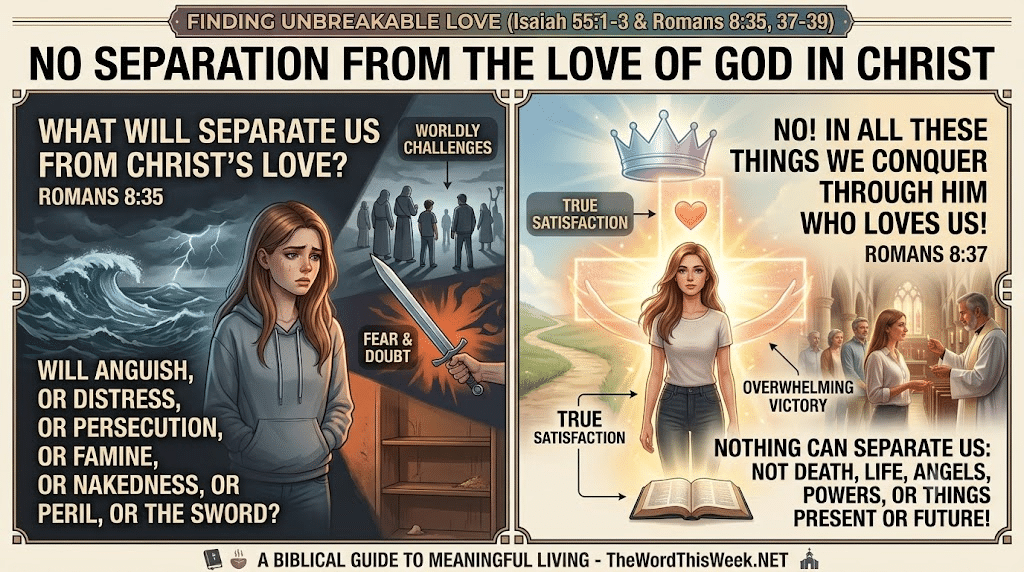
What discourages you the most? What can help you overcome your discouragement?
Commitment divides the weak from the strong. Can you stay with it? The answer to this question trumps any notion of personal strength as power. The bully can get his way sometimes. The self-centered will find a way, sometimes. But, the committed person will win out over the bully or the self-seeking just by shear tenacity. The true believer’s stubbornness has far more staying power than those who seek advantage for the moment.
For Paul, faith was the ultimate commitment, for it envisioned an intimate place with God beyond death. If eternal life was the goal, everything else paled in comparison. The sufferings of life, the lack of necessities, even the threat of death could not stop the believer. This was true because the causes of these miseries were secondary: the limitations of life and death, present and future events, physical and spiritual power in creation, not even the universe itself could stop the love of God made manifest in Christians. Our place, the place of all who trust God, lay in his everlasting presence. Faith convinces us of that fact.
Paul was right: faith is the ultimate commitment. It is an orientation to that beyond this life and its demise. As long as we affirm that commitment, we will trust God to brush away all obstacles. Nothing will get in the way!
How has God eliminated personal obstacles? How does your faith in God help you when you feel down? When you look to the future with the Lord, do you find yourself lifted up?
18th Sunday of Year A
Create a simple, modern infographic illustrating [INSERT BIBLE PASSAGE OR TOPIC]. Use a [SPLIT-SCREEN / 3-PANEL] layout. The style should be clean, high-quality digital art or vector illustration.
Visuals:
Panel 1: Show [DESCRIBE SCENE 1 – e.g., a stormy sea].
Panel 2: Show [DESCRIBE SCENE 2 – e.g., Jesus calming the waves].
Text & Typography:
Font: Use EXTRA LARGE, BOLD, SANS-SERIF FONT (like Arial). Ensure high contrast so text is easily readable.
Header: Write “[INSERT MAIN TITLE]” at the top.
Captions: Include short, punchy text summaries in the panels: “[TEXT FOR PANEL 1]” and “[TEXT FOR PANEL 2]”.
Overall Vibe: Professional, educational, and uncluttered. Avoid small details; focus on big images and big text.

Matthew 14:13-21
Write an engaging description meant to get readers to read Larry Broding’s commentary which can be used to help preachers prepare their own homily. After a brief introduction give bulletin points of why this commentary matters for your homily. conclude with “Read Larry Broding’s full commentary to help your congregation…” Complete sentence. XXXXXXXXXXXXXXXXXXXXXXX
Create a verse by verse (NAB) commentary relating xxxxxxxxxxxxx TO CATHOLIC doctrine and practice. Give real life applications when appropriate
give me three thought provoking questions followed up with detailed answer reflection based on xxxxxxxxxxxx
The Miracle of the Multiplication of the Loaves and Fishes (Matthew 14:13–21) is one of the foundational narratives across the Gospels. While it displays Christ's deep human compassion, the Catholic Church has always read this miracle as an explicit, undeniable prefiguration of the Holy Sacrifice of the Mass and the Sacrament of the Holy Eucharist.
Here is a verse-by-verse commentary mapping Matthew 14:13–21 to Catholic doctrine, liturgical practice, and daily life.
Matthew 14:13–14
"When Jesus heard of it, he withdrew in a boat to a deserted place by himself. The crowds heard of this and followed him on foot from the towns. When he disembarked and saw the vast crowd, his heart was moved with pity for them, and he cured their sick."
Catholic Doctrine: The Heart of the Divine Physician
- The Context of Grief and Rest: Jesus had just heard of the brutal execution of his cousin, John the Baptist. He seeks a "deserted place" (erēmos topos) for prayer and mourning. Yet, when the crowds interrupt His rest, His response is not frustration, but deep, visceral compassion (splagchnizomai—moved from the depths of His gut).
- Christ as the Source of Healing: Before He feeds their bodies, He heals their infirmities. In Catholic theology, Christ is the Divine Physician who treats the entire human person—body, mind, and spirit. The Church continues this dual mission today through her extensive network of charitable healthcare institutions and the Sacrament of the Anointing of the Sick.
Real-Life Application:
- Prioritizing People Over Programs: It is incredibly easy to treat people as interruptions to our schedules or burdens on our energy.
- The Practice: When a family member, neighbor, or stranger disrupts your "deserted place" or planned quiet time with a genuine need, consciously pray for the grace to see them through the eyes of Christ. Let your heart be "moved with pity" rather than annoyance, recognizing that charity always takes precedence over our personal schedules.
Matthew 14:15–16
"When it was evening, the disciples approached him and said, 'This is a deserted place and it is already late; dismiss the crowds so that they can go to the villages and buy food for themselves.' Jesus said to them, 'There is no need for them to go away; give them some food yourselves.'"
Catholic Doctrine: Co-Responsibility and Human Cooperation with Grace
- The Poverty of Human Logic: The disciples operate out of a mindset of scarcity. They want to dismiss the crowd because, humanly speaking, the logistics are impossible.
- The Call to Action: Jesus challenges them: "Give them some food yourselves." Catholic doctrine emphasizes the necessity of human cooperation with divine grace. God rarely acts entirely apart from human instruments. While Jesus possesses the divine power to create bread from nothing, He chooses to demand the disciples' meager resources and active participation. This forms the basis of the Catholic understanding of stewardship and our moral obligation to feed the hungry (the first Corporal Work of Mercy).
Real-Life Application:
- Answering the "Impossible" Call: When confronted with massive issues—like parish volunteer shortages, systemic poverty in your city, or deep division within your own family—the temptation is to pass the buck and say, "Let someone else handle it."
- The Practice: Never underestimate what God can do with your meager efforts. When you feel unequipped for a spiritual or charitable task, step up anyway. Bring whatever small amount of time, talent, or treasure you have, trusting that Christ's command to act comes with the grace to sustain it.
Matthew 14:17–18
"But they said to him, 'Five loaves and two fish are all we have here.' Then he said, 'Bring them here to me,'"
Catholic Doctrine: The Matter of the Sacrament & The Offertory
- Sacramental Matter: The specific elements brought forward—loaves of bread—point directly to the physical matter required for the valid celebration of the Eucharist. In the Catholic Church, the Sacraments always use tangible, earthly elements (water, oil, bread, wine) raised up by divine power to convey supernatural life.
- The Offertory at Mass: This dynamic is replicated at every single Catholic Mass during the Presentation of the Gifts (The Offertory). The faithful bring forward simple bread and wine, which represent the "fruit of the earth and work of human hands." By presenting them to the priest, the parish community collectively says to Christ, "This is all we have here."
Real-Life Application:
- Surrendering Your Smallness: We often withhold our lives from God because we feel our gifts are too insignificant to matter.
- The Practice: During the Offertory at Sunday Mass, as the bread and wine are carried down the aisle, mentally place your personal "five loaves and two fish" on the altar. Offer up your micro-victories, your current anxieties, your financial stress, and your limitations. When Jesus says, "Bring them here to me," He is asking you to hand over control of your inadequate resources so He can transform them.
Matthew 14:19
"and he ordered the crowds to sit down on the grass. Taking the five loaves and the two fish, and looking up to heaven, he said the blessing, broke the loaves, and gave them to the disciples, who in turn gave them to the crowds."
Catholic Doctrine: The Eucharistic Action and the Ministerial Priesthood
- The Four Eucharistic Verbs: Pay exact attention to the four verbs Jesus uses here: He took, blessed (said the blessing), broke, and gave. These are the identical four verbs used at the Last Supper (Matthew 26:26) and repeated by the priest at every single Mass during the Consecration. This is the structural blueprint of the Liturgy of the Eucharist.
- The Ministerial Priesthood: Notice the distribution pattern: Jesus does not hand the bread directly to the crowds. He gives the transformed bread to the disciples, and the disciples distribute it to the people. In Catholic ecclesiology, this prefigures the Holy Orders and the role of the priest. The priest acts in persona Christi (in the person of Christ) to consecrate the bread, but he relies on the ministers of the Church to feed the flock.
Real-Life Application:
- Deepening Mass Attendance: It is easy to view the Mass as a boring weekly obligation or a simple community gathering.
- The Practice: The next time you watch the priest break the large host over the chalice (the Fraction Rite), remember this hillside in Galilee. Recognize that the exact same divine action is occurring: the bread of life is being broken to feed a spiritually starving world. Approach the Communion rail with the same awe and hunger as the crowds sitting on the grass.
Matthew 14:20–21
"They all ate and were satisfied, and they picked up the fragments left over—twelve wicker baskets full. Those who ate were about five thousand men, not counting women and children."
Catholic Doctrine: The Superabundance of Grace & The Sacred Fragments
- Eucharistic Satisfaction: The text notes that they were not merely given a snack; they were satisfied. The Eucharist is the ultimate fulfillment of our spiritual hunger, granting a peace that the secular world cannot replicate.
- The Care for the Fragments (Eucharistic Reverence): The collection of the twelve remaining baskets highlights a vital Catholic doctrine: The Real Presence. Because Catholics believe that Jesus is truly, substantially present in the Eucharist—even in the smallest particle—the Church treats the consecrated species with absolute reverence.
- This is why the priest carefully cleanses the sacred vessels (the ablution) after Communion, ensuring that no "fragments" of Christ's Body or Blood are discarded or treated carelessly.
- The Twelve Baskets: The number twelve represents the twelve tribes of Israel and the Twelve Apostles, signaling that the Church has a superabundance of grace capable of feeding the entire world across all generations.
Real-Life Application:
- Showing Exterior and Interior Reverence: If the fragments of this miraculous bread were meticulously gathered, how much more carefully should we treat the true Body of Christ?
- The Practice: Assess your habits regarding receiving Holy Communion.
- If you receive Christ in your hand, ensure you inspect your palms immediately to check for any tiny fragments of the Host, consuming them reverently.
- Observe the Eucharistic fast (abstaining from food or drink except water or medicine for one hour before Communion) to prepare your body and soul to be truly satisfied by the Heavenly Banquet.
Algorithmically generated text
"But they said to him, 'Five loaves and two fish are all we have here.' Then he said, 'Bring them here to me,'" (Matthew 14:17–18)
The disciples looked at the crowd, looked at their inventory, and did the math. Their calculation wasn't wrong—it was just incomplete. They operated from a mindset of scarcity, a deeply human survival mechanism that tells us if we don’t have enough to solve a problem completely, we shouldn't bother trying to solve it at all. We do this constantly in our own lives: we withhold our time, our money, or our emotional energy because we feel our small contributions won't make a dent in the massive problems around us.
Jesus completely upends this logic. He doesn't look at the five loaves and two fish and say, "You're right, that's pathetic, let's wait until we have more." He says, "Bring them here to me."
The lesson here is that God does not demand that we possess total adequacy before we act; He demands our availability. The miracle doesn't happen in a vacuum; it requires the vulnerability of handing over what little we have. When we stop staring at what we lack and instead offer what we have, we give the Divine space to multiply our meager efforts. Your small gesture of kindness, your imperfect apology, or your modest donation doesn't need to be enough on its own—it just needs to be placed in His hands.
The Calculation of Adequacy
The Scarcity Calculation(The Human Survival Mechanism) | The Logic of Availability(The Divine Multiplication) |
The Internal Process Staring at the massive scope of the problem, looking at our tiny inventory, and doing the math. | The Radical Command Jesus acknowledging the small offering without judgment and saying, "Bring them here to me." |
The Paralyzing Conclusion Believing that if our resources cannot solve the problem completely, it isn't worth trying at all. | The Liberating Truth God does not demand total personal adequacy before we act; He simply asks for our raw availability. |
The Action Taken Withholding our time, money, or emotional energy because we assume a small contribution won't make a dent. | The Action Taken Embracing the vulnerability of handing over what little we have, giving the Divine the space to multiply it. |
The Underlying Fear Protecting our limited supply out of fear that giving it away will leave us entirely empty and exposed. | The Spiritual Reality Realizing that an imperfect apology, small gesture, or modest donation becomes completely sufficient once placed in His hands. |
The Core Takeaway: Your small contribution doesn't need to be enough on its own—it just needs to be placed in His hands. The miracle of multiplication never happens in a vacuum; it requires the courage to stop staring at what we lack and start offering what we have.
Algorithmically generated text
"When Jesus heard of it, he withdrew in a boat to a deserted place by himself. The crowds heard of this and followed him on foot... When he disembarked and saw the vast crowd, his heart was moved with pity..." (Matthew 14:13–14)
It is easy to gloss over the emotional weight of verse 13. Jesus had just learned that his cousin and forerunner, John the Baptist, had been brutally murdered. He was grieving, exhausted, and explicitly trying to escape to a "deserted place" for solitude. Humanly speaking, He had every right to turn the boat around or tell the crowds to go away. Yet, when He sees the people waiting for Him, His response isn't irritation at being interrupted; it is deep, gut-level compassion.
Most of us treat interruptions as hostile invasions of our time. We structure our lives for maximum efficiency and personal comfort, and when a crisis, a needy neighbor, or a demanding family member breaks through our boundaries, our initial reaction is often resentment.
This passage challenges us to rethink the architecture of our days. Jesus demonstrates that the interruption is often the actual mission. True spiritual maturity is the ability to pivot from our legitimate personal needs to the immediate needs of the person standing in front of us. It doesn't mean we never rest, but it asks us to remain pliant enough that when love requires us to change our plans, we can do so without bitterness.
The Architecture of Interruption
The Efficiency Trap(Protecting Our Plans) | The Pliant Heart(Embracing the Mission) |
The Human Context Structuring days for maximum personal efficiency, predictable comfort, and rigid schedules. | The Divine Context Jesus navigating profound grief, emotional exhaustion, and a legitimate need for solitude after John's death. |
View of Interruptions Treating unexpected demands as hostile invasions of our time and personal space. | View of Interruptions Recognizing that the sudden disruption or the person in front of us is often the actual mission. |
The Initial Reaction Resentment, irritation, or emotional withdrawal when needy neighbors or crises break our boundaries. | The Initial Reaction Deep, gut-level compassion (splanchnizomai) that moves outward instead of turning inward. |
The Spiritual State A brittle faith that fractures under inconvenience, valuing the schedule over the soul. | The Spiritual State True spiritual maturity—the capacity to pivot from our own needs to love others without bitterness. |
The Core Takeaway: Jesus demonstrates that true spiritual maturity isn't the absence of boundaries, but the willingness to let love break them. When we remain pliant enough to alter our plans without bitterness, we stop seeing interruptions as obstacles and start seeing them as the very places God is working.
Algorithmically generated text
"...he said the blessing, broke the loaves, and gave them to the disciples, who in turn gave them to the crowds." (Matthew 14:19)
Jesus could have easily made bread rain down from heaven directly into the mouths of the five thousand, bypassing the disciples entirely. It would have been cleaner, faster, and left no room for human error. Instead, He meticulously involves the very disciples who had just advocated for sending the crowds away hungry. He breaks the bread, but they have to distribute it.
This reveals a foundational truth about how God chooses to operate in the world: He values co-responsibility. God rarely works apart from human agency. He invites us into the messy, exhausting work of mediation.
Think about the weight of being a disciple in that moment. You walk into a crowd of thousands with a tiny piece of bread in your hand, probably feeling ridiculous, only to watch it multiply as you hand it off. God wants us to experience the thrill and the terror of being the vessels through which His care reaches other people. It forces us to stay humble, because we know we didn't manufacture the bread, but it also gives us immense dignity, because we realize that God chose our hands to feed His world.
Which of these three dynamics—overcoming a scarcity mindset, handling life's unexpected interruptions, or stepping into the role of being a mediator for others—feels the most relevant to the challenges you are personally navigating right now?
The Dynamic of Mediation
The Fantasy of Direct Exemption(Bypassing Human Agency) | The Reality of Co-Responsibility(The Messy Work of Mediation) |
The Visual Bread raining down directly from heaven into the mouths of the crowd—clean, fast, and completely bypassing human error. | The Visual Jesus breaking the bread, but handing it to imperfect disciples who must physically carry it into a massive crowd. |
The Human Role Remaining passive consumers or spectators who watch a miracle occur from a safe distance. | The Human Role Stepping forward as active vessels, experiencing the thrill and terror of holding a small resource that multiplies in action. |
The Comfort Level Convenient, predictable, and entirely free from the exhaustion or messiness of dealing with people. | The Comfort Level Highly vulnerable; forces us to overcome a scarcity mindset and step directly into unexpected interruptions. |
The Internal Result A small, self-focused perspective that misses out on the creative, expanding work of God's Kingdom. | The Internal Result Immense personal dignity combined with deep humility—knowing we didn't create the bread, but our hands were chosen to distribute it. |
The Core Takeaway: God rarely works entirely apart from human agency; He values co-responsibility. True spiritual maturity means stepping out of the role of a passive observer and embracing the messy, exhausting, and deeply dignifying work of being a conduit for His care.
Algorithmically generated text
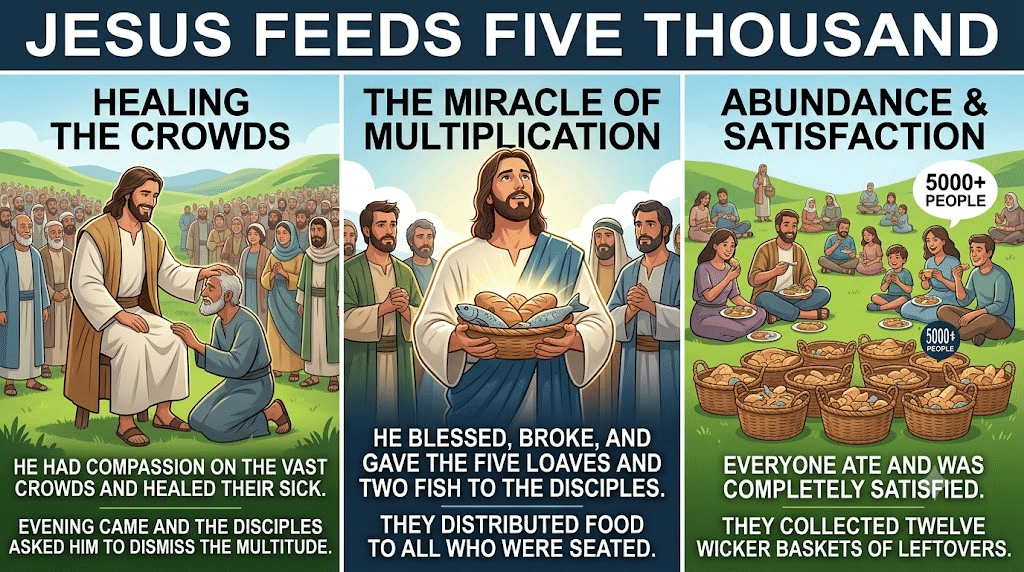
What was the last truly memorable meal you ate? Why does the memory stand out?
Since the beginning of civilization, meals have signified a time of social interaction. We meet friends for lunch, spend quality time as a family at dinner, and honor community leaders with banquets. While the different meals require different dress, manners, and conversation, every meal can begin or deepen relationships.
What turns a simple meal into an event, something that people talk about for years afterwards? Jesus created such an event when he took food for two and fed over five thousand people.
The multiplication of the loaves and fish can be divided into two scenes: the gathering and the test of the disciples, and the miracle itself…
Jesus took the bread and fish, looked up to heaven, spoke the eulogos (Greek for “well spoken words”). Mentioning his body posture, Matthew implied Jesus pronounced a blessing prayer for bread like this one: Blessed are you, Lord God, King of the Universe, who brings forth bread from the earth. (Blessing for Matzoh from a Passover Haggadah)
Notice who was blessed in the prayer: God the creator. Also notice God was praised for the production of bread, a human activity. While God provided the grain, humans harvest and mill the grain; humans prepare and bake the bread. The prayer, however, assumed God’s activity included the cooperation of humanity. In other words, God produced the bread; humans only cooperated in the effort. In the Jewish mind, people should only bless the all-powerful God for the food before them. And they should bless God in the spirit of gratitude.
After the blessing, Jesus had the followers distribute their food, and the distribution produced an abundance of twelve baskets. In this context, the number twelve had many powerful symbolic references. The number also represented the twelve tribes of Israel. The audience symbolized the gathered nation. The number represented the apostles (a basket for each) who served them. Finally, the number itself represented fullness or completion in the Jewish imagination. The event itself and its results possessed fullness. The gathered tribes, the servants, and the event point toward the fullness of time in God’s Kingdom, when the chosen would feast in the presence of the Lord. [14:19-20]
The multiplication of the loaves contained many Eucharistic overtones. The Lord called the faithful to a life-giving meal. At the meal, the faithful recognize the little they have came from God himself. The Lord would bless what the faithful offered and that small amount would provide an overabundance. Finally, the results of the meal pointed to the coming Kingdom. This was (and is) the miracle of Christian worship.
What little to do you bring to the Lord? What abundance does he give you in return?
Video courtesy of Larry Broding.
Sunday Prep Videos
18th Sunday of Year A