Commentary Intro to Mass Readings Sunday Readings
CommentaryIntro to Mass Readings Sunday Readings
August 9, 2026
⭐⭐⭐ Hearers of the Word—PDF | VIDEO


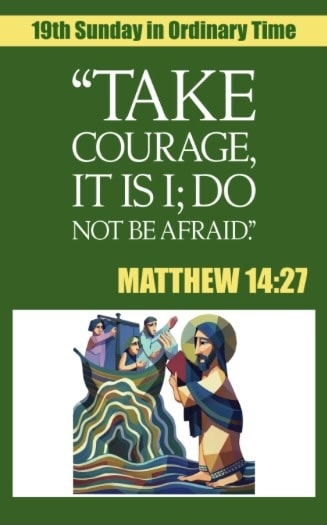
August 9, 2026
Our Sunday Readings *
Edrianne Ezell
Scripture Study for Catholics *
Vince Contreras
Hearers of the Word *
Fr. O’Mahony OSA
Friar Musings, OFM *
Fr. George Corrigan, OFM
Echoing God’s Word *
Fr. Clement Thibodeau


“A Walk in The Word” series is based on the Sunday Mass readings and led by International Catholic evangelist and bible teacher, Hector Molina.

Ten minute video excerpts from the “The Mass Readings Explained” subscription series based resource from Catholic Productions.

Francis Martin (1930 – 2017) was an American Catholic priest of the Archdiocese of Washington, and a professor of Sacred Scripture. His teaching appointments included the Dominican House of Studies, the John Paul II Institute, the Catholic University of America, and Sacred Heart Major Seminary.
Kevin Aldrich
Kevin Aldrich’s “Doctrinal Homily Outlines” is a lectionary-based aid for homilists. A career Catholic K-12 educator in Catholic schools., he has written the teacher guides for nine of the Didache series high school religion texts. He has a Master’s Degree in Theology with an emphasis on Sacred Scripture from Holy Apostles College and Seminary.
19th Sunday of Year A
Create a simple, modern infographic illustrating [INSERT BIBLE PASSAGE OR TOPIC]. Use a [SPLIT-SCREEN / 3-PANEL] layout. The style should be clean, high-quality digital art or vector illustration.
Visuals:
Panel 1: Show [DESCRIBE SCENE 1 – e.g., a stormy sea].
Panel 2: Show [DESCRIBE SCENE 2 – e.g., Jesus calming the waves].
Text & Typography:
Font: Use EXTRA LARGE, BOLD, SANS-SERIF FONT (like Arial). Ensure high contrast so text is easily readable.
Header: Write “[INSERT MAIN TITLE]” at the top.
Captions: Include short, punchy text summaries in the panels: “[TEXT FOR PANEL 1]” and “[TEXT FOR PANEL 2]”.
Overall Vibe: Professional, educational, and uncluttered. Avoid small details; focus on big images and big text.

1 Kgs 19:9a, 11-13a
Create a verse by verse (NAB) commentary relating xxxxxxxxxxxxx TO CATHOLIC doctrine and practice. Give real life applications when appropriate
give me three thought provoking questions followed up with detailed answer reflection based on xxxxxxxxxxxx
Scripture Passage & Event | Primary Catholic Doctrine / Spiritual Tradition | Real-Life Application |
Cave & Solitude (1 Kgs 19:9a) | Interiority & Desert Spirituality Solitude and retreat are necessary to quiet the soul before divine revelation. | Establish a daily "cave" of silence—15 minutes without digital distractions or background noise to pray. |
Wind, Earthquake & Fire (1 Kgs 19:11–12a) | Discernment of Spirits & God’s Transcendence God cannot be reduced to emotional highs, raw power, or spectacular phenomena. | Avoid measuring faith solely by feelings or emotional "highs." Trust God's presence during seasons of spiritual dryness. |
Light Silent Sound (1 Kgs 19:12b) | Eucharistic Presence & Divine Gentleness God reveals Himself in humility and quiet, prefiguring Christ hidden in the Eucharist. | Spend time in quiet Eucharistic Adoration, listening for God's gentle promptings in your conscience. |
Elijah Veils His Face (1 Kgs 19:13a) | Holy Fear (Timor Domini) & Reverence Filial awe and respect when standing in the presence of the infinite, sacred God. | Approach the Sacraments (especially Mass and Confession) with conscious physical and spiritual reverence. |
1 Kings 19:9a
"There he came to a cave, where he took shelter."
- Doctrinal & Spiritual Context: Elijah retreats to Horeb—the same mountain where God revealed the Law to Moses. In Catholic spiritual theology, Elijah’s cave represents the necessity of interiority, silence, and desert spirituality (the interior castle or spiritual retreat). Before God reveals Himself, the soul often needs a space of solitude away from the noise and anxieties of the world.
- Real-Life Application:
- Sacred Silence & Retreats: Make time for regular quiet prayer—whether through a weekend retreat, a holy hour in Adoration, or simply 15 minutes of quiet time without phones or distractions. God meets us when we step into our own "cave" of quiet reflection.
1 Kings 19:11
"Then the LORD said: Go out and stand on the mountain before the LORD; the LORD will pass by. There was a strong and violent wind rending the mountains and crushing rocks before the LORD—but the LORD was not in the wind. After the wind, an earthquake—but the LORD was not in the earthquake."
- Doctrinal & Spiritual Context:
- The Transcendence & Immanence of God: While God often manifests His power through spectacular nature imagery in the Old Testament (the theophanies of Exodus), this passage teaches that God cannot be reduced to earthly power, sensationalism, or raw emotion.
- Discernment of Spirits: Catholic mystical tradition (e.g., St. John of the Cross, St. Ignatius of Loyola) warns against relying on dramatic emotional highs or sensory experiences in prayer. God is present even when spiritual experiences feel calm, ordinary, or dry.
- Real-Life Application:
- Faith Beyond Emotion: Don't measure your relationship with God purely by "feeling" His presence or seeking grand, miraculous signs. True faith trusts that God is present in everyday duties, even when life feels calm or dry.
1 Kings 19:12
"After the earthquake, fire—but the LORD was not in the fire. After the fire, a light silent sound." (Note: often translated as "a still, small voice" or "a gentle whisper")
- Doctrinal & Catholic Practice:
- The Real Presence & Sacramental Hiddenness: This "light silent sound" (kol demamah dakkah) foreshadows the hiddenness of God in the Eucharist. Christ does not arrive in power and thunder on the altar; He comes under the humble, quiet appearances of bread and wine.
- The Holy Spirit & Prayer: The Catechism of the Catholic Church notes that God reveals Himself in gentleness and quiet whisper. The Holy Spirit prompts the conscience quietly rather than forcing belief.
- Eucharistic Adoration: Sitting silently before the Blessed Sacrament mirrors Elijah standing outside the cave—waiting on the quiet, real presence of the Lord.
- Real-Life Application:
- Cultivating Quiet Conscience: In a world filled with constant noise, social media, and outrage, learn to listen for God’s "silent sound" through daily examination of conscience and silent Eucharistic Adoration.
11 Kings 19:13a
"When Elijah heard it, he wrapped his face in his cloak and went out and stood at the entrance of the cave."
Doctrinal & Spiritual Context:
- Reverence and Holy Fear (Timor Domini): Wrapping his face in a mantle shows Elijah’s profound reverence and holy awe before the majesty of God. In Catholic tradition, this fear of the Lord is not terror, but deep filial respect for God’s holiness (one of the Seven Gifts of the Holy Spirit).
- Liturgical Reverence: This gesture mirrors liturgical reverence in the Catholic Mass—genuflecting before the tabernacle, bowing during the Creed, or maintaining a respectful posture when receiving Holy Communion.
Real-Life Application:
- Approaching the Sacred: Bring a sense of reverence to your prayer life and worship. When entering a church or approaching the Sacraments (especially Confession and the Holy Eucharist), take a moment to pause, collect your thoughts, and recognize whose presence you are standing in.
Algorithmically generated text
give me three thought provoking questions followed up with detailed answer reflection based on xxxxxxxxxxxx
In 1 Kings 19, Elijah witnesses three massive displays of natural power: a rock-shattering wind, a violent earthquake, and a roaring fire. In ancient Near Eastern cultures, these cosmic events were classic markers of divine revelation. Yet the text explicitly notes: "the Lord was not in the wind... the Lord was not in the earthquake... the Lord was not in the fire." Instead, God revealed Himself in a “light silent sound”—a gentle whisper.
We often condition ourselves to look for God only in dramatic, life-altering moments—emotional breakthroughs, sudden answers to prayer, or crisis situations. But God frequently chooses to communicate in subtle, gentle ways through a quiet voice in prayer, the voice of conscience, or the humble hiddenness of the Eucharist.
If our daily lives are saturated with constant digital noise, notifications, and inner anxiety, we risk completely missing His whisper. Elijah had to journey to a cave in the wilderness to hear God. To hear the "still, small voice," we must intentionally retreat into our own "cave" of silence—whether through a daily holy hour, quiet Eucharistic Adoration, or simply setting aside un-plugged time every morning to listen rather than just speak.
Key Takeaways for Practice
- Shift Your Focus: Stop measuring God’s presence by the intensity of your feelings or circumstances.
- Create Boundaries: Establish daily "digital fasts" to keep notifications and noise from overwhelming your inner peace.
- Practice Active Listening: In prayer, balance your vocal requests with times of total silence, giving God the space to whisper to your heart.
Listening for the "Light Silent Sound": From Horeb to Daily Life
Aspect | The Dramatic Display | The Gentle Whisper |
Manifestation in 1 Kings 19 | Rock-Shattering Wind, Earthquake, Fire Sensational, cosmic displays of natural power expected in ancient Near Eastern divine encounters. | "Light Silent Sound" (Kol Demamah Dakkah) A subtle, gentle whisper where God truly chose to reveal His presence to Elijah. |
Our Human Expectations | Seeking God only in dramatic moments: emotional breakthroughs, crisis situations, or sudden, obvious answers to prayer. | Expecting God in the ordinary and hidden: a subtle inner prompt, the quiet voice of conscience, or regular personal prayer. |
Modern Obstacles | Constant Noise & Distraction Digital notifications, constant media consumption, busy schedules, and internal anxiety that drown out quietness. | Receptivity & Interior Quiet Slowing down the mind and heart to listen rather than constantly demand, speak, or react. |
Catholic Theological Connection | Sensory & Emotional Dependency Relying solely on "spiritual highs" or intense emotional feelings as proof of God’s active presence. | The Eucharistic Mystery & Interiority Recognizing God in the ultimate hiddenness of the Blessed Sacrament and the quiet movement of grace. |
Entering the "Cave" of Silence | Expecting God to interrupt our noisy, uncurated schedules with grand, unprompted signs. | Intentional Retreat Setting aside dedicated, "unplugged" time daily—such as a morning holy hour or quiet Eucharistic Adoration—to simply listen. |
Algorithmically generated text
Elijah had just come off a sensational victory at Mount Carmel (1 Kings 18), where fire fell from heaven in front of the whole nation. Yet shortly after, exhausted and fleeing for his life, he ended up cowering in a cave. When God passed by, He deliberately detached Elijah’s expectation of His presence from spectacular sensory phenomena (wind, earthquake, fire) and led him into a quiet, almost imperceptible encounter.
In Catholic mystical tradition—most notably articulated by St. John of the Cross and St. Ignatius of Loyola—there is a critical distinction between the consolation of God and the God of consolation. When we are new in faith or experiencing spiritual renewal, God often grants dramatic emotional feelings of His presence. However, mature faith requires moving past sensory dependency.
When prayer feels dry, unimpressive, or silent, it does not mean God is absent. God often uses seasons of quiet and "spiritual dryness" to purify our motives, teaching us to love Him for who He is rather than for the spiritual "highs" or emotional comfort He provides. True faith trusts that He is fully present in the quiet and routine, even when the wind and fire have passed.
Key Spiritual Lessons
- Distinguish the Gift from the Giver: Seek the Lord Himself rather than just the pleasant emotions He produces in your heart.
- Persevere in Dryness: When prayer feels unimpressive or silent, view it as an invitation to mature rather than a reason to retreat.
- Anchor in the Routine: Trust that God works just as deeply in quiet, everyday fidelity as He does in moments of dramatic spiritual renewal.
Moving Beyond Sensory Dependency: From Carmel to Horeb
Aspect | Sensory & Emotional Faith | Mature & Purified Faith |
Elijah’s Experience | Victory at Mt. Carmel (1 Kgs 18) Fire falling from heaven, obvious public triumph, and dramatic sensory proof of God’s power. | The Quiet Cave at Horeb (1 Kgs 19) Exhausted, stripped of dramatic signs, and encountering God in an almost imperceptible whisper. |
Mystical Tradition Connection | "The Consolation of God" Enjoying the warm feelings, emotional breakthroughs, and tangible sweetness that God often gives early in spiritual life. | "The God of Consolation" Loving God for Who He is in Himself, regardless of whether He grants emotional comfort or felt sweetness. |
Spiritual Maturity Stage | Sensory Dependency Relying on emotional "highs," dramatic answers, or constant spiritual feelings as validation of God’s presence and favor. | Purified Intentions Trusting God’s abiding presence through pure faith, obedience, and commitment, even in the routine and quiet. |
Understanding "Spiritual Dryness" | Mistaken View: Interpreted as God’s absence, abandonment, personal failure, or a sign that prayer "isn't working." | Catholic Mystical View (St. John of the Cross): A necessary purification used by God to detach the soul from spiritual self-interest. |
Practical Response in Prayer | Chasing new spiritual highs, switching devotions constantly out of boredom, or abandoning quiet prayer when it feels dry. | Persevering in routine prayer, remaining faithful to duty, and resting in faith without demanding emotional proof. |
Algorithmically generated text
Upon recognizing the Lord’s presence in the light, silent sound, Elijah immediately “wrapped his face in his cloak and went out and stood at the entrance of the cave.” Veiling his face was an act of profound reverence and holy fear (timor Domini)—an acknowledgement that a finite, sinful human creature is standing on holy ground before the infinite, holy God.
In a modern culture that often prioritizes casualness, informality, and immediate self-expression, Elijah’s gesture challenges us to recover a deep sense of sacred awe. Holy fear is not terror or dread of punishment; it is the filial reverence of a child who deeply loves their Father and stands in wonder at His majesty.
This translates directly into how we approach the sacred in our daily life and liturgical practice. Do we approach prayer, the Scriptures, and especially the Sacraments with intentionality and reverence? When we step into a church or prepare to receive the Eucharist, recognizing that Christ is truly present under the humble, quiet forms of bread and wine should evoke in us the same inward response as Elijah: a quiet, awe-filled pause, a physical or spiritual "wrapping of the face," acknowledging that we are standing before the Lord of Heaven and Earth.
Key Takeaways for Practice
- Redefine Holy Fear: Understand timor Domini not as dread of punishment, but as a deep, loving awe that guards our respect for God's holiness.
- Practice the "Quiet Pause": Before entering a church, beginning prayer, or stepping up to receive Holy Communion, take a brief moment to collect your thoughts and intentionally place yourself in God's presence.
- Align Exterior with Interior: Use reverent physical gestures—such as a deliberate genuflection, bowing your head, or maintaining respectful silence—to anchor your mind in sacred awe.
The Posture of Recovering Sacred Awe: From Elijah’s Cloak to Modern Practice
Aspect | Modern Secular / Casual Mindset | Sacred Awe & Holy Fear (Timor Domini) |
Elijah’s Gesture | Standing barefaced, demanding proof or addressing the Divine as an equal. | Wrapping His Face in His Cloak (1 Kgs 19:13a) An act of profound reverence acknowledging human finitude before the infinite God. |
Core Attitude | Casualness & Self-Expression Prioritizing personal comfort, informality, and immediate emotional self-expression above all else. | Filial Reverence & Wonder The loving awe of a child standing before a majestic Father; a gift of the Holy Spirit rather than terror or dread. |
Approach to Sacred Spaces | Viewing a church or sanctuary as merely a social gathering hall or an ordinary public space. | Recognizing Holy Ground Entering with intentionality, maintaining a quiet, awe-filled pause, and acknowledging God's unique presence. |
Liturgical & Sacramental Practice | Approaching the Sacraments casually out of habit or routine without interior preparation. | Physical & Spiritual "Veiling" Preparing the heart for Mass, genuflecting with intention, and receiving the Eucharist with deep interior and exterior reverence. |
Engagement with Scripture & Prayer | Treating prayer and Scripture reading as casual, transactional background tasks. | Standing Before the Lord Approaching prayer and the Word with quiet attentiveness, acknowledging that the Lord of Heaven and Earth is speaking. |
Algorithmically generated text


Write an engaging description meant to get readers to read Larry Broding’s commentary which can be used to help preachers prepare their own homily. After a brief introduction give bulletin points of why this commentary matters for your homily. conclude with “Read Larry Broding’s full commentary to help your congregation…” Complete sentence.
The Whisper of God

Read Larry Broding’s full commentary to help your congregation hear God’s voice even in the quietest moments.
In a world filled with noise and high-pressure demands, Larry Broding’s commentary offers an insightful, deeply reflective dive into Elijah’s journey to Mount Sinai (1 Kings 19). Uncovering rich theological layers, Broding illuminates a pivotal moment in salvation history that will strongly resonate with your parish community.
While fleeing a royal death sentence, the exhausted prophet sought sanctuary at the holy mountain, likely expecting a grand, dramatic encounter with the Almighty. Yet, God did not reveal Himself in the traditional, thunderous Exodus symbols—the roaring wind, the terrifying earthquake, or the consuming fire. Instead, the Lord made His presence known in a faint, gentle whisper, precisely where Elijah least expected it.
Broding’s commentary unwraps this classic text with precision, giving you the historical grounding and pastoral hooks needed to craft a homily that speaks directly to modern listeners who are searching for God amidst their own personal pressures, noisy routines, and quiet struggles.
Why This Commentary Matters for Your Homily
- Historical & Pilgrimage Context: Unpacks Elijah’s journey as both a desperate refugee and a pilgrim, providing rich background details to paint a vivid picture for your listeners.
- Reframing Divine Expectations: Contrasts the grand Exodus symbols of wind, earthquake, and fire with the faint whisper, giving you a powerful pivot for preaching on how God actually works in our daily lives.
- Pastoral Application for the Hurting: Connects Elijah’s state of being under pressure to the struggles of your congregation, showing how God reveals Himself on His terms, not ours.
- Encouragement to Patient Waiting: Offers a clear, actionable spiritual takeaway on quiet trust and waiting for God’s voice when life feels overwhelming.

Commentary by Fr. Francis Martin | The Word Proclaimed
clean up grammar and spelling, create an outline for the following transcript Transcript xxxxxxxxxxxx
Introduction: The Theme of Divine Quietude
This reflection examines the First Reading alongside the Psalm and Gospel. While connecting these texts can seem challenging, the First Reading traditionally serves to prepare us for the Gospel.
Today's passage focuses on Elijah’s experience at the cave on Mount Horeb—navigating the violent storm, the earthquake, and the fire, before ultimately encountering Adonai in the quiet. In contrast, the Gospel depicts the storm at sea, where Peter walks on water and receives a divine revelation from Jesus.
The underlying theme curated for this liturgy is quiet—not inertia, but divine peace. In a world where people constantly worry about the economy and daily burdens, God invites His people to find peace. In both readings, when Adonai speaks—whether pulling Peter from the water or speaking to Elijah—He invites us out of fear and into trusting silence.
The Identity and Struggle of the Prophet
We begin with Elijah (Eliyahu), whose name translates to "My God is Yahweh." His very name proclaims that Adonai alone is God, establishing him as a foundational figure in prophecy. He famously confronted the 400 prophets of Baal, demonstrating Adonai's power.
Yet, being called to a prophetic role often makes one an outlier. Today, when many place their trust in world governments, Christians proclaim that salvation comes through Jesus Christ, the living Son of God. Though the world may view this truth as outmoded, Christ is alive and actively working in our lives.
Having fled for his life, Elijah arrives at a cave on Mount Horeb. There, the word (dabar) of Adonai comes to him:
"What are you doing here, Elijah?"
Elijah responds with exhaustion and zeal:
"I have been full of jealous zeal for Adonai Sabaoth, because the Israelites have abandoned Your covenant, torn down Your altars, and put Your prophets to the sword. I am the only one left, and they are seeking my life."
Elijah retreated to Horeb—the mountain of Sinai where God spoke to Moses—seeking a renewal of divine revelation. Feeling isolated and defeated, he needed to return to the source.
The Burden of the Call
Elijah’s struggle mirrors that of other biblical figures, such as Jeremiah, who cried out against the heavy burden of his ministry:
"You enticed me, O Lord, and I was deceived... I have become a laughingstock all day long. I must cry out, 'Violence and destruction!' So I said, 'I will not mention Him or speak any more in His name.' But His word was in my heart like a burning fire shut up in my bones, and I could not hold it in."
Prophesying is rarely desirable or easy. Moses pointed to his speech impediment; Jeremiah cited his youth. Prophecy is not about earthly popularity; it requires standing firm in truth despite opposition.
Elijah had reached his breaking point under the broom tree, praying for death: "It is enough, Lord; take my life." Yet God provided bread through an angel, giving him the strength to walk forty days to Horeb.
Encountering God in the Gentle Whisper
Standing before Adonai on the mountain, Elijah witnesses overwhelming displays of power:
- A great wind rends the mountains and crushes rocks, but Adonai is not in the wind.
- An earthquake shakes the mountain, but Adonai is not in the earthquake.
- A fire blazes across the landscape, but Adonai is not in the fire.
Unlike the thunder, lightning, and fire at Mount Sinai during the giving of the Law, Adonai does not give Elijah a spectacular new manifestation. Instead, there comes a light, murmuring sound—a tiny whispering sound.
Recognizing the presence of God, Elijah wraps his face in his mantle and steps to the entrance of the cave. When Adonai asks again, "What are you doing here, Elijah?", Elijah receives a new commission. God does not offer worldly pity; instead, He recommits Elijah to his mission, sending him to anoint new leaders.
God demands resilience from His prophets because He trusts them. As He said to Jeremiah: "If you have raced with men on foot and they have tired you out, how will you run with horses?" God promises His presence, even as the path becomes demanding.
Application for the Faithful: Perseverance and Family Life
This message extends beyond biblical figures to modern leaders, like Pope St. John Paul II, who faced immense opposition yet persevered in his call.
For every Christian, the key takeaway is simple: Do not quit. Difficulties on the journey do not mean you have taken a wrong turn.
This truth applies directly to parents, who exercise a vital prophetic role within their homes:
- Persevere in your vocation: Do not give up when facing challenges with your children.
- Seek wisdom: Pray for the Holy Spirit's guidance to lead with love, truth, and forgiveness rather than harshness.
- Understand their world: Strive to comprehend the modern challenges your children face.
- Speak in the quiet: Ensure there are peaceful, loving moments where you guide them with a quiet voice.
Click chevron banner to read transcript
organized into thematic sections.
Verbal fillers, stumbles, and repetitions have been removed
while keeping the original phrasing, theological precision, and cadence intact.
19th Sunday of Year A
Create a simple, modern infographic illustrating [INSERT BIBLE PASSAGE OR TOPIC]. Use a [SPLIT-SCREEN / 3-PANEL] layout. The style should be clean, high-quality digital art or vector illustration.
Visuals:
Panel 1: Show [DESCRIBE SCENE 1 – e.g., a stormy sea].
Panel 2: Show [DESCRIBE SCENE 2 – e.g., Jesus calming the waves].
Text & Typography:
Font: Use EXTRA LARGE, BOLD, SANS-SERIF FONT (like Arial). Ensure high contrast so text is easily readable.
Header: Write “[INSERT MAIN TITLE]” at the top.
Captions: Include short, punchy text summaries in the panels: “[TEXT FOR PANEL 1]” and “[TEXT FOR PANEL 2]”.
Overall Vibe: Professional, educational, and uncluttered. Avoid small details; focus on big images and big text.

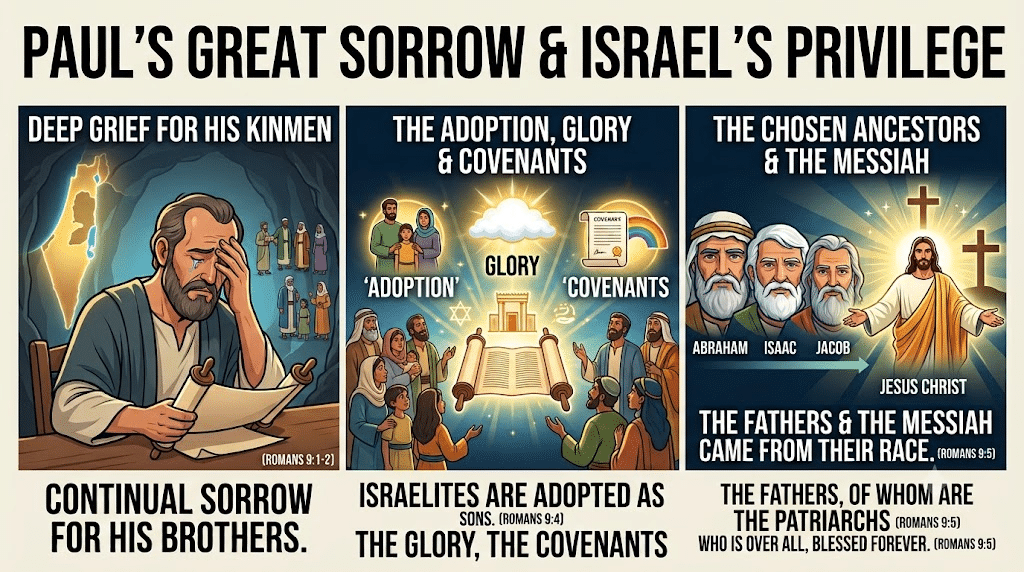
Romans 9:1-5
Create a verse by verse (NAB) commentary relating xxxxxxxxxxxxx TO CATHOLIC doctrine and practice. Give real life applications when appropriate
give me three thought provoking questions followed up with detailed answer reflection based on xxxxxxxxxxxx
Scripture Passage & Event | Primary Catholic Doctrine / Spiritual Tradition | Real-Life Application |
Witness in the Holy Spirit (Rom 9:1) | Moral Conscience & Sincerity in Oaths A well-formed conscience operates under the light of the Holy Spirit (CCC 1778). | Align moral decisions with Church teaching and the Holy Spirit rather than popular opinion or personal comfort. |
Great Sorrow & Anguish (Rom 9:2–3) | Redemptive Suffering & Intercession Offering up spiritual sorrow and personal sacrifices for the salvation of others (Col 1:24). | Offer up daily mortifications, holy hours, or Mass intentions for family members who have fallen away from the faith. |
Gifts to Israel (Rom 9:4) | Continuity of Salvation History (Nostra Aetate) Catholic liturgy and theology are rooted in God's unrevoked covenants with Israel. | Recognize how deeply the Mass is rooted in Jewish scripture and worship to deepen liturgical participation. |
Christ Over All, God Blessed (Rom 9:5) | Christology & Sacred Dogma Explicit affirmation of Jesus Christ as true God and true man (Councils of Nicaea & Chalcedon). | Surrender daily anxieties and decisions to Christ, trusting both His human empathy and His divine authority. |
Romans 9:1
"I speak the truth in Christ, I do not lie; my conscience bears me witness in the Holy Spirit..."
- Doctrinal & Spiritual Context:
- Conscience and the Holy Spirit: St. Paul appeals to his conscience, illuminated by the Holy Spirit. The Catechism of the Catholic Church (CCC 1778) defines conscience as a judgment of reason whereby the human person recognizes the moral quality of a concrete act. Paul demonstrates that a well-formed Christian conscience operates in communion with Christ and the Holy Spirit.
- Oaths and Truthfulness: Paul takes a solemn oath in Christ’s name. Catholic moral theology permits taking oaths when done in truth, justice, and judgment (CCC 2150–2154), recognizing God as the ultimate witness to human sincerity.
- Real-Life Application:
- Forming Your Conscience: Ensure your moral decisions and convictions are grounded in prayer and aligned with the teachings of the Church, rather than dictated by personal feelings or popular culture. Seek the guidance of the Holy Spirit when speaking hard truths to others.
Romans 9:2–3
"…that I have great sorrow and constant anguish in my heart. For I could wish that I myself were accursed and separated from Christ for the sake of my brothers, my kindred according to the flesh."
- Doctrinal & Spiritual Context:
- Redemptive Suffering & Intercession: Paul’s willingness to suffer for the salvation of his brethren reflects Christlike pastoral charity (caritas). In Catholic theology, believers are called to participate in the redemptive mission of Christ by offering up their own sufferings, prayers, and sacrifices for the conversion and salvation of others (Colossians 1:24).
- Sorrows for the Lost: Paul’s "constant anguish" demonstrates that salvation is serious business. The Church constantly prays for the salvation of all souls, especially through the Holy Sacrifice of the Mass and devotion to the Sacred Heart of Jesus.
- Real-Life Application:
- Praying for Loved Ones: Many Catholics have family members or friends who have fallen away from the faith. Follow St. Paul’s example (and that of St. Monica): don't give up on them. Offer up small daily mortifications, holy hours, or Mass intentions for their spiritual return.
Romans 9:4
"They are Israelites; theirs the adoption, the glory, the covenants, the giving of the law, the worship, and the promises;"
- Doctrinal & Catholic Practice:
- The Roots of Catholic Worship and Salvation History: Catholic theology emphasizes continuity in salvation history. Israel was blessed with six fundamental gifts that prepare the way for the Church:
- Adoption: divine filiation prefiguring our baptismal adoption.
- Glory (Shekinah): the visible presence of God, prefiguring the Holy Spirit and Eucharistic presence.
- Covenants: the solemn bonds God established with Noah, Abraham, Moses, and David.
- The Law: the moral foundation fulfilled in Christ’s law of love.
- The Worship (Latreia): Old Testament temple worship, which serves as the archetype and shadow of the Catholic Liturgy and the Holy Sacrifice of the Mass.
- The Promises: the messianic prophecies fulfilled in Jesus Christ.
- Nostra Aetate: The Second Vatican Council (Nostra Aetate, 4) reaffirms Paul’s teaching here: God's covenant with Israel has never been revoked, and the Church draws nourishment from the root of that good olive tree.
- The Roots of Catholic Worship and Salvation History: Catholic theology emphasizes continuity in salvation history. Israel was blessed with six fundamental gifts that prepare the way for the Church:
- Real-Life Application:
- Appreciating the Mass: When you attend Mass, recognize how deeply rooted Catholic liturgy is in Jewish scripture and tradition—from the Liturgy of the Word to the Eucharistic prayers. Entering into worship with this historical awareness enriches our reverence for the Sacraments.
Romans 9:5
"…the patriarchs are theirs, and from them, according to the flesh, is the Messiah, who is over all, God blessed forever. Amen."
- Doctrinal & Spiritual Context:
- The Divinity and Humanity of Christ: This verse is one of the clearest biblical assertions of the deity of Jesus Christ in the Pauline epistles. Paul explicitly states that Jesus, while coming "according to the flesh" from the Jewish lineage of the Patriarchs (Abraham, Isaac, Jacob), is also "over all, God blessed forever."
- Trinitarian and Christological Dogma: This foundational passage supports the dogmas defined at the Councils of Nicaea (325 AD) and Chalcedon (451 AD): Jesus Christ is true God and true man—one Divine Person with two natures.
- Doxology in Liturgy: Paul concludes with an "Amen" and a doxology (a hymn of praise to God), a practice preserved in Catholic liturgical life (e.g., the Great Amen at the conclusion of the Eucharistic Prayer).
- Real-Life Application:
- Living the Divine Mercy: Because Jesus is both fully human (understanding our weaknesses) and fully God (having all power to save), we can place absolute trust in Him. Proclaim His Lordship not just with words, but by surrendering every area of your daily life—your work, relationships, and anxieties—to His sovereign care.
Algorithmically generated text
give me three thought provoking questions followed up with detailed answer reflection based on xxxxxxxxxxxx
In Romans 9:2–3, St. Paul expresses an extraordinary, visceral grief: "I have great sorrow and constant anguish in my heart... I could wish that I myself were accursed and separated from Christ for the sake of my brothers." Paul’s sorrow stems from seeing those closest to him by blood—his own kinmen—rejecting the gospel of Christ. His love is so intense that he uses Moses-like hyperbole (Exodus 32:32), willing to surrender his own comfort for their salvation.
In a modern culture that emphasizes individual autonomy and "live and let live" attitudes toward religion, Paul’s intense anguish challenges our spiritual complacency. It asks us to examine our hearts: Do we care about the eternal salvation of those around us, or have we grown indifferent?
In Catholic theology, Paul’s sorrow is a manifestation of true pastoral charity (caritas) and redemptive love. Many Catholics today have children, spouses, siblings, or friends who have fallen away from the practice of the faith. Rather than falling into hopelessness or passive acceptance, Paul models the path of redemptive intercession—offering up daily prayers, holy hours, Mass intentions, and small personal mortifications (following the example of St. Monica) for the spiritual awakening of those we love.
Key Takeaways for Practice
- Examine Your Heart: Ask yourself whether spiritual indifference or fear of conflict has replaced genuine concern for the salvation of loved ones.
- Embrace Intercessory Prayer: Turn worry into prayer by offering specific intentions during Mass or spent before the Blessed Sacrament.
- Follow St. Monica's Example: Combine persistent prayer with patient, unconditioned love—trusting that no prayer offered in faith for another soul is ever wasted.
Redemptive Intercession: From Personal Anguish to Pastoral Charity
Aspect | Modern Relativism & Indifference | St. Paul’s Redemptive Sorrow |
St. Paul’s Reaction | Passive acceptance or treating faith as a strictly private matter. | Visceral Anguish (Rom 9:2–3) Expressing "great sorrow and constant anguish" for his fallen-away kin, using Moses-like hyperbole to express his desire for their salvation. |
Prevailing Mindset | Individual Autonomy & "Live and Let Live" Viewing another's departure from faith as purely a personal choice to be ignored or accepted uncritically. | Pastoral Charity (Caritas) Recognizing that salvation is of paramount importance and that love compels us to care deeply for the eternal well-being of others. |
Response to Fallen-Away Loved Ones | Complacency, spiritual indifference, or slipping into hopelessness and resignation. | Active Intercession & Hope Refusing to give up; channeling grief into spiritual action and trusting in God’s persistent mercy. |
Catholic Theological Connection | Isolated Spirituality Viewing one's relationship with God as entirely disconnected from the spiritual state of family or community. | Redemptive Suffering & Communion of Saints Uniting personal anguish and sacrifices with Christ’s cross for the conversion of others (Col 1:24). |
Practical Application | Avoiding spiritual conversations or remaining passive in prayer for loved ones. | The "St. Monica Path" Offering up daily prayers, Eucharistic Adoration, Mass intentions, and small mortifications for the spiritual renewal of family and friends. |
Algorithmically generated text
"For I am convinced that neither death, nor life, nor angels, nor principalities... nor any other creature will be able to separate us from the love of God..." (Romans 8:38–39)
In Romans 9:4–5, Paul lists the eight spiritual privileges granted to Israel: divine adoption, the glory (Shekinah), the covenants, the Law, the temple worship, the promises, the patriarchs, and the human lineage of the Messiah Himself. Yet, despite possessing all these divine gifts, many failed to recognize the ultimate fulfillment of those gifts standing right in front of them in Jesus Christ.
This serves as a profound warning against spiritual presumption. It is entirely possible to be surrounded by extraordinary spiritual riches—sacraments, scripture, sound doctrine, beautiful traditions—and yet remain interiorly distant from God.
For Catholics, this passage prompts deep self-examination regarding our approach to the Church’s gifts. We are blessed with the fullness of the Sacraments, the real presence of Christ in the Eucharist, and thousands of years of holy wisdom. Do we approach the Mass and Holy Communion with lukewarm habituality, or do we recognize them as living encounters with the Son of God? Possessing privileges is not enough; we must allow those gifts to transform our hearts and bear fruit in action.
Key Takeaways for Practice
- Beware Spiritual Presumption: Simply possessing Catholic privileges—such as access to the Sacraments or rich traditions—does not guarantee a holy life.
- Move Beyond Routine: Examine your heart before Mass to ensure you are receiving the Holy Eucharist as a living encounter with Christ rather than out of mere habit.
- Let Gifts Bear Fruit: Allow the spiritual riches of the Church to transform your internal character and manifest as active love, charity, and service to others.
The Eight Privileges & Avoiding Spiritual Presumption: From Israel to the Church
Aspect | The Eight Spiritual Privileges (Rom 9:4–5) | Spiritual Danger: Presumption & Routine | Living Encounter & Transformation |
1. Adoption | Israel was chosen as God's firstborn son (filiation). | Taking grace for granted; assuming salvation based on title or identity alone. | Living as a true child of God through active obedience and baptismal grace. |
2. The Glory | The divine presence (Shekinah) dwelling in the wilderness tent and Temple. | Treating sacred spaces or spiritual realities with casual indifference or routine. | Approaching the Real Presence of Christ in the Eucharist with awe and devotion. |
3. Covenants | Solemn oaths established with Noah, Abraham, Moses, and David. | Viewing church membership as a passive contract rather than a living bond of love. | Intentionally renewing our covenantal fidelity through regular prayer and Sacraments. |
4. The Law | The gift of moral guidance and divine truth revealed on Sinai. | Intellectual pride or legalistic compliance without interior love and charity. | Allowing the Law of Christ to shape daily choices, speech, and moral integrity. |
5. Temple Worship | God-given liturgical rites (latreia) prefiguring true worship. | Attending Mass with lukewarm habituality, distraction, or empty routine. | Entering into the Holy Sacrifice of the Mass with active, heart-felt participation. |
6. The Promises | Prophetic assurances of the coming Kingdom and Messianic salvation. | Relying on past spiritual achievements or heritage while ignoring present conversion. | Trusting in God's promises while actively seeking daily conversion of heart. |
7. The Patriarchs | The spiritual foundation laid by Abraham, Isaac, and Jacob. | Resting on ancestral or institutional history without personal faith and action. | Emulating the heroic faith and courage of the saints and church fathers. |
8. The Messiah | Jesus Christ coming "according to the flesh" from Israel's lineage. | Failing to recognize and surrender to Christ standing right in front of us. | Surrendering every aspect of life to Jesus as Lord ("over all, God blessed forever"). |
Algorithmically generated text
Romans 9:5 contains one of the most explicit declarations of Christ’s divinity in all of the Pauline epistles: "…from them, according to the flesh, is the Messiah, who is over all, God blessed forever. Amen." Paul highlights the mystery of the Incarnation—Jesus comes "according to the flesh" from human lineage, yet He is simultaneously "over all" as God supreme.
This doctrinal truth is not merely a formula for theological debates; it demands a radical reorientation of our daily existence. If Jesus is truly "over all," then there is no compartment of our lives that falls outside of His authority.
In daily life, we often relegate faith to a Sunday routine while letting personal desires, career ambitions, or societal pressures rule our weekday decisions. Proclaiming Christ as "God blessed forever" means surrendering our anxieties, political views, relationships, and finances to His sovereignty. It invites us to live with the confidence that no matter how chaotic the world or our personal circumstances become, Christ remains supreme and His mercy is unwavering.
Here is an expanded chart based on that reflection, detailing the contrast between compartmentalized faith and living under the absolute Lordship of Christ, the dual reality of the Incarnation, and how surrendering daily life to His sovereignty transforms our practical actions.
Key Takeaways for Practice
- Break Down Compartments: Audit your weekly routine and ask whether Christ is given authority over your career, media habits, finances, and relationships, or if He is restricted to designated "prayer times."
- Anchor in His Divinity: When life or global events feel chaotic, declare Rom 9:5 as a short prayer of faith: "Christ, You are over all, God blessed forever."
- Align Action with Confession: Let your daily choices reflect what you proclaim in the Creed—if Jesus is truly Lord, let His love and truth govern every weekday decision.
The Sovereignty of Christ: From Theological Truth to Daily Living
Aspect | Compartmentalized / "Sunday-Only" Faith | Surrendering to Christ "Over All" (Rom 9:5) |
Theological Understanding | Intellectual Formula Acknowledging Christ’s divinity in theory or creed, but treating it as abstract doctrine for debate. | The Mystery of the Incarnation Embracing Jesus as both fully human ("according to the flesh") and fully divine ("over all, God blessed forever"). |
Scope of Authority | Limited Domain Restricting Christ’s influence to religious rituals, personal morality, or Sunday Mass attendance. | Total Lordship Recognizing that no compartment of life—work, family, finances, politics, or anxieties—is outside His authority. |
Response to Worldly Pressure | Ruled by Circumstance Allowing societal pressures, career ambitions, political tribalism, or fear to dictate daily priorities and choices. | Rooted Confidence Living with peace and conviction, knowing that regardless of worldly chaos, Christ remains supreme and His mercy is unwavering. |
Practical Application: Decisions | Self-Directed Life Making major life decisions based solely on personal comfort, financial gain, or worldly success. | Surrendered Life Seeking God’s will in prayer, forming conscience through Church teaching, and aligning goals with Gospel values. |
Practical Application: Inner Life | Carrying Anxieties Alone Bearing burdens, fears, and future uncertainties with self-reliance, leading to stress and despair. | Trusting Providence Surrendering anxieties into the hands of the sovereign Lord, trusting His supreme power and steadfast love. |
Algorithmically generated text
Just Like Family
Read Larry Broding’s full commentary to help your congregation cultivate deeper empathy, pray for reconciliation, and recognize the enduring roots of their own faith.
- Relatable Pastoral Hook: Connects Paul’s anguish to the universal human experience of family division and scarred relationships, offering an immediate emotional entry point for your congregation.
- Illuminating Biblical Background: Contextualizes verses 4–5 by detailing the specific spiritual gifts God gave to Israel—the adoption, the covenant, the Law, and the patriarchs—showing how Gentiles are welcomed through a Jewish Messiah.
- Clear Theological Bridge: Unpacks Paul’s paradoxical willingness to be cut off for the sake of his kin, helping you explain the depth of apostolic love and the urgency of the Gospel message.
- Modern Ecumenical Call to Action: Draws on the legacy of St. John Paul II to inspire a message of healing, respect, and heartfelt prayer for our Jewish brothers and sisters in faith.

Commentary by Dr. Brant Pitre | Catholic Productions

Commentary by Fr. Francis Martin | The Word Proclaimed
clean up grammar and spelling, create an outline for the following transcript Transcript xxxxxxxxxxxx
Context and Shift in Romans 9
Now we look at Part 3, that is the second reading. It begins Chapter 9 of the Letter to the Romans—just perhaps a little bit to locate us. We've been working with Romans a long time, and we will continue for some time. The lectio continua in the middle, as I've explained before, goes its own way. So now we finish Chapter 8, which is the high point—the goal of all the chapters from 1 up to 8. There we have this treatise on the Holy Spirit: His presence in us, the love of God the Father for us, and the inseparability between us and God. God will never separate Himself from us; if we want to be separate, we have to do it. We have to fight, because He will keep going after us.
That is why, at the end, Paul asks: What can separate us from the love of Christ? Persecution, nakedness, the sword, hunger? Nothing can separate us from the love of God, which is in Christ Jesus our Lord.
Now, suddenly, we are in a whole other world, and we are going to be in it for a while.
Paul’s Heartbreak and Anguish for His People
Now, His preoccupation: well, then, what about the Jews? They were chosen. Yes, they were chosen, and they still are chosen.
So, we have this poignant testimony of Paul, and it is the Word of God, so this is the truth: "I speak the truth in Christ; I am not lying." That is pretty powerful, isn't it?
"My conscience bears me witness in the Holy Spirit that there is great and unremitting sadness in my heart."
He is telling the truth. He loves his people as much as they cause him suffering. He loves them, and the love he has for his people is Christ’s love for them. So he is saying: "My conscience bears me witness that I am not lying... that there is this great sorrow and unremitting agony in my heart."
Then he goes further: "I could wish—I could pray—that I be accursed and cut off from Christ for the sake of my own people."
Does he mean he is willing to go to hell? What is he saying? To be without Christ, when "for me to live is Christ"?
It is very important to grasp this, in so far as we can. This is a saint, and he loves like a saint—that means there is no limit to his love. These people are bone of his bone and flesh of his flesh. They are resisting the preaching of the Gospel—not every single one, but lots, the majority—and they have it in for him. He goes to preach to the Jews. He gives us that litany in 2 Corinthians about receiving forty lashes less one. It should be forty, but in case the person beating him loses track (because they are very careful about these things), it is 39, so you do not exceed the limit. They lay the man down, strip him to the waist, and hit him with this big instrument as hard as they can 39 times. He says this happened to him multiple times.
He has had a lot of suffering, but the greatest suffering he carries in his life is so great that, by an impossibility, the worst thing that could happen to him—to be without Christ—he would take if it would bring his people in. That is a saint.
Now you see what drives Paul. He is an intellectual, and he can be pushy, so you forget there is a fire of love in his spirit. It is amazing. Even in the Corinthian correspondence, when a man is sleeping with his stepmother, Paul says, "This does not even happen among the pagans, and now it is happening among Christians. I want to hand that man over to Satan." That means cutting him off from the community—an excommunicatio. It does not mean just a piece of paper; it means you cannot associate with the only living, real thing on the globe. If it gets this man straightened up, okay. But then he says a little later in that same letter, "Go easy, show him love, show him kindness, win him back over," because he is in a state of very serious sin, and if he were to die, he would be cut off from Christ.
So here we have the other side of this anguish: "If I could be cut off from Christ, if this could benefit the brothers who are my own flesh and blood..." Of course, if you have ever lived in the Middle East, that still means a lot. I remember the first time I met a cook where I was living—Abu someone. The first thing they wanted to tell me was that the man who shot Robert Kennedy was a distant relative. He did not want me to find that out somewhere else and have them disgraced in my eyes. I thought, We would never do that; that would never occur to us. But to him, he is still bone of their bone. He shot Robert Kennedy, but he is still part of the family, and they have to acknowledge that. It is such a different mindset.
So Paul is saying, "I would be cut off from Christ if this could benefit the brothers who are my own flesh and blood." That is his hurt.
The Privileges and Heritage of Israel
Now he goes on to meditate on who they are. They are Israelites. Israel—that means they have been the island where the Word of God dwelt for a millennium, the only ones in the whole world who knew and worshiped the one true God by the call of Abraham and the mercy of God.
Every prophet had to say, "Stop worshiping Baal," because they were wandering off, but the people as a whole held fast: "There is only one true God. Listen, Israel, the Lord is your God, the Lord is One. And you shall love the Lord your God with all your heart, with all your affections, with all your energy, with all your mind, with all your soul, with all your strength."
They tell a beautiful story about Rabbi Akiva. The Romans had passed a law forbidding the teaching of the Law after the Bar Kokhba Revolt, because studying the Law gave them the idea that there was something special about them, leading to revolutions. So they banned teaching the Law.
What do you do? The Rabbi said: "A fox walked along the brook and saw a fish. He said to the fish, 'You're underwater all the time; why don't you come out here where there is air and sunshine?' The fish said, 'If I go out there, I will die.' So it is with me: my water is the Torah. If I stop teaching Torah, I will die."
So they caught Rabbi Akiva, put him on a gridiron, and burned him to death. When the moment came to recite the Shema—the prayer I just recited, "You shall love the Lord your God with all your heart and with all your soul"—he began to sing it. They said, "Even now you sing that?" He replied, "All my life I wondered what it meant to love the Lord with all my soul. Now I know."
It is this tradition that Paul is talking about. They have the covenants—from Abraham through Moses. God makes these covenants, and God is faithful to them. How many times in the Psalms do we sing, "His loving-kindness is forever"? We try to translate it as "His love is everlasting," but His hesed—as I think I've said a million times already—means enthusiastic fidelity to the Covenant. God never broke the Covenant. In fact, as Pope John Paul II said at a talk in the synagogue at Mainz, the Covenant has never been revoked. It has been fulfilled, but it has never been revoked. So we are waiting for our Jewish brethren, with all these privileges, to come and enter into their inheritance.
They were given the Law. What a privilege this is—learning how to live. You know how powerful law is. I can remember before the integration of schools and busing—there was a law that you cannot discriminate against African Americans, and that changed the whole ethos of the country. Law is formative. That is why the Supreme Court must make laws in keeping with the truth and human nature.
They have the worship of God, and they have the promises. They have been living by these promises. Remember how St. Luke describes Simeon: he was waiting for the Consolation of Israel, the Christ, and the Holy Spirit was upon him when he came into the Temple.
So Paul is saying: the Law, the worship, the promises, the Patriarchs—remember Abraham, Isaac, and Jacob; remember the zechut, the merits of the Patriarchs. It is all theirs. And from them, according to the flesh, is the Christ, who is over all, God blessed forever.
Click chevron banner to read transcript
organized into thematic sections.
Verbal fillers, stumbles, and repetitions have been removed
while keeping the original phrasing, theological precision, and cadence intact.
19th Sunday of Year A
Create a simple, modern infographic illustrating [INSERT BIBLE PASSAGE OR TOPIC]. Use a [SPLIT-SCREEN / 3-PANEL] layout. The style should be clean, high-quality digital art or vector illustration.
Visuals:
Panel 1: Show [DESCRIBE SCENE 1 – e.g., a stormy sea].
Panel 2: Show [DESCRIBE SCENE 2 – e.g., Jesus calming the waves].
Text & Typography:
Font: Use EXTRA LARGE, BOLD, SANS-SERIF FONT (like Arial). Ensure high contrast so text is easily readable.
Header: Write “[INSERT MAIN TITLE]” at the top.
Captions: Include short, punchy text summaries in the panels: “[TEXT FOR PANEL 1]” and “[TEXT FOR PANEL 2]”.
Overall Vibe: Professional, educational, and uncluttered. Avoid small details; focus on big images and big text.

Matthew 14:22-33
Create a verse by verse (NAB) commentary relating xxxxxxxxxxxxx TO CATHOLIC doctrine and practice. Give real life applications when appropriate
Scripture Passage & Event | Primary Catholic Doctrine / Spiritual Tradition | Real-Life Application |
Jesus Prays Alone (Matt 14:22–23) | Contemplation in Action Balancing active apostolic work with regular, solitary prayer with the Father. | Prioritize mental prayer and solitude even amidst demanding work schedules or parish ministries. |
Walking on the Sea (Matt 14:24–27) | Divine Identity (Egō Eimi) & Indefectibility Jesus demonstrates His deity ("I AM"); the Church (Navis Ecclesiae) endures through trials. | Remain steadfast in hope during dark times in life or culture, knowing Christ comes to us in the darkest hours. |
Peter Steps Out on Water (Matt 14:28–29) | Petrine Ministry & Elevating Grace Peter's leadership role (the Papacy); divine grace enables acts exceeding human nature. | Step out in obedience when called to difficult vocational choices or moral stands, relying on grace over self-reliance. |
Peter Sinks & Cries Out (Matt 14:30–31) | Sacrament of Reconciliation & Mercy Christ immediately catches those who cry out for mercy ("Lord, save me!"). | Turn immediately to the Sacrament of Confession when slipping into sin or doubt, letting Christ lift you up. |
Homage in the Boat (Matt 14:32–33) | Adoration (Latreia) & Internal Peace Supreme worship is reserved for Christ; His presence brings peace to the Church. | Anchor your soul in the Church and Sacraments to experience true peace amidst surrounding turbulence. |
Matthew 14:22–23
"Then he made the disciples get into the boat and precede him to the other side, while he dismissed the crowds. After doing so, he went up on the mountain by himself to pray. When it was evening he was there alone."
- Doctrinal & Spiritual Context:
- Christ’s Example of Prayer: Jesus shows us the necessity of balancing active ministry with solitary prayer. In Catholic spiritual theology, interior quiet and solitary prayer are indispensable for maintaining communion with the Father.
- The Boat as Navis Ecclesiae (Ship of the Church): In Early Church Father writings (e.g., St. Augustine, St. Ambrose), the boat is a classic symbol for the Church sailing through the turbulent waters of history while Jesus intercedes for her from the "mountain" (heaven).
- Real-Life Application:
- Prioritizing Silent Prayer: Even amidst busy schedules or demanding parish ministries, follow Christ’s example by stepping back for personal prayer, mental prayer, or time before the Tabernacle.
Matthew 14:24–25
"Meanwhile the boat, already a few miles offshore, was being tossed about by the waves, for the wind was against it. During the fourth watch of the night, he came toward them, walking on the sea."
- Doctrinal & Catholic Practice:
- Divinity over Creation: In the Old Testament, walking on the sea is a power reserved for God alone (e.g., Job 9:8, Psalm 77:19). Jesus’ action reveals His divine identity as the Son of God (Consubstantial with the Father).
- Trials of the Church: The "fourth watch" (between 3:00 AM and 6:00 AM) represents the darkest, most exhausting hour. Catholic doctrine teaches that while the Church will endure trials and persecutions until Christ's return, the gates of hell will not prevail against her (Matthew 16:18).
- Real-Life Application:
- Persevering in Spiritual Dark Times: When going through personal spiritual dryness or cultural adversity, remember that Christ comes to us precisely when the night feels darkest. Trust His timing even when relief seems delayed.
Matthew 14:26–27
"When the disciples saw him walking on the sea they were terrified. 'It is a ghost,' they said, and they cried out in fear. At once Jesus spoke to them, 'Take courage, it is I; do not be afraid.'"
- Doctrinal & Spiritual Context:
- "It is I" (Egō Eimi): Jesus uses the Divine Name revealed to Moses at the burning bush (I AM, Exodus 3:14). He is declaring His full divinity to reassure their hearts.
- Sacramental Grace over Fear: Christ’s command to "Take courage" echoes throughout Catholic moral theology. Fear is overcome not by human effort alone, but by divine revelation and the gift of grace.
- Real-Life Application:
- Overcoming Fear with Divine Truth: When life feels overwhelming, ground yourself in the promises of Christ. Meditate on His words—"It is I; do not be afraid"—during Eucharistic Adoration or while praying the Rosary.
Matthew 14:28–29
"Peter said to him in reply, 'Lord, if it is you, command me to come to you on the water.' He said, 'Come.' Peter got out of the boat and began to walk on the water toward Jesus."
- Doctrinal & Catholic Practice:
- Primacy of Peter: Peter acts as the representative and leader of the apostles. Catholic doctrine sees in Peter’s unique relationship with Jesus the groundwork for the Petrine Ministry (the Papacy). Peter steps out on faith at Christ's word alone.
- Faith and Supernatural Grace: Human beings cannot walk on water by natural power. Catholic theology teaches that by grace, human nature is elevated to perform acts of divine faith and charity that exceed natural capacity.
- Real-Life Application:
- Stepping Out in Obedience: When God calls you to step into a difficult vocation, a challenging moral stand, or a task that feels impossible, rely on His grace rather than your own strength.
Matthew 14:30–31
"But when he saw how strong the wind was he became frightened; and beginning to sink, he cried out, 'Lord, save me!' Immediately Jesus stretched out his hand and caught him, and said to him, 'O you of little faith, why did you doubt?'"
- Doctrinal & Spiritual Context:
- Distraction from Christ: Peter begins to sink the moment he takes his eyes off Jesus and focuses on the storm. In Catholic ascetical theology, spiritual downfall begins when we shift our gaze from God's mercy to our own anxieties or surrounding temptations.
- The Prayer of the Heart: Peter’s short prayer, "Lord, save me!" is a fundamental model of Christian prayer. It mirrors the Jesus Prayer ("Lord Jesus Christ, Son of God, have mercy on me, a sinner") and the Catholic understanding of our continuous need for divine mercy.
- Christ as Savior (Redemptor): Jesus does not abandon Peter; He stretches out His hand immediately, illustrating God's readiness to grant mercy in the Sacrament of Reconciliation.
- Real-Life Application:
- Turning to the Sacrament of Reconciliation: When you slip into sin or doubt, cry out immediately like Peter. The Sacrament of Confession is Christ extending His hand to lift us out of spiritual drowning.
Matthew 14:32–33
"After they got into the boat, the wind died down. Those who were in the boat did him homage, saying, 'Truly, you are the Son of God.'"
- Doctrinal & Catholic Practice:
- Adoration and Worship (Latreia): The disciples bowing and doing him homage (proskynesis) is a recognition of Christ’s divinity. Catholic theology reserves this supreme worship (latreia) for God alone, which is given to Christ present in the Holy Eucharist.
- Peace in the Church: Once Jesus steps into the boat, the storm ceases. This demonstrates that true peace in the Church and in individual souls comes through the abiding presence of Jesus Christ.
- Real-Life Application:
- Anchoring in the Church: Remain anchored within the Church and her Sacraments during turbulent times in the world. Place Jesus at the center of your heart, family, and daily decisions to experience the peace that surpasses understanding.
Algorithmically generated text
give me three thought provoking questions followed up with detailed answer reflection based on xxxxxxxxxxxx
In Matthew 14:22, the text notes that Jesus "made the disciples get into the boat and precede him to the other side." He didn't accidentally leave them to face a storm; He intentionally sent them directly into it while He went up the mountain to pray. The disciples were in the exact place Jesus commanded them to be, yet they found themselves battered by wind and waves in the dark of night.
We often assume that encountering hardship, spiritual resistance, or emotional suffering means we have made a wrong turn or fallen out of God's will. However, this passage reveals that obedience to Christ does not guarantee smooth sailing. Sometimes, God deliberately permits or leads us into difficult seasons—not to destroy us, but to stretch our capacity for faith and reveal His power in ways we could never experience on calm waters.
In Catholic spiritual theology, trials are seen as opportunities for spiritual purification. When the storms of life hit—whether illness, family distress, or professional uncertainty—recognizing that Christ allowed you to be in that boat transforms your perspective. Instead of asking "Why is God punishing me?", the question becomes "What is Christ revealing to me about His power and my need for Him through this trial?"
Key Takeaways for Practice
- Reframe the Question: When facing unexpected hardship in your family, health, or work, shift your mindset from "Why is this happening to me?" to "Lord, how are You inviting me to trust You right now?"
- Obedience Before Comfort: Trust that being in the middle of a storm while following Christ's command is far safer than being on calm shores outside of His will.
- Look for the Revelation: Remember that the disciples only saw Jesus walk on water because they were out in the deep during a storm—difficult seasons often precede our deepest encounters with God's power.
Trials as Divine Purification: From Punishment to Faith-Building
Aspect | Viewing Hardship as Punishment or Mistake | Viewing Hardship as Divine Purification (Matt 14:22) |
Command & Direction | Assuming that following God's will guarantees smooth sailing, immediate success, and an absence of friction. | Recognizing that Jesus intentionally "made the disciples get into the boat" (Matt 14:22) and directed them into the storm's path. |
Interpretation of Hardship | "I made a wrong turn." Interpreting emotional suffering, illness, or trials as a sign of being out of God's will or under divine punishment. | "I am in the boat Christ prepared." Understanding that trials are often permitted within God's providence to stretch our faith and deepen reliance on Him. |
Catholic Theological Lens | Retributive Mindset Viewing difficulties as karma or God's vengeance for past failings. | Purgative & Pedagogical Mindset Viewing trials as opportunities for spiritual purification, detaching us from self-reliance and strengthening virtue. |
Primary Inner Question | "Why is God punishing me?" Yielding to bitterness, resentment, or despair when life becomes turbulent. | "What is Christ revealing to me?" Asking how Christ is revealing His divine power and showing us our need for Him in the middle of the storm. |
Practical Application | Trying to escape trials at all costs, abandoning commitments, or losing hope during seasons of spiritual darkness. | Persevering in duty, maintaining daily prayer, and trusting that Christ intercedes for us from the "mountain" until He joins us in the boat. |
Algorithmically generated text
When Peter steps out of the boat at Jesus' command, he initially performs the humanly impossible—walking on water. But the moment he shifts his focus from Jesus to the strength of the wind and the height of the waves, fear takes over and he begins to sink (Matthew 14:30). The physical storm hadn't changed; what changed was Peter’s attention.
In our daily lives, "the wind and waves" take many forms: overwhelming news cycles, financial anxieties, workplace pressure, or personal insecurities. When we fixate on these tumultuous circumstances rather than on the Lord who commands the storm, our spiritual life naturally collapses into fear, doubt, and spiritual drowning.
Peter’s immediate recovery provides a crucial lesson for daily prayer. The moment he realizes he is sinking, he does not try to swim on his own or rationalize his situation; he cries out with a short, desperate prayer: "Lord, save me!" When we feel overwhelmed by circumstances, our immediate response must be to redirect our gaze back to Christ through brief, heart-felt prayers of trust (such as the Jesus Prayer) and by grounding ourselves in the Sacraments, particularly the Sacrament of Reconciliation, where Christ stretches out His hand to lift us up.
Key Takeaways for Practice
- Audit Your Attention: When anxiety or fear spikes, ask yourself: "Am I looking at the storm, or am I looking at the Lord who commands it?"
- Pray the Arrow Prayers: Memorize short, simple ejaculatory prayers to pray in moments of panic, such as "Lord, save me!" or "Jesus, I trust in You."
- Let Christ Lift You Up: When you fall or slip into doubt, do not wait until you feel "worthy" to pray—cry out immediately and allow Christ’s hand to catch you through the Sacraments.
Fixing Our Gaze: From Fixating on the Storm to Calling on Christ
Aspect | Fixating on the Wind & Waves | Fixing Our Eyes on Christ (Matt 14:30) |
Peter’s Shift in Focus | Looking at the Storm Shifting attention from Jesus to the churning waves and howling wind, causing fear to take over and sinking to begin. | Stepping Out on Faith Fixing his eyes entirely on Jesus, enabling him to walk on water and accomplish what is humanly impossible. |
Modern "Wind & Waves" | Distractions & Stressors Overwhelming news cycles, financial anxieties, workplace pressure, health concerns, or personal insecurities. | Divine Truth & Presence Anchoring the mind on Christ’s real presence, His promises in Scripture, and His supreme sovereignty over creation. |
Internal Effect | Spiritual Drowning A collapse into anxiety, doubt, helplessness, and emotional exhaustion as self-reliance fails. | Supernatural Peace Remaining grounded and steady amidst life’s uncertainties by trusting in God's elevated grace. |
Failing Response vs. Recovery | Trying to swim on our own, rationalizing the crisis, or drowning in panic and negative self-talk. | Short, Heartfelt Prayer Immediately crying out "Lord, save me!" without delay, pride, or complicated pretense. |
Sacramental & Prayer Practice | Isolating oneself, avoiding prayer out of shame or stress, and carrying burdens alone. | Grace & Reconciliation Frequent use of arrow prayers (like the Jesus Prayer) and turning to Confession, where Christ stretches out His hand to restore us. |
Algorithmically generated text
From the earliest centuries of Christianity, the Church Fathers saw in the disciples' boat a vivid symbol of the Church—the Navis Ecclesiae (Ship of the Church)—navigating the treacherous waters of human history. The boat is tossed about, the wind is against it, and the disciples are exhausted. Yet, it is precisely inside the boat that safety ultimately lies, because Christ returns to it and brings peace.
In an era where many people feel tempted to abandon organized religion or step away from the Church due to scandal, cultural pushback, or personal fatigue, this passage offers profound wisdom. Notice that Peter did not jump out of the boat on a whim; he only stepped out at the direct command of Christ to go toward Christ. The ultimate goal was for both Jesus and Peter to end up back in the boat together, at which point the wind ceased and worship broke out.
True spiritual peace is not found by abandoning the ship when the waves get rough. Remaining anchored in the Church, participating in her Sacramental life, and holding fast to the Eucharist allows us to experience Christ’s calming presence. Even when the night feels long and the fourth watch seems delayed, Christ always returns to His boat, assuring us that the gates of hell will not prevail.
Key Takeaways for Practice
- Stay in the Vessel: Resist the temptation to abandon the Church during seasons of cultural hostility or internal difficulty; Christ’s promise of protection applies to His Church.
- Focus on the Re-entry: Like Peter, any step of faith we take must ultimately draw us closer to Christ and build up the Body of Christ inside the Church.
- Participate in Sacred Worship: Remember that when Christ steps into the vessel, the wind dies down—our ultimate response inside the Church is to join the disciples in doing Him homage ("Truly, you are the Son of God").
The Ship of the Church: Safety Amidst the Storms of History
Aspect | Abandoning the Ship (Individualism / Deconstruction) | Remaining in the Navis Ecclesiae (Matt 14:32–33) |
Patristic Symbolism | Viewing the boat as an outdated, fragile vessel to be abandoned when the waves of history grow rough. | The Ship of Salvation The Church Fathers recognized the boat as the Navis Ecclesiae—the God-ordained vessel navigating the turbulent seas of history. |
Response to Institutional Storms | Stepping away or abandoning the Church due to scandal, cultural pushback, institutional failures, or personal fatigue. | Enduring the Storm Recognizing that while the boat is battered and the crew exhausted, safety lies inside the vessel where Christ dwells. |
Peter’s Action | Jumping out of the boat on a personal whim or out of frustration with the surrounding chaos. | Stepping Out Only at Christ’s Command Peter left the boat solely to go toward Christ, with the ultimate goal of returning to the vessel with Jesus. |
Source of Peace & Stability | Seeking spiritual peace through isolated, self-styled spirituality outside of communal and sacramental bonds. | Christ Entering the Boat True peace comes when Jesus steps into the boat with His disciples, causing the storm to cease and bringing collective worship. |
Sacramental Practice | Disconnecting from the Sacraments and communal worship when the night feels long and Christ seems delayed. | Anchoring in the Eucharist Holding fast to the Sacraments, trustfully enduring the "fourth watch," and believing the gates of hell will not prevail against the Church. |
Algorithmically generated text
Trust in Times of Stress
Read Larry Broding’s full commentary to help your congregation recognize Christ’s saving presence and hear his reassuring voice above the roar of their personal storms.
- Vivid Geographic & Cultural Context: Explains the real-world science behind sudden violent storms on the Sea of Galilee—and why ancient listeners viewed deep waters as the terrifying domain of evil spirits—helping you paint a realistic, dramatic picture for your listeners.
- Deep Old Testament Connections: Connects Jesus’ walk on the sea and his proclamation of “I AM” directly to YHWH’s power in Job, Isaiah, and Habakkuk, giving you the tools to explain this miracle as a profound epiphany of divine identity.
- Reframing Christian Leadership: Uses Peter’s hesitation as a relatable touchpoint for modern ministry leaders, parents, and believers who feel called to step out in faith but struggle when distracted by pressing daily pressures.
- Powerful Ecclesial Symbolism: Unpacks the traditional image of the boat as the Church enduring persecution and chaos.

Commentary by Dr. Brant Pitre | Catholic Productions
Commentary by Fr. Francis Martin | The Word Proclaimed
clean up grammar and spelling, create an outline for the following transcript Transcript xxxxxxxxxxxx
Gospel Context and the Eucharistic Connection
Now we are going to look at the Gospel of Matthew (14:22–33) for this 19th Sunday in Ordinary Time. It matches closely with the first reading; both have to do with storms and with the Lord's power over the storm. It is good for us to know about the Lord's power over storms.
This is the storm that Matthew and Mark both tell us about right after the multiplication of the loaves. It is extraordinary: the Lord demonstrating His power over the material universe. He takes this bread, and what are the four things He does? He takes, He blesses, He breaks, and He gives—take, bless, break, give. Look at the Last Supper: take, bless, break, give. At every Mass, taking bread into His holy and venerable hands, looking up to heaven, giving thanks and praise, He blessed it, broke the bread, gave it to His disciples, and said, "Take..."
Now, following that, we have this other demonstration of the lordship of Jesus over all the forces of the universe. The Gospel text for the day begins after He had fed the people—which helps locate them in the text. Then He made—almost forced—the disciples to get into the boat and go before Him to the other side while He dismissed the crowds.
The Interior Dimension ("Smith and Jones" Analogy)
Now, there is a very fine piece of historical reflection on this in an article by Father Os. In other words, we have the inner dimension of the event. We have talked about this before using my famous example of Smith and Jones at the cocktail party.
Imagine we are at a cocktail party. I say to you, "Did you notice that Smith came into the room, walked right across, and shook Jones's hand, and Jones took his hand in both of his own and smiled?" You say, "Okay, so what?" Then I tell you, "Smith and Jones have been enemies for twelve years." I have revealed to you an inner dimension of the event. That really happened, but you have to know the inner dimension to understand it.
Or, if you and I were at the Cross and I said, *"There is the salvation of the world"—*not just a poor, unfortunate guy caught in the Roman justice system, but the salvation of the world—I would be right, but I would need a prophetic grace to see it. That is the interior dimension of what really happened.
Here we have the same notion: this prophecy Jesus gives about how He is going to take care of His people, while at the same time proclaiming Himself the new Moses because He is feeding the people in the desert.
The Storm on the Sea of Galilee and the "I AM"
So, Jesus saw that the crowd was getting excited, so He told His disciples, "Get out of here; go." He went up to the top of the mountain until the crowd calmed down and left. On the surface level, that is what was going on. But on another level, Jesus was preparing to show another dimension of His authority over the material universe.
After He dismissed the crowd, He went up to the mountain all by Himself to pray. We do not know what those events took out of Him: breaking bread, having it multiplied, the crowd eating, getting excited, wanting to make Him king—all while He is listening to the Father: "What do I do now? How do I act now? Holy Spirit, guide me; what am I supposed to be doing?" So He goes up to pray.
When it was evening, He was there monos—alone. The crowd had left. Meanwhile, the boat, already a few miles offshore, was being tossed about by the waves, for the wind was against it. This is a rather calm description of the storm. The Jordan River comes down between the mountains and empties into the Sea of Galilee, and then at the other end flows down to the Dead Sea. When the wind blows down that funnel, these are not just little one- or two-foot waves on a lake; these are real waves and real wind. This is a storm coming through that mountain funnel, hitting the lake, and putting it into real turmoil. That is what they are faced with.
He was alone, and the boat was being tossed about by the waves a few miles offshore because the wind was against it—they were trying to go east-west, and the wind was coming north-south.
He came toward them walking on the sea about the fourth watch of the night—between 2:00 and 6:00 in the morning. When they saw Him walking on the sea, they said, "It's a spirit! It's a ghost!" They were scared to death and cried out in fear. They did not think it was Jesus; they thought it was a spirit walking on the water and that they were sunk.
So Jesus says to them, "Take courage, Ego Eimi"—meaning "It is I," but also "I AM." He is asserting His divine authority here. This wonderful Greek phrase, which can be translated either way, is used often. It appears in John at the same point when they see Him walking and get frightened, and He says, "I AM."
Peter's Walking on Water and the Lesson for the Church
Peter said, "Lord, if it is you, command me to come to you on the water." Where he got this idea, who knows? Jesus said, "Come," to give everybody peace. So Peter gets out of the boat, starts walking on the water, and all of a sudden he realizes what he is doing and freaks out. He gets frightened and begins to sink, so he calls out, "Lord, save me!"
The Lord reached out His hand, caught him, and said, "Why did you doubt, you of little faith?" What is He teaching him?
"Peter, one day you are going to be an obscure Galilean peasant in the middle of Rome as the head of the whole Church which is spreading. Do you think this water is going to make you sink when you get into those waters? You have got to keep on believing Me. I have prayed for you," He says at the Last Supper, "that your faith fail not, and when you have turned again, strengthen your brethren." That is his main job.
We can all empathize with Peter. First of all, who among us would have the guts to get out of the boat in the first place? But then we lose our nerve if we do not keep our eyes on Jesus. The lesson is: "Pope, you have got to keep watching Me or you will sink, because you have got to walk on water once you are Pope, just as I do."
Jesus uses this famous term, oligopistos—"you of little faith." Matthew especially loves this word; it is almost his definition of a disciple: one of little faith. He says to him, "Why did you doubt?" Why did Peter doubt? Because he stopped leaning on Christ. "Learn something, Pedro, because walking on water is a piece of cake compared to what is going to happen to you when you are living in Rome trying to keep this whole thing going, until finally they get you and crucify you"—which Jesus prophesies in John 21.
When they got into the boat, the wind died down. Those who were in the boat did Him homage, saying, "Truly, you are the Son of God." As far as their faith could take them, they had just seen something extraordinary: Jesus walk across the lake, catch up to them, have Peter walk on the water, and get into the boat to calm the storm. They said, "Boy, you are the Son of God!" Their faith was starting to advance.
They saw the multiplication of the loaves, and now they see this. Both events are prophecies of the way the Lord will care for His Church until He comes back.
Old Testament Roots and Psalms of Deliverance
It is amazing how many times this theme appears in the Old Testament. The best example—and the one John evokes in a very powerful way when he says they went down to the sea in a boat—comes from Psalm 107:
"Some went down to the sea in ships, conducting business on the mighty waters..."
In Psalm 107, whenever people get in trouble—whether they lose their way in the desert and He leads them out, or they are in prison because of their sins and food becomes repugnant to them and He heals them—every time, it is these acts of God proving that He is the Lord.
The Psalm continues:
"They saw the deeds of Adonai, His wondrous works in the deep. For He commanded and raised the stormy wind, which lifted up the waves of the sea. They mounted up to heaven; they went down to the depths; their courage melted away in their calamity. They reeled and staggered like drunkards and were at their wits' end. Then they cried to the Lord in their trouble, and He brought them out from their distress. He made the storm be still, and the waves of the sea were hushed. Then they were glad because they had quiet, and He brought them to their desired haven."
Those words are also echoed in John's account of the walking on the water. Ego Eimi means both "I AM" (as in God's name revealed to Moses) and "It is I."
What is the takeaway? The Church faces storms. In the other account in Matthew of a storm on the sea, the disciples followed Him into the boat, a storm came up, He was asleep, and they said, "Lord, save us, we are perishing!" That cry—"Lord, save us"—Matthew takes directly from the Liturgy of his church and places it there. (The parallel spot in Mark has them saying, "Master, do you not care that we are going under?")
Matthew frames it this way so the Church learns: Never despair. Never give up, no matter how bad the storm is—even if you are 60% responsible for the storm because of your own infidelity. Do not worry: Christ will be with you, and He will calm the storm.
Click chevron banner to read transcript
organized into thematic sections.
Verbal fillers, stumbles, and repetitions have been removed
while keeping the original phrasing, theological precision, and cadence intact.
Doctrinal Homily Outlines
The Prayer of Christ’s Followers
Central idea: Christ’s prayer to the Father
Doctrine: The prayer of Jesus and Mary
Practical application: Important norms for our own life of prayer
Sunday Prep Videos
19th Sunday of Year A