Commentary Intro to Mass Readings Sunday Readings
CommentaryIntro to Mass Readings Sunday Readings
August 16, 2026
⭐⭐⭐ Hearers of the Word—PDF | VIDEO


August 16, 2026
Our Sunday Readings *
Edrianne Ezell
Scripture Study for Catholics *
Vince Contreras
Hearers of the Word *
Fr. O’Mahony OSA
Friar Musings, OFM *
Fr. George Corrigan, OFM
Echoing God’s Word *
Fr. Clement Thibodeau



“A Walk in The Word” series is based on the Sunday Mass readings and led by International Catholic evangelist and bible teacher, Hector Molina.

Ten minute video excerpts from the “The Mass Readings Explained” subscription series based resource from Catholic Productions.

Francis Martin (1930 – 2017) was an American Catholic priest of the Archdiocese of Washington, and a professor of Sacred Scripture. His teaching appointments included the Dominican House of Studies, the John Paul II Institute, the Catholic University of America, and Sacred Heart Major Seminary.

Kevin Aldrich
Kevin Aldrich’s “Doctrinal Homily Outlines” is a lectionary-based aid for homilists. A career Catholic K-12 educator in Catholic schools., he has written the teacher guides for nine of the Didache series high school religion texts. He has a Master’s Degree in Theology with an emphasis on Sacred Scripture from Holy Apostles College and Seminary.
20th Sunday of Year A
Create a simple, modern infographic illustrating [INSERT BIBLE PASSAGE OR TOPIC]. Use a [SPLIT-SCREEN / 3-PANEL] layout. The style should be clean, high-quality digital art or vector illustration.
Visuals:
Panel 1: Show [DESCRIBE SCENE 1 – e.g., a stormy sea].
Panel 2: Show [DESCRIBE SCENE 2 – e.g., Jesus calming the waves].
Text & Typography:
Font: Use EXTRA LARGE, BOLD, SANS-SERIF FONT (like Arial). Ensure high contrast so text is easily readable.
Header: Write “[INSERT MAIN TITLE]” at the top.
Captions: Include short, punchy text summaries in the panels: “[TEXT FOR PANEL 1]” and “[TEXT FOR PANEL 2]”.
Overall Vibe: Professional, educational, and uncluttered. Avoid small details; focus on big images and big text.

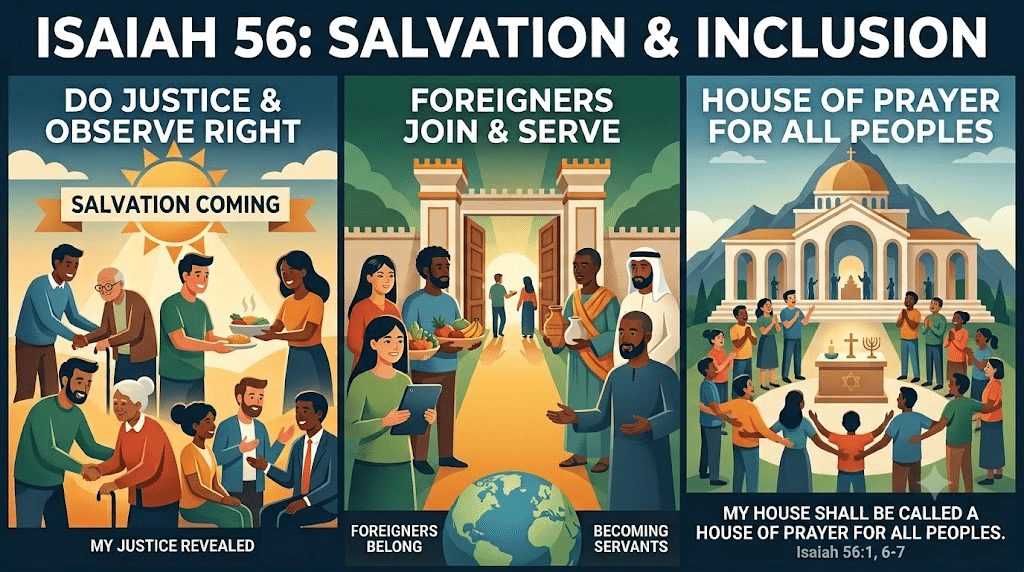
Isaiah 56:1, 6-7
Create a verse by verse (NAB) commentary relating xxxxxxxxxxxxx TO CATHOLIC doctrine and practice. Give real life applications when appropriate
give me three thought provoking questions followed up with detailed answer reflection based on xxxxxxxxxxxx
Verse & Text (NABRE) | Catholic Doctrine & Theology | Sacramental & Liturgical Connection | Real-Life Application |
Isaiah 56:1 "Observe what is right, do what is just, for my salvation is about to come..." | • Faith & Works: Grace requires a response through faith working in love (fides formata). • Eschatology: Preparing with hope for Christ’s return. | • Advent Season: Waiting in joyful hope. • Sacrament of Reconciliation: Purifying the heart to receive God's justice. | • Put Catholic Social Teaching into practice (defending dignity, seeking justice). • Perform an examination of conscience before receiving the Eucharist. |
Isaiah 56:6 "And foreigners who join themselves to the LORD... all who keep the sabbath..." | • Catholicity: The Church is universal, open to all nations through faith. • Baptismal Priesthood: The faithful are called to serve and worship God. | • Sacrament of Baptism: Entry point into the New Covenant. • Third Commandment: Keeping Sunday holy as the New Sabbath. | • Practice intentional parish hospitality toward converts, visitors, and immigrants. • Guard Sunday from unnecessary work, commercialism, and overscheduling. |
Isaiah 56:7 "...make them joyful in my house of prayer; their burnt offerings... acceptable on my altar..." | • Fulfilled Sacrifice: Old Testament sacrifices prefigure Christ's ultimate sacrifice. • Temple Cleansing: Jesus reclaims God's house as a place of prayer for all nations. | • The Holy Sacrifice of the Mass: The unbloody re-presentation of Christ on Calvary. • Reverence in the Sanctuary: The Church building as God’s house of prayer. | • Arrive early for Mass to prepare through quiet personal prayer. • Mentally unite your daily trials and personal sacrifices with the gifts on the altar. |
Isaiah 56:1
"Thus says the LORD: Observe what is right, do what is just, for my salvation is about to come, my justice, about to be revealed."
Catholic Doctrine & Theology
- Faith and Good Works: Isaiah ties the coming of God’s salvation directly to moral action ("observe what is right, do what is just"). In Catholic dogmatic theology (Council of Trent), salvation is a free gift of grace (sola gratia), but it demands an active response through faith working in love (fides formata, Galatians 5:6). Faith is not merely mental assent; it produces fruits of righteousness.
- Eschatological Preparation: The phrase "my salvation is about to come" echoes the Catholic understanding of Advent and the Christian life as an ongoing "waiting in joyful hope" for the Second Coming of Christ. Grace prompts us to prepare our souls so we are ready when the Master returns.
Real-Life Application
- Living the Catholic Social Teaching: Being Catholic means pursuing justice in daily life—advocating for the unborn, feeding the hungry, treating workers fairly, and rejecting gossip or systemic dishonesty.
- Sacramental Readiness: Before receiving Christ in the Eucharist, examine your conscience. Regular reception of the Sacrament of Reconciliation purifies the heart so that God’s righteousness can bloom within you.
Isaiah 56:6
"And foreigners who join themselves to the LORD, to minister to him, to love the name of the LORD, to become his servants—all who keep the sabbath without profaning it and hold fast to my covenant..."
Catholic Doctrine & Theology
- The Universality ("Catholicity") of the Church: In Old Testament times, strict ritual purity laws often segregated Israel from non-Jews. Here, God explicitly opens His covenant to "foreigners" (Gentiles). This finds its total fulfillment in the Catholic Church (katholikos = universal), where membership is not based on ethnicity, lineage, or social status, but on faith in Jesus Christ and baptism (CCC 830–831).
- The Lord’s Day (The New Sabbath): Keeping the Sabbath without profaning it translates directly to the Third Commandment and the Church’s precept to keep holy the Lord’s Day (Sunday, the day of Resurrection). Catholics fulfill this obligation by attending Holy Mass and refraining from unnecessary servile labor (CCC 2176–2188).
- Baptismal Priesthood: The call of Gentiles to "minister to him" and "become his servants" prefigures the common priesthood of all the faithful received at Baptism (1 Peter 2:9, CCC 1268).
Real-Life Application
- Welcoming the Stranger: Parishes must avoid becoming insular clubs. Practice intentional hospitality—welcoming converts, immigrants, or visitors of different ethnic and economic backgrounds into parish life.
- Guard Your Sunday: Protect Sunday from the creeping demands of work, endless sports leagues, and consumer culture. Treat the Sunday Mass as an unshakeable centerpiece of your week, reserving the rest of the day for family, rest, and prayer.
Isaiah 56:7
"them I will bring to my holy mountain and make them joyful in my house of prayer; their burnt offerings and their sacrifices will be acceptable on my altar, for my house shall be called a house of prayer for all peoples."
Catholic Doctrine & Theology
- The Holy Sacrifice of the Mass: Under the Old Covenant, sacrifices consisted of animals offered on the Jerusalem temple altar. In the Catholic tradition, these prefigure the Holy Sacrifice of the Mass—the one, unbloody re-presentation of Christ’s perfect sacrifice on Calvary. At every Mass around the world, fulfillment occurs: Gentiles offer acceptable worship on God's altar (Malachi 1:11).
- Joy in Worship: God promises to make His people "joyful in my house of prayer." Catholic liturgy is not meant to be a dry, exterior duty, but an encounter with the living God that instills deep spiritual joy (gaudium).
- Jesus Quotes Isaiah: Jesus explicitly quotes this verse when He cleanses the Temple (Matthew 21:13; Mark 11:17; Luke 19:46), rebuking those who turned a space intended for all nations into a place of greed and exclusion.
Real-Life Application
- Active Participation in Mass: Enter the church building recognized as a true "house of prayer." Prepare your heart before Mass begins through quiet prayer, rather than treating the nave as a social lounge.
- Offering Your Daily Crosses: Unify your personal sacrifices—troubles at work, physical pain, difficult relationships—with the bread and wine at Mass. When the priest offers the gifts on the altar, mentally place your personal sacrifices alongside them, knowing God accepts them.
Algorithmically generated text
give me three thought provoking questions followed up with detailed answer reflection based on xxxxxxxxxxxx
This question strikes at the heart of the Christian tension between grace and human action. In modern culture, it is easy to reduce God's love to a passive acceptance that requires nothing of us. However, Catholic theology—echoing Isaiah—holds that while salvation is entirely a free gift (sola gratia) merited by Christ on the Cross, it is not a passive legal transaction. Grace is dynamic; it invites and demands a response.
When Isaiah says, "do what is just, for my salvation is about to come," he is describing the posture of cooperative preparation. In Catholic doctrine, God's grace precedes us (preventing grace), but we must freely cooperate with it (fides formata—faith animated by love). Doing justice does not "earn" salvation in a commercial sense; rather, practicing righteousness expands our spiritual capacity to receive the salvation God is bringing.
If our hearts are hardened by injustice, self-absorption, or unrepentant sin, we will be unable to recognize or welcome God's justice when it appears. Thus, performing works of mercy, seeking justice in our communities, and repenting of personal sin are not burdens imposed upon us—they are the necessary exercises that open our hands to receive the gift of God's life.
Algorithmically generated text
In the ancient Near East, the Temple boundaries were strictly guarded. Foreigners were excluded from the inner courts, held at a spiritual and physical distance. When God declares through Isaiah that foreigners who hold fast to His covenant will be brought to His "holy mountain" and minister to Him, it represents a revolutionary shift. It foreshadows the catholicity (universality) of the Church, where ethnic, cultural, and social barriers are dissolved in Christ (Galatians 3:28).
Yet, human nature continuously tends toward exclusivism. In contemporary Catholic life, parishes can subtly drift into becoming cozy, insular clubs centered around specific demographics, political leanings, or longstanding social cliques. A stranger entering the church—whether a seeker with no religious background, someone carrying visible life struggles, an immigrant, or someone of a different socio-economic background—can quickly feel like the "foreigner" in Isaiah's era.
Isaiah’s prophecy forces us to ask uncomfortable questions: Do our parishes actively welcome the person who doesn't look, talk, or act like the established congregation? Do we view newcomers as guests to be tolerated, or as fellow ministers called by God to serve at the same altar? True catholicity requires us to dismantle our subtle "court of the Gentiles" and ensure that the House of God is genuinely open as a house of prayer for all people.
Algorithmically generated text
God promises through Isaiah to make His people "joyful in my house of prayer" and to accept their sacrifices on His altar. In the Catholic tradition, the fulfillment of this altar and house of prayer is the Holy Sacrifice of the Mass. Yet, many Catholics experience Mass primarily as a dry routine, an obligation to be checked off, or even a source of boredom rather than deep spiritual joy.
The disconnect often lies in how we understand both "joy" and "worship." Christian joy (gaudium) is not mere emotional excitement or entertaining spectacle; it is the deep, abiding fruit of the Holy Spirit that comes from union with God. When liturgy feels lifeless, it is often because we approach it as passive spectators waiting to be entertained, rather than active participants offering a sacrifice.
Isaiah connects joy directly to covenantal fidelity and self-offering ("their burnt offerings and their sacrifices will be acceptable"). Joy in the Liturgy is unlocked when we bring our whole lives to the altar—our gratitude, our grief, our daily struggles, and our personal efforts at justice throughout the week—and unite them with the Holy Sacrifice of Christ. When we realize that at every Mass, heaven touches earth and the Creator of the universe invites us to His banquet, the duty transforms into a profound, joy-filled encounter.
Algorithmically generated text

Write an engaging description meant to get readers to read Larry Broding’s commentary which can be used to help preachers prepare their own homily. After a brief introduction give bulletin points of why this commentary matters for your homily. conclude with “Read Larry Broding’s full commentary to help your congregation…” Complete sentence.
Spiritual “Ears”

Preaching on how to navigate tension within the faith community—balancing tradition with openness, or interior piety with active inclusion—requires more than just taking sides. It demands guiding your congregation toward true spiritual discernment and deep listening.
Larry Broding’s commentary offers preachers an insightful historical framework and a grounded spiritual approach to Third Isaiah’s message, helping you craft a homily that speaks directly to modern polarization.
Why This Commentary Matters for Your Homily
- Provides Essential Historical Context: Unpacks the real-world tensions during the 5th century B.C. rebuilding of the Temple, revealing how ancient debates over religious purity and inclusion mirror our own contemporary struggles.
- Reframes Division into Spiritual Discernment: Shifts the conversation away from simplistic “liberal vs. conservative” labels to ask deeper questions: What is worth conserving? What needs to be liberated?
- Highlights the Priority of Listening: Emphasizes Third Isaiah’s key to balance—cultivating “spiritual ears” through prayer and moral living to listen genuinely to oneself, others, and God.
- Connects Worship to Universal Inclusion: Shows how true fidelity to God’s covenant naturally expands our hearts toward those on the margins rather than shutting them out.

Commentary by Fr. Francis Martin | The Word Proclaimed
clean up grammar and spelling, create an outline for the following transcript xxxxxxxxxxxx
Cleaned Transcript
The Gospel Context: Universal Salvation and the Syrophoenician Woman
Now we move to part two to look at the first reading and, if time allows, to look quickly at the Psalm. The theme of these readings, as always, is set by the Gospel. This is a very beautiful and mysterious choice. The Gospel is about the Syrophoenician woman who called out to Jesus and whom He apparently rebuffed, yet she kept right at it and became an intercessor for the Gentiles.
The first text is from Isaiah 56, and it speaks about how everyone is welcome into the family of God. The Jewish people knew that; as Psalm 86 says, "All the nations shall come to worship You." It was the dream of the Jewish people, and they were aware that an important part of God's plan for the entire universe was being worked out through them. How many times do the scriptures speak of it? "My house shall be a house of prayer for all peoples."
They knew that what had been entrusted to them was of universal and eternal significance. Where they stumbled was in thinking that they would be the exclusive custodians or givers of this gift—which they were, but ultimately in Jesus Christ, the eternal incarnate Word of God, who is Himself a Jew.
Isaiah 56: Justice as Divine Fidelity (Sedeqah)
The first reading is from Isaiah 56:1, skipping verses 2 through 5, and then continuing with verse 6. Some of those intermediate verses help set the overall tone:
"Thus says Adonai: 'Make fair judgments your concern (Shamru mishpat), and act with justice (Sedeqah)... for My salvation (Yeshuati) is drawing near, and My saving justice will be revealed.'"
In Hebrew, sedeqah (justice) means respecting and honoring the truth of every relationship. Notice how God's salvation (yeshuati) is paired in parallel with His justice (sedeqah). Why? Because God manifests His justice by being faithful to His promises.
He promises to calm our poor, doubting, cynical hearts. It would be enough for God simply to say, "I love you and I will take care of you," but knowing we would forget it in an hour, He binds Himself to a covenant promise. Because He has promised, He owes it to sedeqah—to His own justice and character—to remain faithful to Himself and to care for us. Thus, God’s justice is parallel to salvation: working His salvation manifests His justice.
What is the most supreme act of divine justice in all of creation? The Cross. On the Cross, He saves us and provides a salvation far beyond anything we could ever achieve on our own while stuck in sin.
The Inclusivity of the Covenant: Foreigners and Eunuchs
Looking at the intermediate verses of Isaiah 56 that are often omitted:
"Blessed is anyone who does this... observing the Sabbath, not profaning it, and abstaining from every evil deed. Let no foreigner who is adhering to Adonai say, 'Adonai will utterly exclude me from His people.' ...And let no eunuch say, 'Look, I am a dried-up tree.' For thus says Adonai to the eunuchs who keep My Sabbaths, choose what pleases Me, and hold fast to My covenant: 'I will give them in My house and within My walls a monument and a name better than sons and daughters; I will give them an everlasting name that will never be cut off.'"
In ancient times, not having children was deeply difficult because a family line depended entirely on descendants. Today, we observe a form of national demographic decline in places like Europe—where low birth rates fail to sustain future generations—often driven by modern consumerism rather than prioritizing family and legacy.
Loving the Name of the Lord and the "Holy Pagans"
Returning to the liturgical text of Isaiah 56:
"As for foreigners who join themselves to Adonai, to serve Him and to love the name of Adonai (Ahavah et-shem Adonai), to become His servants—all who keep the Sabbath without profaning it and hold fast to My covenant—them I will bring to My holy mountain and make them joyful in My house of prayer."
To "love the name of the Lord" means to love the entire person of God and His divine presence made known through His name.
Cardinal Jean Daniélou wrote a book titled Holy Pagans of the Old Testament. Figures like Job (from the land of Uz), his friends, and Melchizedek were not ethnically Jewish, yet they sought and honored God. They demonstrate God's reach throughout history.
However, recognizing this does not mean Christian mission is unnecessary. It is a dangerous illusion to think, "Everyone is doing fine, so there is no need for missionaries." The greatest saints risked their lives and suffered martyrdom to bring the Word of Salvation to all nations. Knowing God as Father, Son, and Holy Spirit, receiving the Eucharist, and being anointed in the Sacraments is profoundly precious.
Fulfillment in the Church and Sacred Scripture
As Lumen Gentium (Paragraph 16) teaches: while it is possible for those who through no fault of their own do not know Divine Revelation to attain salvation by following God's grace, it remains foolhardy to deprive people of the fullness of Revelation.
Jesus explicitly quotes Isaiah 56 when cleansing the Temple:
"My house shall be called a house of prayer for all the nations, but you have made it a den of thieves."
Furthermore, as Jesus revealed to the Samaritan woman in John 4:
"A time is coming when you will worship the Father neither on this mountain nor in Jerusalem... true worshipers will worship the Father in Spirit and in Truth."
Worshipping "in Spirit and in Truth" means offering worship through the Holy Spirit in the Truth who is Jesus Christ. The Church is that house of prayer foretold by the prophets—the Temple of the Lord open to every nation, language, and people.
Click chevron banner to read transcript
organized into thematic sections.
20th Sunday of Year A
Create a simple, modern infographic illustrating [INSERT BIBLE PASSAGE OR TOPIC]. Use a [SPLIT-SCREEN / 3-PANEL] layout. The style should be clean, high-quality digital art or vector illustration.
Visuals:
Panel 1: Show [DESCRIBE SCENE 1 – e.g., a stormy sea].
Panel 2: Show [DESCRIBE SCENE 2 – e.g., Jesus calming the waves].
Text & Typography:
Font: Use EXTRA LARGE, BOLD, SANS-SERIF FONT (like Arial). Ensure high contrast so text is easily readable.
Header: Write “[INSERT MAIN TITLE]” at the top.
Captions: Include short, punchy text summaries in the panels: “[TEXT FOR PANEL 1]” and “[TEXT FOR PANEL 2]”.
Overall Vibe: Professional, educational, and uncluttered. Avoid small details; focus on big images and big text.

Rom 11:13-15, 29-32
Create a verse by verse (NAB) commentary relating xxxxxxxxxxxxx TO CATHOLIC doctrine and practice. Give real life applications when appropriate
give me three thought provoking questions followed up with detailed answer reflection based on xxxxxxxxxxxx
Verse & Text (NABRE) | Catholic Doctrine & Theology | Sacramental & Liturgical Connection | Real-Life Application |
Romans 11:13–14 "Inasmuch then as I am the apostle to the Gentiles, I glory in my ministry in order to make my race jealous..." | • Catholicity & Mission: Commissioned to bring the Gospel to all nations. • Holy Jealousy: God uses the visible holiness of one group to attract others to faith. | • Sacrament of Confirmation: Empowered by the Holy Spirit for active witness and evangelization. • Nostra Aetate: Vatican II teaching on the Church's deep spiritual roots in Israel. | • Evangelize through a life of visible joy, peace, and charity rather than pushy arguments. • Reject anti-Semitism and respect the Jewish heritage of Christian faith. |
Romans 11:15 "For if their rejection is the reconciliation of the world, what will their acceptance be but life from the dead?" | • Divine Providence: God brings ultimate good out of human failure and resistance. • Eschatological Hope: Final resurrection and total fulfillment of history in Christ. | • Eucharistic Liturgy: Anamnesis—recalling Christ's passion, death, resurrection, and future coming. • Universal Prayer: Interceding for the unity and salvation of all people at Mass. | • Trust God’s timing when loved ones reject the faith; God works through hidden detours. • Maintain hope in seasons of grief, trusting in the promise of "life from the dead." |
Romans 11:29 "For the gifts and the call of God are irrevocable." | • Unbroken Covenant: God’s covenantal fidelity to His chosen people is permanent. • Indelible Mark: God's grace and call cannot be cancelled by human weakness. | • Sacramental Character: Baptism, Confirmation, and Holy Orders leave an indelible spiritual seal. • Sacrament of Reconciliation: God's call remains intact, always welcoming back the sinner. | • Never give up on yourself or others—God’s baptismal call and love for you are permanent. • Return to Confession with confidence, knowing God's mercy is never revoked. |
Romans 11:30–31 "Just as you once disobeyed... so they have now disobeyed in order that... they too may now receive mercy." | • Universal Need for Mercy: Both Jews and Gentiles stand equally in need of grace. • Interconnected Mercy: Mercy flows through human channels to reach all peoples. | • Penitential Act (Confiteor): Acknowledging personal sinfulness at the start of every Mass. • Works of Mercy: Living out the Spiritual and Corporal Works of Mercy. | • Eliminate spiritual pride—faith is an unmerited gift, not a personal accomplishment. • Practice patient forgiveness and active mercy toward difficult family members and neighbors. |
Romans 11:32 "For God delivered all to disobedience, that he might have mercy upon all." | • Universal Salvific Will: God wills all people to be saved (1 Tim 2:4). • Primacy of Mercy: Divine Mercy is God's love healing and lifting up fallen humanity. | • Divine Mercy Sunday: Celebrating God’s boundless desire to forgive. • Chaplet of Divine Mercy: Devotional prayer for mercy on the whole world. | • Never despair of anyone's salvation, no matter how far they have strayed. • Pray regularly for the dying, sinners, and peace in divided communities. |
Romans 11:13–14
"Now I am speaking to you Gentiles. Inasmuch then as I am the apostle to the Gentiles, I glory in my ministry in order to make my race jealous and thus save some of them."
Catholic Doctrine & Theology
- The Mission to the Nations: St. Paul explicitly frames his apostolic authority around his specific charism: being the "apostle to the Gentiles." Catholic ecclesiology recognizes that while the Gospel emerged from the Jewish matrix, the Church is fundamentally catholic (universal), commissioned by Christ to make disciples of all nations (Matthew 28:19).
- Providential Provocation ("Holy Jealousy"): Paul uses the concept of "jealousy" not as a vice, but as a providential tool. God allows the Gentiles to receive the riches of the Messiah so that Israel might recognize the fulfillment of her own promises in Jesus. In Catholic theology, God often uses the witness and holiness of one group to awaken faith in another.
Real-Life Application
- Evangelization through Attraction: The most effective form of Catholic evangelization is a life so visibly transformed by grace that it makes others curious—and even "jealous"—for the peace and joy you possess. St. Francis de Sales famously noted that "a spoonful of honey attracts more flies than a barrel of vinegar."
- Honoring Israel's Legacy: Gentile Christians must never look down upon the Jewish people. As the Second Vatican Council taught in Nostra Aetate, the Church received the revelation of the Old Testament through the Jewish people, and our spiritual roots remain irrevocably linked.
Romans 11:15
"For if their rejection is the reconciliation of the world, what will their acceptance be but life from the dead?"
Catholic Doctrine & Theology
- The Mystery of Providence and Redemptive Suffering: Paul highlights a profound mystery: Israel's temporary "rejection" or stumble opened the door for the Gospel to spread across the Greco-Roman world, bringing reconciliation to humanity. God brings the ultimate good (the salvation of the world) out of human failure and resistance.
- Eschatological Hope ("Life from the Dead"): The full reconciliation and future inclusion of Israel is described as "life from the dead"—an allusion to both the Resurrection of Christ and the final resurrection at the end of time. Catholic eschatology looks forward to the ultimate fulfillment of history when all God's chosen will be united in Christ (CCC 674).
Real-Life Application
- Trusting God in Seasons of Rejection: When your efforts to share faith with family or friends seem rejected, remember that God's plans operate on a timeline far larger than our own. God can use temporary setbacks or detours to work hidden graces in ways you cannot yet see.
- Praying for the Restoration of All Things: Offer prayers during Mass—especially during the Universal Prayer (Petitions)—for unity, peace, and the spiritual awakening of all humanity.
Romans 11:29
"For the gifts and the call of God are irrevocable."
Catholic Doctrine & Theology
- God’s Unbroken Covenantal Faithfulness: This is one of the most dogmatically significant verses in the New Testament regarding Jewish-Catholic relations. The Catholic Church explicitly teaches that God has never revoked His covenant with the Jewish people (Nostra Aetate, 4; Catechism of the Catholic Church, 121). God does not abandon His promises when human beings fail; His fidelity is absolute.
- Sacramental Indelibility: Analogously, this principle reflects the Catholic understanding of the indelible sacramental character. In Baptism, Confirmation, and Holy Orders, God bestows a spiritual mark that can never be erased or revoked by sin or time (CCC 1272). God's call remains intact.
Real-Life Application
- Reclaiming Your Baptismal Dignity: Even if you have been away from the Church for decades or feel weighed down by severe sin, God’s original call to you in Baptism remains. His grace is always waiting in the Sacrament of Reconciliation—He never "cancels" His promise to welcome you back.
- Combating Anti-Semitism: Catholics are strictly obligated to reject all forms of anti-Semitism. To despise the Jewish people is to deny the irrevocable nature of God's gifts and promises.
Romans 11:30–31
"Just as you once disobeyed God but have now received mercy because of their disobedience, so they have now disobeyed in order that, by the virtue of the mercy shown to you, they too may now receive mercy."
Catholic Doctrine & Theology
- The Equality of Need for Mercy: Paul levels the playing field between Gentiles and Jews. Both groups share a history of disobedience; therefore, both groups stand in equal need of divine mercy. Salvation cannot be claimed as an inherent right or racial privilege—it is entirely a work of mercy (misericordia).
- Interconnected Mercy: God structures salvation history so that mercy flows through human channels: Gentiles received mercy through Israel's history, and now Israel is meant to encounter divine mercy through the witness of the Gentile-inclusive Church.
Real-Life Application
- Eradicating Spiritual Pride: No Catholic can claim superiority over non-believers or members of other faiths. If you enjoy the fullness of truth in the Catholic Church, it is an unmerited gift of mercy, not a trophy of personal merit.
- Becoming Instruments of Mercy: As recipients of God's mercy in the Sacraments, Catholics are called to extend that same mercy to others—through forgiveness in relationships, corporal and spiritual works of mercy, and patient dialogue.
Romans 11:32
"For God delivered all to disobedience, that he might have mercy upon all."
Catholic Doctrine & Theology
- The Universal Salvific Will of God: This verse sums up Paul's grand theological argument in Romans. God permits human freedom and its consequence (sin/disobedience) so that the depth of His mercy might be revealed to every human soul. This underpins the Catholic dogma that God "wills everyone to be saved and to come to knowledge of the truth" (1 Timothy 2:4; CCC 851).
- The Primacy of Mercy: Saint John Paul II made divine mercy a central pillar of modern Catholic practice (establishing Divine Mercy Sunday). Mercy is not merely a secondary attribute of God; it is His love encountering human misery and sin to heal and restore it.
Real-Life Application
- Never Despair of Anyone's Salvation: Because God's mercy extends to "all," no person is beyond the reach of grace—no matter how deeply entangled in sin, addiction, or unbelief they may be. Never stop praying for the conversion of loved ones.
- Praying the Chaplet of Divine Mercy: Integrate prayers for divine mercy into your devotional life, especially for the dying, for sinners, and for peace throughout the world.
Algorithmically generated text
give me three thought provoking questions followed up with detailed answer reflection based on xxxxxxxxxxxx
In a culture driven by "cancel culture" and transactional relationships, human commitments are often conditional and fleeting. We tend to view status—including spiritual standing—as something that can be revoked when standards aren't met. However, St. Paul's declaration that "the gifts and the call of God are irrevocable" reveals the absolute immutability of divine love.
In Catholic theology, this principle is reflected most clearly in the indelible sacramental character received at Baptism, Confirmation, and Holy Orders. When a person is baptized, God places a permanent spiritual mark upon their soul that can never be erased, overwritten, or cancelled—not by mortal sin, not by formal apostasy, and not by time. God does not "un-child" His sons and daughters.
This truth completely changes our pastoral and personal orientation:
- Toward Lapsed Catholics: We must stop viewing family members or friends who have left the Church as lost causes. Their baptismal identity remains fully intact. They do not need to be "re-made," but rather awakened to the dignity they already possess.
- Toward Our Own Failures: When we fall into grave sin or struggle with long-standing vices, Satan tempts us with despair, whispering that God has given up on us. Romans 11:29 reminds us that God's original call to holiness remains standing. The door to the Sacrament of Reconciliation is always wide open because God never revokes His promise to forgive and restore.
Algorithmically generated text
When St. Paul describes his desire to make his fellow Israelites "jealous" through his ministry to the Gentiles (Rom 11:14), he introduces a radical model of evangelization: attraction over argument. He implies that the Gentile Christians ought to be living out their faith with such profound joy, freedom, charity, and peace that those outside the fold look at them and say, "Whatever they have, I want it."
All too often, modern religious outreach relies on intellectual debate, political polarization, moralizing lectures, or anxiety-driven warnings. While doctrinal truth is essential, truth presented without love or lived without visible joy rarely wins hearts. If our practice of Catholicism leaves us bitter, scrupulous, judgmental, or cynical, we do not provoke "holy jealousy"—we provoke valid skepticism.
Pope Francis echoed Paul’s insight in Evangelii Gaudium when he wrote that the Church grows not by proselytizing, but "by attraction." This forces a sharp self-examination: Does my daily life—the way I handle stress, treat my spouse, speak to colleagues, and react to cultural turmoil—make faith look attractive? Does my life witness to the Resurrection, or does it look like a perpetual Good Friday? True evangelization begins when our interior peace makes others curious about the source of our hope (1 Peter 3:15).
Algorithmically generated text
Romans 11:32 is one of the most mysterious and sweeping statements in the New Testament: "For God delivered all to disobedience, that he might have mercy upon all." At first glance, it might sound as though God orchestrates human sin. However, Catholic theology clarifies that God does not cause sin; rather, in His infinite wisdom and respect for human freedom, He permissively allows humanity to experience the reality and consequences of its own brokenness.
Why would God permit this? Because self-righteousness is the ultimate barrier to divine life. If human beings could achieve perfect justice, peace, and holiness on their own strength, grace would be unnecessary, and pride would reign supreme. By allowing both Gentiles and Jews—indeed, every individual human heart—to experience their total inability to save themselves, God levels the spiritual playing field.
This reveals that Divine Mercy is not a backup plan; it is the ultimate objective of revelation. Mercy (misericordia) is God's covenantal love entering directly into human misery and weakness to lift it up. Recognizing our shared "disobedience" eradicates any room for spiritual pride or religious elitism. None of us can stand before the altar and claim we earned our spot. When we realize that we are saved purely by unmerited mercy, two things happen: we are freed from the crushing weight of perfectionism, and we are empowered to extend that exact same unconditional mercy to every flawed person around us.
Algorithmically generated text

Write an engaging description meant to get readers to read Larry Broding’s commentary which can be used to help preachers prepare their own homily. After a brief introduction give bulletin points of why this commentary matters for your homily. conclude with “Read Larry Broding’s full commentary to help your congregation…” Complete sentence.
Through A Larger Vision
Larry Broding’s commentary provides preachers with insights and thematic framing necessary to turn complex Pauline arguments into a clear, hope-filled message.
- Illuminates Complex Theology: Simplifies Paul’s paradox in Romans—showing how human disobedience and rejection became the unexpected avenue through which God’s mercy reached the entire world.
- Reframes Misfortune into Divine Purpose: Demonstrates how early church obstacles and missed opportunities forced the Apostles to expand their vision from a localized Jewish mission to a truly universal, global calling.
- Offers Pastoral Comfort in Times of Scandal: Bridges Paul’s historical struggle to modern spiritual life, showing how God can bring ultimate good out of failure or rejection.
- Centers the Core Message on Universal Mercy: Regardless of background or past failings, every person stands in equal need of—and is equally offered—God’s mercy.
Commentary by Dr. Brant Pitre | Catholic Productions

Commentary by Fr. Francis Martin | The Word Proclaimed
clean up grammar and spelling, create an outline for the following transcript xxxxxxxxxxxx
The Apostle to the Gentiles and Holy Jealousy
The third part of our consideration—the second reading—is from the Letter to the Romans. It is toward the end of the letter, a part in the middle, and then at the end. It is Paul reflecting, as he was last week, on his ministry. Remember last week: "I would wish to be cut off from Christ for the sake of my fellow Jews." What kind of deep love is that?
Now he goes on at another part of the letter and says:
"Now to you—I speak to you Gentiles, inasmuch as I am the Apostle to the Gentiles, I honor that service, that ministry; I glory in it, so that I can make my own race jealous and thus save some of them."
That works, you know. When I lived in Israel, we had some prayer groups. Some were made up of Jewish believers, and they prayed with Palestinian believers. Sometimes there would be an event, like a wedding, where people invited Palestinian Muslim or Israeli friends. They would come and see the way these people related as believing Christians, and they would be jealous. Wouldn't it be nice to have a group of people you can totally trust, who aren't out to get your money or your house?
Searching for Wisdom: A Testimony from India and Israel
I remember once there was a couple whom I knew from India. They had been looking for wisdom. They were civilly married, but they went looking for true wisdom. They were in India, at the Ganges or another holy place, and one of the old holy men said to them, "You have to find Jesus Christ; that is how you are going to find wisdom." They were shocked. All over India, their mother and father had told them that, but they didn't pay attention. Now they go to a guru in India, and that is what he tells them.
So they wrote to me while I was in Israel. They said, "We would like to come and get married in the Church." I said, "Yes, come up." They hitched rides and traveled all the way from India in dungarees, T-shirts, and a small knapsack.
When they arrived, I said, "Now, you are going to need three months to get ready because you don't know the faith yet. I can't marry you as Christians when you don't yet know what Christianity is." They were open and spoke French, so I entrusted them to a young French-speaking community to work with them and prepare them. They did this for about three months, and I met with them as well.
"Behold How These Christians Love One Another"
Then came the big day—I believe it was Easter Sunday afternoon. We had the wedding in the Church of Dominus Flevit, the church on the slope of the Mount of Olives where the Lord wept over the city. There is a large window overlooking the entire city of Jerusalem. The sun was going down, bathed in golden light, and that is where we had the wedding.
I had another friend who had gotten to know them, an Israeli-born Sabra whose native language was Hebrew, but who translated French to Hebrew professionally. She was at the Mass and the reception afterward. We had finger food and wine, and the couple was dressed nicely—they borrowed a suit and dress from people in the community.
She said to me, "Who is paying for all of this?" I explained that the community borrowed the clothes for them, and as for the party, the community was simply thrilled that these people were coming into the Church and coming to know Jesus Christ. She looked at me and said, "They really do love them, don't they?"
That remark of Tertullian—"Behold how these Christians love one another"—still makes an impact. That is why Paul says, "I could stir my own race, my own flesh, to jealousy and save some of them." They see that believers have something special. You can have it too; just come to know Jesus, get baptized, and it is yours. It is just as much a gift to me as it is to you.
Rejection, Reconciliation, and Ezekiel's Vision
Paul continues:
"For if their rejection is the reconciliation of the world, what will their acceptance be but life from the dead?"
That phrase, "life from the dead," refers to the prophecy in Ezekiel 37, where Ezekiel is told to prophesy to the dry bones. He prophesies over the bones, and the Spirit comes and clothes them with flesh. That was a vision of God saying to the Jewish people: "You are in exile and disgraced, but don't give up. I love you, and I will restore you to life." Paul is saying that if their initial rejection resulted in the reconciliation of the rest of the world, their ultimate acceptance will be nothing short of life from the dead.
Irrevocable Gifts and Modern Parallels
The liturgical text skips a section and moves to the conclusion: the gifts and the call—the charismata—of God are without recall; they are irrevocable.
Just as the Gentiles once disobeyed God but received mercy through the context of Israel's journey, Paul reminds them of where they came from. Pagan antiquity was filled with moral confusion. The Roman historian Tacitus once wrote that the Jews were "enemies of the human race" partly because they refused to expose their newborn children in the gutters—a common practice in ancient Rome where infants were left to die or be taken into slavery.
We have not advanced as far from the first century as we might think. In many ways, the era when the Gospel was first preached was what historians call "The Age of Anxiety"—a time when people felt uncertain and distrustful, much like today. Yet God's gifts and call remain irrevocable.
Papal Teaching and the Continuity of the Covenants
In 1980, Pope John Paul II spoke at a synagogue in Mainz, Germany, emphasizing the permanent validity of the Old Covenant:
"The first dimension of this dialogue—that is, the meeting between the People of God of the Old Covenant, never revoked by God, and that of the New Covenant—is at the same time a dialogue within our Church, that is to say, between the first and second parts of her Bible... Effort must be made to understand better everything in the Old Testament that has its own permanent value, since this value was not wiped out by the later interpretation of the New Testament, which on the contrary gave the Old Testament its full meaning."
After 55 years of studying Scripture, that is my personal experience as well: you hear the Lord and see the face of Christ within the Old Testament texts. I recall a meeting with a young Jewish scholar who noted that referring to the Old Covenant or Old Testament is a sign of deep historic respect for the foundation of the faith.
As Saint Paul summarizes:
"For God has delivered all to disobedience, that He might have mercy on all."
Everyone owes God an infinite debt, and this is His way of revealing His mercy so that we are bound to Him in love. The Old Covenant and the New Covenant are two expressions—the preparation and the completion—of one divine plan of God.
Click chevron banner to read transcript
organized into thematic sections.
20th Sunday of Year A
Create a simple, modern infographic illustrating [INSERT BIBLE PASSAGE OR TOPIC]. Use a [SPLIT-SCREEN / 3-PANEL] layout. The style should be clean, high-quality digital art or vector illustration.
Visuals:
Panel 1: Show [DESCRIBE SCENE 1 – e.g., a stormy sea].
Panel 2: Show [DESCRIBE SCENE 2 – e.g., Jesus calming the waves].
Text & Typography:
Font: Use EXTRA LARGE, BOLD, SANS-SERIF FONT (like Arial). Ensure high contrast so text is easily readable.
Header: Write “[INSERT MAIN TITLE]” at the top.
Captions: Include short, punchy text summaries in the panels: “[TEXT FOR PANEL 1]” and “[TEXT FOR PANEL 2]”.
Overall Vibe: Professional, educational, and uncluttered. Avoid small details; focus on big images and big text.

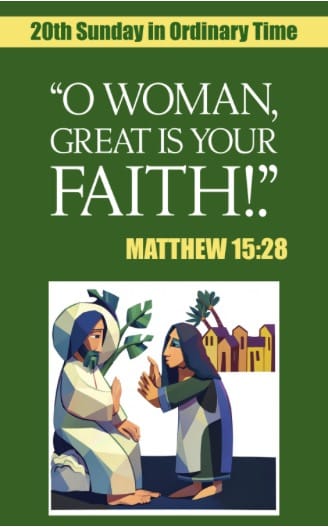
Matthew 15:21-28
Create a verse by verse (NAB) commentary relating xxxxxxxxxxxxx TO CATHOLIC doctrine and practice. Give real life applications when appropriate
Verse & Text (NABRE) | Catholic Doctrine & Theology | Sacramental & Liturgical Connection | Real-Life Application |
Matthew 15:21–22 "Have pity on me, Lord, Son of David! My daughter is tormented by a demon." | • Catholicity: Jesus enters Gentile territory, prefiguring the universal Church. • Intercessory Prayer: Standing in the gap to bring another's suffering to Christ. | • Penitential Act (Kyrie Eleison): Praying "Lord, have mercy" at every Mass. • Intercession of Saints: Modeling our role as spiritual intercessors. | • Never stop praying for children or loved ones struggling with illness or lost faith. • Step out of personal comfort zones to encounter and serve those on the margins. |
Matthew 15:23–24 "But he did not say a word... 'I was sent only to the lost sheep of Israel.'" | • Testing of Faith: God's silence purifies desire and draws out deeper trust. • Salvation History: The Gospel goes first to Israel before expanding to all nations. | • Spiritual Dryness: Experiencing the dark night of the soul in prayer. • Human Church: Disciples act as flawed mediators, yet Christ's plan moves forward. | • Treat seasons of unanswered prayer as invitations to deepen love for the Giver over the gift. • Do not let the impatience or flaws of church members drive you away from Christ. |
Matthew 15:25–26 "But the woman came and did him homage, saying, 'Lord, help me.'" | • Adoration (Latria): True worship belongs to God alone. • Foundation of Prayer: Humility and total dependence on God are required for grace. | • Eucharistic Adoration: Kneeling in surrender before Christ in the Blessed Sacrament. • Arrow Prayers (Ejaculations): Short, unceasing cries from the heart. | • Pray simple, earnest breath prayers like "Lord, help me" during moments of anxiety. • Approach God without entitlement, recognizing that grace is an unmerited gift. |
Matthew 15:27–28 "'Even the dogs eat the scraps...' 'O woman, great is your faith!'" | • The Eucharist: Christ is the Bread of Life; even a fraction contains His full presence (concomitance). • Efficacy of Grace: Christ's healing word transcends distance and human barriers. | • Prayer of Humble Access: Praying "Lord, I am not worthy..." before Holy Communion. • Sacramental Healing: Christ's power actively present in the Sacraments today. | • Approach the Holy Eucharist with profound awe and reverence. • Turn moments of rejection or trial into opportunities for humble, persistent faith. |
Matthew 15:21
"Then Jesus went from that place and retired to the region of Tyre and Sidon."
Catholic Doctrine & Theology
- The Crossing of Boundaries: Tyre and Sidon were ancient pagan, Gentile territories northwest of Galilee. By intentionally withdrawing to this region, Jesus prefigures the expansion of the Church to all nations. Catholic ecclesiology sees this as a foundational moment where the seeds of the Church's catholicity (universality) are planted in Gentile soil.
- Retreatment and Preparation: Jesus frequently retreats to quiet or foreign places to pray, teach His disciples, and prepare for the next stage of His mission. This highlights the balance between active ministry and interior reflection.
Real-Life Application
- Stepping Out of Comfort Zones: Authentic Catholic evangelization requires leaving familiar, comfortable Catholic spaces to meet people where they are—including those who feel far from God or outside the traditional bounds of the faith.
- Making Time for Spiritual Retreat: Follow Christ’s example by stepping away from daily noise through structured personal retreats, quiet time before the Blessed Sacrament, or weekend parish days of recollection.
Matthew 15:22
"And behold, a Canaanite woman of that district came and called out, 'Have pity on me, Lord, Son of David! My daughter is tormented by a demon.'"
Catholic Doctrine & Theology
- Messianic Recognition by a Gentile: Matthew specifically calls her a "Canaanite"—an ancient enemy of Israel—to emphasize her background. Remarkably, she addresses Jesus as "Lord" (Kyrios) and "Son of David", explicitly recognizing His royal Messianic identity before many of His own countrymen did.
- Intercessory Prayer: The woman does not ask for herself; she cries out on behalf of her afflicted daughter. In Catholic doctrine, this exemplifies the power of intercessory prayer. We are called to stand in the gap for others, carrying their suffering to Christ, just as saints and believers do daily (CCC 2634–2636).
Real-Life Application
- The Persistence of Parental Prayer: Parents carrying the burden of a child who is struggling, sick, or away from the faith should look to this mother. Never cease pleading for your children before the Lord; intercessory love moves the heart of Christ.
- The Kyrie Eleison: Her plea—"Have pity on me, Lord"—echoes directly in the Mass during the Penitential Act (Kyrie, eleison / "Lord, have mercy"). Approach every Mass with the same urgent humility.
Matthew 15:23
"But he did not say a word in answer to her. His disciples came and asked him, 'Send her away, for she keeps calling out after us.'"
Catholic Doctrine & Theology
- The Testing of Faith (The "Silence" of God): Jesus’ initial silence is not indifference, but a pedagogical trial designed to draw out, refine, and manifest the depth of her faith for the benefit of His disciples and all future generations. St. Augustine notes that God sometimes delays answering our prayers not to reject us, but to enlarge our desire.
- Clerical Imperfection and Mediation: The disciples demonstrate human impatience—they want to dismiss her because she is inconvenient. Yet, ironically, they still act as mediators, bringing her presence to Jesus' attention. The Church, while divine in her head (Christ), is composed of flawed human ministers.
Real-Life Application
- Navigating Spiritual Dryness & Unanswered Prayer: When God seems silent in prayer, do not interpret it as absence or abandonment. Use seasons of spiritual dryness to purify your motives—praying for love of the Giver rather than merely the gift.
- Overcoming Obstacles in the Church: If you encounter impatience, coldness, or poor witness from church members or clergy, do not let it drive you away from Christ. Look past the disciples directly to the Master.
Matthew 15:24
"He said in reply, 'I was sent only to the lost sheep of the house of Israel.'"
Catholic Doctrine & Theology
- Salvation History Order: Jesus highlights the divine ordering of salvation history: the Gospel must be offered first to the covenant people of Israel to fulfill God’s promises (Romans 1:16). Only after Israel's initial response is the mission fully opened to the entire world through the Resurrection and Pentecost.
- The Unfolding Manifestation of Grace: Catholic theology distinguishes between the historical scope of Jesus’ earthly ministry (focused on Israel) and the universal scope of His Paschal Mystery, which redeemed all humanity.
Real-Life Application
- Respecting God’s Order and Timing: Recognize that God works through structured stages in our personal lives. Patience with God’s timing is essential when waiting for spiritual growth, personal healing, or life decisions.
Matthew 15:25
"But the woman came and did him homage, saying, 'Lord, help me.'"
Catholic Doctrine & Theology
- Adoration and Worship (Latria): Instead of giving up after a double refusal, the woman draws closer. She does Him "homage" (prosekynēsen—the Greek verb for worship and prostration). In Catholic theology, this prefigures the posture of true worship (latria), which belongs to God alone.
- The Prayer of Simple Surrender: Her prayer—"Lord, help me"—is one of the purest expressions of faith in the Gospels. It echoes the Catholic tradition of short, heart-felt arrow prayers (ejaculations) that turn the soul instantly toward God (CCC 2668).
Real-Life Application
- Short, Powerful Breath Prayers: In moments of acute anxiety, temptation, or weakness, repeat this simple prayer throughout your day: "Lord, help me." It requires no theological complexity, only complete trust.
- Eucharistic Adoration: When facing overwhelming trials, physically bring yourself before the Blessed Sacrament in Eucharistic Adoration, kneeling in the same posture of homage and surrender.
Matthew 15:26
"He said in reply, 'It is not right to take the food of the children and throw it to the dogs.'"
Catholic Doctrine & Theology
- Testing Cultural Prejudices: Jesus uses a common contemporary Jewish idiom that distinguished between the "children" (Israel) and the "dogs" (Gentiles). However, Jesus uses the diminutive form in Greek (kynariois—meaning "house dogs" or "puppies"), softening the harshness. He sets up a theological parable to test whether her faith rests on pride or true humility.
- Humility as the Foundation of Prayer: Catholic spiritual theology teaches that "humility is the foundation of prayer" (CCC 2559). To receive grace, one must acknowledge total dependence on God, claiming no intrinsic rights or merit of one's own.
Real-Life Application
- Crushing Spiritual Pride: Approach God without entitlement. We cannot demand blessings from God as if He owes us; every grace is an unmerited gift. True spiritual growth begins when we recognize our utter need for His mercy.
Matthew 15:27
"She said, 'Please, Lord, for even the dogs eat the scraps that fall from the table of their masters.'"
Catholic Doctrine & Theology
- Witty, Humble Faith: The woman displays brilliant spiritual agility. She accepts Jesus’ framing without offense or resentment, turning His own words into an argument for grace: even a small "crumb" of divine power is more than enough to heal her daughter.
- The Abundance of the Eucharist: In Catholic sacramental theology, this verse deeply connects to the Holy Eucharist. Christ is the "Bread of Life" on the table of the altar. Because Christ is fully present—Body, Blood, Soul, and Divinity—in every single particle of the Blessed Sacrament (the doctrine of concomitance), even the smallest "crumb" conveys infinite grace.
Real-Life Application
- Reverence for the Holy Eucharist: This verse inspires the Catholic prayer said right before Communion in traditional liturgies (the Prayer of Humble Access): "We are not worthy so much as to gather up the crumbs under thy Table." Approach the Eucharist with deep awe, recognizing the immense gift present in the smallest Host.
- Refusing to Take Offense: In daily life, practice her humility by choosing not to take offense when overlooked or criticized. Turn moments of humiliation into opportunities for prayer and growth.
Matthew 15:28
"Then Jesus said to her in reply, 'O woman, great is your faith! Let it be done for you as you wish.' And her daughter was healed from that hour."
Catholic Doctrine & Theology
- The Victory of Faith: Jesus publicly commends her: "Great is your faith!" (Only two people in the Gospels are praised by Jesus for having "great faith," and both are Gentiles: this woman and the Roman Centurion in Matthew 8:10). Her faith breaks through the historical boundary and inaugurates the universal mission.
- Efficacy of Sacramental/Distant Healing: Jesus heals the daughter from a distance through His word alone. This illustrates the divine power that operates through the Sacraments today: Christ's healing grace is not bound by physical distance or human limitations.
Real-Life Application
- Cultivating Persistent Faith: Do not give up on prayer when answers are delayed. Bold, persistent, and humble prayer moves the heart of God.
- Interceding for Deliverance: Trust in Christ's power over spiritual evil. When loved ones are bound by addiction, spiritual oppression, or sin, continue to present them to Jesus in Mass and Rosaries, confident in His power to set them free.
Algorithmically generated text
give me three thought provoking questions followed up with detailed answer reflection based on xxxxxxxxxxxx
At first glance, Jesus’ initial silence ("He did not say a word in answer to her") and His sharp metaphor regarding "dogs" and "children" can feel shocking. Modern readers often struggle to reconcile this exchange with Christ’s gentleness. However, in Catholic spiritual theology, Jesus is not displaying cruelty; He is engaging in a pedagogical testing of faith.
St. John Chrysostom observed that Jesus knew the depth of this woman’s faith from the beginning. By remaining silent at first, He did not intend to reject her, but rather to draw her faith out into the open so that His disciples—who harbored deep cultural prejudices against Gentiles—could witness true, saving faith in action. God's silence was the chisel that carved out a monument of persistent trust.
In our own lives, we often interpret God's silence as absence, apathy, or rejection. Yet, Catholic spiritual masters like St. John of the Cross teach that periods of "unanswered" prayer or spiritual dryness (the dark night) are frequently divine invitations. God delays His response to stretch our desire, purify our motives (moving us from loving God for His favors to loving God for Himself), and cultivate a faith that relies on trust rather than immediate emotional consolation.
Algorithmically generated text
When Jesus mentions taking the children's bread and throwing it to the dogs, the woman had every opportunity to become offended, defensive, or prideful. Instead, she displays extraordinary spiritual agility and humility. She accepts her position without entitlement, effectively saying, "Lord, even if I have no legal claim to the inheritance of Israel, even a single crumb of your power and mercy is more than enough to heal my daughter."
This response highlights a foundational principle of Catholic spirituality: humility is the vessel that holds grace. St. Teresa of Ávila noted that "humility is walking in truth." The truth is that none of us can demand anything from God as an inherent right; salvation and grace are completely unmerited gifts.
This humility finds its highest expression in how Catholics approach the Holy Eucharist. Before receiving Holy Communion, the entire congregation prays the words of another Gentile (the Roman Centurion): "Lord, I am not worthy that you should enter under my roof, but only say the word and my soul shall be healed." Furthermore, Catholic doctrine teaches the concept of concomitance—that Christ is fully present, Body, Blood, Soul, and Divinity, in every single host and every fraction of a particle. We do not need "grand spectacles" of grace; like the Canaanite woman, we recognize that even the smallest "crumb" from the altar of God contains infinite, divine life.
Algorithmically generated text
The Canaanite woman did not come to Jesus seeking personal advancement, relief from financial hardship, or physical healing for herself. Her plea was entirely vicarious: "Have pity on me... My daughter is tormented by a demon." Notice how she makes her daughter’s suffering her own. Her love for her child drives her past cultural taboos, disciples' impatience, and initial divine silence.
In Catholic doctrine, parents are recognized as the primary educators and spiritual guardians of their children (CCC 2221). This story offers a profound archetype for parental intercession. In a world filled with modern spiritual "demons"—addiction, despair, secularism, mental distress, and moral confusion—parents often feel helpless watching their children suffer or drift away from faith.
The Canaanite mother demonstrates that when a parent cannot directly fix their child's situation, they can always bring that child directly to Christ through relentless prayer. She teaches us that true intercession requires three things:
- Unconditional Love: Viewing our children's spiritual battles as our own.
- Patience with the Church: Looking past the flaws, coldness, or impatience of human ministers (the disciples) to stay focused on Christ.
- Refusal to Quit: Pleading at the feet of Jesus until the blessing comes.
Her story reassures every praying parent, spouse, or friend that no soul is beyond the reach of Christ when carried there on the wings of persistent, loving intercession.
Algorithmically generated text

Write an engaging description meant to get readers to read Larry Broding’s commentary which can be used to help preachers prepare their own homily. After a brief introduction give bulletin points of why this commentary matters for your homily. conclude with “Read Larry Broding’s full commentary to help your congregation…” Complete sentence.
Prejudice and Faith
Larry Broding’s commentary offers precisely the context and pastoral insight you need to craft a compelling, transformative sermon on the encounter between Jesus and the Canaanite woman in Matthew 15.
- Unpacks Complex Cultural Context: Broding carefully navigates the tension between First-Century Jewish-Gentile relations and the nuanced meaning behind Jesus’ boundary-testing metaphor of the “children” and the “dogs.”
- Highlights Textual & Translation Nuances: By pairing a popular translation alongside a literal Greek translation, the commentary illuminates key ambiguous phrasing.
- Bridges Exegesis to Social Justice: Connects the Canaanite woman’s persistent faith directly to the Church’s teaching on human dignity and solidarity (CCC 1928–1942).
- Provides Ready-to-Use Application: Offers thought-provoking questions about modern prejudices, cultural division, and overcoming discouragement.

Commentary by Dr. Brant Pitre | Catholic Productions
Commentary by Fr. Francis Martin | The Word Proclaimed
clean up grammar and spelling, create an outline for the following transcript xxxxxxxxxxxx
Contextualizing the Gospel of Matthew (Matthew 15:21–28)
Now we're going to look at the Gospel for the 20th Sunday in Ordinary Time, which is from the Gospel of Matthew, chapter 15, verses 21 through 28. It's the story of the Syrophoenician woman, as I mentioned before, but I want to contextualize it for you.
The story immediately preceding in St. Matthew is that discussion about why His disciples eat with unwashed hands and break their traditions. Our Lord goes after them and finally says, "You see, it's not what goes into a man that makes him defiled; it's what comes out." Therefore, in a way, He did away with all of those dietary and other ceremonial regulations. They're not necessary.
Then, by way of illustration, we have this story of Jesus going up to the region of Tyre and Sidon—which is north and a little bit west of Palestine—and talking to this pagan woman. As the Fathers of the Church saw with great perspicacity (though we moderns didn't see it, and in all the years I've been working with this, I never grasped it), that Syrophoenician woman is like the mother of the Gentiles. She is calling out, and she wins salvation for all the Gentiles.
The other famous story of a healing at a distance is the Centurion's servant—another Gentile. In other words, at a distance, Jesus is healing. But there will be a moment when there will be no more distance, because you will be receiving the Eucharist just as we do. So that's the background for this story, which is so beautiful and so illustrative for us in our own life of prayer.
The Encounter in Tyre and Sidon
So the text begins: leaving the place where they were having that discussion, He withdrew to the region of Tyre and Sidon, which is Lebanon today. And behold, a Canaanite woman from that region came out to Him.
Now, she is called a Canaanite woman in Matthew. In Mark, she's called a Syrophoenician, which is saying the same thing because that is Syria, and of course, that's where the Phoenicians lived (Lebanon today). So this woman comes out who is a Syrophoenician, or in this text, a Canaanite woman—which is historically the same, as the Canaanites lived up there.
She comes out from that region crying out, "Have mercy on me, Kyrie—Lord, Son of David!" That's a Christian prayer; it's a Jewish prayer. Why does she know that? Did she hear Him? Was she one of those who walked down into Galilee when our Lord was teaching and healing? Did she know Him slightly? It is hard to know. But she's very bold because she has a daughter who is tormented. The text literally says, "My daughter is daimonizomai"—she's badly demonized.
So she's appealing—as St. John Chrysostom and Origen even noticed—this is a Gentile appealing for her posterity. Jesus is sensitive to that.
The Test of Faith and the Disciples' Reaction
But the text says He did not answer her a word. Why not? Is He rude? No, He loves this woman, but He wants to bring her to a higher level so that her intercession and the healing of her daughter reverberate through history and become a model for the Lord's care and actual gracing of the Gentiles.
So it says He did not answer her a word. She didn't give up, and He knew she wouldn't because of the care for her daughter. She's a mother.
The text says the disciples came and said to Him, "Would you get rid of her? She keeps calling out after us. She's following us down the street, and couldn't you get rid of her, Jesus?" Now, they don't hesitate to say that. Here is Jesus planning this thing in His own way, bringing this woman—like He did in another way for the Samaritan woman—and the guys are just saying, "This lady is a pain in the neck, can you get rid of her, Jesus? Heal her daughter, do whatever You want, but get rid of her." They're implying, "Heal her—you can heal anybody—heal her and she'll go home, and we'll be at peace."
That's not a very exalted apostolic motive, is it? I mean, they're nowhere—these pillars of the Church who, as the Preface for the Mass of the Apostles says, from their place in Heaven guide us still. Look how they started! Why do they put that in? So that nobody will think more highly of them than they should, and so that we'll all say, "Look, I was there, or I am there, but I could improve." Look at what happened to them—it's to encourage us! Scripture always tells their faults. In fact, it's a characteristic of biblical religion that all the heroes, except Jesus Himself, have all their faults laid out. Abraham lied about his wife, David committed adultery and murder, Moses got angry.
The Syrophoenician Woman’s Persistence
So He said to her, "I was not sent except to the lost sheep of the house of Israel." That's His main mission, of course: to fulfill the promise that was made by the Word of God through the prophets for a millennium. "That's My mission."
So she comes right back. She worships Him—it says proskynēo—and says, "Lord, help me!"
Now, His previous remark was more or less to the disciples: "You want Me to heal this Canaanite woman's daughter, but I am only sent to the lost sheep of the house of Israel." Now she comes up directly and says, "Help me!"
He says, "It is not good to take the bread of the children and throw it to the dogs." That's not nice! That's a tough saying. Saying to the Canaanites, Syrophoenicians, non-Jews: "You're dogs." In that culture, to call anybody a dog was the worst thing.
Anyhow, she goes right past it because of her love for her daughter. She doesn't care. He can call her anything He wants, but she knows He can heal her daughter. Beyond everything else, even the preoccupation for her daughter, is this faith: "You can call me a dog if You want, but I know You can heal my daughter."
So she answers and says, "Oh yes, Lord, but even the dogs eat the scraps that fall from the table of their masters." In other words: "You're a Jew, and You're sent to the Jews. You're at a banquet here. You're feeding Your people with the Word of God day after day, with the power of healing day after day. Surely some of it must fall from the table, and we could eat that."
Great is Your Faith
He's thrilled to death! Now He's got a hero, just like the Centurion. Remember what He said about the Centurion during that other healing at a distance? "I haven't found faith like this in all of Israel."
And now He says to this woman—which is so beautiful—He says, "O woman, great is your faith! Let it be done for you as you wish." And her daughter was healed at that moment.
It is an interesting vocabulary: the woman says she is tormented by a demon, and He says she is healed. In other words, in that intimate and obscure area of demonic activity and sickness—ultimately, since the devil hates man, he causes all the sickness he can, he causes all the abortion he can because he hates—she's right that a demon is bothering her daughter. And our Lord just says, "O woman, great is your faith."
When we read these passages, we should pray and try to enter into our Lord's thrill at this faith. It's the same when He describes the prayer of that tax collector in the back of the Temple compared to the Pharisee. The devout soul goes up to the front, thanking God for all the good things that he does, while the guy in the back is just saying, "O God, be merciful to me, a sinner." When you read the text, pray to the Holy Spirit to hear how our Lord's heart leaps as he hears that prayer. He is more identified with him than He is with the Pharisee. He who is pure, divine, spotless holiness is more identified with this sinner than He is with the guy in the front. Just read it and feel that enthusiasm! I promise you, this one went home justified, not that one.
Here you have the same thing: "O woman, great is your faith! I am so proud of you. You come from a Gentile background, you didn't have good Jewish training, but you know I've got this power and you're calling me by the right words. You're calling Him Kyrie, calling Him Son of David. I rebuff you, and you take it and rise, rise, rise! So now we're talking, and I love you, and I admire your faith. Let it be done as you wish."
At that moment, the daughter was healed. That's the story.
We can read there the love in the heart of Christ for all unbelievers. The solution is not to say, "Well, they're doing fine." No, the solution is recognized in how many millions have gone out and risked their lives—and sometimes been martyred—because to be inside the Gospel makes it thousands of times easier to attain salvation than to be outside the Gospel. And that's very important to remember: "Woman, not great is your luck; woman, great is your faith!"
Click chevron banner to read transcript
organized into thematic sections.
Doctrinal Homily Outlines
Salvation and the Virtue of Justice

Central idea: God’s salvation is for everyone who wants it
Doctrine: Living out our salvation by doing what is just
Practical application: Being more just
Sunday Prep Videos
20th Sunday of Year A