Fr. Tony’s Homily, Homily Starters
Fr. Tony’s Homily, Homily Starters
August 16, 2026



RELATED
PAGES




We Accept (2017)
20th Sunday of Year A

HOLY AD: The ad features a close-up montage of faces representing diverse ethnicities, ages, genders, and religious backgrounds. As the faces blend into one another, onscreen text reads: “We believe no matter who you are, where you’re from, who you love, or who you worship, we all belong. The world is more beautiful the more we accept.”
THEOLOGICAL CONNECTION: Isaiah 56 envisions a radical expansion of God’s covenant, declaring that the temple is not an exclusive club for a single nation, but a home open to all who draw near to God. Foreigners and marginalized figures who were previously excluded are warmly gathered into divine worship.
Airbnb’s “We Accept” commercial echoes this prophetic vision of open-door hospitality. While the advertisement addresses human belonging within global travel and community, it serves as a cultural reflection of Isaiah’s theological premise: sacred space and divine welcome are inherently universal. God’s kingdom dismantles artificial human barriers, ethnic divides, and exclusionary criteria. The commercial’s message that “we all belong” aligns with the Isaiah passage’s core truth—that God’s gathering grace is expansive enough to encompass all peoples, inviting everyone into a shared sanctuary of peace and dignity.
Signs (2002)
20th Sunday of Year A

FAITH & FILM: When an alien invasion reaches their home, former priest Graham Hess (Mel Gibson) and his family lock themselves in the basement. His young son, Bo, suffers a severe asthmatic attack in the dark. With no medicine available, Graham holds his suffocating child, weeping, pleading, and desperately talking to his son and to God. Earlier in the film, Graham had abandoned his faith after his wife’s tragic death, but in this climactic moment of sheer helplessness, his desperate cry for his child’s survival marks the raw turning point of his spiritual restoration.
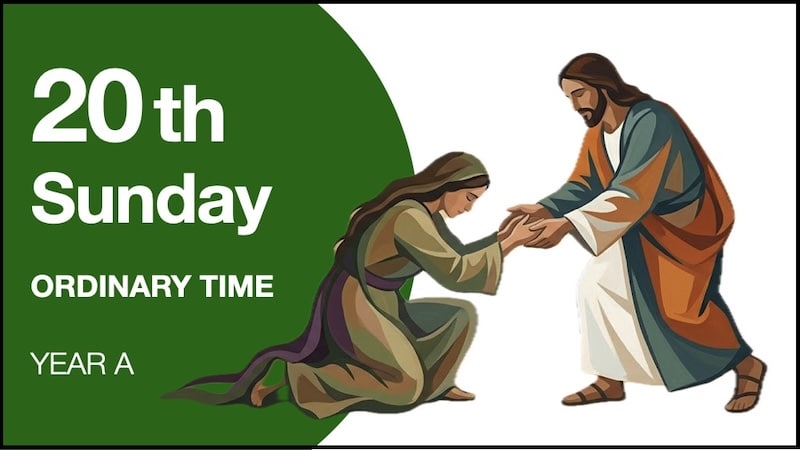
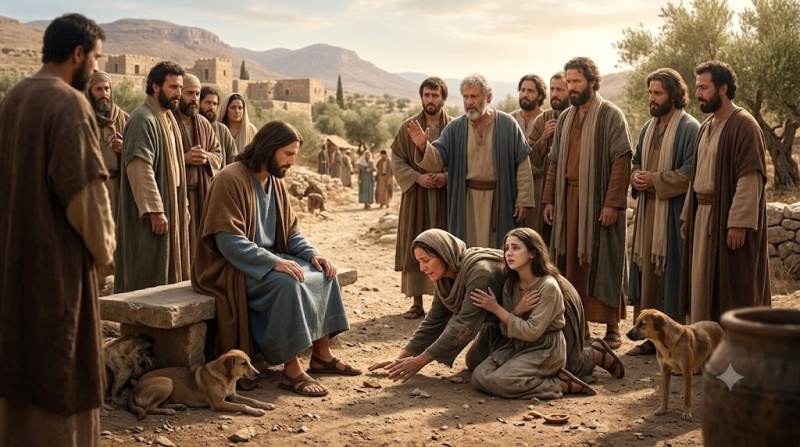
THEOLOGICAL CONNECTION: In Matthew 15, the Canaanite mother approaches Jesus out of intense desperation for her suffering child. When met with initial silence and hard boundaries, her love refuses to back down; she humbles herself and continues to plead.
The basement scene in Signs mirrors this raw, unpolished posture of intercessory prayer. Father Graham Hess has spent years in spiritual exile, angry at a silent God. Yet, when faced with the imminent death of his child, his intellectual defenses collapse into a mother-like, desperate plea for life. Like the Canaanite woman, Graham’s willingness to cry out from the depths of crisis demonstrates that true faith often begins not with tidy doctrine, but with a relentless, humble refusal to let go of hope. His desperate petition becomes the catalyst through which divine grace re-enters his life and heals his broken faith.
Outstretched Arms
20th Sunday of Year A

As he lay on his hospital bed in Melbourne, an Australian Marist Brother told his gathered friends the story of his spirituality. It came from watching trapeze artists performing in a circus a few years ago. Trapeze artists are those who perform in a circus with swings. It is an air-borne performance.
Here is what one trapeze artist told him, “As a flyer I must have complete trust in my catcher, He has to be there for me with split–second precision and grab me out of the air as I come to him in the long jump.”
The flyer does nothing and the catcher does everything. When the artist flies, he has simply to stretch out his arms and hands and wait for the catcher to catch him and pull him safely over the apron behind the catcher.
The flyer should actually do nothing. The worst thing the flyer can do is to try to catch the catcher. The flyer is not supposed to catch the catcher. If the flyer grabbed the catcher’s wrists, he might break them, or the catcher might break the flyer’s wrists, and that would be the end of them both.
A flyer has to fly and the catcher has to catch, and the flyer has to trust with outstretched arms, that his catcher will be there for him.”
THEOLOGICAL CONNECTION: The story of the trapeze artist illuminates the core dynamic of faith in Matthew 15:21–28. When the Canaanite woman approaches Jesus, her radical persistence is not an attempt to control the outcome or “catch” the Savior through her own strength. Rather, her desperate petition is the ultimate act of letting go—stretching out her arms in complete, vulnerable surrender.
Just as the flyer must remain completely passive in the moment of the leap, trusting entirely in the catcher’s timing and grip, the Canaanite woman releases all pride, status, and self-reliance. She accepts even the lowest posture under the table, trusting that Christ’s mercy is broad enough to catch her. Her “great faith” is not defined by her ability to save her daughter herself, but by her absolute trust in the Catcher. True faith requires us to abandon the illusion of control and simply reach out, confident that Christ will catch us according to His timing and grace.
Never Give Up
20th Sunday of Year A

Many years ago in Illinois, a young man with six months formal schooling to his credit ran for an office in the legislature. As might have been expected, he was beaten. Next, he entered business but failed in that too, and spent the next seventeen years paying the debts of his worthless partner. He fell in love with a charming lady, they became engaged – and she got sick and died, causing her lover a mini-nervous breakdown. He ran for Congress and was defeated. He then tried to obtain an appointment to the U.S. Land Office but didn’t succeed. He became a candidate for the Vice-Presidency and lost. Two years later he was defeated in a race for the Senate. He ran for President and finally was elected. That man was Abraham Lincoln.
THEOLOGICAL CONNECTION: Today’s Gospel presents a Canaanite woman who persisted in her prayer on obtained from the Lord what she prayed for. The story of Abraham Lincoln’s relentless chain of failures, heartbreaks, and political defeats mirrors the deep, persistent faith displayed in Matthew 15:21–28. When the Canaanite woman approaches Jesus, she faces immediate silence, societal rejection, and apparent dismissal. Yet, much like Lincoln’s refusal to allow repeated failure to define his ultimate purpose, her faith is forged through endurance. She does not turn back when the odds are stacked against her; instead, her desperation drives a tenacious persistence that presses through every obstacle.
Theologically, Lincoln’s life and the Canaanite woman’s plea illustrate that hardship and delay are not indicators of divine abandonment. In Matthew 15, Jesus tests and refines the woman’s devotion, transforming what seemed like a closed door into a testament of “great faith.” Both narratives reveal that true, transformative grace often requires enduring the long, difficult path of perseverance, trusting that God’s purpose will ultimately prevail despite continuous setbacks.
More Anecdotes
“Lord, I believe:” If you want to get into Olympic competition, you’d better be a pretty good athlete. If you want to get into the New York Philharmonic Orchestra, you need excellent musical ability and training. If you want to get into the Miss America Pageant, you’ll be greatly helped if you are good-looking and somewhat talented.
But to get into the Kingdom of God, all you need is Faith – to say, “Lord, I believe,” and to say this, not in words alone, but also in action, expressing Faith through life. The Canaanite woman in today’s Gospel story believed.
“But not with that bunch.” Billy Graham once told of an incident that happened a long time ago when teachers could talk about religion in the classroom. A teacher was talking to her class of young boys, and she asked, “How many of you would like to go to Heaven?” And all the hands instantly shot into the air at once, except one. She was astounded. She asked, “Charlie, you mean you don’t want to go to Heaven?” He said, “Sure, I want to go to Heaven, but not with that bunch.”
Unfortunately, that is how many religious groups feel about one another. Consider the Middle East where, in parts of Lebanon, Christian militias are fighting each other and in Syria and Iraq extremist Muslims are driving all Christians from their territories on pain of death, unless they convert. All three great Faiths in that part of the world trace their origins through the patriarch Abraham. All three of them honor the Mosaic Law. All three are monotheistic. And yet as the political walls of this world come tumbling down, the religious walls seem to grow higher and higher. How tragic. Today’s Gospel tells us how Jesus healed the daughter of a Gentile woman in spite of the religious prejudice of his fellow Jews for the Gentiles.(Rev. King Duncan)
“Nag, nag, nag.” A cartoon in a magazine showed a woman preacher speaking from the pulpit. Two middle-aged portly men were seated near the front. Looking up at the preacher, one of them said, “Nag, nag, nag.”
It is a truism that men do not like nagging women. In his Journal, John Wesley tells of some Methodists who were arrested for disturbing the peace with their prayers. They were brought to court, and the judge asked what the charges against them were. One reported, “Your honor, they pretend to be better than other people; and besides, they pray from morning to night. And what’s more, they have even converted my wife. Until she started going among Methodists, she had such a tongue! And now she is quiet as a lamb.” The judge shouted, “Let them go! Let them all go and convert all the nagging wives in town!”– In today’s Gospel lesson, Jesus and the disciples were confronted with a nagging woman.
It says, “Kills fleas for six months.“ Jesus never met a person he didn’t love. People from all kinds of situations found themselves comfortable in his presence. He didn’t come across as stuffy or pretentious. It reminds me of the story of a priest in the mountains of Kentucky who had gone home with a family of new converts for dinner. He was received cordially by all but the small daughter in the family, who stared at him unblinkingly throughout the meal. The priest, somewhat uncomfortable, tried to put the little girl at ease. “Is it my collar you are staring at?” he asked, taking it off and holding it up. When he did so he saw the cleaning instructions on the inside of the collar, and to make conversation, he asked, “Do you know what it says here?” “Yes,” responded the little girl. “My cat has a small collar like it. It says, Kills fleas for six months.” [Buddy Westbrook, London, Kentucky, Loyal Jones, The Preacher’s Joke Book (Little Rock: August House, 1989), p. 26.]
I can hear Jesus telling such a joke on himself, can’t you? People who are secure in themselves don’t have to “put on airs.” He was open and caring. People of all sorts were drawn to him, including the Gentile woman in today’s Gospel story. (Rev. King Duncan)
Universal Nature of the
“Kingdom of God
20th Sunday of Year A
All three readings today speak of the expansive and universal nature of the “Kingdom of God,” in contrast with the theory that salvation was to beoffered first to the Jews and then, through them alone, to the rest of the world. Although God set the Hebrew people apart as His chosen race, He included all nations in His plan for salvation and blessed all the families of the earth in Abraham (Gn 12:1-3).
Isaiah 56:1, 6-7
By declaring through the prophet Isaiah (first reading), “My house shall be called a house of prayer for all peoples,” God reveals the truth that in His eyes there is no distinction among human beings on the basis of race, caste, or color. The long-expected Messianic kingdom was intended not only for the Jews but for all nations as well.
Rom 11:13-15, 29-32
In the second reading, Paul explains that, although the Jews were the chosen people, many of them rejected Jesus as the promised Messiah, and, consequently, God turned to the Gentiles who received mercy through their Faith in Jesus.
Matthew 15:21-28
In the Gospel story, Jesus demonstrates that salvation was meant for the Gentiles as well as for the Jews by healing the daughter of a Gentile woman as a reward for her strong Faith. Thus, Jesus shows us that God’s mercy and love are available to all who call out to Him in Faith.
Life Messages
20th Sunday of Year A

Persist in Prayer with Trustful Confidence
Although the essential parts of prayer are adoration and thanksgiving, the prayer of petition, like that of contrition, plays a big part in most people’s daily life. We cannot provide, by our unaided selves, for our spiritual and temporal needs. Christ Himself has told us to ask Him for these needs: “Ask and you shall receive.” Asking with fervor and perseverance proves that we have the “great Faith” we need to be able to receive all that Christ wants to grant us in response to our requests.
We must realize and remember that we do not always get exactly what we ask for, but rather what God knows we need, what He wants for us, and what is really best for us. What we need most is to receive the peace and security that come from being in harmony with God’s will for us.
As Christians, we also know that our particular requests may not always be for our good, or for the final good of the person for whom we are praying. In that case, the good God will not grant what would be to our, or their, eternal harm. But if the prayer is sincere and persevering, we will always get an answer—one which is better than what we asked for. Hence, let us trust that every time we pray for something, the answer is already on its way, even before we have asked God for it. We just need to trust God’s timetable and infinite wisdom that He will answer us according to His will and purpose.
Tear Down Walls and Share God’s Universal Love
Very often we set up walls which separate us from God and from one another. Today’s Gospel reminds us that God’s love and mercy are extended to all who call on Him in Faith and trust, no matter who they are. In other words, God’s care extends beyond the boundaries of race and nation to the hearts of all who live, and God’s House is intended to become a House of prayer for all peoples.
It is therefore fitting that we should pray that the walls which our pride, intolerance, fear, and prejudice have raised may crumble. Next, we have to be grateful to God for all the blessings we enjoy. As baptized members of the Christian community, we have been given special privileges and easy access to God’s love. But we also have serious responsibilities arising from these gifts. One of these responsibilities is to make clear to others, with true humility and compassion, that God’s love, mercy, and healing are for them also because they too are the children of God.