Liturgy, Liturgy Notes, Liturgy Planner, Sunday Prep, Planning for Mass
Liturgy Notes, Liturgy Planner, Sunday Prep, Planning for Mass
August 16, 2026
Aug 16 | Today | Aug 23 | Aug 30 | Sept 6







PETITIONS
August 16, 2026
The Church
Governments and Salvation of the World
Those Burdened by Adversity
Local Parish / Faith Community
THE WORD
IN SONGS
THIS WEEK


ONE WORD
MANY CHARISMS
Sunday Lectionary Perspectives Across Religious Traditions


20th Sunday of Year A
August 16, 2026



THE WORD THIS WEEK
A mother cries out,
Great faith in the Master's grace—
Healing for her child.
August 16, 2026




Papal Homilies







✍️ Amid the Bombs
Homily by Fr. Kevin Rettig
Featured Blog Posts
August 16, 2026

Fr. George Corrigan, OFM
Traditions and Great Faith
The Canaanite Woman
A Framework to Understand the Response
How are We to Understand Jesus' Response?
Universal Salvation
Msgr. Joseph Pellegrino (PDF) | Archive
One Church (2026)
Fr. Tommy Lane | Archive
Persisting in prayer like the Canaanite woman and Saint Monica
Related: on faith: Have faith during crises
Why pray when God knows what we want?
on healing We have faith in the power of Jesus to heal us and pick us up
stories about persistence
Scripture Commentary: Jesus’ ministry to those on the margins
Fr. Michael Fallon, MSC | Archive
20th Sunday in Ordinary Time (PDF)
Bulletin Inserts
First Reading | Second Reading | Gospel
August 16, 2026

Liturgy Notes



OCP Music

Response & Acclaim
Response & Acclaim


2026 PLAYLIST (152 VIDEOS)


2026 PLAYLIST (152 VIDEOS)
Presentation & Preparation
Presentation and Preparation

Communion
Communion

Sending Forth
Sending Forth

See, I Make All Things New (Ken Canedo)
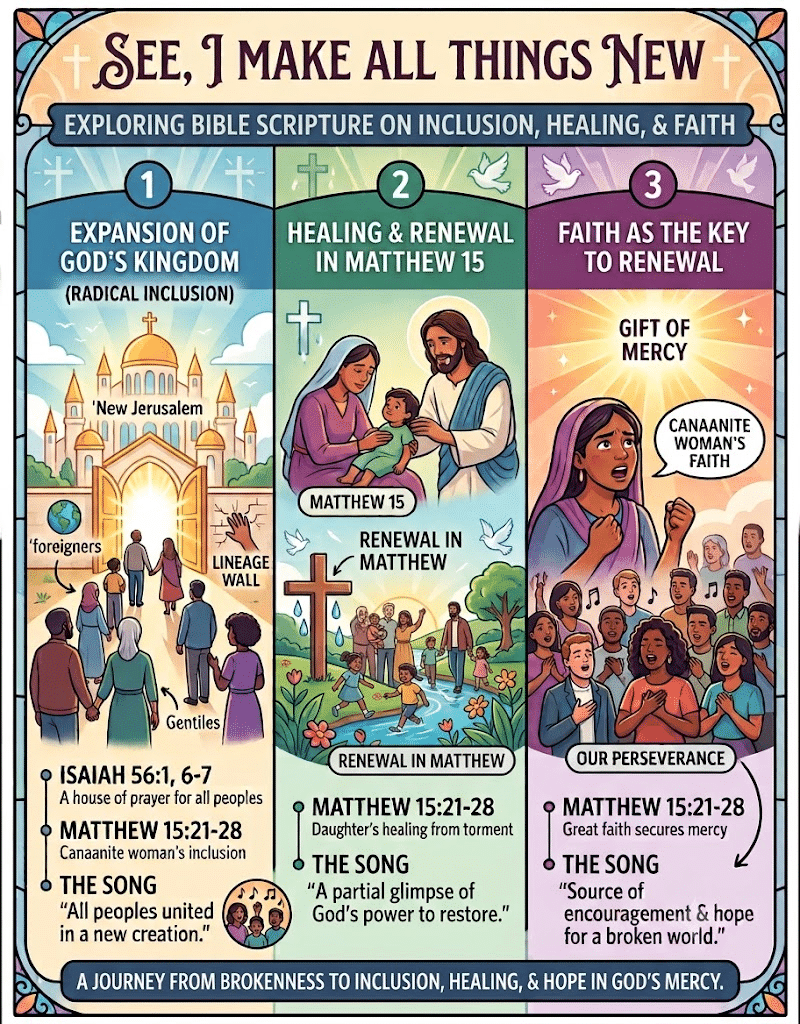
Liturgy Blog is a weekly liturgy planning resource for musicians, liturgists, homilists, youth groups, faith sharing groups, and all who look to the liturgical readings for inspiration and nourishment. Join Ken Canedo as he breaks open the Scripture and suggests tracks from the Spirit & Song contemporary repertoire.
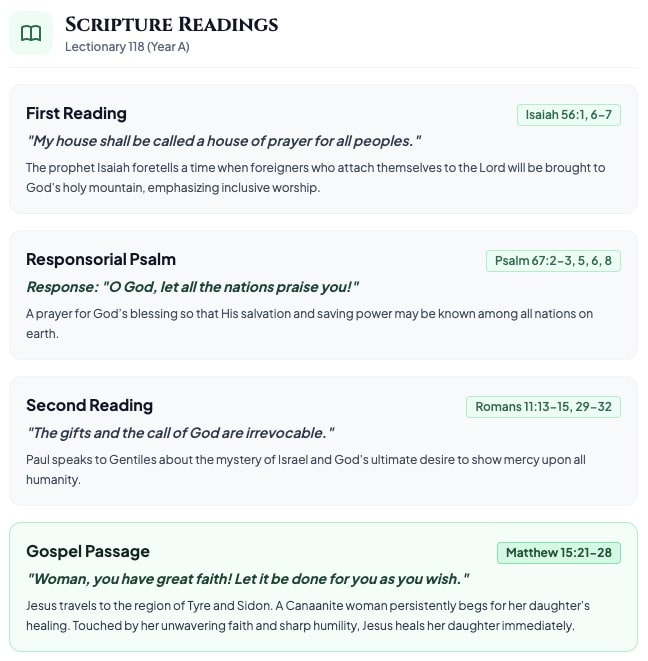
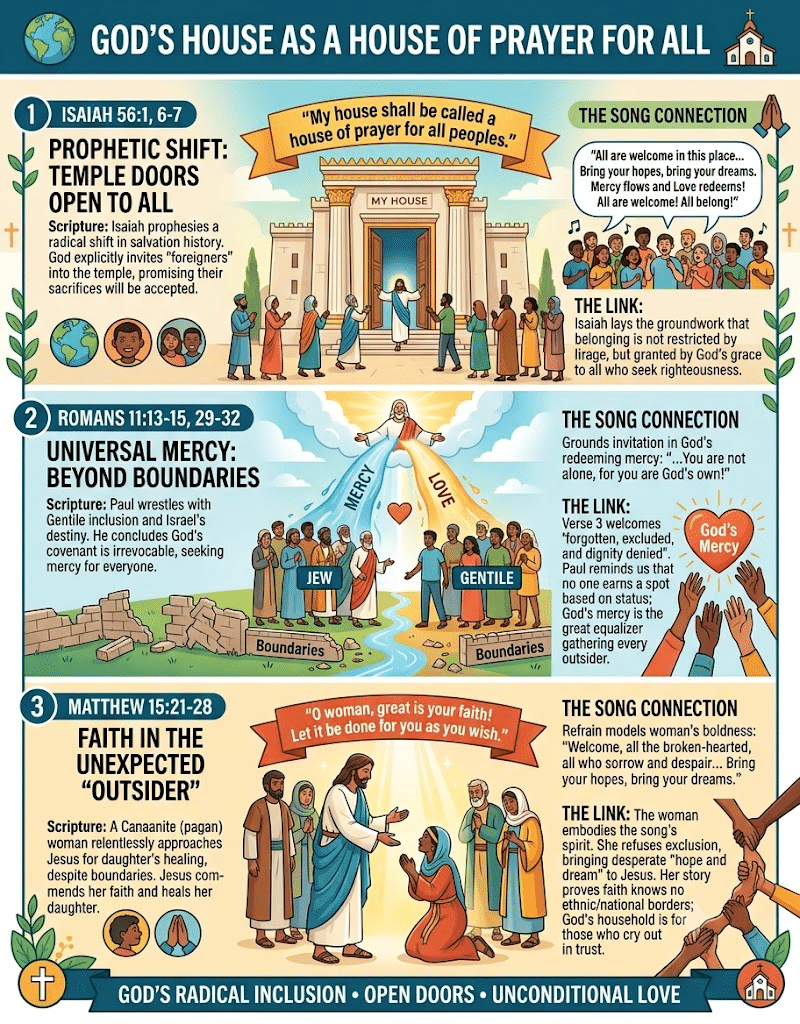
Isaiah 56:1, 6-7

2026 video courtesy of Lector with Lisa | 2023

Isaiah 56:1, 6-7
Text Segment | Vocal Tone | Pacing & Ambo Actions |
A reading from the Book of the Prophet Isaiah. | Clear, informative, welcoming. | Look directly at the assembly while proclaiming. Mandatory Pause after Isaiah to let the context settle while maintaining eye contact. Look back at the lectionary, pause, gather your line, then raise your eyes again. |
Thus says the LORD: | Strong, authoritative divine herald. | Deliver with weight. Signals to the assembly that God Himself is about to speak. |
Observe what is right, | Punched, command-like. | Observe [small pause] what is right [longer pause]. Lock eye contact with a specific section of the assembly. |
do what is just; | Firm, resonant. | Deliver with direct eye contact to a new section of the assembly. |
for my salvation is about to come, | Driving, confident. | Strong emphasis on "my" (God speaking). Keep the pace slow and measured. |
my justice, about to be revealed. | Declarative, powerful. | Emphasize "my". Deliver frame-by-frame with full eye contact. Major Pause after revealed to mark a shift in tone. |
The foreigners who join themselves to the LORD, ministering to him, loving the name of the LORD, and becoming his servants— | Explanatory, building a list. (Context: Unexpected inclusion of Gentiles) | Slow down. Treat this as a distinct list. Elevate pitch slightly on each clause (ministering... loving... becoming) to build anticipation. |
all who keep the sabbath free from profanation | Measured, instructional. | Profanation = desecration/treating improperly. Pronounce clearly: pro-fa-NAY-shun. |
and hold to my covenant, | Resonant, firm. | Maintain steady pacing leading into the divine promise. |
them I will bring to my holy mountain | Triumphant, reassuring. | Heavy emphasis on "them" (the unexpected foreigners). Very slow, deliberate delivery. |
and make joyful in my house of prayer; | Warm, expansive, joyful. | Allow the magnitude of God's promise to shine through your delivery. |
their burnt offerings and sacrifices will be acceptable on my altar, | Decisive, firm, strong emphasis. | Slow pace. Let the shocking generosity of this acceptance land. |
for my house shall be called a house of prayer for all peoples. | Climax: Majestic, grand, resounding. | The core message. Deliver with maximum conviction and deliberate spacing. Look up directly at the entire assembly on "for all peoples." |
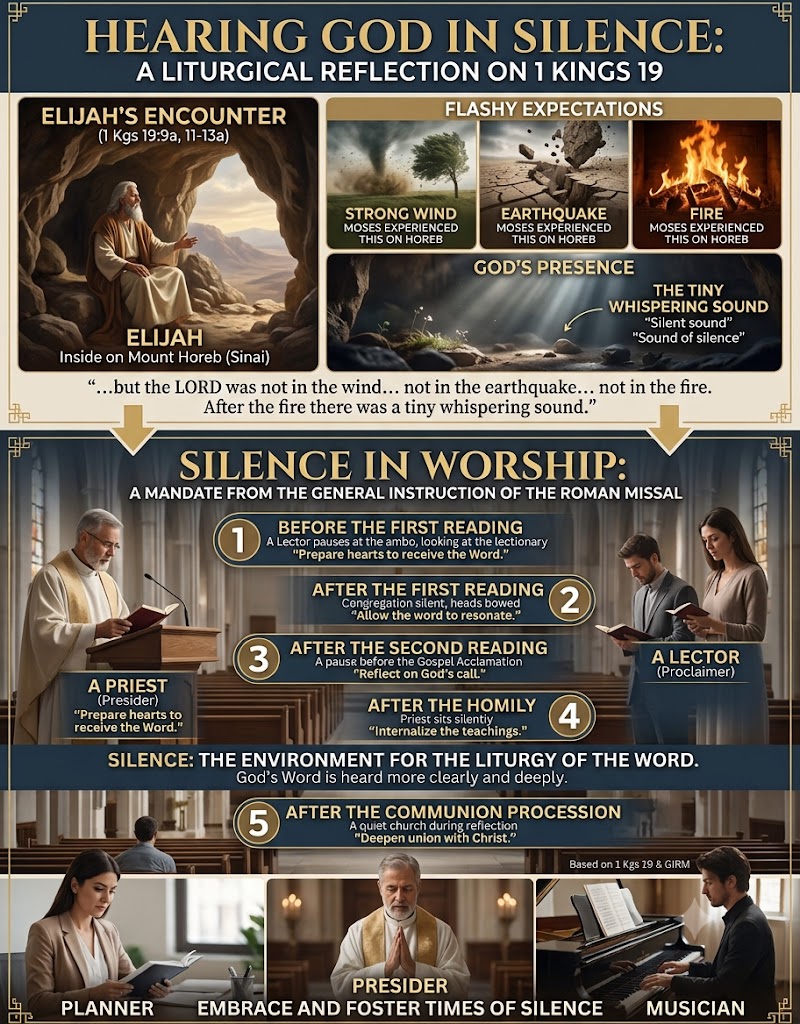
(Silence) | Quiet stillness. | Lower eyes to the lectionary. Mandatory Pause. |
The word of the Lord. | Grateful, grounded. | Look back up at the assembly, make direct eye contact as you proclaim, then set the book down. |
Ambo Reminders
- Master the "Gather & Look" Technique: Do not read to the page—read to the people. Gather each short phrase with your eyes on the book, then lift your head to deliver the text directly to a specific person or section of the assembly with confident eye contact.
- Exaggerate the Pauses: Give the assembly space to digest the radical message. Pause after naming the prophet, pause heavily after revealed, and hold a full moment of silence before declaring The word of the Lord.
- Be a Prayerful Anchor: After setting the book down, step back and remain standing in quiet, prayerful reflection. Do not turn pages or leave until the instrumental psalm music begins. Your silent reverence models how the assembly should digest God's Word.
Isaiah 56:1, 6-7


Today's passage first gives a general reassurance about God's intention to renew the covenant. If you can, make yourself sound hopeful as you proclaim the first sentence. Then pause. The rest of the reading announces the radical change in the covenant, the welcoming of foreigners. In reading it aloud, you should emphasize the words referring to the newcomers, as the prophet would have in announcing this to the people for the first time. So:
The foreigners who join themselves to the Lord ... them I will bring to my holy mountain ... their burnt offerings and sacrifices will be acceptable ... for my house shall be called a house of prayer for all peoples.
(The place "my holy mountain" means the hill Mount Zion, in the center of Jerusalem, where the temple ("my house") stood.)
Rom 11:13-15, 29-32

2026 video courtesy of Lector with Lisa | 2023
Rom 11:13-15, 29-32
Text Segment | Vocal Tone | Pacing & Ambo Actions |
A reading from the letter of Saint Paul to the Romans. | Clear, inviting, and grounded. | Intro Frame: Make direct eye contact through "Saint Paul to the..." Take a slight, deliberate pause after "Romans." Look down at the lectionary to let the congregation settle, then pause again before speaking the text. |
Brothers and sisters: | Warm, personal, and direct. | Look up and lock eyes with someone in the assembly. Pause briefly before returning your eyes to the text. |
I am speaking to you Gentiles. | Direct and intentional. | Briefly look back up at the congregation across both sides of the sanctuary. |
Inasmuch as I am the apostle to the Gentiles, I glory in my ministry | Strong, bold, and claiming authority. | Saint Paul at his most confident self — not arrogant, but deeply convinced of his calling. |
in order to make my race jealous and thus save some of them. | Shift to a lower, conversational tone. | Shift voice dynamics on "and thus." Race refers to Paul's fellow Jewish people; jealous here means longing for the salvation they see in the Gentiles. |
For if their rejection is the reconciliation of the world, | Thoughtful, explanatory. | Reconciliation: Restoring a broken relationship with God. Keep tempo steady to lay out the logic. |
what will their acceptance be but life from the dead? | Awed, joyous, and dramatic shift. | Elevate vocal energy and lift pitch slightly on "what will their acceptance be." Treat "life from the dead" as an astounding revelation. |
For the gifts and the call of God are irrevocable. | Commanding, resonant, and unshakable. | Key Word: Irrevocable (ih-REV-uh-kuh-bul) — means "cannot be taken back or canceled." Put strong emphasis on the REV syllable and let the rest of the word fall naturally. |
Just as you once disobeyed God but have now received mercy because of their disobedience, | Emphatic contrast. | Place heavy emphasis on now, and stress their to contrast Gentiles with Jewish believers. |
so they have now disobeyed in order that, by virtue of the mercy shown to you, they too may now receive mercy. | Softened, profound tone. | Notice the dramatic voice shift here. Take this line slowly to let the audience track God's exchange of mercy. |
For God delivered all to disobedience, that he might have mercy upon all. | Slow, expansive, and filled with gratitude. | Maximum Space: Scan both left and right sides of the sanctuary during this line. Drop pace significantly to emphasize God's final word: mercy. |
The word of the Lord. | Solemn and precise. | Take a long pause after the text. Look back down at the book, say the line clearly, look up to receive "Thanks be to God," then remain standing in quiet reflection. |
Ambo Reminders
- Master the Mindset & the Accent: Master the pronunciation of irrevocable (ih-REV-uh-kuh-bul) in practice so it lands with complete confidence.
- Use the "Frame vs. Picture" Technique: Treat the introduction as the frame and the reading as the picture — use deliberate pauses and clear eye contact right before "Brothers and sisters" to draw everyone into the story.
- Be the Prayer Role Model: After concluding with "The word of the Lord," stand completely still and look prayerfully at the congregation. Do not close the lectionary or move until the Gospel Acclamation music begins.
Rom 11:13-15, 29-32

Make sure you know the referent of every pronoun in this passage, and that you contrast them properly with tones of voice. Paul ("I") is a Jew speaking to pagans ("you") about the Jews ("my race," "some of them") and so on. Every third-person pronoun here refers to the Jews, and every second-person pronoun to the just-converted Gentiles. Let your listeners hear the differences.