Liturgy, Liturgy Notes, Liturgy Planner, Sunday Prep, Planning for Mass
Liturgy Notes, Liturgy Planner, Sunday Prep, Planning for Mass
August 30, 2026
Aug 30 | Today | Sept 6 | Sept 13 | Sept 20







PETITIONS
August 30, 2026
The Church
Governments and Salvation of the World
Those Burdened by Adversity
Local Parish / Faith Community
THE WORD
IN SONGS
THIS WEEK


ONE WORD
MANY CHARISMS
Sunday Lectionary Perspectives Across Religious Traditions


22nd Sunday of Year A
August 30, 2026


THE WORD THIS WEEK
Take up your own cross,
Lose your life to save your soul,
Follow in His steps.
August 30, 2026


Papal Homilies






✍️ Fire in the Bones: Holy Purification
"The Dark Night"


Featured Blog Posts
August 30, 2026



Fr. George Corrigan, OFM
The Suffering Messiah
Peter’s Response, Jesus’ Rebuke
Discipleship and Its Consequences
One’s Life; One’s Motivation
A Final Reflection
Msgr. Joseph Pellegrino (PDF) | Archive
Duped by Love (2026)
Fr. Michael Fallon, MSC | Archive
22nd Sunday in Ordinary Time (PDF)

Liturgy Notes


Taking Up the Cross at Mass
The infographic connects the demands of Matthew 16:21-27 with the spiritual experience of the Catholic Mass. This Sunday's Gospel passage details Christ’s prophecy of his suffering, resurrection, and the subsequent command to disciples to "take up their cross." The infographic links these concepts. Christ’s prediction of his passion is fulfilled in the Liturgy of the Eucharist, where the central mystery of the cross is re-presented. The call for the faithful to self-denial is reflected in the congregation’s active and conscious participation in the sacrifice. The promise of resurrection finds its manifestation in the reception of Holy Communion, which is the foretaste of eternal life and future glory. The connection highlights how the Mass makes Christ's historical sacrifice a present, transformative reality for believers, strengthening their call to discipleship.


22nd Sunday of Year A
Fullness Over Comfort
Preachers are called to preach God’s word in its fullness and to apply it to contemporary situations. Most, if not all, of those situations are contested politically and socially, and every congregation has members who will be offended by mention of any given topic.
Pastors, especially, find themselves in a bind. If they offend people by tackling difficult issues, the collections may go down and the parish budget may be in trouble. But, if they try to keep everyone happy, they are reduced to preaching pabulum that eviscerates the message of the Bible.
But, it is not only ordained preachers who are called to speak God’s truth. In the Gospel today, Jesus calls us to take up our cross and follow him. And, in the second reading, St. Paul urges us to offer our “bodies as a living sacrifice.” He goes on to remind us: “Do not conform yourselves to this age but be transformed by the renewal of your mind, that you may discern what is the will of God, what is good and pleasing and perfect.”
We are all called to promote the will of God, which is often in conflict with the ways of our society.
Preachers and planners might challenge themselves this week to discern where their own values and assumptions might be in conflict with God’s ways. We cannot effectively preach what we do not embrace in our own lives. When we are in tune with God, then our words and our actions will prophesy!
Full Series: Cycle A Resources

Entrance Song

Response & Acclaim
Response & Acclaim

2026 PLAYLIST (152 VIDEOS)


2026 PLAYLIST (152 VIDEOS)
Presentation & Preparation
Presentation and Preparation

Communion
Communion
Sending Forth
Sending Forth

Fish with Me (Ken Canedo)
Liturgy Blog is a weekly liturgy planning resource for musicians, liturgists, homilists, youth groups, faith sharing groups, and all who look to the liturgical readings for inspiration and nourishment. Join Ken Canedo as he breaks open the Scripture and suggests tracks from the Spirit & Song contemporary repertoire.
Jeremiah 20:7-9

Video courtesy of Lector with Lisa

Proclamation
Text Segment | Vocal Tone | Pacing & Ambo Actions |
A reading from the Book of the Prophet Jeremiah. | Calm, reverent, grounded. | Pause 3 full seconds. Establish firm eye contact across the assembly before speaking. |
You duped me, O LORD, and I let myself be duped; | Raw, vulnerable, dejected. Express quiet betrayal. | Very slow. Enunciate duped (fooled/misled) deliberately. Action: Eye contact on "You duped me," look down at lectionary for "and I let myself..." |
you were too strong for me, and you triumphed. | Subdued yield; heavy, defeated resignation. | Moderate speed, dropping pitch slightly at the end of the sentence to show yield. |
All the day I am an object of laughter; everyone mocks me. | Hurt, isolated. Relate to the feeling of being an outcast. | Pause. Speak with tender vulnerability. Hold eye contact with the center aisle. |
Whenever I speak, I must cry out, violence and outrage is my message; | Rising intensity, strained, urgent. | Increase volume slightly. Lean slightly forward to project urgency. |
the word of the LORD has brought me derision and reproach all the day. | Bitter, heavy. Relish the sharp consonants. | Slow pace. Enunciate derision (ridicule) and reproach (disgrace) with crisp diction. |
I say to myself, "I will not mention him, I will speak his name no more." | Quiet, guarded, tired; a weary whisper of surrender. | Drop volume significantly. Action: Look directly down at the text, as if retreating inward. |
But then it becomes like a fire burning in my heart, imprisoned in my bones; | Building passion, energetic, unstoppable warmth. | Accelerate pace slightly; let the vocal energy swell naturally from deep within. |
I grow weary holding it in, I cannot endure it. | Climax of internal struggle; intense, exhausted conviction. | Speak with full vocal breath. Action: Look up and sweep the entire assembly with direct eye contact. |
[Mandatory Silence] | (Silent) | Count a full 4–5 seconds in silence. Do not break posture or look away from the congregation immediately. |
The word of the Lord. | Grounded, solemn, unbroken connection. | Maintain the same emotional weight and tone as the final line; do not abruptly shift to a cheerful tone. |
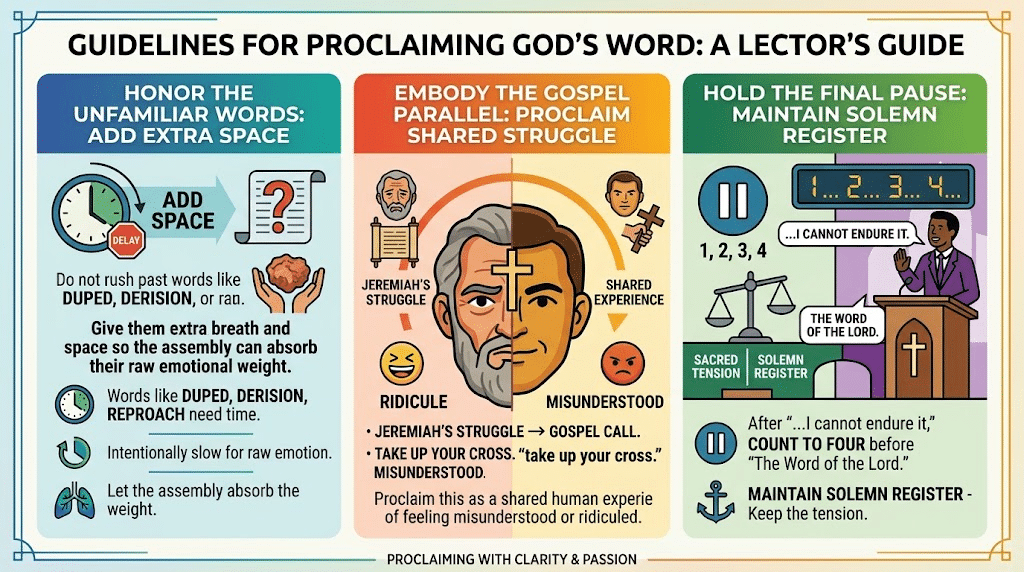
Ambo Reminders
- Honor the Unfamiliar Words: Do not rush past words like duped, derision, or reproach. Give them extra breath and space so the assembly can absorb their raw emotional weight.
- Embody the Gospel Parallel: Remember that Jeremiah's struggle directly sets up the Gospel call to "take up your cross." Proclaim this as a shared human experience of feeling misunderstood or ridiculed while trying to do the right thing.
- Hold the Final Pause: After "I cannot endure it," anchor yourself and count to four before proclaiming "The word of the Lord." Keep your voice in the same solemn register—do not break the sacred tension early.
Jeremiah 20:7-9
Greg Warnusz

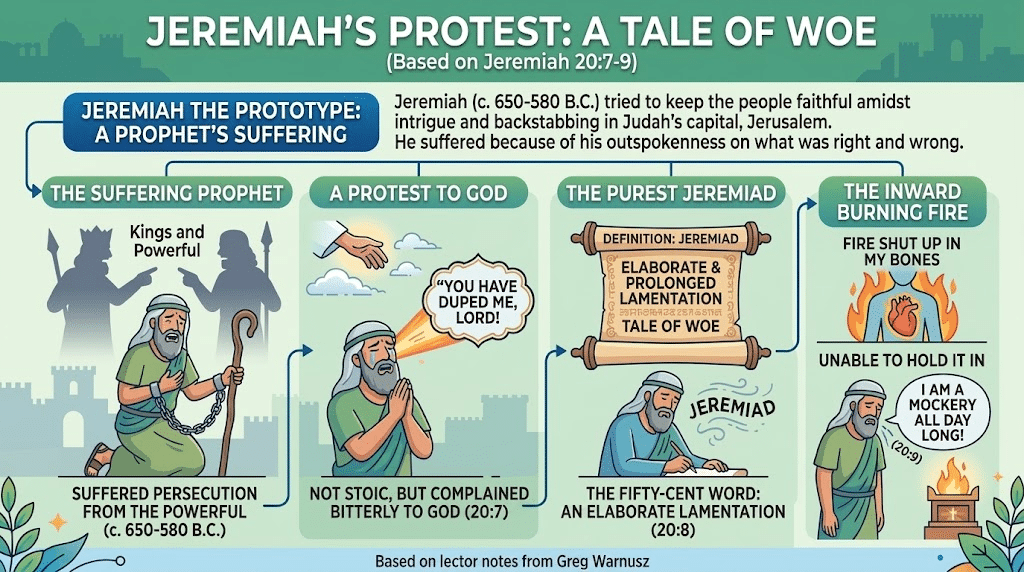
The Historical Situation: As almost always, the first reading prepares us to hear the gospel. Jeremiah was certainly a prototype of the suffering Christ. The prophet lived from about 650 B.C. to perhaps 580 B.C. Most of his work was in Judah's capital Jerusalem. He tried to keep the people and several kings faithful to God amidst an atmosphere of political intrigue and backstabbing... Jeremiah was blunt about what was right and what was not, and he suffered at the hands of the powerful because of his outspokenness.
What's interesting about this prophet is that he did not bear his persecution stoically, but complained bitterly to God. His outspoken protests are remembered in the fifty-cent English word jeremiad, which means an elaborate and prolonged lamentation or tale of woe. Today's passage is the purest of jeremiads.
Proclaiming It: Proclaim this with great drama and irony in your voice. Hit hard the word "duped" in the first sentence, then hit hard the expression "let myself be duped." When you say that the word of God you are stifling "becomes like fire burning in my heart," let the congregation feel the heat! You are trying to convey the prophet's anguish, and you are preparing us to hear the day's ominous gospel passage. This is not bland prose. If you believe grace builds on nature, don't proclaim this blandly.
Romans 12:1-2

Video courtesy of Lector with Lisa
Proclamation
Text Segment | Vocal Tone | Pacing & Ambo Actions |
A reading from the Letter of Saint Paul to the Romans. | Clear, grounded, authoritative. | Pause 3 full seconds. Look up and make calm, direct eye contact with the entire congregation before speaking. |
I urge you, brothers and sisters, by the mercies of God, | Intense, passionate, urgent appeal. | Slow, measured tempo. Establish direct eye contact across the assembly right at the word urge. |
to offer your bodies as a living sacrifice, holy and pleasing to God, | Deeply earnest, reverent, reflective. | Unrushed pace. Living sacrifice means offering your everyday, ordinary life (eating, sleeping, working). Pause slightly after God. |
your spiritual worship. | Firm, deliberate, anchoring. | Drop pitch slightly. Action: Glance down at the lectionary, then look back up to let the concept land. |
Do not conform yourselves to this age, | Strong, corrective, challenge. | Pause before starting. This age means modern culture; do not fit in without thinking. Use a firm tone. |
but be transformed by the renewal of your mind, | Inspiring, expansive, uplifting. | Shift tone toward hope. Enunciate transformed with deliberate emphasis to mark the mental pivot. |
that you may discern what is the will of God, | Focused, thoughtful, inviting. | Slow down to allow the assembly to reflect on discern (distinguishing and understanding God's direction). |
what is good and pleasing and perfect. | Warm, joyful, encouraging. | Brighten your tone. Begin smiling naturally as you convey this encouraging roadmap for daily life. |
[Mandatory Silence] | (Silent) | Count a full 4 seconds in silence. Maintain posture and eye contact; do not break the moment early. |
The word of the Lord. | Warm, resonant, grateful. | Speak with a joyful, grounded register that carries the warmth of the reading's final lines. |
Ambo Reminders
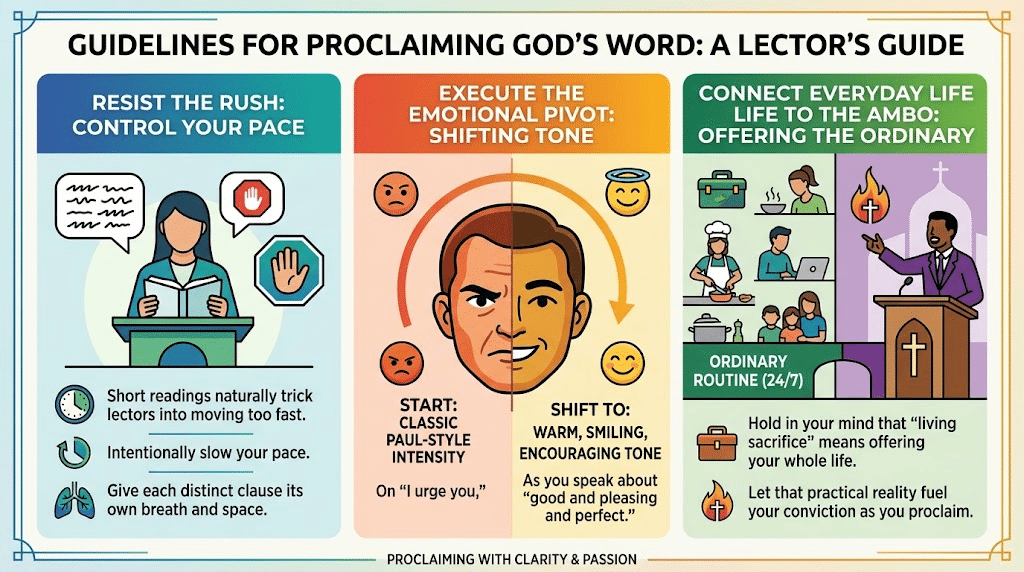
- Resist the Rush: Short readings naturally trick lectors into moving too fast. Intentionally slow your pace and give each distinct clause its own breath and space.
- Execute the Emotional Pivot: Start with classic Paul-style intensity on "I urge you," but consciously shift to a warm, smiling, encouraging tone as you speak about what is "good and pleasing and perfect."
- Connect Everyday Life to the Ambo: Hold in your mind that "living sacrifice" means offering our 24/7 ordinary routine to God—let that practical reality fuel your conviction as you proclaim.
Romans 12:1-2
Greg Warnusz
The Theological Background: Paul's letters usually end with several paragraphs of moral instruction. One of the ways religious people define themselves is by how their morals differ from those of other religions. (One could say this of most cultural groups, whether the differences are in morals, religion, dress, food, housing, marriage customs, politics, or any behavior.) Here Paul is telling his mixed Jewish and Gentile Christian audience how they differ both from old-fashioned Jews and from pagans...
- The sacrifices we make are not the rituals of the Jewish temple, but our bodies "as a living sacrifice, ... spiritual worship." That's how we differ from the Jews.
- We're to differ from the pagans by our non-conformity to the present age.
The two verses of today's reading are, for Paul, just a high-level introduction to the moral teaching he wants to give (and that teaching is about how Christians should respond to the "mercies of God" detailed in eleven prior chapters). The 1970 edition of the New American Bible summaries Paul's teaching on the Christian sacrificial way of life this way:
- It consists of the humble use of ones gifts for the benefit of the community (12:3-13);
- It is marked by love of enemies (12:14-21), and by the acceptance of legitimate civil authority (13:1-7).
- The commandments of the Mosaic covenant (Exodus 20:13-17) remain its norm, and the hope of salvation in Christ its incentive (13:11-14).
Proclaiming It: The congregation will get a cursory overview of the moral teaching over the next two Sundays. Your proclamation is necessarily out of context and therefore not easy. Emphasize the word spiritual in the phrase "your spiritual worship." That may distinguish it in the listener's minds from merely formal, ritualistic worship. Emphasize the phrase "that you may discern what is the will of God," since that is the part that gives the listeners the most responsibility.
