Papal Homilies, Pope Francis, Pope Benedict, Pope John Paul II, Pope Leo
August 30, 2026
⭐⭐⭐ Pope Leo XIV



Holy See
- The Bible
- Catechism of the Catholic Church
- Codes of Canon Law
- Ecumenical Councils
- Official Acts of the Holy See
- Social Doctrine of the Church
- Abuse of Minors, the Church’s Response
- Press Office
- Vatican News – Radio Vaticana
- L’Osservatore Romano
- Vatican Websites
- Vatican City State
- Basilicas and Papal Chapels – Virtual Tours
- Liturgical Celebrations
- Tickets for Papal Audiences and Celebrations
22nd Sunday of Year A

Theme of the Readings
FROM THE ARCHIVES (1999)
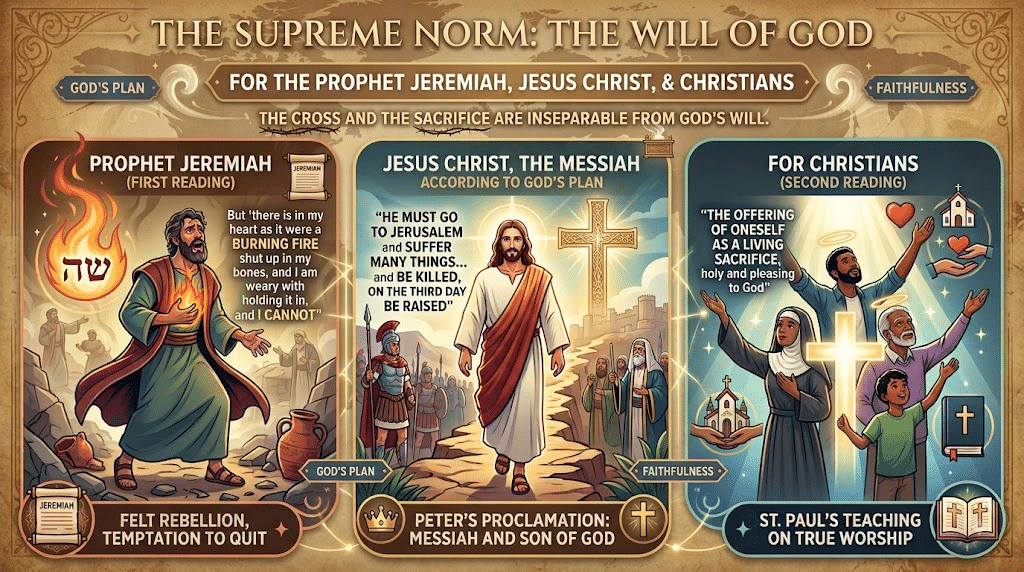
The will of God is the supreme norm for the prophet Jeremiah, for Jesus Christ and for Christians. The cross and the sacrifice to be faithful to it are inseparable from God’s will. Jeremiah feels the stimulus of rebellion, the temptation to throw everything overboard; but “there is in my heart as it were a burning fire shut up in my bones, and I am weary with holding it in, and I cannot” (first reading). Today’s Gospel follows Peter’s proclamation of Jesus as the Messiah and Son of God (previous Sunday). Now, Jesus makes very clear what this means for him, as the Messiah, according God’s plan. “He must go to Jerusalem and suffer many things from the elders and chief priests and scribes, and be killed, on the third day be raised” (Gospel). Saint Paul teaches us that true worship consists in the offering of oneself as a living sacrifice, holy and pleasing to God (second reading).
Doctrinal Messages
The Will of God is history’s divine set of norms for the salvation of mankind
Being divine, this set of norms has a logic that differs from human logic, and may even appear to be contradictory and hostile to it. The prophet Jeremiah knows something about that. He was a peaceful man, but God called him to a vocation that was the opposite of his natural inclination: he would have to cry “ruin, destruction.” In spite of everything, the power of God’s will shakes him up inside and devours him, and is such that he cannot refuse. Jeremiah’s “passion” as he narrates it in his “confessions,” is the most faithful expression of his fidelity to God’s mysterious plan for human history.
In the Gospel’s account, Jesus announces for the first time the will of God for him in the future
“From that time Jesus began to show his disciples that he must go to Jerusalem and suffer many things” (Gospel). Moved perhaps by his will to stand out and by his misunderstood love for Jesus, Peter wants to steer him away from the path of God’s will, a path of passion and the cross. Jesus knows the will of the Father and cannot allow anyone to interfere with his personal relationship with God. As a man, he has a very hard time in accepting God’s plan, so hard and painful. Yet, fidelity to his Father’s will is so important in his life that nothing or no-one can separate him from it. His passion is such that he does not hesitate to call Peter “Satan,” for in his eyes he is like a devil seeking to steer him away from God’s plan.
The need and the importance of knowing God’s will
Jeremiah and especially Jesus show us the need and the importance of knowing God’s will and adhering to it with all one’s heart and strength without hesitation or complicity with evil, however minor. A transition must be made in real life from the knowledge and love of the divine will to action. Do the will of God, with the difficulties, pain, and hardships this may imply. Jesus is very clear about this. “If any man would ocme after me, let him deny himself and take up his cross and follow me” (Gospel). In other words, if anyone wants to do the Father’s will in everything, let him renounce his own thoughts and desires, so human and so far from God’s thoughts and desires. Saint Paul, on his part, asks the Christians of Rome to offer their bodies “as a living sacrifice, holy and acceptable to God” (second reading).
Pastoral Suggestions
In the footsteps of God’s will
The great footsteps of God’s will are first of all inscribed in our very nature, then in our Christian vocation, and finally in our state and condition of life. Therefore, those who live according to their condition as rational and spiritual beings, live as faithful followers of Jesus Christ, and responsibly perform their duties and work. Most of us perceive such obligations relatively easily, but to follow them is a different matter. We find many attractive things that distract us, many obstacles that we are not always ready to overcome, a lot of resistance when we try to behave according to our conscience. What are the distractions, the obstacles, the resistance that we encounter in our milieu, in our parish, in our community, in ourselves?
The cross and the glory
At Easter, the apex of God’s plan for Jesus Christ, the cross and glory are interwoven. In the life of Christians, in God’s plan for each one of us, it is no different. The will of God does not foresee the cross first and then the glory, or vice versa. It is the cross and the glory at the same time. To know and do the will of God entail both the cross and glory, which are different and yet inseparable. Those who do God’s will offer a living sacrifice, dedicated and acceptable to God. Those who do the will of God perceive, in the midst of their pain, an inner song of joy and peace, which is a prelude to the glory which they will share with Christ in the kingdom of heaven. There are those who only see the cross, and there are those who only want to see the glory. The real Christian combines both in the will of God, and accepts them with love and joy.
SOURCE: YEAR A DICASTERY NOTES (1999)
Note: The header image is an AI-generated visual concept illustrating the central themes, scripture quotes, and visual motifs from this week’s Mass readings.

22nd Sunday of Year A

Taking Up the Cross
30 August 2020 Saint Peter’s Square (Angelus)
I. The Announcement of the Passion
Today’s Gospel passage (cf. Mt 16:21–27) is linked to that of last Sunday (cf. Mt 16:13–20). After Peter, on behalf of the other disciples as well, has professed his faith in Jesus as Messiah and Son of God, Jesus himself begins to speak to them about his Passion.
Along the path to Jerusalem, he openly explains to his friends what awaits him at the end in the Holy City: he foretells the mystery of his death and Resurrection, of his humiliation and glory. He says that he will have to “suffer many things from the elders and chief priests and scribes, and be killed, and on the third day be raised” (Mt 16:21).
But his words are not understood, because the disciples have a faith that is still immature and too closely tied to the mentality of this world (cf. Rom 12:2). They think of too earthly a victory, and therefore they do not understand the language of the cross.
II. Peter’s Resistance and
the Temptation to Flee the Cross
At the prospect that Jesus may fail and die on the cross, Peter himself rebels and says to Him: “God forbid, Lord! This shall never happen to you!” (v. 22). He believes in Jesus—Peter has faith, he believes in Jesus, and he wants to follow him—but he does not accept that his glory will pass through the Passion.
For Peter and the other disciples—and for us too—the cross is an uncomfortable thing; the cross is a hindrance. Whereas Jesus considers the hindrance to be escaping the cross, which would mean avoiding the Father’s will and the mission that the Father has entrusted to him for our salvation.
For this reason Jesus responds to Peter: “Get behind me, Satan! You are a hindrance to me; for you are not on the side of God, but of men” (v. 23). Ten minutes earlier, Jesus had praised Peter. He had promised him he would be the base of his Church, its foundation; ten minutes later he says to him, “Satan.”
How can this be understood? It happens to us all! In moments of devotion, of fervor, of goodwill, and of closeness to our neighbor, we look to Jesus and we go forward; but in moments in which we approach the cross, we flee. The devil, Satan—as Jesus says to Peter—tempts us. It is typical of the evil spirit to make us stray from the cross of Jesus.
III. The Marks of True Discipleship:
Self-Denial and Spiritual Combat
Addressing everyone then, Jesus adds: “If any man would come after me, let him deny himself and take up his cross and follow me” (v. 24). In this way he indicates the way of the true disciple, showing two attitudes.
- Self-Renunciation: The first is “to renounce oneself,” which does not mean a superficial change, but a conversion—a reversal of mentality and of values.
- Taking Up the Cross: The other attitude is that of taking up one’s own cross. It is not just a matter of patiently enduring daily tribulations, but of bearing with faith and responsibility that part of toil and suffering that the struggle against evil entails.
The life of Christians is always a struggle. The Bible indicates that the life of Christians is a spiritual combat: fighting against the evil spirit, fighting against Evil.
IV. The Meaning of the Cross
and Imitating Christ
Thus the task of “taking up the cross” becomes participating with Christ in the salvation of the world. Considering this, let us make sure that the cross hanging on the wall at home, or that little one that we wear around our neck, is a sign of our wish to be united with Christ in lovingly serving our brothers and sisters, especially the littlest and most fragile.
The cross is the holy sign of God’s love; it is a sign of Jesus’ sacrifice, and is not to be reduced to a superstitious object or an ornamental necklace. Each time we fix our gaze on the image of Christ crucified, let us contemplate that he, as the true Servant of the Lord, has accomplished his mission by giving his life and shedding his blood for the forgiveness of sins.
Let us not allow ourselves to be drawn away by the temptation of the Evil One. Therefore, if we want to be his disciples, we are called to imitate him, expending our life unreservedly out of love for God and neighbor.
Note: The header image is an AI-generated visual concept illustrating one of the central themes, scripture quotes, from the pope’s homily.

August 30, 2020
MORE HOMILIES
In the Eucharistic Celebration We Relive the Mystery of the Cross
3 September 2017 | Saint Peter’s Square
Is Your Faith Good?
24 August 2014 | Saint Peter’s Square
22nd Sunday of Year A

The Divergence between the Father’s Loving Plan and the Disciples’ expectations
28 August 2011 | Courtyard of the Papal Summer Residence, Castel Gandolfo
The Prophecy of the Passion
In today’s Gospel, Jesus explains to his disciples that he must go to Jerusalem and suffer many things from the elders, chief priests, and scribes, and be killed, and on the third day be raised (Matthew 16:21).
The Disciples’ Resistance to the Cross
Everything seems to have been turned upside down in the disciples’ hearts. How could “the Christ, the Son of the living God” (v. 16) suffer unto death? The Apostle Peter rebels; he refuses to accept this route and rebukes the Teacher, saying, “God forbid, Lord! This shall never happen to you” (v. 22). The divergence between the Father’s loving plan—which went as far as the gift of the Only-Begotten Son on the Cross to save humanity—and the disciples’ expectations, wishes, and projects stands out clearly.
Today, this contrast is repeated: when the fulfillment of one’s life is geared solely to social success and to physical and financial well-being, one no longer reasons according to God, but according to men (v. 23).
Thinking with the World vs. Following Christ
Thinking as the world thinks is to set God aside, refusing to accept his plan of love and preventing him from doing his wise will. For this reason, Jesus speaks particularly harsh words to Peter: “Get behind me, Satan! You are a hindrance to me” (v. 23).
The Lord teaches that the way of discipleship is the way to walk behind him, the Crucified. In all three Synoptic Gospels, he interprets this following on the way of the Cross as the indispensable way for man to “lose his life,” without which it is impossible for him to find himself.
The Call to Take Up the Cross
As he invited the disciples, Jesus also addresses an invitation to us: “If any man would come after me, let him deny himself and take up his cross and follow me” (Matthew 16:24). A Christian follows the Lord when he lovingly accepts his own cross—which in the world’s eyes seems like a defeat and a loss of life (cf. vv. 25–26)—knowing that he is not carrying it alone, but with Jesus, sharing in his same journey of self-giving.
Filial Obedience and Universal Salvation
The Servant of God Paul VI wrote:
“In a mysterious way, Christ himself accepts death… on the Cross, in order to eradicate from man’s heart the sins of self-sufficiency and to manifest to the Father a complete filial obedience” (Gaudete in Domino).
By willingly accepting death, Jesus carries the cross of all human beings and becomes a source of salvation for the whole of humanity.
Patristic Witness on the Power of the Cross
Saint Cyril of Jerusalem commented:
“The glory of the Cross led those who were blind through ignorance into light, loosed all who were held fast by sin, and brought redemption to the whole world of mankind” (Catechetical Lectures XIII, 1).
Note: The header image is an AI-generated visual concept illustrating one of the central themes, scripture quotes, from the pope’s homily.

22nd Sunday of Year A
Proclaiming Christ and the Paths of Ecclesial Renewal
8 August 1999 | Angelus
In the Gospel passage presented to us in today’s liturgy, we once again listen to Jesus’ words to his terrified and fearful disciples: “Take heart, it is I; have no fear” (Mt 14:27). The Evangelist notes that encouraged by the Lord’s presence, “those in the boat worshiped him, saying, ‘Truly you are the Son of God'” (ibid, 14:33). The Church makes her own this profession of faith in the Son of God, and renews it constantly as she spreads the Good News which he came to bring the people of all times and places.
The Legacy and Witness of Paul VI
The Servant of God Paul VI, my venerable Predecessor, was also a tireless proclaimer and bold witness of Christ’s Gospel. On 6 August, 35 years ago now, he promulgated his first Encyclical entitled Ecclesiam suam. Fourteen years later, also on the Feast of the Transfiguration and precisely here in Castel Gandolfo, he was called to contemplate the Lord’s face forever in the blessed homeland.
Three Paths for the Church’s Mission
In Ecclesiam suam, this great Pontiff indicated the paths of an inspired ecclesial journey towards the third millennium:
- The Spiritual Path: Refers to the awareness the Church must have of herself to conform to the vocation entrusted to her by the Redeemer.
- The Moral Path: Concerns the authentic ascetic, practical, and canonical renewal she needs to carry out her mission in the world.
- The Way of the Apostolate: For the ecclesial community, the method of dialogue is becoming the way in which to work to bring the Lord’s comforting message of salvation everywhere.
Guided by Faith Toward the New Millennium
How is it possible not to thank God for the gift of this prophetic teaching which has guided the journey of the Christian people in the past 35 years? With the Second Vatican Council, wisely led by Paul VI, the Church more closely examined her inmost nature and universal mission. With the constant support of the Holy Spirit, her faith has remained steadfast in these last decades of the century, marked by many lights, but also by numerous shadows, and she is now preparing confidently to cross the threshold of the next millennium.

Matthew 16:21-27
Search Engine created by Jeff Pinyan
22nd Sunday of Year A
Jeremiah 20:7-9
Search Engine created by Jeff Pinyan
22nd Sunday of Year A
Romans 12:1-2
Search Engine created by Jeff Pinyan
22nd Sunday of Year A