Fr. Tony’s Homily, Homily Starters
Fr. Tony’s Homily, Homily Starters
August 30, 2026



RELATED
PAGES





Counting the Cost
22nd Sunday of Year A

“For whoever wants to save their life will lose it, but whoever loses their life for me will find it.”—Mt 16:25
Cheryl’s She Shed
22nd Sunday of Year A

“…like fire burning in my heart, imprisoned in my bones;I grow weary holding it in, I cannot endure it.”—Jer 20:9
Ted Lasso: Object of Laughter
22nd Sunday of Year A

“You duped me, O LORD… All the day I am an object of laughter; everyone mocks me.”—Jer 20:7
Heat of Discipleship
22nd Sunday of Year A

“For whoever wants to save their life will lose it, but whoever loses their life for me will find it.”—Mt 16:25
Three Priests in Hospice
22nd Sunday of Year A

“Be transformed by the renewing of your mind, that you may discern what is the will of God…”—Rom 12:2
Dissolving Riches
22nd Sunday of Year A
“For whoever wants to save their life will lose it, but whoever loses their life for me will find it. What good will it be for someone to gain the whole world, yet forfeit their soul? Or what can anyone give in exchange for their soul?”—Mt 16:25–26
True, Dynamic
Christian Discipleship
22nd Sunday of Year A
The clipart is from the archive of Father Richard Lonsdale © 2000. It may be freely reproduced in any non-profit publication.
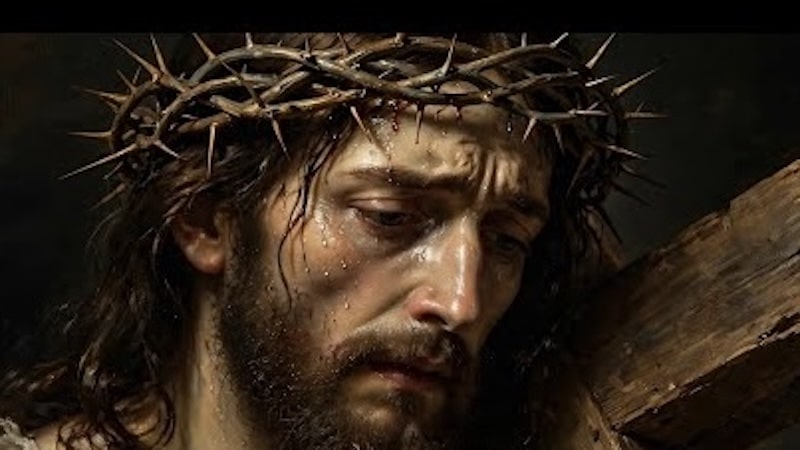
The readings for this Sunday remind us that Christians are called to live their lives in a different way from others around them. Christian discipleship demands honesty, the willingness to suffer (“take up your cross”), generosity (“to offer our bodies as a living sacrifice to God”), and readiness to follow Jesus by obeying his commandment of love. Today’s readings explain how this Christian mission should be accomplished. They explain how we should know and live the will of God, accepting the suffering involved in doing so. These readings tell us as well that while suffering is an integral part of our earthly life, it is also our road to glory. There is no crown without a cross.
Jeremiah 20:7-9

In the first reading, Jeremiah is a certainly a prototype of the suffering Christ. He tried to live the will of God bravely facing confrontations and persecution, and he continued to proclaim His message because the message itself “becomes like a fire, burning in my heart, imprisoned in my bones; I grow weary holding it in, I cannot endure it.”
The prophet Jeremiah lived from about 650 B.C. to about 580 B.C. Most of his work was done in Judah’s capital, Jerusalem. Jeremiah was sent by God, “to tear up and to knock down, to destroy and to overthrow” (Jer 1:10). He tried to keep this people, who lived in an atmosphere of political intrigue and backstabbing, faithful to God. Jeremiah was regarded as a traitor by his own people because, as God’s mouthpiece, he had to foretell the dire results that would follow from their plan of revolt against the mighty power of Babylon. So, he became depressed andcomplained bitterly to God. The English word jeremiad means an elaborate and prolonged lamentation or tale of woe. Today’s first reading is the purest of jeremiads. In it, Jeremiah accuses Yahweh of tricking him and offers us a powerful description of someone suffering for obedience to his conscience.
Romans 12:1-2

In the second reading, Paul advises the Romans and us (Rom 12:1-2): to ‘’offer our bodies as a living sacrifice” to God by explicitly rejecting the ungodly behavior of the world around us and by discerning and doing the will of God. He learned from his experience that commitment to God’s will required an attitude of non-conformity to one’s contemporary culture and drew hostility and physical danger on him because of his fidelity to Jesus.
Paul advises the Roman Christians that they must live their Christian lives in such a way that they differ both from the Jews and from the pagans. St. Paul calls them to adopt an attitude of sacrifice in their worship of God. In order to do this, they must explicitly reject the behavior of the world around them. Paul tells them, and us (Rom 12:1-2): “Offer your bodies as a living sacrifice” to God. Paul then explains that the sacrifices that should be offered are not the animals or grain of Jewish Temple worship, but their bodies “as a living sacrifice … spiritual worship.” In this way, by non-conformity to their own age, they should differ from the Jews and the pagans, which would cost them suffering and sometimes their very lives, as we, in our turn, must do. Like Paul’s Christians, we, too, must “discern what is the will of God, what is good and pleasing and perfect,”– and then do it!
Matthew 16:21-27

In today’s Gospel, Jesus takes his disciples by surprise when, after Peter’s great confession of Faith, Jesus “began to show his disciples that he must go to Jerusalem and suffer greatly from the elders, the chief priests and the scribes, and be killed and on the third day be raised.” After correcting Peter’s protest, Jesus announces the three conditions of Christian discipleship: “deny yourself, take up your cross, and follow me.” Unless we constantly remind ourselves of the demands of this difficult vocation from God, we will fail to be the kind of disciples that Christ expects us to be.
Gospel exegesis: “Get behind me, Satan!” After Peter had confessed his Faith that Jesus was the Messiah, the Son of God, Jesus, in today’s Gospel, explained to the apostles what the Messianic Mission and their responsive discipleship really meant. Jesus realized that, although he had predicted his suffering and death three times, his disciples were still thinking in terms of a conquering Messiah, a warrior king, who would sweep the Romans from Palestine and lead Israel to power. That is why Peter could not bear the idea of a suffering Messiah. It was then that Jesus rebuked him so sternly,“Get behind me, Satan,” in an attempt to nullify what was, in fact, a temptation of the evil one urging Him to shrink from doing the work for which He had come. It was the same kind of rebuke He had delivered to Satan in the wilderness.
Origen suggests that Jesus was saying to Peter: “Peter, your place is behind me, not in front of me. It’s your job to follow me in the way I choose, not to try to lead me in the way YOU would like me to go.” Satan is banished from the presence of Christ, and Peter is recalled to become, again, Christ’s follower. “
This foundation-stone-become-stumbling-stone stands as a cautionary tale for all of us who are called to serve with authority in the Church, a reality that surely extends to parents with respect to their children and teachers with respect to students.” (Fr. Reginald Fuller).
The Good News is that, by the grace of God, rehabilitation is not only possible but likely, if we pray. Like Peter, the Church is often tempted to judge the success or failure of her ministry by the world’s standards. But Jesus teaches that worldly success is not always the Christian way. That is why Jesus decided that the time had come for him to confront the forces of the scribes and the Pharisees at the seat of their power, Jerusalem, realizing fully well what the agonizing consequences would be.
Three conditions of Christian discipleship: After correcting Peter for trying to divert him from what would be his way of the cross in Jerusalem, Jesus declares three conditions for anyone who would become and live as his disciples: a) deny yourself b) take up your cross and c) follow me.
A) Self-denial means evicting selfish thoughts, desires, and tendencies from our hearts and letting God fill our hearts with Himself. It also means being cleansed of all evil habits, enthroning God in in our hearts, and sharing Him with others.
B) Carrying the cross with Jesus always entails pain and suffering. Our personal sufferings become the cross of Jesus when: 1) we suffer by serving others selflessly; 2) we give ourselves — our health, wealth, time and talents – to others until it hurts us; 3) we join our physical, mental or emotional sufferings to Jesus’ and offer them with him to the Father in reparation for our sins and those of the world; and we work with the Spirit Who is purifying us through our personal sufferings or penitential practices.
C) Following Jesus means that, as disciples of Christ, we should live our lives according to the word of God by obeying Jesus’ commandment of love. To follow someone who has asked us to “take up our cross” daily seems foolish. But in the words of the Venerable Archbishop Fulton Sheen, “to be a fool for Christ is the greatest compliment the world can give. You and I are in good company, because most of the saints embraced the Cross of Christ and were considered fools for doing so.” The Catechism teaches, “The way of perfection,” that is, the path leading to holiness, “passes by way of the Cross” (CCC #2015). “There is no holiness without renunciation and spiritual battle” (CCC #2015). “Spiritual progress entails the ascesis and mortification that gradually lead to living in the peace and joy of the Beatitudes” (CCC #2015).
Losing life, finding life: Matthew was writing for the Christian community in the bitterest days of persecution – AD 80-90. Hence, he emphasizes Jesus’ teaching that a man who is faithful may die for his Faith in Jesus, but in dying he will live. The man who risks everything for Christ finds life. On the other hand, the man who abandons his Faith for safety or security may live, but he is actually dying. History is full of noble souls who risked their lives for the sake of others. If certain scientists had not been prepared to take risks, many a medical cure would not exist. If mothers were not prepared to take risks, no child would ever be born. If we’re honest with ourselves, we know that there are constant opportunities for us to choose to be true to the Gospel. But the world is essentially opposed to the Gospel and those who live out its truths. Archbishop Desmond Tutu was questioned once as to whether or not he was a politician. He answered, “No, I am not. I am a Church person who believes that religion does not deal just with a certain compartment of life. Religion has relevance for the whole of life, and we have to say whether a particular policy is consistent with the policy of Jesus Christ or not, and if you want to say that that is political, then I will be a politician in those terms….My role, the role of people of Faith, is to be able to say: ‘Thus saith the Lord.'”
Life Messages
22nd Sunday of Year A

Extremophiles for Christ
True disciples of Christ are:
- truly compassionate: they are willing to visit the infected and the sick in hospitals, the incontinent elderly, the handicapped, and those who suffer dementia in nursing homes, and AIDS patients in hospices;
- truly humble: they are able to see that every good gift comes from God alone, and that His gifts to us of time, personal talents, and resources should inspire gratitude, not pride;
- truly patient: they are committed to working with challenging children, adolescents with problems, young adults who are struggling with their Faith, with the intellectually challenged, and with those suffering dementia;
- truly forgiving: they are willing to forgive, not just once or twice but again and again, because they know that God has forgiven them again and again;
- truly loving: they willingly visit people in prisons, in retirement homes, and in homeless shelters;
- truly faithful: they are living out a committed, trusting relationship with God, with spouse, with family and friends.
Examining Our Conscience
A true disciple examines his or her conscience every day asking three questions about discipleship:
- Did I sacrifice a part of my time, talents, and income for my parish and the missionary activities of the Church?
- Did I practice self-control over my thoughts, words, deeds, and use of mass media, and put loving restriction on the cell phone and Internet activities of my children?
- Did I train my children in my Faith in a loving, providing, redeeming God by encouraging them as we spend some time together as a family praying and reading the Bible and by teaching them through example and word to pardon each other, to ask for God’s pardon for our own sins and failures, to thank God for His blessings and to participate in the Sunday school classes and youth programs?