Homilies
Homilies
August 30, 2026
⭐⭐⭐ Dolly Parton (1946-2026)


22nd Sunday of Year A

Looking for the perfect homily opener? Each week, TWTW features standout anecdotes from Fr. Tony Kadavil’s longstanding collection, along with a few fresh picks of our own.

Authentic Discipleship
The liturgical readings for the 22nd Sunday in Ordinary Time (Year A) confront believers with the demanding, countercultural nature of authentic discipleship. The overarching message is clear: true life is found not in self-preservation, but in self-surrender. The following anecdotes provide preachers with dynamic touchpoints—ranging from pop culture and biology to history and humor—designed to bridge the scriptural paradox of losing one’s life to find it into modern pastoral application.
Papal Homilies / Catechism
22nd Sunday of Year A


Featured Homilies
Deacon Peter McCulloch
22nd Sunday of Year A
✍️ Take Up Your Cross
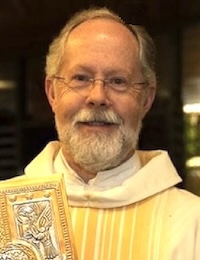
EXCERPT: If you look, you’ll see the Cross of Christ most everywhere – in churches, in schools, in jewelry, in art and in people’s homes. There are crucifixes and plain crosses of all shapes, sizes and colours, in gold, silver, wood, paint and paper. There’s the Celtic Cross, Jerusalem Cross, Cross of St Damian, Latin Cross, Maltese Cross, Cross of St Andrew and the Coptic Ankh. They’re everywhere: on walls, clothing, TV, online, in books, and in people’s hearts, minds and lives.
In our Gospel today, Jesus tells his disciples to take up their Cross and follow him. But what does that mean? What does it mean to take up your Cross and follow Jesus? Christians have been trying to work that out for 2,000 years.

Click to Enlarge
Bishop Robert Barron
22nd Sunday of Year A

TRANSCRIPT / INFOGRAPHICS FOR BISHOP’S 2023 HOMILY
Click the video above, then follow along using the infographics and transcripts below.
The graphic was generated by AI and is not affiliated with Word on Fire.
Click Graphic to Enlarge
The Humanity and Reluctance
of the Prophet Jeremiah
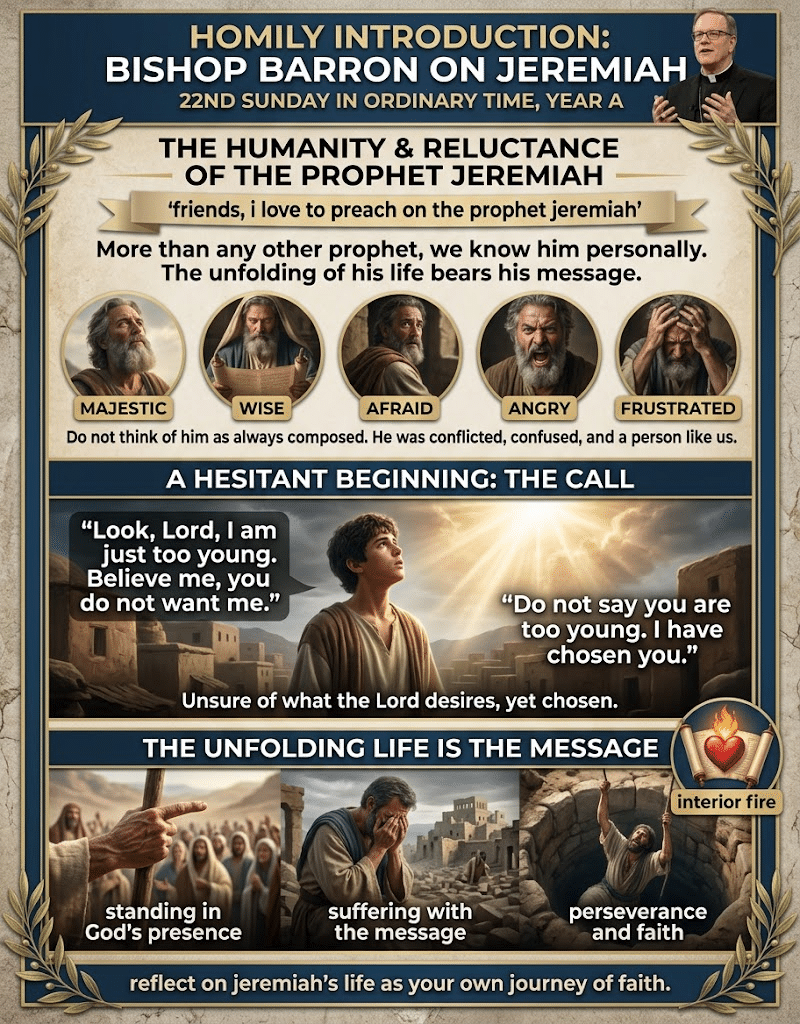
Peace be with you. Friends, whenever I have the chance, I love to preach on the prophet Jeremiah. Our first reading for this weekend is from the twentieth chapter of Jeremiah. There is so much spiritual wisdom in Jeremiah, but more than any of the other prophets, we come to know him personally; his personality comes through. There is more about the life of the prophet Jeremiah, and in some ways, that is the point—the very unfolding of his life bears the message he carries. Jeremiah is by turns majestic, deeply wise, afraid, angry, and frustrated. You see the entire range of human emotion. Do not think of Jeremiah the prophet as someone who had it totally together from the beginning and simply delivered oracles of truth in every direction. He was a person like us: conflicted, confused at times, standing in the presence of God without knowing what that fully meant, and afraid of its implications.
Think of that wonderful passage of the call of Jeremiah when he was a very young man—scholars estimate he might have been just fifteen or sixteen years old. You find this passage at almost every ordination ceremony: the Lord calls him, and Jeremiah responds, "Look, Lord, I am just too young. Believe me, you do not want me." God replies, "Do not say you are too young. I have chosen you." From the very beginning, he is hesitant and unsure of what the Lord desires.
The graphic was generated by AI and is not affiliated with Word on Fire.
Click Graphic to Enlarge
A Burdensome Mission and
"Terror on Every Side"
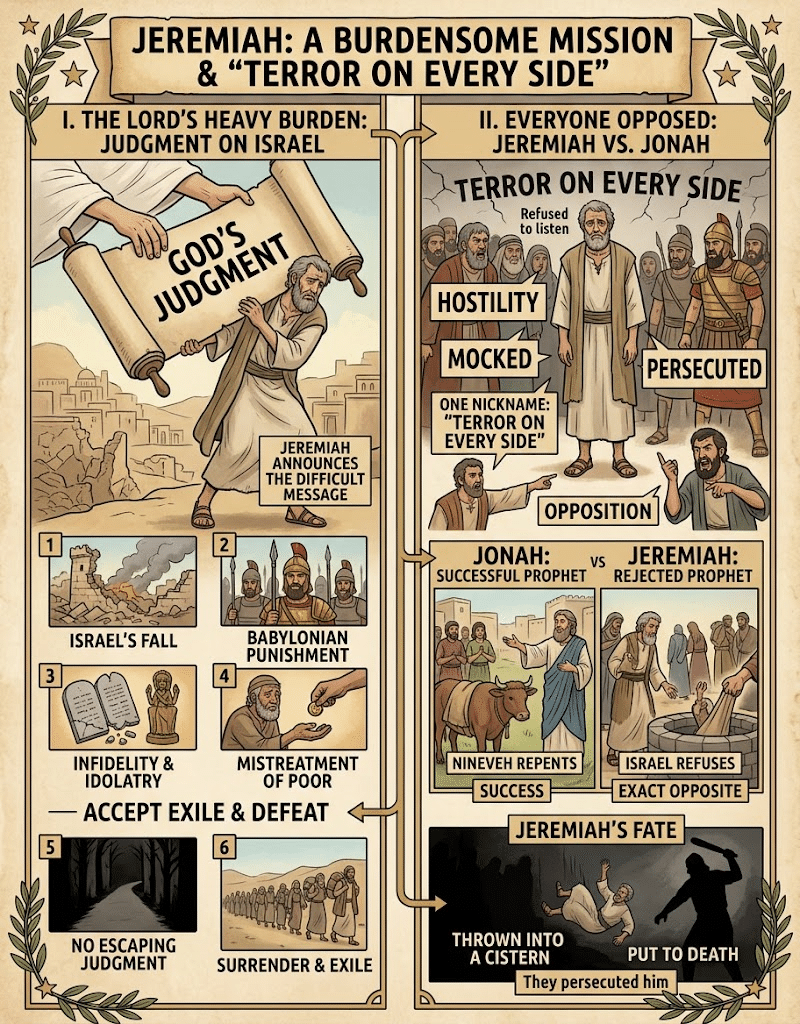
Then the Lord gives him a heavy burden. He does not say, "Jeremiah, you are going to announce wonderful good news and become the most popular person in Israel." On the contrary, he is given a difficult message to deliver: Israel is going to fall under God’s judgment. God will use the Babylonians to punish Israel for its infidelity, idolatry, and mistreatment of the poor, and there is no escaping it. All they can do is accept this judgment, surrender to this foreign invader, and accept their exile and defeat.
That was the message. Did it make him popular? No. On the contrary, everyone hated Jeremiah. One of his nicknames became "Terror on every side," because as he looked around, that is what he heard and saw: the threat of Babylon that God told him to announce, and the hostility coming from his contemporaries who were outraged by his message. Moreover, they didn't listen to him. Consider Jonah by contrast: Jonah announces, "You must repent," and Nineveh repents; even the cattle wear sackcloth. Jonah is the most successful prophet in the history of Israel. Jeremiah experienced the exact opposite. They persecute him. They throw him down. In the cisterns. And we don’t know. This for sure, but very likely he was put to death by his own people.
The graphic was generated by AI and is not affiliated with Word on Fire.
Click Graphic to Enlarge
Jeremiah’s Lament and
Modern Parallels
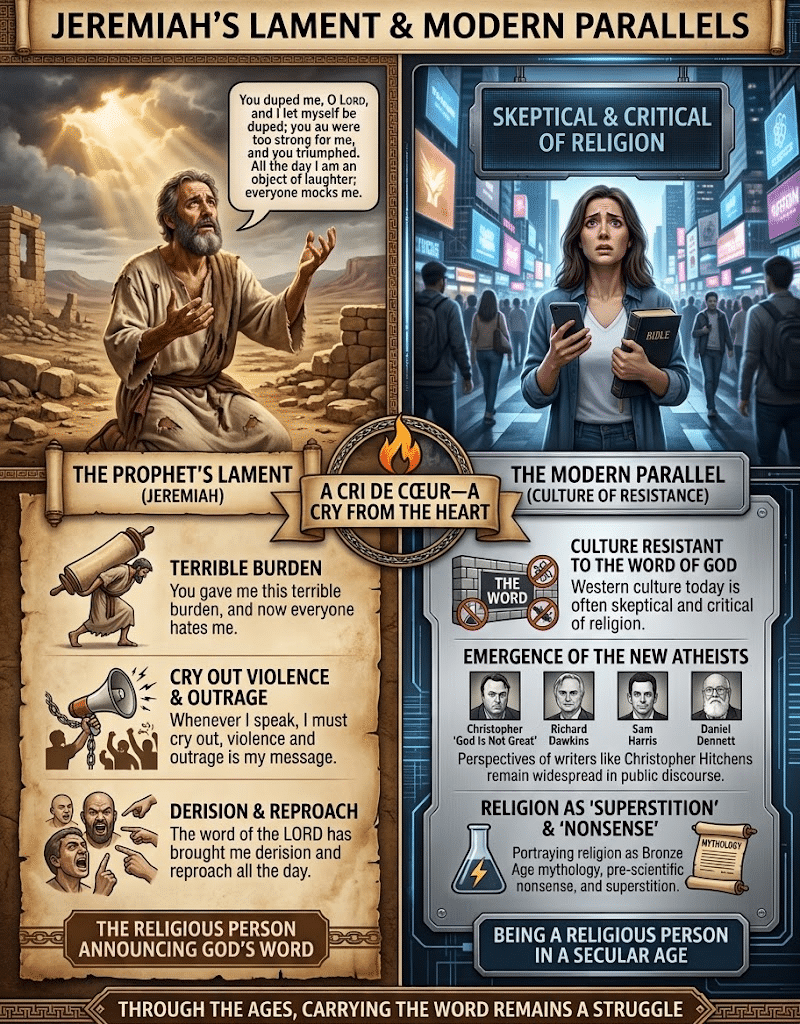
With that prophetic career in mind, listen to the opening line of our passage for this weekend. This is Jeremiah speaking: "You duped me, O LORD, and I let myself be duped; you were too strong for me, and you triumphed. All the day I am an object of laughter; everyone mocks me."
This is not someone standing serenely in the presence of God, offering a simple word of praise. This is someone saying, "You made me a prophet, but it amounted to being duped, taken advantage of. You gave me this terrible burden, and now everyone hates me." He continues: "Whenever I speak, I must cry out, violence and outrage is my message... The word of the LORD has brought me derision and reproach all the day." It is a cri de cœur—a cry from the heart. This is the religious person announcing the word of God in the midst of a culture and a people that does not want to hear it.
To be a religious person in a culture resistant to the word of God sounds very familiar. In my work preaching on the internet, you reach many people, but Western culture today is often skeptical and critical of religion. When the New Atheists emerged—writers like Christopher Hitchens, Richard Dawkins, Sam Harris, and Daniel Dennett—Hitchens wrote the bestseller God Is Not Great: How Religion Poisons Everything, portraying religion as Bronze Age mythology, pre-scientific nonsense, and superstition. Those perspectives remain widespread in our public discourse.

The graphic was generated by AI and is not affiliated with Word on Fire.
Click Graphic to Enlarge
Proclaiming Moral Truth
in a Relativistic Culture
Consider the challenge of speaking about the behavioral implications of a religious worldview. Talking about God abstractly is one thing, but addressing how life must change in light of religious belief is quite another. Try speaking in the public square about the infinite dignity of every human person from conception to natural death. We live in a culture that widely promotes abortion on demand and where state-sponsored euthanasia is increasingly accepted. When you stand up and say, "The Lord has commissioned me to say that human life must be respected from conception to natural death," you quickly begin to feel like Jeremiah.
Try urging that every person—regardless of race, background, or identity—must be cherished and respected, as is fundamental to a biblical perspective. At the same time, try telling a culture rooted in radical self-definition that we have objective moral responsibilities and that there is a given structure to our moral and sexual lives. In a culture that insists, "It is entirely my prerogative to determine who I am and how I live," announcing real, objective moral values will quickly meet derision. As Jeremiah said, "All the day I am an object of laughter; everyone mocks me."
The graphic was generated by AI and is not affiliated with Word on Fire.
Click Graphic to Enlarge
The Fire Burning Within
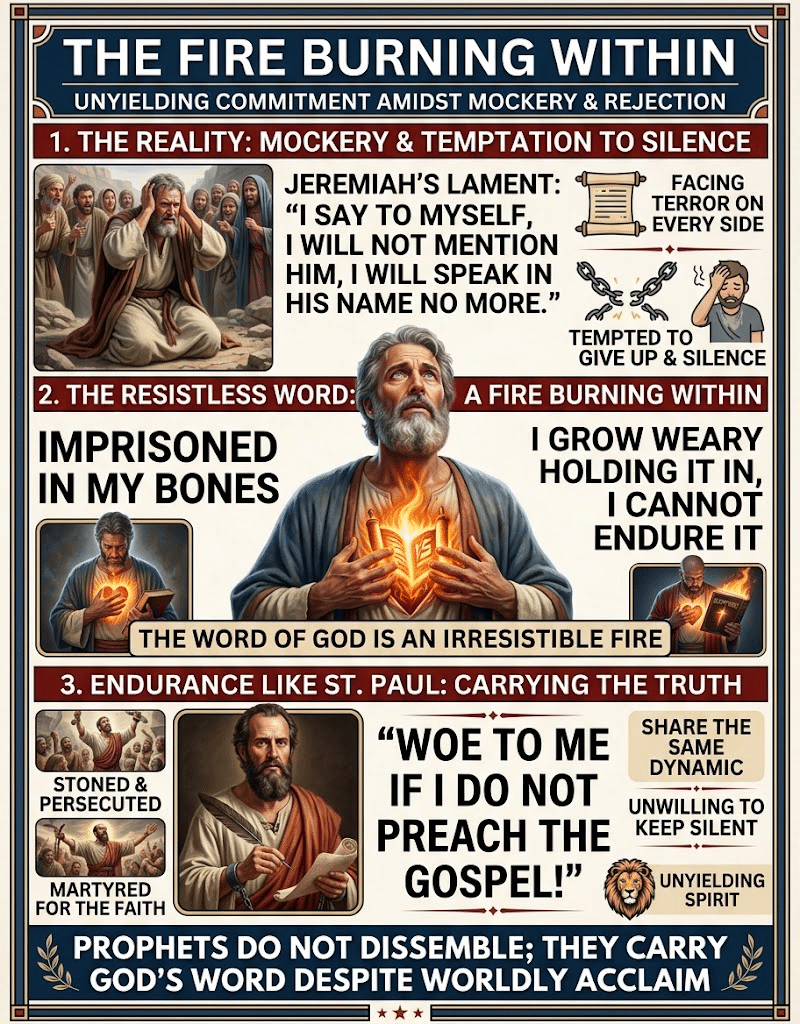
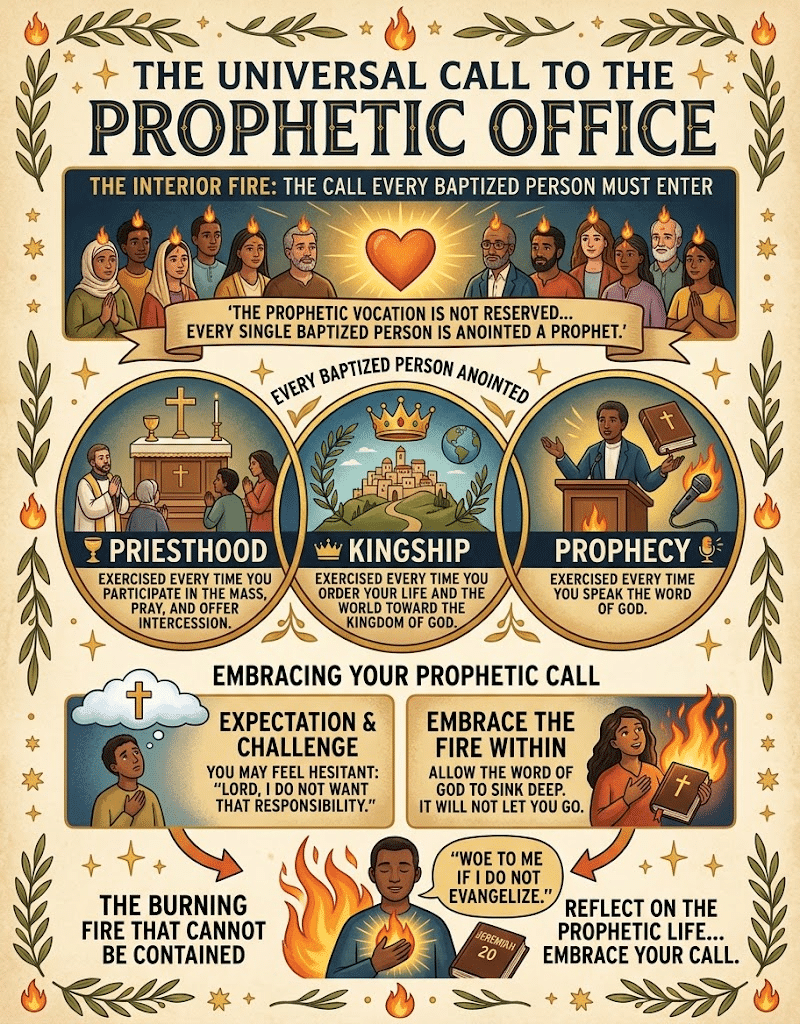
Jeremiah did not live in a space of worldly success; he encountered mockery and rejection. Does that mean we give up? No. Here is the most crucial part of the passage: having acknowledged the reality of "terror on every side," Jeremiah says: "I say to myself, I will not mention him, I will speak in his name no more. But then it becomes like fire burning in my heart, imprisoned in my bones; I grow weary holding it in, I cannot endure it."
This reveals the interior life of the prophet. Jeremiah is completely honest about the negativity; he does not dissemble or pretend it is not there. He is tempted to give up and say, "I am not going to do this anymore." Anyone involved in public preaching and teaching has felt that desire to withdraw from criticism. Yet the word of God is like a fire burning within.
Prophets often use the image of consuming the scroll of the word of God, finding it sweet as honey in the mouth. When you take in the Scriptures, you encounter a word that is deeply challenging, yet irresistible. St. Paul shared this same dynamic. Paul did not meet with constant worldly acclaim; he was stoned, expelled from cities, persecuted, and ultimately martyred. Yet Paul declared, "Woe to me if I do not preach the gospel!" The word of God penetrated so deeply into St. Paul and Jeremiah that they could not keep silent.
The graphic was generated by AI and is not affiliated with Word on Fire.
Click Graphic to Enlarge
The Universal Call
to the Prophetic Office
That interior fire defines the reality all prophets must enter. In Catholic doctrine, every baptized person is anointed priest, prophet, and king:
- Priesthood: Exercised every time you participate in the Mass, pray, and offer intercession.
- Kingship: Exercised every time you order your life and the world toward the kingdom of God.
- Prophecy: Exercised every time you speak the word of God.
The prophetic vocation is not reserved solely for rare figures like Jeremiah and Paul; every single baptized person is anointed a prophet. You may feel hesitant and say, "Lord, I do not want that responsibility." When you announce the word of God today, expect opposition and difficulties. But if you allow the word of God to sink deep into your heart, mind, and life, it will not let you go. It will become a fire burning within you that you cannot contain, leading you to say, "Woe to me if I do not evangelize." Read the twentieth chapter of Jeremiah, reflect on the full reality of the prophetic life, and embrace your call as a prophet. God bless you.
YouTube transcript edited for readability by removing fillers, stumbles, and false starts while strictly preserving the homily’s original cadence and theological accuracy. Infographics are independently produced by TWTW and have no affiliation with Word on Fire.
In the News
22nd Sunday of Year A
Dolly Parton: Locked into Higher Wisdom while Living Out God’s Creative Call
When news broke of Dolly Parton’s passing at the age of 80 in her Nashville home, the reaction was immediate, visceral, and universal. Across the country and around the globe, phones lit up not merely with breaking news banners, but with quiet messages of personal grief between friends, coworkers, and families. People reacted as though they had lost a cherished member of their own household—an aunt, a mother, a lifelong companion whose presence had been woven into the fabric of their days.
Generations of listeners grew up with her voice in the background of their lives, from the humble mountain ballads of the 1960s to the monumental anthems that defined modern country and pop music. Yet people gravitated toward her not because of secular prestige, glittering awards, or chart-topping records, but because she remained profoundly anchored to something transcendent.
As we gather to hear this Sunday’s scripture readings, her life offers far more than a nostalgic retrospective. In the prophetic urgency of Jeremiah, the radical self-offering of Romans, and the self-emptying cross of Matthew’s Gospel, we see the clear blueprint of a soul that remained intentionally locked into higher wisdom while answering God’s creative call.

The Fire in the Bones: Jeremiah 20:7–9
The prophet Jeremiah captures the burden and joy of an unavoidable vocation: "If I say, 'I will not mention him, or speak any more in his name,' then within me there is something like a burning fire shut up in my bones; I am weary with holding it in, and I cannot."
A true creative calling is never self-manufactured ambition; it is an inner fire that must be stewarded. Born one of twelve children in an East Tennessee cabin, Dolly grew up in the church where her grandfather preached "hell so hot you could feel the heat." From that early soil, she learned that Jesus loved her and that through God, all things were possible. She inherited a fierce work ethic from her father's farming kin and an expressive, spiritual spark from her mother. Over the course of writing more than three thousand songs, Dolly continually refused to take sole credit for her genius, insisting that she stayed "locked into that higher wisdom, that greater spirit." Whenever a song flowed that surpassed her own ability, she gave thanks upward.
Even in the heights of the entertainment industry, she never hid that flame. When collaborating across musical genres or winning contemporary Christian Grammys, she remained unapologetic: "People say, 'Well, I'm surprised that you talk about your faith.' And I say, 'Why not? That's who I am. That's what keeps me going.'" Like Jeremiah, the truth in her bones was impossible to silence.
A Living Sacrifice: Romans 12:1–2
Paul writes to the Romans: "Present your bodies as a living sacrifice, holy and acceptable to God, which is your spiritual worship. Do not be conformed to this world, but be transformed by the renewing of your minds."

To avoid conforming to the world means resisting its self-centered cynicism. Dolly’s daily life began not in self-congratulation, but on her knees, reading her morning devotionals and praying a direct prayer: "Lord, bring all the right things and the right people into my life, take all the wrong things out, and let me every day do something to uplift mankind and to glorify You." That prayer took flesh in radical, tangible generosity. To honor her father—who never had the opportunity to learn to read—she established the Imagination Library, personally funding and mailing hundreds of millions of books to young children worldwide.
When devastating wildfires tore through the Great Smoky Mountains, she stepped in directly with $12.5 million in relief funds. She brought thousands of jobs back home through Dollywood and quietly funded groundbreaking medical research. Her spiritual worship was lived out with open hands, proving that wealth and influence find their true purpose only when transformed into instruments of mercy.
Saint Paul defines genuine worship not as abstract sentiment or passive ritual, but as offering the body—one's physical presence, time, material resources, and influence—to God in service to others. When prayer "takes flesh" through tangible sacrifice, faith moves from private piety into public redemptive action. Dolly’s decision to channel her platform and wealth into concrete infrastructure for children is a portrait of worship translated into everyday love.
Losing One’s Life to Find It: Matthew 16:21–27
In Matthew’s Gospel, Jesus confronts his disciples with the core condition of following Him: "Whoever wants to be my disciple must deny themselves and take up their cross and follow me. For whoever wants to save their life will lose it, but whoever loses their life for my sake will find it."
To take up the cross is to embrace the discipline of open hands. It means choosing self-emptying generosity over self-preservation. Dolly learned from parents who had no money to spare that the truest gifts are helping hands and kind words. When she stood at career crossroads—even walking away from safe, lucrative partnerships to follow her own path—she did so without malice, writing songs like "I Will Always Love You" as blessings rather than bitter goodbyes. She understood that life is found not in clutching prestige, but in pouring oneself out for the joy of others.
Earthly honors and awards inevitably fade, but love freely given remains eternal. As we approach the altar today, the scriptures invite us to search our own hearts: Are we clinging to our lives in fear and self-protection, or are we willing to let God’s word burn in our bones, renew our minds, and make our daily lives a joyful offering for the world?
This essay based on Sunday's readings and current events was developed collaboratively using artificial intelligence alongside human pastoral curation and theological editing. It is not intended as a finished script, but as a catalyst to spark reflection, provide thematic inspiration, and support preachers in crafting their own authentic homilies for their communities.

DOLLY PARTON (5:09): Here is What She Said About God
The Fire in the Bones: Jeremiah 20:7–9
A Living Sacrifice: Romans 12:1–2
Romans 12: Resisting the World’s Conformity
Fr. Mike Schmitz
22nd Sunday of Year A

Fr. Mike Schmitz is the chaplain for the Newman Center at the University of Minnesota Duluth (UMD) and serves as the Director of Youth and Young Adult Ministry for the Diocese of Duluth. He has created an extensive amount of online video content addressing faith, morality, and culture. 2023 video courtesy of Sundays with Ascension
Fr. Michael Chua
22nd Sunday of Year A

✍️ Not on the Way, in the Way

Fr. Michael Chua
Homilies (2026)
Choose Salvation and not just Safety (2020)
You have to Choose (2017)
Living Sacrifice (2014)
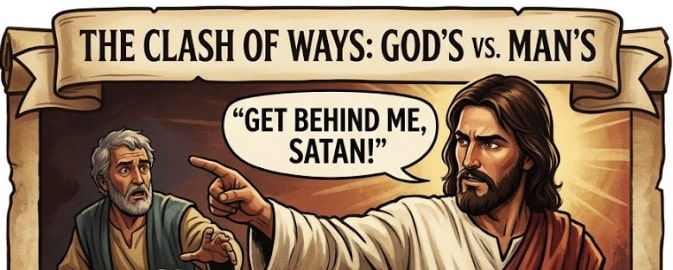
EXCERPT: Our Lord’s reaction to Peter’s attempt to give Him guidance was as sharp as it was instantaneous: He turned and said to Peter, “Get behind me, Satan! You are an obstacle in my path, because the way you think is not God’s way but man’s!” The Lord notes that unlike last week’s passage, where our Lord affirms that Peter’s confession of faith was revealed by the Father, the source of this week’s statement was from Peter himself. What’s worse, is that this human opinion was being used by the devil to tempt the Lord to turn His back on the cross, to choose safety and honour, over suffering and sacrifice. This was the nature of the three temptations which Satan used on our Lord in the wilderness before He began His public ministry. Satan had returned to tempt our Lord in the person of Peter. Of course, our Lord will have none of it because He knew that glory comes only after sacrifice. As one of my seminary formators once told a group of us, “If you are not on the Way, you are in the way!”
This dramatic exchange between our Lord and Peter would have been accentuated by the stunning backdrop. The town is Caesarea Philippi, a town built and named by an heir of Herod the Great in honour of Great Caesar and yet Philip the Tetrarch arrogantly attaches his name to the title – Caesarea Philippi – Philip’s City of Caesar. The vassal seeks to rule his liege. The arrogance of Philip, a minor ruler, is pretty rich. Similarly, Peter in remonstrating with the Lord, seeks to lord over Him. Instead of renouncing himself and follow the Lord’s lead, Simon Peter seeks to have the Lord follow his instructions and lead.
Dominican Blackfriars
22nd Sunday of Year A
✍️ The Power of the Cross
EXCERPT: Jeremiah is perhaps the most obviously political of all the prophets of Israel. He lived in a time of huge political turmoil, surviving as he did the destruction of Jerusalem and her temple by the Babylonians, and being dragged off against his will – not to the Babylonian exile, but to Egypt, against his will, by a group of refugees. Right up until these cataclysmic events he had been warning the inhabitants of the Holy Land and their rulers that their policies were misguided, and to many he must have seemed like something of a Quisling, or at least an appeaser. This is why he was put in stocks by Passhur the priest, son of the king’s chief minister, leading to the powerful religious-political piece of poetry from which our first reading is taken.

Fr. Austin Fleming
22nd Sunday of Year A
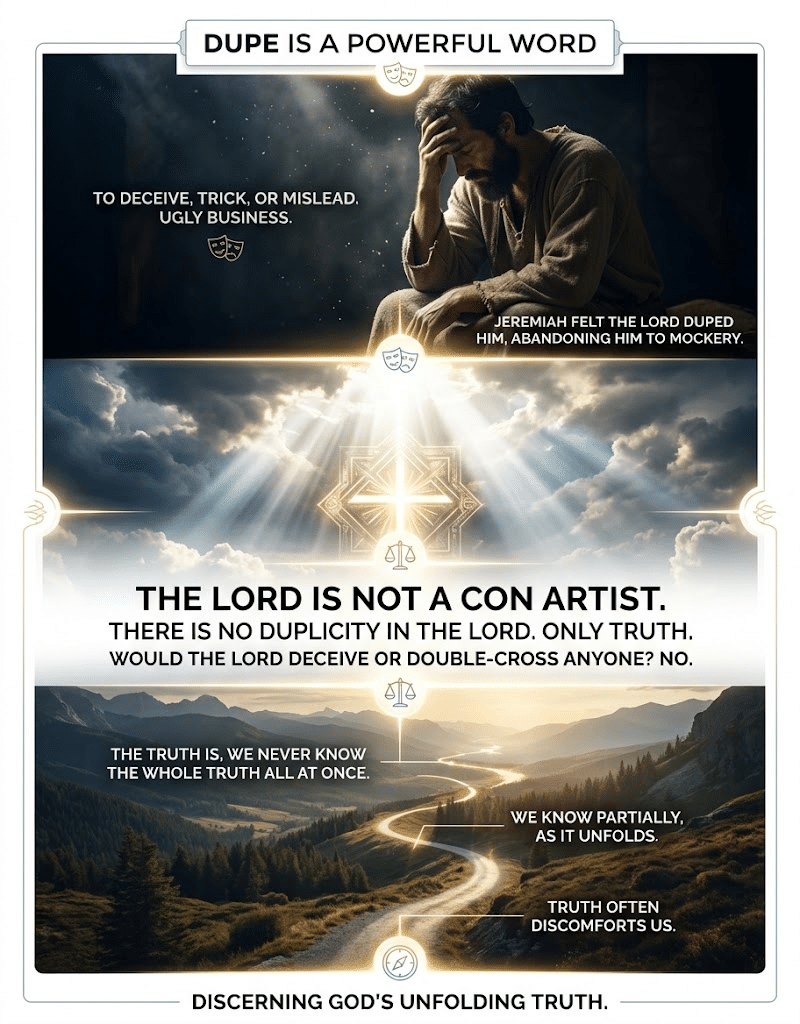
✍️ You Duped Me, Lord
Fr. Austin Fleming
EXCERPT: DUPE is quite a word: it means to deceive, trick, hoodwink, swindle, defraud, cheat, delude, double-cross, mislead or fool someone. Ugly, nasty business – all of it. So, was this Jeremiah’s fate? Did the Lord DUPE him? There’s certainly no doubt that Jeremiah felt duped: he felt the Lord had used him and then abandoned him to mocking reproach and derision of those around him.
But, would the Lord deceive or double-cross anyone let alone someone who’d been faithful in doing what the Lord asked? No. The Lord is not a con artist. There is no duplicity in the Lord. There is only truth.
Monsignor Peter Hahn
22nd Sunday of Year A

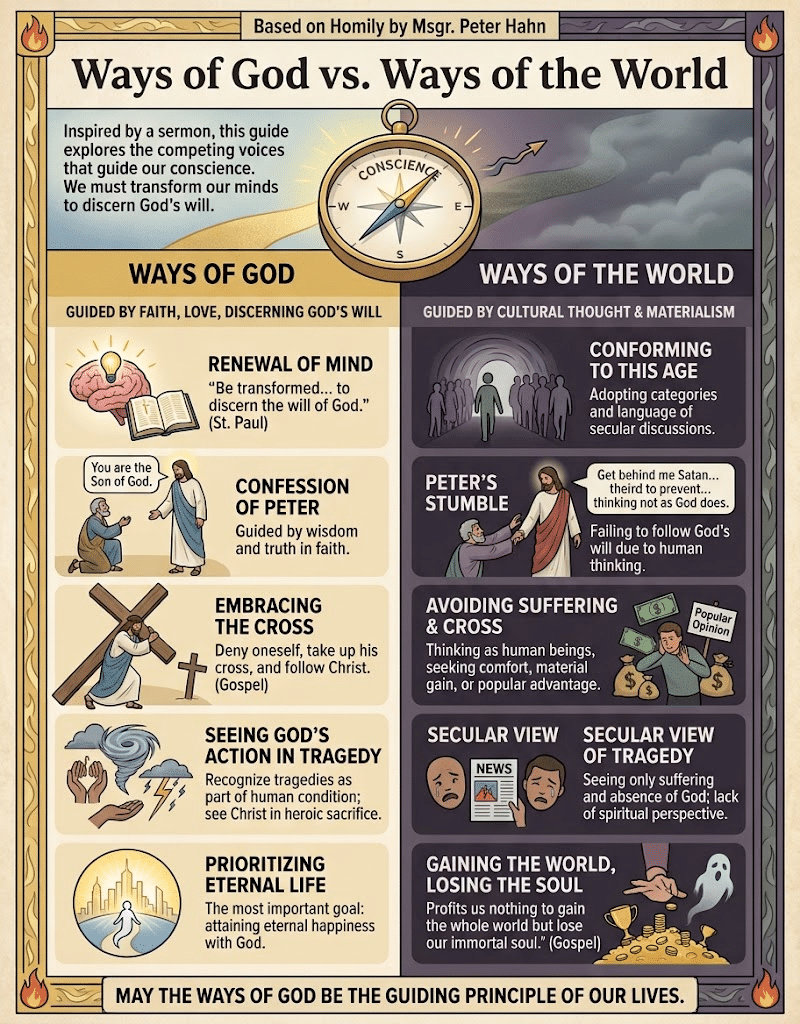
▶️ Ways of God vs. Ways of the World
Msgr. Peter Hahn
EXCERPT: I look back over the last three or four generations that is my personal experience and living. And I think there seems to have been a fundamental shift in many ways away from the ways of God. To the ways of the world. I think of my parents and their lives and their parents lives. The ways of God govern all that they did faith and the church were the central and most important realities in their lives…
The ways of the world seemed to be predominating in this time of instantaneous and worldwide communication when so many different and disparate voices speak to us and you and I cannot help to be affected by it.
Fr. Charles E. Irvin
22nd Sunday of Year A
✍️ Transforming Suffering into Purpose

Fr. Charles E. Irvin
EXCERPT: Christ’s suffering was infinitely meaningful, so much so that in His suffering He negated the power of evil and defeated all of the forces of evil. Rising from the dead, Christ drained the power of evil to hold us in bondage and opened for us the way to heaven. Our destiny now is not oblivion, our achievable goal is to live forever with God in His heaven now opened for us if we are joined into His Son, Jesus Christ.
Whenever we enter into a Catholic church we are immediately confronted with the crucifix, that visualization presents you and me with the truth that is not only Christ who suffers, but it is also all of humanity that writhes crucified in pain. It is horrible; it depicts our reality. It tells us that our humanity is nailed to crosses of pain, pain not caused by God but rather pain caused by others.
Fr. Tommy Lane
22nd Sunday of Year A

✍️ Peter Grew to Accept the Cross

Fr. Tommy Lane
Clearly Peter went from a small stone or skandalon that makes one trip to become someone who was powerful, mighty, a rock, the first Pope. What changed? Peter’s faith in Jesus grew so that he no longer acted under impulse but under the power of the Holy Spirit. We see two alternatives in Peter: rejecting the cross and being a stone to make one trip or accepting the cross to live a new life in union with Jesus. In our second reading today Paul wrote,
I urge you therefore, brothers, by the mercies of God, to offer your bodies as a living sacrifice, holy and pleasing to God, your spiritual worship. Do not conform yourselves to this age but be transformed by the renewal of your mind, that you may discern what is the will of God, what is good and pleasing and perfect. (Rom 12:1-2).
Fr. Langeh, CMF
22nd Sunday of Year A

▶️ There can be No Crown without a Cross
EXCERPT: The experience of Jeremiah in the First reading today is not really easily understandable. How can God seduce someone and instead of a message of PEACE, he is to shout violence and devastation. Following God, Jeremiah gets insult and derision, he becomes a laughing stock. In the same way Jesus tells his disciples what awaits him as he goes to Jerusalem: he would suffer many things from the Jewish authorities, the chief priests and the teachers of the law. Worst still he would be killed.
The sharp intervention of Peter: ‘Heaven preserve you, Lord…this must not happen to you; shows how Christians today want to receive crowns without crosses. Religion has become a sort of a commercial product like an analgesic pain killer. Religion is advertised now like Panadol, Paracetamol, Dolipranne, Efferalgran. We hear new generational churches claiming to be pain killers: Immediately you attend this crusade or visit this pastor or watch the TV program, you are healed. Religion can be akin to “take two Efferalgran tablets, and your headache will vanish”.
Msgr. Charles Pope
22nd Sunday of Year A

✍️ Trademarks of the True Messiah
Msgr. Charles Pope
EXCERPT: In Sunday’s Gospel the Lord firmly sets before us the need for the cross, not as an end in itself, but as the way to glory. Let’s consider the Gospel in three stages.
I. The Pattern that is Announced
II. The Prevention that is Attempted
III. The Prescription that is Awarding
The heart of Jesus’ teaching here is the deep paradox that in order to find our life we must lose it. More specifically, in order to gain Heaven, we must die to this world. That dying is a process more so than just an event at the end of our physical life here. Although we cling to life in this world, it is really not life at all. It is a mere spark compared to the fire of love that God offers; it is a single note compared to the great symphony God directs.
Father Kevin Rettig

22nd Sunday of Year A
▶️ Hearing as God Hears
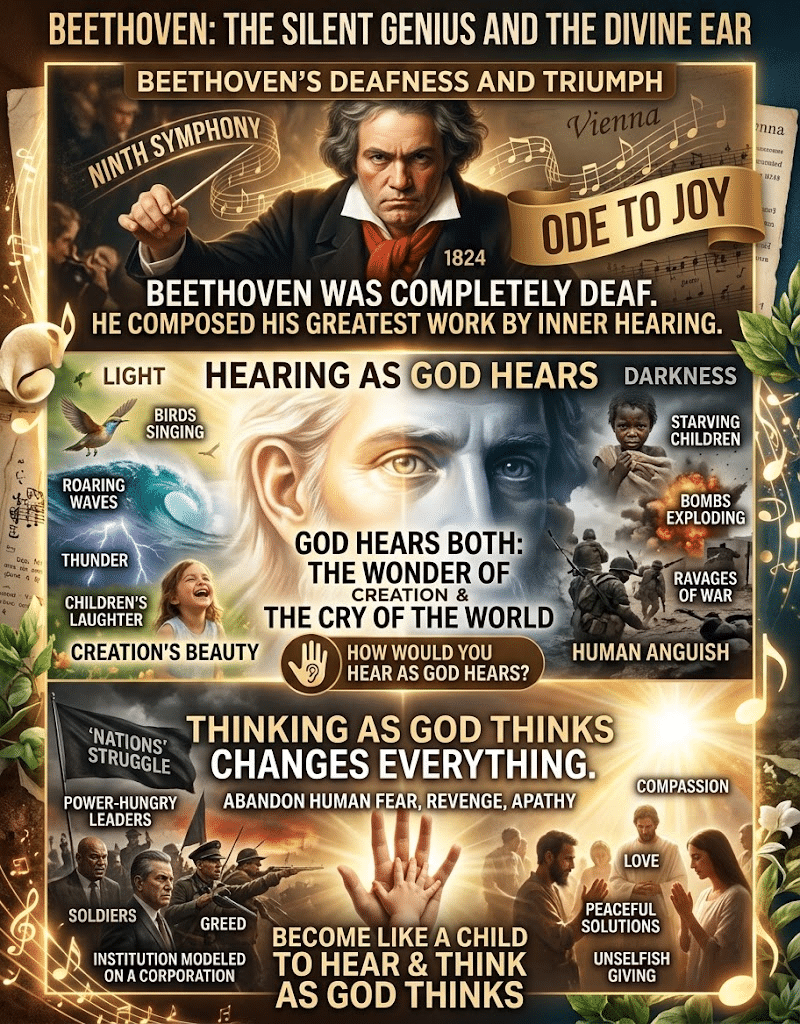
ABSTRACT: This reflection draws an analogy between Ludwig van Beethoven composing masterpieces while deaf—explaining that he could “hear as God hears”—and the spiritual challenge for humanity to perceive and think through a divine perspective. It concludes that true alignment with God’s heart demands unlearning worldly cynicism and returning to the open, unfiltered posture of a child, which Christ identified as the gateway to the Kingdom of Heaven. To think as God thinks requires rejecting human impulses toward fear, vengeance, greed, and institutional control—a failure illustrated by Peter’s rebuke from Jesus (“Get behind me, Satan”).
Fr. George Smiga
22nd Sunday of Year A
✍️ It’s Personal

Matthew 16:21-27
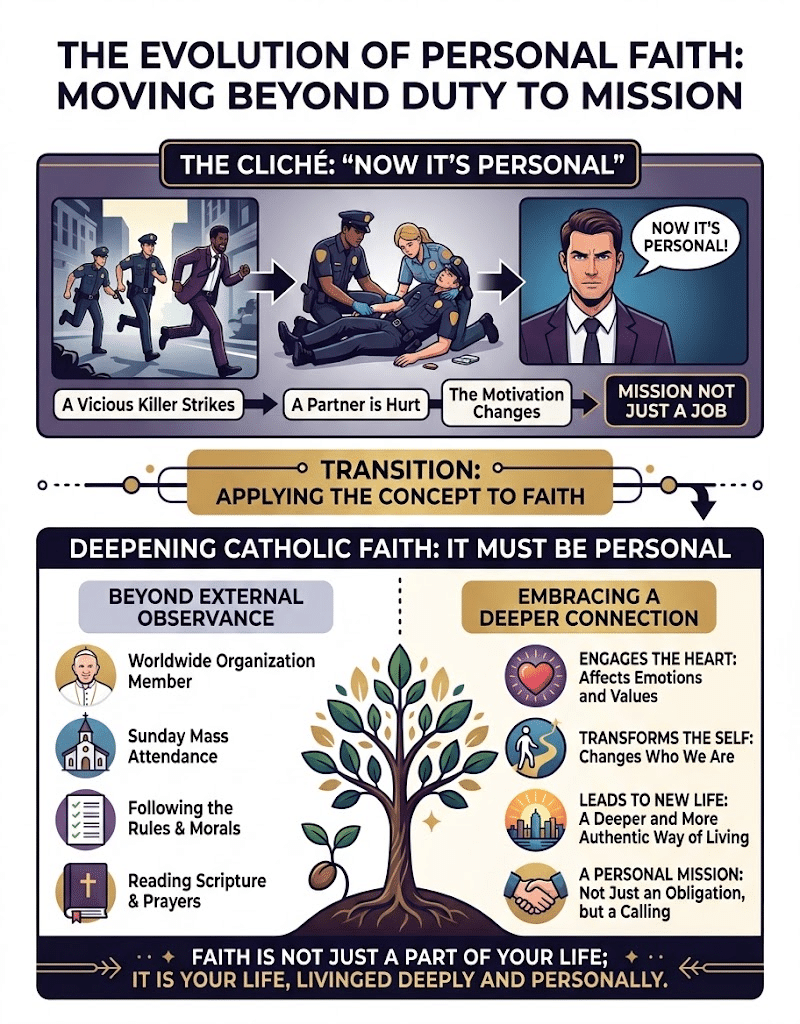
EXCERPT: It has become a cliché in recent movies and TV programs. It usually occurs in detective stories, when the police are chasing a vicious killer. The killer strikes out against those who are trying to arrest him, and in the process one of the cops is hurt or killed. At that moment it is usually the partner of the person who has been hurt who looks at the camera and says the line. That line is this: “Now it’s personal.” That cliché testifies that catching the killer is no longer a matter of doing a job or drawing a paycheck. Because the criminal has struck out against someone that the speaker has known and loved, bringing this criminal to justice is now a mission. It has risen to a new level of intensity. Everything is different. Now it’s personal…
Being a Catholic is more than admitting that we belong to worldwide organization led by the Pope. It is more than coming to church on Sunday, as good as that is. It is more than knowing the rules and living a good, moral life. It is more than reading the Bible and saying our prayers. If faith is to be real, it needs to be personal. We need our faith to hit us in the gut, to affect our heart. It is only then that our faith can change the person that we are and lead us to live in a new and deeper way.
Religious Orders
22nd Sunday of Year A

Transformed by the Journey
Reading Selected: Romans 12:1–2
Augustinian Theme: Ongoing Conversion (Conversio)
In his letter to the Romans, Saint Paul offers us a gentle yet radical invitation: “Do not conform yourselves to this age, but be transformed by the renewal of your mind, that you may discern what is the will of God.”
Saint Augustine understood this transformation not as an overnight triumph, but as a lifelong pilgrimage—a holy peregrinatio. When Augustine reflected on his own wandering years, he realized that conversion is rarely a single, finished chapter. It is the patient, daily work of allowing God to reshape where our love lands. We often cling to the familiar patterns of our culture: self-protection, status, and the illusion of self-sufficiency. Yet Paul reminds us that our spiritual life begins precisely when we stop conforming to these transient molds and let grace renew our interior vision.
To live in ongoing conversion means having the courage to wake up each morning and admit, “I have not yet arrived.” It is an act of profound humility. We do not transform ourselves by sheer willpower or moral rigidness; rather, we offer our lives as a living sacrifice, open hands ready to receive the gentle sculpting of the Holy Spirit. When we stumble or find our affections straying back toward old habits, we need not fall into despair. Augustine reminds us that our restlessness is the very compass guiding us back toward our true home in God.
Today, let us ask for the grace of a renewed mind. May we allow the Lord to re-order our desires, loosening our grip on what the world values, so that step by step, our hearts are slowly, beautifully formed into the likeness of Christ.

Denying the Ego: The Path of Humility
Reading Selected: Matthew 16:21–27
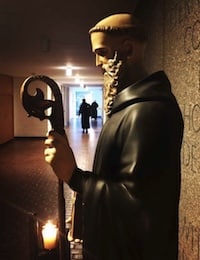
Benedictine Theme: Humility (Humilitas)
In the Gospel of Matthew, Jesus speaks words that startle our human nature: “Whoever wishes to come after me must deny himself, take up his cross, and follow me. For whoever wishes to save his life will lose it, but whoever loses his life for my sake will find it.”
Peter reacted to this truth with immediate resistance, just as we often do. Our instinct is self-preservation—to protect our status, control our outcomes, and place our own wills at the center of the universe. Yet Saint Benedict recognized that the heart of discipleship is the steady, quiet descent down the Ladder of Humility.
In Chapter 7 of the Rule, Benedict teaches that true elevation in Christ begins with lowering our defenses. To “deny oneself” is not an act of self-loathing; it is the liberation of unmasking our pride. It means stepping off the pedestal of self-importance and embracing authentic self-truth before God. When we stop trying to manufacture our own security and control every narrative, we make room for God to lead.
Taking up the cross in the Benedictine tradition is rarely found in grand, dramatic gestures. It lives in the ordinary, everyday moments: choosing patience when interrupted, listening to someone we disagree with, surrendering our need to always be right, and serving our community without seeking recognition. When we let go of our ego-driven demands to “save our life,” a profound freedom emerges. By descending the steps of humility and walking behind Christ rather than trying to direct His path, our restless grasp loosens. We discover that losing our false self is the only way to find our true, eternal life in God.


Lectio Divina
ePUB | PDF
Fire in the Bones: Holy Purification
Reading Selected: Jeremiah 20:7–9
Carmelite Theme: The “Dark Night” and Purification
Jeremiah’s cry in today’s first reading cuts straight to the heart of anyone who has ever felt overwhelmed by the spiritual journey: “You duped me, O Lord, and I let myself be duped; you were too strong for me, and you prevailed.” Jeremiah is weary, misunderstood, and brought to the edge of despair. Yet when he resolves never to speak in God’s name again, he finds that the divine presence has become “like a fire burning in my heart, imprisoned in my bones.”
This raw interior tension is precisely what Saint John of the Cross named the Dark Night of the Soul. In the Carmelite tradition, the dark night is not God’s absence or punishment; it is the burning intensity of God’s purifying love. When our early consolations fade, when spiritual joy gives way to dryness, and when following the Lord feels heavy or misunderstood by the world, God is doing His deepest work. He is gently stripping away our false expectations, our desire for easy spiritual comfort, and our attachment to our own plans.
Jeremiah wanted to walk away, yet he could not extinguish the flame within him. That holy fire was burning away his self-reliance so that only pure fidelity remained. Carmel teaches us that when our interior life feels arid or burdensome, we must not flee into distraction or bitterness. Instead, we stay in the quiet, surrender our bruised expectations, and allow God to purify our love. In the silence of your own trials, trust the fire. The darkness is not the end of the story—it is the holy crucible where God refines the soul, preparing the heart for profound, unshakable union with Him.

The Fire That Must Be Preached
Reading Selected: Jeremiah 20:7–9
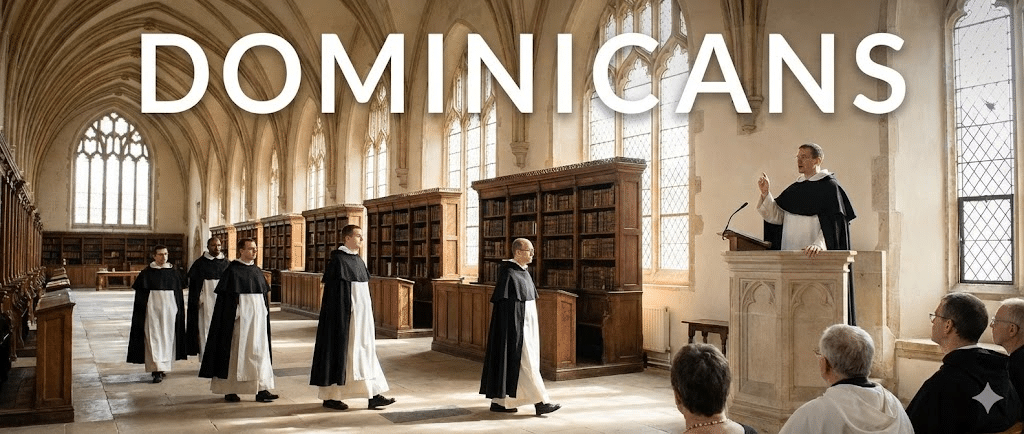
Dominican Theme: Salvation of Souls & The Contemplative Foundation
In today’s first reading, the prophet Jeremiah voices the deep anguish of an authentic messenger: “You duped me, O Lord, and I let myself be duped; you were too strong for me, and you prevailed.” Jeremiah is surrounded by mockery and derision. Weary from the hostility of those around him, he resolves to step down, silence his voice, and speak no more in God’s name. Yet he finds silence impossible: “It is as if fire is burning in my heart, imprisoned in my bones; I grow weary holding it back, I cannot.”
This interior crucible illustrates the beating heart of the Dominican motto: Contemplare et contemplata aliis tradere—“To contemplate and to hand on to others the fruits of contemplation.” For Saint Dominic and the Order of Preachers, proclaiming the Word of God is never a safe career or a comfortable platform. True preaching is not academic lecture or easy rhetoric; it is the overflow of an interior fire kindled in deep, contemplative communion with God. When we sit with divine Truth (Veritas), that truth inevitably takes hold of us. It burns away our complacency and compels us to speak for the salvation of souls, even when the truth is unpopular or resisted by the culture.
Like Jeremiah, every Christian faces moments when standing for truth, justice, and Gospel integrity brings fatigue, criticism, or misunderstanding. The temptation is to retreat into comfortable silence. But when God’s truth is truly alive within us, love will not allow us to keep it to ourselves. May we have the courage to remain grounded in silent prayer, allowing God’s living Word to ignite our hearts. And when the world hungers for light, may we step forward boldly to share that holy flame.

Freedom of the Lower Place:
A Homily on The Cross
Reading Selected: Matthew 16:21–27
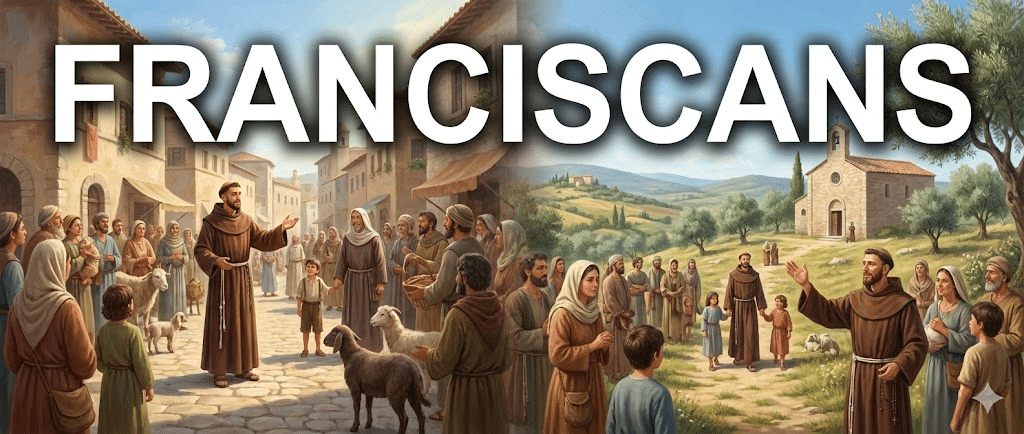
Franciscan Theme: Minoritas (Lesser-ness and Humility) & Gospel Living
In the Gospel of Matthew, Jesus speaks words that cut directly across our natural craving for security and prestige: “Whoever wishes to come after me must deny himself, take up his cross, and follow me. For whoever wishes to save his life will lose it, but whoever loses his life for my sake will find it.”
When Saint Francis of Assisi heard the Gospel, he did not treat Christ’s words as mere metaphors to admire from a distance. He resolved simply to live them. Francis looked at the Crucified Christ—naked, vulnerable, and poured out in total love—and discovered the true heart of discipleship in Minoritas: the courageous choice of “lesser-ness.”
Our culture constantly pressures us to climb higher, amass control, and guard our self-image. Yet Jesus shows us that God’s way is a downward journey. Taking up our cross is not about seeking suffering for its own sake; it is about stepping down from the pedestals of pride and ego. It means choosing the posture of a servant, embracing simplicity, and walking in the humble footsteps of the poor Christ.
When we cling tightly to our lives—our titles, our comforts, and our need to always win—we end up spiritually impoverished and weary. But when we open our hands, surrender our need for dominance, and embrace the ordinary crosses of patience, service, and gentle forgiveness, a radiant joy is born. This is what Francis called “Perfect Joy”—the freedom found when we have nothing of self left to defend, because Christ is our all. Today, let us lay down the heavy burden of worldly ambition. May we follow Jesus into the beauty of simplicity and love, finding our true life in Him.

Discerning the Sacred:
Holy Renewal
Reading Selected: Romans 12:1–2
Jesuit Theme: The Spiritual Exercises (Discernment of Spirits)
Saint Paul offers us a timeless spiritual challenge in his letter to the Romans: “Do not conform yourselves to this age, but be transformed by the renewal of your mind, that you may discern what is the will of God, what is good and pleasing and perfect.”
In the Ignatian tradition, discernment is not merely an intellectual calculation—it is the holy art of tuning our hearts to the voice of God in the midst of a noisy world. Saint Ignatius of Loyola understood that our minds are constantly tugged by competing currents. The “spirit of this age” pulls us toward anxiety, self-glorification, and immediate gratification, leaving us interiorly divided and restless.
To be “transformed by the renewal of your mind” means learning to notice what is happening deep within. In the Spiritual Exercises, Ignatius invites us to pay close attention to our inner movements: Where are we experiencing true spiritual consolation—deep peace, faith, hope, and love? And where are we falling into desolation—the hollow pull of fear, cynicism, and worldly conformity? Discernment calls us to pause in our daily lives, step back through reflective prayer like the Examen, and ask: Which voice am I listening to? Where is the Lord truly inviting me to act?
When we offer our everyday lives as a “living sacrifice,” we let go of the pressure to keep up with the demands of our culture. Instead, our interior sight is cleared. We gain the holy freedom to choose not what is merely convenient, but the Magis—the greater good that brings life to others and reflects God’s presence in our world. Today, let us invite the Spirit to renew our minds, giving us clear eyes to see God at work in all things.
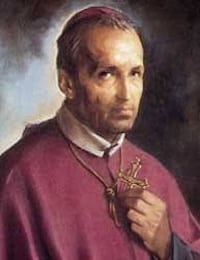
An Honest Cry to a Faithful Friend
Reading Selected: Jeremiah 20:7–9
Redemptorist Theme: Prayer of the Heart and Mental Prayer (Speaking to God as a Friend)
Jeremiah stands before God today without any masks, holding nothing back: “You duped me, O Lord, and I let myself be duped; you were too strong for me, and you prevailed.” Jeremiah is exhausted, mocked by the world, and weary of the heavy burden of his prophetic calling. He even tries to run away and keep silent, only to discover God’s presence burning within him “like a fire shut up in my bones.”
In the Redemptorist tradition, this raw, unfiltered prayer is not viewed as a lack of faith. Saint Alphonsus Liguori taught that true prayer—the prayer of the heart—is not about reciting rigid, rehearsed formulas. Rather, it is having the courage to speak to God with complete honesty, transparency, and childlike confidence, exactly “as a friend speaks to a friend.”
When life feels overwhelming, we often fall into the trap of thinking we must hide our frustration, our doubts, or our weariness from God. But the Redeemer does not ask for polished performances; He desires our real hearts. Jeremiah could pour out his anger and his tears before the Lord precisely because he was in an intimate, trusting relationship with Him. Even in his deepest struggle, Jeremiah never stopped speaking to God.
The burning fire in Jeremiah’s bones is a testament to the unshakeable love of God that will not abandon us, even when our own strength runs out. When ministry is heavy, when family life strains, or when quiet doubts weigh down your spirit, do not withdraw in shame. Step into the quiet. Tell the Lord the exact truth of where you are hurting. Trust that His mercy is plentiful, His listening ear is endlessly gentle, and His fire within you will never let you go.
Click a tab to view different ways of understanding the readings.
Additional Homilies
22nd Sunday of Year A
Fr. George Corrigan, OFM
The Suffering Messiah
Peter’s Response, Jesus’ Rebuke
Discipleship and Its Consequences
One’s Life; One’s Motivation
A Final Reflection
Msgr. Joseph Pellegrino (PDF) | Archive
Duped by Love (2026)
Fr. Michael Fallon, MSC | Archive
22nd Sunday in Ordinary Time (PDF)
Bilingual Homily
22nd Sunday of Year A
A brief homily for those who are learning Spanish or English. The grammar is kept uncomplicated and uses present-tense vocabulary to ensure it is easy to deliver. The homily focuses on the practical, everyday meaning of Sunday’s Gospel.
VOCABULARY

