Liturgy, Liturgy Notes, Liturgy Planner, Sunday Prep, Planning for Mass
Liturgy Notes, Liturgy Planner, Sunday Prep, Planning for Mass
September 20, 2026
Sept 20 | Today | Sept 27 | Oct 4 | Oct 11






PETITIONS
September 20, 2026
The Church
Governments and Salvation of the World
Those Burdened by Adversity
Local Parish / Faith Community
THE WORD
IN SONGS
THIS WEEK
ONE WORD
MANY CHARISMS
Sunday Lectionary Perspectives Across Religious Traditions


25th Sunday of Year A
September 20, 2026



THE WORD THIS WEEK
Master shares his grace:
Last are first and first are last,
Unearned mercy reigns.
September 20, 2026


Papal Homilies






"My Fair Share"—Charlie Brown Anecdote
Children's Activities


Featured Blog Posts
September 20, 2026


Fr. George Corrigan, OFM
Thoughts on what we pass over
About Blessings and Radical Grace
The Parable of Workers in the Vineyard
The Landowner
The Laborers
Caught in the Midst of Assumptions
The Complaints
A Final Thought
Msgr. Joseph Pellegrino (PDF) | Archive
Amazing Grace (2023)
Justice and Mercy (2020)
Graced Moments (2017)
It is Never Too Late (2014)
Are You, Am I, Good Enough? (2011)
The Amazing Grace of the Divine Employer (2008)
Fr. Michael Fallon, MSC | Archive
25th Sunday in Ordinary Time (PDF)

Liturgy Notes

Courtesy of The Sunday Mass—2023 Cycle A

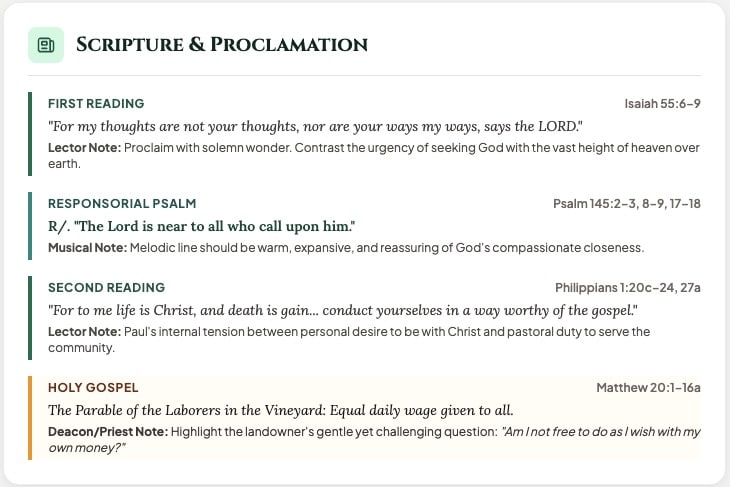

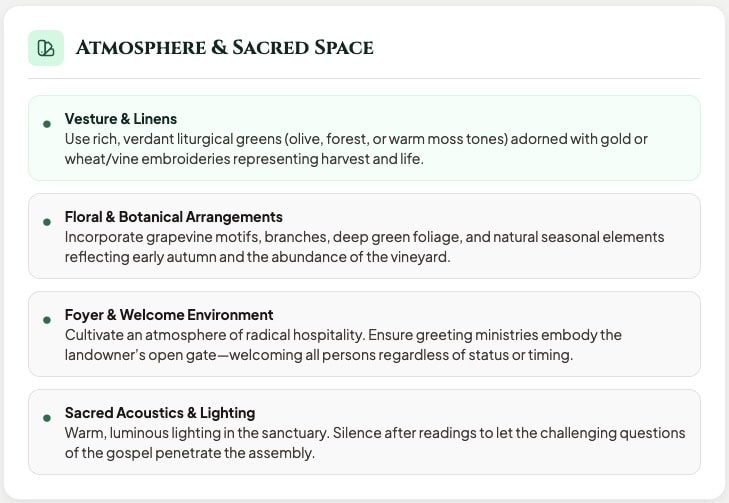
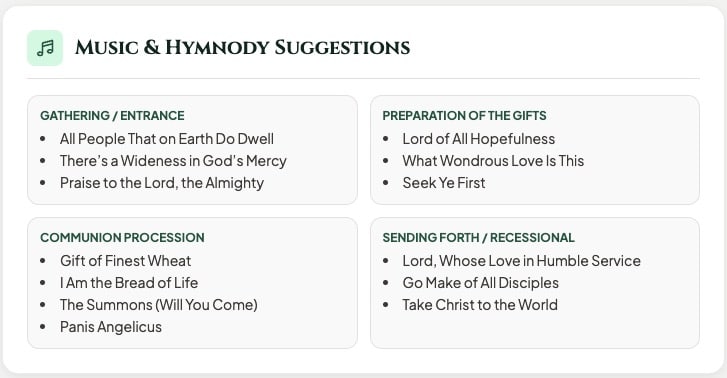

25th Sunday of Year A
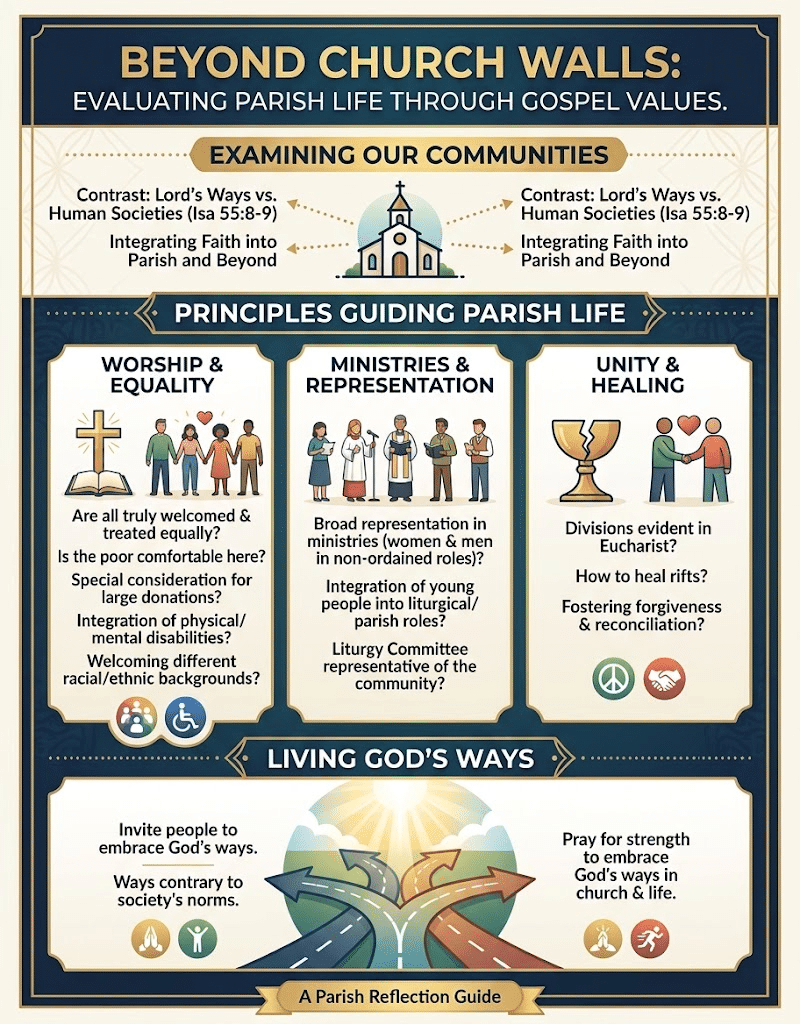
Auditing Our Church’s Principles
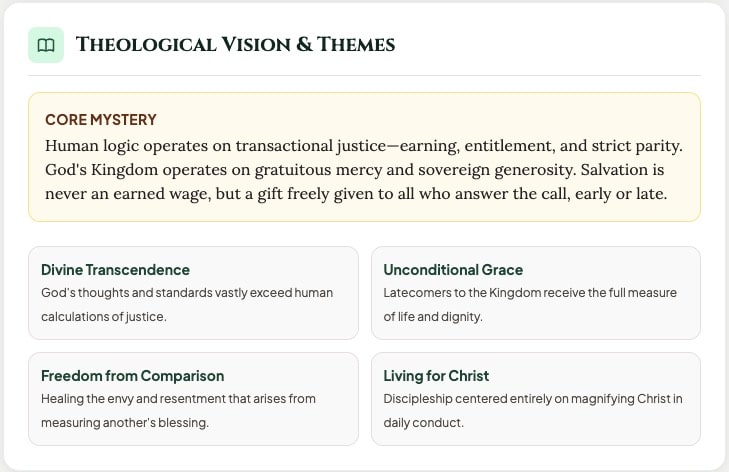
Today’s readings again present us with strong reminders that the ways of the Lord are often quite different from the ways of human societies, including our own. The first reading says it explicitly: “For my thoughts are not your thoughts, nor are your ways my ways, says the Lord. As high as the heavens are above the earth, so high are my ways above your ways and my thoughts above your thoughts.” The Gospel parable offers us a clear example of that truth. Many parishioners, hearing that parable, are inclined to agree with the workers who complain about the master’s generosity. Those who worked all day shouldget more pay than those who only worked an hour, right? The parable reminds us that God works with different principles than our capitalist society.
September 20th is
Catechetical Sunday in the United States
This Sunday is designated as Catechetical Sunday in the United States. It’s a day to affirm and support all those who carry out catechetical ministry in the parish, ranging from those who teach the very young to those who provide catechesis in the catechumenate to those who offer spiritual formation for the elderly. It’s also a day to simply recognize the importance of ongoing catechesis for every member of the church, since God calls us all to continual growth.
Planners should consult with catechetical leaders in the parish to determine how to recognize catechists this weekend. (2026 Materials are available online from the USCCB).
An order for blessing catechists can be found in Chapter 4 of the Book of Blessings; the order to use within Mass starts at #504. Note that the prayer of blessing can be used at the end of the General Intercessions or at the end of Mass (#508)
Today’s readings suggest a focus on forgiveness as a critical catechetical challenge and as a powerful witness to our faith. Is there any doubt that there is a crying need for forgiveness in today’s society? So many are focused on revenge rather than forgiveness! Christians could (and should) be people known for mercy, for forgiveness, for reconciliation, for peace. Wouldn’t that draw people to Christ?
A key insight is that forgiveness is as valuable to the one forgiving as it is to the one forgiven. As the first reading puts it: “Wrath and anger are hateful things, yet the sinner hugs them tight.” Holding on to anger and refusing to forgive destroys the peace and joy of the one who does not forgive. Often it hurts that person even more than the person they need to forgive. Helping people to see this truth does not make forgiving easy, but it may help people decide to keep trying to forgive more quickly and more often.
Full Series: Cycle A Resources

Entrance Song

Response & Acclaim
Response & Acclaim



Presentation & Preparation
Presentation and Preparation

Communion
Communion
Sending Forth
Sending Forth

The Wonders of Your Love (Tom Booth and Ben Walther)
SPIRIT & SONG | THE COMMONS
Liturgy Blog is a weekly liturgy planning resource for musicians, liturgists, homilists, youth groups, faith sharing groups, and all who look to the liturgical readings for inspiration and nourishment. Join Ken Canedo as he breaks open the Scripture and suggests tracks from the Spirit & Song contemporary repertoire.
Isaiah 55:6-9

2026 video courtesy of Lector with Lisa

1st Reading Proclamation Tips
Text Segment | Vocal Tone | Pacing & Ambo Actions |
"A reading from the Book of the Prophet Isaiah." | Clear, inviting announcement. | Look directly at the assembly. After speaking, pause intentionally and look down at the Lectionary to collect your first line while the assembly absorbs the introduction. |
"Seek the LORD while he may be found," | Warm, urgent invitation. | Lift your eyes. Deliver the entire phrase with full eye contact. |
"call him while he is near." | Gentle, accessible. | Look down to collect the phrase, then look up to proclaim. |
"Let the scoundrel forsake his way, and the wicked his thoughts;" | Sober, earnest, non-judgmental. | Look down to collect; deliver looking out. Maintain steady pacing through both clauses. |
"let him turn to the LORD for mercy; to our God, who is generous in forgiving." | Hopeful, warm, reassuring. | Deliver in two clear beats: anchor the promise of mercy, then emphasize generous in forgiving. |
"For my thoughts are not your thoughts," | Tender, compassionate understanding. | Do not sound stern. Speak to human confusion with patience: "I see your struggle, it's okay." |
"nor are your ways my ways, says the LORD." | Grounded, comforting authority. | Look up directly. Allow a slight pause before says the LORD to let the contrast sink in. |
"As high as the heavens are above the earth," | Expansive, elevated, awe-filled. | Let your vocal pitch and your eyes gently lift upward to mirror the vastness of the heavens. |
"so high are my ways above your ways," | Reassuring, patient. | Return gaze forward. Insert an intentional mental pause between my ways and your ways to emphasize the contrast. |
"and my thoughts above your thoughts." | Peaceful resolution; reassuring closure. | Deliver with finality. Return your eyes to the book immediately after the final word. |
[Mandatory Silence] | Complete silence. | Look down at the text. Silently count to three (or say a brief prayer of thanksgiving). Do not rush. |
"The Word of the Lord." | Reverent, firm proclamation. | Look up directly at the assembly. Proclaim without lifting or holding up the Lectionary book. |
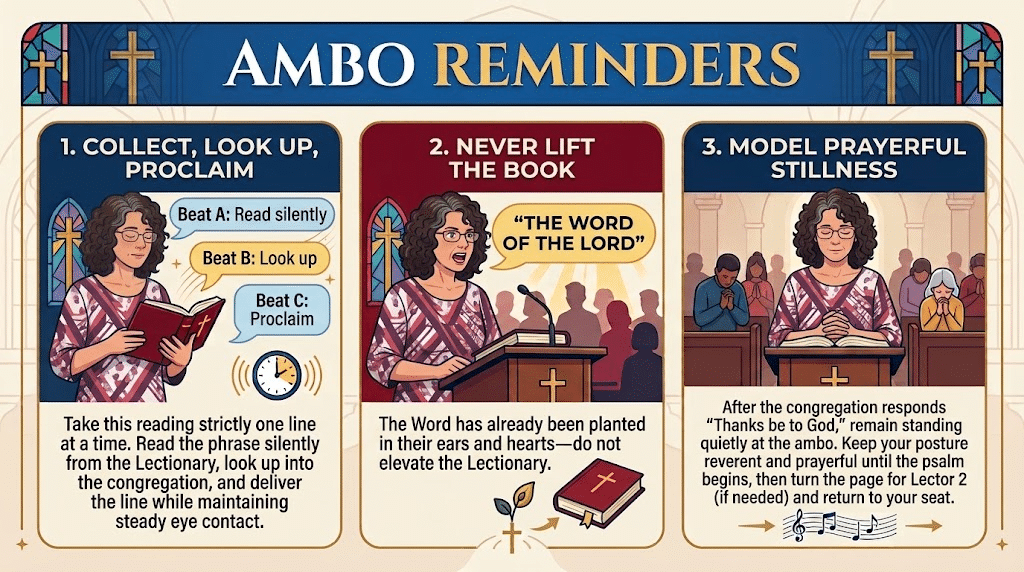
- Collect, Look Up, Proclaim: Take this reading strictly one line at a time. Read the phrase silently from the Lectionary, look up into the congregation, and deliver the line while maintaining steady eye contact.
- Never Lift the Book: Proclaim "The Word of the Lord" looking straight into the assembly. The Word has already been planted in their ears and hearts—do not elevate the Lectionary.
- Model Prayerful Stillness at the Conclusion: After the congregation responds "Thanks be to God," remain standing quietly at the ambo. Keep your posture reverent and prayerful until the psalm music begins, then turn the page for Lector 2 (if needed) and return to your seat.
Isaiah 55:6-9
Greg Warnusz


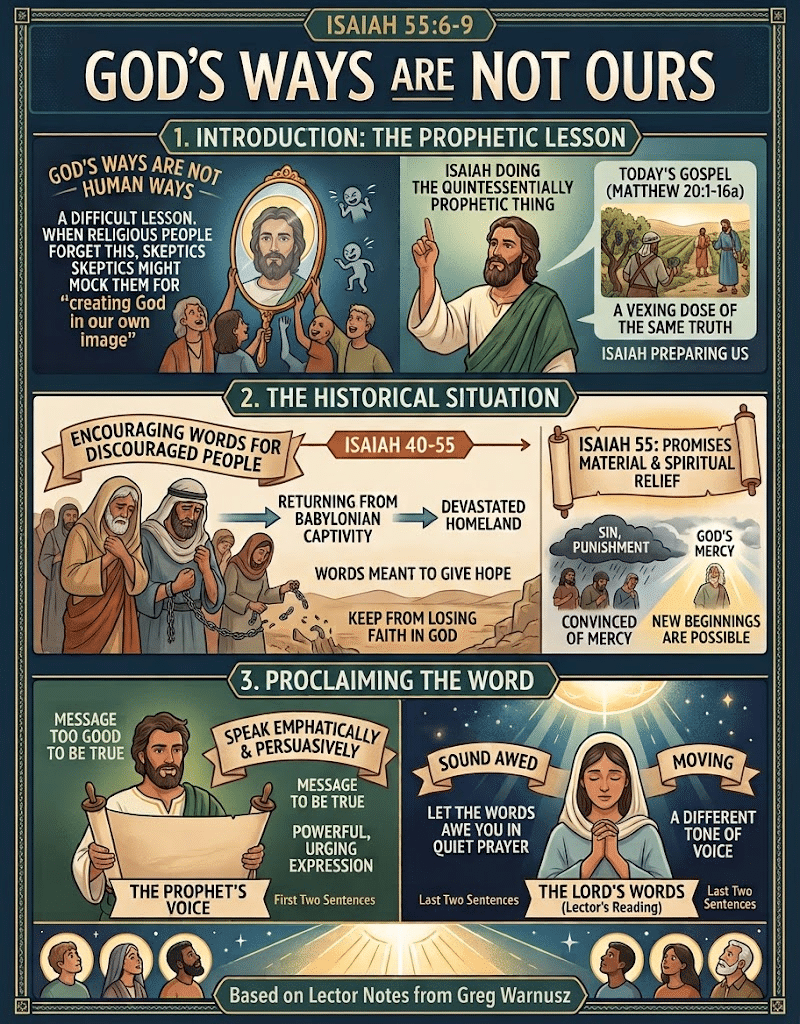
A Theological Reflection: That God's ways are not ours is a most difficult lesson; when we religious people forget that, skeptics rightly mock us for creating God in our own image. Isaiah is doing the quintessentially prophetic thing here when he reminds us that God doesn't think the way we do. In today's gospel, Matthew 20:1-16a, we get another vexing dose of the same truth. The Isaiah passage prepares us for that, if such preparation is possible, but it stands beautifully on its own, too.
The Historical Situation: As Lector's Notes often note, because the Lectionary so often cites this prophet, indeed this chapter, these were encouraging words for very discouraged people. Chapters 40-55 of Isaiah record prophecies spoken at the end of the Babylonian captivity of the people of Judah, when they were returning from enslavement far away, to a devastated homeland. The words were meant to give them hope and to keep them from losing faith in God. The whole chapter 55 promises both material and, like today's passage, spiritual relief. Convinced that their sins had led to their punishment by exile, the people need to be reminded, nay convinced, that God is capable of mercy and inclined once again to show it. New beginnings are possible at every level.
Proclaiming It: First, note that there are two voices speaking in succession. The prophet utters the first two sentences. If the historical and theological assertions above are correct, the prophet's audience must have thought his message too good to be true. So he must have spoken emphatically and persuasively. Imitate him.
But the last two sentences are the very words of the Lord. As a mortal speaking them, you should sound awed. That's a different tone of voice than the one recommended for the prophet's words. If you let the words awe you in quiet prayer over them, you may sound so.
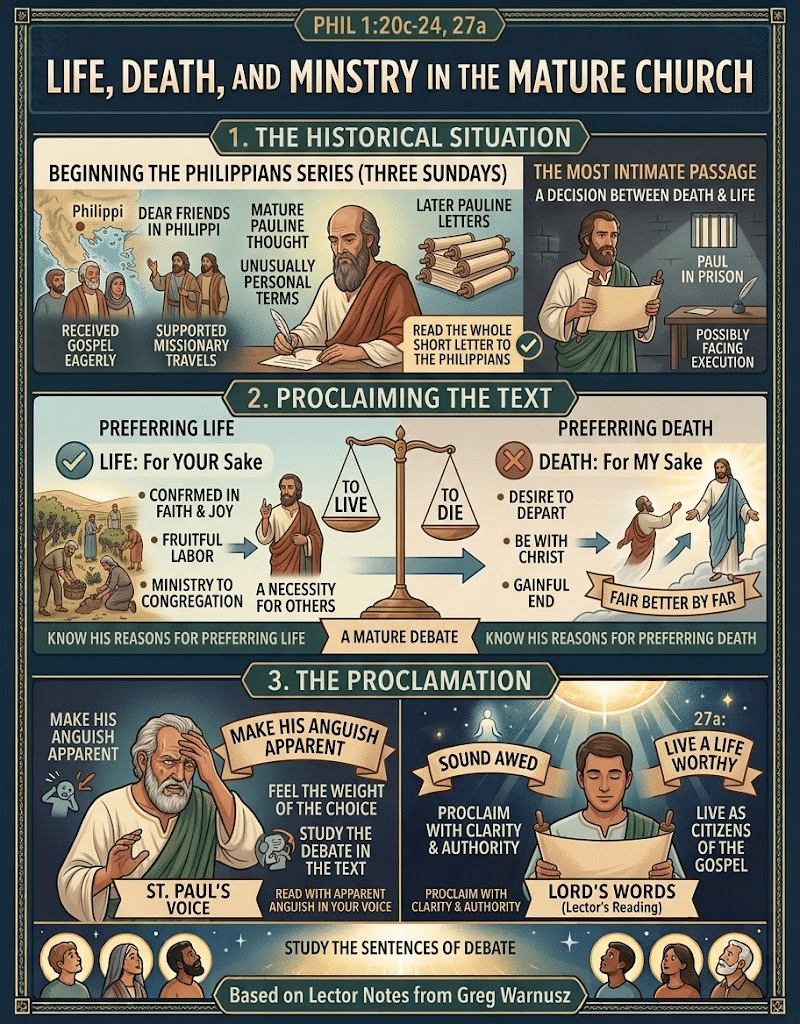
Phil 1:20c-24, 27a

2026 video courtesy of Lector with Lisa
2nd Reading Proclamation Tips
Text Segment | Vocal Tone | Pacing & Ambo Actions |
"A reading from the Letter of Saint Paul to the Philippians." | Clear, formal announcement. | Proclaim out to the assembly. Mandatory Long Pause: Look down at the text to let the assembly orient their minds before beginning the passage. |
"Brothers and sisters: Christ will be magnified in my body, whether by life or by death." | Resolute, courageous conviction. | Establish direct eye contact immediately on "Brothers and sisters." Deliver the entire line outward with steady intensity. |
"For to me, life is Christ, and death is gain." | Bold, dramatic, deeply personal. | Look down to collect; look up to speak. Insert a deliberate mental comma after "For to me" and slow down significantly on "life is Christ." |
"If I go on living in the flesh, that means fruitful labor for me." | Thoughtful, reflective realism. | Deliver outward at a measured pace, emphasizing the purpose behind staying: fruitful labor. |
"And I do not know which I shall choose. I am caught between the two." | Candid, conflicted, vulnerable. | Reveal Paul’s inner tug-of-war. Speak with open, direct eye contact as if wrestling with the choice in real time. |
"I long to depart this life and be with Christ, for that is far better." | Yearning, gentle, peaceful. | Soften vocal tone slightly to express the deep longing for heavenly rest with Christ. |
"Yet that I remain in the flesh is more necessary for your benefit." | Pastoral, resolute, self-giving. | Deliver firmly to the assembly. Connect with those asking why they are still here: your presence has an active purpose. |
"Only, conduct yourselves in a way worthy of the gospel of Christ." | Heartfelt plea; audible exasperation / deep sigh. | Look down to collect, then look up. Deliver with a "Give me a break / come on, guys" begging energy: Paul stays for them, so they must step up. |
[Mandatory Long Pause] | Complete silence. | Look down at the Lectionary. Ground yourself in the silence and collect your final phrase without rushing. |
"The Word of the Lord." | Reverent, firm proclamation. | Look directly out into the assembly to proclaim. Do not elevate or lift the book. |
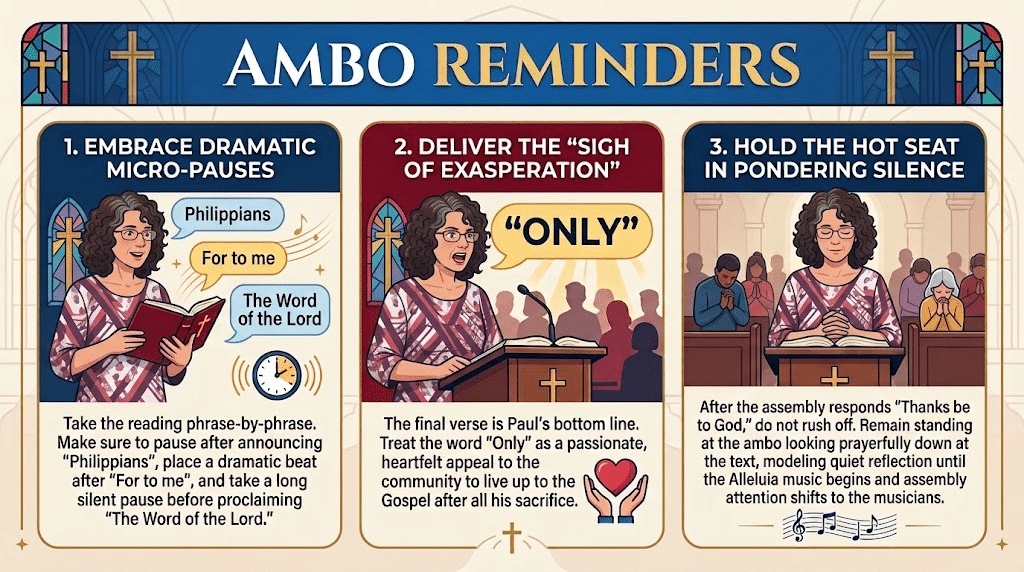
- Embrace the Dramatic Micro-Pauses: Take the reading phrase-by-phrase. Make sure to pause after announcing "Philippians", place a dramatic beat after "For to me", and take a long silent pause before proclaiming "The Word of the Lord."
- Deliver the "Sigh of Exasperation": The final verse is Paul's bottom line. Treat the word "Only" as a passionate, heartfelt appeal to the community to live up to the Gospel after all his sacrifice.
- Hold the Hot Seat in Pondering Silence: After the assembly responds "Thanks be to God," do not rush off. Remain standing at the ambo looking prayerfully down at the text, modeling quiet reflection until the Alleluia music begins and assembly attention shifts to the musicians.
Phil 1:20c-24, 27a
Greg Warnusz

The Historical Situation: Beginning today and continuing three more Sundays, we skim through Saint Paul's letter (really three letters) to his dear friends in Philippi. They had received the gospel from Paul eagerly, and supported him on his further missionary travels. He is very grateful. This is mature Pauline thought for a mature community, expressed in unusually personal terms. (The letter deserves a more thorough reading; the liturgical calendar doesn't encourage this, but that shouldn't keep you from reading the whole short Letter to the Philippians.)
Today's passage is most intimate. Paul is trying to decide whether to prefer death (he was in prison, possibly facing execution) or life. There's hardly a more important choice in any of our lives.
Proclaiming It: Study the text carefully so you know his reasons for preferring death and for preferring life. Know which sentences come down on which side of the debate. When you read this to the congregation, try to make his anguish apparent in your voice.