Children, Catholic Home School, Liturgy of the Word, Children’s Liturgy
Children, Catholic Home School, Liturgy of the Word, Children’s Liturgy
September 20, 2026
⭐⭐⭐ TBD

⬅️  ➡️
➡️


Matthew 20:14-16
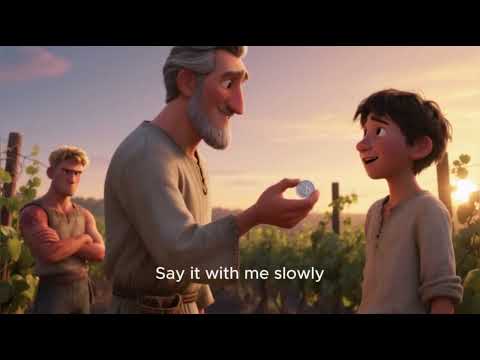
BIBLE GARDEN STORIES (3:58) – Jesus’ parable of The Workers in the Vineyard


MARY JO COLE (2023): Our Lady of Grace’s Liturgy with Children in Edina, Minnesota. (2023)

HEIDI WITTE : Kids’ Liturgy (2020)

UGANDA CATHOLIC TELEVISION: Children’s Liturgy (2023)

HOLY HEROES (2020)

EDMONTON CATHOLIC SCHOOLS (2026)

BIG AL & FR. JOE: Annie is feeling kind of jealous of Big Al (2023)
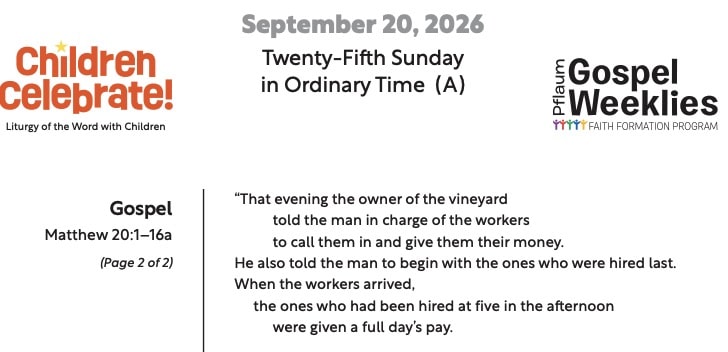

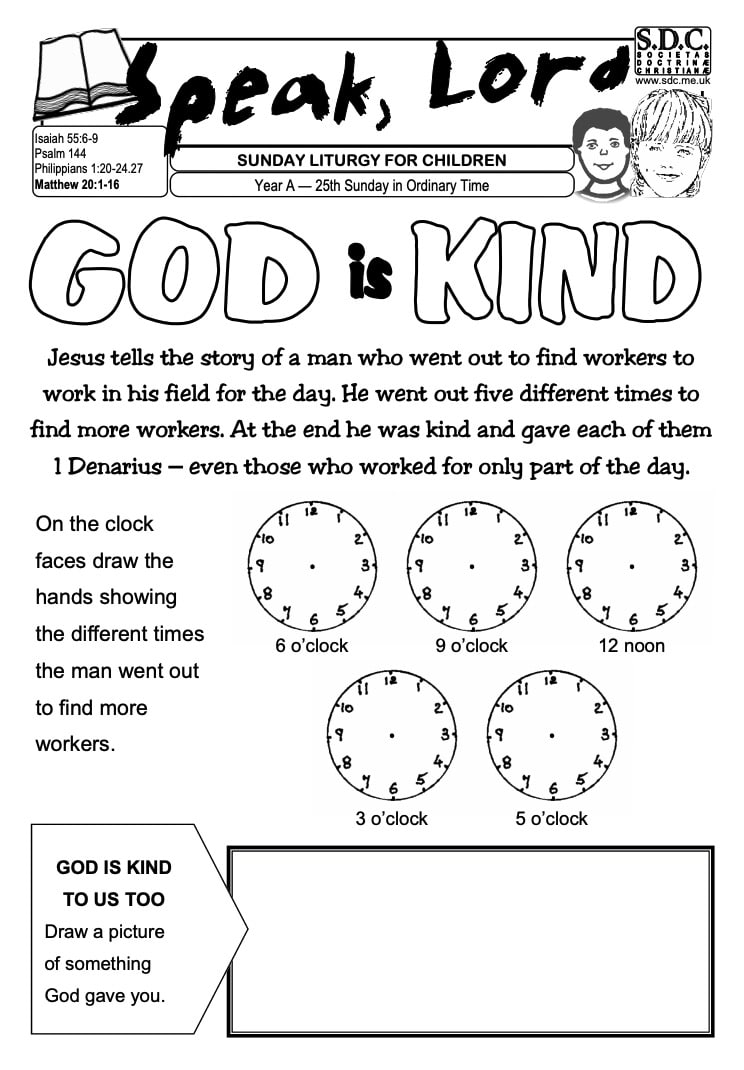
S.D.C. is a Catholic Society that works in the field of Catechesis and the spreading of the Word of God in different ways.
TWTW
AI GENERATED
WORKSHEETS

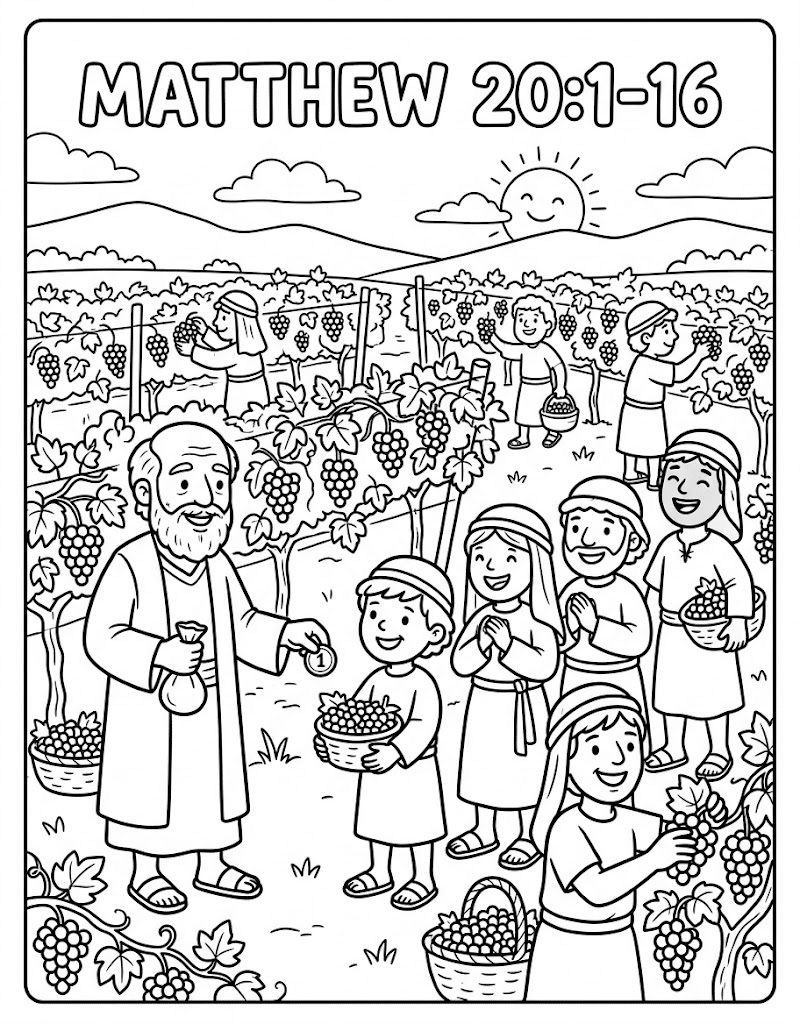


CHILDREN ACTIVITIES
BIBLE QUIZ


Non-profits have permission to use quiz (generated by AI for TWTW website).
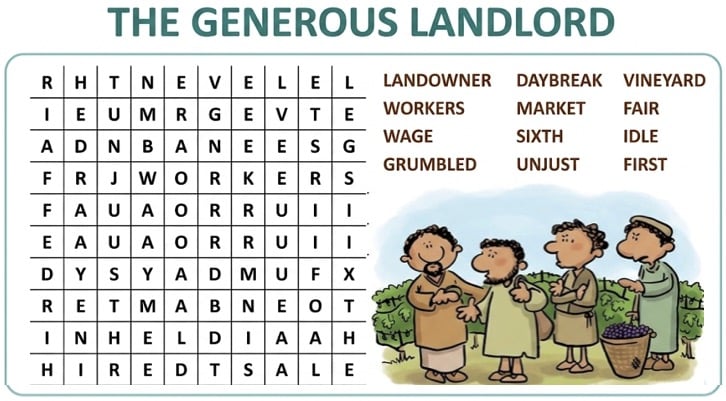
WORD FIND
Unending Supply of Grace
Activity 1: The Big Trade-Off
- An English Dictionary (for visual illustration)
- Whiteboard/markers or large poster paper
- Paper, markers/crayons, stickers
- For the “Activity”: One large bag of pennies, 1 small piece of paper (representing a contract) per child.
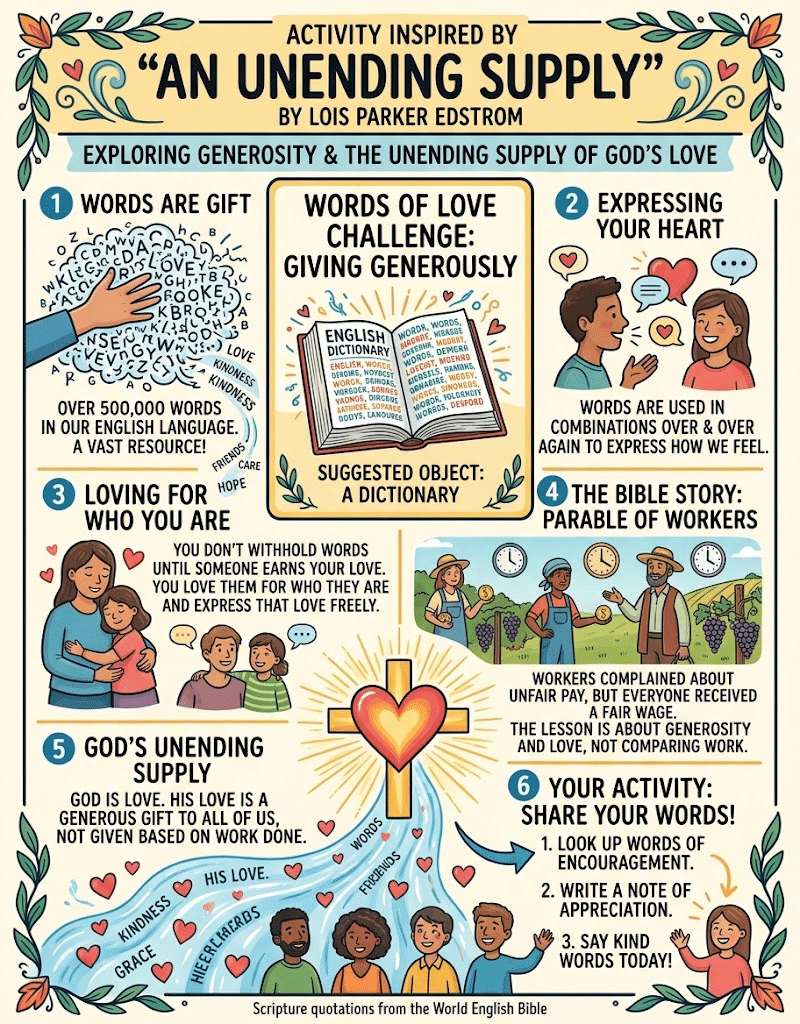
- Take-Home Worksheet: A printed copy of the [Activity Infographic provided in image_0.png] for each child.
2. Opening & Hook (5 Minutes)
Goal: Introduce the concept of a massive, unending supply using a dictionary.
(Hold up the Dictionary.)Say: “Who knows what this is? Right, a dictionary! Inside this book, there are over half a million words! That is a vast resource. More words than one person could ever use.”
Say: “Think about this: We use words to tell people how we feel. When we love our family or friends, we use these words to express that love. Words are used over and over again, in new combinations. The dictionary has an unending supply of words.”
Say: “Today, we are going to learn about something else that is an ‘Unending Supply’: God’s Love.”
3. The Bible Story & Roleplay (15 Minutes)
Goal: Experience the parable firsthand to spark discussion.
Preparation: Divide the class into five groups. Group 1 represents the “Early Morning” workers; Group 2 the “9 AM” workers; Group 3 the “Noon” workers; Group 4 the “3 PM” workers; and Group 5 the “5 PM” workers.
The Script: (Tell the story dramatically, or choose a child to read the passage from the World English Bible.)
Leader (The Landowner): “Good morning, Group 1! I need workers in my vineyard today. I will pay you one silver coin (show a penny) for a full day’s work. Do you agree?” (Have Group 1 agree and pretend to “sign” their paper contract.)
(Continue calling groups 2, 3, and 4 at the appropriate ‘times.’ Do NOT mention a specific wage, just say “I will pay you what is right.”)
(Finally, call Group 5.)
Leader (The Landowner): “Group 5! It’s already 5 o’clock! Why are you standing around? Go and work in my vineyard, and I will pay you what is right.”
(Have all children pretend to work hard—picking grapes, pulling weeds—for about 60 seconds. Make Group 1 “sweat” the most.)
Leader (The Landowner): “Okay, work is done! Time for your pay!”
(Gather everyone in a circle. Hand out one penny to every child in Group 5 (the last ones hired).)
Leader: “Wow, Group 1! You worked all day long, and these guys only worked one hour. What do you think you should get paid?” (Listen to their responses: 12 coins! 10 coins! More than them!)
(Hand out exactly one penny to every remaining child in Groups 1-4.)
Leader: “Alright, everyone received their fair wage. Have a good evening!”
(Prompt Group 1 to “complain.”)
Group 1 Child (reading Scripture or prompted): “These last workers only worked one hour, but you gave them the same pay as us! We worked in the heat all day!”
Leader (The Landowner): “Friend, I am not being unfair. Did you not agree to work for one coin? Take what is yours and go. I want to give to this last person the same as I gave you. Is it against the law for me to use my own money the way I want? Are you jealous because I am generous?”
Say: “And Jesus said, ‘So the last will be first, and the first will be last.'”
4. Group Discussion (10 Minutes)
Goal: Translate the parable into the context of God’s love.
(Use the infographic to guide discussion.)
- Reflect on the Simulation: Ask Group 1, “How did it feel when the last group got paid first, and they got the same amount as you?” (Listen for feelings of unfairness.)
- Infographic Panel 4 (“The Bible Story”): Show this panel. Point out the text: “The lesson is about generosity and love, not comparing work.”
- Explain the Meaning: “The Landowner in this story is like God. He is extremely generous. The coins represent God’s love and grace—the promise of eternal life with Him. Does God love the people who have been Christians their whole life more than someone who becomes a Christian just five minutes ago?” (Answer: No, He loves them both the same.)
- Infographic Panel 5 (“God’s Unending Supply”): Point to this section. Read the text: “God is love. His love is a generous gift to all of us, not given based on work done.”
- Connect Back to the Dictionary: “Remember our dictionary? The landowner had an ‘unending supply’ of generosity. God’s love is like that. It doesn’t run out! You don’t have to work hard enough to get God to love you; He gives it freely because of who He is.”
5. Application Activity: “Words of Love Challenge” (15 Minutes)
Goal: Practice generosity in our speech.
(Refer to Infographic Panel “WORDS OF LOVE CHALLENGE: GIVING GENEROUSLY”)
Say: “We learned that God gives us an unending supply of love. The best way to show that we are grateful for His generosity is to be generous ourselves! Today, we are going to use our own unending supply of words to show love to others.”
Challenge:
- Give each child a blank sheet of paper and stickers/crayons.
- Ask them to identify one person (a family member, friend, teacher, or neighbor) they love or appreciate.
- Prompt 1 (Infographic Step 2: “Expressing Your Heart”): “Write down or draw how this person makes you feel loved.”
- Prompt 2 (Infographic Step 3: “Loving for Who You Are”): “Write something you love about them, not because of what they do for you, but just because they are them.” (e.g., instead of “Thank you for cleaning my room,” try “You are a very joyful person.”)
6. Closing & Take-Home (5 Minutes)
(Hand out the printed copies of the infographic as the take-home worksheet.)
Say: “When you look at this infographic this week, I want you to remember these six steps. Remember that God’s grace is for everyone. We don’t need to be jealous of what others receive; we need to be thankful that God’s generosity knows no bounds.”
Take-Home Challenge: “Finish the task on the infographic. Make a plan to deliver your ‘Words of Love’ letter this week. Also, complete step 1: Look up a new word of encouragement in the dictionary!”
Final Prayer: “Generous Father, thank You for Your unending supply of love. Thank You that Your love is a free gift to all of us. Help us to use our words this week to show others how much You love them. Amen.”

Purpose and Audience of Parables
Q: Why did Jesus preach to crowds in parables rather than direct teachings?
A: Jesus used parables to teach people who had not yet become disciples what God is like and what it takes to become a disciple, without demanding immediate followership, allowing them to understand through relatable stories rather than lists of beliefs.
Q: What makes parables effective teaching tools for conveying Kingdom truths?
A: Parables are short, didactic stories using allegory that express moral lessons about the Kingdom of God through familiar settings (farmers, shepherds, workers, families) while challenging conventional wisdom of the time.
Dual Function of Concealing and Revealing
Q: How did parables serve different purposes for disciples versus outsiders?
A: Jesus explained that “knowledge of the mysteries of the kingdom of heaven has been granted to you, but to them it has not been granted” (Mt 13:11), meaning parables revealed Kingdom mysteries to disciples while concealing them from outsiders.
Core Message and Method
Q: What essential truth do parables communicate about God’s relationship with humanity? A: Parables express how much God loves people and what they should do in response, teaching God’s nature and how to reciprocate His love through stories rather than demanding compliance.

OSV Lifelong Catechesis
25 Sunday
in Ordinary Time
Religion Teacher
25th Sunday of Year A
Key Themes
- Earthly Juxtaposition (Parabole): By placing everyday images—farming, vineyards, family life—alongside sacred realities, parables make transcendent truths concrete and accessible.
- Targeted Invitation: Aimed at the uncommitted crowds rather than formed disciples, parables meet spiritual outsiders where they are, inviting rather than forcing a decision of faith.
- Narrative Over Dogma: Jesus trades dry rulebooks and propositional lists for vivid stories that invite listeners to explore and internalize truth organically.
Theological Insights
- The Mystery of the Kingdom: The full reality of the Kingdom (mysterion) requires spiritual openness; outsiders grasp the narrative surface, while disciples perceive its hidden divine depth.
- Divine Accommodation: Recognizing human limitations, Jesus clothes transcendent holiness in domestic analogies so seekers can safely encounter God’s nature.
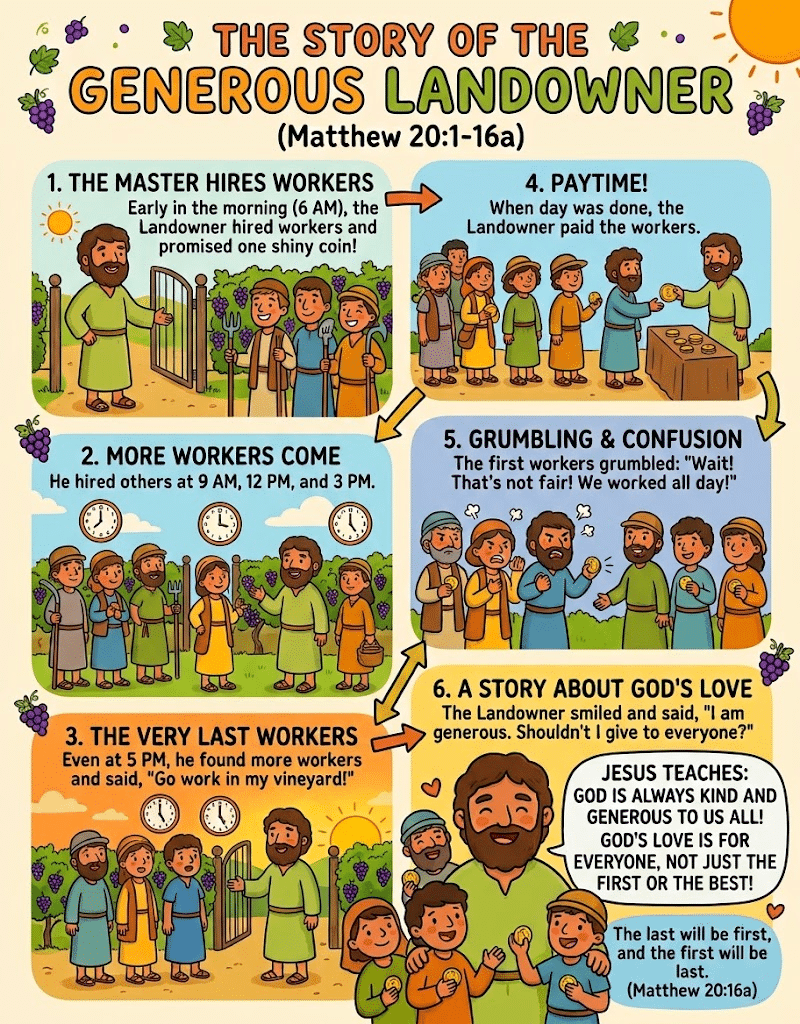
Infographic generated by AI for TWTW website.
Non-profits have permission to use it in their ministry.
Videos for Children
Animated Bible Stories (Saddleback Kids)
Bible Crafts (Ministry to Children)
Object Lesson Sermons (Ministry to Children)
25th Sunday of Year A

LESSON NOTES (PDF)
Life’s Not Fair!
In this message, we will explore the parable of the workers (Matthew 20) and the idea that sometimes things don’t seem fair. However, God’s grace and mercy to us aren’t fair, either! We don’t deserve to benefit from what Jesus did for us, and yet we do, and are welcomed into God’s family. Kids will experience the story in a real life way, and will be reminded that God loves all of us no matter what.


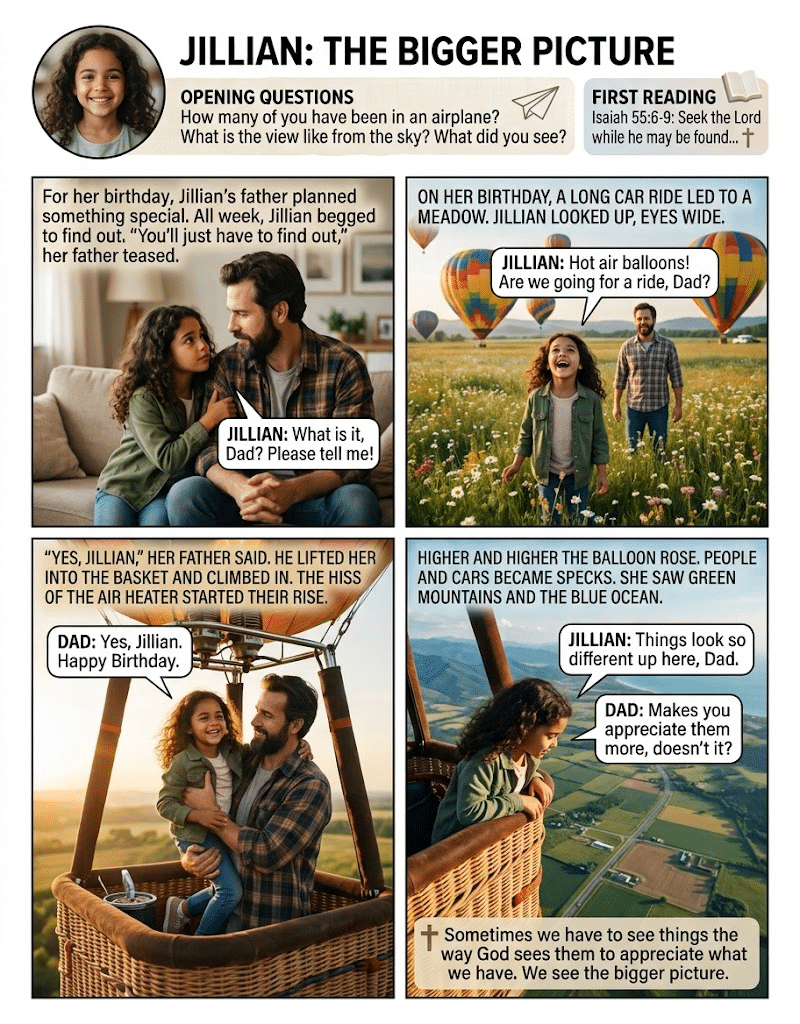
- What surprise did Jillian’s father plan for her birthday?
A: A ride in a hot air balloon. - How did Jillian feel while waiting to find out what her surprise was?
A: She was eager and impatient, asking and begging her father all week long to find out. - What did people and cars look like once the balloon rose high into the sky?
A: They looked like tiny specks far below. - What natural sights could Jillian see from high above in the balloon?
A: Green mountain tops and the blue ocean. - What does Jillian’s father say the high view helps them do?
A: It makes them appreciate things more because they can see everything from a completely different perspective. - How does being in a hot air balloon compare to how God views the world?
A: Up high, you see the entire landscape rather than just what is immediately in front of you. Similarly, God sees the “bigger picture” of our lives and creation, knowing how every part fits together. - How does this story connect to the reading from Isaiah 55:6–9?
A: In Isaiah 55, God reminds us that “as the heavens are higher than the earth, so are my ways higher than your ways.” Just as Jillian had to rise above to understand the full landscape, God’s perspective is far higher and wider than ours. - What should seeing the “bigger picture” inspire us to do?
A: It helps us appreciate what God has created and encourages us to align our hearts and actions with His greater perspective and love. - When is a time you felt worried about a small problem, but later realized it wasn’t as bad when you looked at the bigger picture? (Open-ended for personal sharing or classroom reflection.)
- How can asking God for help change the way you look at a difficult situation with family or friends? (Open-ended to prompt thinking about patience, forgiveness, and seeing others through God’s loving eyes.)
25th Sunday of Year A

DID YOU ENJOY THIS WEEK’S CONTENT?
Share the link below with a friend, teacher, or pastor
to get the latest updates.
https://thewordthisweek.net/?redirect_to=latest&cat=760119222
Spread the word on social media!