Bishop Robert Barron Word on Fire
September 20, 2026


25th Sunday of Year A

Friends for this Twenty-fifth Sunday in Ordinary Time, we hear a story from Jesus that tends to bother everybody: the parable of the laborers in the vineyard. We’re meant to hear our own voices in the complaint of these workers. Dealing with God, we often think things are unfair. Why does he do what he does? I’d like to get at this with a clarification that comes out of the heart of the spiritual tradition: You don’t fall in love with the benefits of God; you fall in love with God.

Follow along using the infographics and transcripts below.

Click Graphic to Enlarge
- Troubling Gospel Parable
- Preaching Ministry Experience
- Parables Doing Work
- Spiritual Surgery Analogy
- Unmasking Soul Resistances
- Examining Personal Discomfort
The Spiritual Scalpel
of Matthew 20
Peace be with you. The parable that is at the heart of our Gospel today from Matthew 20 is one that I love, because based on thirty-seven years of preaching, it is one of those passages in the New Testament that really bothers people. I could pick out a handful, like four or five; the Martha and Mary story is another one. But this is one where, over all the years I have been preaching, more people come up to me and say, “Father or Bishop, I don’t get that parable,” or, “It really bothers me. How could this be right? I don’t know what Jesus is talking about here.”
I love that, because it proves something very interesting: the parable itself is doing its spiritual work. What I mean is, it is not just conveying correct information about God. Some parables teach us truth about God, and that is great. But other ones reach into our souls. They bug us because it is a bit like a surgeon doing exploratory surgery; in this process, he uncovers difficulties in the body. This parable is like that in regard to the soul. It unmasks or sheds light upon certain darknesses in our soul, certain resistances to God. So it is very interesting and important to follow our resistance here. Where is that coming from? How come I don’t like this parable? How come this parable bugs me?

Click Graphic to Enlarge
- Hiring Vineyard Laborers
- Staggered Work Shifts
- Equal Daily Wage
- Early Workers’ Expectations
- Unfairness Complaints Ariseounter
The Parable of the Generous Landowner
Now, this parable is about the kingdom of heaven being like a landowner who went out and hired workers for his vineyard first thing in the morning. He said, “I’ll pay you the daily wage.” They said, “Great.” So they work all day in the hot sun. He goes out at noon, hires others—same deal. He hires others at three, and then finally at the very end of the day, he hires more workers.
Then the time comes for payment. Those hired at the very end of the day, who worked for only an hour, get the daily wage. Naturally, the ones hired earlier think, “Hey, this is great. I’ll be getting more.” But they get the same wage as those hired at five. Even those who were hired at nine and worked all day in the hot sun get the same thing, and they squawk: “Well, this is unfair. It is unjust. These people worked for one hour. I worked for eight hours. Why are we getting paid the same?”

Click Graphic to Enlarge
- Spiritual Life Connection
- Lifelong Faith Versus Deathbed
- The Chicago Hitman
- Public Outrage Reaction
- Saint Dismas Example
- The Good Thief
- Perceived Injustice Dilemma
- The Scalpel Cuts
- Examining Our Resistance
The Scandal of the Eleventh-Hour Convert
Of course, everyone sees the connection to the spiritual life. Let’s say you have been at it your whole life long—honoring God, doing what you are told to do, trying to be a good person, and following the commands of the Church. Suppose there is somebody who, at the very end of life, after living a terrible life of dissolution, violence, and deep sin, repents at the very end. Is it right that they get the same reward as you would get? That you both get to heaven?
I remember hearing this story from an older priest friend of mine. This goes back to the 1930s or ’40s, and there was a notorious gangland hitman in Chicago. I mean, one of the worst people you can imagine, someone whose whole life was dedicated to killing people. He was involved in a shootout, and he was lying in the street dying. He was a Catholic, though, and he had the presence of mind to ask for a priest. The priest came, and with his dying breaths, this man confessed his sins and then died.
The priest was asked about it, and he said, “Well, yes, I am sure he will require purgatory, but this man will go to heaven just as St. Francis of Assisi went to heaven.” Evidently, this older priest friend told me, it caused a real furor in the press, with people writing letters and complaining. How could it be true that this hitman, this terrible person, with just one simple confession, gets the same heaven that St. Francis gets? It doesn’t seem right. It doesn’t seem fair or just.
I’ll give you an example from the Scriptures: How about the good thief, Dismas? In fact, we call him St. Dismas, don’t we? We don’t know anything about him, but his life ends on a Roman cross, accused of thievery. We are not talking about Mother Teresa here; we are talking about someone who probably lived a wicked life. But at the very end, he reaches out to Jesus, and what does he hear? “Today you will be with me in paradise.”
Imagine someone who has been Catholic all their life. They have gone through all kinds of struggles and temptations, but they have hung in there, done the Lord’s work, tried to be good, just, and loving, and struggled through to the end. And they get the same reward as that guy, as Dismas? In fact, St. Dismas? It just doesn’t seem fair. It doesn’t seem just.
Now, this is where the scalpel is cutting. This is where the light is shining. This resistance needs to be looked at, and let me do so now under two different rubrics.

Click Graphic to Enlarge
- Catherine of Siena’s Insight
- Heaven as the Way
- False Reward Mentality
- The “Tough Slog” Error
- Mother Teresa Example
- Love Prepares for Heaven
- Privilege of Divine Life
- Love as Present Anticipation
The Way to Heaven Is Heaven
St. Catherine of Siena said, “Because Jesus said that he himself is the way, then the way to heaven is itself heaven.” Let me say that again. Jesus said, “I am the truth and the life,” but he also said, “I am the way.” That means the way to heaven is itself heaven.
Here is a false way to think about things spiritually: heaven is this great Candyland, this great reward, this great prize that I get after a terrible, tough slog through life. God knows why, but I am asked to do all these really challenging, difficult things—to pray, to sacrifice, and to love, yes, even my enemies. I have tried, and it is just a tough slog with no letting up, meant to go on your whole life long. So I guess after I have paid that terrible price, then I deserve this reward at the end; I deserve the prize of heaven. And someone, therefore, who hasn’t done the work, who hasn’t gone through the long slog, who has lived a self-indulgent life and maybe at the very end does the right thing—he gets the same reward I get? Come on!
Remember Catherine of Siena: “All the way to heaven is heaven.” Let me put it this way: Do you really think that Mother Teresa of Calcutta, now in heaven, confronted there with someone in need and offered the opportunity to love, would say, “No, I am done with that. I did that all my life long on earth. I put up with all these people all my life long, and now I deserve a little R&R. I deserve my nice reward here in heaven”? No! The point is, the way to heaven is heaven, meaning the love she was demonstrating all her life long is precisely what was preparing her for the fullness of life in heaven.
Instead of saying, “I worked in the hot sun all day,” say rather, “I was given the enormous privilege of participating in the divine life all my life long.” Maybe Dismas, the good thief, or that mob hitman didn’t have that grace; they didn’t have that opportunity. This is not some drudgery that we are forced to go through in order to get a reward, but rather, we must see the path of love as itself already an anticipation of heaven.
Click Graphic to Enlarge
- Resentment Reveals Misunderstanding
- Religious Burden Mindset
- Calcutta Motherhouse Scenario
- From Hell to Heaven
- Self-Regard as Hell
- Soul Uneasiness Welcomed
Transcending the Resentment of Self-Regard
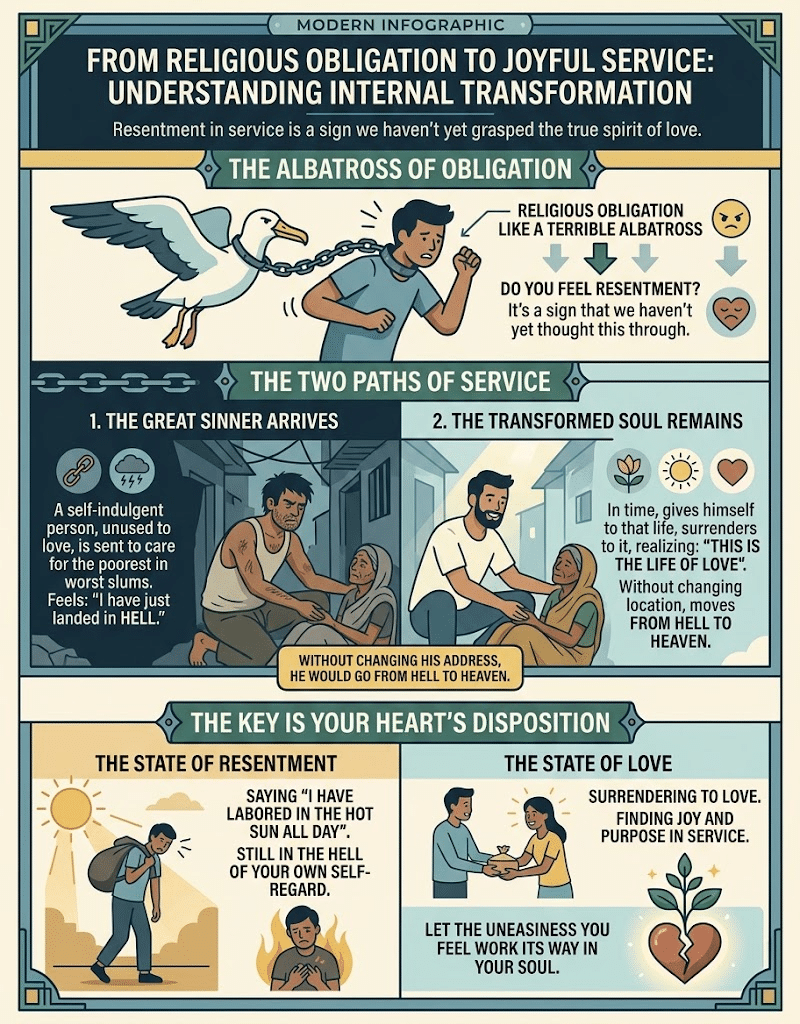
Do you see how the resentment we feel is a sign that we haven’t yet got this right, that we haven’t thought this through? If you are wearing your religious obligation like a terrible albatross around your neck, you haven’t gotten it yet. Think about this—let me turn that Mother Teresa image around.
Suppose somebody who is a great sinner is suddenly sent to Mother Teresa’s motherhouse in Calcutta and told, “I want you to live the life of the sisters for the next year.” He is completely unused to it. He has been a self-indulgent person who never engaged in the works of love, and now here he is in the worst slum in the world, caring for the poorest of the poor. He would say, “I have just landed in hell.” But now imagine that, in time, as he gives himself to that life and surrenders to it, he realizes, “This is the life of love that I have been called to.” Without changing his address, he would go from hell to heaven.
When you say, “I have labored in the hot sun all day,” you are still in the hell of your own self-regard. So let the uneasiness you feel upon hearing this work its way in your soul.
Click Graphic to Enlarge
- Heaven as Perfect Love
- Love Outlasts Faith and Hope
- Willing the Other’s Good
- Resentment Reveals Lack of Love
- Love Surpasses Strict Justice
- Rejoicing in Latecomers’ Salvation
- Beyond Deserving and Fair
- Parable as Spiritual Director
- Exposing Our Loveless Darkness
Love: Willing the Good of the Other
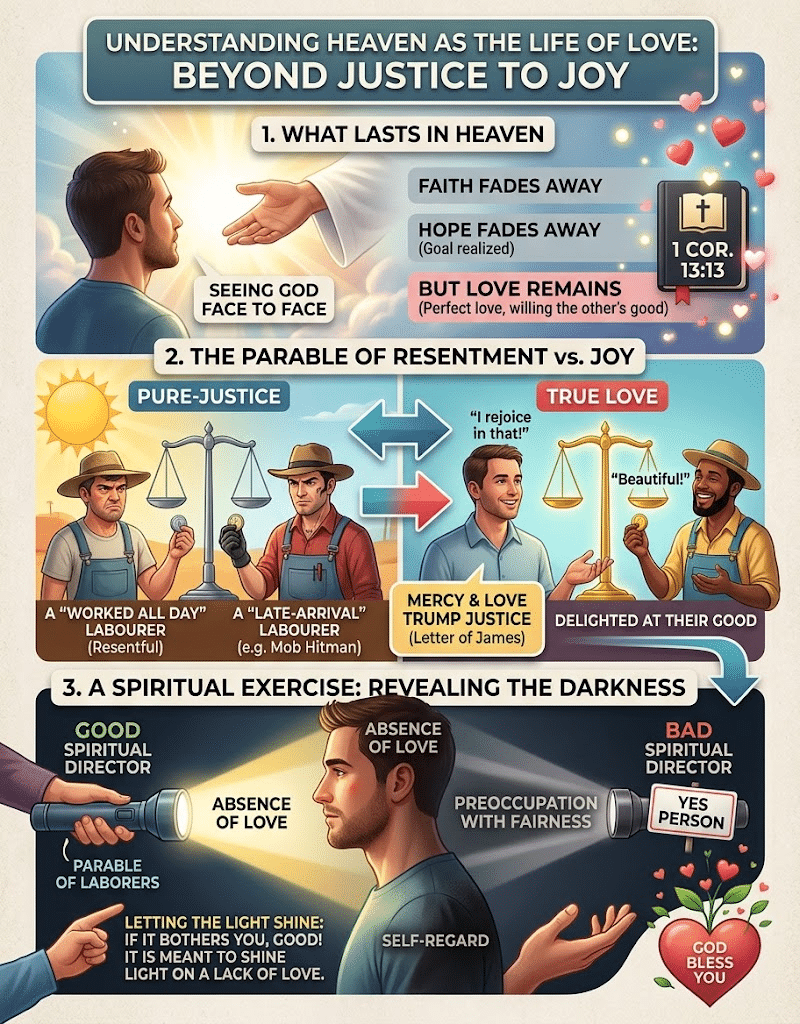
Now here is the second observation I want to make. If heaven is the life of love—and that is how all the great spiritual masters describe it: “There are three things that last: faith, hope, and love, and the greatest of these is love.” That is because in heaven, faith will fade away; I will see God face to face, so I don’t need faith. Hope will fade away because I have realized my goal. But love remains, because love is what heaven is. Heaven is the place of perfect love, and love is willing the good of the other.
Go back to this parable: “You mean that guy who worked for one hour is getting the same reward I am getting? It’s ridiculous. I worked all day in the hot sun; I should get eight times what he got.” What is on display in that attitude? An extraordinary lack of love. To love is to will the good of the other. Notice, please—you find this in the Letter of James—our great tradition has nothing at all against justice, but mercy and love trump justice. Love goes beyond justice. If we are caught in a pure-justice frame of mind, we haven’t moved to the level of true love: willing the good of the other.
Now move into that space. You have labored all day. “Yes, I have been given the opportunity to love all my life long.” But someone who wasn’t given that opportunity, someone like the mob hitman who gets in at the very end? If your heart is filled with willing the good of the other, what is your attitude? Great! Terrific! I am delighted. If someone objects, “Hey, wait a minute, it’s not fair,” you are beyond this preoccupation with fair and unfair. All you want is what is good for the other.
He gets into heaven; he gets to share the life of God. Beautiful. Beautiful! I rejoice in that. Love has burned away any preoccupation with who deserves it more and who worked harder.
Let this parable shine its light upon the darkness in us, which simply means an absence of love. Let our very resistance to it be a spiritual lesson. I have been in spiritual direction since I was a kid in the seminary. A bad spiritual director just says yes to you all the time: “You are doing great. Nothing is wrong with you. Everything is fine.” A good spiritual director shines light in dark places and turns things over to reveal truth that maybe we don’t want revealed. This parable functions as a good spiritual director. If it bothers you, good; it is meant to shine light on a lack of love. And God bless you.
YouTube transcript edited for readability by removing fillers, stumbles, and false starts while strictly preserving the homily’s original cadence and theological accuracy. Infographics and discussion questions are independently produced by TWTW and have no affiliation with Word on Fire.
 Highlight text or double-click a paragraph anywhere on the site to ADD TO NOTES. You can also click ASK AI to copy your selection to the clipboard with a command prompt, ready for you to paste manually into the chat above.