Bishop Robert Barron Word on Fire
September 13, 2026


24th Sunday of Year A

Friends, our Gospel for this Twenty-fourth Sunday in Ordinary Time is the familiar story of Peter asking the Lord how many times he should forgive his brother: “As many as seven times?” Jesus responds, “Not seven times but seventy-seven times.” I want to get at this passage by looking at the second reading, taken from the Letter of Saint Paul to the Romans, which sheds distinctive light on it. When we are clear about our mission—when we know that we belong to the Lord—we can let go of resentments and harms done to us, and get on with the business of our lives!
Click Graphic to Enlarge
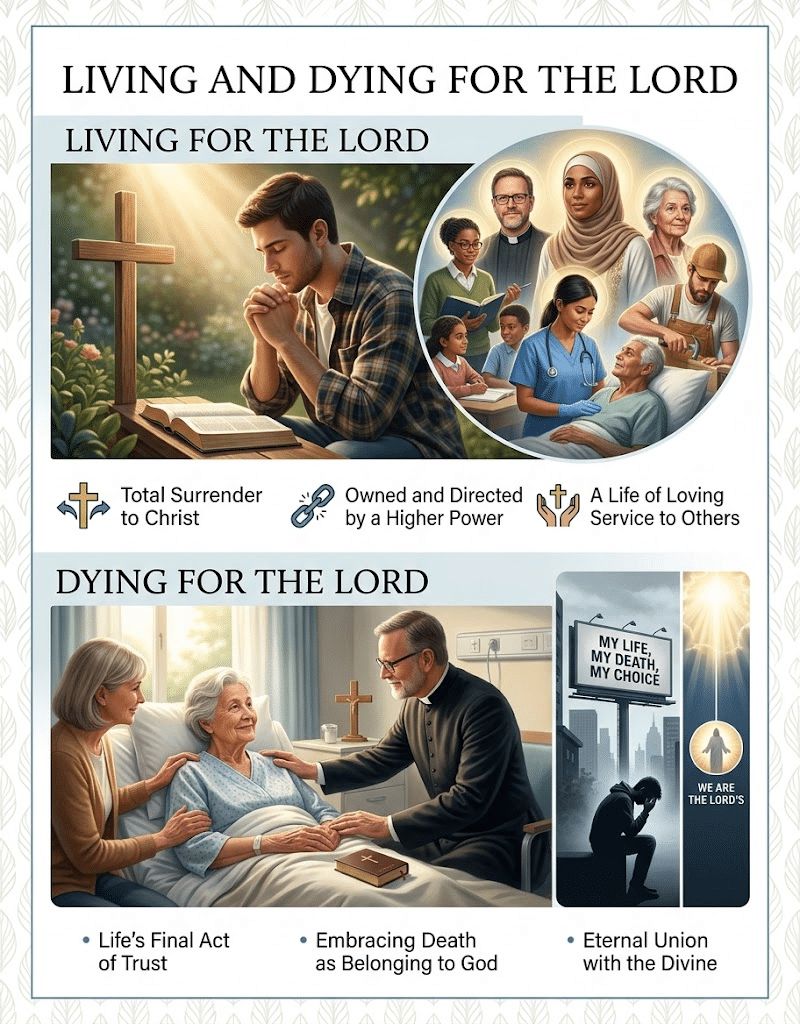
- Call for forgiveness
- Paul’s Letter to Romans
- Life belongs to God
- Modern autonomy challenged
- Total surrender to Christ
Living and Dying
for the Lord
Peace be with you, friends. Our Gospel for this 24th Sunday in Ordinary Time is the familiar story of Peter asking the Lord, “How many times should I forgive my brother? Seven?” The Lord says, “No, not seven, but seventy-seven times”—or “seventy times seven times,” as some translations have it. I will talk about that, but I want to approach it by looking at the second reading, which is from St. Paul. I think it sheds a distinctive light on this familiar Gospel.
Let us start with reading two, which comes from the 14th chapter of Romans. We have been reading from Paul’s greatest letter for the last several weeks. Listen: “None of us lives for oneself, and no one dies for oneself. For if we live, we live for the Lord, and if we die, we die for the Lord; so then, whether we live or die, we are the Lord’s.”
That is a very strong statement. My life, my death, all of it is not mine. It is not about me; it belongs to the Lord. It is my life—I am not denying that—but it belongs to a higher power.
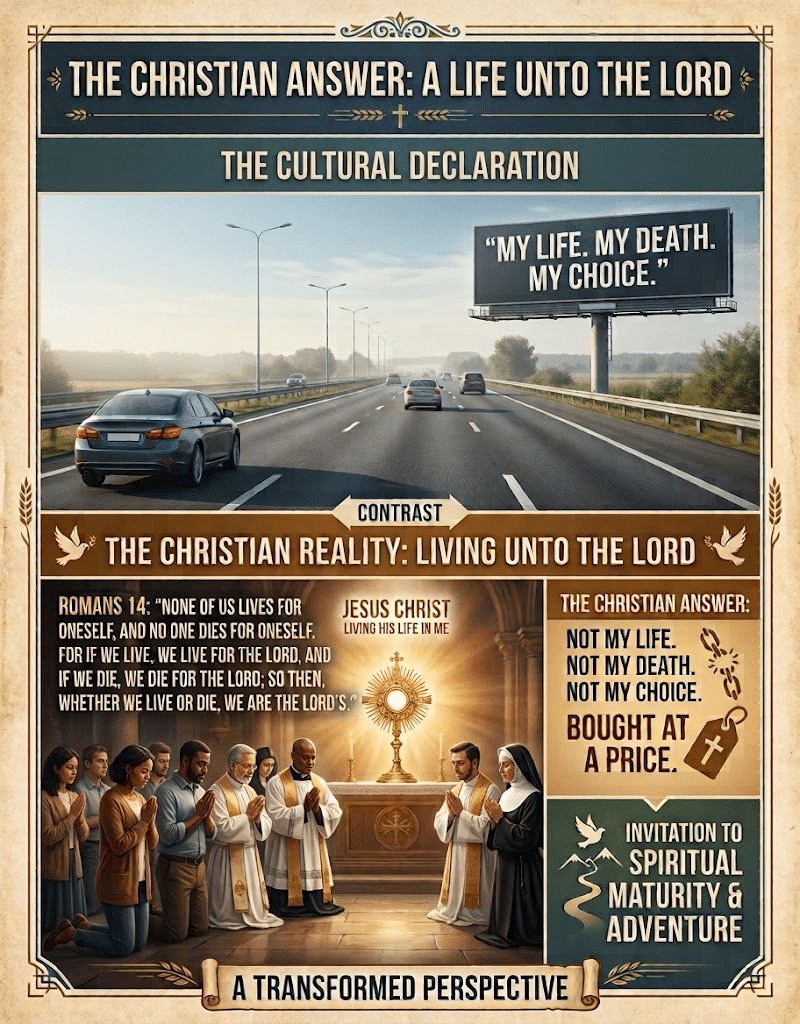
It always stays in my mind when I come across this reading: years ago, when I was in California and they were considering assisted suicide legislation, a billboard touting the proposed law read, “My life, my death, my choice.” I remember thinking it would be hard to find a statement more directly repugnant to Christianity than that, because it directly contradicts what Paul says here. That is the motto of radical modernity, which places massive stress on autonomy: “It’s my life. I decide. I choose. My life, my death, my choice. Don’t tell me what to do.”
Christianity is playing a very different game. Think of Paul saying at the beginning of Romans, “I am a slave of Christ Jesus.” Who wants to be anyone’s slave? Paul knew all about slavery; it was common in his time. Yet he says without hesitation, “I am a slave. I am owned by someone else. I am here to serve not my own purposes, but those of Christ.” Or even more radically: “It is no longer I who live, but Christ who lives in me.” All of these proclaim the same truth: Christian life is about surrendering one’s mind, heart, body, soul, and everything else to the higher power of Christ.
Click Graphic to Enlarge
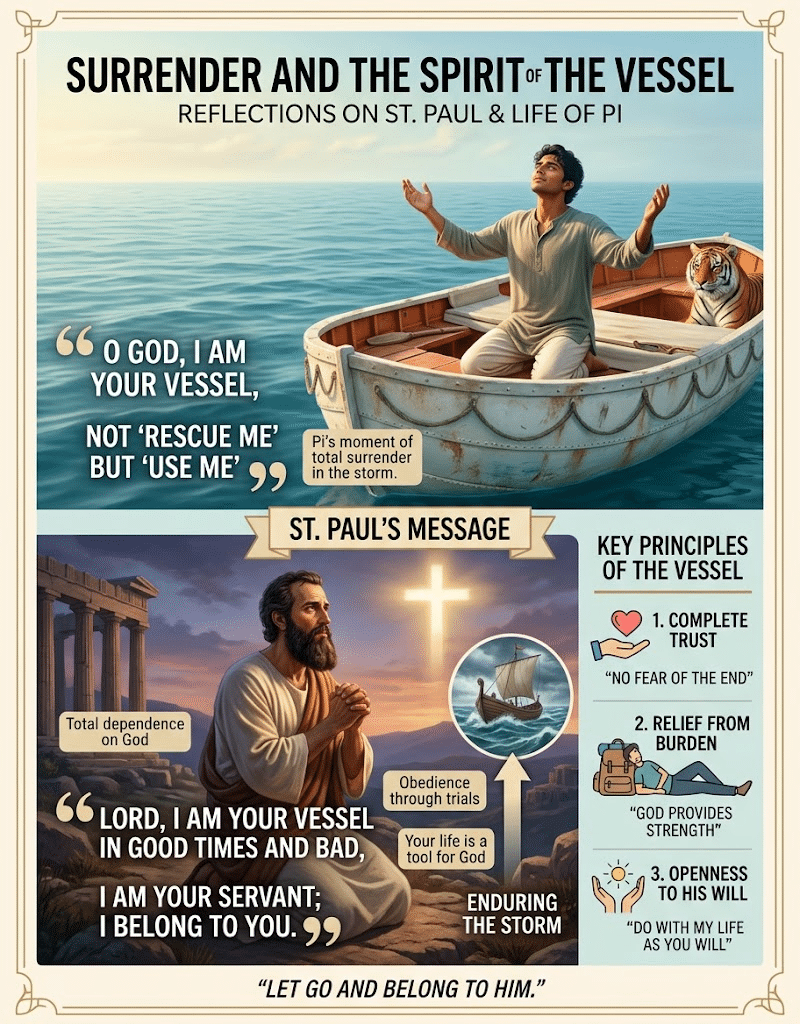
- Life of Pi reflection
- Desperate sea storm
- Surrender replaces rescue
- Praying as a vessel
- Doing God’s will
Surrender and
the Spirit of the Vessel
Just the other day, I was flipping through television channels and came across the film from ten or fifteen years ago called Life of Pi. I remember reading the book and liking it very much, and Ang Lee directed a beautifully composed film. It tells the peculiar story of an Indian boy who survives a terrible shipwreck on a small lifeboat with a Bengal tiger.
Here is the scene that stayed with me: the poor boy, Pi, is at the end of his rope. He has been at sea for several weeks, running low on basic supplies, when a violent storm rocks the boat and fills it with water. Feeling he has reached the very end, he kneels down and utters a prayer. His prayer is not, “Rescue me, God,” or “Send me supplies,” or “Get me out of this.” Instead, he raises his arms and says, “O God, I am your vessel.”
It is a beautiful prayer, completely in the spirit of St. Paul: “Lord, I am your vessel in good times and bad. When things are going great or when I am at the end of my rope, I am your vessel. I am your servant; I belong to you. Do with my life what you will.”

LIFE OF PI (0:20) – Pi prays to God.
Click Graphic to Enlarge
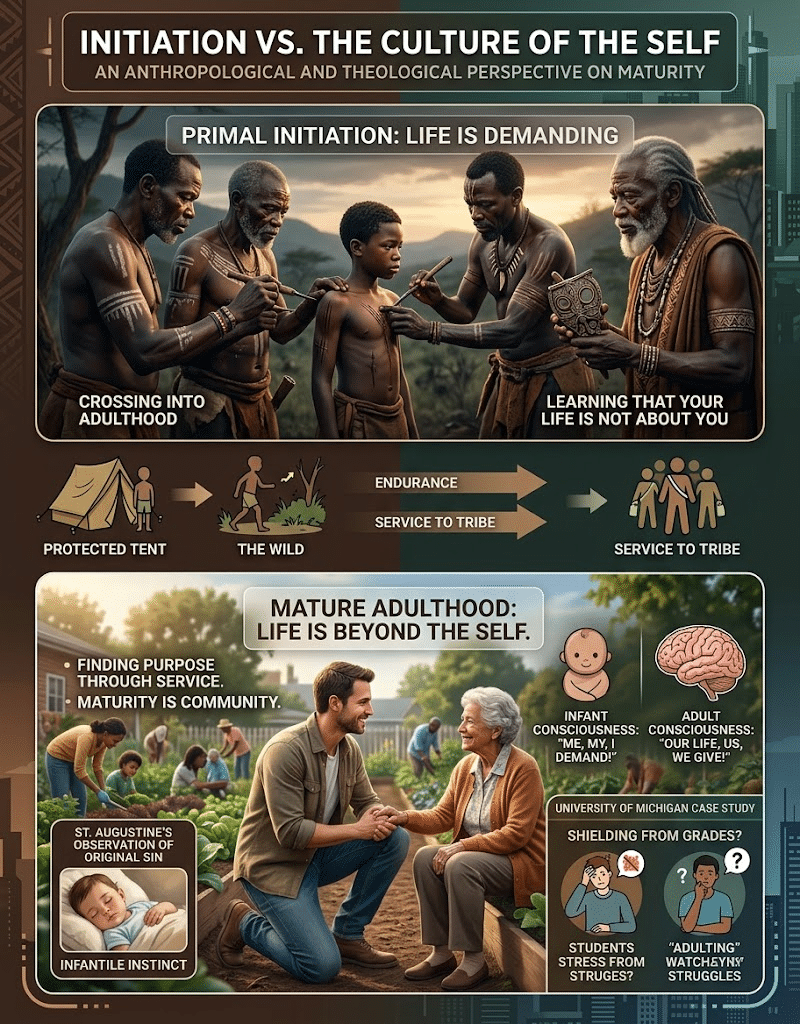
- Ancient tribal rites
- Learning life is hard
- Adult bodies, baby minds
- Augustine on original sin
- Maturing beyond self
The Peril of
the Grown-Up Infant
The problem is that we live in a culture teaching us the exact opposite. Anthropological research into primal initiation rituals shows a consistent pattern across the world. A young boy is torn away from his bed late at night by the men of the tribe. They wound him, scarify him, or knock out a tooth. The lesson is immediate: life is hard. When you are a child, you are the center of attention and all your needs are met. But to grow up, you must learn that life is demanding. The elders then introduce him to the lore and history of the tribe and send him into the wilderness to survive on his own. The point is clear: your life is not about you.
An infant assumes life revolves around itself. But an infant’s consciousness inside an adult body is dangerous. Today, our culture is filled with adult bodies possessing adult powers, yet operating with the minds of infants.
Toward the beginning of the Confessions, St. Augustine expresses zero romanticism about babies. When you look at an infant, Augustine observes original sin. He remarks, essentially: thank God an infant’s limbs are weak, because a baby is purely about “me, mine, give me, I want, I demand.” If a baby had the strapping body of an adult alongside that self-centered mind, imagine the destruction.
We now have a culture full of grown-up babies who were never initiated. They never learned that life is hard, nor did they grasp that life is not about them. They remain stuck in an adolescent phase of total self-regard.
Consider young people struggling with “adulting.” Recently, the University of Michigan addressed what they termed a student mental health crisis in one of their colleges by dropping first-semester grades, arguing that receiving grades is too debilitating and humiliating. Does shielding people from reality solve a mental health crisis, or does it exacerbate it by enabling an infantile consciousness to endure? Mature adulthood begins when a person can finally say, “My life is not about me.”
Click Graphic to Enlarge
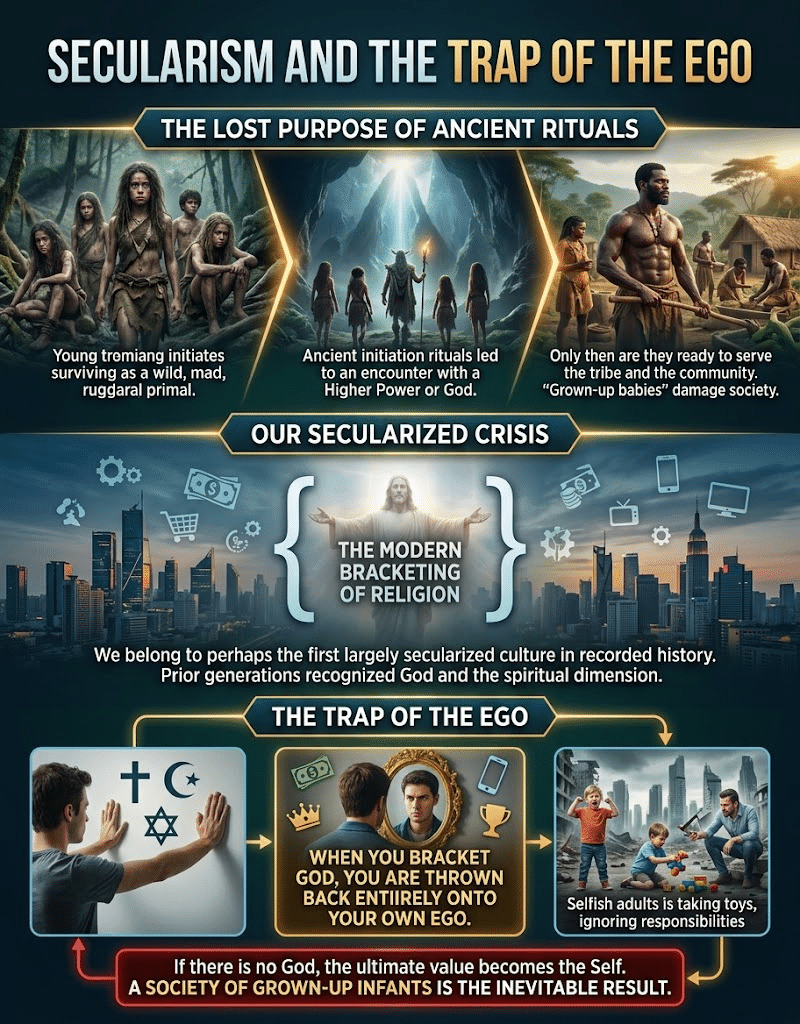
- Wilderness leads to God
- Prepared to serve others
- Largely secular modern world
- God bracketed away
- Self becomes ultimate concern
Secularism and
the Trap of the Ego
If you trace those ancient initiation rituals to their conclusion, their ultimate purpose is religious. After surviving in the wilderness, the initiates are led to encounter a higher power—to encounter God. Only then are they ready to serve the tribe and the community. Grown-up babies cannot serve the community; they only damage it.
There is a direct correlation between this crisis and the modern bracketing of religion. We belong to perhaps the first largely secularized culture in recorded history. Prior generations, across all civilizations, recognized God, the divine realm, or the spiritual dimension.
When you bracket God, you are thrown back entirely onto your own ego. If there is no God, the ultimate value becomes the self. When the self is the ultimate concern, a society of grown-up infants is the inevitable result.

Click Graphic to Enlarge
- Pride prevents forgiving
- Resentment paralyzes mission
- Life is not ours
- Fury crew unites
- Forgive seventy-seven times
Forgiveness as
Freedom for Mission
This brings us directly to the Gospel. Peter asks Jesus, “Lord, if my brother sins against me, how often must I forgive? As many as seven times?” Jesus answers, “I say to you, not seven times, but seventy-seven times.”
What prevents us from forgiving others? Intense self-regard. When we nurse a grievance—”I was wounded, you hurt me, and I refuse to move past it until you apologize”—we become paralyzed by wounded pride. When we refuse to forgive those who harm us, we cannot carry out our mission. We remain trapped, staring at one another in resentment rather than looking together toward God and His purposes. The inability to forgive is a symptom of an infantile consciousness that suffocates our vocation.
Conversely, when you understand that your life is not about you, and you are aligned with God’s purpose, you can release injuries. You forgive because you have more important work to do: the will of God.
This dynamic is captured well in the war film Fury, starring Brad Pitt and Shia LaBeouf. It follows a battle-worn tank crew toward the end of the Second World War. Throughout the story, the men are at each other’s throats, bitter and resentful. Near the end, their tank breaks down at a critical crossroads. Faced with an overwhelming enemy force, the commander decides to hold the line, and one by one, the crew chooses to stand with him. United by a shared mission, their petty grievances vanish. They forgive one another and fight as one because they are committed to something larger than themselves.
When you are clear on your mission, you realize your life is not about you. Whether you live or die, you belong to the Lord. That realization frees you to let go of bitterness and forgive seventy-seven times. Christ calls us beyond our self-absorbed, infantile egos so that we may be liberated for His mission. If you feel trapped in resentment today, remember: your life is not about you. You belong to the Lord.

FURY (6:51) – The ultimate test of loyalty. As the enemy approaches and all hope seems lost, Wardaddy (Brad Pitt) and his crew make a final, heroic stand inside their disabled tank, choosing to fight together until the very end.
Click Graphic to Enlarge
- Euthanasia Billboard Encounter
- Modern Culture Captured
- Romans 14 Contrast
- The Christian Rebuttal
- True Spiritual Maturity
The Christian Alternative to Autonomous Culture
I will close with this. When I was out in California during a debate over euthanasia, I saw a large billboard along the highway that read: “My life. My death. My choice.” That captures our modern culture.
Consider how tiny that spiritual space is, and how repugnant it is to what we hear in Romans 14: “None of us lives for oneself, and no one dies for oneself. For if we live, we live for the Lord, and if we die, we die for the Lord; so then, whether we live or die, we are the Lord’s.”
What is the Christian answer to that billboard? It is not my life. It is not my death. It is not my choice. I have been bought at a price, and I belong to a higher power: Jesus Christ living His life in me. That is the true invitation to spiritual maturity and spiritual adventure.
God bless you.
YouTube transcript edited for readability by removing fillers, stumbles, and false starts while strictly preserving the homily’s original cadence and theological accuracy. Infographics and discussion questions are independently produced by TWTW and have no affiliation with Word on Fire.

Follow along using the infographics and transcripts below.
Click Graphic to Enlarge
- Romans 14 Introduction
- Belonging to God
- Core Biblical Message
- Christ Within Us
- Bought at Price
Belonging to the Lord: The Heart of Revelation
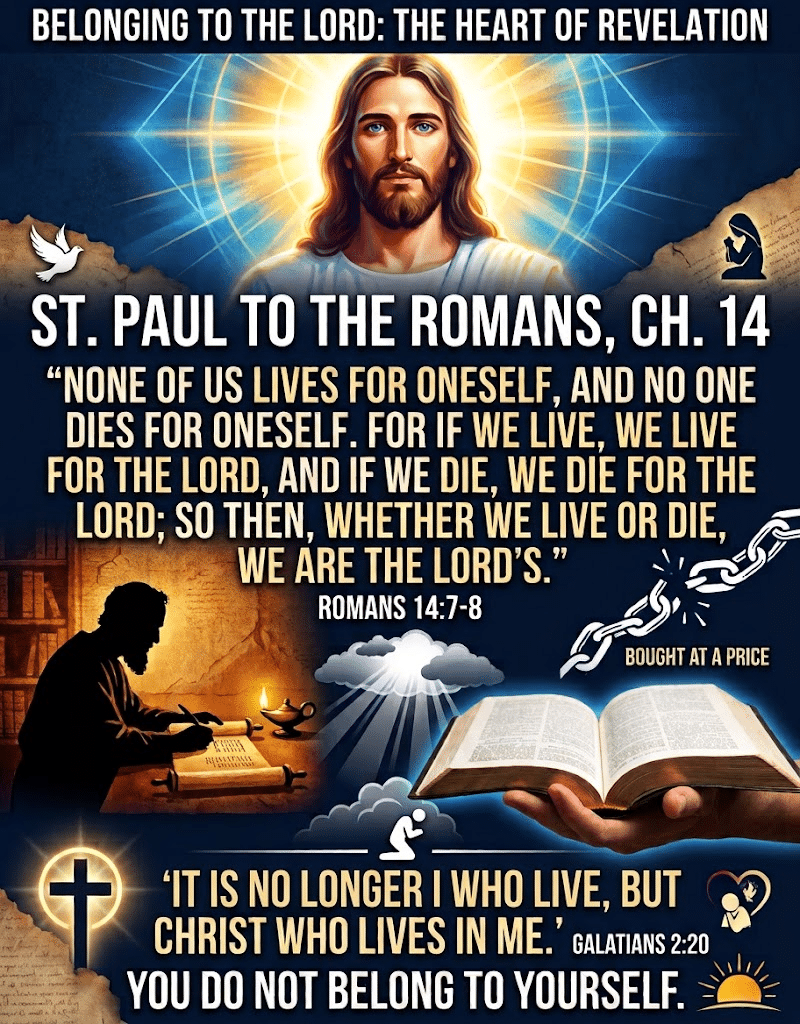
Peace be with you. Friends, last week I spoke about Paul to the Romans, this great text, this marvelous text by the first great theologian of the Church. Today we are reading from the very end of Romans, Romans 14. I wonder if you could put this statement up wherever you would see it—on your refrigerator, on your computer screen? Listen: “None of us lives for oneself, and no one dies for oneself. For if we live, we live for the Lord, and if we die, we die for the Lord; so then, whether we live or die, we are the Lord’s.”
I think, in many ways, the whole Bible—the whole of revelation—is summed up in this statement: “None of us lives for oneself.” When I spoke about justification last week, I referred to that line from Paul: “It is no longer I who live, but Christ who lives in me.” It is not the old self that lived for itself. That is gone; Paul considers that rubbish. It is Christ who lives in me. I belong to somebody else. It is not my mind and its prerogatives, my will and its desires, my inclinations that matter. It is what Christ is thinking, willing, and acting in me. I am not my own, and Paul says that too: “You have been bought at a price.” You do not belong to yourself.
Click Graphic to Enlarge
- Cultural Individualism Conflict
- Self-Determination Message
- Biblical Metanoia Call
- Belonging to Another
The Cultural Myth of Self-Ownership and the Call to Metanoia
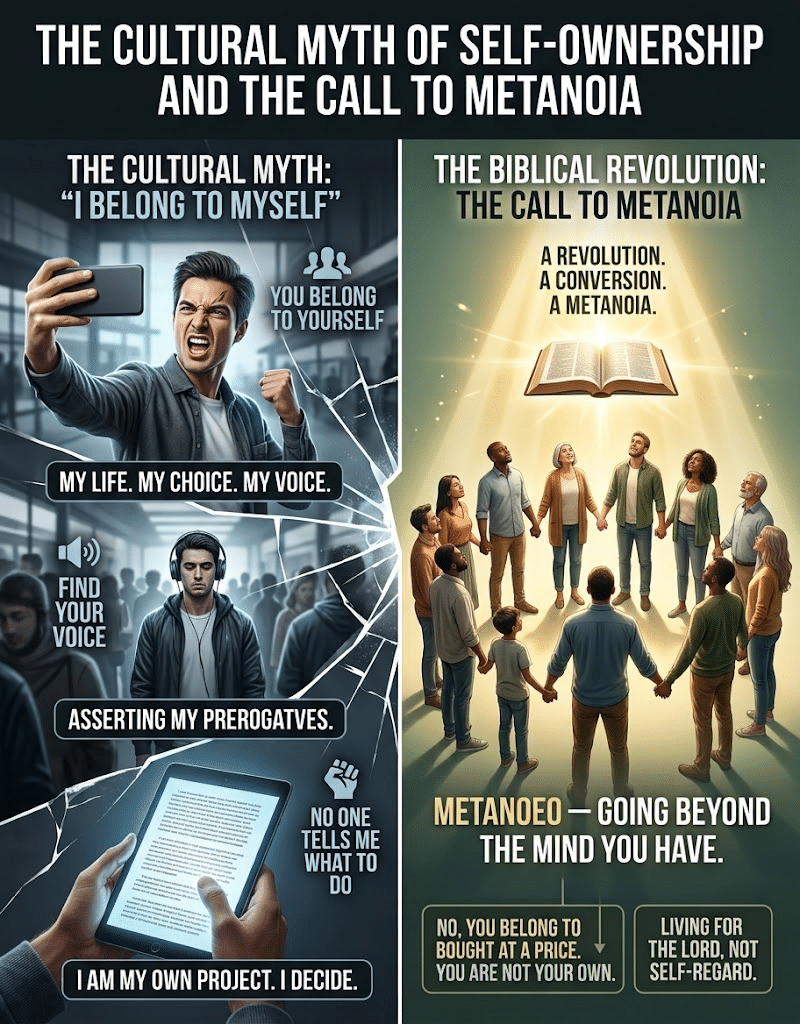
Now, the reason I say this is so important for us is: can you see how everything in our culture militates against this? I think that is why Christianity is struggling in our world today. We say the opposite: “No, no, it is your life. You decide; you choose. It is all about finding your voice, asserting your prerogatives.” Everywhere you listen and everywhere you look in the culture, you find the same message: you belong to yourself, and you have had it with other people telling you what to do.
The Bible, however, is calling for a revolution, a conversion, a metanoia. That is the word we find in the New Testament, metanoeo—going beyond the mind you have. The mind we have now in our culture is clearly: “I belong to myself. I am my own project.” No, you belong to another.
Click Graphic to Enlarge
- Primal Initiation Rituals
- Stripping the Ego
- The Wilderness Ordeal
- Rohr’s Five Principles
- Our Natural Resistance
Rites of Passage: Stripping the Child of Self-Regard
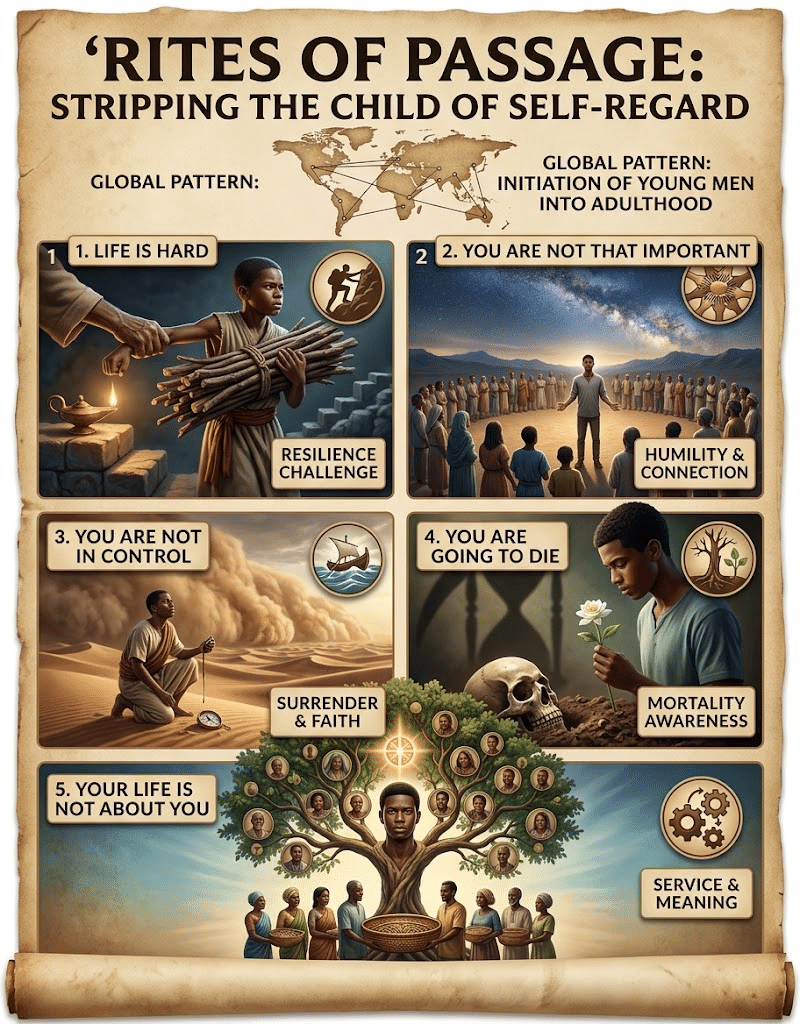
I might have referenced this before with you, but Richard Rohr has done work on the initiation rituals of primal peoples, and I find it very illuminating. Across cultures and around the world, there is a similarity in the way young men especially are initiated into manhood and adulthood. It always involves a kind of stripping away of the self-regarding child and moving that child into the far greater space of powers that transcend him.
Typically, a young man is ripped away from his home—perhaps in the middle of the night, taken out of his sleep. He is scarified in some way: a tooth is knocked out, or his face is scarred. He is physically marked. He is initiated into the lore and history of the tribe. Then, in a culminating moment, he is brought out into nature—whether it is the tundra or the jungle, depending on the geography—and told to survive. He has to make his way. Only having survived this natural challenge, coming into contact with the power of God, is he to return to the tribe and function as an adult.
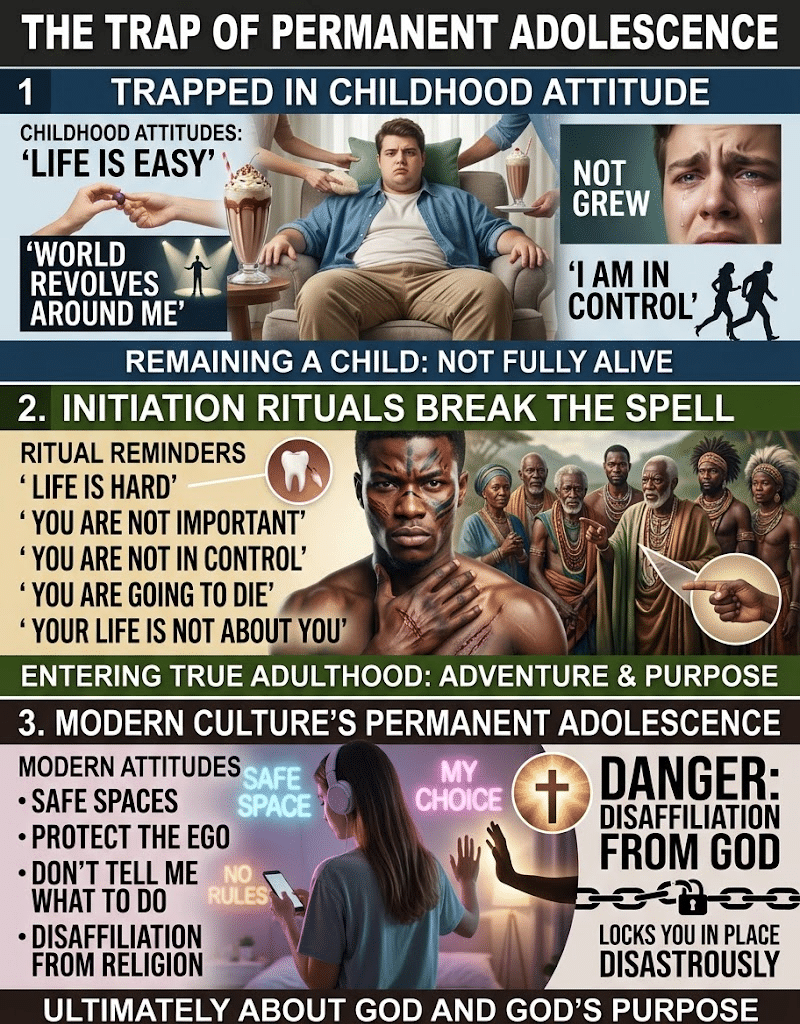
Rohr sums this up—and I want to juxtapose it to Paul’s observation—in these principles: “The initiation ritual is meant to tell the young man, first, life is hard. Secondly, you are not that important. Thirdly, you are not in control. Fourthly, you are going to die. And finally, your life is not about you.” Each one of those, even as I say them—and I have said them before—strikes a chord of resistance in me, and I bet you have the same experience.
Click Graphic to Enlarge
- Childhood Ego Mindset
- Breaking Self-Absorption
- The Ritual’s Purpose
- Higher Belonging Awakened
- Cultural Permanent Adolescence
- Spiritual Disaffiliation Danger
The Trap of Permanent Adolescence
Think of this now in comparison to the attitude of a child. “Life is hard.” Well, not for a child; life is easy. He is being taken care of. People are bringing him food, sheltering him, and keeping him warm or cool. “You are not that important.” A child thinks he is very important; he is the center of his parents’ attention, and the world seems to revolve around him and his needs. “You are not in control.” A child can cry, make a funny face, or smile, and parents bring him what he wants; he seems very much in control. “You are going to die.” A little child is probably not even aware of the fact of death. “Your life is not about you.” Tell that to a child! His life is all about him, meeting his needs and desires.
The very point of initiation rituals is to shake us out of that consciousness. As long as you live in that little world, you will not be fully alive; you will be permanently a child, or at best an adolescent. You will never enter into the adventure of being a true human being because you will remain in the small, well-lighted space of your own self-regard. How dull that is for an adult. That is why the initiation ritual performs this painful work. The scarification or the knocking out of a tooth serves as a permanent, bodily reminder that life is hard, you are going to die, and your life is not about you. Rather, it is about the family and tribe to which you belong, the natural world of which you are a small part, and ultimately about God and God’s great purpose for you.
Our culture right now is stuck in a kind of permanent adolescence: excessive self-regard, self-justification, safe spaces, protecting the ego, asserting “don’t tell me what to think or do,” and disaffiliating from the churches. I know everyone is full of righteous indignation about corruption in the Church, and God knows that has existed from the beginning. But spiritually speaking, it is very dangerous to disaffiliate from this transcendent source of meaning. Nothing will lock you into place more disastrously than a disaffiliation from God.
Click Graphic to Enlarge
- Treasure in Field
- Moral Purpose Awakened
- Hero Journey Pattern
- Serving Higher Goods
- Societal Breakdown Roots
- Cross Over Comfort
- Spiritual Adventure Call
The Heroic Path of Self-Transcendence
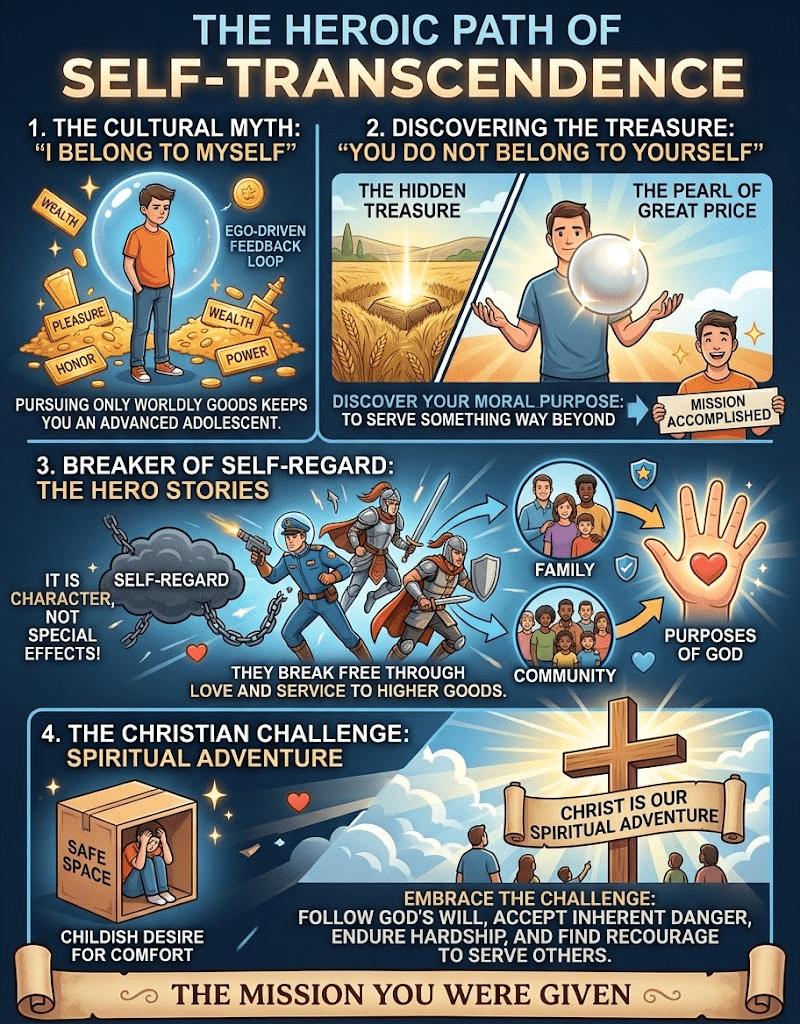
One way to look at this is as the treasure buried in the field that Paul speaks of: discovering that you do not belong to yourself. When you discover your moral purpose—that you are here to serve something way beyond your little ego and its needs—that is when you come to life. That is why you sell everything you have to buy that field. That is the pearl of great price. You think you will find fulfillment in the worldly goods that serve the ego—wealth, pleasure, honor, and power—but pursuing only those keeps you an advanced adolescent serving adolescent ends.
Think of all the hero stories we love in popular culture. Setting aside the special effects and computer graphics, what do those stories hinge upon? They are about a self-regarding person living in a small spiritual space who breaks free precisely through love and service to higher goods and powers. Only when you break out of self-regard to serve your family, community, wider society, or the purposes of God do you become a hero who can truly help others.
The permanent adolescence of our society is causing immense breakdown because people caught in an ego-driven feedback loop fail to accomplish the mission they were given. Safe spaces represent a childish desire for comfort. While basic psychological safety is necessary, a religion that places before our eyes Someone nailed to a cross does not put a premium on mere safety. We place a premium on spiritual adventure: following God’s will, embracing the inherent danger, requiring real courage, enduring hardship, and accepting that life is not about ourselves.
Click Graphic to Enlarge
- Euthanasia Billboard Encounter
- Modern Culture Captured
- Romans 14 Contrast
- The Christian Rebuttal
- True Spiritual Maturity
The Christian Alternative to Autonomous Culture
I will close with this. When I was out in California during a debate over euthanasia, I saw a large billboard along the highway that read: “My life. My death. My choice.” That captures our modern culture.
Consider how tiny that spiritual space is, and how repugnant it is to what we hear in Romans 14: “None of us lives for oneself, and no one dies for oneself. For if we live, we live for the Lord, and if we die, we die for the Lord; so then, whether we live or die, we are the Lord’s.”
What is the Christian answer to that billboard? It is not my life. It is not my death. It is not my choice. I have been bought at a price, and I belong to a higher power: Jesus Christ living His life in me. That is the true invitation to spiritual maturity and spiritual adventure.
God bless you.
YouTube transcript edited for readability by removing fillers, stumbles, and false starts while strictly preserving the homily’s original cadence and theological accuracy. Infographics and discussion questions are independently produced by TWTW and have no affiliation with Word on Fire.
 Highlight text or double-click a paragraph anywhere on the site to ADD TO NOTES. You can also click ASK AI to copy your selection to the clipboard with a command prompt, ready for you to paste manually into the chat above.