Bishop Robert Barron Word on Fire
September 6, 2026


23rd Sunday of Year A
Friends, for the wokeist philosophy that dominates today, empathy—feeling the feelings of the other and not harming those feelings—is treated as a supreme value. But while empathy is perfectly good and decent, the Bible teaches that love, not empathy, is the supreme value. And love does not mean, primarily, feeling the feelings of the other or not hurting those feelings; it means willing the good of the other—and that can be, as Dostoevsky said, “a harsh and dreadful thing.”

Follow along using the infographics and transcripts below.
Click Graphic to Enlarge
The Reformation Debate and Today’s Second Reading
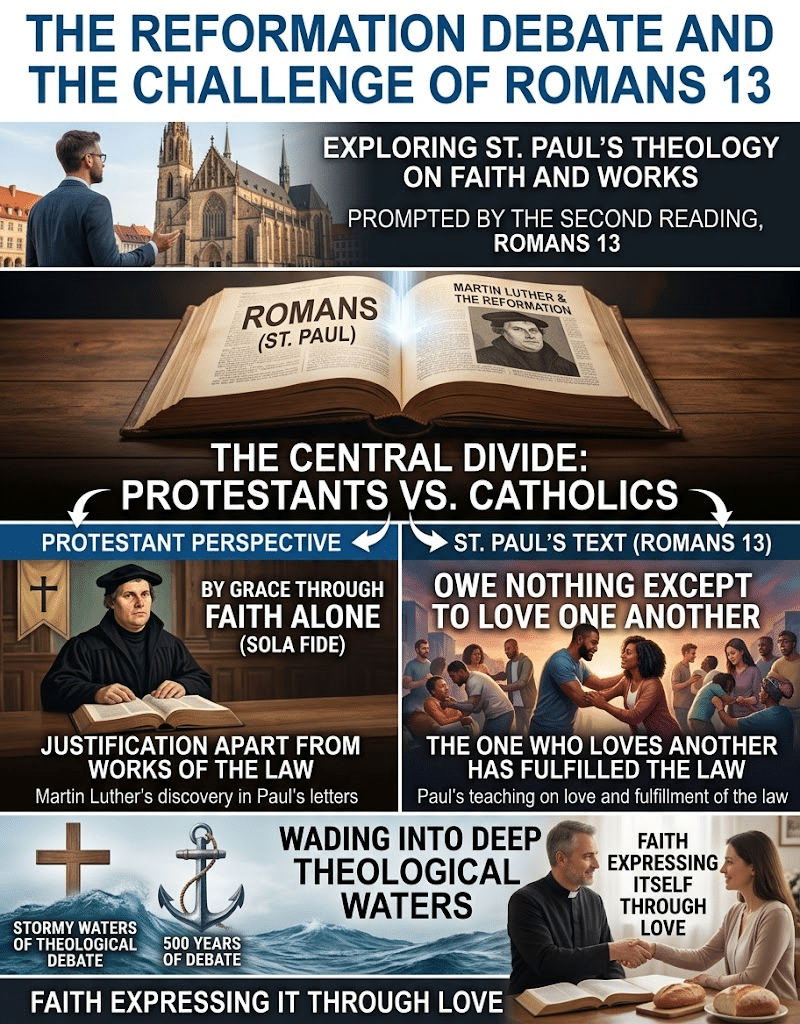
Peace be with you. They say, “Fools rush in where angels fear to tread.” Well, I’m going to rush today into some stormy waters by looking at what really was the central issue of the Protestant Reformation: the divide between Protestants and Catholics around this issue of faith and works, or faith and the law. It’s prompted by our second reading. I’ve been focusing on Romans—we’ve been reading from it the last several weeks—and it’s Paul’s greatest statement of his theology. It’s the first theologian of the Church, Paul, in his greatest statement of the Christian faith. Toward the end of the letter, in Romans 13, here is what he says: “Brothers and sisters: Owe nothing to anyone, except to love one another; for the one who loves another has fulfilled the law.”
“The one who loves another has fulfilled the law.” Now let’s go back to the beginning of the Protestant Reformation when Martin Luther famously says what he discovered in Paul, and in texts like Romans, Galatians, Ephesians, and others, is that it seems we are justified or saved—set right—not by works of the law, but by faith. So Luther says, “By grace through faith,” and he intensifies it by saying, “Gratia sola, fide sola”—by grace alone, by faith alone we are saved, and not by the works of the law. So how come at the end of Romans, the same Paul who said that toward the beginning talks about love as the fulfillment of the law? Well, again, I’m wading into these stormy waters. We’ve been debating this for five hundred years, and I’m under no illusion that in twelve minutes I’m going to solve this problem.

Click Graphic to Enlarge
The Complex Witness of the New Testament
Let me say this now, speaking as a Catholic theologian. Yes, we can find those texts in Paul indeed that seem to indicate we are justified by faith and by grace alone, not by works. However, in the same St. Paul we find texts such as this one today. We find a text such as, “If you have faith enough to move mountains, but have not love, you are nothing.” I don’t know about you, but to me that doesn’t sound like I’m justified by faith alone. Paul sings the praises of faith, but if I have faith enough to move mountains but have not love, I am nothing. The same Paul talks about “working out our salvation with fear and trembling.” Well, you’d wonder on purely Protestant grounds: if you’ve been justified by grace through faith and you’ve accepted the Lord as your Savior, what do you have to work out, and why would you do so with fear and trembling? Wouldn’t you have complete, utter confidence that you’re saved?
Think too of a text like Matthew 25—go outside of St. Paul. When the Judge at the end of time separates the sheep from the goats, the basis of the separation is not, “Oh well, some had faith and others didn’t.” Rather, it is: “Whatsoever you did to the least of my brothers, you did to me.” It seems as though love is the criterion rather than faith. Now my point here is not to undermine those texts where Paul talks about the primacy of faith, but it is to complicate the matter—it is to say the witness of the New Testament is richly complex.
Click Graphic to Enlarge
Distinguishing Ceremonial Precepts from Moral Law
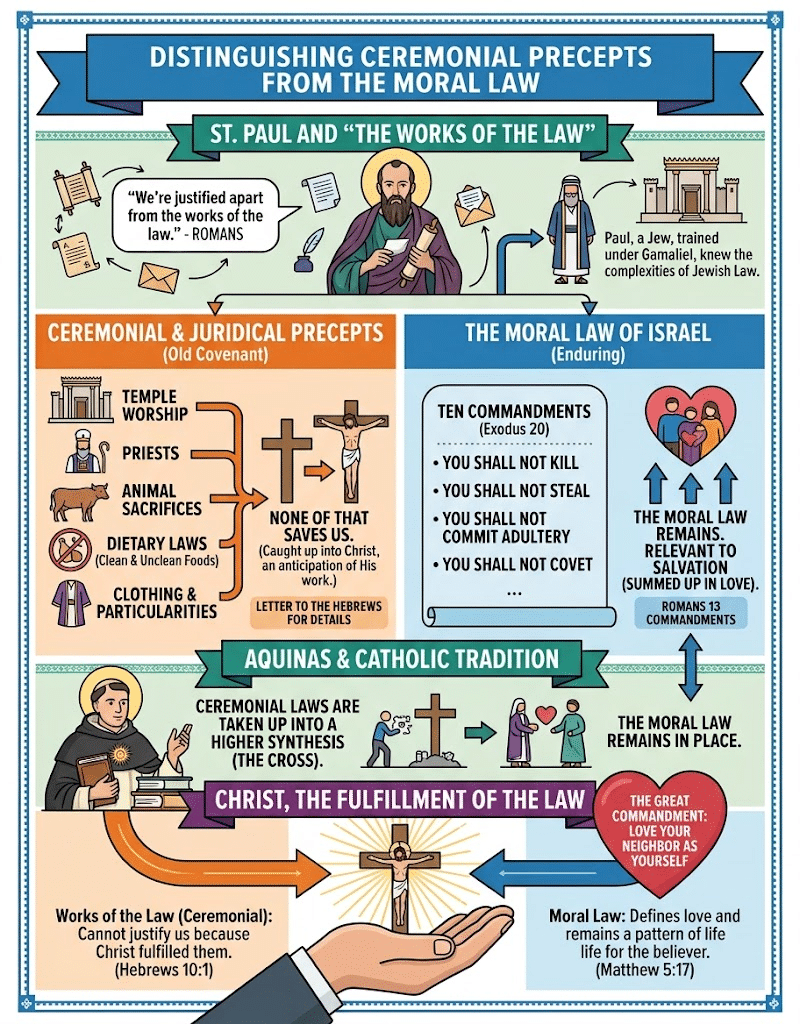
How would I get at it? I think something like this: “We’re justified apart from the works of the law.” What does Paul mean by the law? Now, Paul is a Jew, trained in the great Israelite tradition at the feet of Gamaliel. He would’ve known all about the complexities of Jewish law. He would’ve known all about temple worship—what Aquinas calls the ceremonial and juridical precepts of the law. Think here of temple sacrifice, of priests, of dietary laws, and of all the particularities by which Israelite life is defined in terms of clothing, diet, worship, and so on.
None of that saves us. How come? Not because it’s bad in itself, but because now it’s been caught up into Christ. All of that is now seen as an anticipation of what happened through the cross of Jesus. So we’re not saved by those works of the law because Christ, in his dying and rising, has taken all that up into himself. Read the Letter to the Hebrews for all the details on that point.
It seems clear in Paul that he means we are not saved by those works. But how about the moral law of Israel? Aquinas would speak for the mainstream of the Catholic tradition in saying that even though those other laws have been taken up into a higher synthesis, the moral law taught to Israel remains, and it is indeed relevant to our salvation. Look at Paul again here in Romans 13 as he goes on: “The commandments, ‘You shall not commit adultery; you shall not kill; you shall not steal; you shall not covet,’ and whatever other commandment there may be, are summed up in this saying, ‘You shall love your neighbor as yourself.’” Notice, please: he is not talking about the ceremonial, dietary, or juridical precepts of ancient Israel. We know that those are not relevant now to our salvation. He is talking indeed about the moral law, which remains in place. What he is saying here is all of that moral law is summed up in the great commandment to love.

Click Graphic to Enlarge
Faith Expressing Itself in Love vs. Pelagianism
Now let’s go back to another Pauline text that Catholic theology has insisted upon. Paul in fact never says that we are justified by faith alone. In fact, the only time that phrase is mentioned in the New Testament is in the Letter of James, and it is explicitly condemned. What does Paul in fact say? What matters, he says, is “faith expressing itself in love.” That is the best summary of the complexity of Paul’s position.
Now let me put some more meat on the bones. A Protestant might say, “Well look, aren’t you defending some kind of Pelagianism here—that we’re justified by our works, that it’s because of our heroic works that we’re saved?” No, there is no salvation apart from Christ. There is no salvation apart from his grace. I cannot earn my way into the love of Christ. Rather, that love expressed in the cross and the Resurrection—that grace—is offered to me as a free gift. It is only by moving into the space of that grace that I can be saved.
So no Catholic defends that I can be justified apart from faith. The Council of Trent says that “faith is the beginning and root of all justification.” I cannot be justified apart from Christ.
Click Graphic to Enlarge
Justification as Real Transformation, Not Mere Imputation
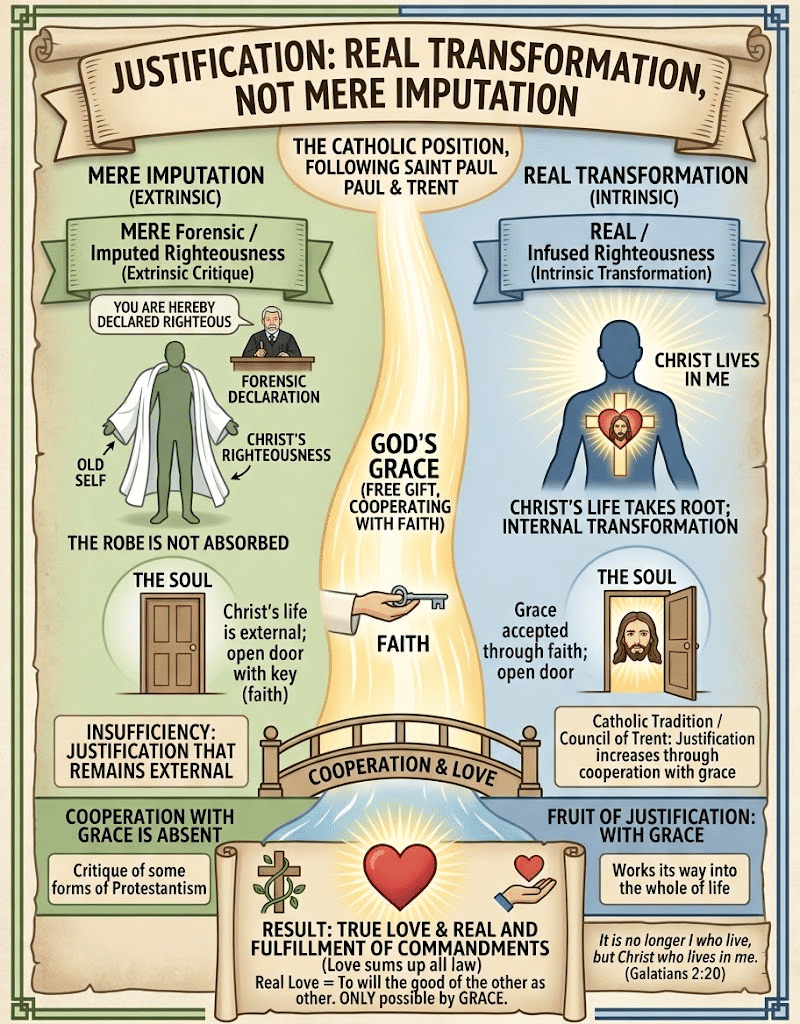
Once drawn into the power of Christ, I have through faith opened the door and invited Christ into my life. Now his life is not extrinsic to me. This, again, would be a Catholic critique of some forms of Protestantism: that justification remains extrinsic to me, a mere forensic declaration of righteousness, an imputed righteousness, rather than a real righteousness. The Catholic tradition, following the complexity of Paul, has insisted: no, justification now, through my cooperation, works its way into the whole of my life. Again, the Council of Trent says justification that begins through faith increases through one’s cooperation with grace.
Paul says, “It is no longer I who live, it is Christ who lives in me.” That is the whole picture right there. It is no longer I—this old self predicated upon self-protection, hatred, and violence. That old self has been put away by grace accepted in faith. It is no longer I who live, but Christ who truly lives in me. What does that look like? It looks like love; it expresses itself as love.
The commandments—do not commit adultery, do not kill, do not steal, do not covet—are all summed up by saying, “You shall love your neighbor as yourself.” You might say, “Well, all right, aren’t we back to Pelagianism? It’s by love that we’re saved.” Love is not a feeling, not just benevolence, not just a sentiment. To love is to will the good of the other as other. Can you do that apart from grace? I think the answer is no. Ancient moral philosophers talked about decency, magnanimity, and generosity, but willing the good of the other as other—this ecstatic moving outside of the confines of one’s ego, even to the point of death—you don’t find that in the ancient moral philosophers.
What makes real love possible? Grace. It is only when I, through faith, open the door to Christ and allow him to begin living in me that I begin to live according to his mind. Remember, Paul says, “May that same mind be in you that was in Christ Jesus.” I begin to will with his will; I begin to move, act, and react according to him. This is not just Christ as a moral exemplar; it is Christ living in me. This has happened not by my accomplishment, but by grace accepted in faith. To that degree, Luther is right. But this is not a mere imputed or forensic righteousness, but rather it has taken root in me and, through my cooperation, expresses itself as something entirely new and strange: it expresses itself as love.
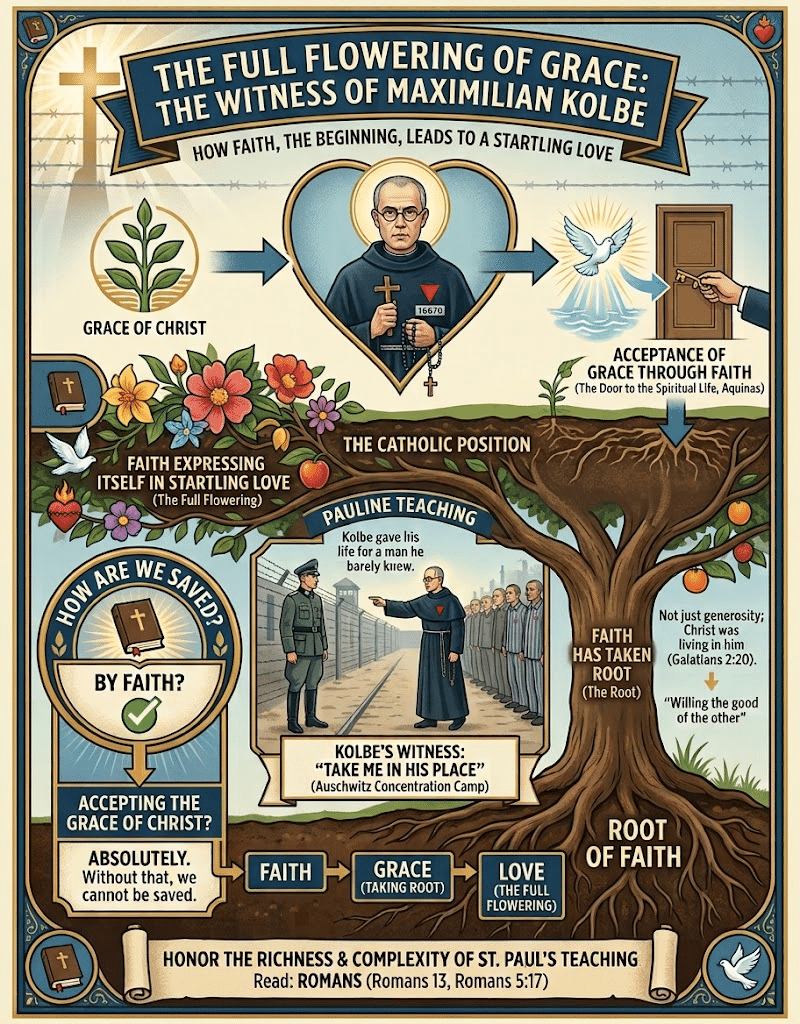
Click Graphic to Enlarge
The Full Flowering of Grace: The Witness of Maximilian Kolbe
I often go back to the great example of Maximilian Kolbe when I think about this. Kolbe gave his life for a man he barely knew, a fellow inmate in the prison at Auschwitz. At the moment of truth, Kolbe said, “Take me in his place.” How do you explain that? Saying, “Oh, he was being very generous,” doesn’t come close to explaining it. You explain it by saying it was no longer Kolbe who lived, but Christ who was living in him. Kolbe had accepted Christ and his grace through faith. That is the door to the spiritual life, as Aquinas says. But then, allowing Christ to come to full flower in him, it looked like love—willing the good of the other.
So how are we saved? By faith? Yes. Accepting the grace of Christ? Absolutely. Without that, we cannot be saved. But that is the door, the beginning, the root. This faith, now having taken root, expresses itself in this startling love. That is the Catholic position, and it honors the richness and complexity of the teaching we find in Paul. Take a look during these summer weeks, read through Paul’s Letter to the Romans with this very issue in mind, and notice the rich complexity of his thought.
God bless you.
YouTube transcript edited for readability by removing fillers, stumbles, and false starts while strictly preserving the homily’s original cadence and theological accuracy. Infographics and discussion questions are independently produced by TWTW and have no affiliation with Word on Fire.
 Highlight text or double-click a paragraph anywhere on the site to ADD TO NOTES. You can also click ASK AI to copy your selection to the clipboard with a command prompt, ready for you to paste manually into the chat above.