Liturgy, Liturgy Notes, Liturgy Planner, Sunday Prep, Planning for Mass
Liturgy Notes, Liturgy Planner, Sunday Prep, Planning for Mass
September 6, 2026
Sept 6 | Today | Sept 13 | Sept 20 | Sept 27







PETITIONS
September 6, 2026
The Church
Governments and Salvation of the World
Those Burdened by Adversity
Local Parish / Faith Community
THE WORD
IN SONGS
THIS WEEK
ONE WORD
MANY CHARISMS
Sunday Lectionary Perspectives Across Religious Traditions


23rd Sunday of Year A
September 6, 2026





THE WORD THIS WEEK
Two or three meet now,
In My name and in My love,
I am with you all.
September 6, 2026



Papal Homilies



✍️ The Voice of St. Dominic
"Preaching for the Salvation of Souls"


Featured Blog Posts
September 6, 2026

Fr. George Corrigan, OFM
Liturgical Choices and Narrative Continuity
Instruction for the Community
Sins Against You: Prelude
Sins Against You: Restoration
Sins Against You: Listening
Sins Against You: What's Next
How Serious a Sin?
Msgr. Joseph Pellegrino (PDF) | Archive
The Church, the Vehicle of Mercy (2023)
Fr. Michael Fallon, MSC | Archive
23rd Sunday in Ordinary Time (PDF)

Liturgy Notes

Courtesy of The Sunday Mass—2023 Cycle A


23rd Sunday of Year A
Practices in Need of Correction
The Gospel is likely a challenging one for most of us. It is very hard to confront a family member or friend or co-worker or neighbor to urge them to change their behavior. It’s hard, first of all, to clearly discern when such intervention is appropriate and necessary. No one wants to become known as a busybody pushing himself or herself into other people’s business. And it’s hard to know when such correction has a chance of being successful. Many times it may simply reinforce bad behavior because we all tend to be defensive when corrected.
Yet, the words of the Lord still stand:
“If I tell the wicked, “‘O wicked one, you shall surely die,’ and you do not speak out to dissuade the wicked from his way, the wicked shall die for his guilt, but I will hold you responsible for his death.”
Most of the time we are not dealing with such drastic and clear-cut situations as death, but we are often in situations that call for correction. Planners might consider practices or customs in the liturgy that really are not in accord with the shape of the ritual or its purpose.
- Do many parishioners regularly show up late for Mass? Sometimes, that is due to unavoidable circumstances, but often it’s a sign that the liturgy is not a high priority. Can you find ways to gently urge such folks to reconsider their pre-Mass timing? Many also leave Mass early; can that habit be challenged by urging concern for the community and the importance of taking the whole ritual seriously?
- Many parishioners do not even attempt to sing the Communion song during the Communion procession. Can you teach them the reasons that the ritual calls for all to sing until the procession ends and only then sit or kneel for silent prayer?
- Sometimes children are allowed to play throughout the liturgy, both disturbing those around them and ignoring the Mass completely. Can you be understanding about the challenges of parenting at Mass and still urge parents to train their children from their early years to pay attention to what is happening at Mass?
What other behaviors do you see at your parish liturgies that need correction? How can you work with presiders and preachers to improve the way your community worships?
Full Series: Cycle A Resources

Entrance Song

Response & Acclaim
Response & Acclaim


Presentation & Preparation
Presentation and Preparation
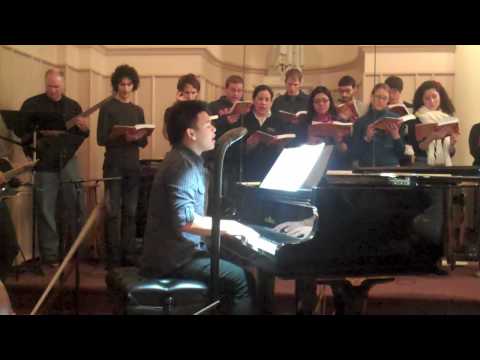
Communion
Communion

One Bread, One Cup (Bobby Fisher, Greg Lee, Craig Aven and Ken Canedo)
SPIRIT & SONG | OFFICIAL LYRICS
Sending Forth
Sending Forth

By Our Love (Tom Kendzia)
SPIRIT & SONG | THE COMMONS
Liturgy Blog is a weekly liturgy planning resource for musicians, liturgists, homilists, youth groups, faith sharing groups, and all who look to the liturgical readings for inspiration and nourishment. Join Ken Canedo as he breaks open the Scripture and suggests tracks from the Spirit & Song contemporary repertoire.
Ezekiel 33:7-9

2026 video courtesy of Lector with Lisa

Proclamation
Text Segment | Vocal Tone | Pacing & Ambo Actions |
Thus says the Lord: | Authoritative, resonant, firm | Set the standard. Pause slightly after this opening to let the divine authority register with the assembly. |
You, son of man, I have appointed watchman for the house of Israel; | Direct, solemn, commissioning | Eye contact cue: Look up directly at someone in the congregation on "You, son of man." Treat this as an explicit personal charge. |
when you hear me say anything, you shall warn them for me. | Serious, urgent | Maintain strong, forward vocal energy. Emphasize "warn them for me." |
If I tell the wicked, "O wicked one, you shall surely die," | Sharp voice shift (quoting God's warning) | Drop into a stern, pointed tone. Let your vocal inflection mirror a pointed finger on "O wicked one." |
and you do not speak out to dissuade the wicked from his way, | Deliberate, firm | Elongate and stretch the word "dis-suade" (convey the physical sense of pushing/turning someone away from a dangerous path). |
the wicked shall die for his guilt, but I will hold YOU responsible for his death. | Heavy, sober, weight of consequence | Punch the emphasis on "YOU". Let the heavy responsibility of silence sink in with a brief pause. |
If, however, you warn the wicked, trying to turn him from his way, | Shift in tone (the alternative scenario) | Lift vocal energy slightly to mark the contrast ("on the other hand"). Emphasize the active effort in "trying to turn him." |
and he refuses to turn from his way, | Voice shift (narrating stubborn refusal) | Use a matter-of-fact, resolved inflection to reflect the wicked person's obstinate choice. |
he shall die for his guilt, | Decisive, declarative | Clear pronouncement of justice. |
but you shall save yourself. | Intense, resolved, slightly personal | Deliver with full conviction. Do not drop vocal energy. Take a mandatory 3-second pause before the final acclamation. |
The Word of the Lord. | Strong, commanding, matched intensity | Look directly up at the entire assembly. Match the intensity of the reading itself. |

Ambo Reminders
- Hold Your Energy to the Very End: Maintain intensity throughout the entire passage—do not let your voice fade or soften on "you shall save yourself." Keep the proclamation powerful through "The Word of the Lord."
- Execute the Eye Contact on the Opening Charge: Lock eyes with a specific section or person on "You, son of man" to instantly ground the congregation in the gravity of the watchman's duty.
- Hands Off the Lectionary: When finished, do not close the book and do not turn the page. Remain still at the ambo until the psalm or music begins.
Ezekiel 33:7-9
Greg Warnusz

The Theological Background: God wanted the people of Israel to have every chance to stay on the straight and narrow, turn from their sins, and avoid the destruction threatened by foreign invaders. So God takes a step to ensure that Israel has all it needs to stay morally upright. Most of all, they need a watchman, a human voice to challenge and correct them, so that the responsibility for their fate is only theirs. We'd call that fair; fair to the people if not to the hapless watchman.
But the watchman, the prophet Ezekiel, needs to be impressed with the importance of his duty. No prophet has an easy vocation (See last week's commentary about another prophet's calling), so God always takes pains to bolster the prophets, and in a variety of ways. Here Ezekiel gets straightforward orders assigning responsibility to him and to the people, with no if's, and's or but's tolerated.
Proclaiming It: The meaning of this passage isn't too difficult to discern, but the oral interpretation of it to an unprepared congregation will be challenging. It's hard to proclaim because it's one person talking to a second about the second's relationship to a third person and to a group.
When you proclaim this, imagine you are God talking to the prophet. You love him but you have to lay a heavy burden on his shoulders because you love the people and you're very worried about them. It should sound quite solemn.
Secondly, make every effort to speak slowly and distinctly. While the words are simple, the sentences are complex. Use contrasting tones of voice to distinguish "you" from "him" and "he." If you read this too fast or if you sound too flat, it will be lost on your hearers. Think of how carefully Ezekiel would have spoken his warnings to the wicked, knowing what was at stake!

Romans 13:8-10

2026 video courtesy of Lector with Lisa
Proclamation
Text Segment | Vocal Tone | Pacing & Ambo Actions |
Brothers and sisters: | Warm, affectionate, inviting | Eye contact cue: Look directly at someone in the assembly. Deliver with a genuine, welcoming smile—Paul is greeting people he deeply loves. |
Owe nothing to anyone, except to love one another; | Bold, succinct, instructive | Clear, steady proclamation. Emphasize the core paradox of owing only love. Brief pause after this thesis statement. |
for the one who loves another has fulfilled the law. | Resonant, authoritative yet warm | Channel Paul the teacher. Connect love directly with the ultimate completion of the law. |
The commandments, "You shall not commit adultery; | Clear, distinct, rhythmic | Eye contact technique: Look down to read, look up at the assembly on "You shall not commit adultery," then return eyes to the page. |
you shall not kill; | Clear, distinct | Look up at a new section of the congregation, deliver the line, and glance back down to the book. |
you shall not steal; | Clear, distinct | Look up again directly at the assembly, deliver, and return to the text. |
you shall not covet"; | Clear, distinct | Look up once more, deliver, and return to the lectionary. |
and whatever other commandment there may be, | Expansive, conversational | Deliver with a slight knowing lilt (acknowledging the hundreds of Jewish dietary and ceremonial laws). |
are summed up in this saying, namely, "You shall love your neighbor as yourself." | Central, grounded, resonant | Deliver the quotation with full warmth and deliberate clarity. Let the summary statement settle. |
Love does no evil to the neighbor; | Direct, clarifying | Steady, logical cadence. Clear articulation. |
hence, love is the fulfillment of the law. | Triumphant, warm, resolving | Lean gently into "hence"—let it bridge the final truth. End with a visible smile and full warmth as you close the circle started in verse 8. |
The Word of the Lord. | Confident, grateful, serene | Mandatory pause: Wait 3 full seconds after the final line before looking up at the assembly to acclaim. |

Ambo Reminders
- Smile and Establish Warmth Early: Begin "Brothers and sisters" with direct eye contact and a warm smile to establish an affectionate, pastoral tone that immediately contrasts with the first reading's tension.
- Execute the "Look Down, Look Up" Rhythm on the Commandments: Do not rush through the list of commandments. Read each command, lift your eyes to address the assembly, and drop your eyes back to the text before moving to the next.
- Breathe and Take Your Time: This is a brief reading. Do not hurry through it—use generous pauses, savor transitional words like "hence," and hold your stillness at the ambo until the music begins.
Romans 13:8-10
Greg Warnusz
The Theological Background: Most of Saint Paul's letters begin with a treatment of doctrinal questions. Then, having established important truths about Christ and our relationship to him, Paul usually writes a "morals" section, an application of the doctrine to the day-to-day behavior of the congregation receiving the letter. In the earlier doctrinal sections of Romans, Paul has written of the Law (by which he means the Law of Moses which the Jews so revered) and its inability to save anyone, no matter how well one keeps the Law. In today's passage from the "how-to" section, he seems to be saying, "You still want the law? I'll give you the real law. Love one another. That fulfills the law. Enough said."
Proclaiming It: Read this slowly, and emphasize the word love every time it occurs. There's a long sentence in the middle that might tie your tongue if you haven't practiced. So practice. Read it aloud. Several times. Do it alone if it might embarrass you, or, better, before a small "congregation" like a family member or a friend.
