Commentary Intro to Mass Readings Sunday Readings
CommentaryIntro to Mass Readings Sunday Readings
August 23, 2026
⭐⭐⭐ Fr. George Corrigan, OFM—PDF


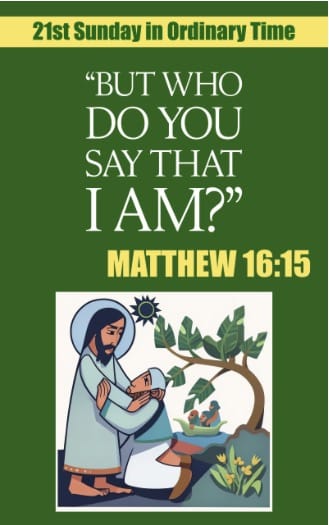
August 23, 2026
Our Sunday Readings *
Edrianne Ezell
Scripture Study for Catholics *
Vince Contreras
Hearers of the Word *
Fr. O’Mahony OSA
Friar Musings, OFM *
Fr. George Corrigan, OFM
Echoing God’s Word *
Fr. Clement Thibodeau


“A Walk in The Word” series is based on the Sunday Mass readings and led by International Catholic evangelist and bible teacher, Hector Molina.

Ten minute video excerpts from the “The Mass Readings Explained” subscription series based resource from Catholic Productions.

Francis Martin (1930 – 2017) was an American Catholic priest of the Archdiocese of Washington, and a professor of Sacred Scripture. His teaching appointments included the Dominican House of Studies, the John Paul II Institute, the Catholic University of America, and Sacred Heart Major Seminary.
Kevin Aldrich
Kevin Aldrich’s “Doctrinal Homily Outlines” is a lectionary-based aid for homilists. A career Catholic K-12 educator in Catholic schools., he has written the teacher guides for nine of the Didache series high school religion texts. He has a Master’s Degree in Theology with an emphasis on Sacred Scripture from Holy Apostles College and Seminary.

Fr. Geoffrey Plant
21st Sunday of Year A
Create a simple, modern infographic illustrating [INSERT BIBLE PASSAGE OR TOPIC]. Use a [SPLIT-SCREEN / 3-PANEL] layout. The style should be clean, high-quality digital art or vector illustration.
Visuals:
Panel 1: Show [DESCRIBE SCENE 1 – e.g., a stormy sea].
Panel 2: Show [DESCRIBE SCENE 2 – e.g., Jesus calming the waves].
Text & Typography:
Font: Use EXTRA LARGE, BOLD, SANS-SERIF FONT (like Arial). Ensure high contrast so text is easily readable.
Header: Write “[INSERT MAIN TITLE]” at the top.
Captions: Include short, punchy text summaries in the panels: “[TEXT FOR PANEL 1]” and “[TEXT FOR PANEL 2]”.
Overall Vibe: Professional, educational, and uncluttered. Avoid small details; focus on big images and big text.

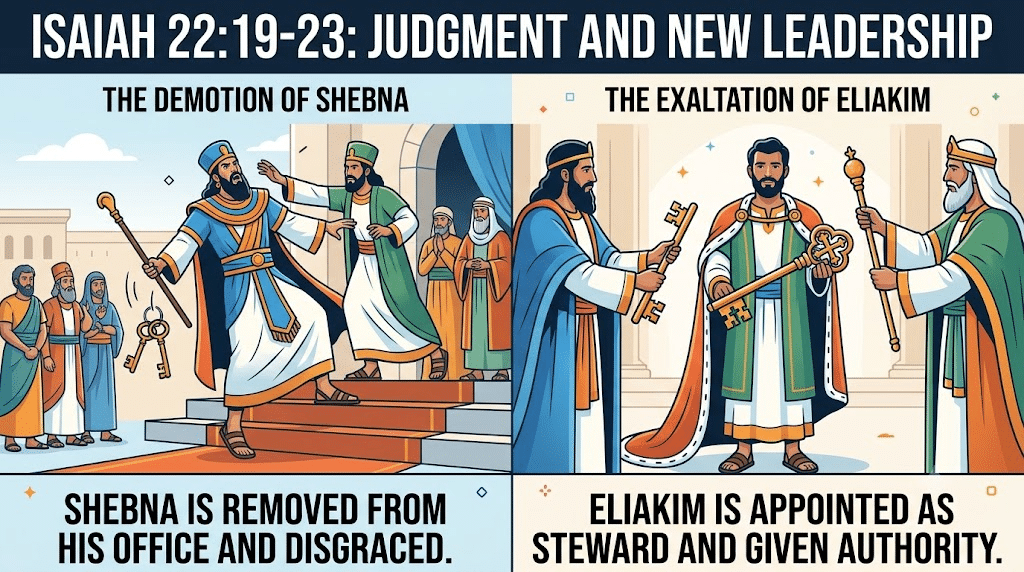
Isaiah 22:19-23
Create a verse by verse (NAB) commentary relating xxxxxxxxxxxxx TO CATHOLIC doctrine and practice. Give real life applications when appropriate
give me three thought provoking questions followed up with detailed answer reflection based on xxxxxxxxxxxx
Verse (NAB) | Old Testament Typology (Isaiah 22) | New Testament Realization (Matthew 16) | Catholic Doctrine & Practical Application |
Isaiah 22:19 | Shebna is deposed from his office as royal steward (al-habayit). | Jesus warns against unworthy stewardship, but establishes a permanent office for His Church. | Permanence of Office: The office exists independently of the individual. Human ministers may fail, but the Petrine Office endures. |
Isaiah 22:20 | God specifically summons His servant Eliakim ("God will establish"). | Jesus singles out Simon son of Jonah, renaming him Petros ("Rock") (Mt 16:17–18). | Divine Vocation: Church authority is a divine calling and responsibility, not a secular or self-appointed office. |
Isaiah 22:21 | Eliakim receives royal vestments (robe, sash) and is "a father to Jerusalem." | Jesus entrusts spiritual governance and pastoral care over the flock to Peter (Jn 21:15–17). | Spiritual Fatherhood: The title "Pope" (Papa / Father) and distinct vestments reflect delegated spiritual authority over God's household. |
Isaiah 22:22 | Placed with the "key of the House of David" to open and shut. | Jesus gives Peter "the keys to the kingdom of heaven" to bind and loose (Mt 16:19). | Papal Primacy & Magisterium: Supreme legislative, judicial, and teaching authority (Papal Primacy and Infallibility). |
Isaiah 22:23 | Fixed as a "peg in a firm place," a seat of honor for the kingdom. | Simon is established as the "Rock" upon which Christ builds His Church (Mt 16:18). | Stability & Unity: The Papacy serves as an unchanging anchor of unity and truth against cultural shift and error. |
Isaiah 22:19
"I will thrust you from your office and pull you down from your station."
- Catholic Doctrine & Context:In the Old Covenant, Shebna was the royal steward of King Hezekiah. He abused his self-serving position, prompting God to depose him. This verse illustrates that the office of royal steward exists independently of the person holding it. Shebna is deposed, but the office itself remains intact and is handed to another. In Catholic theology, this underpins the concept of ecclesial offices—specifically the Petrine office—which remain valid and permanent regardless of the moral flaws or personal unworthiness of any individual man who fills them.
- Real-Life Application:Separate the divine office from the human officer. A priest or bishop may fail, sin, or cause scandal, but the sacrament and the office established by Christ endure. Faithful Catholics trust in the institution Christ founded while praying for the personal holiness of its ministers.
Isaiah 22:20
"On that day I will summon my servant Eliakim, son of Hilkiah;"
- Catholic Doctrine & Context:God calls Eliakim ("God will establish") His "servant." In Old Testament typology, Eliakim serves as a type (a foreshadowing) of Saint Peter. Just as God specifically calls Eliakim to assume governance over the royal household, Jesus personally singles out Simon son of Jonah, renaming him Peter ("Rock"), and calling him to lead the Church (CCC 552).
- Real-Life Application:Leadership in the Church is not a self-appointed title or a political victory; it is a divine calling (vocation). In daily life, true authority in the family, workplace, or parish is rooted in humility and service to God, rather than personal ambition.
Isaiah 22:21
"I will clothe him with your robe, gird him with your sash, confer on him your authority. He shall be a father to the inhabitants of Jerusalem, and to the house of Judah."
- Catholic Doctrine & Context:
- Vestments and Governance: Vesting Eliakim with a robe and sash symbolizes the transfer of liturgical and administrative authority. This is reflected today in the unique vestments worn by Catholic clergy, particularly the Pope's distinct garb and the bishop's pallium and miter.
- The Papacy as "Holy Father": Eliakim is called "a father to the inhabitants of Jerusalem." The title Pope comes from the Greek Papas (and Latin Papa), meaning "Father." The Pope exercises spiritual fatherhood over the universal Church, guarding and feeding Christ's flock (John 21:15–17).
- Real-Life Application:We are called to view Church leadership through the lens of spiritual fatherhood rather than secular bureaucracy. Pray for the Holy Father and your local bishop, asking God to give them the heart of a loving father who protects and nurtures his spiritual family.
Isaiah 22:22
"I will place the key of the House of David on his shoulder; what he opens, no one will shut, what he shuts, no one will open."
- Catholic Doctrine & Context:
- The Keys of the Kingdom: This is the most direct Old Testament parallel to Matthew 16:19, where Jesus says to Peter: "I will give you the keys to the kingdom of heaven. Whatever you bind on earth shall be bound in heaven; and whatever you loose on earth shall be loosed in heaven."
- Succession and Governance: In the Davidic monarchy, the king gave the keys of the gates and treasury to his prime minister, allowing him to govern in the king’s name. Jesus—the Davidic King par excellence (Luke 1:32–33)—gives Peter the "keys" to the Church, instituting the Papacy. The language of opening/shutting and binding/loosing denotes supreme legislative, judicial, and teaching authority (Papal Primacy and Infallibility, CCC 881-882).
- Real-Life Application:This authority grants Catholics confidence in the Church’s doctrine. When the Church definitively teaches on faith and morals or grants absolution through Sacramental Reconciliation, we can trust that Christ’s authority stands behind it.
Isaiah 22:23
"I will fix him as a peg in a firm place, a seat of honor for his ancestral house;"
- Catholic Doctrine & Context:
- The Rock of Peter: The metaphor of a "peg in a firm place" (māqôm ne’ĕmān) directly prefigures Jesus designating Simon as Petros ("Rock") upon which He will build His Church (Matthew 16:18).
- Stability of the Church: The Petrine ministry provides an anchor of stability, unity, and truth throughout history. The Papacy ensures that the Church does not blow away with every cultural wind or theological confusion.
- Real-Life Application:Anchor your personal faith in the foundational teachings of Christ transmitted through the Magisterium. When surrounded by modern cultural noise or personal doubts, lean on the "firm peg" of Catholic tradition, the Sacraments, and the unity of the Church to stay grounded.
Algorithmically generated text
give me three thought provoking questions followed up with detailed answer reflection based on xxxxxxxxxxxx. Keep questions and answers appropriate for Sunday congregation giving real life application.
In Isaiah 22:19, God forcefully deposes Shebna, the master of the palace, because he abused his authority for personal ambition and luxury instead of serving the people. Yet, God does not abolish the office of steward; He replaces the unworthy steward with Eliakim.
In our personal lives, it can be deeply shaking when a priest, bishop, or parish leader makes a grievous mistake or causes scandal. We might be tempted to walk away from the Church or lose trust in God altogether. However, Scripture reveals a critical distinction between the office instituted by God and the unworthy minister who temporarily fills it.
The Church’s holiness comes from Christ, her Bridegroom, not from the perfection of her human leaders. Recognizing this calls us to two practical actions:
- Pray for our leaders rather than simply complaining: Instead of surrendering to cynicism or gossip when clergy or parish leaders fall short, commit to offering daily prayer and sacrifice for their conversion, humility, and holiness.
- Separate the divine institution from human flaw: Trust that Christ's authority, transmitted through the sacraments and the Petrine office, remains pure even when transmitted through fragile human hands.
Algorithmically generated text
God places "the key of the House of David" on Eliakim’s shoulder, giving him the unique authority that "what he opens, no one will shut, what he shuts, no one will open" (Isaiah 22:22). Christ explicitly bestows these same "keys of the kingdom" onto St. Peter in Matthew 16:19, establishing a authority meant to safeguard truth, offer mercy, and open the gates of heaven to God's children.
While the supreme authority of the keys belongs uniquely to the Pope and the Magisterium, every Christian has been entrusted with a derivative "key"—a degree of influence and responsibility over others in their home, workplace, and community.
Consider how you exercise authority in your daily roles:
- In the workplace and community: Do you use your position, words, or social standing to build bridges and welcome the forgotten, or to guard your own status and shut out those who inconvenience you?
- As parents and grand-parents: Are you using your influence to open the doors of faith, forgiveness, and prayer for your children, or are rigid attitudes and harsh judgments closing their hearts to God?
Algorithmically generated text
In verse 23, God promises to fix Eliakim as a "peg in a firm place," providing a secure anchor of stability for his entire house. In Catholic tradition, this prefigures St. Peter as the Rock—the unchanging anchor that keeps the Church grounded through centuries of cultural turmoil, war, and moral confusion.
Our modern culture undergoes constant, rapid shifts in values, morality, and popular opinion. Trying to build a peace-filled life on secular trends is like hanging a heavy weight on a loose nail driven into crumbling plaster—eventually, the wall gives way, and everything falls.
To build a life anchored to a "firm peg":
- Practice spiritual routine: Strengthen your anchor by establishing non-negotiable spiritual habits: regular Sunday Mass, frequent Confession, daily prayer, and anchoring your family in the objective moral truth of the Catholic faith.
- Evaluate your daily anchors: Ask yourself honestly where you turn first for guidance during personal crises—is it the timeless wisdom of Scripture and the Catechism, or the reactionary opinions of social media and news commentary?
Algorithmically generated text

Write an engaging description meant to get readers to read Larry Broding’s commentary which can be used to help preachers prepare their own homily. After a brief introduction give bulletin points of why this commentary matters for your homily. conclude with “Read Larry Broding’s full commentary to help your congregation…” Complete sentence.
Measure to the Heart

Larry Broding’s commentary on Isaiah 22:19–23 unpacks a sharp historical confrontation in King Hezekiah’s court, offering pastors an insightful historical and theological foundation for building a compelling homily on divine judgment, integrity, and servant leadership.
- Engaging Real-World Hook: Broding opens with the universal question of how we measure character and intent, providing preachers with an immediate, relatable bridge to connect ancient court politics with daily modern choices.
- Vivid Historical Context: The commentary frames Isaiah’s prophecy within the high-stakes conflict between Judah and the Assyrian empire, bringing the figures of Shebna and Eliakim to life so you can paint a clear, memorable picture for your listeners.
- Illuminating Biblical Connections: By detailing the royal office of the prime minister and the symbol of the “key of David,” this reflection offers essential Old Testament backdrop that directly illuminates Gospel passages like Peter receiving the keys to the Kingdom in Matthew 16.

Commentary by Dr. Brant Pitre | Catholic Productions

Commentary by Fr. Francis Martin | The Word Proclaimed
clean up grammar and spelling, create an outline for the following transcript xxxxxxxxxxxx
Outline
I. Background of Isaiah 22: Shebna and Eliakim
- A. The Prime Minister’s Pride: Shebna, the master of the palace, constructs an extravagant tomb to secure his own legacy apart from hope in the resurrection.
- B. The Prophecy of Removal: Through Isaiah, the Lord removes Shebna from office due to his self-exaltation.
- C. The Appointment of Eliakim: Eliakim, son of Hilkiah, is invested with authority, clothed with the robe and sash, and appointed as a father to Jerusalem and Judah.
- D. The Keys of the Kingdom: The key of the house of David placed on Eliakim’s shoulder prefigures Christ bestowing the keys of the kingdom upon Peter.
II. Psalm 138: A Response of Praise and Thanksgiving
- A. The Meaning of Praise (Yadah): Prayer as heartfelt acknowledgment, thanksgiving, and public proclamation of God’s works.
- B. The Psalms as a School of Prayer: Inspired prayer that elevates the heart to God, reflecting divine initiative and covenant loyalty.
- C. God’s Covenant Fidelity (Hesed and Emet): God’s active love, steadfast faithfulness, and unchanging truth ('emet) ground our trust in His promises.
- D. The Glory of God’s Name and Word: Universal recognition of the Lord’s ways (derekh) and glory (kavod) by the kings of the earth.
Cleaned Transcript
Background of Isaiah 22: Shebna and Eliakim
First, I have to tell you a little bit about the background of this Isaiah 22 text. It is addressed to a fellow by the name of Shebna. Shebna was master of the palace, as this translation goes. He had a high position; he ran everything. Then he went and built himself a tomb. You see, when you do not know about the resurrection from the dead, you are only going to exist in the memory of other people. So then you want a big monument, which means to admonish the mind. You can look at Hadrian's tomb at the end of the Via; it is an enormous thing and it is still called Hadrian's tomb. So we still do remember Hadrian, but that is all the eternity he could think of.
Shebna is building this great big thing, and the word of the Lord comes from Isaiah, who was also part of the court, it seems, to Shebna. It is tough. Why do we have this? Because in here there is this word we are going to see: "I will place the key of the house of David on Eliakim's shoulder." When we get to the Gospel, it is all about Peter being made the rock—the very place where the temple was built, as I will try to explain. That is why this first reading is meant to prepare us for some of the terminology that our Lord will use when establishing Peter as the rock.
The Lord says to Shebna, master of the palace: "I will thrust you from your office and pull you down from your station. On that day I will summon my servant Eliakim, son of Hilkiah. I will clothe him with your robe, gird him with your sash, and give to him your authority." He is going to be the master of the whole palace; the only one higher than him is the king. Because Shebna was full of himself, he is going to be removed from office.
Pastoral Authority and Covenant Knowledge
That is not the part that is going to shed so much light on the Gospel, but it is chosen to illuminate the Gospel. He shall be a father to the inhabitants of Jerusalem and to the house of Judah; he has got to care for them. There was a text addressed to one of the kings, the son of Josiah, from Jeremiah. Now, this king had a big building program, a lot of wives, and a lot of money. So Jeremiah had a word from the Lord for him, the same kind of thing: "Thus says the Lord: Your father lived modestly, he cared for the poor, and he was loyal to me. Is this not to know the Lord?" That is knowing the Lord: to recognize, to experience, to obey, and to honor Him. Both of those mean to know the Lord, you see. So equivalently, He is saying, "You never knew me."
Eliakim will be a father to the inhabitants of Jerusalem and to the house of Judah. Now, it is because of this kind of terminology, which we will be returning to: "I will place the key of the house of David on Eliakim's shoulder. When he opens, no one shall shut; when he shuts, no one shall open. I will fix him like a peg in a sure spot, to be a place of honor for his family." In other words, he is going to be from now on second to the king, and he is going to have this key, which represents authority. We just have to remember that because it will come up again: "I will give to you the keys of the kingdom." It is this authority given to Peter. There is so much Old Testament allusion in that text when we get there. I am whetting your appetite for when we get there.
Psalm 138: Thanksgiving and the School of Prayer
The psalm is thanksgiving for all of that. I want to be able to read the whole psalm to you. The editors, as I pointed out before, leave out verses, I think because they are worried about time. Sometimes when you are preaching, people are looking at their watches. I think that is one of the reasons that we have this shortened text.
This psalm is from David. The first line is: "I will give thanks to you with all my heart." The word for "give thanks" in this text comes from the verb yadah, and it means to acknowledge. It is an expression of gratitude, but it is more than that. It means: "I want the whole world to come; I want to tell you what God did for me." So with my whole heart I give you thanks, I acknowledge you, I praise you, I thank you. It means all of those things. The same word expresses praise, acknowledgment, and giving thanks because He is good, or because it is good.
This psalm starts off as a school of prayer. These psalms are a school of prayer. If you are stuck on how to pray, pick up the psalms. St. Augustine has this beautiful insight on prayer in the psalms: "I am praying in you, and you are praying in me." As I pray in you, I move toward the Father, because these are inspired words. They are like no other words anywhere. There are beautiful poems in honor of God and beautiful songs, and they are quite lovely, but they do not have the power to change our hearts or to carry us to God the way the psalms do.
God’s Steadfast Love (Hesed) and Truth (Emet)
So I will worship in Your presence and again make known Your name. Do you recognize how many times when we read these Old Testament texts these same words come up? Isn't it amazing that God is enthusiastically faithful to the covenant? What would you do if He were not? Would you call a cop? What could you do? Do you see His total spontaneity and generosity? In case we get nervous, He promised. He said it, and He promises, so we have His word. He is faithful to that, just as justice is honoring the truth of every relationship. What is this relationship? It is God to Himself; He has promised us. Now we can be sure because He owes it to Himself to be faithful to His promise.
"I will praise your name because of your hesed and your 'emet." Nine times out of ten when we stop to look at the psalm, we see His steadfast love—His enthusiastic faithfulness to His covenant—His justice, His right relationship, and then His 'emet: that He is solid and does not change. That is truth.
In the Semitic mind, truth is not merely a correspondence between point A and point B; it is solidity. That is why falsehood and evil are evanescent. Blessed is the man who does not walk according to the counsel of the wicked, nor sit in the seat of the scoffers. Why? What is the result of that? He is like a tree planted by rivers of water, always bearing fruit. To be like that is to bear the fruit of justice.
So he is saying that because of Your hesed and Your 'emet, "I will worship at Your holy temple and give thanks to Your name because of Your kindness and Your truth"—which are the two words I just told you, hesed and 'emet. Why don't they write down "enthusiastic fidelity to the covenant" and "stability"? People would say, "What does that mean?" So we translate them simply, but it is nice to know what lies behind them, because otherwise they can become mere slogans: "your kindness and your truth." For You have made great above all things Your name and Your promise.
The most powerful, most stable thing in the world is the name of God, His reputation, and the expression of who He is, along with His promise. Now, why does this psalm explain the reading? Because the promise is: "I will place the key of the house of David on Eliakim's shoulder. When he opens, no one shall shut; when he shuts, no one shall open." That is a word of God that is going to happen, and so this psalm is a response to that.
Universal Acclaim and the Glory of the Lord
Then it says: "All the kings of the earth shall give thanks to You, O Lord." And you can imagine what "give thanks" means here—what is the root of it? It comes from yadah: "I acknowledge what You have done; I give thanks."
When they hear the words of Your mouth, they shall sing about the ways of the Lord. We have that expression in English: "I like his ways; I like the way he does things." The Hebrew word derekh means "way." A madrich on a tourist trip is a guide—the one who takes everybody around—derived from derekh, the way. They shall sing of the ways of God and speak of the kavod of God. Another beautiful word is kavod: the glory of Yahweh, of Adonai. The text goes on to say: "The Lord is exalted."
Click chevron banner to read transcript
organized into thematic sections.
21st Sunday of Year A
Create a simple, modern infographic illustrating [INSERT BIBLE PASSAGE OR TOPIC]. Use a [SPLIT-SCREEN / 3-PANEL] layout. The style should be clean, high-quality digital art or vector illustration.
Visuals:
Panel 1: Show [DESCRIBE SCENE 1 – e.g., a stormy sea].
Panel 2: Show [DESCRIBE SCENE 2 – e.g., Jesus calming the waves].
Text & Typography:
Font: Use EXTRA LARGE, BOLD, SANS-SERIF FONT (like Arial). Ensure high contrast so text is easily readable.
Header: Write “[INSERT MAIN TITLE]” at the top.
Captions: Include short, punchy text summaries in the panels: “[TEXT FOR PANEL 1]” and “[TEXT FOR PANEL 2]”.
Overall Vibe: Professional, educational, and uncluttered. Avoid small details; focus on big images and big text.

Romans 11:33-36
Create a verse by verse (NAB) commentary relating xxxxxxxxxxxxx TO CATHOLIC doctrine and practice. Give real life applications when appropriate
give me three thought provoking questions followed up with detailed answer reflection based on xxxxxxxxxxxx
Verse (NAB) | Biblical Focus & Theme | Catholic Doctrine & Context | Real-Life Application |
Romans 11:33 | "Oh, the depth of the riches... How inscrutable are his judgments!" | Divine Incomprehensibility: God exceeds all human intellect (CCC 230). Root of Apophatic (Negative) Theology. | Embracing Mystery: Surrender the need for total control or immediate answers when facing personal suffering or unexplained trials. |
Romans 11:34 | "Who has known the mind of the Lord or who has been his counselor?" | Sovereignty & Limits of Reason: Divine initiative requires no human advice. Reason is valued (Fides et Ratio) but must submit to Revelation. | Avoiding "Custom-Made" Religion: Conform intellect and habits to Scripture and the Magisterium rather than reshaping doctrine to fit culture. |
Romans 11:35 | "Or who has given him a gift that he might be repaid?" | Gratuity of Grace: All grace is an unmerited gift (CCC 1996). Even human merit is rooted in God's prior initiative. | Rejecting Transactional Faith: Pray and perform good works out of gratitude for love already received, not to force God into our debt. |
Romans 11:36 | "For from him and through him and for him are all things. To him be glory forever." | Trinitarian Creation & Liturgy: The Father (from), Son (through), and Spirit (for). Basis of the Mass's Eucharistic Doxology. | Living for God's Glory: Direct daily work, family decisions, and talents back to God (Ad Majorem Dei Gloriam). |
Romans 11:33
"Oh, the depth of the riches and wisdom and knowledge of God! How inscrutable are his judgments and how unsearchable his ways!"
- Catholic Doctrine & Context:
- Divine Incomprehensibility and Mystery: Catholic theology holds that God is ultimate Being (Actus Purus), whose essence exceeds human intellect. While God truly reveals Himself through Sacred Scripture, Tradition, and Creation, He remains an infinite mystery. The Catechism of the Catholic Church notes that God’s truth and wisdom are unsearchable, transcending all human comprehension (CCC 230, 300).
- Apophatic Theology (Negative Theology): This verse underpins the ancient Catholic tradition of apophatic theology (practiced by St. Augustine, St. Thomas Aquinas, and the Eastern Fathers), which acknowledges that whatever we say about God, He is always infinitely greater than our language can capture.
- Real-Life Application:
- Embracing Mystery in Suffering: When facing unexplained trials, loss, or suffering, we often struggle to understand "why." Recognizing that God’s judgments are inscrutable allows us to surrender our need for total control and intellectual certainty. It invites us to trust in God's loving providence, even when His ways do not align with our immediate understanding.
Romans 11:34
"For 'who has known the mind of the Lord or who has been his counselor?'"
- Catholic Doctrine & Context:
- The Sovereignty and Independence of God: Quoting Isaiah 40:13, Paul emphasizes that God needs no human advisor or external guidance. God’s plan of salvation—including the Church, the Sacraments, and the incarnation of Christ—originates solely in His free, uncoerced divine will (CCC 257).
- Humility of Human Reason (Fides et Ratio): Catholic teaching highly values human reason (as affirmed by St. John Paul II in Fides et Ratio), but places it in proper relation to faith. Human intellect is a gift, but it is finite and wounded by original sin; it cannot critique or measure divine revelation on purely human terms.
- Real-Life Application:
- Avoiding "Custom-Made" Religion: Modern culture often tempts Christians to act as God's "counselors"—redefining morality, doctrine, or commandments to fit personal comfort or secular trends. True Catholic discipleship means conforming our minds to Christ and the Magisterium rather than trying to conform God’s revelation to our preferred worldview.
Romans 11:35
"Or 'who has given him a gift that he might be repaid?'"
- Catholic Doctrine & Context:
- Gratuity of Grace (Gratia): Quoting Job 41:11, Paul highlights the core Catholic truth that God owes humanity nothing. All grace is an unmerited, supernatural gift (CCC 1996).
- Correct Understanding of Merit: While Catholicism teaches that believers can "merit" heavenly rewards through good works performed in a state of grace (CCC 2008), this merit is entirely rooted in God's prior initiative. As St. Augustine famously wrote, "When God rewards our merits, He crowns His own gifts." God is never placed in our debt.
- Real-Life Application:
- Freedom from Transactional Faith: It is easy to slide into a transactional mindset with God: "I said my prayers, went to Mass, and did good deeds, so God owes me a blessing or smooth circumstances." Romans 11:35 frees us from this mentality. We serve, obey, and love God not to put Him in our debt, but out of gratitude for the infinite love He has already poured out on us.
Romans 11:36
"For from him and through him and for him are all things. To him be glory forever. Amen."
- Catholic Doctrine & Context:
- Trinitarian Creation and Teleology: Catholic dogmatic theology views this verse through a Trinitarian and cosmological lens:
- "From him": God the Father as the primary source and origin of all created reality.
- "Through him": God the Son (the eternal Logos), through whom all things were made and through whom redemption comes (John 1:3; Colossians 1:16).
- "For him": God the Holy Spirit, who sanctifies creation and directs all things back to God as their final end (teleology).
- Liturgical Practice (The Great Doxology): This verse forms the scriptural backbone of the Catholic Mass, specifically the end of the Eucharistic Prayer (The Doxology): "Through Him, and with Him, and in Him, O God, Almighty Father, in the unity of the Holy Spirit, all glory and honor is Yours, forever and ever. Amen."
- Trinitarian Creation and Teleology: Catholic dogmatic theology views this verse through a Trinitarian and cosmological lens:
- Real-Life Application:
- Living for God’s Glory (Ad Majorem Dei Gloriam): Make this verse the guiding rule of daily decisions. Ask: Are my work, my family life, my talents, and my time directed "for Him"? Reciting a short doxology (like the Glory Be) throughout the workday keeps our daily labors aligned with our ultimate end: God's eternal glory.
Algorithmically generated text
give me three thought provoking questions followed up with detailed answer reflection based on xxxxxxxxxxxx. Keep questions and answers appropriate for Sunday congregation giving real life application.
Romans 11 Movement | Eucharistic Prayer Element | Liturgical Action / Text |
v. 33: Wonder at God's inscrutable ways | Preface & Sanctus | Acknowledging God's holiness and transcendent salvation plan. |
v. 34–35: Divine initiative & unmerited grace | Epiclesis & Anamnesis | Invoking the Spirit; offering back to God the gift He first provided. |
v. 36a: From Him, through Him, for Him | The Great Doxology | "Through Him, and with Him, and in Him..." |
v. 36b: To Him be glory forever. Amen. | The Great Amen | The faithful ratify the prayer of praise with a solemn "Amen." |
Romans 11:33 — The Preface & The Mystery of Faith
"Oh, the depth of the riches and wisdom and knowledge of God! How inscrutable are his judgments and how unsearchable his ways!"
- Liturgical Realization:
- The Preface: Every Eucharistic Prayer opens with the Preface ("It is truly right and just, our duty and our salvation, always and everywhere to give you thanks..."). The priest, on behalf of the assembly, stands before the grand sweep of salvation history and marvels at God’s unmerited wisdom—just as Paul does after reviewing salvation history in Romans 9–11.
- The Memorial Acclamation: Immediately following the Consecration, the priest proclaims, "The mystery of faith" (Mysterium Fidei). This is an explicit liturgical declaration that what has just occurred on the altar (bread and wine becoming the Body and Blood of Christ) belongs to the inscrutable and unsearchable depth of God's wisdom, exceeding human comprehension and inviting humble adoration.
Romans 11:34–35 — The Epiclesis & Gratuity of the Sacrifice
"For 'who has known the mind of the Lord or who has been his counselor?' Or 'who has given him a gift that he might be repaid?'"
- Liturgical Realization:
- Divine Initiative (Epiclesis): In Romans, Paul affirms that God acts independently of human counsel or merit. In the Eucharistic Prayer, this is expressed through the Epiclesis—the moment the priest extends his hands over the gifts and calls down the Holy Spirit: "Make holy, therefore, these gifts, we pray, by sending down your Spirit upon them like the dewfall..." Humanity cannot cause transubstantiation by its own power or logic; it depends entirely on God’s sovereign initiative.
- Pure Gift over Transaction: Paul highlights that no one gives God a gift to demand repayment. In the Eucharistic Prayer, the Church does not offer a human gift to place God in her debt. Rather, as the Roman Canon (Eucharistic Prayer I) states, the Church offers back to the Father "a pure victim, a holy victim, a spotless victim"—Christ Himself, the gift that God first gave to us. We offer God only what He has first graciously bestowed.
Romans 11:36 — The Great Doxology & Amen
"For from him and through him and for him are all things. To him be glory forever. Amen."
- Liturgical Realization:
- Trinitarian Structure: Paul's prepositional phrasing (from Him, through Him, for Him) maps directly onto the Trinitarian theology embedded in every Eucharistic Prayer:
- "From Him" (The Father): The Eucharistic Prayer is addressed directly to God the Father as the source (fontem) of all holiness and creation.
- "Through Him" (The Son): The entire sacrifice is made present through Jesus Christ, the eternal High Priest and Mediator.
- "For Him / In Him" (The Holy Spirit): The offering is united in the communion of the Holy Spirit, directing all creation back to the Father's glory.
- The Great Doxology (Per Ipsum): The climax of the Eucharistic Prayer is a literal translation and liturgical fulfillment of Romans 11:36. Holding aloft the Body and Blood of Christ, the priest sings:"Through Him, and with Him, and in Him, O God, Almighty Father, in the unity of the Holy Spirit, all glory and honor is Yours, forever and ever."
- The Great Amen: Just as Paul closes his doxology with an "Amen," the entire congregation responds to the Great Doxology with the Great Amen—affirming their participation in Christ's ultimate act of praise to the Father.
- Trinitarian Structure: Paul's prepositional phrasing (from Him, through Him, for Him) maps directly onto the Trinitarian theology embedded in every Eucharistic Prayer:
Algorithmically generated text
Romans 11:33–36 | Eucharistic Prayer III Section | Line-by-Line Movement |
v. 33 (Inscrutable Depth & Riches) | Introductory Praise | "You are indeed Holy, O Lord... You never cease to gather a people..." |
v. 34 (Sovereign Mind & Initiative) | Epiclesis | "We humbly implore you: by the same Spirit graciously make holy these gifts..." |
v. 35 (Unmerited Gift / No Repayment) | Anamnesis & Oblation | "We offer you in thanksgiving this holy and living sacrifice... recognizing the sacrificial Victim..." |
v. 36a (From, Through, For Him) | Intercessions & Petition | "Make of us an eternal offering... through whom you bestow on the world all that is good..." |
v. 36b (To Him be glory forever. Amen.) | The Great Doxology | "Through him, and with him, and in him... all glory and honor is yours... Amen." |
Eucharistic Prayer III, introduced after the Second Vatican Council, is a dense theological summary of salvation history. Its structure directly mirrors Saint Paul’s movement in Romans 11:33–36: moving from the praise of God’s sovereign grandeur to the calling down of grace, culminating in an offering given entirely through Christ for the Father’s glory.
Here is a line-by-line breakdown showing how Romans 11:33–36 is reflected throughout Eucharistic Prayer III.
1. Romans 11:33 — The Depth of God's Riches, Wisdom, and Inscrutable Ways
"Oh, the depth of the riches and wisdom and knowledge of God! How inscrutable are his judgments and how unsearchable his ways!"
Paul opens his doxology in awe of God's cosmic plan. Eucharistic Prayer III opens with identical praise for God's holiness and His unsearchable, constant work in drawing humanity to Himself.
- EP III:"You are indeed Holy, O Lord, and all you have created rightly gives you praise..."
- Reflection: Acknowledges God as the ultimate source of holiness and the rightful receiver of all creation's praise (riches and wisdom).
- EP III:"For through your Son our Lord Jesus Christ, by the power and working of the Holy Spirit, you give life to all things and make them holy..."
- Reflection: Marvels at the depth of God’s mysterious, trinitarian action in giving life and sanctifying the world.
- EP III:"And you never cease to gather a people to yourself, so that from the rising of the sun to its setting a pure sacrifice may be offered to your name."
- Reflection: Reflects the "unsearchable ways" of divine providence—God's persistent, relentless plan across all time and geography to gather a redeemed people.
2. Romans 11:34 — Who Has Known the Mind of the Lord or Been His Counselor?
"For 'who has known the mind of the Lord or who has been his counselor?'"
God’s action is entirely His own initiative. Human beings cannot direct, instruct, or compel God; we depend entirely on His sovereign mercy and the sending of the Holy Spirit (Epiclesis).
- EP III:"Therefore, O Lord, we humbly implore you: by the same Spirit graciously make holy these gifts we have brought to you for consecration..."
- Reflection: Highlights human dependency. We do not transform the bread and wine by human intellect or counsel; we "humbly implore" God to act according to His divine sovereign power.
- EP III:"That they may become the Body and Blood of your Son our Lord Jesus Christ, at whose command we celebrate these mysteries."
- Reflection: The Church acts not on human innovation or advice, but purely in obedience to Christ’s explicit "command."
3. Romans 11:35 — Who Has Given Him a Gift That He Might Be Repaid?
"Or 'who has given him a gift that he might be repaid?'"
We cannot place God in our debt. We have nothing of our own origin to offer Him. Therefore, in the Eucharist, we offer back to God the very gift He first gave us—Christ’s own perfect sacrifice (Anamnesis & Offering).
- EP III:"Therefore, O Lord, as we celebrate the memorial of the saving Passion of your Son... and as we look forward to his second coming, we offer you in thanksgiving this holy and living sacrifice."
- Reflection: We offer a "holy and living sacrifice"—not a gift of human origin to earn God's favor, but the unmerited gift of Christ Himself given on the Cross.
- EP III:"Look, we pray, upon the oblation of your Church and, recognizing the sacrificial Victim by whose death you willed to reconcile us to yourself..."
- Reflection: We acknowledge that reconciliation is rooted in God’s prior will ("by whose death you willed to reconcile us"). God is not repaid by us; He fulfills His own promise through the Victim He provided.
4. Romans 11:36 — From Him, Through Him, and For Him Are All Things
"For from him and through him and for him are all things. To him be glory forever. Amen."
The climax of Romans 11:36 provides the exact Trinitarian and teleological framework for the concluding petitions, intercessions, and final Doxology of Eucharistic Prayer III.
- EP III (Intercessions - "From Him & For Him"):
- "May he make of us an eternal offering to you..."
- "May this Sacrifice of our reconciliation, we pray, O Lord, advance the peace and salvation of all the world."
- Reflection: Requests that our very lives and the Church's sacrifice be directed entirely back to God's purpose ("for Him").
- EP III (Communion of Saints):
- "There we hope to enjoy forever the fullness of your glory through Christ our Lord, through whom you bestow on the world all that is good."
- Reflection: Mirrors "from Him and through Him"—every good gift in this life and the glory of heaven flows exclusively through Christ.
- EP III (The Great Doxology & Amen - Liturgical Realization of Rom 11:36):
- "Through him, and with him, and in him, O God, Almighty Father, in the unity of the Holy Spirit, all glory and honor is yours, forever and ever."
- Assembly: "Amen."
- Reflection: A direct, word-for-word theological translation of Saint Paul’s praise. All creation and salvation exist through Christ, with Christ, and in Christ, giving eternal glory to the Father in the Holy Spirit.
Algorithmically generated text
In Romans 11:33, Saint Paul exclaims, "How inscrutable are his judgments and how unsearchable his ways!" Paul writes this after wrestling with one of the most painful dilemmas of his life: why so many of his fellow Israelites had rejected the Gospel while Gentiles were accepting it. Instead of becoming bitter or demanding that God conform to his human expectations, Paul ends his long reflection by bowing before the vast depth of God's wisdom.
In daily life, we frequently face situations that feel deeply unfair, confusing, or painful—a sudden diagnosis, the loss of a job, a broken relationship, or unanswered prayers. Our natural impulse is to ask, "Why would God allow this?" or to demand that He explain His plan on our terms.
Surrendering to God's "unsearchable ways" does not mean suppressing grief or suppressing honest questions; rather, it means recognizing the limits of our finite human perspective.
- Shift from "Why?" to "Who?": When circumstances are inscrutable, focus less on deciphering every hidden reason behind a trial and more on trusting the character of the God who accompanies you through it.
- Release the need for total control: Acknowledge that God sees the entire tapestry of salvation history, while we see only a single thread.
Algorithmically generated text

Write an engaging description meant to get readers to read Larry Broding’s commentary which can be used to help preachers prepare their own homily. After a brief introduction give bulletin points of why this commentary matters for your homily. conclude with “Read Larry Broding’s full commentary to help your congregation…” Complete sentence.
In Ways Unknown
Larry Broding’s commentary on Romans 11:33–36 tackles the universal human impulse to master our environment and offers pastors a rich theological and practical foundation for constructing a memorable homily.
- Relatable Opening Hooks: Broding connects Paul’s doxology directly to the modern daydreams of control and predictability, offering preachers a strong, human-centered entry point to engage parishioners who struggle when life doesn’t go according to plan.
- Cultural & Linguistic Context: The commentary illuminates how Paul intentionally bridged Greek philosophy (“riches, wisdom, knowledge”) and Hebrew theology (“unsearchable judgments”), equipping you to explain the scriptural depth of God’s infinite nature without overwhelming listeners.
- Counter-Cultural Application: By contrasting the post-modern temptation toward intellectual narcissism with the reality that increased knowledge only deepens mystery, the commentary gives you a sharp, contemporary lens to critique modern self-reliance.
Commentary by Dr. Brant Pitre | Catholic Productions

Commentary by Fr. Francis Martin | The Word Proclaimed
clean up grammar and spelling, create an outline for the following transcript xxxxxxxxxxxx
Outline
I. Historical Context and Paul’s Heartbreak (Romans 9–11)
- A. Structure of Romans: Continuous narrative flow in the first eight chapters leading into Paul’s reflection on God’s salvation plan.
- B. Personal Reflections on Jewish Identity: Shared experiences of recognizing Jesus as "one of us" among Jewish people.
- C. Paul’s Agony: Deep grief for his fellow Israelites, who possess the covenants, the patriarchs, and the heritage from which Christ came.
II. The Mystery of Israel’s Restoration and Salvation Plan
- A. The Remnant and Covenant: Reaffirmation that God has not rejected His people, referencing the 7,000 faithful during Elijah’s time.
- B. The Unrevoked Covenant: Grafting of Gentiles into the cultivated Olive Tree without nullifying the original branches or revoking God’s promise.
- C. Regathering the Twelve Tribes: Ezekiel’s vision of dry bones and Revelation’s symbolic regathering fulfilled through Christ’s Cross and Resurrection.
III. Doxology and the Depth of Divine Wisdom
- A. Paul’s Mystical Enlightenment: Overwhelming awe at God’s infinite love, mercy, and unsearchable ways (Romans 11:33).
- B. Quotation of Old Testament Wisdom: Citing Isaiah on the unfathomable mind of God and the impossibility of counseling the Almighty.
- C. The Trinitarian Doxology: Exalting God from whom, through whom, and for whom all things exist.
IV. Personal Application: Prayer, Purification, and Hope
- A. Seeking God’s Direction in Crisis: Bringing world troubles, division, and economic distress into prayer to understand divine providence.
- B. The Church’s Call to Unity: The necessity of internal purification and ecumenical unity to fulfill Christ’s mission to the world.
- C. Surrender to the Holy Spirit: Approaching Scripture and prayer with open hearts to share in Paul’s joyful worship.
Cleaned Transcript
Introduction: Paul’s Heartbreak and the Context of Romans
Now we are going to reflect on a most beautiful text. It is the conclusion of chapter 11 in the Letter to the Romans. Just by way of recall, remember that through the first eight chapters we have been going right through Romans in a continuous reading. Matthew is continuous, Romans is continuous, and the first reading is always chosen to develop an aspect of what the Gospel addresses from the Old Testament.
Paul has just described God's plan, including his own personal pain. I lived in Jerusalem for five years. I did not have Paul's spiritual depth, but I saw that these people are made to know Jesus; He is one of them. That reminds me of two moments in my life. Once I was on the bus right behind the driver, and we were talking. I mentioned something, and he said, "I know you're a Christian, so are you over here to preach to everybody?" I said, "No, I am teaching, but I am happy to preach!" He said, "Who, Yeshua? This Jesus? He is one of us!" And later he became a Christian. I asked him, "Are you heavy into theology?" He said, "No, I don't pay much attention to that stuff. Jesus became a Christian!"
The other time, I was in the Church of the Nativity. On the floor there is a big golden star with the Latin inscription Hic de Virgine Maria Jesus Christus natus est ("Here Jesus Christ was born of the Virgin Mary"), marking the spot where the Savior of the world was born. I was in a side chapel praying away, and it was Shabbat. Young Israelis come in to look at it and see what it is all about. Usually a young man serving in the IDF comes in uniform with his girlfriend. They stand there holding hands, looking at the spot where the Son of God was born. I heard this more than once: the young man turned to the girl and said, "He's one of us!" I felt like jumping up and saying, "Then why don't you find out who He really is?"
God's Unbroken Covenant with Israel
This text in Romans begins with Paul’s broken heart: "I tell you, I have such agony in my heart. I could wish that I myself were accursed and cut off from Christ for the sake of my brothers, my kinsmen according to the flesh. Theirs is the adoption, the glory, the covenants, the giving of the law, the worship, and the promises. To them belong the patriarchs, and from their race, according to the flesh, is the Christ, who is God over all, blessed forever. Amen."
You can tell that Paul has been mystically enlightened about God's plan. That enlightenment was born out of his pain: God, what are You going to do about my people? So he explains that the Gentiles must come in, but then there will be a time when the Jewish people come in, and that will be life from the dead. That is an allusion to Ezekiel 37, where Ezekiel had the vision of the dry bones representing Israel.
Paul asks, "Has God rejected His people? By no means! I myself am an Israelite, a descendant of Abraham, a member of the tribe of Benjamin." When Elijah complained that he was the only faithful one left, God answered that He had reserved 7,000 men who had not bowed the knee to Baal. Paul picks up on this: it is by grace, no longer on the basis of works. What Israel sought, it did not obtain, but the elect obtained it, and the rest were hardened.
Did they stumble so as to fall beyond recovery? Of course not! Remember that famous expression of Pope John Paul II when he visited the Synagogue of Rome: "The covenant has never been revoked." So Paul addresses the Gentiles: "Branches were broken off so that you could be grafted in. But if you were cut from what is by nature a wild olive tree and grafted, contrary to nature, into a cultivated olive tree, how much more will these, the natural branches, be grafted back into their own olive tree!"
Doxology: Praise for God's Infinite Wisdom
Paul reaches the point where he praises God from the depths of his spirit as he grasps this divine plan, which he sees is full of love and mercy. When I lived over there and we had our prayer groups going, I told the Palestinians: "As Paul says, if you are joyful, generous, and loving toward them, you will make them jealous. They have an eye for goodness, and when they see it, they will say, 'They have something we don't have. How do I get it?' By believing in Jesus."
Then Paul breaks into praise: "Oh, the depth of the riches and wisdom and knowledge of God! How unsearchable are His judgments and how inscrutable His ways!" He quotes Isaiah: "For who has known the mind of the Lord, or who has been His counselor? Or who has given a gift to Him that he might be repaid?" Then comes the grand doxology: "For from Him and through Him and for Him are all things. To Him be glory forever. Amen."
Try to pray with that text and gain a sense of the deep experience Paul had when God revealed this plan to him, bringing relief from his agony. His people were rejecting the Messiah, but God showed him: I have a plan. When the full number of the Gentiles comes in, all Israel will be saved.
The ancient Jewish hope was the regathering of all twelve tribes, ten of which were lost. Jesus came, taught, died, and rose to gather the scattered children of God. If someone asks, "Where are those lost tribes today?", look at Revelation chapter 7. There are 144,000 sealed from every tribe—Reuben, Judah, Benjamin, Gad—all gathered together by the Cross, the Resurrection, and the mercy of the Father.
Entering into God's Plan Through Prayer
The Jerusalem Bible translates the Isaiah passage this way: "Who has directed the Spirit of the Lord, or as His counselor has instructed Him? Whom did He consult for His enlightenment, and who taught Him the path of justice?" Nobody! That truth needs to become real to us. Who is God's advisor? Who is God's spiritual director? He is God! Paul did not just experience God's abstract wisdom and power; he experienced all of it as animated by divine love, and he was overwhelmed by it.
In Genesis, when the Lord walked near Abraham, He said, "Shall I hide from Abraham what I am about to do?" Why? Because of His love; He reveals His plan to His friends. Paul was a recipient of that same revelation.
How do we enter into that? We pray, we ponder, and we say, "Lord, show me. Help me understand Your plan. Right now, most of the world does not recognize You, and even many who claim to know You are at war with one another. Look at the mess we make of this world." If enough people dropped bombs, the economy would collapse and the poor would starve. What is the plan? We listen to many words from the Lord through the Scriptures, teaching, and prophetic insights. As Jesus told a friend of mine: "I am coming back not merely to end the world, but to dwell in the hearts and minds of everyone who knows Me and loves Me, so that together we may work to make this world safe again for all of God's children."
What lies between now and then? Probably a great deal of suffering first. It does not take a rocket scientist to figure out that the Church needs deep purification. We struggle to hold our own act together, yet the Lord has entrusted to us the care of the world. First, we must come back together—having thousands of Christian sects is a tragedy. If you want to understand the depth of worship and joy in Paul, ponder God's plan. Ask the Holy Spirit and Our Lady to open your heart so that you can understand what the Spirit instructs, and you will want to sing praise just as Paul did.
Click chevron banner to read transcript
organized into thematic sections.
21st Sunday of Year A
Create a simple, modern infographic illustrating [INSERT BIBLE PASSAGE OR TOPIC]. Use a [SPLIT-SCREEN / 3-PANEL] layout. The style should be clean, high-quality digital art or vector illustration.
Visuals:
Panel 1: Show [DESCRIBE SCENE 1 – e.g., a stormy sea].
Panel 2: Show [DESCRIBE SCENE 2 – e.g., Jesus calming the waves].
Text & Typography:
Font: Use EXTRA LARGE, BOLD, SANS-SERIF FONT (like Arial). Ensure high contrast so text is easily readable.
Header: Write “[INSERT MAIN TITLE]” at the top.
Captions: Include short, punchy text summaries in the panels: “[TEXT FOR PANEL 1]” and “[TEXT FOR PANEL 2]”.
Overall Vibe: Professional, educational, and uncluttered. Avoid small details; focus on big images and big text.

Matthew 16:13-20
Create a verse by verse (NAB) commentary relating xxxxxxxxxxxxx TO CATHOLIC doctrine and practice. Give real life applications when appropriate
Matthew 16 Verse | Scriptural Event & Context | Old Testament Typology (Isaiah 22) | Catholic Doctrine & Practice |
Mt 16:16 | Simon confesses Christ's divine identity: "You are the Messiah, the Son of the living God." | — | Personal Faith: Necessity of Personal Faith Profession; solemnized in the Creed at Baptism and Mass. |
Mt 16:17 | Faith revealed by the Father, not human intellect: "Flesh and blood has not revealed this..." | Eliakim is called by God as His servant (Is 22:20). | Papal Infallibility: Guided by the Spirit; the Pope is preserved from error when definitively teaching on faith/morals (CCC 891). |
Mt 16:18 | Simon renamed Peter (Rock); Church built on this Rock: "Upon this rock I will build my church..." | Eliakim fixed as a peg in a firm place (Is 22:23). | Papal Primacy: Petrine Office as the center of unity and visible foundation of the Church (CCC 881). |
Mt 16:18b | Indefectibility Promise: "Gates of the netherworld will not prevail..." | — | Indefectibility: The Church endures until the end of time; her essential nature and faith remain intact despite error and crisis. |
Mt 16:19 | Given the Keys of the Kingdom; Binding/Loosing authority over the universal Church. | Given the Key of the House of David; Opening/Shutting power over the royal household (Is 22:22). | Suprem Authority: Supreme Legislative, Judicial, and Teaching Authority; Sacrament of Reconciliation (binding/loosing sin, CCC 1444). |
In Matthew 16:13–20, Jesus establishes the foundational authority and structure of His Church. Set against the pagan backdrop of Caesarea Philippi, this passage serves as the central scriptural anchor for Catholic doctrines on Papal Primacy, the Magisterium, the Sacraments, and Apostolic Succession.
Matthew 16:13
"When Jesus went into the region of Caesarea Philippi he asked his disciples, 'Who do people say that the Son of Man is?'"
- Catholic Doctrine & Context:Caesarea Philippi was a center of pagan worship dominated by a massive rock cliff dedicated to the god Pan and a temple built to Caesar. By choosing this location, Jesus sets up a stark contrast between worldly powers/false gods and His true Kingdom. His question tests the disciples' discernment and distinguishes popular opinion from divine revelation.
- Real-Life Application:Notice how Jesus asks about public opinion first. Culture is full of competing opinions about who Jesus is—a moral teacher, a revolutionary, or a philosopher. As Catholics, we must evaluate whether our view of Christ is shaped by popular culture or by the Church’s divine Tradition.
Matthew 16:14
"They replied, 'Some say John the Baptist, others Elijah, still others Jeremiah or one of the prophets.'"
- Catholic Doctrine & Context:The public recognized Jesus as a great prophet, but fell short of grasping His true identity as the incarnate Son of God. This highlights the limits of human speculation regarding divine truth. Private interpretation and popular consensus are insufficient for preserving orthodox faith.
- Real-Life Application:Believing Jesus was merely a "good person" or "wise teacher" is incomplete. Acknowledging Him as Lord demands a total commitment of our life, moral choices, and daily priorities to His lordship.
Matthew 16:15
"He said to them, 'But who do you say that I am?'"
- Catholic Doctrine & Context:Jesus shifts from public opinion to a personal, direct inquiry. This question lies at the heart of Christian discipleship. The Church requires each believer to make a personal profession of faith, which is solemnly expressed during Baptism, the Creed at Mass, and the renewal of baptismal promises.
- Real-Life Application:This is the defining question for every Christian: Who is Jesus to you personally? It is not enough to rely on the faith of parents, spouses, or parish community; every believer must personally surrender their heart and intellect to Christ.
Matthew 16:16
"Simon Peter said in reply, 'You are the Messiah, the Son of the living God.'"
- Catholic Doctrine & Context:Simon Peter acts as the spokesman for the Apostles, making the first full, explicit christological confession of faith in the Gospels. This moment prefigures Peter’s unique role as the chief shepherd and teacher of the universal Church (CCC 552).
- Real-Life Application:Proclaiming Christ as the "Son of the living God" gives us hope and confidence. Whatever earthly trials or cultural shifts we face, we serve a God who is alive, present, and actively working in our lives through His grace.
Matthew 16:17
"Jesus said to him in reply, 'Blessed are you, Simon son of Jonah. For flesh and blood has not revealed this to you, but my heavenly Father.'"
- Catholic Doctrine & Context:
- Gratuity of Faith & Infallibility: Peter’s confession was not the result of human intellect ("flesh and blood"), but divine revelation. This forms the foundation for the Catholic doctrine of Papal Infallibility (CCC 891). When the Pope teaches definitively on faith and morals (ex cathedra), his guidance is protected from error by the Holy Spirit, not because of his personal genius or sinlessness, but because of God's revelation.
- Real-Life Application:Faith is a supernatural gift (grace), not a human achievement. When sharing the faith or speaking with family members who have drifted from the Church, pray for God to open their hearts through divine grace rather than relying solely on debate or human persuasion.
Matthew 16:18
"And so I say to you, you are Peter, and upon this rock I will build my church, and the gates of the netherworld shall not prevail against it."
- Catholic Doctrine & Context:
- The Petrine Office: Jesus renames Simon Petros (Greek for "Rock", translating the Aramaic Kepha). Simon himself becomes the foundation rock upon which Christ builds His Church (CCC 881).
- Indefectibility of the Church: Christ promises that the "gates of the netherworld" (hell/death) will never overcome the Church (CCC 813). The Catholic Church may endure persecution, corruption, and internal crises, but her essential nature, sacraments, and faith will endure until the end of time.
- Real-Life Application:Anchor your hope in Christ’s promise. When Church scandals, cultural pushback, or personal doubts arise, remember that the Church is sustained by Christ Himself. Trust in the stability of the Rock rather than falling into despair.
Matthew 16:19
"I will give you the keys to the kingdom of heaven. Whatever you bind on earth shall be bound in heaven; and whatever you loose on earth shall be loosed in heaven."
- Catholic Doctrine & Context:
- Old Testament Typology: Jesus directly invokes Isaiah 22:22, where the Davidic King hands the keys of the royal house to his chief steward (Eliakim). As the eternal King of David's line, Jesus designates Peter as His Prime Minister over the Kingdom of God (the Church).
- Binding and Loosing: Rabbinic terminology for legislative, judicial, and teaching authority. This confers on Peter and his successors (the Papacy) the authority to govern the Church, define doctrine, and grant sacramental absolution (the Sacrament of Reconciliation, CCC 1444-1445).
- Real-Life Application:Approach the Sacrament of Reconciliation with deep gratitude. When a priest pronounces the words of absolution in Confession, Christ’s authority stands behind it, loosed in heaven just as it is loosed on earth.
Matthew 16:20
"Then he strictly ordered his disciples to tell no one that he was the Messiah."
- Catholic Doctrine & Context:Known as the "Messianic Secret," Jesus instructs them to wait because popular Jewish expectations envisioned a political, military Messiah. Christ’s true messianic mission—the Cross and Resurrection—had to be accomplished first. True faith requires understanding the Messiah through the lens of the Paschal Mystery.
- Real-Life Application:Avoid reducing Christianity to a political movement, social agenda, or worldly self-help routine. Following Christ means embracing the way of the Cross, self-sacrifice, and eternal salvation before seeking temporal success.
Algorithmically generated text
give me three thought provoking questions followed up with detailed answer reflection based on xxxxxxxxxxxx. Keep questions and answers appropriate for Sunday congregation giving real life application.
In Matthew 16:15, Jesus turns to His disciples and asks the most pivotal question in all of Scripture: "But who do you say that I am?" Peter responds with bold clarity: "You are the Messiah, the Son of the living God."
It is easy to recite this answer during the Creed on Sunday morning, but Jesus is not asking for a rehearsed definition from a textbook. He is asking for a declaration of personal allegiance. The true test of our answer is not found in what we say with our lips, but in how we live throughout the week.
Consider what your choices proclaim about Christ's role in your life:
- Move from head to heart: Acknowledge Christ not just as a historical figure or wise moral teacher, but as the living God who active in your daily decisions, struggles, and relationships.
- Examine your priorities: If a neighbor or coworker observed your calendar, your finances, and how you treat others, would they conclude that Jesus is truly the Lord of your life, or merely a weekend hobby?
Algorithmically generated text
Before asking His disciples for their personal faith, Jesus asks, "Who do people say that the Son of Man is?" (Matthew 16:13). The crowds had plenty of theories—John the Baptist, Elijah, Jeremiah—popular guesses that fell far short of the truth. Jesus then establishes His Church on the "Rock" of Peter, promising that even the powers of hell will not prevail against it.
We live in a culture saturated with changing opinions, trending moral theories, and endless noise. It is tempting to let secular trends or social pressure dictate our values, beliefs, and moral choices rather than standing firmly with the timeless teachings of Christ and His Church.
Building your life on the Rock requires intentional choices:
- Stand firm in times of storm: When cultural pushback or personal doubt arises, take comfort in Christ’s promise of indefectibility. Human institutions, political regimes, and cultural trends come and go, but the Church established by Christ endures.
- Seek truth at the source: When you face difficult moral or spiritual questions, turn first to Sacred Scripture, the Catechism, and the sacraments rather than relying on social media trends or popular consensus.
Algorithmically generated text
TIn Matthew 16:19, Jesus entrusts Peter with "the keys to the kingdom of heaven," giving the Apostles the authority to bind and loose. In Catholic tradition, this authority is most intimately experienced in the Sacrament of Reconciliation (Confession), where the priest acts in the person of Christ to loose us from the burden of our sins.
Too often, we treat the Sacrament of Reconciliation with hesitation, fear, or spiritual apathy. We carry heavy burdens of guilt, resentment, or habitual sin for months or years, forgetting that Christ left His Church a literal key designed to unlock our hearts and set us free.
To make practical use of this divine gift:
- Form a regular habit: Don't wait for a crisis to seek God's mercy. Make regular confession a regular part of your spiritual routine, bringing your sins to the altar and walking away assured of Christ's forgiveness.
- Reframe Confession: Stop viewing the Sacrament of Reconciliation as a place of judgment or shame. View it as a doorway to freedom, healing, and direct encounter with the mercy of Jesus.
Algorithmically generated text
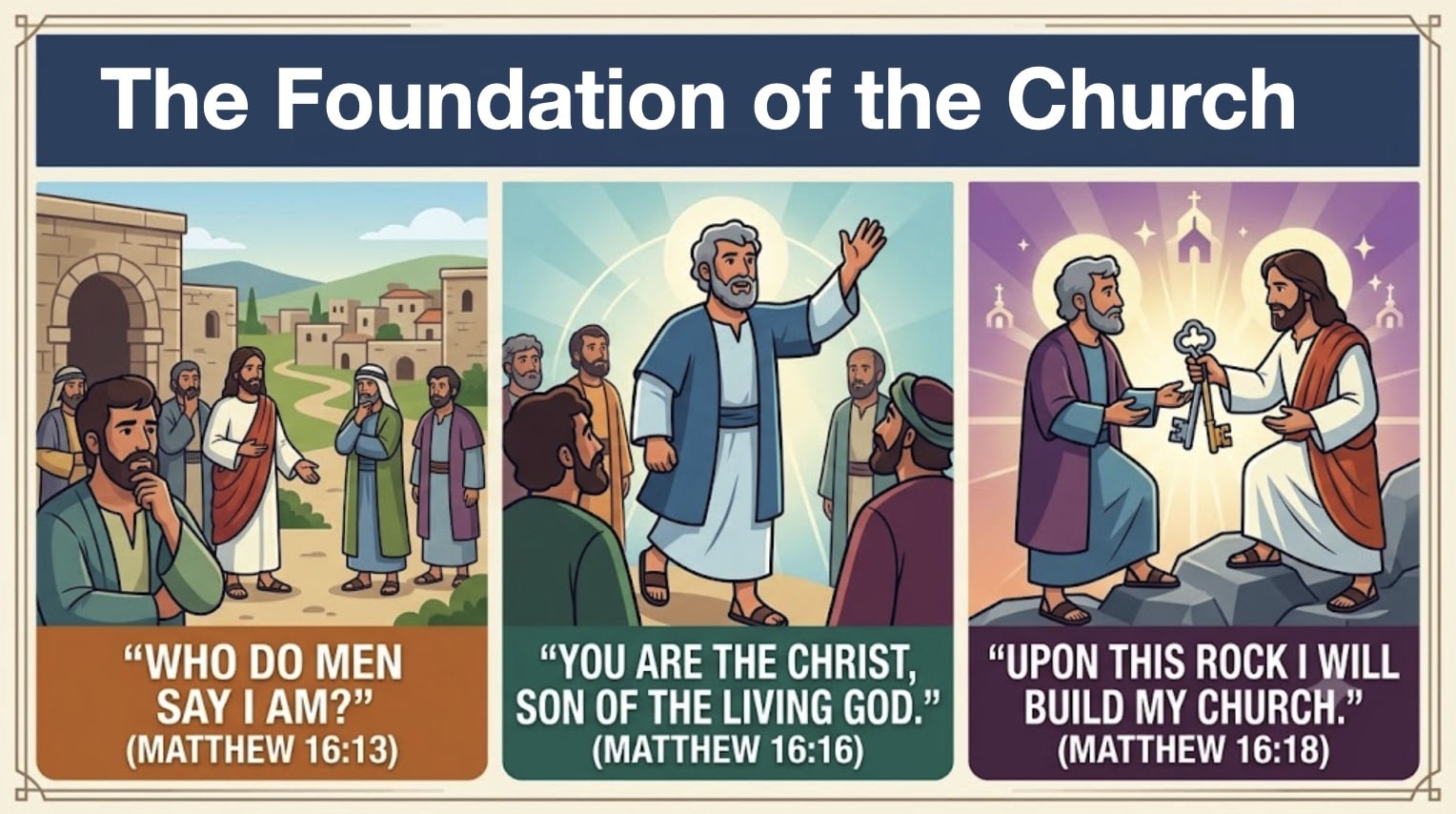
Write an engaging description meant to get readers to read Larry Broding’s commentary which can be used to help preachers prepare their own homily. After a brief introduction give bulletin points of why this commentary matters for your homily. conclude with “Read Larry Broding’s full commentary to help your congregation…” Complete sentence.
Faith and Church Leadership
Larry Broding’s commentary on Matthew 16:13–20 bridges the gap between ancient cultural contexts and modern spiritual realities, offering pastors a rich springboard for homily preparation.
- Provocative Homiletic Hooks: Broding opens by connecting our modern struggle for self-identity—and our susceptibility to peer pressure—with the cultural backdrop of first-century Israel. This offers an engaging entryway to introduce Jesus’ ultimate question (“Who do you say I am?”) to a modern congregation.
- Cultural & Contextual Depth: The commentary highlights the shift in group-oriented dynamics at Caesarea Philippi, helping you illustrate to your parishioners how identity in the ancient world was defined by community, and how Simon’s confession redefined the entire group.
- Nuanced Linguistic Insights: With clear breakdowns of terms like “flesh and blood,” “gates of Hades,” and “Simon bar-Jonah,” you gain accessible background details to enrich your sermon without bogging listeners down in overly academic jargon.
Commentary by Dr. Brant Pitre | Catholic Productions

Commentary by Fr. Francis Martin | The Word Proclaimed
clean up grammar and spelling, create an outline for the following transcript xxxxxxxxxxxx
Outline
I. Historical Setting and the Identity of Jesus
- A. Journey to Caesarea Philippi: Setting the scene in a Gentile region to signify the universal scope of Jesus' mission.
- B. The "Son of Man" Title:
- Understanding the Hebrew idiom as the quintessential human being.
- Rooting the title in Daniel 7:13 (the apocalyptic figure receiving eternal dominion and embodying the saints of the Most High God).
- Analogy of the solution and string: how the term crystallizes diverse threads of Jewish theology.
- C. Popular Opinions vs. Disciples' Belief: Popular views of Jesus as a resurrected prophet (John the Baptist, Elijah, Jeremiah) versus the direct question to the disciples.
II. Peter’s Confession and Divine Revelation
- A. The Confession: Peter acknowledges Jesus as the Christos (the Messiah, the anointed successor to King David) and the Son of the Living God.
- B. Old Testament Foundations of the Messiah: Citing 2 Samuel 7 and Chronicles regarding the enduring house of David and the promised ideal ruler.
- C. Divine Revelation: Jesus’ declaration that human reasoning ("flesh and blood") did not reveal this, but the Father in Heaven; the beatitude of receiving eschatological revelation.
III. The Primacy of Peter and the Foundation of the Church
- A. The Name Change: Simon becomes Kepha / Petros (Rock), marking a major salvation-historical turning point akin to Abram becoming Abraham or Jacob becoming Israel.
- B. The Rock and the Temple (Petra):
- Linking the Rock to Jewish traditions regarding the foundation stone of the Jerusalem Temple (the cosmic center and the place of Isaac's binding).
- The Church (Ekklesia) as the new temple built upon this foundation.
- C. Overcoming the Gates of Hades: The Church positioned over the forces of darkness, guarding against evil.
IV. The Keys, Binding and Loosing, and Pastoral Office
- A. Authority of the Keys: Fulfilling the prefiguration of Eliakim in Isaiah 22 through the bestowal of the keys of the kingdom.
- B. Human Weakness and Divine Guidance: Peter as both a flawed human being (e.g., Paul’s confrontation in Galatians) and the divinely appointed shepherd.
- C. The Petrine Ministry Today: Praying for the Pope and bishops, recognizing the enduring continuity of the oldest institution in human history.
Cleaned Transcript
Historical Setting: Caesarea Philippi
Now we come to that famous section of the Gospel of Matthew—chapter 16—where our Lord establishes Peter as the Rock. I think it is going to be very helpful to realize, through good historical context, how the text becomes so much more understandable. After making it understandable, of course, we still have to commit ourselves to it in faith.
Jesus went into the region of Caesarea Philippi. Up to this point, He had been around the Sea of Tiberias, but now He goes northeast into a region that is predominantly Gentile and pagan. Why does Matthew stop to tell us that? Because by setting this moment in a non-Jewish environment, Matthew implies the universal scope of what Jesus is about to establish.
Jesus asks His disciples, "Who do people say that the Son of Man is?" Now, isn't that interesting? "Son of Man" is His primary self-designation. What does it mean? In Semitic idiom, "son of..." expresses the quintessential quality of something. So the Son of Man is the ultimate human being. But it is also a direct allusion to Daniel 7:13, where Daniel has a vision of "one like a Son of Man" coming to the Ancient of Days and receiving an everlasting kingdom, power, and authority.
That Son of Man in Daniel is a mysterious figure who also embodies all of faithful Israel—later referred to as "the saints of the Most High God." Jesus uses this title because it means: I am the most human of human beings, but I also embody all of Israel, and to Me will be given universal reign, power, and authority.
Back when I was in high school, we did a chemistry experiment with a beaker filled with a solution. You suspended a string into the solution, and over time all the minerals in the liquid crystallized around that single string. "Son of Man" is like that string: when dropped into the environment of Jewish theology, it gathers and crystallizes all the messianic hopes, human realities, and apocalyptic visions around itself.
The Confession at Caesarea Philippi
The disciples report what the crowds are saying: "Some say John the Baptist, others Elijah, and still others Jeremiah or one of the prophets." People assumed one of the great figures of old had come back from the dead.
Then Jesus challenges them directly: "But what about you? Who do you say that I am?"
Simon Peter answers: "You are the Christ, the Son of the living God."
In Romans 11, we saw the mystical enlightenment given to Paul that burst into a hymn of praise. Here in Matthew 16, we have the mystical enlightenment given to Peter that yields this profound profession of faith. Peter says, "You are the Christos, the Son of the living God."
Who is the Christos? He is the anointed successor to David. Christos comes from the Greek word chrisma, meaning "anointing"—the exact equivalent of the Hebrew Mashiach (Messiah). The prophets held out hope for an anointed successor to David who would bring peace, righteousness, and loyalty to God, leading the nations to live according to God's law.
We see the roots of this in 2 Samuel 7, in Nathan's prophecy to David: "When your days are fulfilled and you lie down with your ancestors, I will raise up your offspring to succeed you... I will be his father, and he shall be my son." In 1 Chronicles, this promise is reaffirmed with even greater messianic focus: that this throne will endure forever. Peter looks at Jesus and says: You are that one. You are the Christos, the Son of the living God.
Divine Revelation and the New Name
Jesus answers him: "Blessed are you, Simon son of Jonah! For flesh and blood has not revealed this to you, but my Father in heaven."
God the Father enlightened Peter above all the others so that he could speak with certitude and clarity: "You are the Messiah, the Son of the living God." Imagine the spiritual leap required to utter those words! That is why Jesus pronounces a beatitude over him: "Blessed are you." Human resources—flesh and blood—could never yield that insight. It was revealed directly by the Father.
This beatitude of receiving divine revelation is mirrored in Matthew 13, where Jesus tells the disciples: "Blessed are your eyes because they see, and your ears because they hear. Truly I tell you, many prophets and righteous people longed to see what you see but did not see it, and to hear what you hear but did not hear it." If we remain faithful in prayer, the Lord reveals Himself to us in that same intimate way.
Jesus continues: "And I tell you that you are Petros [Rock], and on this petra [rock] I will build my Church."
In Aramaic, Jesus used the word Kepha—"Rock." In Greek, it translates to Petros for the masculine name and petra for the rock foundation. This is a salvation-historical turning point. Whenever God gives someone a new name in Scripture—Abram becoming Abraham, Jacob becoming Israel—it signifies a new mission and a new identity.
Jesus adds: "And on this rock I will build my Church [Ekklesia], and the gates of Hades shall not prevail against it."
In Jewish tradition, the foundation stone (Even Shetiyya) beneath the Jerusalem Temple on Mount Zion was viewed as the center of the cosmos, sealing the entrance to the watery abyss below, and marking the spot where Abraham offered Isaac. Jesus uses that familiar imagery: Peter is the new foundation stone, and upon this rock Jesus builds His new temple—the Church. Sitting atop the powers of evil, the Church is built so that the forces of darkness will never overwhelm it. Commentators like Dale Allison and W.D. Davies note that the informed reader sees the Church situated at the cosmic center, standing victorious over the underworld.
The Authority of the Keys and the Petrine Ministry
Jesus then promises: "I will give you the keys of the kingdom of heaven." This directly echoes Isaiah 22, where the prime minister Eliakim receives the key of the house of David on his shoulder—what he opens no one shuts, and what he shuts no one opens.
Jesus bestows real authority upon Peter to shepherd, to govern, and to guide the worshipping community—to bind and to loose. Why establish a visible human head? Because you can dialogue and interact with a living shepherd, whereas people simply argue over a written document.
Peter was a real human being who could make personal mistakes. In Galatians, Paul describes confronting Peter face-to-face when Peter withdrew from eating with Gentile believers out of fear of the Judaizers. Peter was the Rock, but he remained a human shepherd subject to growth and correction. There is immense divine wisdom in this structure: despite the human frailties of individual popes throughout history, Christ's promise stands firm, making the Catholic Church the oldest continuous institution in the world.
This is why at every Mass we pray for the Pope and the bishops who share in his shepherd's care. Christ knew what He was doing; He knew He could guide His Church through human instruments. Peter receives the authority of the keys to care for the flock, to preserve the unity of faith, and to lead the household of God.
Click chevron banner to read transcript
organized into thematic sections.
Doctrinal Homily Outlines
Central idea: The Keys of the Kingdom
Doctrine: The Office of the Pope
Application: Cooperating with the Pope and one’s Bishop
Sunday Prep Videos
21st Sunday of Year A