Liturgy, Liturgy Notes, Liturgy Planner, Sunday Prep, Planning for Mass
Liturgy Notes, Liturgy Planner, Sunday Prep, Planning for Mass
August 23, 2026
Aug 23 | Today | Aug 30 | Sept 6 | Sept 13






PETITIONS
August 23, 2026
The Church
Governments and Salvation of the World
Those Burdened by Adversity
Local Parish / Faith Community
THE WORD
IN SONGS
THIS WEEK


ONE WORD
MANY CHARISMS
Sunday Lectionary Perspectives Across Religious Traditions


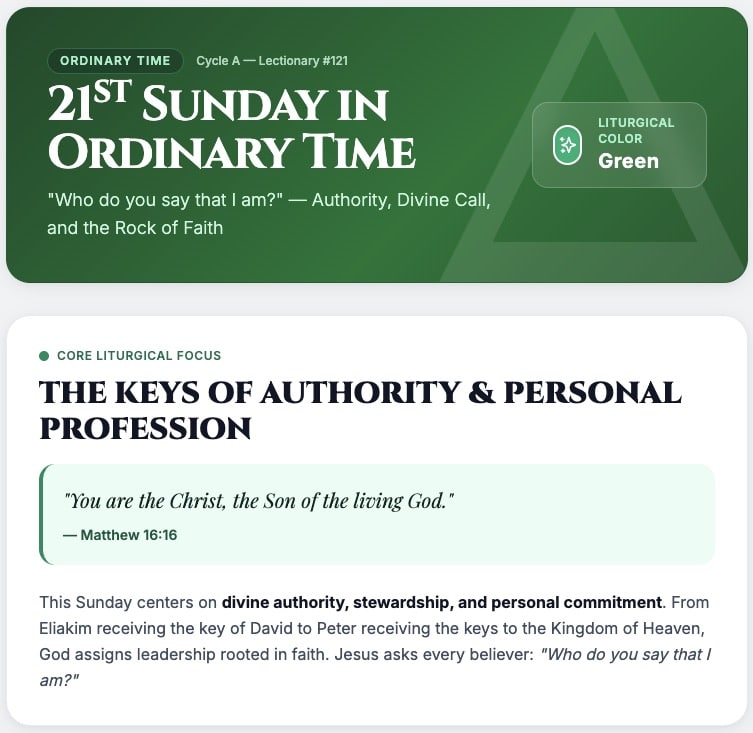
21st Sunday of Year A
August 23, 2026



THE WORD THIS WEEK
Rock of the true church,
Keys of heaven handed down,
Bound and loosed on earth.
August 23, 2026


Papal Homilies




✍️ From Presidents to Saints
Faces on Rock
Featured Blog Posts
August 23, 2026
Fr. George Corrigan, OFM
The Three Questions
Forming the Church
Christology for 21st Sunday (A)
An Emerging Church
The Developing Church
The Keys to the Kingdom
What Kind of Person...What Kind of Community
When We Don't Feel Rock Solid
Msgr. Joseph Pellegrino (PDF) | Archive
You Are Peter (2026)
Fr. Tommy Lane | Archive
Spoiler alert! Evil will not prevail 2023
You are Peter and on this rock I will build my Church 2008
Jesus the Messiah different than expected
You are the Christ, the Son of the living God
Fr. Michael Fallon, MSC | Archive
21st Sunday in Ordinary Time (PDF)
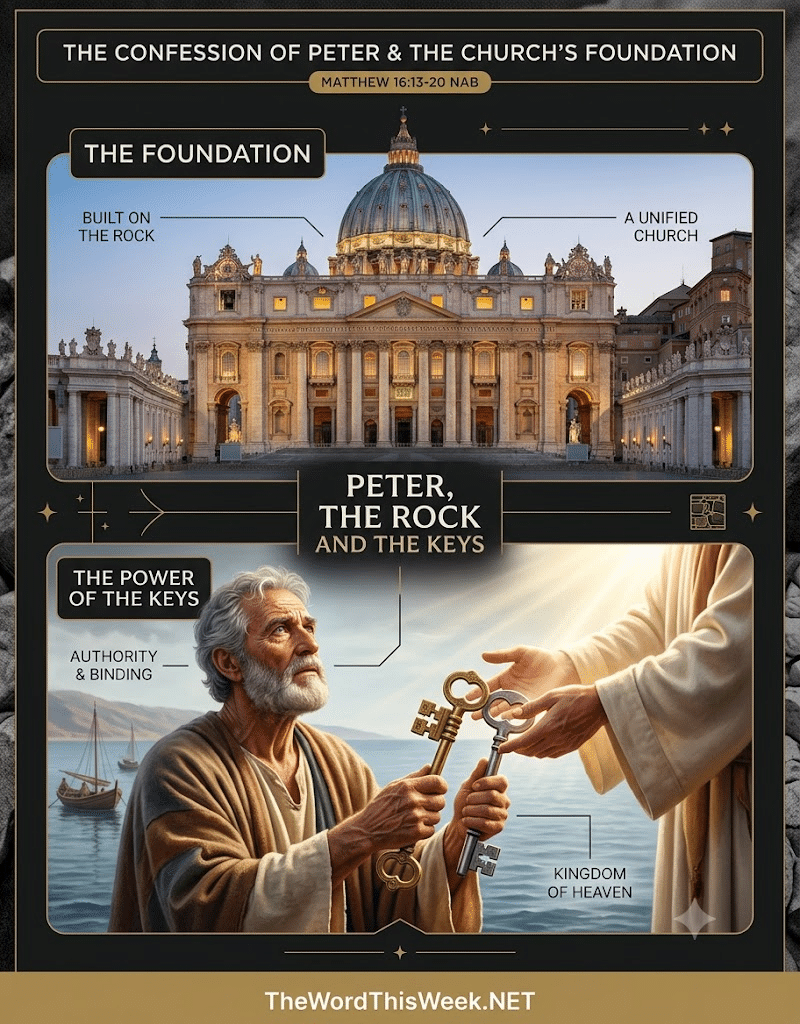
Liturgy Notes

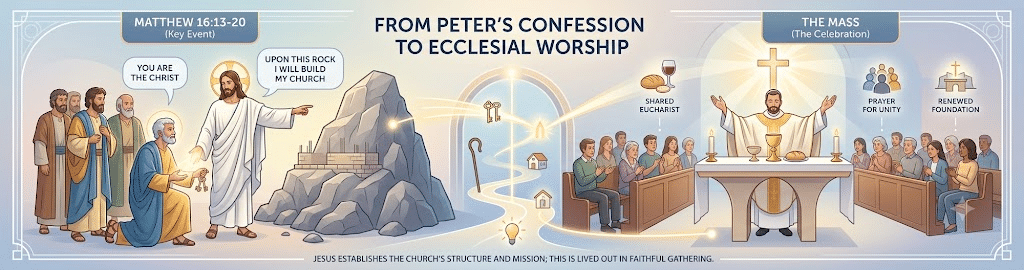



Entrance Song

Response & Acclaim
Response & Acclaim


2026 PLAYLIST (152 VIDEOS)


2026 PLAYLIST (152 VIDEOS)
Presentation & Preparation
Presentation and Preparation

Communion
Communion
Sending Forth
Sending Forth

He Is Exalted (Twila Paris)
SPIRIT & SONG | THE COMMONS
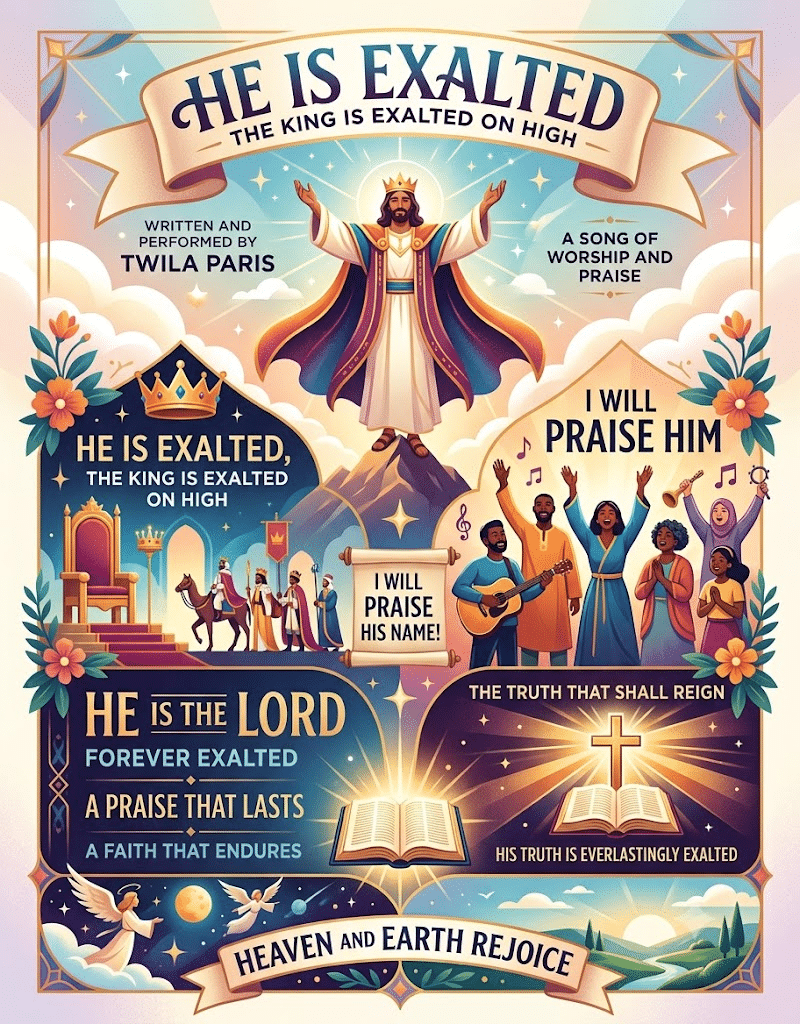
Liturgy Blog is a weekly liturgy planning resource for musicians, liturgists, homilists, youth groups, faith sharing groups, and all who look to the liturgical readings for inspiration and nourishment. Join Ken Canedo as he breaks open the Scripture and suggests tracks from the Spirit & Song contemporary repertoire.
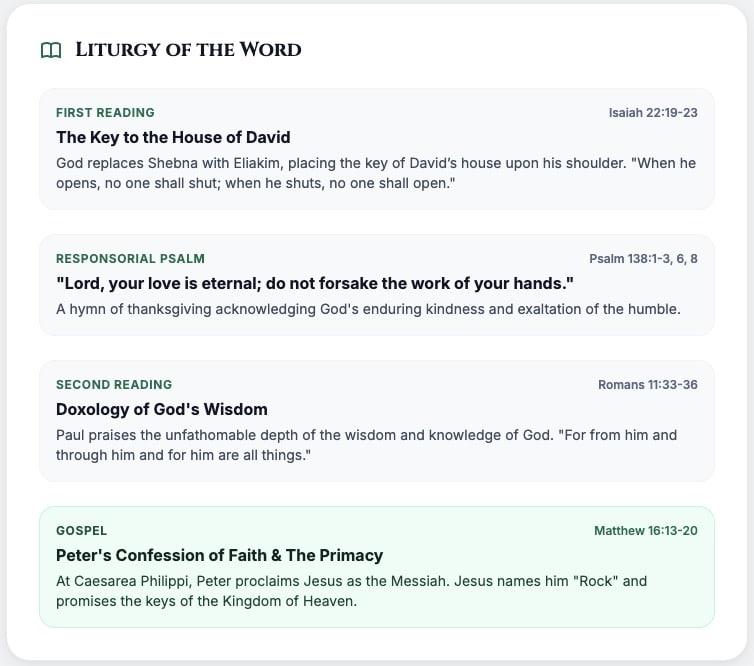
Isaiah 22:19-23

Video courtesy of Lector with Lisa

Proclamation
Text Segment | Vocal Tone | Pacing & Ambo Actions |
A reading from the book of the prophet... | Warm, inviting, clear | Eye Contact: Look up and make eye contact with the assembly. |
...Isaiah. | Distinct emphasis | Pause: Brief pause after "prophet." Pause again after "Isaiah" to let the congregation settle and prepare to listen. |
Thus says the Lord to Shebna, | Authoritative, firm | Pause: Deliberate pause right after "Shebna." |
master of the palace: | Explanatory, defining | Note: Pronounced SHEB-nah. Define his title clearly so the audience understands his high rank. |
I will thrust you from your office and pull you down from your station. | Stern, severe, unyielding | Long Pause: Hold a long pause after "station." Let the weight of God's anger and judgment sit in the room. |
On that day I will summon my servant Eliakim, son of Hilkiah; | Proclamatory, shifting tone | Pronunciation: eh-LYE-ah-kim (accent 2nd syllable) and hil-KYE-ah (accent 2nd syllable, long 'i'). |
I will clothe him with your robe, | Direct, declarative | Action: Direct voice to the left side of the church. |
and gird him with your sash, | Direct, declarative | Action: Pivot voice to the right side of the church. |
and give over to him your authority. | Decisive climax | Action: Bring voice back to center. Emphasize the transfer of power. |
He shall be a father to the inhabitants of Jerusalem, and to the house of Judah. | Warm, caring, reassuring | Shift to a softer tone—Eliakim will actually care for the people. |
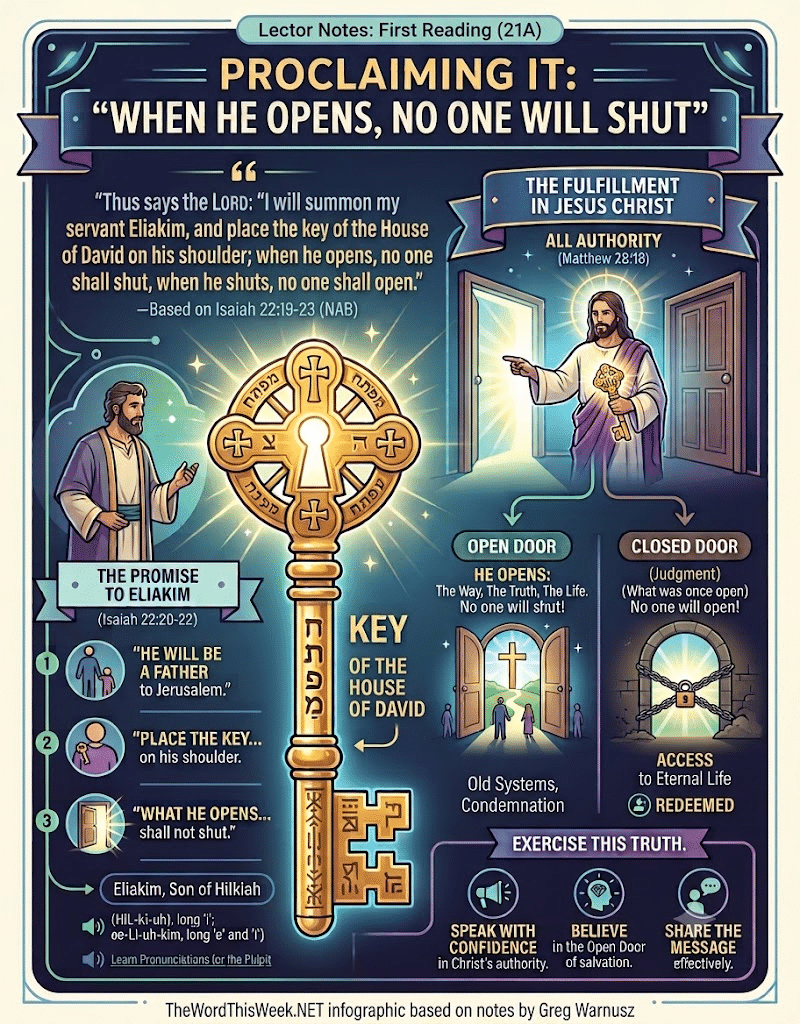
I will place the key of the House of David on Eliakim's shoulder; | Solemn, prophetic | Highlight "key" and "shoulder." This foreshadows the Gospel authority. |
when he opens, no one shall shut; | Pitch inflection: RISING | Pitch: Raise vocal pitch slightly on "opens." |
when he shuts, no one shall open. | Pitch inflection: FALLING | Pitch: Drop vocal pitch firmly on "shuts." Tone signals: This is a done deal. |
I will fix him like a peg in a sure spot, | Grounded, stable | Emphasize "peg" and "sure spot"—absolute permanence. |
to be a place of honor for his family. | Affirming, reverent | Action: Subtle, deliberate head nod. Highlight the reward for righteousness. |
(Silence) | Quiet stillness | Action: Lower eyes back to the lectionary, pause, look back up to the assembly. |
The word of the Lord. | Reverent, conclusive | Clear, strong finish. |
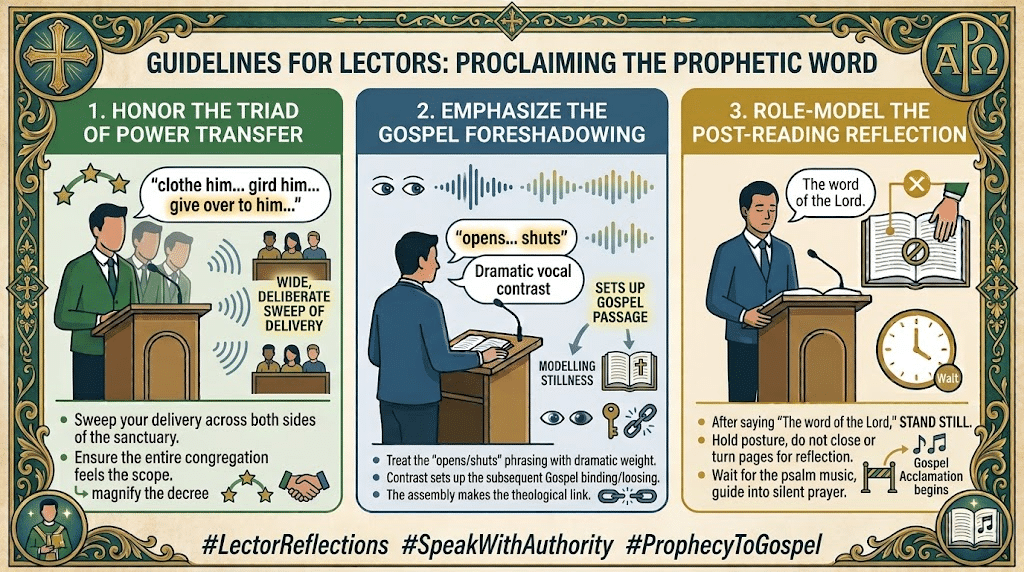
Ambo Reminders
- Honor the Triad of Power Transfer: When proclaiming "clothe him... gird him... give over to him...", deliberately sweep your delivery across both sides of the sanctuary to ensure the entire congregation feels the scope of the decree.
- Emphasize the Gospel Foreshadowing: Treat the "opens/shuts" phrasing with dramatic weight. Your vocal contrast here sets up the Gospel passage ("whatever you bind on earth shall be bound in heaven...").
- Role-Model the Post-Reading Reflection: After saying "The word of the Lord," do not turn the page or walk away immediately. Stand still, hold your posture, and reverently reflect on the Word for a few seconds. Wait until the psalm music begins before moving so you guide the congregation into silent prayer.
Isaiah 22:19-23
Greg Warnusz

The Historical Situation: Chapters 13 through 23 of Isaiah are oracles in which the prophet pronounces God's judgment against various nations. Babylon, Assyria, Syria, Tyre, Sidon and Egypt all take their licks, as you might expect. But chapter 22 is directed at Jerusalem, capital of Judah and home of many of God's chosen people. In particular, a royal official named Shebna gets severely criticized and told that he will have to yield to a replacement named Eliakim. When Isaiah promises the "key of the house of David" to Eliakim, he's summoning the memory of Judah's long-gone greatest king, and the happy memory of an old golden age. We read this passage today only to prepare ourselves to hear the day's gospel, Matthew 16:13-20, where Jesus grants Peter "keys to the kingdom of heaven."
Romans 11:33-36

Video courtesy of Lector with Lisa
Proclamation
Text Segment | Vocal Tone | Pacing & Ambo Actions |
A reading from the Letter of Saint Paul to the Romans | Warm, inviting, settled | Eye Contact: Establish strong eye contact with the assembly. Pause: Brief pause before starting the text. |
Oh, the depth of the riches and wisdom and knowledge of God! | Filled with awe and wonder | Launch with genuine passion and emotion. Do not rush—let "depth," "riches," "wisdom," and "knowledge" land with weight. |
How inscrutable are his judgments | Reverent, contemplative | Definition: Inscrutable means impossible to understand or scrutinize. Deliver with humility. |
and how unsearchable his ways! | Majestic, building intensity | Treat the scriptural exclamation point with true marvel. We cannot map out God's ways. |
"For who has known the mind of the Lord | Inquiring, direct | Vocal Shift: Shift into a clear questioning tone. Pose it directly to the congregation as a real question. |
or who has been his counselor? | Slightly rhetorical, humbled | Eye Contact: Sweep your gaze across the assembly. Tone implies: None of us. |
Or who has given the Lord anything that he may be repaid?" | Piercing, clear | Emphasize "anything" and "repaid." Let the implied answer (no one) settle in the silence. |
For from him and through him and for him are all things. | Decisive, declarative climax | Vocal Shift: Heavy vocal stress on the three prepositions: from, through, and for. |
To him be glory forever. | Solemn, exalted | Bring the declaration to a majestic, full-throated conclusion. |
Amen. | Confident, reverent | Pause after saying "Amen." Allow space if the congregation responds with an "Amen." |
(Silence) | Quiet stillness | Action: Lower eyes to the lectionary, pause, pray briefly for those struggling to trust God's plan, then look back up. |
The word of the Lord. | Clear, firm, conclusive | Proclaim with warmth and reverence. |
Ambo Reminders
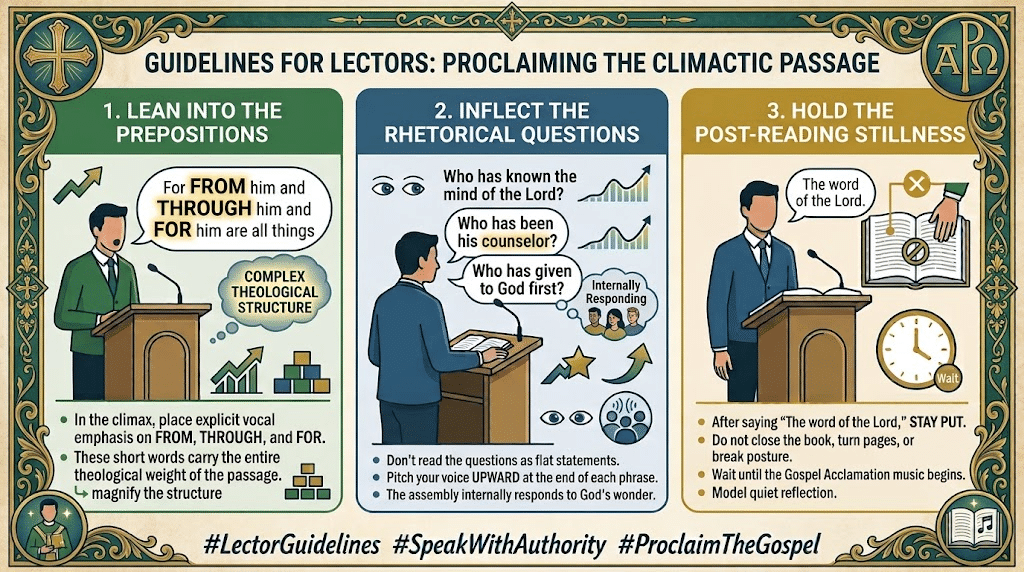
- Lean Into the Prepositions: In the climax ("from him and through him and for him..."), place explicit vocal emphasis on from, through, and for. These short words carry the entire theological weight of the passage.
- Inflect the Rhetorical Questions: Don't read the three middle questions as flat statements. Pitch your voice upward at the end of each phrase so the assembly internally responds to the wonder of God's mind.
- Hold the Post-Reading Stillness: After saying "The word of the Lord," stay put. Do not close the book, turn pages for Father, or break your posture until the Gospel Acclamation music begins. Use those quiet seconds to model quiet reflection for the congregation.
Romans 11:33-36
Greg Warnusz
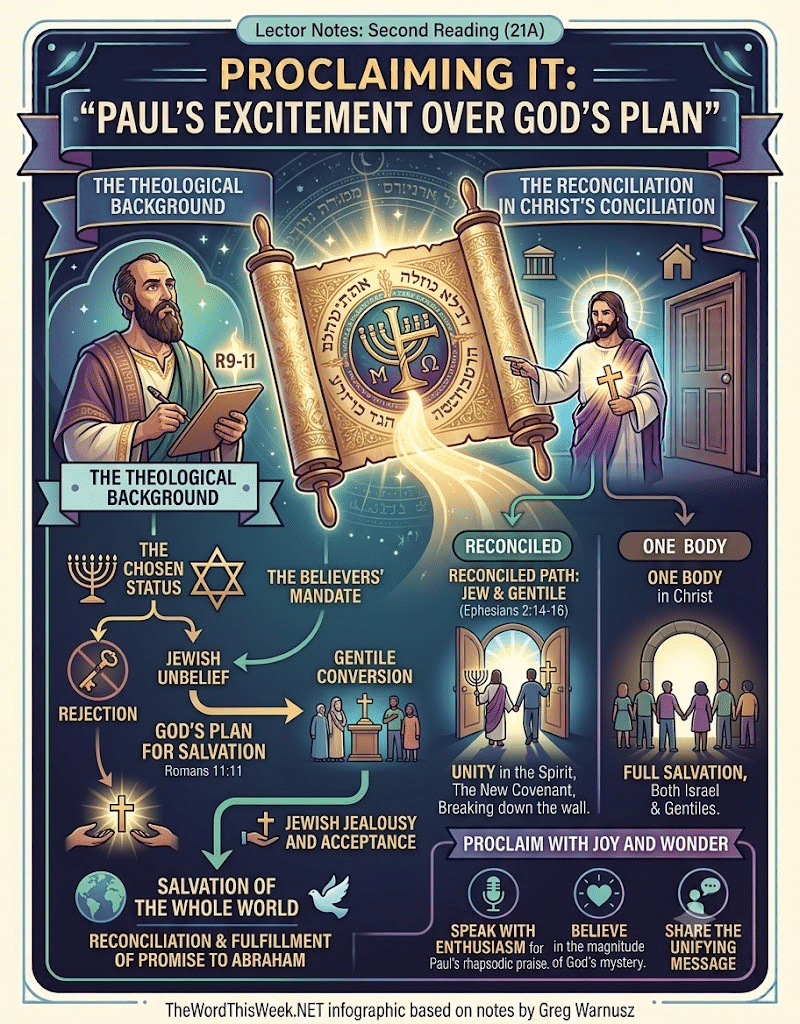
The Theological Background: What had Paul so excited? In Romans, chapters 9-11, Paul speculates on how the Jews, always God's chosen people, could apparently forfeit their chosen status by failing to accept Jesus. Since we don't get to read the whole passage, let me summarize it. God's plan calls for the Jews to reject Jesus so that a few believers, like Paul, would be forced to carry the good news outside Judaism and evangelize the Gentiles. When Gentiles are converted, the Jews will be impressed, not to mention jealous, and accept Christ themselves. The result will be the salvation of the whole world and the reconciliation of Jews and Gentiles, goods even greater than the election of Israel. The ancient promise of God to Abraham will not go unfulfilled.
Proclaiming It: This beautiful passage calls for careful oral interpretation. Saint Paul is so excited about something he has written in prior paragraphs that he bursts into this rhapsodic praise of God. Try to capture Paul's mood when you proclaim this passage to the congregation.