Commentary Intro to Mass Readings Sunday Readings
CommentaryIntro to Mass Readings Sunday Readings
September 13, 2026
⭐⭐⭐ Fr. George Corrigan, OFM—PDF


September 13, 2026
Our Sunday Readings *
Edrianne Ezell
Catholic Scripture Study *
Vince Contreras
Hearers of the Word *
Fr. O’Mahony OSA
Friar Musings, OFM *
Fr. George Corrigan, OFM
Echoing God’s Word *
Fr. Clement Thibodeau


“A Walk in The Word” series is based on the Sunday Mass readings and led by International Catholic evangelist and bible teacher, Hector Molina.

Ten minute video excerpts from the “The Mass Readings Explained” subscription series based resource from Catholic Productions.

Francis Martin (1930 – 2017) was an American Catholic priest of the Archdiocese of Washington, and a professor of Sacred Scripture. His teaching appointments included the Dominican House of Studies, the John Paul II Institute, the Catholic University of America, and Sacred Heart Major Seminary.
Kevin Aldrich
Kevin Aldrich’s “Doctrinal Homily Outlines” is a lectionary-based aid for homilists. A career Catholic K-12 educator in Catholic schools., he has written the teacher guides for nine of the Didache series high school religion texts. He has a Master’s Degree in Theology with an emphasis on Sacred Scripture from Holy Apostles College and Seminary.

Fr. Geoffrey Plant
24th Sunday of Year A

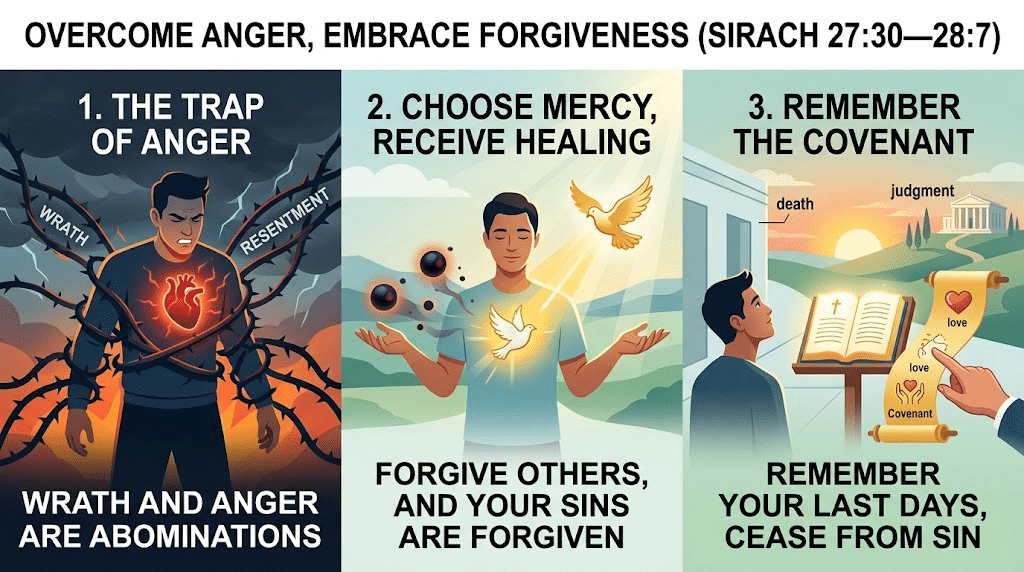
Sirach 27:30—28:7
Create a verse by verse (NAB) commentary relating xxxxxxxxxxxxx TO CATHOLIC doctrine and practice. Give real life applications when appropriate
give me three thought provoking questions followed up with detailed answer reflection based on xxxxxxxxxxxx
Sirach 27:30
"Wrath and anger, these also are abominations, yet a sinner holds on to them."
- Catholic Doctrine & Tradition: Wrath (ira) is classified among the Seven Capital Vices (CCC 1866). While righteous indignation against injustice can be morally neutral or good, the deliberate cultivation of destructive anger and resentment is sinful. Holding tight to anger turns a passing passion into a habitual state of soul that blinds moral judgment and disrupts charity.
- Practice: Examination of Conscience. In Catholic spiritual direction, holding grudges is recognized as spiritual poison that blocks the reception of grace.
- Real-Life Application: When someone betrays you or slighted you at work, your initial flash of anger is an emotion; choosing to replay the event obsessively, nurse the hurt, and plan retaliation is "hugging the anger tight." Healing begins by acknowledging the hurt in prayer and consciously refusing to feed the grievance.
Sirach 28:1
"The vengeful will face the Lord’s vengeance, indeed he remembers their sins in detail."
- Catholic Doctrine & Tradition: Divine Justice and Divine Retribution. St. Paul echoes Deuteronomy: "Beloved, do not look for revenge but leave room for the wrath; for it is written: 'Vengeance is mine, I will repay, says the Lord'" (Rom 12:19; Deut 32:35). Usurping God’s role as the supreme Judge invites strict divine judgment upon oneself (James 2:13).
- Practice: The Act of Contrition and Sacrament of Penance. We rely entirely on God's willingness to blot out our transgressions (Ps 51:1); if we demand absolute scorekeeping for others, God measures us by the same standard.
- Real-Life Application: Refrain from digital "call-outs," subtle sabotage, or passive-aggressive retaliations against difficult family members or colleagues. Leaving justice to God means refusing to inflict payback.
Sirach 28:2
"Forgive your neighbor the wrong done you; then when you pray, your sins will be forgiven."
- Catholic Doctrine & Tradition: This verse directly anticipates the 5th Petition of the Lord's Prayer: "Forgive us our trespasses, as we forgive those who trespass against us" (Matt 6:12, CCC 2838–2845). Catholic theology teaches that God’s mercy cannot penetrate a hardened, unforgiving heart. Forgiveness is not merely an emotion, but an act of the will aided by grace.
- Practice: The Liturgy. Before presenting gifts at the altar or receiving the Holy Eucharist, the faithful are called to reconcile with their brethren (Matt 5:23–24; the Sign of Peace).
- Real-Life Application: When praying for personal forgiveness—whether during the Confiteor at Mass or in private night prayer—explicitly name those who have injured you and pray a blessing over them, choosing to release the moral debt they owe you.
Sirach 28:3–4
(3) "Could anyone nourish anger against another and expect healing from the Lord?
(4) Could anyone refuse mercy to another like himself, can he seek pardon for his own sins?"
- Catholic Doctrine & Tradition: Solidarity and the Parable of the Unforgiving Servant (Matt 18:21–35). Because all human beings share a fallen nature and stand in equal need of divine mercy, withholding forgiveness from a fellow creature while begging pardon from the Creator is a profound moral contradiction (CCC 2843).
- Practice: Spiritual Works of Mercy—specifically forgiving injuries and bearing wrongs patiently.
- Real-Life Application: Within a marriage or close family dynamic, when tempted to give the "silent treatment" or demand endless groveling before granting forgiveness, remember how quickly you run to Christ expecting total, unearned absolution for your own repeated failures.
Sirach 28:5
"If one who is but flesh cherishes wrath, who will forgive his sins?"
- Catholic Doctrine & Tradition: Human Frailty and Creatureliness. As creatures made of dust ("flesh"), humans have no ground for self-righteous pride. Pride is the root of an unforgiving spirit; humility recognizes our shared vulnerability and mutual dependence on God’s unmerited favor (CCC 2559).
- Practice: Ash Wednesday liturgy ("Remember that you are dust, and to dust you shall return").
- Real-Life Application: When feeling morally superior to an offender, remind yourself of your own secret faults, moral lapses, and physical mortality. A humble perspective diffuses indignation.
Sirach 28:6
"Remember your last days, set enmity aside; remember death and decay, and cease from sin!"
- Catholic Doctrine & Tradition: The Four Last Things (Novissima): Death, Judgment, Heaven, and Hell (CCC 1020–1050). The Catholic tradition of Memento Mori ("remember your death") serves as a powerful antidote to trivial earthly quarrels. Entering eternity carrying unresolved hatred endangers one's eternal salvation.
- Practice: Night Prayer (Compline), where the Church prays: "Into your hands, Lord, I commend my spirit," acknowledging the possibility of dying before dawn.
- Real-Life Application: Ask yourself: "If I or this person were to die tonight, would this argument matter at my Particular Judgment before Christ?" Let the certainty of death extinguish long-standing feuds and estrangements.
Sirach 28:7
"Think of the commandments, hate not your neighbor; remember the Most High’s covenant, and overlook faults."
Real-Life Application: In daily life, give others the benefit of the doubt. Overlook unintentional slights, rude tones, or irritating habits in communal and household life without escalating them into major conflicts.
Catholic Doctrine & Tradition: The Great Commandment and the New Covenant. This verse bridges the Old Covenant Law of Charity (Lev 19:18) with the New Law of the Gospel (John 13:34). Overlooking faults reflects Divine Patience (longanimitas) and charity, which "covers a multitude of sins" (1 Pet 4:8; CCC 1825).
Practice: Practicing fraternal charity by interpreting others' ambiguous intentions in the best possible light (St. Ignatius of Loyola’s Spiritual Exercises, Presupposition).
Algorithmically generated text
give me three thought provoking questions followed up with detailed answer reflection based on xxxxxxxxxxxx. Keep questions and answers appropriate for Sunday congregation giving real life application.
The theological architecture of Sirach 27:30—28:7 forms the direct conceptual and scriptural foundation for Jesus’ Parable of the Unforgiving Servant (Matthew 18:21–35). Both passages establish that human forgiveness is not optional, but a strict prerequisite for receiving divine mercy.
Direct Thematic & Structural Parallels
Theological Theme | Sirach 27:30—28:7 (Old Testament Wisdom) | Matthew 18:21–35 (Gospel Parable) |
The Moral Contradiction | "Could anyone refuse mercy to another like himself, can he seek pardon for his own sins?" (28:4) | "Should you not have had mercy on your fellow servant, as I had mercy on you?" (18:33) |
Clinging to Wrath & Revenge | "Wrath and anger, these also are abominations, yet a sinner holds on to them." (27:30) | The servant seizes his debtor by the throat, demanding payment and refusing patience (18:28–30). |
Conditional Divine Pardon | "Forgive your neighbor the wrong done you; then when you pray, your sins will be forgiven." (28:2) | "So will my heavenly Father do to you, unless each of you forgives his brother from his heart." (18:35) |
Reciprocal Judgment | "The vengeful will face the Lord’s vengeance, indeed he remembers their sins in detail." (28:1) | The master hands the unforgiving servant over to the torturers until the full debt is paid (18:34). |
Shared Human Frailty | "If one who is but flesh cherishes wrath, who will forgive his sins?" (28:5) | Both men are fellow servants (syndouloi), yet the first forgets his shared status (18:29, 33). |
Remembering the Ultimate Reckoning | "Remember your last days... remember death and decay, and cease from sin!" (28:6) | The settling of accounts at the end of time; the inescapable final judgment (18:23–24, 34). |
Key Theological Connections
- The Geometry of Forgiveness (Vertical vs. Horizontal):Both texts reject the idea that our relationship with God (vertical) can be separated from how we treat our neighbor (horizontal). In Sirach 28:3–4, withholding mercy breaks the flow of God's healing. In Matthew 18, the servant's debt of 10,000 talents (an unpayable cosmic sum representing human sin against God) is forgiven freely, making his refusal to forgive a trivial debt of 100 denarii (a small interpersonal wrong) a catastrophic act of ingratitude.
- God’s Judgment Mirrors Our Own Standard:Sirach warns that God will "remember sins in detail" if we hold onto our neighbor's sins. Jesus concludes His parable with the exact same principle: the measure of mercy we extend is the measure we will receive at the Final Judgment (cf. Matthew 7:2; James 2:13).
- Forgiveness as an Act of the Heart:Sirach commands us to "set enmity aside" and "overlook faults" out of fidelity to the Covenant. Jesus takes this to its definitive Gospel depth, demanding forgiveness "from your heart" (Matt 18:35)—not merely external compliance, but a deliberate interior release of resentment.
Algorithmically generated text
Catholic spiritual theology—rooted in St. Thomas Aquinas, St. Francis de Sales, and modern masters like Fr. Jacques Philippe—treats forgiveness not as an immediate emotional reaction, but as a deliberate act of the will aided by grace. When injuries are severe, deep, or repeated, the Church offers a realistic, step-by-step spiritual framework to guide the soul from injury to peace.
1. Distinguish What Forgiveness Is and Is Not
Before beginning, Catholic moral theology clarifies common misunderstandings:
- It is not forgetting or pretending the wrong did not happen: Forgiveness acknowledges the full gravity of the sin. If an act was not evil, it would require understanding, not forgiveness.
- It is not an emotion: You do not have to "feel" warm toward an offender. Forgiveness resides in the rational will (voluntas), not the passions.
- It is not automatic reconciliation or enabling abuse: Forgiveness releases the debt and ill will; prudence, justice, and self-defense may still require firm boundaries, legal accountability, or physical distance (CCC 2264).
2. Acknowledge and Name the Wound
- Bring the unfiltered pain to God in prayer: Follow the model of the Psalms of Lament (e.g., Psalm 55, Psalm 22). Suppressing anger or spiritualizing away deep hurt leads to buried bitterness.
- Admit the injustice: State clearly before the Lord what was stolen or broken—reputation, trust, physical safety, or peace of mind.
3. Make the Decision to Relinquish Vengeance
- Refuse retaliation: Forgiveness begins with the negative choice: “I will not seek payback, slander this person, or wish them harm.” (Rom 12:17–19).
- Transfer the scales of justice to God: Surrender the right to be the judge and executioner. Entrust both the offender and the offense to God’s perfect, eternal justice and mercy (CCC 2843).
4. Rely on the Sacraments and the Cross
- The Crucifix as the Source: Humans cannot forgive grave evil by natural willpower alone. Look to Christ on Calvary: "Father, forgive them, for they know not what they do" (Luke 23:34). Unite your suffering to the Cross.
- Sacrament of Reconciliation: Experiencing total, unmerited absolution for one's own sins softens the heart and provides the grace needed to release others.
- The Holy Eucharist: The Eucharist is the sacrament of charity, infusing supernatural grace to love beyond natural human capacity.
5. Pray for the Spiritual Good of the Offender
- Christ’s explicit command: "Pray for those who persecute you" (Matt 5:44).
- Start simple and dry: Even if spoken through clenched teeth, offer a simple prayer: "Lord, bring them to repentance, heal what is broken in them, and grant them salvation." Praying for an enemy's eternal soul gradually dismantles the spiritual power of hatred in the victim's heart.
6. Practice Repeated, Patient Forgiveness
Patience with oneself: St. Francis de Sales emphasizes that spiritual healing is often gradual. Do not judge yourself for lingering emotional pain as long as your will remains turned toward charity.Algorithmically generated text
"Seventy times seven" (Matt 18:22): For deep wounds, memories and waves of anger will return. Each recurrence is not a failure of the original forgiveness, but a new invitation to renew the act of the will:"Lord, the memory has returned and the pain is fresh, but I reaffirm the choice I made: I forgive them again today."
Resentment is one of the most tenacious passions because it does not feel like a weakness; to the wounded ego, it feels like strength. When Sirach notes that the sinner "holds on" (cherishes or embraces) wrath, he captures the active, possessive grip people keep on their pain.
Holding onto a grievance persists because it offers two powerful psychological and spiritual counterfeits: the illusion of power and the illusion of protection.
1. The False Sense of Power
- Moral Superiority: Resentment keeps the offender permanently in the role of the debtor and the victim in the role of the righteous creditor. Letting go of the grievance feels like forfeiting the high ground.
- The Illusion of Retribution: Nursing anger feels like an active strike against the wrongdoer. There is a subconscious belief that intense, focused indignation somehow penalizes the other person, when in reality, as the adage goes, it is like drinking poison and expecting the other person to die.
- A Substitute for Agency: When an injury leaves someone feeling helpless or violated, anger generates adrenaline and an immediate sense of internal force. It replaces genuine helplessness with an artificial sense of dominance.
2. The False Sense of Protection
- Emotional Armor: Resentment acts as a wall built around a wound. The belief is: "If I stay angry and remember every detail of what you did, I will never let my guard down, and you can never hurt me again."
- Fear of Minimization: Many fear that letting go of wrath means conceding that the injury "didn't matter" or that the injustice was acceptable. Clinging to anger becomes a way of continually testifying that a real evil occurred.
- Identity and Justification: Over time, long-standing grievances become woven into a person's self-concept. The injury becomes an all-purpose excuse for personal shortcomings, cynicism, or emotional distance, creating a fear of who one might be without the grievance.
The Reality: Mere "Flesh and Blood"
Sirach cuts through these illusions by reminding us that we are "but flesh" (Sirach 28:5).
The power resentment promises is purely imaginary—it does not change the past, punish the wrongdoer, or heal the injury. Instead, the grip works in reverse: the person holding the grudge is the one held captive. Releasing wrath is not an admission of weakness or a denial of justice; it is an act of spiritual realism that surrenders the impossible burden of cosmic judge and allows God's grace to heal the actual wound underneath the armor.
Algorithmically generated text
Create a simple, modern infographic illustrating [INSERT BIBLE PASSAGE OR TOPIC]. Use a [SPLIT-SCREEN / 3-PANEL] layout. The style should be clean, high-quality digital art or vector illustration.
Visuals:
Panel 1: Show [DESCRIBE SCENE 1 – e.g., a stormy sea].
Panel 2: Show [DESCRIBE SCENE 2 – e.g., Jesus calming the waves].
Text & Typography:
Font: Use EXTRA LARGE, BOLD, SANS-SERIF FONT (like Arial). Ensure high contrast so text is easily readable.
Header: Write “[INSERT MAIN TITLE]” at the top.
Captions: Include short, punchy text summaries in the panels: “[TEXT FOR PANEL 1]” and “[TEXT FOR PANEL 2]”.
Overall Vibe: Professional, educational, and uncluttered. Avoid small details; focus on big images and big text.

Write an engaging description meant to get readers to read Larry Broding’s commentary which can be used to help preachers prepare their own homily. After a brief introduction give bulletin points of why this commentary matters for your homily.
The Price of Hatred

Navigating cultural tension, broken trust, and fractured relationships isn’t just a modern dilemma—it was the daily reality of second-century B.C. Jerusalem. Larry Broding’s commentary on Sirach cuts straight to the heart of what it means to lead a faithful life when society tempts us to settle scores.
- Exposes the High Cost of Relational Treachery: Slander and betrayal don’t just harm the victim; they corrupt the community and the instigator.
- Frames Forgiveness as Radical Strength, Not Weakness: An uncompromising choice: react to sin at the level of sin, or rise above it with mercy. Forgiveness is not a passive surrender, but as an active, courageous disruption of evil.
- Connects Human Mercy Directly to Divine Grace: If we desire God’s mercy, we must mirror God’s character. Broding highlights this profound biblical principle to challenge listeners to forgive first before asking for pardon.
- Leverages an Urgent Eschatological Reality: Life is short, and our days are numbered. Let go of old grudges today rather than carry bitterness to the grave.

Commentary by Dr. Brant Pitre | Catholic Productions

Commentary by Fr. Francis Martin | The Word Proclaimed
clean up grammar and spelling, divide into sections with titles for the following transcript xxxxxxxxxxxx
Verbal fillers, stumbles, and repetitions have been removed while keeping the original phrasing, theological precision, and cadence intact.
Introduction: Liturgical Context and Theological Basis
We are going to look now at the first reading, which is from Sirach 27, and the psalm. You will see how the Church—those who plan the liturgy for us—arranges these readings. Sirach 27 is against wrath, anger, and nourishing resentment against another. The psalm is entirely about God's forgiveness. Together, they provide the theological basis for the message of this first reading and the Gospel.
Sirach 27: The Danger of Anger and the Call to Forgive
Here is the text from Sirach:
Wrath and anger are hateful things, yet the sinner hugs them tight. The vengeful will suffer the Lord's vengeance, for He remembers their sins in detail. Forgive your neighbor's injustice; then when you pray, your own sins will be forgiven. Can anyone nourish anger against another and expect healing from the Lord? Can anyone refuse mercy to another like himself and seek pardon for his own sins? If one who is but flesh cherishes wrath, who will forgive his sin? Remember your last days, and set enmity aside; remember death and decay, and cease from sin. Think of the commandments; hate not your neighbor. Remember the Most High's covenant, and overlook faults.
This is wisdom reflection in the light of God from Sirach. Wrath and anger are hateful things, yet the sinner hugs them tight. If I am sinning continually, I am so unlike God that the concept of forgiving will never cross my mind. On the other hand, if I am trying to pray and obey God, the ideal of forgiveness enters my heart and mind. Then I have to act upon it, but at least the foundation is present.
This truth is critical, especially as our culture grows harsher, with less forgiveness and more vengeance and anger. The principle is clear: the vengeful will suffer the Lord's vengeance, because He remembers their sins in detail.
The Economics and Act of Forgiveness
If I forgive, the Father will forgive me. It is a demanding reality, but spiritual common sense. The more someone yields to the movement of forgiveness, the freer they become, and the more forgiveness permeates their entire soul.
Sirach asks: "Can anyone nourish anger against another and expect healing from the Lord?" It is contradictory to strike someone, justify it by claiming they deserved it, and simultaneously ask God to forgive our own sins. It is a struggle because human nature can be self-centered and weak; learning to act like God requires discipline.
Psalm 103: The Divine Foundation for Mercy
Psalm 103 is given to us in the liturgy today. It is designated as L'David (of David). It begins: Barchiy nafshiy et-Adonai, v'chol-k'ravay et-shem kodsho ("Bless the Lord, O my soul, and all that is within me, bless His holy name").
The foundation for forgiveness among human beings is the experience of receiving forgiveness from God. When you genuinely recognize how much you need mercy and how freely you receive it, withholding forgiveness from others becomes difficult. That is the core purpose of the Lord's parable in this Mass.
"Bless the Lord, O my soul, and forget not all His benefits." When you remember what God has done for you, you are empowered to forgive. Forgiveness begins primarily in the will. You make the deliberate choice to forgive; the emotions may take time to align, but they eventually follow. Regardless of emotional resistance, forgiveness is an act of the will.
The Theology of Divine Forgiveness: Salach
Psalm 103 speaks of God ha-sole’ach (who forgives). In Biblical Hebrew, salach (to forgive) is a verb used exclusively with God as its subject, similar to bara (to create ex nihilo). While human beings can imitate divine mercy, only God can definitively salach—to blot out and completely remove the guilt of sin.
When Jesus tells the paralytic, "Courage, my son, your sins are forgiven," the scribes react because only God has the authority to forgive (salach) in that absolute sense. Jesus demonstrates His divine authority by telling the man to rise, take up his mat, and walk. Sharing in the life of Christ, we are called to release others from the debt of their offenses against us.
The Boundless Mercy of God
The text continues: "He will not always chide, nor does He keep His wrath forever. Not according to our sins does He deal with us, nor does He requite us according to our crimes." Why does God not repay us according to our faults? Because He is God, and His nature is merciful.
This is the message of the psalm, and the Church repeats the antiphon: "The Lord is kind and merciful, slow to anger, and rich in compassion." Proclaiming God's boundless mercy while harboring hatred for a neighbor presents an irreconcilable contradiction.
The text states: "For as high as the heavens are above the earth, so surpassing is His kindness" (kigvoah shamayim al-ha'aretz). The expanse of the heavens illustrates how completely God removes our transgressions. Recognizing this infinite mercy transforms our understanding of confession from a mere transactional accounting of faults into an encounter with divine grace.
Absolution and the Call to Repentance
In the Byzantine tradition, the prayer of absolution invokes God's historical mercies:
May God, who through Nathan the prophet forgave David confessing his sins, and accepted the tears of the woman weeping at His feet, and received the Prodigal Son, forgive you through me, a sinner, all the offenses of your life, and make you stand uncondemned before His awesome tribunal.
Repentance is ultimately a divine gift. As Jeremiah 31:18 records: "I have heard Ephraim bemoaning: 'You have chastened me... restore me, that I may return.'" In Hebrew, conversion is rooted in the verb shuv—to turn back—from which we derive teshuvah (repentance).
Zechariah similarly proclaims:
Return (shuvu) from your evil ways and from your evil deeds. But they did not hear or heed Me, says the Lord. Your ancestors, where are they? And the prophets, do they live forever? But did not My words and My statutes, which I commanded My servants the prophets, overtake your ancestors? So they repented.
The liturgy presents this unified message: an invitation to receive God's mercy, to turn back through genuine repentance, and to extend that same forgiveness to others.
Click chevron banner to read transcript
organized into thematic sections.
24th Sunday of Year A

Romans 14:7-9
Create a verse by verse (NAB) commentary relating xxxxxxxxxxxxx TO CATHOLIC doctrine and practice. Give real life applications when appropriate
give me three thought provoking questions followed up with detailed answer reflection based on xxxxxxxxxxxx
Romans 14:7
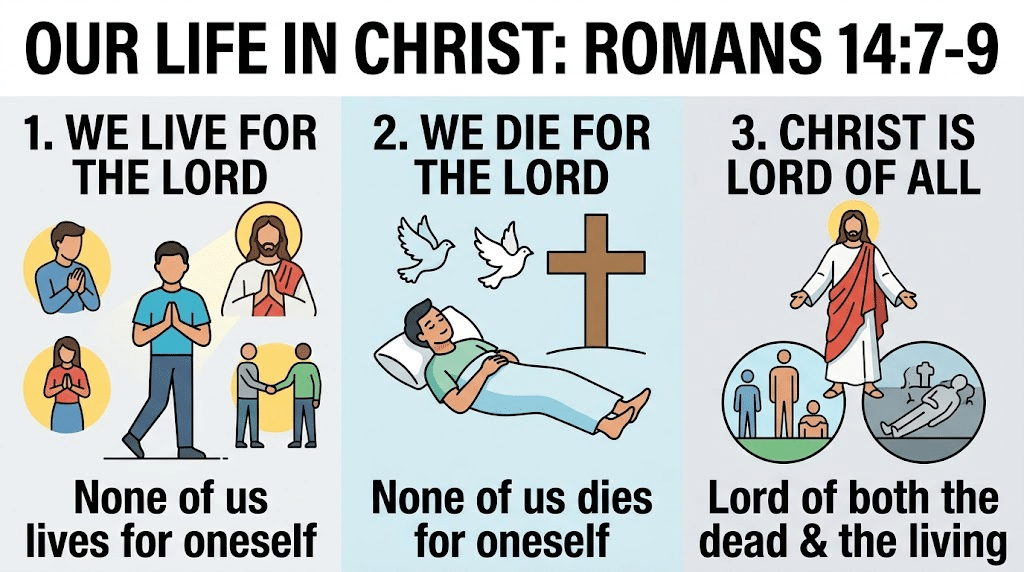
"None of us lives for oneself, and no one dies for oneself."
- Catholic Doctrine & Tradition: The Mystical Body of Christ and the Communion of Saints. Catholic theology rejects radical individualism. St. Paul highlights that our existence is inherently relational and ecclesial. The Catechism of the Catholic Church teaches that every action, sin, or act of charity has an objective social dimension within the Mystical Body of Christ: "The least of our acts done in charity has reverberations for all... every sin harms this communion" (CCC 953, 1469).
- Practice: Intercessory Prayer and the Liturgy. We pray the Mass not as isolated individuals, but with and for the entire Church—militant on earth, suffering in purgatory, and triumphant in heaven. Our personal mortifications and offerings can be united with Christ's cross for the salvation of others.
- Real-Life Application: When making decisions about career moves, leisure, spending, or personal morality, avoid the modern mindset of "It's my life, and it hurts nobody but me." Recognize that secret sins corrode your spiritual health and indirectly weaken the Church, while hidden acts of virtue and quiet prayers strengthen the whole Body.
Romans 14:8
"For if we live, we live for the Lord, and if we die, we die for the Lord; so then, whether we live or die, we are the Lord’s."
- Catholic Doctrine & Tradition: Divine Ownership, Consecration, and Redemptive Suffering. Through the Sacrament of Baptism, the Christian is consecrated entirely to God, sealed with an indelible character, and claimed as His possession (CCC 1272). This verse is a foundational pillar for Catholic bioethics and the sanctity of human life: because our lives and bodies belong to God, human beings do not possess absolute sovereignty to terminate life through euthanasia, assisted suicide, or direct abortion (CCC 2258, 2270, 2277). Furthermore, dying "for the Lord" gives theological meaning to redemptive suffering, allowing our last hours to be an act of total oblation.
- Practice:The Morning Offering and Sacraments of the Sick.
- Morning Offering: Daily dedicating one's prayers, works, joys, and sufferings to the Sacred Heart of Jesus.
- Anointing of the Sick & Viaticum: Receiving the final sacraments so that the passage through physical death is transformed into an act of union with Christ's Paschal Mystery.
- Real-Life Application:
- In ordinary living: Frame everyday labor—from changing diapers and writing reports to yard work—as service rendered directly to Christ.
- In chronic illness or aging: When facing physical decline, loss of independence, or end-of-life planning, replace the fear of "being a burden" with the supernatural trust that you belong to Christ in every breath, uniting your bodily weakness to His Cross.
Romans 14:9
"For this is why Christ died and came to life, that he might be lord of both the dead and the living."
- Catholic Doctrine & Tradition: The Paschal Mystery, the Descent into Hell, and Christ the King. Christ's death and bodily resurrection establish His universal Kingship over the cosmos, history, and every human soul (CCC 655, 668). His descent to the dead (Sheol/Hades) proclaimed victory over death and liberated the just (CCC 632–635). Whether a person is currently walking the earth or has passed into eternity, Christ remains their sovereign Lord and Judge (Particular and General Judgment, CCC 1021–1022).
- Practice: Suffrages for the Holy Souls in Purgatory and Feast of Christ the King. Because Christ is Lord of the dead, our prayers, Masses, and indulgences for deceased family and friends are efficacious across the threshold of death.
- Real-Life Application: When mourning the loss of a loved one, do not grieve as those who have no hope (1 Thess 4:13). Entrust them actively to the Lordship and mercy of Jesus by having Masses offered for their soul, visiting their grave to pray, and letting the reality of Christ’s resurrection anchor you against despair.
Algorithmically generated text
give me three thought provoking questions followed up with detailed answer reflection based on xxxxxxxxxxxx. Keep questions and answers appropriate for Sunday congregation giving real life application.
Modern culture constantly tells us: "It’s my life, my body, my time, and as long as I’m not directly harming anyone, my choices are nobody else’s business." Yet St. Paul declares that no Christian lives or dies in isolation. When you look at how you spend your private moments, manage personal finances, consume media, or harbor private attitudes, do you live as if you belong solely to yourself, or as a living member of Christ’s Body whose health affects the whole community?
Congregational Reflection & Application:
We often underestimate the invisible ripple effect of our private lives. In Catholic theology, the Church is not a club of isolated individuals; it is the Mystical Body of Christ. When one part suffers or stumbles into hidden sin, the spiritual vitality of the whole body is weakened; when one member quietly practices virtue, prayer, and self-sacrifice, grace builds up the entire community (CCC 953).
In real life, this shifts how we evaluate ordinary decisions. Choosing patience when you are alone with your family, resisting gossip when no one would catch you, or offering up a difficult workday for someone else's intentions are not isolated acts. They are spiritual contributions to the community. Living "not for oneself" means recognizing that our holiness—or lack thereof—leaves an indelible mark on our families, our parish, and the wider world.
Algorithmically generated text
St. Paul writes, "If we live, we live for the Lord, and if we die, we die for the Lord; so then, whether we live or die, we are the Lord’s" (v. 8). We easily say "Jesus is Lord" when life is going according to plan, but how do we respond when illness, unexpected loss, aging, or career setbacks strip away our independence and self-reliance?
Congregational Reflection & Application:
Human nature instinctively equates dignity and value with productivity, control, and physical capability. When we face chronic pain, job loss, cognitive decline, or the vulnerabilities of old age, the world tempts us to feel useless or like an unwanted burden.
Belonging to the Lord redefines our worth. Our dignity does not come from what we can produce, but from whose possession we are. St. Paul reminds us that our final, weakest days can be just as holy and fruitful as our strongest years. When we consciously unite our physical limits, aches, and uncertainties to Christ's Cross through a daily Morning Offering, our suffering ceases to be meaningless friction and becomes redemptive prayer. Surrendering ownership means trusting that God is just as present—and just as glorified—in our patience and endurance as He is in our active achievements.
Algorithmically generated text
Christ died and rose so that He might be "Lord of both the dead and the living" (v. 9). When we stand at the graveside of a loved one or confront the reality of our own inevitable death, does our grief look like the despair of the world, or is it illuminated by the certainty that Christ reigns across the boundary of physical death?
Congregational Reflection & Application:
Death often feels like the absolute end of relationship and communication, bringing deep sorrow and loneliness. While the Church honors the natural, raw pain of mourning—just as Jesus wept at the tomb of Lazarus—she calls us not to grieve "as others do who have no hope" (1 Thess 4:13).
Because Jesus conquered the grave, death is not an exit from His kingdom; it is merely a change of state within His sovereign care. This truth gives immense purpose to Catholic practices of praying for the holy souls in purgatory, offering Gregorian or parish Masses for deceased relatives, and maintaining a regular habit of Memento Mori (remembering our own last days). It reminds us that our departed brothers and sisters are still within the reach of Christ's mercy and our intercessory love. Living with Christ as Lord of both the living and the dead frees us from the paralyzing fear of death, allowing us to live each day with eternity clearly in view.
Algorithmically generated text
Create a simple, modern infographic illustrating [INSERT BIBLE PASSAGE OR TOPIC]. Use a [SPLIT-SCREEN / 3-PANEL] layout. The style should be clean, high-quality digital art or vector illustration.
Visuals:
Panel 1: Show [DESCRIBE SCENE 1 – e.g., a stormy sea].
Panel 2: Show [DESCRIBE SCENE 2 – e.g., Jesus calming the waves].
Text & Typography:
Font: Use EXTRA LARGE, BOLD, SANS-SERIF FONT (like Arial). Ensure high contrast so text is easily readable.
Header: Write “[INSERT MAIN TITLE]” at the top.
Captions: Include short, punchy text summaries in the panels: “[TEXT FOR PANEL 1]” and “[TEXT FOR PANEL 2]”.
Overall Vibe: Professional, educational, and uncluttered. Avoid small details; focus on big images and big text.
Write an engaging description meant to get readers to read Larry Broding’s commentary which can be used to help preachers prepare their own homily. After a brief introduction give bulletin points of why this commentary matters for your homily.
Belonging To Another
In a culture that fiercely celebrates radical individualism and self-determination, St. Paul delivers a disarming truth in Romans 14: we do not belong to ourselves. Larry Broding’s commentary cuts straight through the illusion of autonomy, offering preachers a clear, practical framework to help modern congregations rediscover what it truly means to confess Jesus as “Lord.”
- Shatters the Myth of Radical Self-Determination: Modern listeners love the idea of being the sole masters of their fate. Broding unpacks how circumstance, duty, and faith prove otherwise, giving you an instantly relatable hook for any contemporary assembly.
- Reframes the Core Meaning of “Lordship”: Calling Jesus “Lord” is not mere pious language—it is a total surrender of ultimate control. This commentary provides the theological depth needed to challenge parishioners on whether their daily choices reflect that surrender.
- Grounds Pastoral Consolation in Belonging: “Whether we live or die, we are the Lord’s.” This commentary equips you to deliver a homily that balances firm moral challenge with profound comfort, assuring listeners that their destiny rests safely in the hands of the One who conquered death.
Commentary by Dr. Brant Pitre | Catholic Productions

Commentary by Fr. Francis Martin | The Word Proclaimed
clean up grammar and spelling, divide into sections with titles for the following transcript xxxxxxxxxxxx
Verbal fillers, stumbles, and repetitions have been removed while keeping the original phrasing, theological precision, and cadence intact.
CIntroduction: Repentance and the Gift of a New Heart
This next reading from Romans 14 is a profound text. To appreciate its full depth, we must reflect further on the divine gift of repentance, forgiveness, and new life. Saint Paul begins by noting that none of us lives for himself, and no one dies for himself—a truth famously echoed in John Donne's phrase "No man is an island," later used by Thomas Merton.
Repentance is fundamentally a grace; we cannot truly repent by our own strength without being moved by God. Jeremiah 24:7 states: "I will give them a heart (lev) to know Me." In biblical anthropology, the heart is the interior core where a person stands in direct relationship with God. Human beings often construct defenses to avoid the gravity of that encounter, yet God promises: "I will give them a heart to know Me, that I am the Lord; and they shall be My people and I will be their God, for they shall return (shuv) to Me with their whole heart." When we wander into darkness, God calls us back (shuvu).
Zechariah echoes this call: "Do not be like your fathers, to whom the former prophets cried out: 'Thus says the Lord of hosts: Return from your evil ways and your evil deeds.' But they did not hear or heed Me."
Moses' Intercession and the Thirteen Attributes of Mercy
When Moses received the Law on Mount Sinai, the people rebelled. Moses interceded on their behalf, asking God to forgive them or blot him out as well. Moses appealed to the covenant, praying: "Remember Abraham, Isaac, and Jacob, to whom You swore by Your own self."
In Jewish tradition, this plea invokes the Zekhut Avot (the merits of the fathers). The medieval commentator Rashi provides an insightful midrashic reflection on this moment. God explains to Moses that relying solely on the merits of the patriarchs is limited; if those merits were ever exhausted, the people would be left without hope. Therefore, God teaches Moses a prayer anchored directly in the divine nature itself:
The Lord descended in the cloud and stood with him there, and proclaimed the name of the Lord. The Lord passed before him and proclaimed: "The Lord, the Lord, a God merciful and gracious, slow to anger, and abounding in steadfast love (chesed) and faithfulness (emet), keeping steadfast love for thousands, forgiving iniquity and transgression and sin..." (Exodus 34:5–7)
While God notes that consequences reach to the third and fourth generation, His steadfast love (chesed) endures for thousands of generations. When human merits fail, this invocation of divine mercy (El Rachum ve-Chanun) remains inexhaustible.
Romans 14: Living and Dying Unto the Lord
Saint Paul writes in Romans 14:
Brothers and sisters: None of us lives for himself, and no one dies for himself. For if we live, we live for the Lord, and if we die, we die for the Lord; so then, whether we live or whether we die, we are the Lord's. For to this end Christ died and lived again, that He might be Lord both of the dead and of the living.
Our entire existence belongs to God. Even in experiences of profound spiritual desolation—such as the dark night endured by Saint Thérèse of Lisieux toward the end of her life—the soul remains upheld by God. Thérèse experienced severe interior darkness, yet a deep flame of faith endured, allowing her trials to bear fruit for others. No one lives or dies in isolation; our lives are fundamentally oriented toward Christ.
Purification, the Vision of Sin, and the Gift of Tears
Christ died and rose so that He might exercise lordship over both the living and the dead, extending His purifying grace. Spiritual writers describe purification as an experience where the soul finally perceives the true gravity of sin—its rebellion, ugliness, and ingratitude—yet sees it simultaneously through the merciful gaze of Jesus Christ.
This explains why great saints, such as Saint Camillus de Lellis, Saint Augustine, Saint Teresa of Ávila, and Saint Thérèse, wept intensely over their faults. Experiencing this interior purification during earthly life, they saw their shortcomings illuminated by divine mercy.
In the traditional Roman Missal, the liturgy includes a specific collect for the "gift of tears" (pro petitione lacrimarum), asking God, who brought water from the rock, to draw tears of true contrition from a hardened heart. Saint Symeon the New Theologian taught that the gift of tears serves as a profound preparation for the fullness of the Holy Spirit, allowing us to recognize the weight of sin while resting securely in Christ's redemption.
Living the Liturgy
The second reading reinforces the unified message of this Sunday's liturgy: because we belong entirely to the Lord, we are called to embody His mercy.
Whether we live or die, we belong to Christ. He is Lord of both the dead and the living. Recognizing that we have been redeemed by His cross, the proper response is to surrender resentment, receive His grace, and extend unreserved forgiveness to others. Amen.
Click chevron banner to read transcript
organized into thematic sections.
24th Sunday of Year A

Matthew 18:21-35
Create a verse by verse (NAB) commentary relating xxxxxxxxxxxxx TO CATHOLIC doctrine and practice. Give real life applications when appropriate
Matthew 18:21–22
(21) "Then Peter approaching asked him, 'Lord, if my brother sins against me, how often must I forgive him? As many as seven times?'
(22) Jesus answered, 'I say to you, not seven times but seventy-seven times.'"
- Catholic Doctrine & Tradition: Peter proposes forgiving seven times, thinking he is being exceptionally generous compared to standard rabbinic limits (often three times). Jesus counters with "seventy-seven times" (or "seventy times seven"), deliberately reversing Lamech’s ancient curse of boundless, seventy-sevenfold vengeance (Gen 4:24). In Catholic moral theology, this establishes that Christian charity has no quantitative limit (CCC 2845).
- Practice: The Sacramental Life. Christ’s instruction mirrors the inexhaustible mercy available in the Sacrament of Reconciliation. The Church does not cap how many times a truly contrite soul may approach the confessional.
- Real-Life Application: When a spouse, child, or close friend repeats the exact same irritating habit or thoughtless slight day after day, avoid keeping a tally sheet. Recognize when you are tempted to say, "That's the third time this week—I'm done," and choose instead to reset the counter.
Matthew 18:23–25
(23) "That is why the kingdom of heaven may be likened to a king who decided to settle accounts with his servants.
(24) When he began the accounting, a debtor was brought before him who owed him a huge amount.
(25) Since he had no way of paying it back, his master ordered him to be sold, along with his wife, his children, and all his property, in payment of the debt."
- Catholic Doctrine & Tradition: The Infinite Debt of Sin. A single talent was roughly 6,000 denarii (nearly 20 years of daily wages for a laborer). Ten thousand talents (myriad talents) was an astronomical, hyper-inflated figure representing billions of dollars—far exceeding the annual tax revenues of the entire Roman province of Judea. It represents the unpayable infinite offense of mortal sin against an infinite God (CCC 1850). No human effort, penance, or merit can satisfy this cosmic debt on its own.
- Practice: The Mass as Propitiatory Sacrifice. Because humanity cannot pay its debt, Christ provides the infinite satisfaction on Calvary, made present in the Holy Sacrifice of the Mass (CCC 1367).
- Real-Life Application: When you feel self-righteous about how "good" a life you live compared to others, reflect on the absolute debt you owe God for your existence, your salvation, and your hidden transgressions. Humility begins with realizing your ledger cannot be balanced by your own power.
Matthew 18:26–27
(26) "At that the servant fell down, did him homage, and said, 'Be patient with me, and I will pay you back in full.'
(27) Moved with compassion, the master of that servant let him go and forgave him the loan."
- Catholic Doctrine & Tradition: Divine Mercy and Grace. The servant makes an unrealistic, impossible promise ("I will pay you back in full"). The king does not merely extend the deadline; he is moved with compassion (splagchnistheis, visceral mercy) and completely cancels the debt (charizomai). This highlights Catholic teaching on Justification: salvation is an unmerited gift of pure divine grace, not wages earned (CCC 1996).
- Practice: The Act of Contrition. We appeal not to our future promises to be perfect, but purely to God’s boundless compassion through Jesus Christ.
- Real-Life Application: When approaching prayer after a serious moral failure, abandon the bargaining mindset ("God, if you let this pass, I promise I'll do X"). Approach the Lord with simple, transparent sorrow, throwing yourself directly on His unearned mercy.
Matthew 18:28–30
(28) "When that servant had left, he found one of his fellow servants who owed him a much smaller amount. He seized him and started to choke him, demanding, 'Pay back what you owe.'
(29) Falling to his knees, his fellow servant begged him, 'Be patient with me, and I will pay you back.'
(30) But he refused. Instead, he had him put in prison until he paid back the debt."
- Catholic Doctrine & Tradition: The Gravity of Ingratitude and Scandal. One hundred denarii equals roughly one hundred days of labor—a real and tangible sum, but infinitesimally small compared to ten thousand talents (a ratio of roughly 1 to 600,000). The fellow servant uses the exact same words ("Be patient with me..."), yet meets with physical violence and a prison sentence. Withholding pardon after receiving infinite mercy constitutes a grave violation of fraternal charity (CCC 1849).
- Practice: Spiritual Works of Mercy (bearing wrongs patiently and forgiving injuries).
- Real-Life Application: Compare interpersonal grievances (a broken promise, an insulting comment, an unfair criticism) to what Christ bore and pardoned on your behalf. While human injuries hurt, they are "one hundred denarii" compared to what God has forgiven you. Avoid emotional "choking" behaviors: the silent treatment, public shaming, or using leverage to punish.
Matthew 18:31–33
(31) "Now when his fellow servants saw what had happened, they were deeply disturbed, and went to their master and reported the whole affair.
(32) His master summoned him and said to him, 'You wicked servant! I forgave you your entire debt because you begged me to.
(33) Should you not have had mercy on your fellow servant, as I had mercy on you?'"
- Catholic Doctrine & Tradition: The Law of Reciprocity in Charity. The master calls the servant "wicked" (ponēre) only after he refuses mercy to his peer. God’s mercy is not a private possession to be hoarded; it is an active stream meant to flow through the recipient to others. To receive mercy while refusing to give it is a fundamental rejection of the Gospel (CCC 2842).
- Practice: The Sign of Peace before Holy Communion. The Church places the exchange of peace immediately following the Lord's Prayer to signify that the Body of Christ must be reconciled before approaching the Altar of unity.
- Real-Life Application: In workplace, parish, or family life, when someone asks for patience or makes an honest mistake, recall how quickly you expect supervisors, spouses, or God to cut you slack. Extend the same breathing room to them.
Matthew 18:34–35
(34) "Then in anger his master handed him over to the torturers until he should pay back the whole debt.
(35) So will my heavenly Father do to you, unless each of you forgives his brother from his heart."
- Catholic Doctrine & Tradition: The Possibility of Forfeiting Grace & Eternal Damnation. Catholic dogma affirms that a soul can receive sanctifying grace and initial justification, yet lose it through mortal sin (Council of Trent, Session VI). Unforgiveness locks the heart against God; an unyielding, bitter heart literally closes itself off from receiving salvation (CCC 1033, CCC 2843). Jesus insists that forgiveness must come "from your heart" (apo tōn kardiōn hymōn)—a sincere interior surrender of malice, not mere exterior politeness.
- Practice: Nightly Examination of Conscience. Before sleep, reviewing the day to ensure no seeds of bitterness or unrepented resentment remain rooted in the soul.
- Real-Life Application: Check your interior motives. Are you merely acting polite to someone while secretly wishing them harm or keeping a mental dossier of their faults? Pray for the grace to release the resentment at the root level, choosing their good before God.
Algorithmically generated text
give me three thought provoking questions followed up with detailed answer reflection based on xxxxxxxxxxxx. Keep questions and answers appropriate for Sunday congregation giving real life application.
The first servant was forgiven an astronomical, unpayable debt of ten thousand talents—representing the infinite weight of sin that only Christ’s sacrifice on the Cross could cancel. Yet, minutes later, he grabbed a fellow servant by the throat over a small, hundred-denarius debt. Why do we so easily compartmentalize our Sunday gratitude for God’s mercy while demanding immediate payback on Monday morning?
Congregational Reflection & Application:
This contrast exposes the blind spot of self-righteousness. When we pray the Confiteor or receive absolution in the confessional, we readily acknowledge our deep brokenness and need for unmerited pardon. But in daily life, when someone cuts us off in traffic, spreads gossip about us, or forgets a commitment, that offense feels enormous, while our own past failures fade from memory.
To bridge this disconnect, we must cultivate a continuous awareness of our own redemption. Whenever you find yourself demanding that an offender "pay" or grovel before being forgiven, pause and call to mind the ten-thousand-talent debt God canceled for you. The slights, insults, and injuries we suffer from others—though genuinely painful—are "one hundred denarii" compared to what Christ bore for our salvation. Realizing this does not diminish the hurt, but it destroys the pride that fuels a harsh and punitive spirit.
Algorithmically generated text
Jesus concludes the parable with a sobering warning that we will face strict judgment unless we forgive our brother "from the heart" (v. 35). How often do we settle for a counterfeit forgiveness—maintaining a polite, cold exterior while internally nursing bitterness, withholding affection, or secretly hoping the other person fails?
Congregational Reflection & Application:
Surface-level forgiveness often takes subtle forms: the silent treatment, passive-aggressive remarks, venting to friends under the guise of "asking for advice," or using emotional withdrawal to punish the wrongdoer. The servant in the parable put his debtor in prison; we often do the same by locking people into a relational "jail," refusing to give them the freedom to grow or change.
Forgiving from the heart is a supernatural act of the will, aided by grace. It begins in the quiet of personal prayer:
- Renouncing the debt: Deciding consciously, "I release my right to make you pay for this."
- Refusing to slander: Committing not to air the grievance to third parties to damage the person's reputation.
- Praying for their good: Specifically asking God to bless their spiritual conversion, peace, and eternal salvation.
When we forgive from the heart, we open the channels of our own soul, allowing the healing peace of Christ to replace the corrosive burden of anger.
Algorithmically generated text
This examination of conscience uses the Parable of the Unforgiving Servant (Matthew 18:21–35) as a mirror for the soul, focusing on themes of mercy, scorekeeping, gratitude, and the interior disposition of the heart.
I. Limits and Conditions on Forgiveness (Mt. 18: 21–22)
"Lord, if my brother sins against me, how often must I forgive him? As many as seven times?"
- Scorekeeping: Do I maintain a mental ledger of past offenses, keeping track of how many times a spouse, family member, coworker, or friend has hurt me?
- Conditional Mercy: Do I place unspoken conditions or limits on my willingness to forgive, saying internally: "I will forgive this once, but never again"?
- Fatigue in Patience: Have I grown weary of showing patience to people with chronic faults or recurring weaknesses, forgetting that Christ never tires of forgiving me?
- The "Three Strikes" Mentality: Do I cut people off emotionally after repeated slights rather than seeking constructive boundaries guided by charity?
II. Awareness of the Greater Debt (Mt. 18: 23–27)
"Since he had no way of paying it back, his master ordered him to be sold... Moved with compassion, the master... forgave him the loan."
- Sense of Entitlement: Do I treat God’s forgiveness as something owed to me, taking His mercy for granted in the Sacrament of Reconciliation while remaining severe toward others?
- Blindness to Personal Sin: Do I focus obsessively on the faults and failures of those around me while remaining blind or minimizing my own offenses against God?
- Self-Righteousness: Do I secretly believe that I am essentially "good" on my own merits, failing to recognize the astronomical debt of sin that only Christ’s sacrifice on the Cross could cancel?
- Gratitude for Absolution: When I receive absolution in Confession, does it bear fruit in my daily behavior, or do I quickly revert to a spirit of judgment and severity?
III. The "Choking" of Fellow Servants (Mt. 18: 28–30)
"He seized him and started to choke him, demanding, 'Pay back what you owe.' ... He had him put in prison until he paid back the debt."
- Emotional and Relational "Choking": Do I use passive-aggressive silence, coldness, guilt-trips, or sharp words to make someone "pay" for what they did?
- Demand for Immediate Perfection: Am I harsh, impatient, and demanding with people who are struggling, failing to grant them the time and grace to improve?
- Imprisoning Others in Their Past: Do I define people entirely by their past mistakes, refusing to believe in their capacity to change or grow?
- Public Shaming and Retaliation: Have I gossiped, vented on social media, or slandered an offender’s reputation to extract a measure of public revenge?
IV. Scandal and Hypocrisy (Mt. 18: 31–33)
"Should you not have had mercy on your fellow servant, as I had mercy on you?"
- Hypocritical Double Standards: Do I demand strict justice and immediate accountability for other people’s mistakes while expecting complete understanding and excuses for my own?
- Causing Scandal: Does my bitterness, harshness, or inability to reconcile cause pain, division, or spiritual scandal within my family, parish, or workplace?
- Spiritual Hoarding: Have I treated God's gifts of peace, mercy, and patience as private possessions rather than channels meant to flow outward to those around me?
V. Forgiving from the Heart (Mt. 18: 34–35)
"So will my heavenly Father do to you, unless each of you forgives his brother from his heart."
- Surface Politeness vs. Heartfelt Release: Do I act outwardly cordial while harboring secret resentment, malice, or ill will inside?
- Schadenfreude: Do I secretly rejoice or feel vindicated when misfortune, embarrassment, or suffering befalls someone who has wronged me?
- Refusal to Pray for Enemies: Have I refused to obey Christ’s direct command to pray for the good, conversion, and eternal salvation of those who have hurt me?
- Clinging to Grievances: Am I deliberately holding on to past injuries because they provide an excuse for cynicism, self-pity, or emotional distance?
Closing Act of Contrition
O my God, I am heartily sorry for having offended Thee, and I detest all my sins because of Thy just punishments, but most of all because they offend Thee, my God, who art all good and deserving of all my love. I firmly resolve, with the help of Thy grace, to sin no more, to avoid the near occasions of sin, and to forgive all who have trespassed against me as You have forgiven me. Amen.
Algorithmically generated text
Create a simple, modern infographic illustrating [INSERT BIBLE PASSAGE OR TOPIC]. Use a [SPLIT-SCREEN / 3-PANEL] layout. The style should be clean, high-quality digital art or vector illustration.
Visuals:
Panel 1: Show [DESCRIBE SCENE 1 – e.g., a stormy sea].
Panel 2: Show [DESCRIBE SCENE 2 – e.g., Jesus calming the waves].
Text & Typography:
Font: Use EXTRA LARGE, BOLD, SANS-SERIF FONT (like Arial). Ensure high contrast so text is easily readable.
Header: Write “[INSERT MAIN TITLE]” at the top.
Captions: Include short, punchy text summaries in the panels: “[TEXT FOR PANEL 1]” and “[TEXT FOR PANEL 2]”.
Overall Vibe: Professional, educational, and uncluttered. Avoid small details; focus on big images and big text.

Write an engaging description meant to get readers to read Larry Broding’s commentary which can be used to help preachers prepare their own homily. After a brief introduction give bulletin points of why this commentary matters for your homily.
Continual Forgiveness
We all want God’s forgiveness to be limitless, but we often prefer our own mercy to come with strict terms and conditions. Peter’s question about forgiving “up to seven times” reveals our natural instinct to put boundaries around grace. Larry Broding’s commentary unpacks the sheer, intentional absurdity of Jesus’ parable of the unmerciful servant.
- Exposes the Absurdity of the Numbers: Broding breaks down the financial disparity between 10,000 talents (an unpayable sum equivalent to an entire nation’s gross domestic product, requiring over 160,000 years of labor) and 100 denarii (about 100 days’ wages).
- Draws out the Irony of the Parable’s Setting: Jesus uses the customs of a harsh Gentile court—where a debtor’s entire family could be sold into slavery—to shock his listeners. Broding reveals how this unexpected imagery emphasizes that no amount of human effort or collateral could ever begin to pay back what we owe to God.
- Delivers an Uncompromising Pastoral Warning: The parable ends with a sober reality check: holding grudges and demanding petty debts forfeits the very mercy that saved us. The Gospel warns against the spiritual ruin of hoarding grace while demanding strict justice from others.


Commentary by Fr. Francis Martin | The Word Proclaimed
clean up grammar and spelling, divide into sections with titles for the following transcript xxxxxxxxxxxx
Verbal fillers, stumbles, and repetitions have been removed while keeping the original phrasing, theological precision, and cadence intact.
Textual Matthew 18 and the Community Discourse
For this 24th Sunday in Ordinary Time, the Gospel is Matthew 18:21–35. In Matthew 18, Jesus presents a unified series of teachings centered on life in Christian community. This discourse addresses humility, blessing children, handling offenses, seeking the lost sheep, and navigating community life. It leads into chapters 19 and 20 with the Parable of the Workers in the Vineyard.
The laborers arriving at the eleventh hour receive the same daily wage as those who bore the heat of the day. This demonstrates that God levels all believers by His mercy. Even if one strives to do everything right—practicing humility, forgiving others, and seeking the lost—salvation remains a gift of divine grace rather than earned merit. We must never despair of God's mercy; we are all leveled by that mercy, which unites this Gospel with the themes of forgiveness found in the first reading and Psalm 103.
Peter’s Question: The Limits of Forgiveness
Peter approaches Jesus and asks: "Lord, how often will my brother sin against me, and I forgive him? As many as seven times?" Peter believes seven times is generous.
Jesus responds: "Not seven times, but seventy-seven times" (or seventy times seven). The point is to stop calculating and simply forgive without limit. Jesus frequently employs dramatic numerical scale—as seen in the parable of the sower yielding thirty, sixty, and a hundredfold—to impress profound theological realities upon His listeners.
The Parable of the Unforgiving Servant: An Incalculable Debt
To illustrate this, Jesus tells a parable:
The kingdom of heaven may be compared to a king who wished to settle accounts with his servants. When he began to settle, one was brought to him who owed him ten thousand talents.
In antiquity, a single talent was worth well over fifteen years of a laborer's wages (roughly 6,000 denarii). Ten thousand talents represented thousands of lifetimes of labor—an astronomical, incalculable sum far exceeding the annual tax tribute of all Judea to Rome, which Josephus estimated at roughly 650 talents.
Owing 10,000 talents represents the sheer impossibility of human repayment. It symbolizes the weight of our sin against God. Since the servant could not pay, the king ordered him to be sold with his wife, children, and possessions to recover whatever fraction was possible. The servant fell on his knees and pleaded: "Have patience with me, and I will pay you everything." His promise was impossible; human beings lack the means to make full restitution to God on their own. As Pope Pius XII once observed, the greatest sin of our modern age is the loss of the sense of sin.
Divine Compassion: The King’s Radical Mercy
Moved with deep compassion—in Greek, esplagchnisthe (stirred in his innermost depths)—the king released the servant and completely canceled the debt.
This mirrors what God has done for humanity through the cross of Jesus Christ: the unpayable debt of human sin is entirely remitted through divine mercy.
The Failure to Extend Mercy: The Hundred Denarii
Immediately after receiving this pardon, the servant went out and found a fellow servant who owed him one hundred denarii—a modest sum equivalent to roughly a few months of daily wages.
The servant grabbed his fellow servant, began to choke him, and demanded: "Pay what you owe." His fellow servant fell down and pleaded with the exact same words: "Have patience with me, and I will pay you." Yet the unforgiving servant refused, having him thrown into prison until the debt was paid.
When the other servants witnessed this injustice, they were deeply distressed and reported the entire matter to their master.
The Warning Against Unforgiveness
The master summoned the servant and said:
"You wicked servant! I forgave you all that debt because you pleaded with me. Should you not have had mercy on your fellow servant, as I had mercy on you?"
In anger, the master delivered him to the torturers until he should pay all his debt. Jesus concludes with a direct warning: "So also my heavenly Father will do to every one of you, if you do not forgive your brother from your heart."
The Practice and Power of Forgiveness
Harboring resentment is spiritually hazardous; we are called to release grievances quickly. To accomplish this, we must continually ask the Lord for the grace to recognize the depth of what we have been forgiven. As Psalm 103 proclaims: "Bless the Lord, O my soul, and all that is within me, bless His holy name... who forgives all your iniquity, who heals all your diseases."
When God's unmerited, loving forgiveness takes root in us, extending mercy to others becomes our natural witness to the character of God. Forgiveness begins in the human will. Even if emotions lag behind, choosing to forgive breaks the spiritual bond of resentment and lifts the burden. Living out that act of the will brings deeper freedom to both the one who forgives and the one who is forgiven.
Click chevron banner to read transcript
organized into thematic sections.
Doctrinal Homily Outlines

Central idea: Give glory to God by being glorious
Doctrine: God manifests his glory by sharing his goodness
Application: Mental prayer, heartfelt thanksgiving, and conversion
Sunday Prep Videos
24th Sunday of Year A