Papal Homilies
June 7, 2026



NOTABLE QUOTES
Pope Francis
On 1 Corinthians 10:16-17 (The One Bread, The One Body)
“The Apostle Paul states: ‘The cup of blessing which we bless, is it not a participation in the blood of Christ?’ (1 Cor 10:16). This tells us that the Eucharist creates a dynamic of communion that breaks down all human divisions. It is not a private ritual. To live the Eucharist means to allow ourselves to be woven into the body of the Church, especially opening our hearts to love those who are weak or suffering.” — Angelus for the Solemnity of Corpus Christi, 2017
On John 6:51-58 (The Living Bread from Heaven)
“Jesus says, ‘He who eats my flesh and drinks my blood abides in me’ (Jn 6:56). This ‘abiding’ is a beautiful, mutual indwelling. The Eucharist satisfies an inner hunger that normal food can never touch—the hunger for love, the hunger for eternity. Christ enters our wounds, enters our everyday routines, and offers us a love that stays.” — Angelus for the Solemnity of Corpus Christi, 2020
Pope Benedict XVI
On Deuteronomy 8:2-3, 14b-16a (The Manna and the Journey)
“Moses warns the people against the danger of forgetting what God did for them in the desert. When prosperity is achieved, there is the risk of a dangerous spiritual lethargy… The Eucharist is the living memorial that keeps us from forgetting. It is the food that humbles us, reminding us that we are completely dependent on God’s love, not on our own material success.” — Homily for the Solemnity of Corpus Christi, 2006
On 1 Corinthians 10:16-17 (The One Bread, The One Body)
“St. Paul tells us: ‘Because there is one bread, we who are many are one body’ (1 Cor 10:17). This is the great mystery of the Church’s social dimension. In receiving the Eucharist, we do not merely receive a piece of bread; we are pulled into Christ Himself. And because my neighbor is pulled into the exact same Christ, we are no longer separate. The Eucharist is the ultimate remedy for the individualism and isolation of our modern age.” — Homily for the Solemnity of Corpus Christi, 2009
On John 6:51-58 (The Living Bread from Heaven)
“In the biological cycle, we digest food, and it becomes a part of our physical bodies. But with the Eucharist, the opposite happens. We consume Christ, but He is the stronger element; He assimilates us into Him. We are transformed into His likeness. When Jesus says ‘I am the living bread’ (Jn 6:51), He is inviting us to break out of our narrow existences and step into the vastness of His eternal life.” — Homily for the Solemnity of Corpus Christi, 2007
St. John Paul II
On Deuteronomy 8:2-3, 14b-16a (The Manna and the Journey)
“‘Remember all the way which the Lord your God has led you these forty years in the wilderness…’ (Dt 8,2). Today’s Solemnity of Corpus Christi takes us back to the evocative atmosphere of the Passover meal… Christ becomes our inner companion, and with Him, we traverse the paths of time, drawing from the Eucharist the grace that sustains us on our earthly pilgrimage.” — Homily for the Solemnity of Corpus Christi, 2002
On John 6:51-58 (The Living Bread from Heaven)
“When Jesus says, ‘He who eats my flesh and drinks my blood has eternal life’ (Jn 6:54), a ray of the resurrection pierces through time. The Eucharist is truly a glimpse of heaven appearing on earth. It is an immersion into the very life of God, assuring us that our mortal bodies will share in His eternal glory.” — Encyclical Letter, Ecclesia de Eucharistia, 2003
Body and Blood of Christ (A)

Theme of the Readings
FROM THE ARCHIVES (1999)
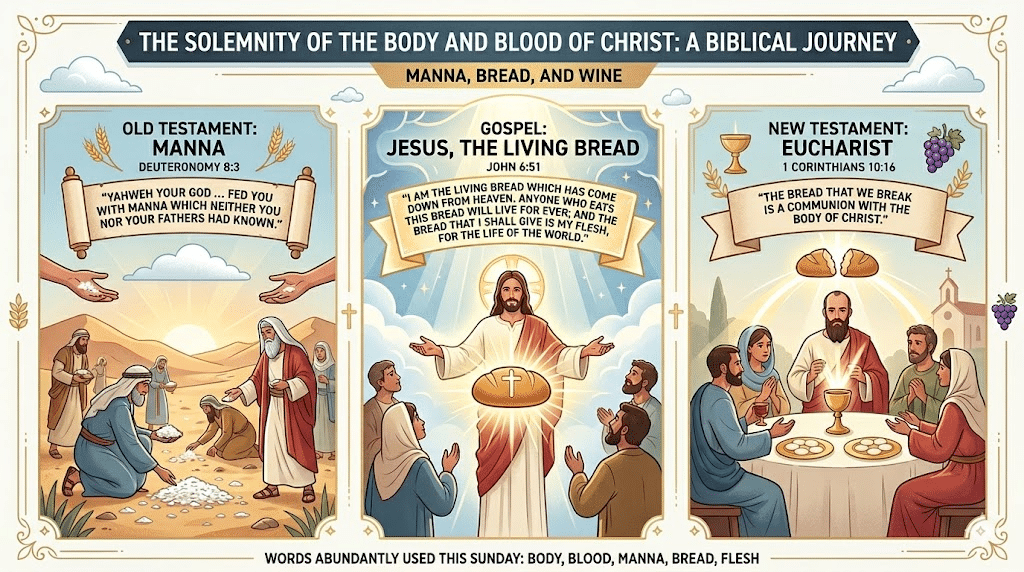
Manna, bread (flesh) and wine (blood) are words abundantly used this Sunday when we celebrate the solemnity of the Body and Blood of Christ. According to Deuteronomy (first reading), Moses says to the people: “Yahweh your God … fed you with manna which neither you nor your fathers had known.” Jesus says in the Gospel: “I am the living bread which has come down from heaven. Anyone who eats this bread will live for ever; and the bread that I shall give is my flesh, for the life of the world.” For his part, Paul tells the Corinthians in his First Letter to them: “the bread that we break is a communion with the body of Christ” (second reading).
Doctrinal Messages
The manna in the desert or the bread of the Eucharist is a bread unknown to man. This means that it is a bread that is not within the human being’s power to produce to satisfy his hunger when he feels the need. In other words, it is God, and only he, who grants it. Therefore it is not a bread that is available to our every whim, one more object of our passing fancy, however “religious” this may seem. It is only available to our humble prayer, to our sincere cry for our great lack and our acute and urgent need.
It is also an unknown bread, for it did not exist and its effects were unknown. Manna did not exist for the Israelites during their stay in Egypt, only in the desert did God give it to them so that they would not die of hunger on their way to the promised land. The Eucharist did not exist before Jesus instituted it at the Last Supper, and made it the most holy instrument of his personal presence among men. Its effects are extraordinary: “A sacrament of love, a sign of unity, a bond of charity, a paschal banquet in which Christ is consumed, the mind is filled with grace and a pledge of future glory is given to us” (Sacrosanctum Concilium, n. 47).
The knowledge in question is a complete knowledge, involving our intellect as much as our experience and our heart, so that it will flow into our actions. With regard to experience, we must come to appreciate and savor the rare and extraordinary value of this food God grants us. With our experience of it, we must come to know all the theological, spiritual and moral riches that this food contains. But it is in no way possible to do without the knowledge of the heart, through an immense loving harmony with those who give us this food and with those who give us Jesus Christ our Lord as food. With this integral knowledge of the Eucharist, we will feel compelled to partake in it fervently and frequently and will succeed in forming one body, in common faith and reciprocal love. Whoever manages to know the Eucharist with all his being, will certainly live by the Eucharist and produce works of the Eucharist: unity, communion, spiritual strength, holiness of life, apostolic zeal, intimacy with God, etc.
Pastoral Suggestions
To know the Eucharist. An ongoing and regular catechesis is necessary, through homilies, religion classes, personal contacts, so that an integral knowledge of the bread of life will constitute the underlying basis of Christian piety whose summit and source is the Eucharist. I will emphasize several aspects of this knowledge:
- one aspect is the real presence of Jesus in the tabernacle, and as a result respect and the feeling of sacredness inside a church. Churches are and must be places of prayer, silence, recollection, and worship, an encounter with God. What an immense task must be done to make the faithful know and live this aspect of the Eucharist!
- Then there is a theological explanation of the fruits of the Eucharist, but in a simple, clear, exemplified and convincing way. After the explanation, one can speak of promoting visits to the Eucharist, especially early in the morning and at the end of the afternoon, to offer Jesus Christ all the hours of work and thank him for his help and comfort. We can encourage exposition of the Blessed Sacrament and adoration. Then we can speak of the transforming power of the Eucharist in those who receive it with rectitude and fervor.
- Lastly, there is preparation for the fruitful reception of Jesus Christ in the Eucharist. This preparation should cover reception of the sacrament of reconciliation, if the person is in a sinful state, reading and meditation on the word of God, as well as forgiveness, reconciliation and the service of one’s brothers and sisters.
To rid oneself of obstacles which impede the knowledge of the living bread, which gives life to the world. Sometimes, the first obstacle can be the temptation to reduce food to pure physical and material needs, alienating or dispensing with any other sort of food. Those who are nourished on earthly realities alone cannot rise to knowledge of the bread of heaven, to them it will seem a meaningless language lacking in value. Another possible difficulty is to make reception of the Eucharist “a social custom,” as congratulating newly married couples at their wedding can be, or going to a friend’s birthday party. The Eucharist is certainly a social event, that is, an ecclesial event, but it is above all a personal encounter with Jesus Christ. Particularly for men, human respect or what will be said, fear of the opinion of others can be a substantial difficulty. Almost as if the Eucharist were a womanly thing! Isn’t it a sign of masculinity to work from conviction and to pay no attention to the opinion of others?
SOURCE: YEAR A DICASTERY NOTES (1999)

Message of Pope Francis
AT A GLANCE
- The Twofold Fruit: The Eucharist produces two inseparable effects: the mystical effect (our personal, vertical union with Christ) and the communal effect (our horizontal union with one another in the Church).
- A Transforming Force: The Presence of Christ in the sacrament is meant to be spiritually assimilated as real nourishment. It provides the grace and renewing energy needed to begin again after a moral or spiritual fall.
- The Necessity of Consent: Sacramental grace requires our conscious cooperation. Without a willingness to let Christ transform our thinking and actions, participation drops into an empty, social ritual.
- The Eucharist Animates the Church: While the Church celebrates the sacrament, it is fundamentally the Eucharist that builds, sustains, and establishes the very identity and mission of the Church.
QUESTIONS FOR REFLECTION
- When I prepare for and attend Mass, do I approach it as a living encounter with Christ who desires to nourish me, or has it become a routine social obligation?
- In what specific areas of my daily thinking and acting am I resisting Christ’s transforming power and withholding my consent from Him?
- If communion with the Body of Christ demands sincere fraternity, are there rivalries, prejudices, or divisions in my heart that I need to bring to the Lord for healing?
ACTIONABLE
TAKEAWAYS
- Offer Your Conscious Consent: Before entering the liturgy, take a moment of silent prayer to explicitly tell the Lord: “I give You permission to change my way of thinking and acting today.”
- Receive Renewing Energy: If you are experiencing a spiritual “pause” or a recent fall, intentionally approach the sacrament asking specifically for the strength and desire to set out again.
- Commit to Sincere Fraternity: Identify one person in your community or family where envy, friction, or prejudice exists. Intentionally pray for them by name after receiving communion, asking Christ to grant you the gift of fraternal love.
Body and Blood of Christ (A)
The Two Effects of
Communion
14 June 2020 – Saint Peter’s Square (Angelus)
Today, in Italy and in other nations, the Solemnity of the Body and Blood of Christ, Corpus Christi, is being celebrated. In the second Reading of today’s liturgy, Saint Paul reawakens our faith in this mystery of communion (cf. 1 Cor 10:16-17). He highlights two effects of the shared chalice and the broken bread: the mystical effect and the communal effect.
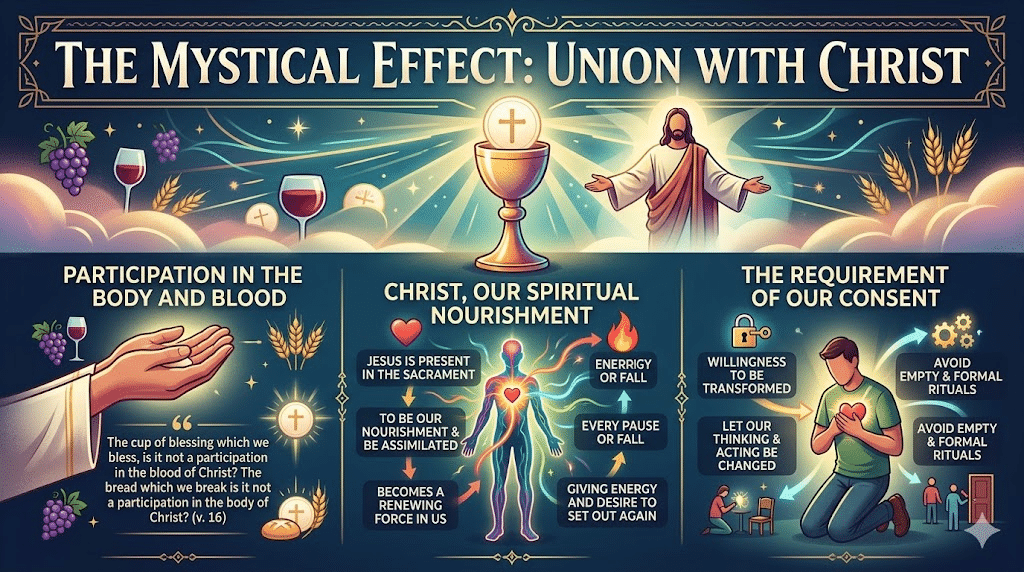
The Mystical Effect: Union with Christ
First, the Apostle states: “The cup of blessing which we bless, is it not a participation in the blood of Christ? The bread which we break is it not a participation in the body of Christ?” (v. 16). These words express the mystical effect, or we might say the spiritual effect of the Eucharist: it relates to the union with Christ, who in the bread and the wine offers himself for the salvation of all.
Jesus is present in the sacrament of the Eucharist to be our nourishment, to be assimilated and to become in us that renewing force that gives once again the energy and gives once more the desire to set out again after every pause or after every fall.
But this requires our consent, our willingness to let ourselves, our way of thinking and acting, be transformed. Otherwise the Eucharistic celebrations in which we participate are reduced to empty and formal rituals. Often some go to Mass because they have to go, as if it were a social event, respectful but social. However, the mystery is something else. It is Jesus who is present and comes to nourish us.
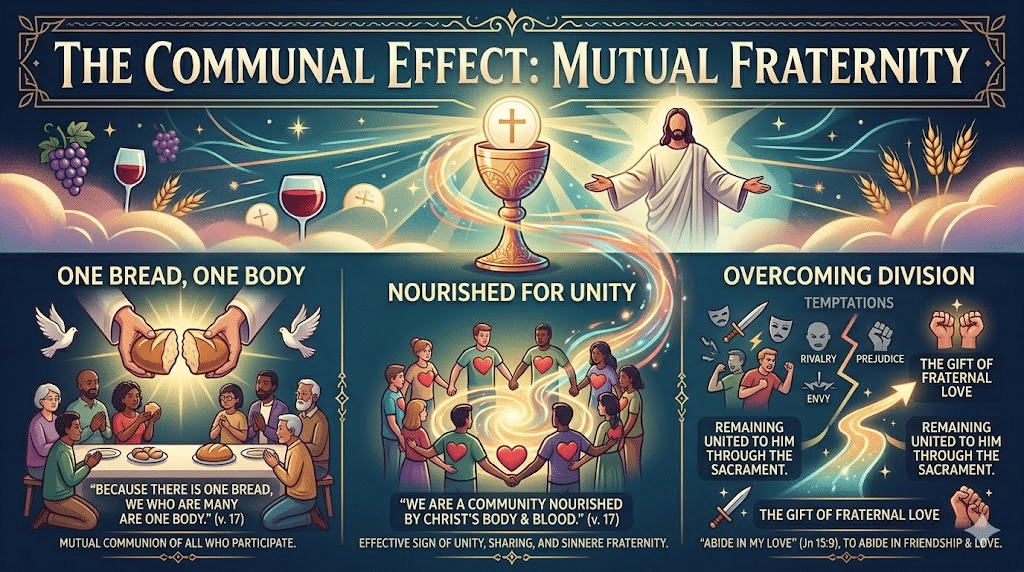
The Communal Effect: Mutual Fraternity
The second effect is the communal one, and is expressed by Saint Paul in these words: “Because there is one bread, we who are many are one body” (v. 17). It is the mutual communion of those who participate in the Eucharist, to the point of becoming one body among them, in the same way that the bread that is broken and distributed is one.
We are a community nourished by the body and blood of Christ. Communion with the body of Christ is an effective sign of unity, of communion, of sharing. One cannot participate in the Eucharist without committing oneself to mutual fraternity, which is sincere.
But the Lord knows well that our human strength alone is not enough for this. On the contrary, He knows that among His disciples there will always be the temptation of rivalry, envy, prejudice, division… We are all aware of these things. For this reason too He left us the Sacrament of His real, tangible and permanent Presence, so that, in remaining united to him, we may always receive the gift of fraternal love. “Abide in my love” (Jn 15:9), Jesus said; and this is possible thanks to the Eucharist. To abide in friendship, in love.
Conclusion: The Eucharist Makes the Church
This twofold fruit of the Eucharist: first, union with Christ and second, communion between those who are nourished by him, generates and continually renews the Christian community. It is the Church that makes the Eucharist, but it is more fundamental that the Eucharist makes the Church, and allows her to be her mission, even before she accomplishes it.
This is the mystery of communion, of the Eucharist: receiving Jesus so He may transform us from within, and receiving Jesus so that He may create unity in us and not division.

Message of Pope Benedict XVI
AT A GLANCE
- The “Synthetic” Feasts: Following the intense historical focus of Lent and Eastertide, the Church transitions into a season celebrating comprehensive theological realities. The Solemnity of Corpus Christi is one of these “synthetic” feasts, unpacking the profound, ongoing mystery of Christ’s presence among us.
- The Three Movements of Corpus Christi: The precise significance of the Solemnity of the Body and Blood of Christ is structurally defined by three physical and spiritual attitudes:
- Gathering (Statio): The Eucharist is inherently public and revolutionary. It destroys human division, pulling people of diverse backgrounds, political ideas, and social classes into a single, unified body around one altar.
- Walking (Procession): The Eucharist is our sustenance for the road. Just as God sustained Elijah and Israel in the desert, Christ breaks our personal paralyses, frees us from despondency, and serves as our criterion and companion on the pilgrimage of life.
- Adoring (Kneeling): Prostration before the Blessed Sacrament is a declaration of true freedom. By bowing to Christ alone—the God who first stooped to wash our feet—the believer is liberated from bowing to any earthly authority or modern idolatry.
- Gathering (Statio): The Eucharist is inherently public and revolutionary. It destroys human division, pulling people of diverse backgrounds, political ideas, and social classes into a single, unified body around one altar.
QUESTIONS FOR REFLECTION
- On Gathering: The homily notes that the Eucharist cannot be a private event reserved for chosen friendships or natural affinities. When you look across the pews at Mass, do you actively welcome the “Christian revolution” of unity, or do you find yourself slipping into temptations of exclusive particularism or isolation?
- On Walking: Where in your life right now do you feel a sense of spiritual “paralysis,” discouragement, or despondency similar to Elijah in the wilderness? How can you consciously lean on the Sacrament of the Bread of Life to help you take the next necessary step forward?
- On Adoring: Kneeling before the Eucharist is described as a radical profession of freedom. What secular authorities, cultural idols, or anxieties are currently competing for your ultimate allegiance, and how can Eucharistic adoration help restore your freedom from them?
ACTIONABLE
TAKEAWAYS
- Intentionally Bridge Parish Divisions: At your next Sunday liturgy, break the habit of routine seating or exclusive socialization. Make a conscious effort to greet, smile at, or sit near someone outside your usual social circle, acknowledging them as a vital part of the one Body.
- Carry the “Criterion” Into Your Week: Before making major decisions or evaluating cultural progress this week, pause to consult the “God-with-us.” Use the teaching and person of Christ as your baseline reference point so you do not lose your way on the journey.
- Commit to a “Profession of Freedom”: Schedule a specific block of time this week—even if just fifteen or twenty minutes—to sit or kneel before the Blessed Sacrament. Use this time of adoration to intentionally hand over your fears and remind your soul that you bow to no earthly power but Christ alone.
Body and Blood of Christ (A)
The Three Dimensions
of the Eucharist
22 May 2008 | Square in front of the Basilica of Saint John Lateran

After the strong season of the liturgical year which, focusing on Easter spreads over three months—first the 40 days of Lent, then the 50 days of Eastertide—the liturgy has us celebrate three Feasts which instead have a “synthetic” character: the Most Holy Trinity, then Corpus Christi, and lastly, the Sacred Heart of Jesus.
What is the precise significance of today’s Solemnity, of the Body and Blood of Christ? The answer is given to us in the fundamental actions of this celebration we are carrying out:
- First of all, we gather around the altar of the Lord, to be together in his presence;
- Secondly, there will be the procession, that is, walking with the Lord;
- And lastly, kneeling before the Lord, adoration, which already begins in the Mass and accompanies the entire procession but culminates in the final moment of the Eucharistic Blessing when we all prostrate ourselves before the One who stooped down to us and gave his life for us.
Let us reflect briefly on these three attitudes, so that they may truly be an expression of our faith and our life.
1. Gathering Together in the Lord’s Presence
The first action, therefore, is to gather together in the Lord’s presence. This is what in former times was called statio.
Let us imagine for a moment that in the whole of Rome there were only this one altar and that all the city’s Christians were invited to gather here to celebrate the Saviour who died and was raised. This gives us an idea of what the Eucharistic celebration must have been like at the origins, in Rome and in many other cities that the Gospel message had reached. In every particular Church there was only one Bishop and around him, around the Eucharist that he celebrated, a community was formed, one, because one was the blessed Cup and one was the Bread broken, as we heard in the Apostle Paul’s words in the Second Reading (cf. 1 Cor 10:16-17).
That other famous Pauline expression comes to mind:
“There is neither Jew nor Greek, there is neither slave nor free, there is neither male nor female; for you are all one in Christ Jesus” (Gal 3:28).
“You are all one!” In these words the truth and power of the Christian revolution is heard, the most profound revolution of human history, which was experienced precisely around the Eucharist: here people of different age groups, sex, social background, and political ideas gather together in the Lord’s presence. The Eucharist can never be a private event, reserved for people chosen through affinity or friendship. The Eucharist is a public devotion that has nothing esoteric or exclusive about it.
Here too, this evening, we did not choose to meet one another, we came and find ourselves next to one another, brought together by faith and called to become one body, sharing the one Bread which is Christ. We are united over and above our differences of nationality, profession, social class, political ideas: we open ourselves to one another to become one in him. This has been a characteristic of Christianity from the outset, visibly fulfilled around the Eucharist, and it is always necessary to be alert to ensure that the recurring temptations of particularism, even if with good intentions, do not go in the opposite direction. Therefore Corpus Christi reminds us first of all of this: that being Christian means coming together from all parts of the world to be in the presence of the one Lord and to become one with him and in him.
2. Walking with the Lord
The second constitutive aspect is walking with the Lord. This is the reality manifested by the procession that we shall experience together after Holy Mass, almost as if it were naturally prolonged by moving behind the One who is the Way, the Journey. With the gift of himself in the Eucharist, the Lord Jesus sets us free from our “paralyses”, he helps us up and enables us to “proceed”, that is, he makes us take a step ahead and then another step, and thus sets us going with the power of the Bread of Life.
As happened to the Prophet Elijah who had sought refuge in the wilderness for fear of his enemies and had made up his mind to let himself die (cf. 1 Kgs 19:1-4). But God awoke him from sleep and caused him to find beside him a freshly baked loaf: “Arise and eat”, the angel said, “else the journey will be too great for you” (1 Kgs 19:5,7). The Corpus Christi procession teaches us that the Eucharist seeks to free us from every kind of despondency and discouragement, wants to raise us, so that we can set out on the journey with the strength God gives us through Jesus Christ.
It is the experience of the People of Israel in the exodus from Egypt, their long wandering through the desert, as the First Reading relates. It is an experience which was constitutive for Israel but is exemplary for all humanity. Indeed the saying:
“Man does not live by bread alone, but… by everything that proceeds out of the mouth of the Lord” (Dt 8:3),
is a universal affirmation which refers to every man or woman as a person. Each one can find his own way if he encounters the One who is the Word and the Bread of Life and lets himself be guided by his friendly presence. Without the God-with-us, the God who is close, how can we stand up to the pilgrimage through life, either on our own or as society and the family of peoples?
The Eucharist is the Sacrament of the God who does not leave us alone on the journey but stays at our side and shows us the way. Indeed, it is not enough to move onwards, one must also see where one is going! “Progress” does not suffice, if there are no criteria as reference points. On the contrary, if one loses the way one risks coming to a precipice, or at any rate more rapidly distancing oneself from the goal. God created us free but he did not leave us alone: he made himself the “way” and came to walk together with us so that in our freedom we should also have the criterion we need to discern the right way and to take it.
3. Kneeling in Adoration Before the Lord
At this point we cannot forget the beginning of the “Decalogue”, the Ten Commandments, where it is written:
“I am the Lord your God, who brought you out of the land of Egypt, out of the house of bondage. You shall have no other gods before me” (Ex 20:2-3).
Here we find the meaning of the third constitutive element of Corpus Christi: kneeling in adoration before the Lord. Adoring the God of Jesus Christ, who out of love made himself bread broken, is the most effective and radical remedy against the idolatry of the past and of the present.
Kneeling before the Eucharist is a profession of freedom: those who bow to Jesus cannot and must not prostrate themselves before any earthly authority, however powerful. We Christians kneel only before God or before the Most Blessed Sacrament because we know and believe that the one true God is present in it, the God who created the world and so loved it that he gave his Only Begotten Son (cf. Jn 3:16). We prostrate ourselves before a God who first bent over man like the Good Samaritan to assist him and restore his life, and who knelt before us to wash our dirty feet.
Adoring the Body of Christ means believing that there, in that piece of Bread, Christ is really there, and gives true sense to life, to the immense universe as to the smallest creature, to the whole of human history as to the most brief existence. Adoration is prayer that prolongs the celebration and Eucharistic communion and in which the soul continues to be nourished: it is nourished with love, truth, peace; it is nourished with hope, because the One before whom we prostrate ourselves does not judge us, does not crush us but liberates and transforms us.
Conclusion: A Source of Communal Joy
This is why gathering, walking and adoring together fills us with joy. In making our own the adoring attitude of Mary, whom we especially remember in this month of May, let us pray for ourselves and for everyone; let us pray for every person who lives in this city, that he or she may know you, O Father, and the One whom you sent, Jesus Christ, and thus have life in abundance. Amen.
Message of Pope Saint John Paul II
AT A GLANCE
- The Eucharist as the Source of Peace: The Eucharist is the ultimate memorial of Christ’s sacrifice, which roots out hatred, reconciles humanity with God, and serves as the true fountain of peace.
- The Divine Command to Remember: True peace requires an active, holy memory—treasuring past experiences and learning from history’s errors and collective sufferings rather than forgetting them.
- Christ’s Peace vs. Worldly Peace: True peace is not built on worldly compromises, political shrewdness, or force. It is a gift won through the Cross and the “weapons” of truth and love.
- Eucharistic Solidarity: Adoring Christ’s Body in the Blessed Sacrament demands active solidarity with the suffering and vulnerable members of His mystical body who are afflicted by war and violence.
QUESTIONS FOR REFLECTION
- When you receive or adore the Eucharist, do you view it simply as a personal devotion, or do you recognize it as a call to enter into solidarity with those suffering across the world?
- God commands His people to “Remember”. Are there recurring errors or past periods of trial in your own history that you need to bring before God to help direct your path today?
- Christ’s peace is won through sacrificial love, whereas the world’s peace is often built on compromises or self-interest. In what areas of your life are you relying on worldly compromises rather than Christlike truth to maintain harmony?
- How authentic is your witness to peace? Can those you live and work with daily see the “Prince of Peace” reflected in your language, attitudes, and reactions?
ACTIONABLE
TAKEAWAYS
- Foster Interior Peace Daily: Commit to a specific daily practice—such as silent prayer, scripture reading, or an evening examination of conscience—to uproot personal grievances and actively cultivate sentiments of peace in your heart.
- Offer Direct Intercessory Prayer: Intentionally dedicate a Holy Hour, a Rosary, or a specific Mass to pray for victims of war, ethnic conflicts, and persecution, begging the “Prince of Peace” for an end to violence.
- Share the “Bread of Hope”: Actively support local or international relief efforts that care for the most vulnerable, defense-less victims, and those facing despair, treating them as suffering members of Christ’s body.
- Pursue Non-Violent Reconciliation: Choose to oppose hostility with the “weapons of truth and love” by extending forgiveness or initiating a conversation to heal a broken, tense relationship in your immediate circle.
Body and Blood of Christ (A)
The Eucharist: Source of True Peace and Remembrance
3 June 1999 | Solemnity of the Body and Blood of Christ
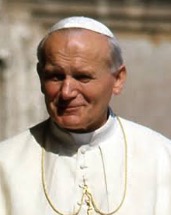
The Solemnity of Corpus Christi is a feast of praise and thanksgiving. On this day the Christian people gather round the altar to contemplate and adore the Eucharistic Mystery, the memorial of the sacrifice of Christ who has brought everyone salvation and peace. This year our solemn celebration and, in a while, the traditional procession which will take us from this square to St. Mary Major have a specific aim: they are meant as a heartfelt and unanimous prayer for peace...

The Command to Remember:
Learning From History
In the first reading the Lord’s command resounded: “Remember all the way which the Lord your God has led you” (Deuteronomy 8:2). “Remember…”! This is the first word. It is not an invitation, but a command that the Lord gives his people before leading them into the promised land. He commands them not to forget.
To have peace, which sums up all the good things promised by God, it is first necessary not to forget past experiences but to treasure them. From errors, too, we can learn a lesson to give better direction to our journey.
In looking at this century and the end of this millennium, how could we forget the terrible sufferings endured by humanity? We must not forget: on the contrary, we must remember. God our Father, help us to learn the right lessons from our history and that of those who have gone before us!
The Gift of Christ’s Peace vs.
the Peace of the World
History speaks of great yearning for peace, but also of the recurring disappointments humanity has had to suffer amid tears and blood. John XXIII, the Pope of Pacem in terris, died precisely today, 3 June, 36 years ago. What a unanimous chorus of praise welcomed that document which outlined the principles for building true peace in the world! But in recent years, how many times have we had to witness the outbreak of violent warfare in one part of the world or another.
The believer, however, does not give up. He knows he can always count on God’s help. In this regard, Jesus’ words at the Last Supper sound particularly eloquent: “Peace I leave with you; my peace I give to you; not as the world gives do I give to you” (John 14:27). Today we want once again to welcome and understand these words in depth. Let us enter into the spirit of the Upper Room to contemplate Christ, who under the appearances of bread and wine gives his Body and his Blood, anticipating Calvary in this sacrament. This is how he gave us peace. St. Paul would later remark: “He is our peace, who has made us both one, and has broken down the dividing wall of hostility… through the cross” (Ephesians 2:14, 16).
In giving himself, Christ gave us peace. His peace is not that of the world, often made of shrewdness and compromises, and of oppression and violence. Christ’s peace is the fruit of his Passover, that is, the fruit of his sacrifice which uproots hatred and violence and reconciles human beings with God and with one another; it is the trophy of his victory over sin and death, of his peaceful war against the evil of the world, a war fought and won with the weapons of truth and love.
It is not by chance that this greeting is frequently heard on the lips of the risen Christ. Appearing to the Apostles, he first shows the signs in his hands and side of the hard struggle he endured, and then he greets them: “Peace be with you!” (John 20:19, 21, 26). He communicates his peace to the disciples as a precious gift, not to keep jealously hidden, but to share with others through their witness.
The Eucharist as the Source of
True Life and Abiding In God
This evening, dear friends, as we carry the Eucharist, the sacrament of Christ our Passover in procession through the streets of Rome, we will be bringing the message of that peace which he left us and which the world cannot give. As we walk, we will ask ourselves about our personal witness to peace. It is not enough, in fact, to speak of peace if we do not strive to foster sentiments of peace in our hearts and to express them in our daily relations with those who live around us.
We will carry the Eucharist in procession and raise our heartfelt prayers to the “Prince of Peace” for the neighbouring land of the Balkans, where already too much innocent blood has been shed and where too many violations have been committed against the dignity and rights of individuals and peoples.
Our prayer this evening is strengthened by the hopeful prospects which are finally emerging.
“The bread which I shall give for the life of the world is my flesh” (John 6:51). In the Gospel passage we have just heard, these words of Jesus have helped us understand what the source of true peace is. Christ is our peace, the “bread” offered for the life of the world. He is the “bread” which God the Father prepared, so that humanity might have life and have it abundantly (cf. John 10:10).
God did not spare his Son, but gave him as the salvation of all, as the Bread we must eat if we wish to have life. Christ’s words are clear: to have life it is not enough to believe in God; it is necessary to dwell in him (cf. James 2:14). This is why the Word was made flesh, died and rose and gave us his Spirit; this is why he left us the Eucharist, so that we could live on him as he lives on the Father. The Eucharist is the sacrament of the gift Christ made of himself for us: he is the sacrament of love and peace, which is the fullness of life.
A Prayer for the Victims of War and
a Commitment to Peace
“Living bread, who gives life!”.
Lord Jesus, before you, our Passover and our peace, we commit ourselves to non-violently opposing man’s violence against man.
Prostrate at your feet, O Christ, today we want to share the bread of hope with our brothers and sisters in despair; the bread of peace with our brothers and sisters tortured by ethnic cleansing and war; the bread of life with our brothers and sisters threatened each day by weapons of destruction and death.
O Christ, we want to share the living Bread of your peace with the innocent and most defenceless victims.
“We offer you this sacrifice of praise for ourselves and those who are dear to us” (Roman Canon), so that you, O Christ, born of the Virgin Mary, Queen of Peace, may be for us, with the Father and the Holy Spirit, the source of life, love and peace.