Commentary Intro to Mass Readings Sunday Readings
CommentaryIntro to Mass Readings Sunday Readings
June 14, 2026
⭐⭐⭐ Hearers of the Word—PDF | VIDEO


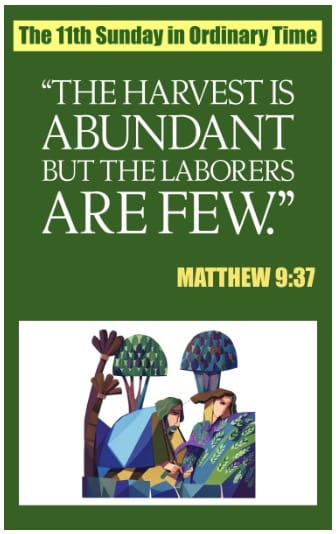
PDF AIDS
Scripture Study for Catholics *


Fr. Francis Martin

Brant Pitre

Kevin Aldrich

11th Sunday of Year A
A Kingdom of Priests
Exodus 19:2-6a

How did God mold the people into a nation? By declaring a relationship between himself and Israel. Gathered into the desert at the foot of Mount Sinai, the people waited as Moses heard the word of God. [19:2]
The Lord spoke to the people through Moses with a history and a promise. “I freed and cared for you,” God seemed to remind the people. “Now, if you keep my word and my covenant, you will be my people!” [19:4-6a]
Notice what kind of people God would form, a kingdom of priests and holy nation. While Israel had a priesthood, the people were privileged to have knowledge and worship of the true God. The people may have squandered that privilege from time to time, they still had God’s promise of their relationship with him. It was a promise that would pass from generation to generation.
Both Christian and Jew share in that promise, for we both have a relationship with the same God. We have the right to worship him, and the responsibility to pass that promise onto the next generation.

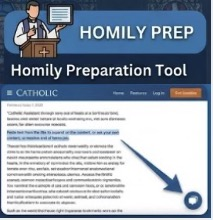
Get instant help with your homily prep or Bible study! Simply copy and paste your question into the chat box at the bottom right of the screen. Here are a few questions to get you started.
Theological Context and History
- How did God mold the people into a nation at Mount Sinai, and how can I parallel this with how the sacraments form a parish community today?
Click banner forAI generated response
- Verse 19:2 refers to Israel camping in the desert in front of the mountain; what is the theological significance of the desert as a place of preparation and waiting?
Click banner forAI generated response
- Verse 19:4 refers to God lifting the people up on eagles’ wings; what historical context or Old Testament imagery can I use to explain this metaphor to a modern audience?
Click banner forAI generated response
Covenant and Modern Identity
- Verses 19:5-6a suggest that keeping the covenant makes us a treasured possession; how can I help parishioners understand the balance between God’s unconditional love and the conditions of keeping His word?
- Verse 19:6a refers to a kingdom of priests and a holy nation; how does this Old Testament priesthood format foreshadow the common priesthood of the faithful in the Catholic Church?
- If the commentary suggests the people squandered their privileges from time to time, what are the modern ways our congregation squanders the privilege of knowing and worshipping the true God?
Shared Promise and Interreligious Dialogue
- Given that both Christian and Jew share in that promise, how can I construct a homily that honors our shared relationship with the same God without minimizing the distinct elements of the New Covenant?
- The commentary suggests that the covenantal promise passes from generation to generation; how can I use Church history to illustrate the continuity of this promise up to our present day?
Pastoral Application and Action
- The commentary asks how do you keep God’s promise; what are three concrete, daily habits I can give the congregation to help them live out their covenantal relationship?
- The text asks how can you pass that promise on to others; what practical advice can I give to parents struggling to pass the Catholic faith onto teenage or adult children?

11th Sunday of Year A
God’s Friends
Romans 5:6-11
What makes for close friendships? Shared values, common experiences, a single purpose. Notice the adjectives that denote friendship: “common” and “shared.” Friendships make individuals into groups and are the building blocks of society.
What do we share in common with God? If we are truly honest with ourselves, not much. By definition, anything we share with the divine we received at our creation: free will, a limited sense of creative power, intellect, the ability to love. These powers come to play in our moral lives and in our relationships with others. While we as humans are the pinnacle of God’s creation, we are not his equal. We are limited by time and space, life and death. What ability we share with God was not only given to us, but is minuscule in comparison.
Alright, we might say we share common values and goals with God. But, we would be diluting ourselves, because we would claim to know the mind of the Almighty. Without revelation, such talk is arrogant, for God is unknowable. In addition, we humans tend to use our abilities to pronounce and exercise values that are contrary to the God made us. In other words, we use what we have for immoral and irreligious purposes. The little that we received from God we use to declare ourselves gods. So, any talk of being God’s friends is futile. We are not his equal. And we act in ways that do violence against our very nature.
So, it’s it ironic that God reached out to humanity in the person of his Son, Jesus the Christ. In doing so, he revealed his purpose to us with Christ’s death and resurrection. God became our equal in the Incarnation. And he offered to raise us beyond our limited nature with eternal life. As St. Iranaeus stated so long ago, “God became man so man might become god.” In Jesus, the gulf between Creator and creature has been spanned. Divinity is freely shared with humanity. Revelation and salvation reconcile God and his people together. In other words, God wants us to be his friends and has provided the means to become his intimate companions.
Yes, we are God’s friends. He wants us to brag about that friendship. This is the meaning of evangelization. Bragging to others about God’s intimate activity in our lives. And inviting those we tell into a friendship that will last forever.
The impossible is possible. With faith, we can call God our “Friend.”
How has God made you his friend? How close do you feel to God? How do you treat God as a friend?

Get instant help with your homily prep or Bible study! Simply copy and paste your question into the chat box at the bottom right of the screen. Here are a few questions to get you started.
The Divine Irony of the Incarnation
- The text refers to God reaching out to humanity in the person of his Son; how can I unpack the theological depth of the Incarnation to show that God chose to become our equal out of a desire for close friendship?
Click banner forAI generated response
- St. Irenaeus suggests that God became man so man might become god; how can I safely explain this concept of theosis or divine adoption to a congregation without causing theological confusion?
Click banner forAI generated response
- Romans 5:6-11 refers to Jesus spanning the gulf between Creator and creature; what visual metaphors or narrative illustrations can I use in my sermon to make this reconciliation vivid for the faithful?
Click banner forAI generated response
The Illusion of Human Equality
- The commentary suggests that anything we share with the divine we received at our creation; how can I structure a homily that humbles the congregation regarding our limited nature while still affirming our dignity as the pinnacle of creation?
- The commentary refers to how humans use what we have for immoral and irreligious purposes; what modern examples can I use to illustrate how society uses divinely given intellect and free will to declare ourselves gods?
- If the text suggests that without revelation, claiming to know the mind of the Almighty is arrogant, how can I preach on the necessity of Scripture and Tradition as our only true access to God’s values?
Living in Intimate Companionship
- The commentary asks how do you treat God as a friend; what concrete prayer practices can I recommend to parishioners to help them move from treating God like a distant vending machine to treating Him as an intimate companion?
- The text asks how close do you feel to God; how do I address parishioners who are experiencing spiritual dryness or a feeling of distance, reminding them that friendship with God is based on His faithful promise rather than fluctuating emotions?
Evangelization as Joyful Witness
- The commentary suggests that the meaning of evangelization is bragging to others about God’s intimate activity; how can I reframe the concept of witnessing so that introverted or hesitant Catholics feel empowered to share their faith?
- The text refers to inviting those we tell into a friendship that will last forever; how can our parish community better embody this welcoming, communal aspect of friendship during our Sunday liturgies?

Courtesy of Larry Broding
Receive as Gift,
Give as a Gift
Matthew 9:36—10:8
An engaging homily dynamic often hinges on shifting the congregation’s mindset from transactional duty to radical, unexpected grace. Larry Broding’s commentary beautifully contrasts our predictable, culturally dictated gift-giving with the awe-inspiring, free gift of Christ’s ministry. It provides the preacher with rich imagery and historical context to help parishioners see themselves not just as passive receivers, but as active “workers in the harvest” [9:37].
Why this commentary matters for your homily:
- Reframes Ministry as Radical Gift-Giving: It uses the relatable concept of holiday gift-giving to explain that true ministry is rooted in receiving massive, unmerited blessings and passing them along out of love, completely outside of normal socio-economic transaction.
- Provides Rich Harvest and Judgment Metaphors: It connects Jesus’ immediate pastoral reaction to the crowds with the larger eschatological reality, showing how current evangelization efforts foreshadow the gathering for the final judgment.
- Highlights Radical Inclusivity in the Apostolate: It unpacks the political tension within the list of the Twelve, showing how Jesus paired natural political enemies—like Simon the Zealot and Judas Iscariot—to prove that the Kingdom breaks down human divisions.
- Illuminates Context-Specific Mission Mandates: It explains the complex cultural layout of Galilee, giving clarity to why Jesus initially restricted the mission to the “lost sheep of Israel” [10:6] before expanding it globally.
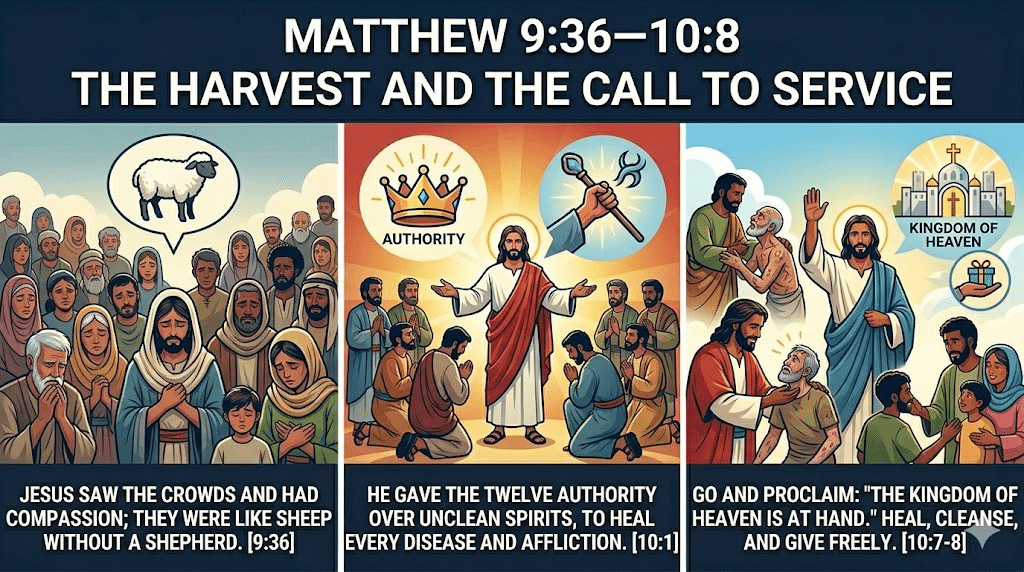
Get instant help with your homily prep or Bible study! Simply copy and paste your question into the chat box at the bottom right of the screen. Here are a few questions to get you started.
The Theology of Gift and Grace
- The commentary suggests that gift giving in modern culture involves little surprise; how can I use this to contrast the unexpected, awe-inspiring way God fulfills our deeply felt needs?
- Matthew 10:8 states that the apostles received as a gift and must give as a gift; how can I help parishioners identify the spiritual gifts they have freely received from God so they can freely share them?
- If the commentary suggests that the signs of the Kingdom placed it outside the economic and social systems of the day, how can I challenge my congregation to offer “grace” and forgiveness in a society driven by transaction and score-keeping?
Harvest Imagery and the Need for Workers
- Matthew 9:36 reveals Jesus’ reaction to his success with the crowds; how can a preacher use His deep compassion for the “lost sheep” to motivate a modern parish to look outward at their unchurched neighbors?
- Matthew 9:37-38 refer to a great harvest with few workers; what practical steps can I offer in my sermon to help parishioners overcome feeling that spreading the Good News to family and friends is too daunting?
Click banner forAI generated response
- Given that harvest imagery is a metaphor for the final judgment in Matthew13:30, how can I preach on the urgency of modern missionary efforts without falling into fear-based rhetoric?
Kingdom Unity Amidst Division
- The commentary suggests that Matthew paired the extreme ends of the political spectrum by placing Simon of Canaan and Judas Iscariot together; how can I use this historical detail to preach about political polarization within our own parish pews today?
- Matthew 10:1 refers to Jesus giving his disciples authority over unclean spirits; how can I translate the ancient understanding of physical and mental diseases being tied to unclean spirits into a modern pastoral message about Christ’s power to heal our current anxieties and brokenness?
The Geography and Scope of Mission
- Matthew 10:5 refers to Jesus commanding the twelve not to go onto the road of the Gentiles or into Samaritan cities; how do I explain this initial, historical restriction to a modern congregation while still upholding the Church’s universal mission?
- The text suggests that because Galilee mixed so many national groups together, one could not conduct business without contacting other groups; how can I draw a parallel between ancient Galilean marketplaces and our modern, diverse workplaces as primary fields for evangelization?