Artificial Intelligence, Catholic Church, Pope Leo XIV, Magnifica Humanitas
May 31, 2026
⭐⭐⭐ Antiqua et Nova





AT A GLANCE
- The Trinitarian Archetype: True intelligence is not a cold, solitary mathematical calculation. It is inherently relational, embodied, and modeled on the eternal, self-giving love shared between the Father, Son, and Holy Spirit.
- The Limit of the Machine: A machine operates through statistical pattern recognition. While it can mimic the vocabulary of mercy or simulate human reasoning, it lacks a soul, meaning it can never possess a heart capable of genuine fidelity, wonder, or moral discernment.
- The Sacred Human Face: The Incarnation proves that God values the physical, embodied human experience. Human faces and voices are unique, distinctive, and sacred features that can never be reduced to algorithmic optimization or pre-packaged digital engagement.
REFLECTION
QUESTIONS
- The essay notes that a machine can mimic the vocabulary of mercy but cannot possess a heart “slow to anger and rich in kindness.” In your daily digital interactions, are you treating others with true Trinitarian patience, or are you slipping into the instantaneous, transactional efficiency of a machine?
- If the Father’s love breaks into human history through the physical reality of the Incarnation, what happens when we shift our primary relationships to virtual or AI-mediated spaces? How can you better protect the sacred value of physical, face-to-face presence in your family or parish community?
- Pope Leo XIV warns that AI cannot stand in “authentic wonder before the beauty of God’s creation.” When was the last time you paused your digital consumption to experience true, silent wonder before God, and how can you intentionally guard that human capacity this week?
HUMANITY CHECK
- The Efficiency Trap: Modern advanced algorithmic models are engineered to do one thing perfectly: optimize for engagement and maximize efficiency. But human fellowship is inherently inefficient. It requires patience, slow listening, the messiness of forgiveness, and sitting with someone in their suffering.
- This Week’s Challenge: Identify one area in your life where you have outsourced a deeply human task to a digital shortcut or an automated process (such as a auto-generated reply, a curated feed determining your focus, or a text summary replacing a real conversation). Intentionally step away from the automated option. Reclaim that space for raw human agency by making a phone call, writing a personal note, or engaging in an unhurried, un-optimized conversation with someone in your life.
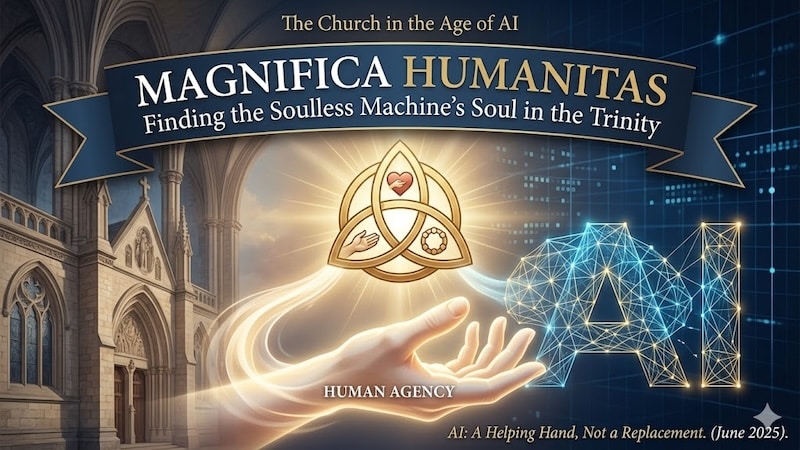
Most Holy Trinity (A)
Communion vs. Calculation: Trinitarian Critique of AI
A look at the Sunday readings through the lens of artificial intelligence
IIn an era defined by rapid technological acceleration, artificial intelligence stands as the preeminent “next industrial revolution.” As algorithms increasingly mediate human labor, communication, and decision-making, humanity faces a profound existential question: What does it mean to be human in the age of the soulless machine?
As Magnifica Humanitas observes at the dawn of this digital epoch,
“In the era of artificial intelligence, when human dignity is threatened by new forms of dehumanization, ours is the pressing duty to remain profoundly human” (Paragraph 15).
To answer this, Christian theology looks not to the mechanical limits of code, but upward to the ultimate archetype of reality—the Most Holy Trinity. By exploring AI through the lens of the eternal, self-giving love shared between the Father, Son, and Holy Spirit, we discover that true intelligence is inherently relational, embodied, and rooted in an absolute reverence for human dignity. This theological framework directly refutes the underlying modern temptations to construct a new, digital Tower of Babel, calling us instead to the patient, collaborative work of rebuilding human coexistence (cf. Paragraphs 7–10).
A Communion of Persons vs. Pattern Recognition
The Trinitarian Archetype (Exodus 34:4b-6, 8-9)
The foundational scriptural understanding of God’s internal nature is revealed in Exodus 34:4b-6, 8-9. Here, the Lord proclaims His name to Moses on Mount Sinai as “a merciful and gracious God, slow to anger and rich in kindness and fidelity.” This revelation underscores that the supreme reality governing the universe is not a cold, calculating cosmic architect, but a personal Communion of Persons characterized by dynamic, overflowing love. The Father, Son, and Holy Spirit exist in an eternal dance of mutual self-emptying and reception.
As the Holy Father affirms, the Church’s Social Doctrine brings us to this exact core: the mystery of the living God who, “as a communion of Persons—Father, Son and Holy Spirit—is love itself in relationship” (Paragraph 48).
The Limits of Statistical Calculation
Artificial intelligence stands in sharp contrast to this Trinitarian mystery. As Dr. Richard Declue (Professor of Theology at the Word on Fire Institute) observes, and as the Vatican document Antiqua et Nova (2025) highlights, modern AI systems operate largely through pattern recognition and statistical calculation. They completely lack the creative, spiritual, and moral dimensions of human thought.
Pope Leo XIV deepens this critique by warning against the “Babel syndrome,” which is “the pretense that a single language—even a digital one—can translate everything, including the mystery of the person, into data and performance” (Paragraph 10).
A machine can mimic the vocabulary of mercy, but it can never possess a heart that is “slow to anger and rich in kindness.” It processes data, but it cannot offer fidelity, because these systems “do not undergo experiences, do not possess a body… and do not know from within what love, work, friendship or responsibility mean” (cf. Paragraph 99).
Pope Leo XIV beautifully illuminated this distinction during his June 2025 Address to the Jubilee of Governments, emphasizing that:
“Our personal life has greater value than any algorithm, and social relationships require spaces for development that far transcend the limited patterns that any soulless machine can pre-package.”
Incarnate Love and the Limits of Simulation
The Economy of the Incarnation (John 3:16-18)
Furthermore, Trinitarian love is fundamentally generative and life-giving, a truth encapsulated in John 3:16-18: “For God so loved the world that he gave his only Son, so that everyone who believes in him might not perish but might have eternal life.” The Father’s love does not remain self-contained; it breaks into human history through the Incarnation. God sends His Son into the world not to condemn, but to save, demanding a relational, embodied response of faith. This mystery stands as the ultimate corrective to the illusions of digital optimization.
Magnifica Humanitas reminds us that “it is ‘only in the mystery of the Word made flesh that the mystery of humanity truly becomes clear'” (Paragraph 1). In Jesus Christ, our fragile human condition is not an error to be bypassed or optimized by electronic components, but the very place where God chooses to dwell (cf. Paragraphs 12, 16).
Creation, Discernment, and Wonder
When Pope Leo XIV addressed the Builders AI Forum in November 2025, he noted that AI, as a product of human invention, springs from this very creative capacity given by God. Scientific discoveries are talents entrusted to humanity to bear fruit, yet they remain secondary to the divine call (cf. Paragraph 9). Because AI lacks a soul, it cannot replicate the moral discernment required to love or to recognize the unconditional, ontological dignity of the person (cf. Paragraph 52).
As the Holy Father stated at the 2025 AI for Good Summit, while a machine can simulate aspects of human reasoning,
“[AI] cannot replicate moral discernment or the ability to form genuine relationships.”
In his live address to the National Catholic Youth Conference, Pope Leo XIV warned young people that AI misses a very important human element:
“AI will not judge between what is truly right and wrong. And it won’t stand in wonder, in authentic wonder before the beauty of God’s creation.”
This incapacity stems from the fact that an algorithm’s learning is merely “a form of statistical adaptation based on data and feedback… it is not the experience of those who allow themselves to be shaped by life and grow over time through choices, mistakes, forgiveness and fidelity” (Paragraph 99).
Sacred Fellowship in an Algorithmic Age
The Blueprint for Community (2 Corinthians 13:11-13)
In the second reading for this Sunday, we are reminded that the Holy Trinity provides the ultimate blueprint for human community and social relations. In 2 Corinthians 13:11-13, Saint Paul exhorts the faithful to “mend your ways, encourage one another, agree with one another, live in peace,” concluding with the famous Trinitarian blessing: “The grace of the Lord Jesus Christ and the love of God and the fellowship of the Holy Spirit be with all of you.”
The Digital Threat to Fraternity
This fellowship is precisely what digital automation and the technocratic paradigm threaten to distort. When human interactions are reduced to algorithmic optimization designed to maximize engagement, the sacred uniqueness of the person is compromised. Pope Leo XIV forcefully defended this in his 2026 Message for the 60th World Day of Social Communications, asserting that
“our faces and voices are unique, distinctive features of every person… Faces and voices are sacred.”
True fellowship requires an embodied, situated human intelligence passed down through generations—a reality the International Theological Commission’s 2026 document Quo Vadis, Humanitas vigorously defended.
The Holy Father warns that when the technocratic paradigm absolutizes technological power, it “tends to amplify the power of those who already possess economic resources, expertise and access to data,” thereby creating severe epistemic, economic, and political asymmetries (Paragraphs 108–109). True solidarity requires us to reject this dominance, to “think and acting in terms of community,” and to recognize that “no one is saved alone” (Paragraphs 73–74).heological Commission’s 2026 document Quo Vadis, Humanitas vigorously defended.
Conclusion
The Superior Ethical Criterion
Ultimately, artificial intelligence must be evaluated by a superior ethical criterion: Does it serve the human person, or does it attempt to replace the divine call to relationship? As Pope Leo XIV poses the definitive question of our age, we must ask whether these innovations “truly help individuals and peoples to become more humane and fraternal, while respecting our common home and future generations” (Paragraph 85).
By anchoring our ethical frameworks in the love of the Father, the grace of the Son, and the fellowship of the Holy Spirit, humanity can ensure that technology remains a tool for the common good, rather than a substitute for the transcendent dignity of the human soul. We are summoned to abandon the self-assertion of Babel, to “disarm AI” from the competition for geopolitical and commercial supremacy, and to become “builders of communion, rather than architects of Babel” (Paragraphs 16, 110). Only then will the human heart remain the sacred space where God desires to dwell.
This essay was generated with the assistance of AI, then reviewed, fact-checked, and edited by Father Don for accuracy and style.
Catholic Articles on AI
SCAN TO READ ON
YOUR PHONE

Add QR Code to
your parish bulletin
Antiqua et Nova Overview
I. Introduction
- Context: Issued on January 28, 2025 (Memorial of St. Thomas Aquinas) by the Dicastery for the Doctrine of the Faith and the Dicastery for Culture and Education; approved by Pope Francis.
- Significance: Explicates a major papal theme regarding the relationship between Artificial Intelligence and human intelligence.
- Scope: Composed of 117 numbered paragraphs across an introduction, four main sections, and a conclusion.
- General Approach: Views AI as a tool presenting both potential benefits and grave dangers.
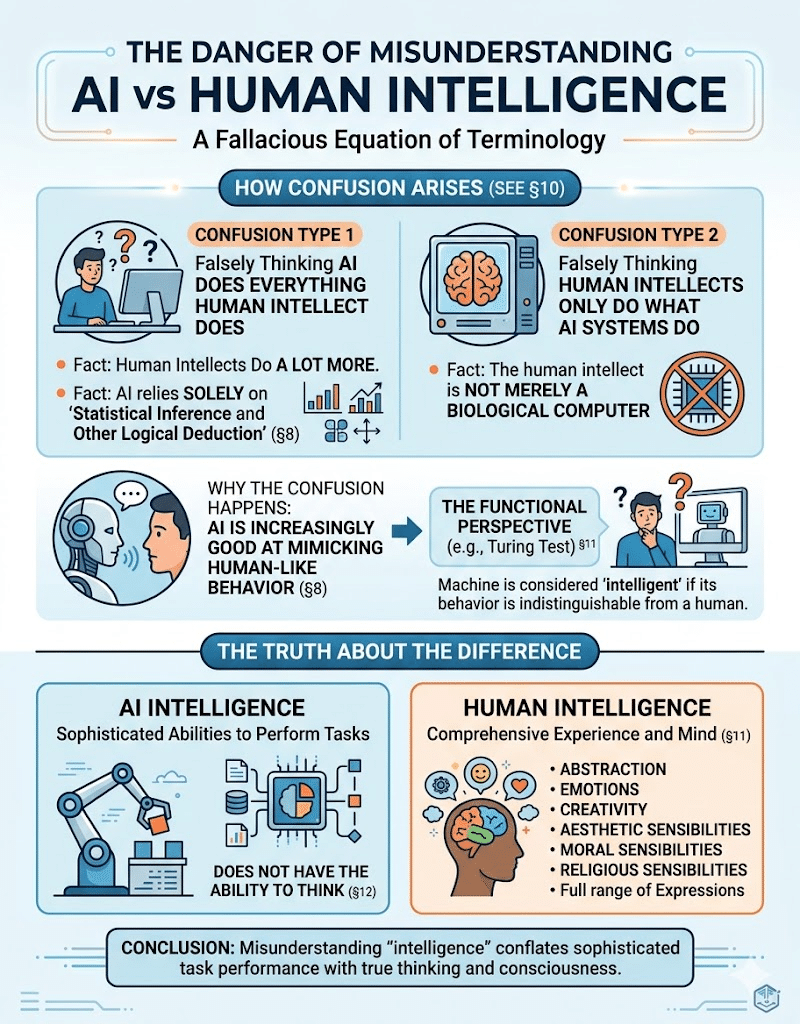
II. Section I: “What is Artificial Intelligence?” (The Danger of Fallacious Equating)
- The Core Danger: Misunderstanding the nature of intelligence by falsely equating AI with human intellect.
- Two Dynamics of Confusion:
- Falsely believing AI can replicate the full scope of human intellect.
- Reducing the human intellect to a biological computer, stripping away its unique attributes.
- The Illusion of the Turing Test: AI excels at mimicking cognitive problem-solving processes (statistical inference and logical deduction), giving it the ability to perform tasks, but not the ability to think.
- Human Elements Lacking in AI: Abstraction, emotions, creativity, and aesthetic, moral, and religious sensibilities.
III. Section II: “Intelligence in the Philosophical and Theological Tradition” (Integral Anthropology)
- The Dual Nature of Human Intelligence:
- Reason (ratio): The inquisitive, analytical, and discursive process.
- Intellect (intellectus): The inward grasp, apprehension, and understanding of truth and the nature of things through abstraction.
- Embodiment: Rejection of dualism in favor of a single nature where spirit and matter are completely united. The whole human person is simultaneously material and spiritual.
- Transcendence: The soul’s intellect and free will share in the divine mind, allowing humans to transcend the material world.
- Relationality and the Pursuit of Truth: Human intelligence is meant for dialogue, collaboration, and solidarity. It naturally seeks the “why” behind reality, ultimately finding its meaning in God.
IV. Section III: “The Role of Ethics in Guiding the Development and Use of AI”
- Human Responsibility: AI cannot make moral judgments; ethical responsibility rests entirely on human developers and end-users.
- Decision-Making vs. Decision-Assisting: AI may assist in compiling data, but only humans possess the agency to make decisions.
- Accountability and Regulation: Call for legal and regulatory frameworks ensuring transparency, privacy, and accountability to prevent overreliance on automated suggestions.
V. Section IV: Specific Questions and Areas of Inquiry
- Scope: Addresses ten specific areas across society formatted as “AI and [Topic].”
- The Ten Areas Treated:
- Society
- Human relationships
- The economy and labor
- Healthcare
- Education
- Misinformation, deepfakes, and abuse
- Privacy and surveillance
- The protection of our common home (Environment)
- Warfare
- Our relationship with God
- Implication: AI carries potential for profound moral, intellectual, economic, and physical harm or help across all these fields.
VI. Conclusion: The Call for Wisdom
- Data vs. Wisdom: Information accumulation is insufficient; technological progress must be guided by spiritual maturity and a deep awareness of human dignity.
- The Principle of Subsidiarity: Ethical implementation requires action at all levels—individuals, families, corporations, and governments.
- A Warning Against Bias: Recognition that AI is neither infallible nor neutral; it can replicate fabricated info or be programmed with intentional bias for social engineering.

Two Cities, Two Loves
Paragraphs 129-130
SCAN TO READ
MAGNIFICA HUMANITAS
ON YOUR PHONE

Add QR Code to
your parish bulletin

What Must Not Be Lost
Paragraph 112
Truth and Democracy
Paragraph 132

The res novae of our time
Two biblical images
Building for the common good
Remaining human
CHAPTER ONE
A DYNAMIC APPROACH FAITHFUL TO THE GOSPEL
A Church journeying through human history
The wisdom of the word of God in dialogue with the human sciences
Social Doctrine as a shared discernment
The development of Social Doctrine from Leo XIII to the present
The first stages of the Church’s Social Doctrine
The years of the Second Vatican Council
The recent Magisterium
Interpreting history in the light of faith
CHAPTER TWO
FOUNDATIONS AND PRINCIPLES OF THE SOCIAL DOCTRINE OF THE CHURCH
The foundations of Social Doctrine
The human person: image of the Triune God
The equal dignity of all human beings
The supreme value of human rights
The principles of Social Doctrine
The principle of the common good
The principle of the universal destination of goods
The principle of subsidiarity
The principle of solidarity
The principle of social justice
Integral human development
An examen for the Church
TECHNOLOGY AND DOMINANCE.
THE GRANDEUR OF HUMANITY IN LIGHT OF THE PROMISES OF AI
The technocratic paradigm and digital power
Artificial intelligence
A valuable tool that requires vigilance
Responsibility, transparency and the governance of AI
What must not be lost
Underlying narratives: transhumanism and posthumanism
The limit, the heart, the grandeur of the human person
The authentic “more than human”: grace and Christian humanism
Two cities and two loves
CHAPTER FOUR
SAFEGUARDING HUMANITY AT A TIME OF TRANSFORMATION.
TRUTH, WORK, FREEDOM
Truth as a common good
Truth and democracy
Communication and the collective imagination
Toward an ecology of communication
An educational alliance for the digital age
The central role of schools
The dignity of work at a time of digital transition
The value of work
The problem of unemployment
An economy that values dignity
Families and young people: the social conditions for hope
Protecting freedom against dependencies and commercialization
Dependencies and societal control
Breaking the chains of new forms of slavery
A shared responsibility
THE CULTURE OF POWER AND THE CIVILIZATION OF LOVE
The civilization of love in the digital age
The culture of power
The normalization of war
Force without limits
Weapons and artificial intelligence
The crisis of multilateralism
A supposed political realism
Building the civilization of love
We can all do our part
The need to disarm words
Building peace through justice
Adopting the perspective of victims
Cultivating a healthy realism
Reviving dialogue
The necessity of diplomacy and multilateralism
Praying and hoping
CONCLUSION
The Word became flesh
One body in Christ
The construction site of our time
The song of hope: the Magnificat