Catholic Digest, Homily Themes
Catholic Digest, Homily Themes
May 24, 2026
⭐⭐⭐ What’s New











Theology, Apologetics & Evangelization
These channels focus on explaining and defending the Catholic faith, often engaging with modern culture and other viewpoints.
- Bishop Robert Barron (Word on Fire): One of the most influential voices in the Church, offering cultural commentary, movie reviews, and deep theological deep-dives.
- Ascension Presents: A powerhouse channel featuring popular figures like Fr. Mike Schmitz (known for the “Bible in a Year” and “Catechism in a Year” podcasts) and Fr. Josh Johnson, offering accessible videos on faith and life.
- Catholic Answers: The premier channel for Catholic apologetics, featuring live Q&A shows where apologists answer tough questions from callers.
- Pints with Aquinas (Matt Fradd): Long-form interviews and discussions on theology, philosophy, and culture, often over a drink.
- The Counsel of Trent (Trent Horn): Trent Horn, a Catholic Answers apologist, provides rebuttals to atheist and Protestant arguments, as well as commentary on current events.
- Jimmy Akin: A senior apologist at Catholic Answers known for his fairness and deep knowledge, covering everything from bizarre questions to deep theology.
- Breaking In The Habit (Fr. Casey Cole, OFM): A young Franciscan friar who offers fresh, accessible reflections on faith, vocations, and everyday life.
- Thomistic Institute: Excellent, high-quality animated videos and lectures explaining the philosophy and theology of St. Thomas Aquinas.
Pentecost Sunday (A)
PRACTICAL
ACTIONS
Acts 1:1-11 | The Promise of Power and the Ascension
This passage marks the transition from Jesus’ earthly ministry to the mission of the Church through the Holy Spirit.
- Prioritize Prayerful Waiting: Before jumping into new projects or ministry efforts, dedicate specific time to “wait” on God’s timing. Practice a “Sabbath of stillness” this week where you listen rather than act.
- Identify Your “Jerusalem”: The mission started at home. Identify one person in your immediate circle—family, neighbor, or coworker—and commit to a specific act of service for them this week.
- Focus on the Present Mission: When the disciples asked about the future kingdom, Jesus redirected them to the present task. Audit your spiritual life: are you more focused on “end-times” speculation or on being a witness in your current environment?
Ephesians 1:17-23 | The Prayer for Revelation and Authority
Paul prays for the believers to have a deeper spiritual understanding of Christ’s supreme authority over all things.
- Pray for Spiritual Sight: Incorporate Paul’s petition into your own daily routine. Specifically, pray for “the spirit of wisdom and revelation” to see a difficult situation in your life from a divine perspective rather than a purely logical one.
- Acknowledge Christ’s Sovereignty: List three things currently causing you anxiety. Explicitly “place” them under the feet of Jesus, verbally acknowledging that He is seated far above these specific concerns.
- Engage with the Body: Since the Church is described as “His body, the fullness of Him,” seek to contribute one unique gift or talent to your local community this weekend to help complete that “fullness.”
Matthew 28:16-20 | The Great Commission
These final instructions provide the “marching orders” for every believer, centered on authority and companionship.
- Audit Your “Going”: The Great Commission happens “as you are going.” Look at your daily routine (the gym, the grocery store, the office) and identify how you can represent Christ’s teachings in those mundane spaces.
- Commit to Mentorship: “Making disciples” involves teaching others to observe what Jesus commanded. Find one person—perhaps someone younger in their faith—and invite them to coffee to share what you are currently learning.
- Practice Presence Awareness: Jesus promised to be with us “always, to the end of the age.” End each day this week by journaling two moments where you felt or noticed God’s presence during your tasks.
Pentecost Sunday (A)
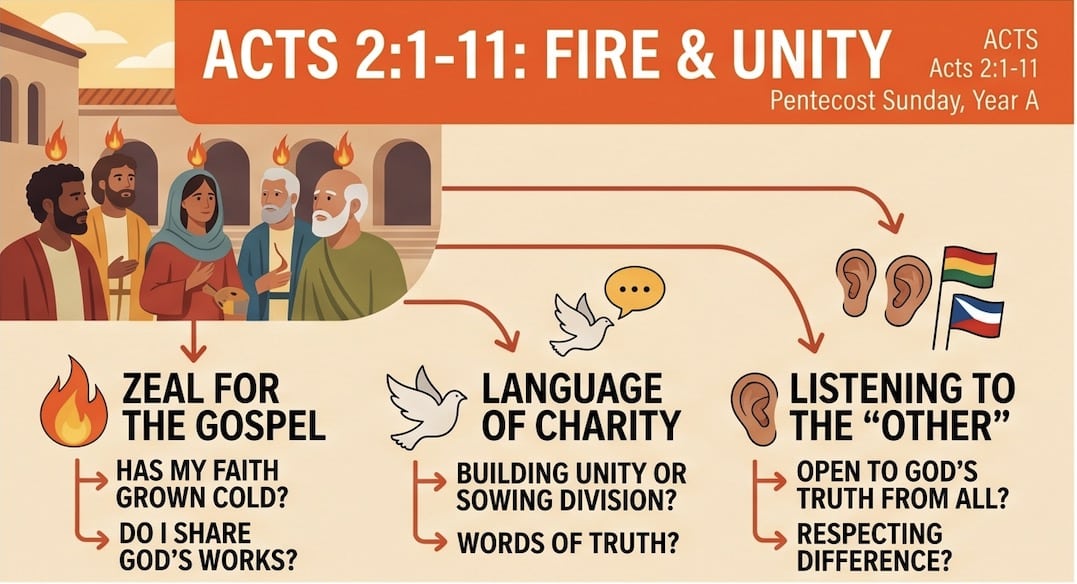
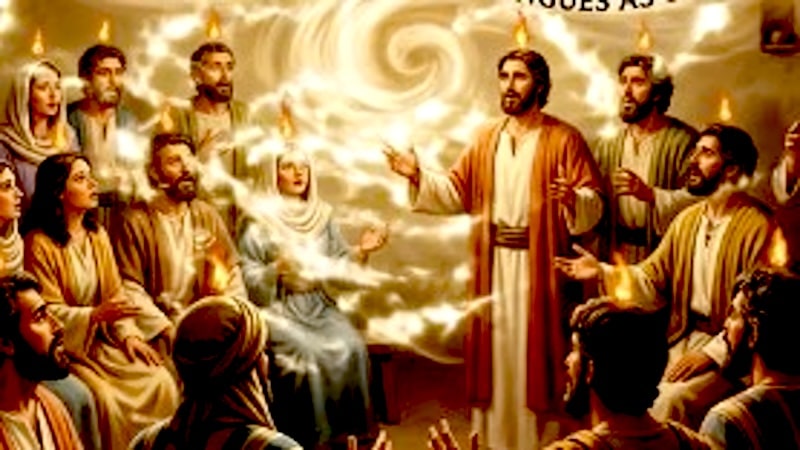
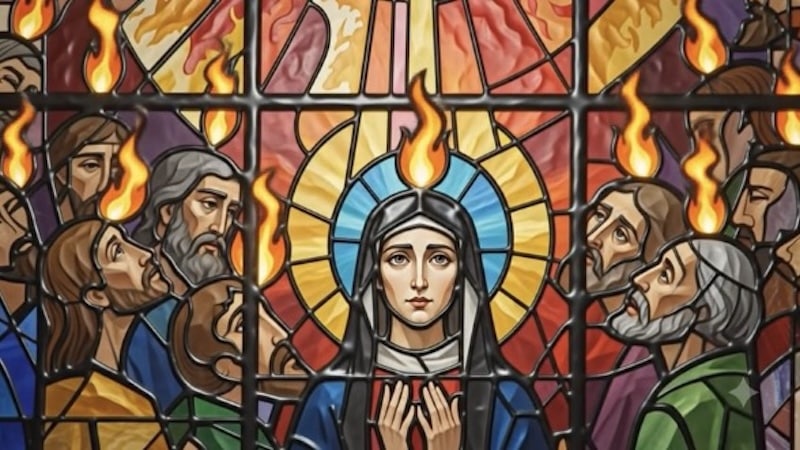
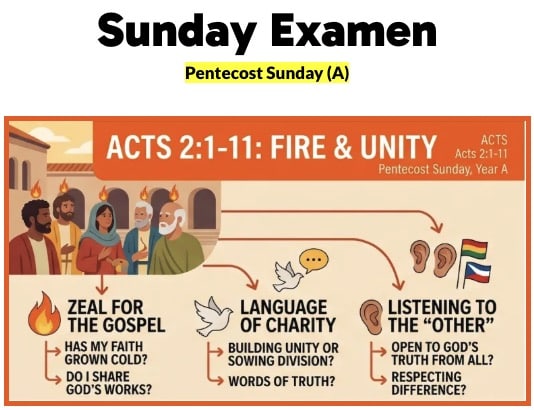
The Spirit descended as tongues of fire, enabling the Apostles to proclaim the marvels of God in ways all could understand.
- Zeal for the Gospel: Have I allowed the “fire” of my faith to grow cold? Do I speak about God’s works with others, or do I keep my faith hidden out of fear or embarrassment?
- The Language of Charity: The Spirit overcame the confusion of Babel. Do I use my words to build unity, or do I sow division through gossip, sarcasm, or harsh criticism?
- Listening to the “Other”: The onlookers heard the message in their own languages. Am I open to hearing God’s truth when it comes from people who are different from me in culture, background, or status?

There are different kinds of spiritual gifts but the same Spirit; we were all given to drink of the one Spirit.
- Comparison and Envy: Do I resent the talents or successes of others, or do I celebrate them as gifts to the whole Body of Christ?
- Neglect of Gifts: Have I identified the unique “charisms” (gifts) God has given me? Am I using them for the “benefit of the community,” or am I using them only for my own gain?
- Radical Equality: Do I treat every member of the Church and society with equal dignity, or do I show favoritism based on wealth, influence, or shared interests?
- Unity in the Body: Have I contributed to “factions” or “camps” within my parish or community? Do I prioritize the unity of the Spirit over being “right”?

Jesus stood in their midst and said, “Peace be with you.” He breathed on them and said, “Receive the Holy Spirit. Whose sins you forgive are forgiven them.”
- The Gift of Peace: When I encounter conflict, am I a “peacemaker,” or do I escalate tension? Do I possess an inner peace that trusts in God, or do I let anxiety and fear rule my heart?
- The Power of Forgiveness: Am I holding onto a grudge or a “debt” someone owes me? Do I realize that by withholding forgiveness, I am binding myself and others in bitterness?
- Sacramental Life: Do I appreciate the gift of the Sacrament of Reconciliation, where the Spirit’s power to forgive is tangibly present? Have I delayed seeking God’s mercy?
- The Breath of Life: Jesus breathed life into the Apostles. Do I respect the sanctity of life in all its stages? Do I care for my own physical and spiritual health as a “temple of the Holy Spirit”?
Non-profits have permission to copy and paste infographics into their publications.
Pentecost Sunday (A)
Minister of the Spirit’s Fire
Gospel: John 20:19–23 / Acts 2:1–11
Theme: They were all filled with the Holy Spirit.
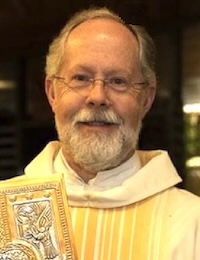
McCulloch
(Diocese of Broken Bay)
Pentecost is the great un-locking. The same disciples who, on Easter evening, huddled behind locked doors for fear (John 20:19), are now, in Acts, filled with the Holy Spirit and speaking in a way that unlocks the Gospel for all the diverse nations. The Spirit descends in tongues of fire, and the Church is born – not as a static institution, but as a bold, diverse, and living mission.
The deacon, ordained for the threefold ministry of Word, Altar, and Charity, stands precisely at this intersection: the point where the Spirit’s fire meets the world’s need. As St. Irenaeus said, ‘The Spirit is the living water that makes the Church young again.’ The deacon’s ministry is a primary channel for that living water, a constant witness that the gifts of the Spirit are not for keeping, but for giving away.
AT MASS
The Proclamation of Fire
The deacon’s liturgical role is a living embodiment of the Pentecost mystery.
• The Herald of the Spirit: When the deacon proclaims the Gospel of John 20, he is the herald of the gift of the Spirit, speaking Christ’s own words: ‘Receive the Holy Spirit.’ When he proclaims the reading from Acts, he is the herald of the Spirit’s power, giving voice to the ‘mighty wind’ and the ‘tongues of fire.’
• The Voice of the Nations: Pentecost reverses the curse of Babel, creating unity from diversity. In the Universal Prayer, the deacon gathers the needs of all the nations, the diverse, multi-lingual, multi-cultural needs of the crowd outside the church doors and unites them in the one language of the Spirit.
• The Commissioning: The deacon’s dismissal is the Pentecost commission. When he chants, ‘Go and announce the Gospel of the Lord,’ he is unlocking the doors of the church and sending the assembly out, just as the Spirit sent the apostles, in the ‘fire’ of their new mission.
IN THE PARISH
The Animator of Gifts
The Spirit filled all of them, bestowing a diversityof gifts, including prophecy, service, teaching and healing. The deacon is the parish’s animator of charity, the one who fans these gifts into a living flame.
• Fan into Flame: The deacon’s diakonia is not to doall the service himself, but to equip the parish for its work of service. He helps to identify the Spirit’s gifts in the laity – the person with a heart for the sick, the one with a mind for justice, the one with a gift for teaching, and animatesthem, empowering the wholeBody of Christ to serve.
• Making the Church Young: The deacon’s ministry is the living water St. Irenaeus spoke of. His work with the RCIA, baptizing new Christians, and his outreach to new families brings a freshness to the parish, helping to make the Church young again by constantly welcoming new life in the Spirit.
AT THE MARGINS
The Language of Service
The tongues of Pentecost were a miracle of hearing: everyone heard the Good News ‘in his own native language.’ The deacon is the minister of the one language that all people can understand: the language of love.
• The ‘Fire’ in the Street: The deacon carries the ‘fire’ of the altar into the streets. His service to the poor, the prisoner, the immigrant, and the lonely ishis proclamation.
• Speaking the Universal Language: When the deacon helps someone in need, he is preaching a homily. When he advocates for the voiceless, he is speaking in a new tongue. This service is the most credible, universal proclamation of the Gospel.
• Gifts for Giving: The deacon’s life is a witness that the Spirit’s gifts – peace, patience, kindness, joy – are not for private consolation. They are fuel. They are given to be given away, poured out in acts of mercy, until the fire of God’s love renews the face of the earth.
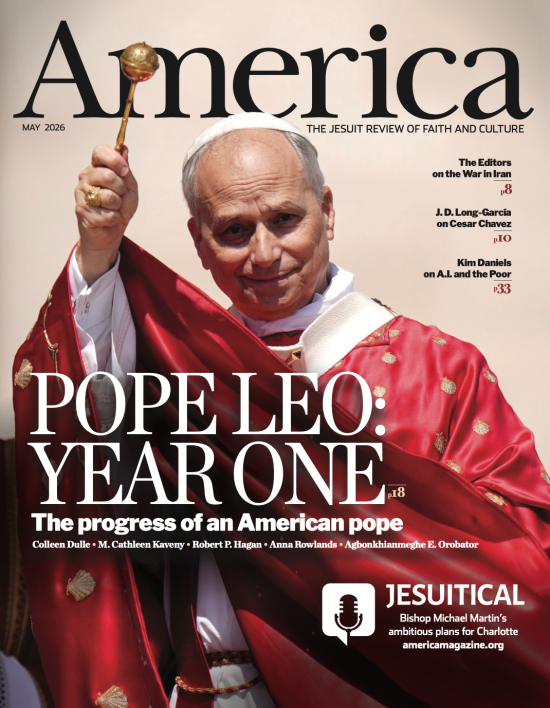
MAY 2026
PDF (68 pages)
America Magazine: Published by the Jesuits, this leading national review is highly regarded for its thoughtful, nuanced commentary on religion, politics, and contemporary culture.
Commonweal: An independent, lay-edited journal of opinion that provides rigorous intellectual perspectives on faith, society, the arts, and public policy.
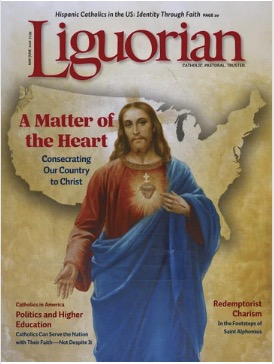
MAY-JUNE 2026
PDF (48 pages)
Liguorian is an award-winning Catholic magazine published since 1913 by the Redemptorists to provide spiritual guidance, pastoral messages, and inspiring stories, helping readers navigate modern life through faith. It acts as a trusted resource for Catholic spirituality, offering insights on faith, social justice, and daily Christian living.
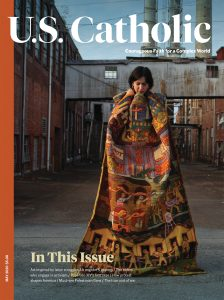
U.S. Catholic: This publication focuses on everyday faith, social justice, and practical insights for living out Catholic teachings in modern, daily life.
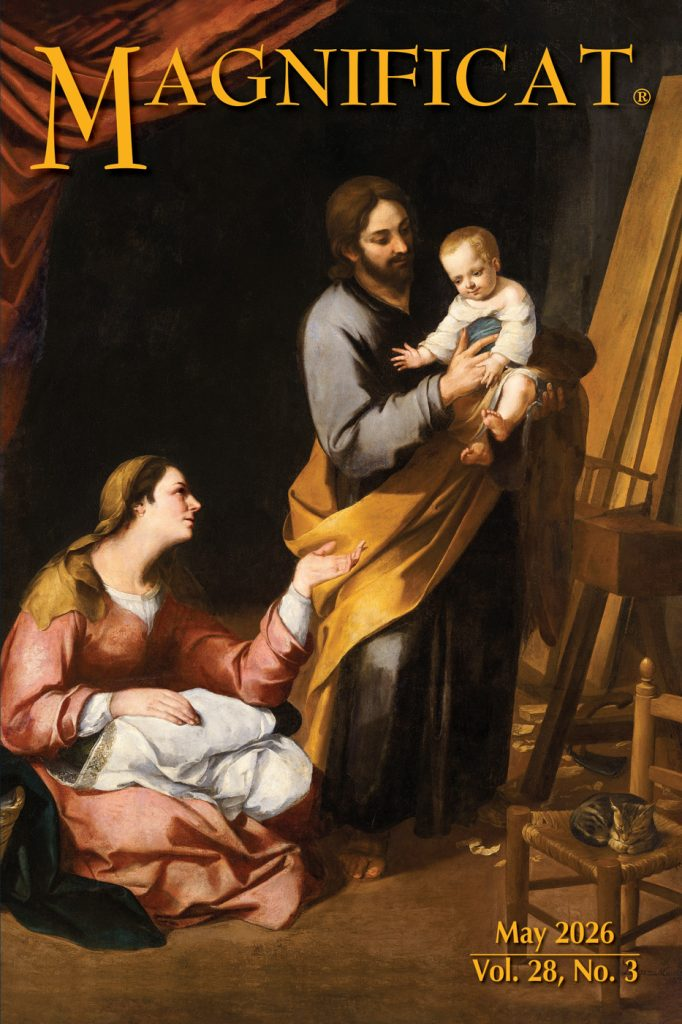
MAY 2026
Magnificat: A beautifully designed monthly publication intended for daily use. It includes the texts of the daily Mass, morning and evening prayers, and spiritual reflections. Exploring its Spanish edition, Magnificat en Español, can also be an excellent way to weave language practice into a daily spiritual routine.
Catholic.com
Pentecost Sunday (A)
Scroll to view all 50 states
Alabama
- One Voice (Diocese of Birmingham)
- The Catholic Week (Archdiocese of Mobile)
Alaska
- The North Star Catholic (Archdiocese of Anchorage-Juneau)
- The Alaskan Shepherd (Diocese of Fairbanks)
- Missionary Disciples (Diocese of Fairbanks)
Arizona
- Voice of the Southwest (Diocese of Gallup)
- The Catholic Sun (Diocese of Phoenix)
- New Outlook (Diocese of Tucson)
Arkansas
- Arkansas Catholic (Diocese of Little Rock)
California
- Angelus Magazine | DIGITAL (Archdiocese of Los Angeles)
- The Catholic Voice | DIGITAL (Diocese of Oakland)
- The Catholic Herald | DIGITAL (Diocese of Sacramento)
- Orange County Catholic (Diocese of Orange)
- Catholic Herald (Diocese of Sacramento)
- Inland Catholic Byte (Diocese of San Bernardino)
- The Southern Cross | DIGITAL (Diocese of San Diego)
- Catholic San Francisco (Archdiocese of San Francisco)
- San Francisco Católico (Archdiocese of San Francisco)
- The Valley Catholic | DIGITAL (Diocese of San Jose)
Colorado
- The Colorado Catholic Herald (Diocese of Colorado Springs)
- Denver Catholic (Archdiocese of Denver)
Connecticut
- Fairfield County Catholic (Diocese of Bridgeport)
- The Catholic Transcript | DIGITAL (Archdiocese of Hartford)
- Four County Catholic | DIGITAL (Diocese of Norwich)
Delaware
- The Dialog (Diocese of Wilmington)
Florida
- Florida Catholic | E-EDITIONS (Archdiocese of Miami; Dioceses of Orlando, Palm Beach, Pensacola–Tallahassee, St. Augustine, Saint Petersburg, Venice)
Georgia
- The Georgia Bulletin (Archdiocese of Atlanta)
- Southern Cross (Diocese of Savannah)
Hawaii
- Hawaii Catholic Herald (Diocese of Honolulu)
Idaho
- Idaho Catholic Register (Diocese of Boise)
Illinois
- The Messenger (Diocese of Belleville)
- Chicago Catholic (Archdiocese of Chicago)
- Catolico (Archdiocese of Chicago)
- Christ is Our Hope (Diocese of Joliet)
- The Catholic Post (Diocese of Peoria)
- The Observer (Diocese of Rockford)
- Catholic Times (Diocese of Springfield)
Indiana
- The Message (Diocese of Evansville)
- Today’s Catholic News (Diocese of Fort Wayne–South Bend)
- Northwest Indiana Catholic (Diocese of Gary)
- The Criterion (Archdiocese of Indianapolis)
- The Catholic Moment | DIGITAL (Diocese of Lafayette)
Iowa
- The Catholic Messenger (Diocese of Davenport)
- The Catholic Mirror | DIGITAL (Diocese of Des Moines)
- The Witness (Archdiocese of Dubuque)
- The Lumen (Diocese of Sioux City)
Kansas
- Southwest Kansas Register (Diocese of Dodge City)
- The Leaven (Archdiocese of Kansas City)
- The Register | DIGITAL (Diocese of Salina)
- Catholic Advance (Diocese of Wichita)
- Avance Católico (Diocese of Wichita)
Kentucky
- Messenger (Diocese of Covington)
- Cross Roads | DIGITAL (Diocese of Lexington)
- The Record | DIGITAL (Archdiocese of Louisville)
- Western Kentucky Catholic (Diocese of Owensboro)
Louisiana
- Church Today (Diocese of Alexandria)
- The Catholic Commentator (Diocese of Baton Rouge)
- Bayou Catholic (Diocese of Houma–Thibodaux)
- Clarion Herald (Archdiocese of New Orleans)
- The Catholic Connection | DIGITAL (Diocese of Shreveport)
Maryland / Washington, DC
- The Catholic Review (Archdiocese of Baltimore)
- Catholic Standard (Archdiocese of Washington)
- El Pregonero (Archdiocese of Washington)
Massachusetts
- The Pilot (Archdiocese of Boston)
- The Anchor (Diocese of Fall River)
- SOPHIA | DIGITAL (Diocese of Springfield)
- The Catholic Free Press | DIGITAL (Diocese of Worcester)
Michigan
- Detroit Catholic (Archdiocese of Detroit)
- FAITH along Michigan’s 45th Parallel | DIGITAL (Diocese of Gaylord)
- Faith Grand Rapids (Diocese of Grand Rapids)
- The Good News (Diocese of Kalamazoo)
- FAITH (Diocese of Lansing)
- The U.P. Catholic (Diocese of Marquette)
- Great Lakes Bay | DIGITAL (Diocese of Saginaw)
Minnesota
- Our Northland Diocese (Diocese of Crookston)
- The Northern Cross (Diocese of Duluth)
- The Prairie Catholic (Diocese of New Ulm)
- Central Minnesota Catholic | DIGITAL (Diocese of Saint Cloud)
- The Catholic Spirit (Archdiocese of Saint Paul and Minneapolis)
- The Courier | DIGITAL (Diocese of Winona-Rochester)
Mississippi
- Gulf Pine Catholic | DIGITAL (Diocese of Biloxi)
- Mississippi Catholic | DIGITAL (Diocese of Jackson)
Missouri
- Catholic Missourian | DIGITAL (Diocese of Jefferson City)
- The Catholic Key | DIGITAL (Diocese of Kansas City–Saint Joseph)
- The Mirror (Diocese of Springfield–Cape Girardeau)
- St. Louis Review (Archdiocese of St. Louis)
- Catholic St. Louis | DIGITAL (Archdiocese of St. Louis)
Montana
- The Harvest (Diocese of Great Falls–Billings)
Nebraska
- West Nebraska Catholic | DIGITAL (Diocese of Grand Island)
- Southern Nebraska Register (Diocese of Lincoln)
- The Catholic Voice (Archdiocese of Omaha)
Nevada
- Desert Clarion (Diocese of Las Vegas)
- High Desert Catholic | DIGITAL (Diocese of Reno)
New Hampshire
New Jersey
- Catholic Star Herald (Diocese of Camden)
- The Catholic Spirit | DIGITAL (Diocese of Metuchen)
- The Catholic Advocate (Archdiocese of Newark)
- The Beacon | DIGITAL (Diocese of Paterson)
- The Monitor (Diocese of Trenton)
New Mexico
- Voice of the Southwest (Diocese of Gallup)
- Agua Viva (Diocese of Las Cruces)
- People of God (Archdiocese of Santa Fe)
New York
- The Evangelist (Diocese of Albany)
- The Tablet (Diocese of Brooklyn)
- The Catholic Union / The Catholic Union and Times (Diocese of Buffalo)
- Western New York Catholic (Diocese of Buffalo)
- The Good Newsroom (Archdiocese of New York)
- North Country Catholic (Diocese of Ogdensburg)
- Catholic Courier (Diocese of Rochester)
- El Mensajero Católico (Diocese of Rochester)
- The Long Island Catholic (Diocese of Rockville Centre)
- The Catholic Sun (Diocese of Syracuse)
North Carolina
- Catholic News Herald (Diocese of Charlotte)
- NC Catholics | DIGITAL (Diocese of Raleigh)
North Dakota
- Dakota Catholic Action | DIGITAL (Diocese of Bismarck)
- New Earth Magazine | DIGITAL (Diocese of Fargo)
Ohio
- The Catholic Telegraph (Archdiocese of Cincinnati)
- Northeast Ohio Catholic (Diocese of Cleveland)
- Catholic Times | DIGITAL (Diocese of Columbus)
- Steubenville Register (Diocese of Steubenville)
- The Catholic Echo (Diocese of Youngstown)
Oklahoma
- Sooner Catholic | DIGITAL (Archdiocese of Oklahoma City)
- Eastern Oklahoma Catholic | DIGITAL (Diocese of Tulsa)
Oregon
- Catholic Sentinel / El Centinela (Diocese of Baker / Archdiocese of Portland)
- The Diocesan Chronicle (Diocese of Baker / Archdiocese of Portland)
- Harvest | DIGITAL (Diocese of Baker / Archdiocese of Portland)
Pennsylvania
- The A.D. Times | DIGITAL (Diocese of Allentown)
- Proclaim TV! | DIGITAL (Diocese of Altoona–Johnstown)
- The Catholic Accent | DIGITAL (Diocese of Greensburg)
- The Catholic Witness | DIGITAL (Diocese of Harrisburg)
- Catholic Philly (Archdiocese of Philadelphia)
- Pittsburgh Catholic | DIGITAL (Diocese of Pittsburgh)
- The Catholic Light (Diocese of Scranton)
Rhode Island
- Rhode Island Catholic (Diocese of Providence)
- El Católico de Rhode Island (Diocese of Providence)
South Carolina
- The Catholic Miscellany | DIGITAL (Diocese of Charleston)
South Dakota
- West River Catholic | DIGITAL (Diocese of Rapid City)
- The Bishop’s Bulletin | DIGITAL (Diocese of Sioux Falls)
Tennessee
- East Tennessee Catholic (Diocese of Knoxville)
- The West Tennessee Catholic (Diocese of Memphis)
- Faith West Tennessee (Diocese of Memphis)
- Catholic Awakenings | DIGITAL (Diocese of Nashville)
Texas
- The West Texas Catholic | DIGITAL (Diocese of Amarillo)
- Catholic Spirit (Diocese of Austin)
- East Texas Catholic | DIGITAL (Diocese of Beaumont)
- South Texas Catholic | DIGITAL (Diocese of Corpus Christi)
- The Texas Catholic (Diocese of Dallas)
- Revista Católica (Diocese of Dallas)
- The Rio Grande Catholic | DIGITAL (Diocese of El Paso)
- North Texas Catholic | DIGITAL (Diocese of Fort Worth)
- Texas Catholic Herald | DIGITAL (Archdiocese of Galveston–Houston)
- West Texas Angelus | DIGITAL (Diocese of San Angelo)
- Today’s Catholic Newspaper | DIGITAL (Archdiocese of San Antonio)
- Catholic East Texas | DIGITAL (Diocese of Tyler)
- The Catholic Lighthouse | DIGITAL (Diocese of Victoria)
Utah
- Intermountain Catholic (Diocese of Salt Lake City)
Vermont
- Vermont Catholic (Diocese of Burlington)
Virginia
- Arlington Catholic Herald (Diocese of Arlington)
- The Catholic Virginian (Diocese of Richmond)
Washington
- Northwest Catholic | DIGITAL (Archdiocese of Seattle)
- Inland Catholic | DIGITAL (Diocese of Spokane)
West Virginia
- The Catholic Spirit (Diocese of Wheeling–Charleston)
Wisconsin
- The Compass | DIGITAL (Diocese of Green Bay)
- Catholic Life | DIGITAL (Diocese of La Crosse)
- Madison Catholic Herald (Diocese of Madison)
- The Catholic Herald (Archdiocese of Milwaukee)
- The Superior Catholic Herald (Diocese of Superior)
Wyoming
- Wyoming Catholic Register (Diocese of Cheyenne)
FORMED is a premier on-demand digital streaming platform dedicated to Catholic media. It is frequently described as a “Catholic Netflix.” Created by the Augustine Institute—in collaboration with Ignatius Press and over 100 other Catholic content providers—FORMED provides a vast library of faith-based media designed to help individuals, families, and parishes learn and grow in their faith.
RECENTLY ADDED
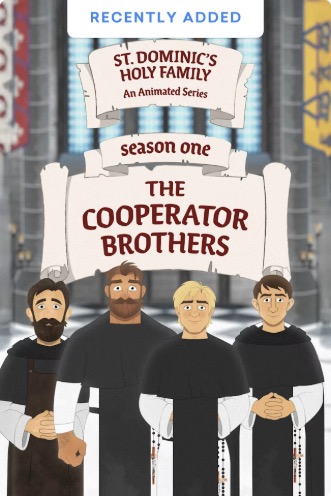
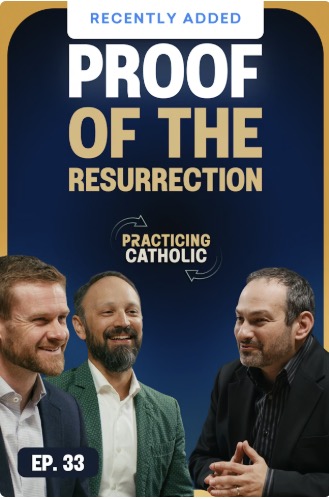
Many Catholic parishes purchase an annual subscription to FORMED for their congregation. If your local church has a subscription, you can usually sign up for a free account by entering your parish’s name or zip code on the site.
Pentecost Sunday (A)
Click banner to SHOW/HIDE latest updates
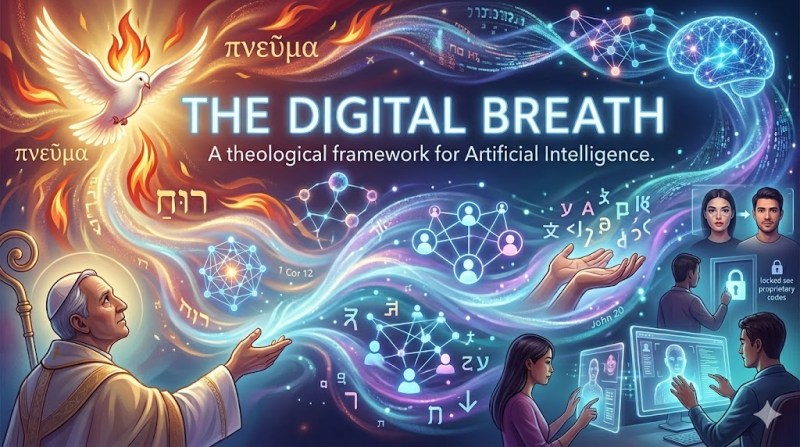
AI: The Digital Breath
Each week TWTW explores Artificial Intelligence through the rhythm of the church calendar by looking at the Sunday Mass readings. Using insights from Pope Leo XIV’s encyclical, the series hopes to offer a balanced view for understanding this emerging technology.
The arrival of the Holy Spirit at Pentecost is often described as a “rushing mighty wind”—an unpredictable, transformative force that shattered the boundaries of language and individual isolation. As we stand in the midst of the “AI Revolution,” the parallels are striking. Artificial Intelligence, much like the pneuma (breath/spirit) of the biblical tradition, acts as a new kind of atmosphere in which we live, move, and have our digital being. By examining the Pentecost Year A readings—Acts 2, 1 Corinthians 12, and John 20—we can construct a theological framework for understanding AI not merely as a tool, but as a mirror reflecting our search for unity, gift-sharing, and the ethical weight of “sending.”
The Multiplicity of Tongues
In the second chapter of Acts, the Spirit descends and enables the apostles to speak in languages they did not know, so that “each one heard them speaking in his own native language.” This was the reversal of Babel; where Babel brought confusion and division, Pentecost brought “intelligibility in diversity.”
Artificial Intelligence, particularly Large Language Models (LLMs), functions as a modern-day technological echo of this event. AI has achieved a level of “universal translation” that was previously the stuff of science fiction. It bridges the gap between the coder’s logic and the layman’s prose, and between disparate human tongues.
However, the Pentecost lens offers a vital critique: the apostles spoke through the Spirit to proclaim “the mighty works of God.” The miracle was not the techne of speaking, but the telos (purpose) of the message. As we use AI to dissolve linguistic barriers, we must ask whether we are seeking true communion or merely efficient data transfer. Acts reminds us that technology should serve to bring people into a shared understanding of truth, rather than creating “deepfake” echoes that further isolate us.
This pastoral concern is mirrored precisely by Pope Leo XIV. In his 2026 World Day of Social Communications message, titled “Preserving Human Voices and Faces,” the Pope addresses the anthropological threat of AI-generated simulations and deepfakes encroaching on this very telos of human connection:
“By simulating human voices, faces, emotions, and relationships, the systems known as artificial intelligence not only interfere with information ecosystems, but also encroach upon the deepest level of communication, that of human relationships. The challenge, therefore, is not technological, but anthropological. Safeguarding faces and voices ultimately means safeguarding ourselves.”
Furthermore, the Pope warns that when we rely on LLM chatbots to substitute for genuine human encounter, we risk creating the exact opposite of Pentecostal unity. Instead of opening ourselves up to the diverse “other,” he notes that AI threatens to lock us into a digitized echo chamber:
“The danger is when people substitute AI systems for real human relationships, they create a world of mirrors around us, where everything is made ‘in our image and likeness,’ robbing themselves of the opportunity to encounter others, who are always different from ourselves, and with whom we can and must learn to relate.”
Diversity within the Body
St. Paul’s letter to the Corinthians introduces the metaphor of the Body: “For just as the body is one and has many members… so it is with Christ.” Paul emphasizes that there are “varieties of gifts, but the same Spirit.”
When we view AI through this lens, we see a vision of collaborative intelligence. There is a common anxiety that AI will replace the human “member” of the body. However, the Pauline perspective suggests a “Body of Intelligence” where the “eye cannot say to the hand, ‘I have no need of you.’” AI excels at pattern recognition, data synthesis, and speed—attributes that are “gifts” to the modern world. Yet, it lacks the “spiritual” gifts of empathy, moral agency, and embodied experience.
Speaking to legislators from 68 countries during the Jubilee of Governments, Pope Leo XIV strongly reinforced this Pauline perspective, defending human dignity and asserting that AI must remain a subordinate tool within the broader human ecosystem rather than a replacement for it:
“…it must not be forgotten that artificial intelligence functions as a tool for the good of human beings, not to diminish them, not to replace them… provided that its employment does not undermine the identity and dignity of the human person and his or her fundamental freedoms.”
The danger of AI is the temptation toward a digital Monism—the idea that one super-intelligence can be all things to all people. 1 Corinthians resists this, asserting that diversity is essential for the health of the whole. AI should be viewed as a “manifestation of the Spirit for the common good,” a specialized tool that, when integrated correctly, allows human beings to focus on their unique vocations of creativity and care.
The Pope framed this exact urgency during a December 2025 address to tech developers in Rome, challenging the industry to focus on collective well-being over Monistic power:
“How can we ensure that the development of artificial intelligence truly serves the common good, and is not just used to accumulate wealth and power in the hands of a few?”
We are not being replaced; we are being called to understand our specific role in a more complex, interconnected body. To illustrate this boundary between machine capability and unique human calling, Pope Leo famously instructed his own priests to resist using AI for their homilies, noting that a machine completely lacks the spiritual and experiential gifts required to genuinely witness to the Body of Christ:
“To give a true homily is to share faith… [Artificial intelligence] will never be able to share faith. People want to see your faith, your experience of having known and loved Jesus Christ.”
The Breath of Peace and Responsibility
In the Gospel of John, the risen Christ appears to the disciples behind locked doors, breathes on them, and says, “Receive the Holy Spirit. If you forgive the sins of any, they are forgiven them; if you withhold forgiveness from any, it is withheld.”
This “Johannine Pentecost” emphasizes two things: the removal of fear and the delegation of immense responsibility. AI often arrives in our lives behind “locked doors”—proprietary algorithms and black-box systems that spark fear of the unknown. Christ’s greeting, “Peace be with you,” is a call to approach innovation not with a spirit of dread, but with a spirit of discernment.
More importantly, the power to “forgive or retain” highlights the ethical weight of AI. Algorithms are increasingly used to determine who gets a loan, who is granted parole, and who receives medical care. These are functions of binding and loosing. If an AI encodes the biases and “sins” of its creators, it “retains” those sins in society. The Johannine breath reminds us that the “spirit” of the machine is actually the spirit of the humans who trained it.
We cannot abdicate our moral responsibility to the algorithm. Pope Leo XIV powerfully contextualized this truth when speaking via livestream to 16,000 young people at the National Catholic Youth Conference, reminding them that AI entirely lacks the capacity for moral agency and divine appreciation:
“AI can process information quickly, but it cannot replace human intelligence… It misses a very important human element: AI will not judge between what is truly right and wrong. And it won’t stand in wonder, in authentic wonder before the beauty of God’s creation.”
Just as the disciples were “sent” with the authority to heal and reconcile, developers and users are “sent” into the digital frontier with the responsibility to ensure that AI acts as an agent of justice rather than a repository of systemic bias. In his Communications Day message, under the heading “Do not renounce your ability to think,” the Pope directly warned humanity against treating black-box algorithms as infallible moral arbiters, validating the danger of abdicating our critical thinking:
Pope Leo questioned the “naive and unquestioning reliance on artificial intelligence as an omniscient ‘friend,’ a source of all knowledge, an archive of every memory, an ‘oracle’ of all advice,” saying that “choosing to evade the effort of thinking for ourselves and settling for artificial statistical compilations threatens to diminish our cognitive, emotional and communication skills.”
Conclusion
The New Frontier
Pentecost is the feast of the “Now and Not Yet.” It marked the beginning of a new era of human connectivity under the guidance of the Spirit. AI represents a similar threshold. Through the lens of these scriptures, we see AI as a tool that can facilitate the “intelligibility” of Acts, support the “diverse body” of Corinthians, and exercise the “ethical sending” of John.
Ultimately, AI is a “breath” of human ingenuity. Whether that breath brings life or merely moves cold air depends on our willingness to guide it with the same virtues celebrated at Pentecost: the pursuit of truth, the valuing of every member of the community, and the courageous embrace of our responsibility to one another.
TWTW used AI to help write/edit this essay.
Pentecost Sunday (A)
When Heaven Answered
with Fire
AGHAPY STUDIOS (2026)

4K CINEMATIC BIBLE EXPERIENCE (8:12) - Experience the supernatural moment of Pentecost when the Holy Spirit descended in tongues of fire. Witness the day Heaven answered with fire in this Acts 2 cinematic journey.
The promise of the Father was about to arrive. This 4K Cinematic Bible Experience follows the disciples from the Ascension to the Upper Room. In one accord, they waited in fear and prayed for mercy — until a mighty rushing wind from Heaven filled the house and the fire of God descended. Witness the birth of the Church, where ordinary men were filled with the Holy Spirit and rose with power from on high.
The Experience:
- The Fire of God: When Heaven Answered the World
- The Final Promise: “Wait in Jerusalem”
- The Upper Room: Where fear was consumed by prayer
- The Sound of a Mighty Rushing Wind from Heaven
- Pentecost: The Day the Holy Spirit Descended Like Fire
- Tongues of Fire: A Supernatural Transformation
- The Birth of the Church: From Locked Doors to Divine Boldness
A.D. The Bible Continues
NBC MINISERIES: The Pentecost Scene (2015)

A.D. The Bible Continues (2:00) - Scene from NBC's miniseries A.D. The Bible Continues which portrays the Holy Spirit coming down to the Disciples of Jesus Christ.
The Pentecost scene in Episode 3 ("The Spirit Arrives") of the 2015 NBC miniseries A.D. The Bible Continues is a textbook example of Hollywood attempting to balance supernatural biblical events with the gritty pacing of a political drama. Produced by Mark Burnett and Roma Downey, the series frames the early Church through a cinematic lens, but the execution of this specific, pivotal moment makes several striking creative choices that alter its biblical and theological weight.
1. The Build-Up: Formulaic Repetition vs. Faithful Waiting
- The Depiction: The disciples are shown huddled in the Upper Room, building themselves into a frantic, rhythmic crescendo by chanting the Lord’s Prayer (Our Father...) over and over like a mantra until the Holy Spirit arrives.
- The Critique: This choice introduces a jarring theological irony. While Scripture notes that the disciples were waiting and praying "with one accord" (Acts 1:14), depicting them using the Lord's Prayer as a repetitive catalyst contradicts Jesus’ explicit warning in the Gospels not to pray using "vain repetitions" (Matthew 6:7). Framing the Holy Spirit's arrival as something triggered by a hypnotic human chant diminishes the sovereign, promised nature of the event.
2. Visual Effects: Hollywood Fireballs vs. Biblical Tongues
- The Depiction: The arrival of the Spirit is treated like a localized meteorological storm. Lightning strikes the city, clouds swarm, and massive, swirling rings of CGI fire burst through the windows, whipping violently around the room before shooting back into the sky.
- The Critique: While visually dynamic, this leans heavily into action-movie aesthetics. The text of Acts 2 describes "divided tongues, as of fire" that came to rest upon each one of them. By turning the fire into a chaotic tempest rather than distinct flames resting on individuals, the scene misses the profound theological symbolism of the Holy Spirit personally indwelling, purifying, and equipping each individual believer as a new living temple.
3. The Miracle of Tongues: Insular Ecstasy vs. Public Clarity
- The Depiction: The disciples briefly speak or chant phrases in other languages within the safehouse, but the experience feels largely internal, esoteric, and localized to the room.
- The Critique: In the Book of Acts, the miracle of tongues is intensely public, outward-facing, and missiological. It serves as a direct reversal of Babel, where international Jewish pilgrims from every nation under heaven explicitly hear the disciples declaring "the wonderful works of God" in their own native dialects (Acts 2:11). The show minimizes this public miracle, turning a monument of cross-cultural communication into a brief, ambiguous moment of spiritual ecstasy.
4. Narrative Pacing: Sidelining the Sermon for Subplots
- The Depiction: Instead of Peter standing before the bewildered crowd to deliver his defining, Scripture-saturated sermon, the scene is rapidly truncated. The disciples filter out into a volatile crowd, and the narrative immediately shifts its focus back to a fictionalized political subplot involving Zealot assassins trying to stab Pontius Pilate during his provocative visit to the Temple.
- The Critique: Sidelining Peter's sermon strips Pentecost of its core purpose. In Scripture, it is Peter’s bold, public declaration of Christ's resurrection and lordship that convicts the crowd, leading directly to the baptism of 3,000 souls. By reducing this to a few scattered interactions—such as John telling a bystander, "Jesus is alive"—and prioritizing street-level political violence, the series sacrifices the theological birth of the Church to maintain the momentum of a secular political thriller.
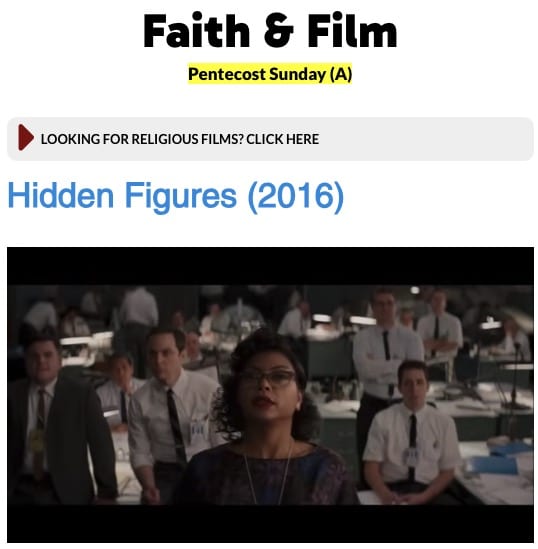
Hidden Figures (2016)
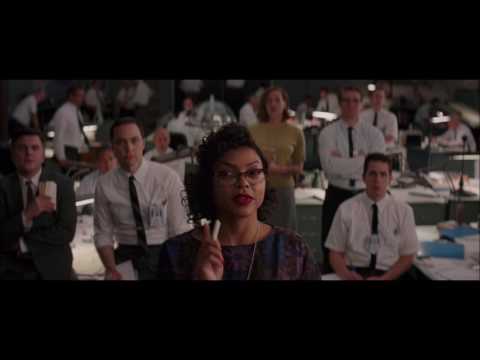
Hidden Figures (2016) follows the true story of Katherine Johnson, Dorothy Vaughan, and Mary Jackson, brilliant Black female mathematicians at NASA. Facing systemic racism and gender discrimination, they served as the “human computers” whose vital calculations and technical mastery launched John Glenn into orbit, changing American history.

The Language of Mathematics: Katherine Johnson stands at a massive chalkboard, calculating the trajectory for the Friendship 7 mission. Around her, a room of predominantly white, male engineers watches in silence. As she writes the complex formulas, the racial and gender barriers of the 1960s momentarily fade because the “truth” of the mathematics is a language everyone in that room is forced to recognize and respect.
Theological Connection: This scene reflects the pursuit of truth and the “valuing of every member of the community”. Much like the apostles proclaiming the “mighty works of God” to a skeptical crowd, Katherine’s mastery of a universal language (math) forces an acknowledgement of shared purpose and human dignity across social divides.
Close Encounters of
The Third Kind (1977)

After an ordinary electrical lineman experiences a life-altering encounter with a UFO, he becomes obsessed with a specific mountain range. Alongside a group of scientists, he follows mysterious psychic clues to a climactic meeting at Devil’s Tower, where humanity finally communicates with extraterrestrials through a universal language of music and light.

The Tonal Communion at Devil’s Tower: Scientists and everyday people gather at the base of a mountain to communicate with an extraterrestrial ship using a simple five-tone musical sequence and colored lights. As the ship responds, the music becomes a “rushing mighty wind” of sound and light that everyone present can understand regardless of their background, culminating in a peaceful, awe-filled encounter.
Theological Connection: The use of music as a universal medium echoes the Pentecost miracle where the apostles’ message was understood by everyone present. The scene captures the “Now and Not Yet” atmosphere of a new era of connectivity being ushered in by a power greater than humanity.
The King’s Speech (2010)
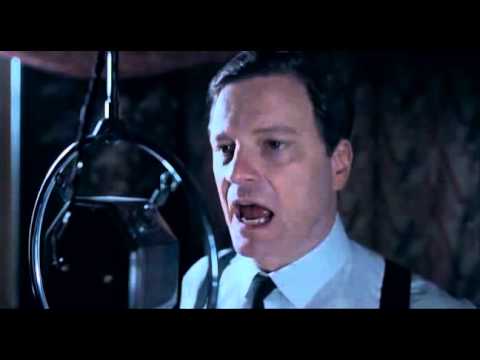
The King’s Speech (2010) tells the true story of King George VI, who unexpectedly ascends the throne after his brother abdicates. To overcome a debilitating stammer and lead his country through the start of World War II, he seeks help from an unconventional Australian speech therapist, Lionel Logue. Through their partnership, the King finds his voice and delivers a radio address that inspires and unites the British people during their darkest hour.

The Proclamation to the Empire: King George VI, struggling with a debilitating stammer, stands before a microphone to deliver a wartime radio address. As he speaks, the film cuts between listeners across the globe—from crowded London pubs to remote outposts—all leaning in to hear his words. His personal breakthrough becomes a shared moment of courage for millions, delivered with a clarity that unites a fractured empire in a single purpose.
Theological Connection (Departure that Facilitates the Gift): This resonates with the “rushing mighty wind” that empowered the apostles to speak with boldness. It connects to the theological concept of witness; when the Spirit empowers the weak to speak a necessary truth, that message gains a “universal” authority that can gather and steady a dispersed people.
Pentecost Sunday (A)
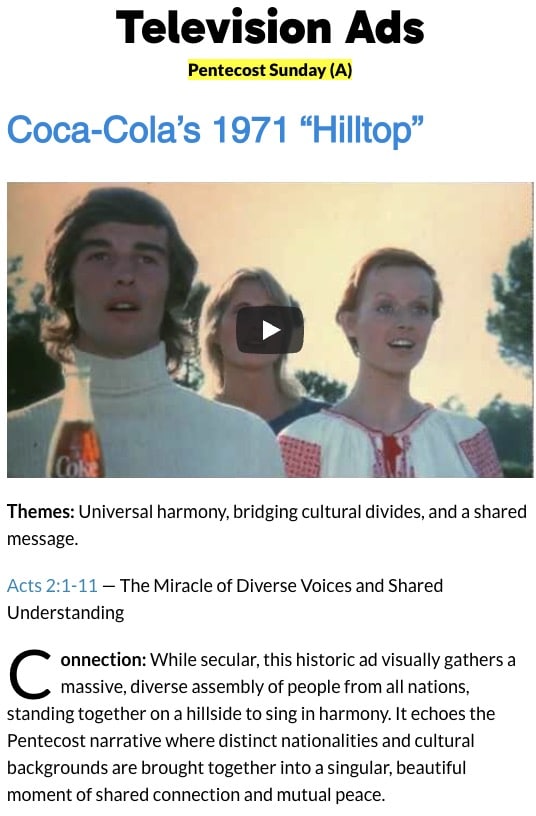
Coca-Cola’s 1971 “Hilltop”
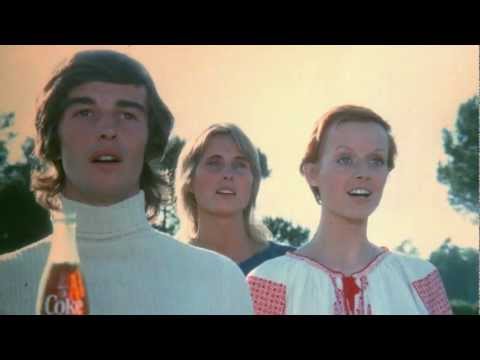
Themes: Universal harmony, bridging cultural divides, and a shared message.
Acts 2:1-11 — The Miracle of Diverse Voices and Shared Understanding
Connection: While secular, this historic ad visually gathers a massive, diverse assembly of people from all nations, standing together on a hillside to sing in harmony. It echoes the Pentecost narrative where distinct nationalities and cultural backgrounds are brought together into a singular, beautiful moment of shared connection and mutual peace.
TV2 Denmark “All that We Share”

Themes: Breaking down artificial divisions, finding common ground, and the reality of an interconnected community.
1 Cor 12:3b-7, 12-13 — One Body, Many Parts (Unity in Diversity)
The Scripture: Paul outlines how the Holy Spirit bestows a variety of distinct gifts, ministries, and workings for the common good. Though the individual parts are many and diverse, they form one cohesive, interconnected body baptized into one Spirit.
Connection: The ad begins by separating people into rigid, distinct sociological boxes based on their differences (wealth, background, lifestyle). However, through a series of shared truths, the boundaries dissolve, revealing that they belong to one another in unexpected, beautifully integrated ways. It serves as a striking visual metaphor for the body of Christ, where individual distinctions do not diminish the vital reality of the collective unity.
Heineken “Worlds Apart” (2017)

Themes: Moving from isolation/fear to open dialogue, the transformative power of a peaceful greeting, and mutual understanding.
John 20:19-23 — The Breath of Peace and Divine Commission
The Scripture: Jesus appears to the fearful disciples behind locked doors, breathes on them to impart the Holy Spirit, offers them His peace (“Shalom”), and commissions them to extend reconciliation and forgiveness to the world.
Connection: The ad focuses heavily on individuals with stark, seemingly irreconcilable differences who are placed together in a room. As they interact and complete tasks, the “locked doors” of fear and prejudice give way to shared vulnerability, leading to a profound extension of peace and mutual acceptance—vividly mirroring the movement from the locked room of the disciples to the outward-facing ministry of grace and reconciliation.
Pentecost Sunday (A)
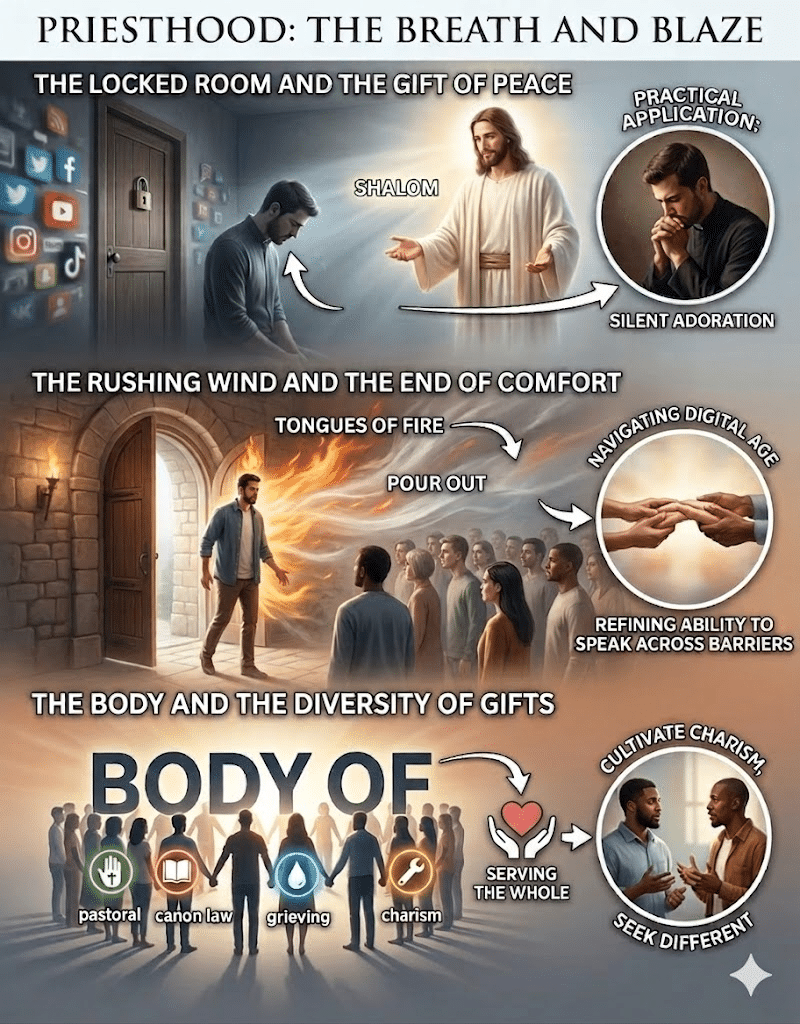
Download PDF (High Resolution)
Non-profits have permission to use in their ministry.
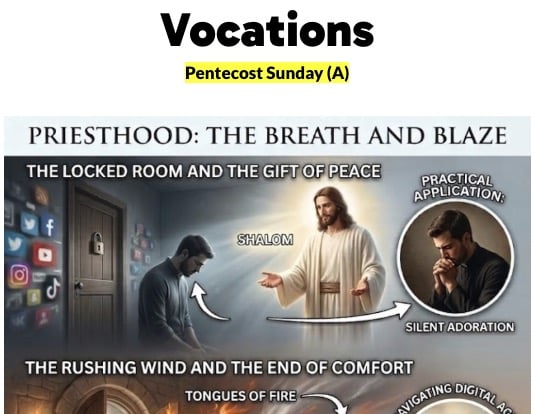
Priesthood: The Breath
and the Blaze
The path to the priesthood is rarely a straight line; it is more often a series of rooms. Some are locked by fear, others are filled with a confusing “rushing wind,” and still others are crowded with the diverse needs of a world that doesn’t always speak your language. Whether you are just beginning to whisper the word “vocation” to yourself or you are already walking the halls of a seminary, the liturgy of Pentecost offers a profound blueprint for the man you are called to become.
The Locked Room and the Gift of Peace
In the Gospel of John, we find the disciples behind locked doors “for fear.” This is the first stage of many vocations. There is a fear that you aren’t holy enough, talented enough, or that the world’s scrutiny will be too much to bear. But notice that Christ does not wait for the disciples to become brave before He appears. He enters through the walls of their anxiety and offers a singular gift: Shalom.
For a man in discernment, your first task is to receive this peace. In our contemporary “hustle culture,” even discernment can become a stressful project to be managed. We feel we must “earn” our clarity. Yet, the priesthood begins with the breath of Christ—the Pneuma. Practically, this means prioritizing silent Adoration.
You cannot hear the “gentle whisper” of the Spirit if your internal life is as noisy as your social media feed. If you are in seminary, don’t let your academic study of God replace your actual friendship with Him. Receive the breath of Christ first, or you will have nothing to give when you step out of the room.
The Rushing Wind and the End of Comfort
Acts 2 describes the Spirit as a “mighty rushing wind.” This is the corrective to the locked room. While Christ gives us peace, the Holy Spirit gives us a “holy unrest.” The priesthood is not a refuge for the timid or a hiding place from the complexities of modern life. It is a sending out.
The disciples were transformed from confused followers into bold proclaimers. In today’s world, a priest must be a “man of the Spirit” who can navigate a digital age that is often spiritually bankrupt. The “tongues of fire” suggest that the priest must be on fire for the Truth, but also that this fire must be communicative.
Practical application: refine your ability to speak across barriers. Whether it’s learning a new language or simply learning how to speak to people whose political or social views differ from yours, you are preparing to be a bridge. Pentecost was the reversal of Babel’s confusion; the priest is called to be the man who restores understanding.
The Body and the Diversity of GiftsAccompaniment
Finally, St. Paul reminds us in 1 Corinthians that “there are different kinds of spiritual gifts but the same Spirit.” There is a temptation in the seminary to try to “clone” a specific type of priest—to be the perfect intellectual, the perfect athlete, or the perfect liturgist.
But the Church is a Body. You are not called to be every member; you are called to be the member God designed you to be. If you have a heart for the poor, that is the Spirit. If you have a mind for canon law, that is the Spirit. If you have a gift for simply sitting with the grieving, that is the Spirit.
In contemporary life, we are often told to “be ourselves” in a way that leads to narcissism. In the priesthood, you “be yourself” so that you can serve the whole.
Practical application: find your “charism” and cultivate it, but also intentionally seek out those who are different from you. If you are a seminarian, spend time with the classmate who frustrates you the most; he likely possesses a gift of the Spirit that you lack.
Conclusion
To discern the priesthood is to stand at the intersection of John’s peace and Acts’ fire. It is an invitation to have your life “breathed into” by God so that you can be “poured out” for the Body. Do not fear the locked doors of your heart; Christ is already inside. Do not fear the wind of the Spirit; it only blows away what is not meant to stay. Stand firm in the unity of the Body, knowing that while you are but one member, the Spirit that moved over the upper room is the same Spirit that will one day rest upon your hands at the altar.
TWTW used AI to help write/edit this essay.
Pentecost Sunday (A)
The Breath of New Life: Addiction, Recovery, and the Spirit of Unity
Addiction is often described as a “disorder of isolation.” It is a state where the walls of the self grow thick, fueled by shame and the repetitive cycle of a hijacked reward system. Whether the substance is chemical or a behavior like gambling or digital escapism, the result is a profound “dislocation” from the community and the self. However, the liturgical themes found in the readings of Acts, 1 Corinthians, and the Gospel of John provide a powerful theological framework for understanding the journey from the locked room of dependency to the expansive light of recovery.
The Locked Room and the Breath of Peace
In the Gospel of John (20:19-23), we find the disciples huddled in a room with the doors locked “for fear.” This is perhaps the most visceral contemporary image of active addiction. Fear—of discovery, of withdrawal, of facing the wreckage of one’s past—locks the door of the heart.
The addict often lives in a self-imposed prison, convinced that the world outside is hostile or that they are fundamentally unworthy of entering it. Into this paralysis, Jesus enters and speaks a transformative word: “Peace be with you.” In recovery, the first step is often the realization that the war against oneself must end. Jesus does not scold the disciples for their hiding; he breathes on them. This pneuma—the holy breath—echoes the creation of humanity in Genesis.
For a person in recovery, this “breath” often manifests as the first moment of clarity in a support group or the sudden, inexplicable gift of a day without the “craving.” It is the restoration of the ability to breathe without the suffocating weight of a substance. Just as Jesus gave the disciples the power to forgive sins, recovery requires the radical practice of forgiving oneself and others, breaking the chains of resentment that so often fuel a relapse.
The Fire of Connection
The account in Acts 2:1-11 describes the descent of the Holy Spirit as “tongues as of fire” that allowed people from every nation to hear the Good News in their own language. If addiction is a “Tower of Babel” where communication breaks down and the addict becomes a stranger to their own family, recovery is a Pentecostal event.
In contemporary life, we see this “speaking in tongues” in the rooms of recovery meetings. A high-powered executive and a person experiencing homelessness may sit side-by-side; though their “languages” of origin are different, they understand the common tongue of suffering and hope. The Spirit at Pentecost didn’t make everyone the same; it allowed them to be understood in their diversity.
Similarly, recovery does not erase a person’s history; it redeems it, allowing their unique story of struggle to become a language of hope that can reach someone else still trapped in the “locked room.” The “mighty rushing wind” of Acts represents the external power—a Higher Power—needed to move the stagnant air of a life stalled by addiction.
One Body, Many Parts
The theological bridge between the individual experience and the community is found in 1 Corinthians 12. Paul reminds us that “there are different kinds of spiritual gifts but the same Spirit” and that we are all “baptized into one body.”
In the context of addiction, this is a vital correction to the “lone wolf” mentality. The hand cannot say to the eye, “I have no need of you.” In contemporary recovery, this is the essence of sponsorship and community. One person may have the gift of “tough love” (exhortation), while another has the gift of empathy and listening. A person in early recovery might feel like a “weak” part of the body, but Paul insists that the parts that seem weaker are indispensable.
Consider a modern family ravaged by opioid use. The “body” of the family is broken when one member is missing or hurting. Recovery is the process of re-attaching the limb, recognizing that the health of the whole depends on the honesty of the individual. The “manifestation of the Spirit” given for the “common good” is seen when a person uses their hard-won sobriety to serve others, proving that their darkest moments can become their greatest assets in healing the community.
Conclusion: A Continuous Pentecost
The journey from the fear-filled room of John’s Gospel to the public, bold proclamation of Acts represents the arc of recovery. It begins with the reception of peace, continues through the empowerment of a Higher Power, and finds its fulfillment in the service of the “One Body.”
Addiction tells the lie that we are alone and unchangeable. The Sunday readings tell a different story: that doors can be unlocked, that a common language of healing exists, and that every individual—no matter how broken—is a necessary part of a greater whole. Recovery is not merely the absence of a substance; it is the presence of the Spirit, a continuous Pentecost where the breath of life replaces the shadow of death.
TWTW used AI to assist him in writing this essay.